Compliant B2B Data in 2026: The Complete GDPR & CCPA Guide
Not all B2B data is legal to use. Here's how to source compliant B2B data under GDPR, CCPA, and 2026 privacy rules — and how to spot vendors cutting corners.
Buying a list is easy. Buying a list you're legally allowed to email is the hard part — and it's where most B2B teams quietly expose themselves to five- and six-figure fines.
Compliant B2B data isn't a checkbox you tick once. It's a chain of custody: where the data came from, whether there was a lawful basis to collect it, whether the person can opt out, and whether your vendor can prove any of it when a regulator asks. This guide walks the whole chain, in plain terms, so you can prospect hard without betting the company on a data source you never vetted.
TL;DR#
- Compliant B2B data means contact records with a documented lawful basis (usually legitimate interest under GDPR), a working opt-out, honest sourcing, and vendor accountability — not just "publicly available" emails.
- GDPR, CCPA/CPRA, and CAN-SPAM cover different things. GDPR governs collection and processing of EU personal data; CCPA governs sale and sharing of California data; CAN-SPAM governs the email itself. You usually need all three handled.
- Scraped-and-sold lists are the biggest risk. If a vendor can't tell you the source and lawful basis for a record, assume it's non-compliant.
- Verification is a compliance control, not just a deliverability trick — sending to dead or wrong addresses inflates complaints and weakens your legitimate-interest case.
- Pick vendors that expose their data sourcing and honor deletion requests fast. Transparency is the single best proxy for compliance.
What is compliant B2B data?#
Compliant B2B data is business contact information you have a lawful, documented, and revocable right to use for outreach. Think of it like food safety: a tomato on a shelf looks identical whether it was grown cleanly or sprayed with something banned. You can't tell by looking — you trust the supply chain and the paperwork behind it. B2B contact data works the same way. Two identical-looking rows — jane@acme.com — can have completely different legal standing depending on how each was collected.
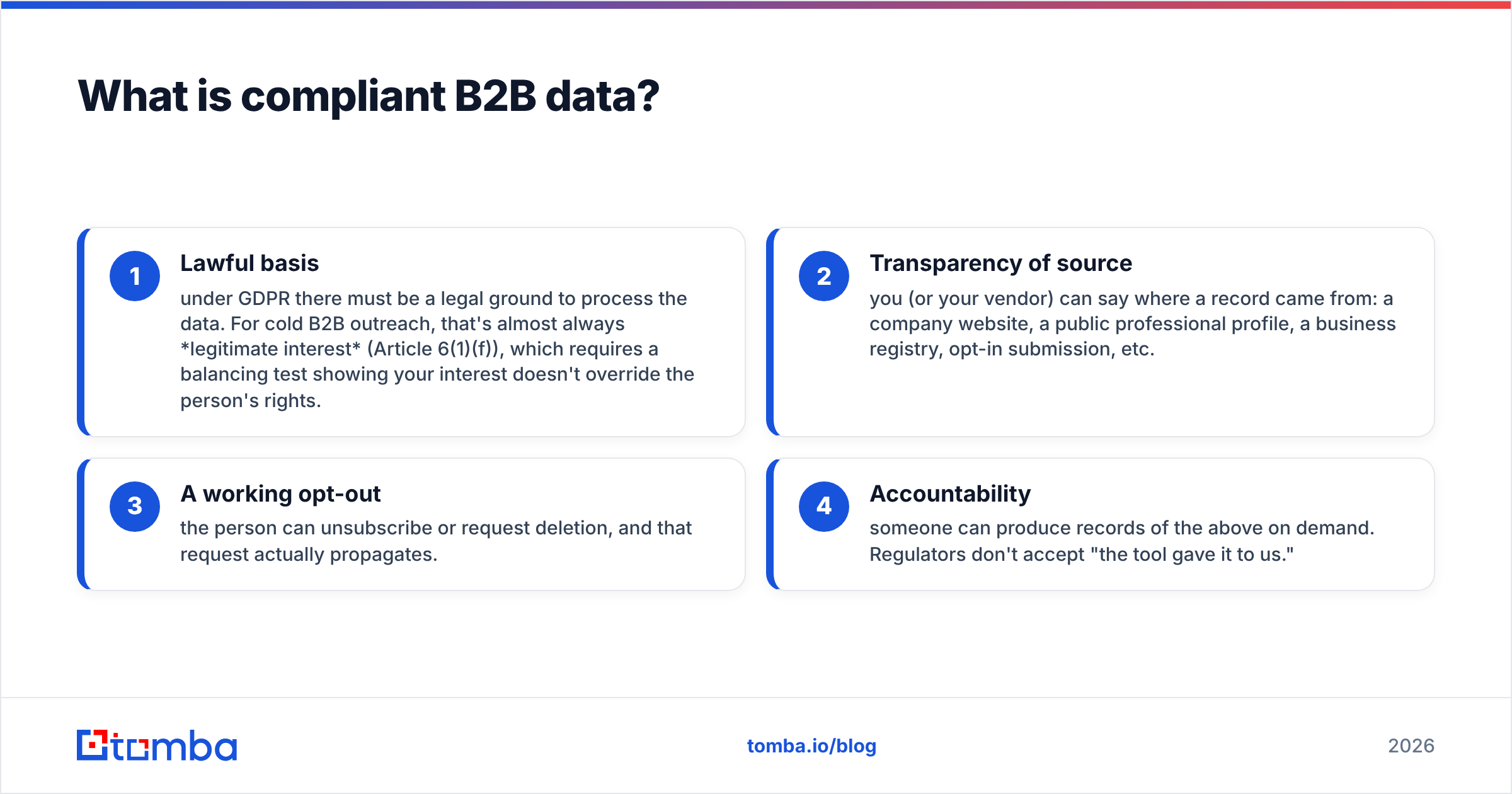
Four things separate compliant records from liability:
- Lawful basis — under GDPR there must be a legal ground to process the data. For cold B2B outreach, that's almost always legitimate interest (Article 6(1)(f)), which requires a balancing test showing your interest doesn't override the person's rights.
- Transparency of source — you (or your vendor) can say where a record came from: a company website, a public professional profile, a business registry, opt-in submission, etc.
- A working opt-out — the person can unsubscribe or request deletion, and that request actually propagates.
- Accountability — someone can produce records of the above on demand. Regulators don't accept "the tool gave it to us."
Note what's not on the list: "I found it on the internet." Public availability reduces the privacy expectation but doesn't grant unlimited processing rights. The European Data Protection Board has been consistent on this — scraping public data still triggers GDPR obligations.
Which laws actually apply to your outreach?#
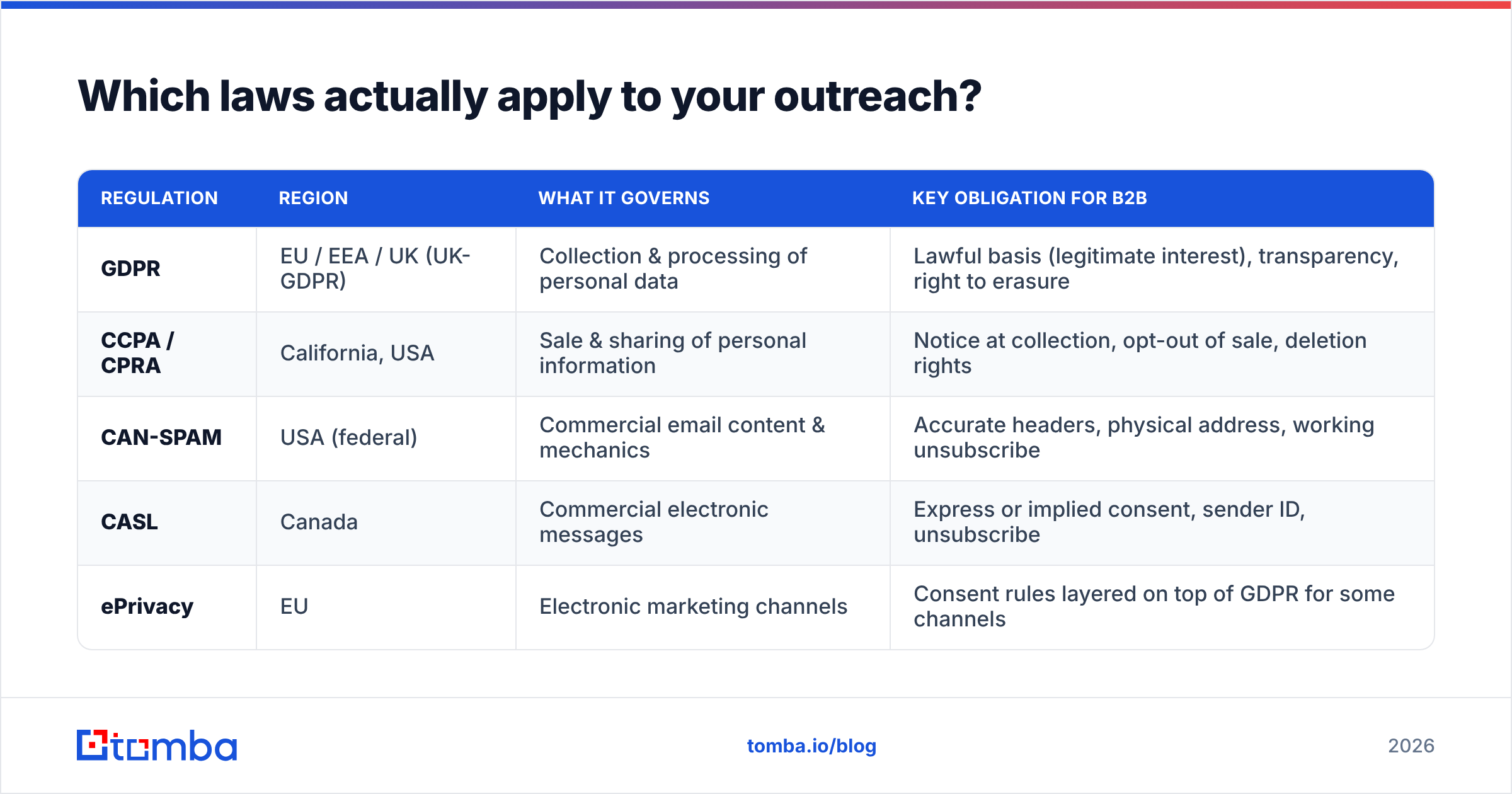
Most teams fixate on GDPR and forget the other two regimes stacked on top of it. Each one governs a different slice of the same campaign.
| Regulation | Region | What it governs | Key obligation for B2B |
|---|---|---|---|
| GDPR | EU / EEA / UK (UK-GDPR) | Collection & processing of personal data | Lawful basis (legitimate interest), transparency, right to erasure |
| CCPA / CPRA | California, USA | Sale & sharing of personal information | Notice at collection, opt-out of sale, deletion rights |
| CAN-SPAM | USA (federal) | Commercial email content & mechanics | Accurate headers, physical address, working unsubscribe |
| CASL | Canada | Commercial electronic messages | Express or implied consent, sender ID, unsubscribe |
| ePrivacy | EU | Electronic marketing channels | Consent rules layered on top of GDPR for some channels |
The practical takeaway: a single cold email to a prospect in London, sent from a US company, promoting a product to a California-based lead can touch GDPR, CAN-SPAM, and CCPA at once. Compliance isn't "pick the law for your HQ" — it's the union of every jurisdiction your recipients sit in.
B2B does get some breaks. In several EU member states, a corporate role-based address (sales@acme.com) carries a weaker privacy expectation than a named individual's. And CAN-SPAM permits cold email outright, provided the mechanics are clean. But none of these exemptions survive a bad data source.
Why does "legitimate interest" matter so much?#
Legitimate interest is the lawful basis that makes cold B2B email possible under GDPR — and it's conditional, not automatic. It's less like a green light and more like a permit you have to keep justifying.
To rely on it, you run a three-part test:
- Purpose — is your interest legitimate? (Selling a relevant business product usually is.)
- Necessity — do you need this data to achieve it, or is there a less intrusive way?
- Balancing — do the person's rights and interests override yours? Emailing a CFO about accounting software they'd plausibly want is defensible; blasting a personal Gmail scraped from a hobby forum is not.
This is exactly why data hygiene is a compliance issue, not just a deliverability one. If half your list is guessed, unverified, or wrong-person addresses, your "necessity" and "balancing" arguments collapse — you're clearly not being careful with people's data. Running every record through an email verifier before send tightens the case: you're contacting real, current, role-relevant people, not spraying a dirty list and hoping.
Document the test once per campaign type and keep it. If a Data Protection Authority ever asks, "the software vouched for it" is not an answer — your Legitimate Interest Assessment is.
How do you tell compliant data sources from risky ones?#
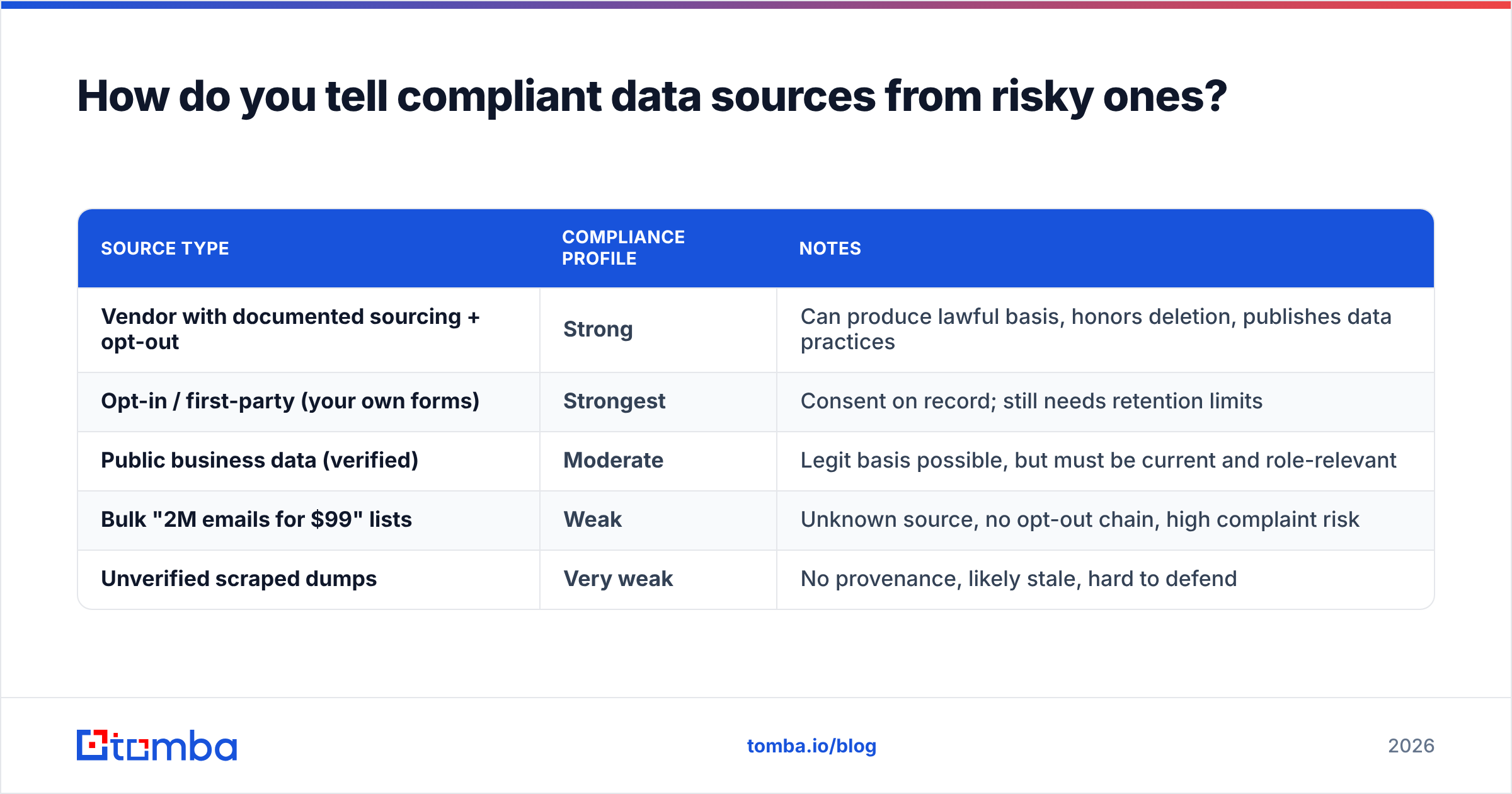
The fastest signal is transparency. Compliant providers tell you where data comes from and how to remove it; risky ones sell you a spreadsheet and go quiet. Here's how the common source types stack up.
| Source type | Compliance profile | Notes |
|---|---|---|
| Vendor with documented sourcing + opt-out | Strong | Can produce lawful basis, honors deletion, publishes data practices |
| Opt-in / first-party (your own forms) | Strongest | Consent on record; still needs retention limits |
| Public business data (verified) | Moderate | Legit basis possible, but must be current and role-relevant |
| Bulk "2M emails for $99" lists | Weak | Unknown source, no opt-out chain, high complaint risk |
| Unverified scraped dumps | Very weak | No provenance, likely stale, hard to defend |
A few questions cut through vendor marketing fast:
- "Where does each record come from?" A real answer names sources. A dodge ("proprietary AI aggregation") is a red flag.
- "How fast do you process a deletion request?" Compliant vendors have an SLA. Some can't delete at all — disqualifying.
- "Do you re-verify data, and how often?" Stale data isn't just inaccurate; it undermines your lawful basis.
- "Can I see your DPA and sub-processor list?" No Data Processing Agreement means no serious compliance posture.
For a deeper look at how a provider should document its inputs, Tomba publishes its data sources openly — the kind of paper trail you want before a single email goes out. Reputable review sites like G2 also surface user reports of vendors that ignore opt-outs, which is worth a scan.
What does a compliant data workflow look like in practice?#
Compliance lives in the workflow, not in a policy PDF nobody reads. Here's a workable loop that keeps you defensible without grinding prospecting to a halt.
- Source from accountable providers. Use tools that expose provenance. When you find email addresses via domain or name lookup, you're pulling from verified public business signals with a source trail — not buying an anonymous dump.
- Verify before you send. Run new contacts through verification to drop dead, catch-all, and role-mismatched addresses. This protects deliverability and your legitimate-interest argument.
- Enrich, don't hoard. Add only the fields you need for relevance (role, company, industry). Collecting everything "just in case" fails GDPR's data-minimization principle. Targeted data enrichment beats bulk grabbing.
- Log lawful basis per segment. One Legitimate Interest Assessment per campaign type, stored and dated.
- Honor opt-outs instantly and globally. An unsubscribe from one campaign should suppress the contact everywhere. Maintain a master suppression list.
- Set retention limits. Purge contacts you haven't engaged in X months. Old data is pure liability with no upside.
The theme across all six steps: less, cleaner, and documented beats more, dirtier, and anonymous. A tight 2,000-record list you can defend outperforms a 200,000-record list that gets you reported.
Is compliant data worth the extra effort versus cheap lists?#
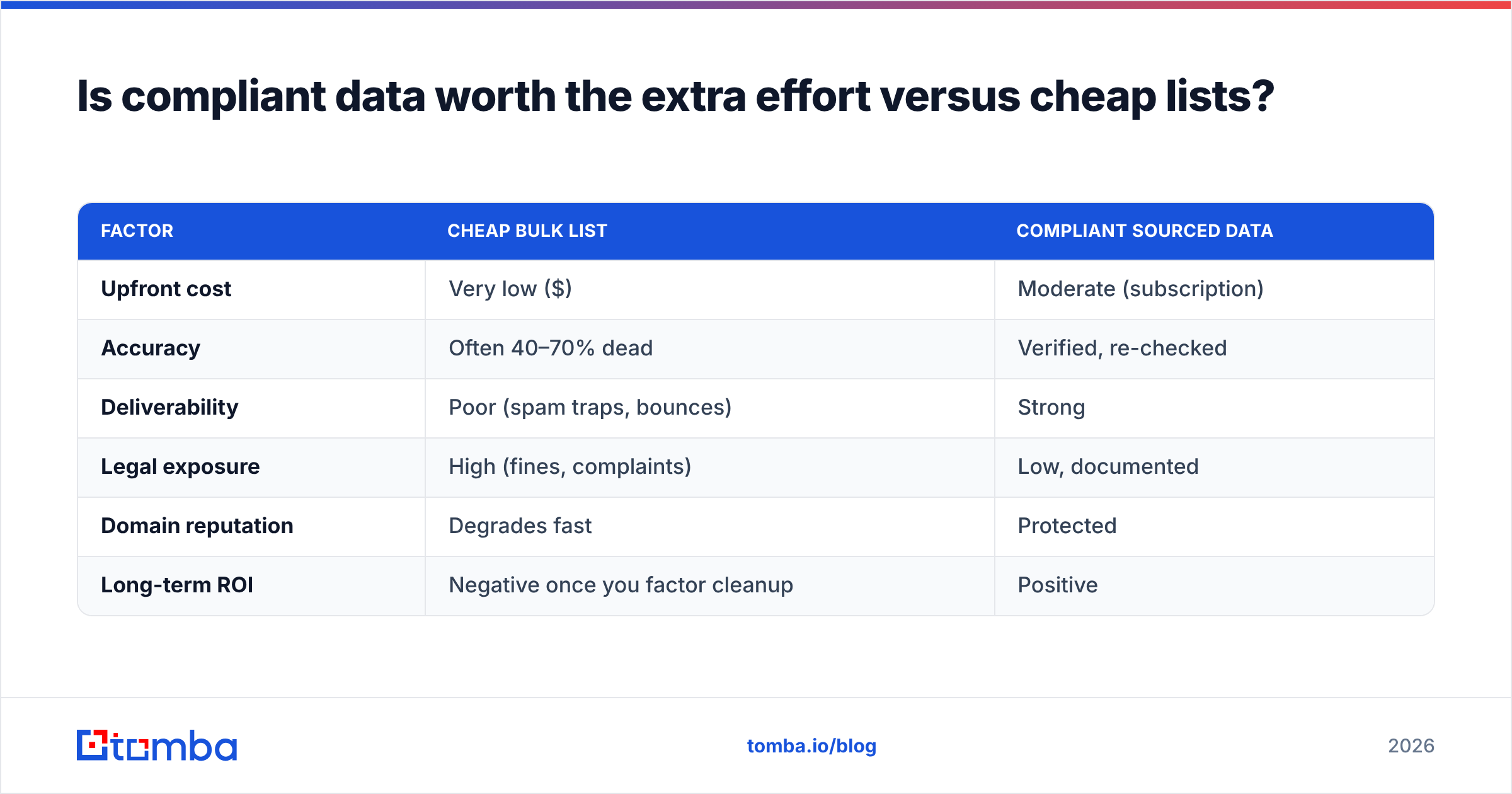
Yes — and the math isn't close once you price in risk. A cheap list looks like savings until you tally the downside.
| Factor | Cheap bulk list | Compliant sourced data |
|---|---|---|
| Upfront cost | Very low ($) | Moderate (subscription) |
| Accuracy | Often 40–70% dead | Verified, re-checked |
| Deliverability | Poor (spam traps, bounces) | Strong |
| Legal exposure | High (fines, complaints) | Low, documented |
| Domain reputation | Degrades fast | Protected |
| Long-term ROI | Negative once you factor cleanup | Positive |
GDPR fines can reach up to €20 million or 4% of global annual turnover, whichever is higher — regulators have levied real penalties in the tens of millions. Even setting fines aside, a dirty list wrecks your sending domain's reputation, which quietly tanks every future campaign, compliant or not. You can find honest cost breakdowns on the Tomba pricing page; the point isn't that compliant data is free, it's that it's cheap compared to the alternative going wrong.
There's also a conversion angle. Compliant, verified, role-relevant contacts reply more because you're reaching real decision-makers with a plausible reason to care. Compliance and performance point the same direction — a rare thing in go-to-market work.
What about catch-all domains and gray-area addresses?#
Catch-all domains are the classic gray area — servers that accept mail to any address, so a standard verifier can't confirm whether a specific inbox exists. Sending blindly to them inflates bounce and complaint rates, which weakens both deliverability and your compliance story.
Handle them deliberately: use a dedicated catch-all verifier to segment these addresses, then treat them as a lower-confidence tier — slower cadence, extra relevance checks, and quick suppression on any negative signal. It's the same principle as the rest of this guide: when you can't fully verify a record, you either raise your care level or you leave it out. Guessing is what gets teams reported.
Common compliance mistakes to avoid#
- Treating "publicly available" as a free pass. It lowers privacy expectations; it doesn't remove GDPR obligations.
- One-way opt-outs. An unsubscribe that only suppresses a single sequence, not the whole contact, is a violation waiting to be filed.
- No sub-processor visibility. If your vendor shares data with parties you can't name, you can't be accountable for it.
- Hoarding fields. Every extra data point you can't justify is a data-minimization failure.
- Skipping verification. Sending to dead addresses is the fastest way to look reckless with people's data — and to hit spam traps.
- Assuming CAN-SPAM covers you in the EU. It doesn't. US federal law has no bearing on a Berlin recipient.
Put a defensible data engine behind your outreach#
Compliant B2B data comes down to one habit: know where every contact came from, and be able to prove it. Get that right and GDPR, CCPA, and CAN-SPAM stop being threats and become table stakes you've already cleared.
If you're building that engine, start at the source. Tomba's Email Finder pulls professional email addresses from verified public business signals with a transparent data trail, pairs with a built-in verifier to keep your list clean, and honors deletion requests — the accountability chain regulators actually ask about. Begin on the free tier (25 searches a month), and scale into a Starter plan at $49/mo when your outbound proves out. Prospect aggressively; just prospect from data you can defend.
Related guides#
Ready to find emails that actually work?
Join 150,000+ professionals who stopped guessing and started sending. Free credits on signup — no credit card required.
Get the Tomba newsletter
Practical outbound tactics and product updates — once every two weeks.
About the author