The 7 Core Components of GTM Strategy That Actually Work
Most go-to-market plans fail because a piece is missing. Here are the 7 components of a GTM strategy that decide whether you hit pipeline — and how they connect.
Most go-to-market plans do not fail because the product is bad. They fail because one of the components of GTM strategy — usually the ICP or the data feeding it — is missing, vague, or bolted on late. When that happens, every downstream effort inherits the gap.
This guide breaks the components of GTM strategy into seven parts you can actually build. We take them in the order they depend on each other. No frameworks for the sake of frameworks — just the pieces that decide whether you generate pipeline or quietly burn budget.
TL;DR#
- A go-to-market strategy is only as strong as its weakest component — skip the ICP and everything downstream misfires.
- The seven components: market and ICP, value proposition and messaging, pricing and packaging, channel and motion, data and tooling, team and process, and metrics and feedback loops.
- Data quality is the silent multiplier: even a perfect ICP fails if the contact list feeding your reps is 30% stale.
- Product-led, sales-led, and community-led motions each demand a different weighting of these components — one template does not fit all.
- Start with the market, end with the feedback loop, and treat the whole thing as a system you revise every quarter.
What is a go-to-market strategy, really?#
A go-to-market (GTM) strategy is your plan for taking a product to a specific market, reaching the right buyers, and turning them into revenue — repeatably. Think of it like planning a road trip. You need a destination (market), a reason someone would come along (value prop), a price for gas (pricing), a route (channel), a working car (data and tooling), a driver (team), and a dashboard (metrics). Miss any one and you either never leave the driveway or run out of fuel halfway.
Technically, a GTM strategy sits at the intersection of marketing, sales, product, and revenue operations. It is not a launch checklist you use once. It is the operating system for how your company acquires customers, and you should revisit it every quarter as the market moves.
The mistake teams make is treating GTM as a marketing deliverable. It is a company-wide system, and each of the seven components below is a subsystem that has to interlock with the others.
What are the 7 components of GTM strategy?#
Here is the full stack, in dependency order. Each component builds on the one before it.
- Market and ICP — who you sell to and why they buy now.
- Value proposition and messaging — the promise and how you say it.
- Pricing and packaging — how value converts to revenue.
- Channel and motion — the path buyers travel to reach you.
- Data and tooling — the fuel and the engine that make the motion run.
- Team and process — who executes and how work moves.
- Metrics and feedback loops — how you know it is working and what to fix.
The rest of this post takes each one apart.
1. Market segmentation and ICP#
Your ideal customer profile is the foundation every other component rests on. Get it wrong and you will write messaging for the wrong person, price for the wrong budget, and prospect in the wrong channel.
A usable ICP is specific: industry, company size, geography, tech stack, trigger events, and the actual job title of the buyer and the champion. "Mid-market SaaS companies" is not an ICP. "Series B–C SaaS companies with 50–200 employees, a HubSpot stack, and a VP of Sales who just posted a hiring req for SDRs" is.

Once the profile is defined, you have to find the companies and people who match it. That is where a reliable domain search turns an abstract profile into a working account list — you feed it target domains and get the verified contacts inside each one.
2. Value proposition and messaging#
Your value proposition is the single most important sentence in your GTM. It answers: why should this buyer switch to you, right now, over the alternatives and over doing nothing?
Strong messaging is layered:
- Core promise — the outcome you deliver (not the feature).
- Differentiators — what only you do, or do meaningfully better.
- Proof — case studies, metrics, logos, third-party validation.
- Objection handling — the pre-emptive answers to "yes, but…".
The test: could a competitor paste their name over your messaging and have it still be true? If yes, it is not differentiated. Frameworks like HubSpot's value proposition guidance are a good starting point, but the real work is pressure-testing every claim against what your best customers actually say in calls.
3. Pricing and packaging#
Pricing is a GTM component, not a finance afterthought. It signals positioning, filters your audience, and determines your sales motion. A $49/month self-serve product cannot support a field sales team; a six-figure enterprise contract cannot survive without one.
Packaging — how you bundle features into tiers — often matters more than the raw numbers. Good packaging makes the upgrade path obvious and aligns price with the value a customer perceives at each stage.
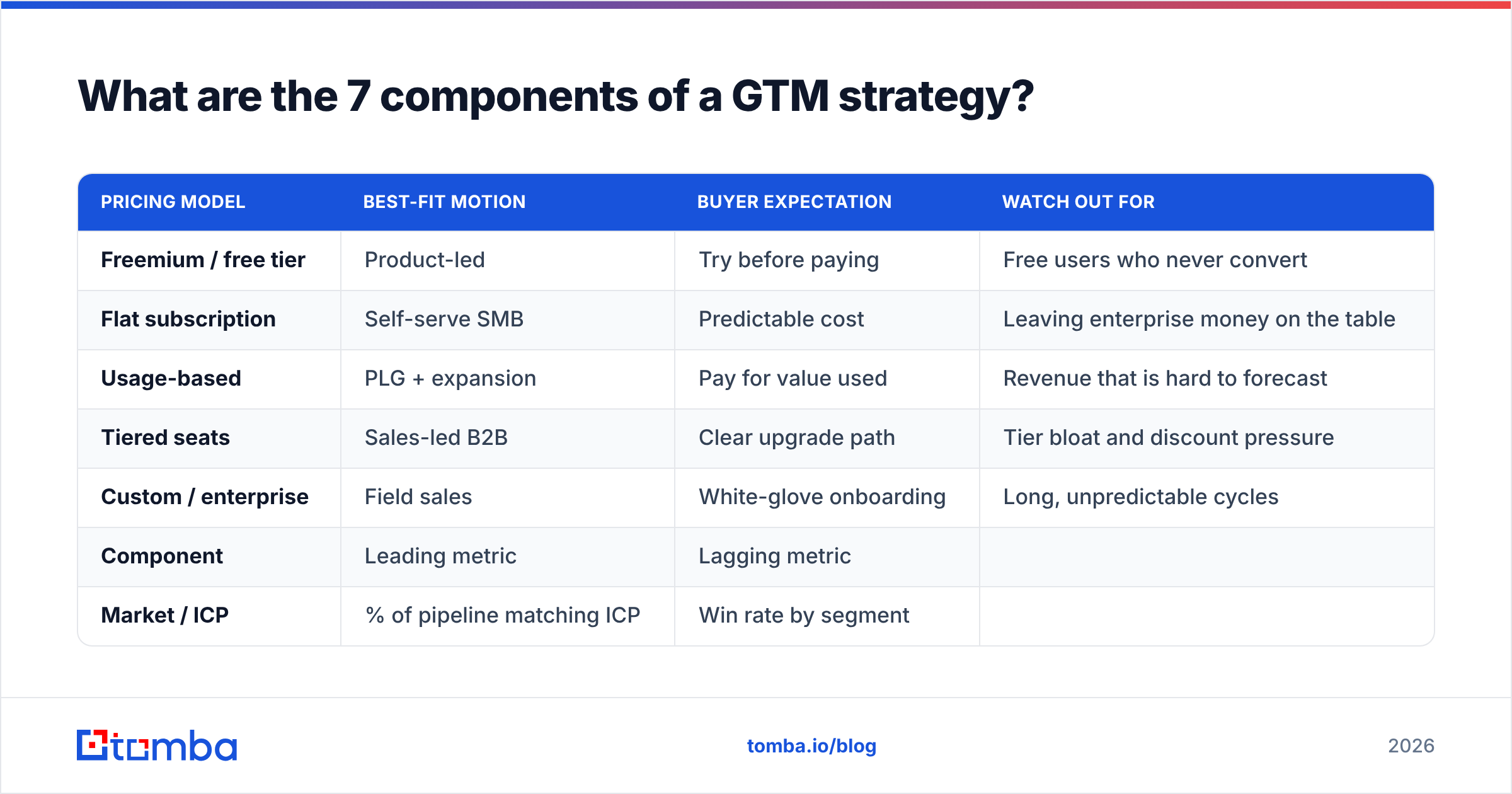
| Pricing model | Best-fit motion | Buyer expectation | Watch out for |
|---|---|---|---|
| Freemium / free tier | Product-led | Try before paying | Free users who never convert |
| Flat subscription | Self-serve SMB | Predictable cost | Leaving enterprise money on the table |
| Usage-based | PLG + expansion | Pay for value used | Revenue that is hard to forecast |
| Tiered seats | Sales-led B2B | Clear upgrade path | Tier bloat and discount pressure |
| Custom / enterprise | Field sales | White-glove onboarding | Long, unpredictable cycles |
Notice how tightly pricing couples to the next component. You do not choose them independently.
4. Channel and sales motion#
Your channel is the path a buyer travels to become a customer, and your motion is how you move them along it. The three dominant motions:
- Sales-led — reps drive deals through outbound and demos. High touch, high ACV.
- Product-led (PLG) — the product itself acquires and converts users. Low touch, high volume.
- Community-led / partner-led — trust and distribution come from ecosystems, not ads.
Most real GTMs blend two. A PLG product still needs a sales team to close its largest accounts; a sales-led company still benefits from self-serve trials. What matters is deciding which motion is primary and staffing accordingly.
For outbound-heavy motions, the channel decision cascades into execution details — email, phone, LinkedIn, or a coordinated sequence across all three. If phone is part of the mix, having accurate B2B phone numbers alongside email is what makes multi-channel cadences actually connect instead of bouncing.
5. Data and tooling#
This is the component teams underinvest in and then blame everything else. Your GTM runs on data: account lists, contact records, enrichment fields, intent signals. If that data is stale or wrong, every other component degrades — perfect messaging sent to a dead inbox still gets zero replies.
Two failure modes dominate:
- Coverage gaps — you cannot find contacts at accounts that match your ICP.
- Decay — B2B data goes stale fast; people change jobs, and roughly 25–30% of a contact list can rot in a year.
The fix is a workflow that finds and continuously verifies contacts, not a one-time list purchase. That is why an email verifier belongs in your stack next to the finder — verification is what keeps your bounce rate low and your sender reputation intact.

Here is how the data-quality tiers actually play out in the field:
- Spray and pray — no ICP, generic blasts, sky-high bounce rates.
- Buy a static list — better than nothing, but decaying from day one.
- Pick a real ICP — targeted, but only as good as your ability to find the contacts.
- Find, verify, and enrich continuously — targeted contacts, low bounce, data that stays fresh.
The tooling layer also includes your CRM, your sequencer, and how they talk to each other. Native connections matter: Tomba's HubSpot integration and Salesforce integration, for example, push verified contacts straight into the system your reps live in, so nobody is copy-pasting emails at 2x the error rate.
6. Team and process#
A strategy no one owns is a document, not a plan. This component defines roles, hand-offs, and the rules of engagement between marketing, SDRs, AEs, and customer success.
The classic breakdown points are the hand-offs: marketing-to-SDR (what counts as a marketing qualified lead?), SDR-to-AE (what qualifies a meeting?), and AE-to-CS (what does a clean handoff look like?). Each seam needs an explicit definition and a shared source of truth, or leads fall through the cracks and every team blames the next one.
Process also means cadence: pipeline reviews, deal desks, and a documented outbound playbook so a new rep can ramp in weeks, not quarters.
7. Metrics and feedback loops#
The final component closes the loop. Without metrics, you cannot tell which of the other six components is broken — you just feel that revenue is off.
Track metrics at each stage of the funnel, not just the bottom line:
| Component | Leading metric | Lagging metric |
|---|---|---|
| Market / ICP | % of pipeline matching ICP | Win rate by segment |
| Messaging | Reply rate, demo-request rate | Conversion to opportunity |
| Pricing | Trial-to-paid, average deal size | Net revenue retention |
| Channel | Cost per opportunity by channel | CAC payback period |
| Data | Bounce rate, contact accuracy | Cost per verified contact |
| Team | Ramp time, activity per rep | Quota attainment |
The feedback loop is what turns a static plan into a living system. A rising bounce rate points you back to component five. A falling win rate in one segment points you back to component one. You are not just measuring — you are diagnosing which subsystem to fix next.
How do the components change by GTM motion?#
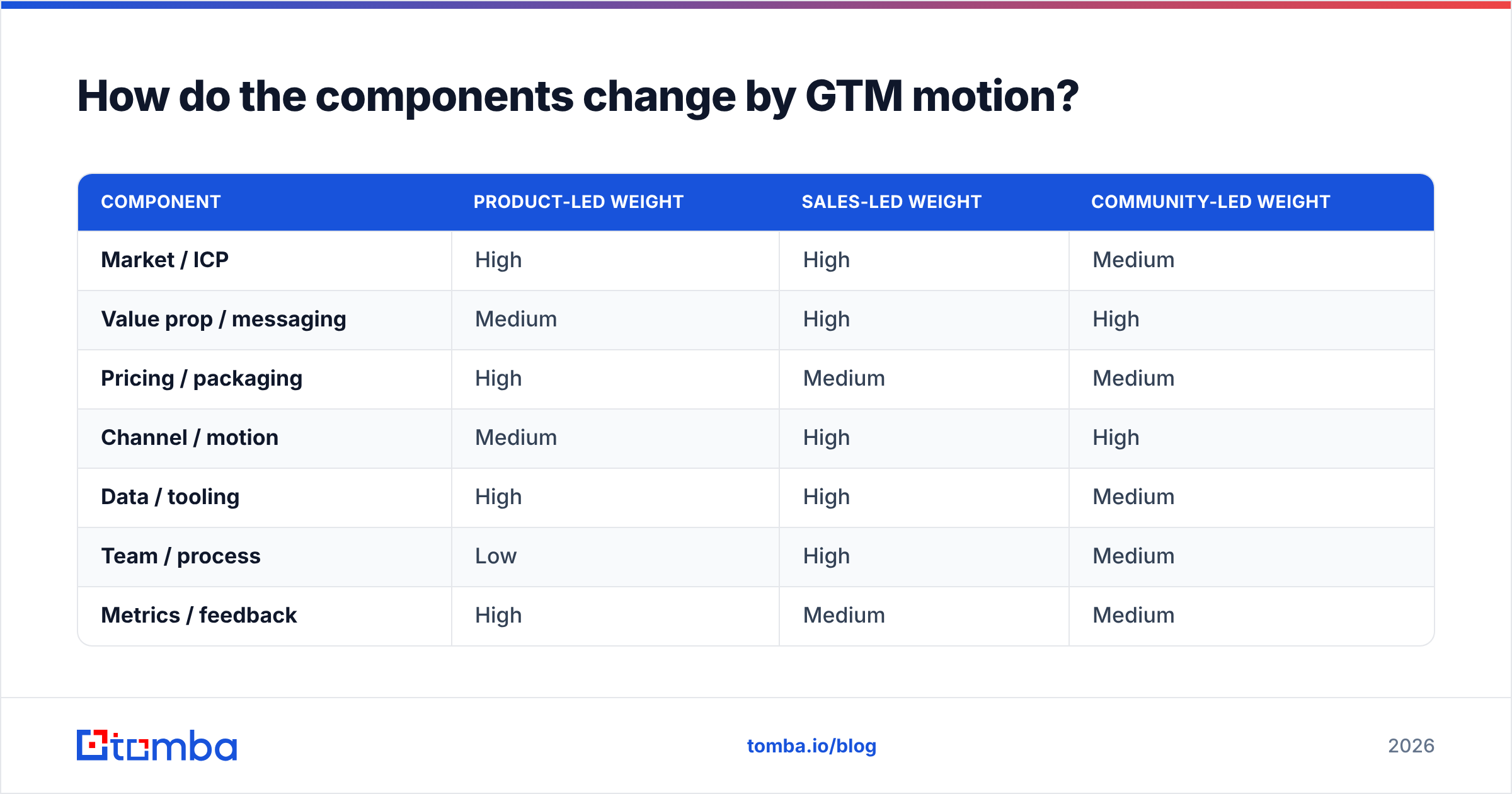
The seven components are constant, but their weighting is not. A product-led company lives or dies on data and product analytics; a sales-led enterprise company lives or dies on team, process, and account data quality.
| Component | Product-led weight | Sales-led weight | Community-led weight |
|---|---|---|---|
| Market / ICP | High | High | Medium |
| Value prop / messaging | Medium | High | High |
| Pricing / packaging | High | Medium | Medium |
| Channel / motion | Medium | High | High |
| Data / tooling | High | High | Medium |
| Team / process | Low | High | Medium |
| Metrics / feedback | High | Medium | Medium |
Do not copy another company's GTM wholesale. Copy the framework, then reweight it for your motion, your price point, and your buyer. Analyst frameworks from Gartner are useful for the vocabulary, but the weighting is yours to earn from your own data.
What is the most common GTM mistake?#
Building the components in isolation. Marketing writes messaging without the sales team's ICP notes. Sales buys a contact list without checking it against the verified-data workflow. Finance sets pricing without knowing the motion. Each piece is fine on its own and the system still fails, because GTM is defined by how the components connect — not by the quality of any single one.
The second most common mistake is treating data as a one-time purchase. Your ICP can be perfect and your messaging sharp, but if 30% of your list bounces, your sender reputation tanks and even the good addresses stop landing. Data is the multiplier that silently amplifies or destroys everything else — which is exactly why the strongest GTMs wire finding, verifying, and enriching contacts into their weekly rhythm rather than their launch week.
Putting the components together#
Build them in order, then run them as a loop:
- Define the market and ICP with real specificity.
- Write messaging that only you could truthfully claim.
- Set pricing and packaging that matches your motion.
- Choose a primary channel and motion and staff for it.
- Wire in data and tooling that stay fresh, not stale.
- Assign owners and hand-offs across the team.
- Instrument metrics and feedback loops, and revise quarterly.
These seven components of GTM strategy only work as a system — and none of it works if step five is broken. The cleanest ICP and the sharpest messaging still land in dead inboxes if your contact data is stale. No amount of strategy fixes a bounce.
That is the gap Tomba's Email Finder is built to close: give it your ICP-matched target domains and names, and it returns verified professional email addresses your reps can actually reach, backed by real data sources rather than a decaying static list. Start on the free tier (25 searches a month), and when the motion proves out, Tomba's paid plans scale from $49/month without you re-plumbing the rest of your stack. Fix the data component, and the other six finally get to do their jobs.
Related guides#
Ready to find emails that actually work?
Join 150,000+ professionals who stopped guessing and started sending. Free credits on signup — no credit card required.
Get the Tomba newsletter
Practical outbound tactics and product updates — once every two weeks.
About the author