Connexio Cloud Pricing, Reviews, Pros and Cons: 2026 Guide
A neutral 2026 breakdown of Connexio Cloud pricing, real user reviews, and the honest pros and cons — plus how to feed it clean contact data so any plan pays off faster.
Connexio Cloud sells itself as an all-in-one hub for B2B communication and engagement. But the pricing page is thin. The plans are quote-gated. And the reviews sit scattered across a dozen directories. This Connexio Cloud pricing, reviews, pros and cons guide gives you a straight answer before you book a sales call.
Below, we break down what it really costs. We cover what buyers say. And we show where it wins or falls short — with no vendor spin.
Connexio Cloud pricing, reviews, pros and cons: the TL;DR#
- Pricing is quote-based, not published. Expect tiered plans (entry, growth, enterprise) with per-seat or per-usage billing. Larger contracts add onboarding fees. Budget for more than the sticker.
- Strong for unified engagement. Reviewers praise the consolidated inbox, automation, and reporting when replacing 3–4 point tools.
- Weak on transparency and ramp time. The most common complaint is a slow setup and a learning curve for smaller teams.
- It is only as good as the data you feed it. Stale or missing contact records burn spend fast. Clean data is the multiplier.
- Verdict: A fair fit for mid-market teams merging tools. It is overkill (and pricey) for a lean SDR pod that mainly needs verified contacts and outbound.
What is Connexio Cloud?#
Connexio Cloud is a cloud-based platform for customer engagement and communications. Analysts at Gartner group this category under CPaaS and multichannel engagement. In plain terms, it is a hub. It pulls messaging, outreach, automation, and reporting into one place. The goal is simple: stop your reps from tab-hopping between five browser windows.
Think of it like a kitchen tool that replaces a drawer full of gadgets. One appliance, many jobs. That is the pitch. Is it worth swapping out your current gadgets? That depends on how many you own — and how well the new one actually sears.
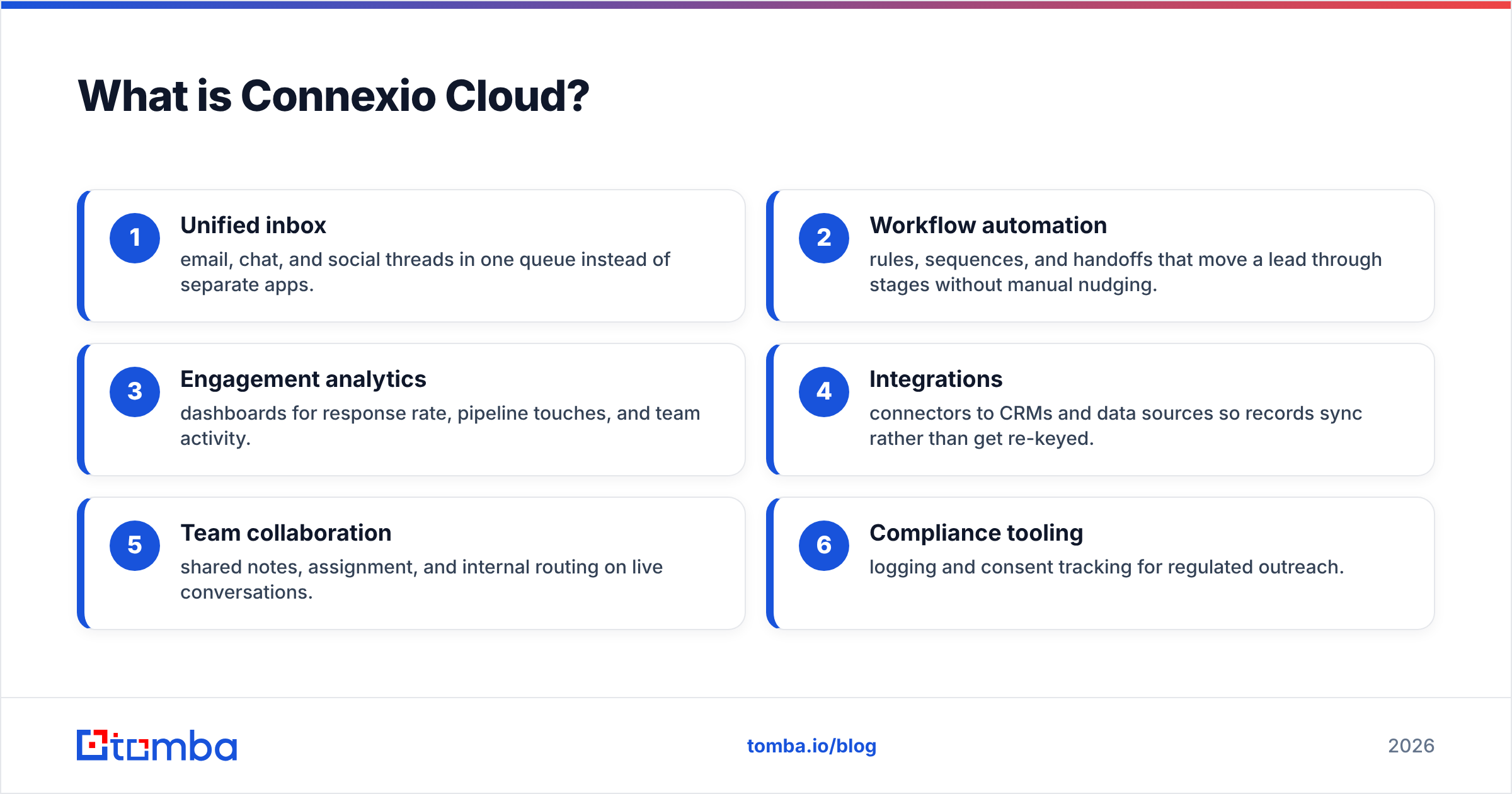
The platform typically bundles these capabilities:
- Unified inbox — email, chat, and social threads in one queue instead of separate apps.
- Workflow automation — rules and sequences that move a lead through stages, with no manual nudging.
- Engagement analytics — dashboards for response rate, pipeline touches, and team activity.
- Integrations — connectors to CRMs and data sources so records sync instead of getting re-keyed.
- Team collaboration — shared notes, assignment, and internal routing on live conversations.
- Compliance tooling — logging and consent tracking for regulated outreach.
This matters because it sets the pricing logic. You pay for a platform, not a feature. That is great when you use most of it. It gets expensive when you use just a slice.
How much does Connexio Cloud pricing cost?#
Short answer: Connexio Cloud does not publish full pricing. Any number you see quoted secondhand is a rough anchor, not a contract. Most platforms in this category use three or four tiers. The reviews and vendor patterns point to the same shape here.
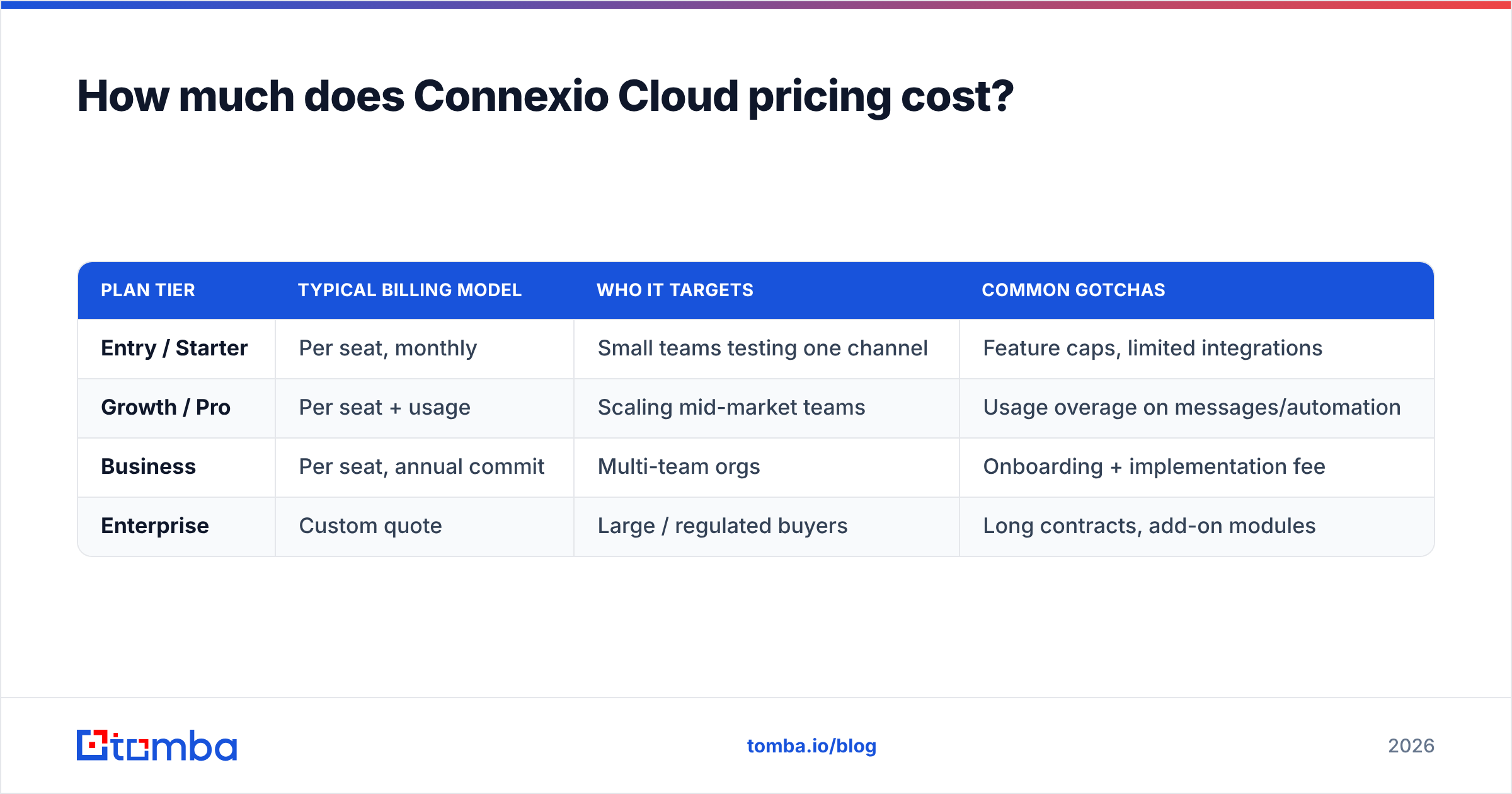
Here is a realistic model of how these tiers are usually built. Treat the figures as rough ranges from comparable platforms. They are not confirmed Connexio Cloud prices. Confirm every number with their sales team.
| Plan tier | Typical billing model | Who it targets | Common gotchas |
|---|---|---|---|
| Entry / Starter | Per seat, monthly | Small teams testing one channel | Feature caps, limited integrations |
| Growth / Pro | Per seat + usage | Scaling mid-market teams | Usage overage on messages/automation |
| Business | Per seat, annual commit | Multi-team orgs | Onboarding + implementation fee |
| Enterprise | Custom quote | Large / regulated buyers | Long contracts, add-on modules |
One thing trips up buyers: the gap between the headline seat price and the all-in cost. The real number is seat price plus usage overage plus onboarding plus any premium module. Those modules include advanced analytics, dedicated support, and extra data connectors. On enterprise deals, setup fees alone can rival a quarter of year-one software spend.
Before you sign anything, get these four line items in writing:
- Per-seat cost at your actual headcount, not the marketing tier.
- Usage limits and overage rates for messages, automations, or API calls.
- Onboarding / implementation fees and how long ramp takes.
- Contract length and auto-renewal terms — annual lock-ins are common.
For contrast, Tomba pricing is public: a free tier at 25 searches a month, Starter at $49/mo, Growth at $99/mo, Pro at $249/mo, and custom Enterprise. You know the number before you talk to anyone. It is a different product category. But the transparency bar is one worth holding every vendor to.
What do Connexio Cloud reviews say?#
Reviews in this space cluster into a few clear themes. The fastest way to find the signal is to cross-check directories like G2 and Capterra. That helps you ignore a single loud reviewer.
The recurring positives:
- Consolidation wins. Teams that replaced multiple point tools report cleaner workflows and fewer dropped conversations.
- Automation depth. Once configured, the sequencing and routing save real hours.
- Reporting. Managers like the unified activity view for coaching and forecasting.
The recurring criticisms:
- Onboarding is slow. The top complaint is a multi-week setup and a learning curve for non-technical reps.
- Opaque pricing. Buyers dislike quote-gated plans and surprise add-on costs.
- Support tiering. Faster support often sits behind the higher plans.
One caveat on reviews: recency and company size matter more than star averages. A five-star review from a 500-seat enterprise tells you little about a 6-person SDR team. Filter by a company size close to yours.
What are the pros and cons of Connexio Cloud?#
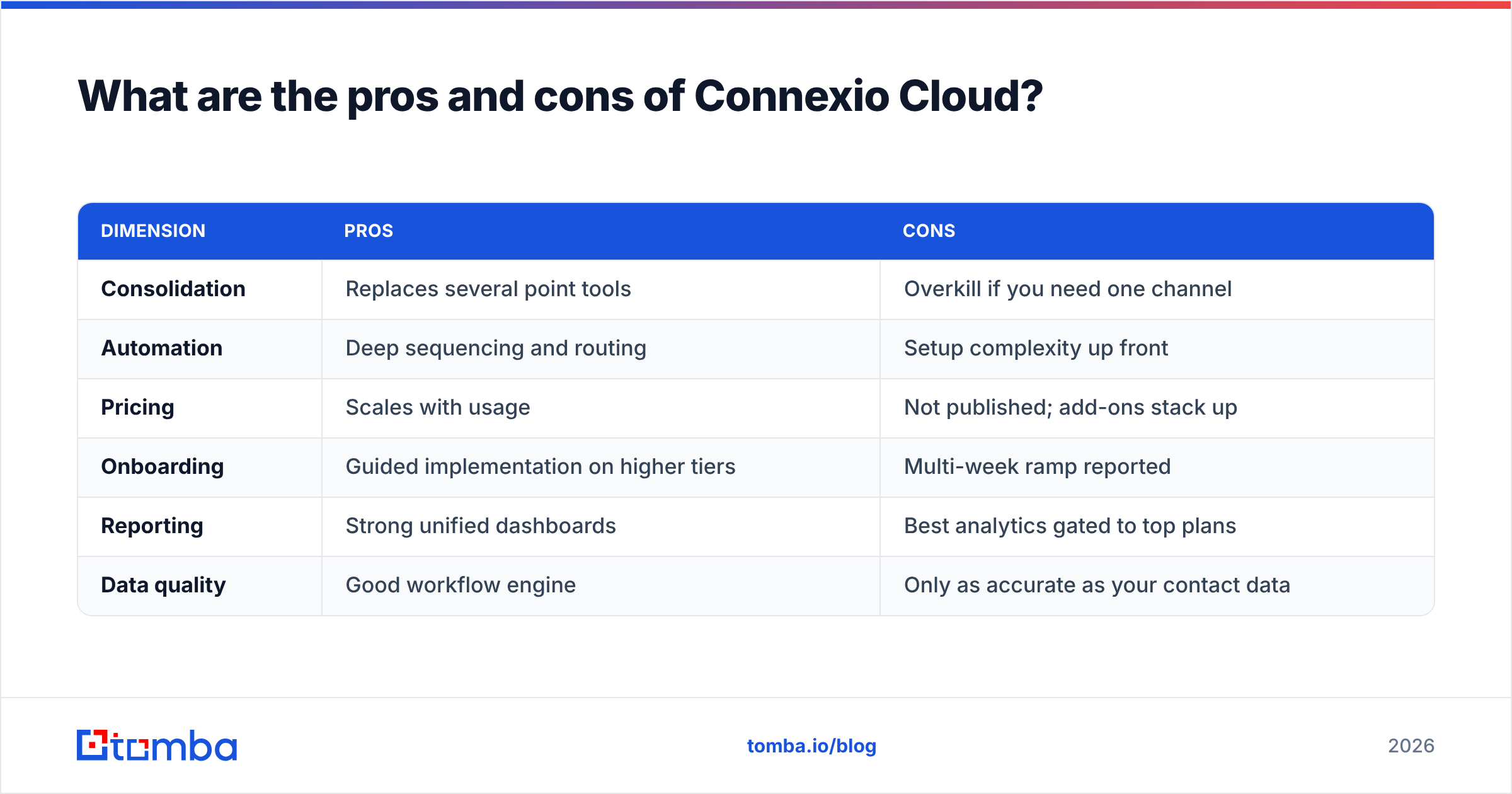
Here is the balanced scorecard — the pros and cons that actually move a buying decision.
| Dimension | Pros | Cons |
|---|---|---|
| Consolidation | Replaces several point tools | Overkill if you need one channel |
| Automation | Deep sequencing and routing | Setup complexity up front |
| Pricing | Scales with usage | Not published; add-ons stack up |
| Onboarding | Guided implementation on higher tiers | Multi-week ramp reported |
| Reporting | Strong unified dashboards | Best analytics gated to top plans |
| Data quality | Good workflow engine | Only as accurate as your contact data |
The last row is the one most buyers underrate. A powerful engine running on bad data does not save money. It spends faster. A list full of bounced addresses and missing decision-makers drags down every campaign. Automation multiplies whatever you feed it, including garbage. That is the real hidden cost. And it is the one no vendor puts on a rate card.

Who should buy Connexio Cloud — and who should skip it?#
Buy it if you are a mid-market or enterprise team merging three or more communication tools. You also need runway for a multi-week rollout. And multichannel engagement must be central to how you sell or support. In that case, the per-seat cost is offset. You kill overlapping subscriptions and cut manual handoffs.
Skip it if you are a lean outbound team. Your main bottleneck is finding and reaching the right people. If your problem is "I don't have verified contacts to email or call," a heavy platform is the wrong first buy. You would be paying for a jet engine to solve a fuel problem.
For that group, start with a solid data layer. Feed it into whatever outreach tool you already have. This is where a good email finder and email verifier pay back fast. Every verified record you load is spend that does not bounce. Need to map a whole company? Domain search pulls the addresses behind it in one pass.
How does Connexio Cloud compare to a data-first stack?#
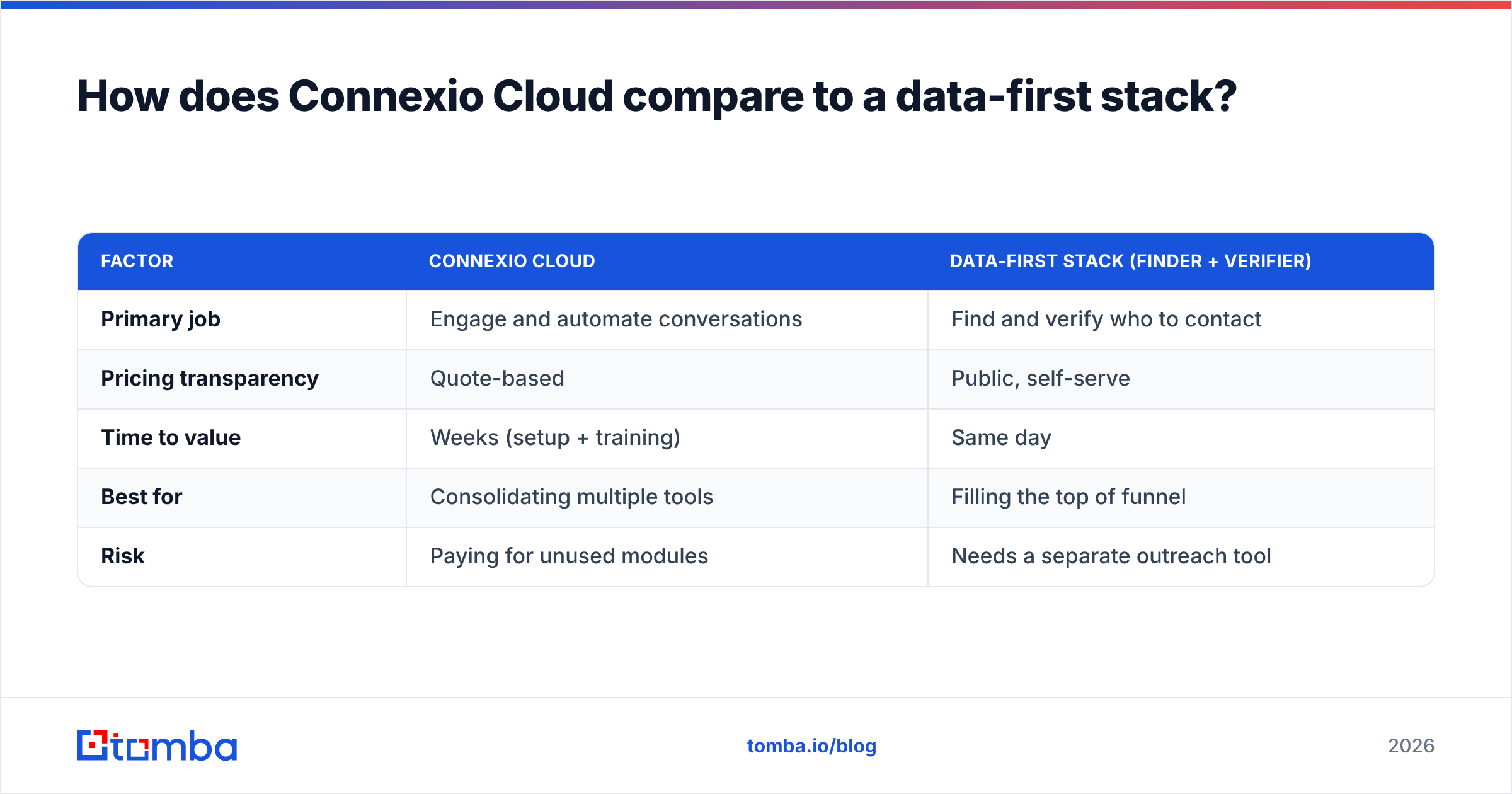
This is not apples to apples. Connexio is a platform. A data tool is an input. But buyers still weigh them against each other, because both compete for the same budget line. Here is the honest framing.
| Factor | Connexio Cloud | Data-first stack (finder + verifier) |
|---|---|---|
| Primary job | Engage and automate conversations | Find and verify who to contact |
| Pricing transparency | Quote-based | Public, self-serve |
| Time to value | Weeks (setup + training) | Same day |
| Best for | Consolidating multiple tools | Filling the top of funnel |
| Risk | Paying for unused modules | Needs a separate outreach tool |
For many teams, the best play is sequencing, not either-or. Nail the data layer first. Fill your pipeline with real, reachable contacts. Then move up to a platform like Connexio Cloud once volume justifies the seat cost and ramp time. Buy the platform too early, and it sits as shelfware. Next year, it shows up in the cost-cutting review.
Frequently asked questions#
Is Connexio Cloud pricing published online? Not in full. Plans are quote-gated, so you will need a sales call for an accurate number. Anchor your budget to seat count plus usage plus onboarding — not the headline tier.
Is Connexio Cloud good value for small teams? Often not. Small outbound teams usually get faster ROI from a simple data stack. Verified contacts and clean lists beat a full platform with a multi-week ramp.
What is the biggest hidden cost? Two things. First, add-on modules and setup fees. Second, the hidden cost of running automation on bad contact data. Both push the real price well past the quoted seat rate.
Can I integrate my contact data with a platform like this? Yes. Most engagement platforms accept CRM syncs and API feeds. A tool like the Tomba API pushes verified records in. That keeps the engine running on data that actually reaches inboxes.
The bottom line#
Connexio Cloud can be a solid consolidation play for mid-market and enterprise teams. But the pricing is opaque, add-ons stack up, and setup takes time. So pressure-test the all-in cost first. And confirm you will use most of the platform before you commit. That is the honest read on Connexio Cloud pricing, reviews, pros and cons.
And whatever tool you land on, it lives or dies on data quality. Before you pour budget into automation, make sure your contacts are real, current, and verified. Start with the Tomba Email Finder. Find professional emails by domain, name, or company on a free tier of 25 searches a month. Then verify every one, so your outreach hits real inboxes instead of bouncing. Get the data layer right first. Every dollar you later spend on a platform then works harder.
Related guides#
Ready to find emails that actually work?
Join 150,000+ professionals who stopped guessing and started sending. Free credits on signup — no credit card required.
Get the Tomba newsletter
Practical outbound tactics and product updates — once every two weeks.
About the author