Consensus Pricing Reviews Pros and Cons: 2026 Buyer's Guide
Consensus keeps its pricing behind a quote, so is the demo automation platform worth it? A neutral look at the reviews, real costs, and the pros and cons before you sign.
Consensus lets buyers watch a tailored product demo whenever they want. It then tells your reps exactly who watched what. That pitch is genuinely good. The friction starts when you ask what it costs. Consensus does not publish pricing, and the answer is almost always "book a call."
This is a neutral guide to Consensus pricing, reviews, pros and cons — the real costs, the honest trade-offs, and whether demo automation earns a line in your 2026 budget. You get the answer here, without sitting through a sales cycle of your own.
TL;DR#
- Consensus (goconsensus.com) is a demo automation platform — interactive, personalized product demos plus "Demolytics" that track buyer engagement across a deal.
- Pricing is quote-only. There is no free tier and no public price. Third-party reviews and reseller data put real-world contracts in the four-to-five-figure annual range, tiered by seats and features.
- The pros are real: it scales pre-sales engineers, shortens demo backlogs, and surfaces hidden stakeholders inside an account.
- The cons are also real: opaque pricing, a meaningful build-and-onboarding effort, and a price point that only makes sense above a certain deal volume.
- Demo automation does not replace pipeline. You still need accurate contact data to get buyers into the demo in the first place — that is a much cheaper problem to solve.
What is Consensus and who is it for?#
Consensus is a demo automation tool. Instead of a sales engineer running the same live demo 40 times a month, you record modular, interactive demos once. Buyers answer a few questions, the platform assembles a personalized walkthrough, and everyone who touches that demo is tracked.
The output your team cares about is the analytics layer Consensus calls Demolytics. It shows who opened the demo, which sections they replayed, who they forwarded it to, and how engaged the wider buying committee is. In enterprise deals with 6–10 stakeholders, that visibility is the actual product. The video is just the delivery mechanism.
That tells you the fit. Consensus is built for:
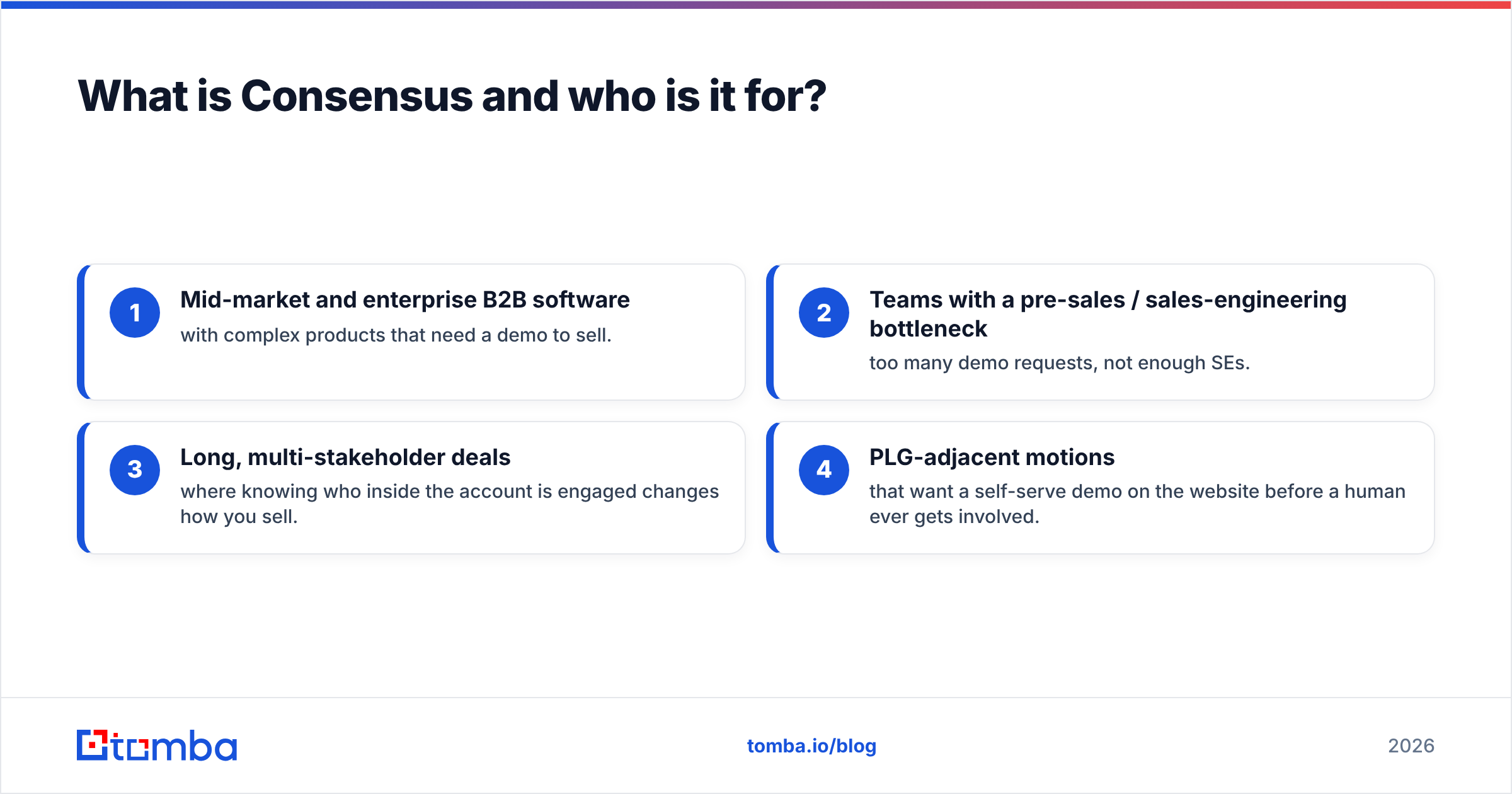
- Mid-market and enterprise B2B software with complex products that need a demo to sell.
- Teams with a pre-sales / sales-engineering bottleneck — too many demo requests, not enough SEs.
- Long, multi-stakeholder deals where knowing who inside the account is engaged changes how you sell.
- PLG-adjacent motions that want a self-serve demo on the website before a human ever gets involved.
If you sell a simple product, run short sales cycles, or your reps can comfortably demo live on demand, the platform is likely overkill — and its pricing model will make that obvious fast.
How much does Consensus actually cost?#
Here is the honest answer: Consensus does not list prices, and any specific number you see quoted online is an estimate, not a rate card. What is well documented across review sites and buyers is the shape of the pricing:
- Quote-based, annual contracts. Expect a yearly commitment, not month-to-month.
- Seat- and tier-driven. Cost scales with the number of users who create and manage demos, plus feature tiers (analytics depth, integrations, admin controls).
- Enterprise positioning. Publicly discussed contracts and reseller listings tend to land in the low-to-mid five figures per year for real deployments, with smaller teams sometimes lower.
- Add-ons and onboarding. Implementation, template building, and premium support can sit on top of the base license.
Because the number is negotiated, two companies of similar size can pay very different amounts. That is normal for enterprise software. But it means "Consensus pricing" is not a fact you can look up — it is the outcome of a procurement conversation. Compare that with a tool like Tomba, where the Tomba pricing tiers are public down to the dollar and start at $49/mo.
Consensus pricing model vs. transparent tools#
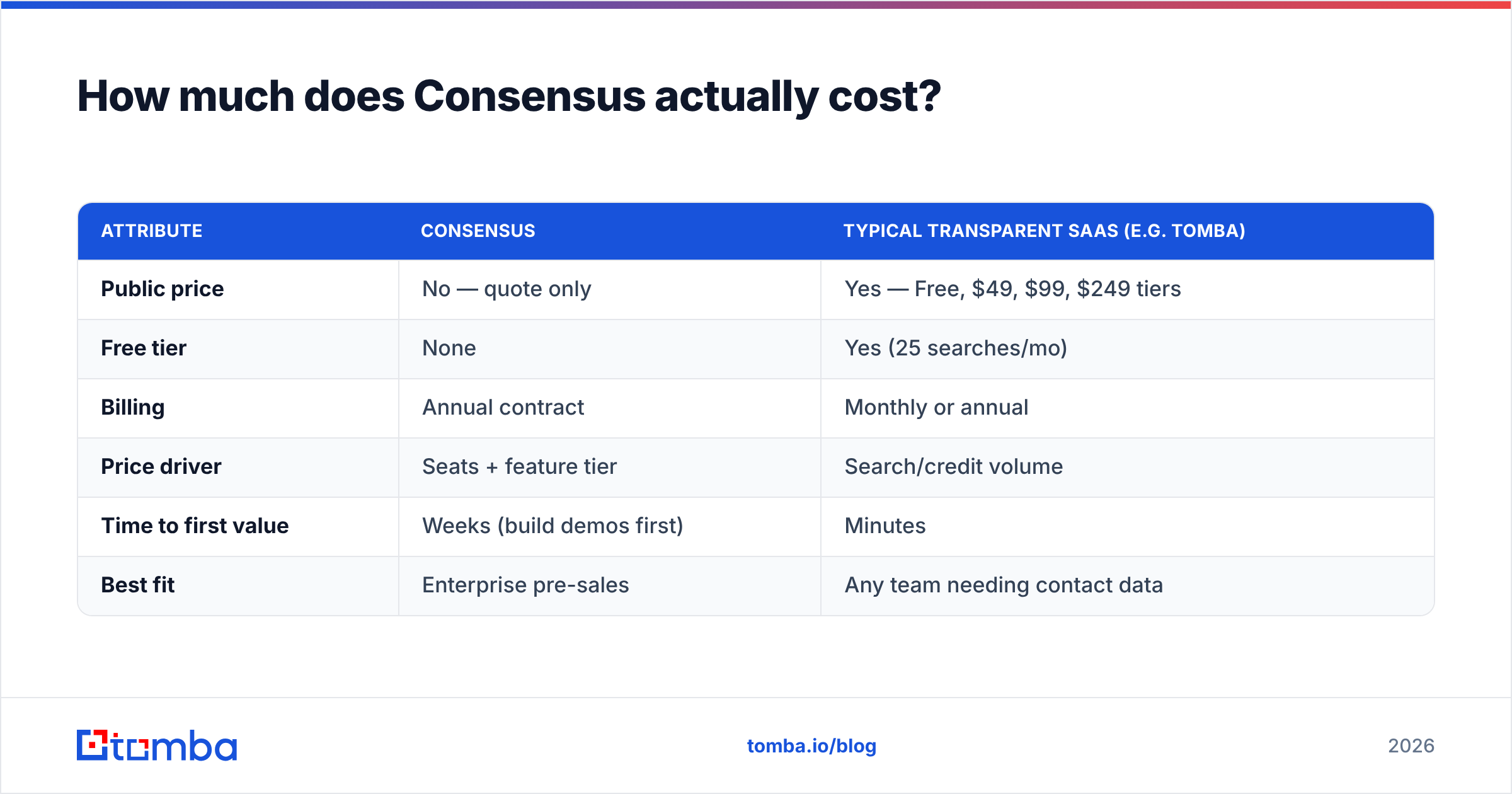
| Attribute | Consensus | Typical transparent SaaS (e.g. Tomba) |
|---|---|---|
| Public price | No — quote only | Yes — Free, $49, $99, $249 tiers |
| Free tier | None | Yes (25 searches/mo) |
| Billing | Annual contract | Monthly or annual |
| Price driver | Seats + feature tier | Search/credit volume |
| Time to first value | Weeks (build demos first) | Minutes |
| Best fit | Enterprise pre-sales | Any team needing contact data |
The table is not saying Consensus is worse. The two tools solve different problems. It shows what you trade for a demo automation platform: a slower, quote-gated buying process in exchange for a heavier, more strategic capability.
Consensus pricing reviews pros and cons: what buyers report#
Across G2 and Capterra, Consensus reviews are broadly positive, with recurring themes on both sides. Here is what buyers actually report.
The pros reviewers repeat#
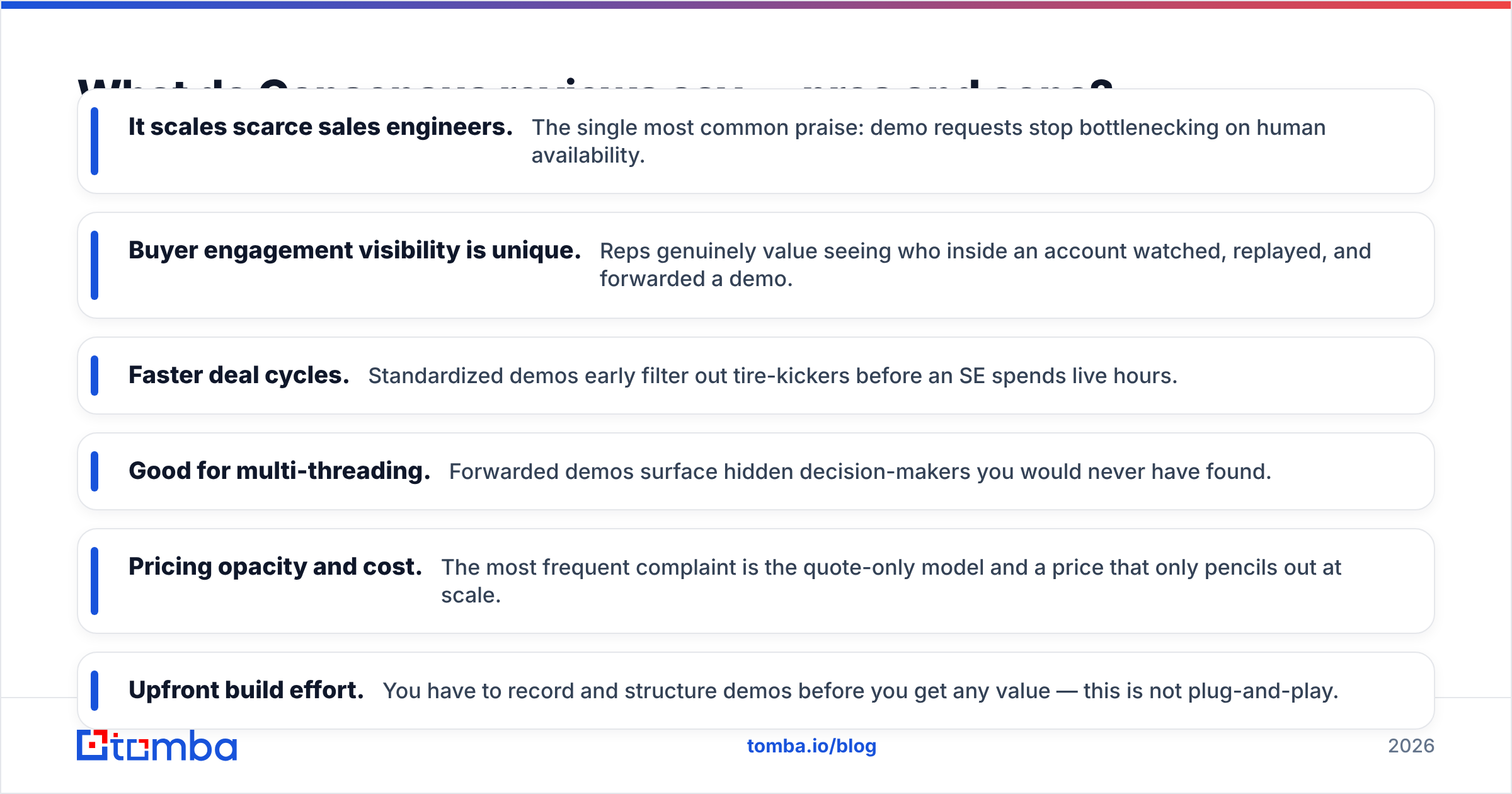
- It scales scarce sales engineers. The single most common praise: demo requests stop bottlenecking on human availability.
- Buyer engagement visibility is unique. Reps genuinely value seeing who inside an account watched, replayed, and forwarded a demo.
- Faster deal cycles. Standardized demos early filter out tire-kickers before an SE spends live hours.
- Good for multi-threading. Forwarded demos surface hidden decision-makers you would never have found.
The cons reviewers repeat#
- Pricing opacity and cost. The most frequent complaint is the quote-only model and a price that only pencils out at scale.
- Upfront build effort. You have to record and structure demos before you get any value — this is not plug-and-play.
- Learning curve. Admins report a ramp period to master templating, branching logic, and analytics.
- Overkill for simple products. Teams with short cycles or self-explanatory products struggle to justify it.

None of these are disqualifying. They are the standard trade-offs of an enterprise pre-sales tool: high ceiling, real setup cost, and a price that rewards volume. The question is whether your motion clears that bar.
Is Consensus worth it in 2026?#
It is worth it when the math is about sales-engineer time, not demo software. Run the calculation the way procurement will:
- Estimate hours your SEs spend on repeat demos per month.
- Multiply by loaded cost per SE hour.
- Compare that reclaimed capacity — plus faster cycles and better multi-threading — against the annual quote.
If you field hundreds of demo requests a month and SEs are the constraint, the ROI story writes itself and the five-figure price is easy. If you run 20 demos a month with one SE who is not underwater, you will struggle to justify it. A lighter tool or a well-recorded Loom library will do most of the job for a fraction of the cost.
A few honest caveats before you sign:
- Negotiate the tier, not just the discount. Much of the cost is feature gating. Make sure you are not paying for analytics depth you will not use.
- Budget the ramp. The demo library is your responsibility. Factor in weeks of build time when you model payback.
- Confirm integrations. Check that it writes engagement data into your CRM cleanly — that is where the value compounds.
What Consensus does not solve — and where the cheaper problem is#
Here is the part every demo automation pitch quietly skips: a demo only works on a buyer you have already reached. Consensus is a mid-funnel and late-funnel tool. It makes the demo experience better and more measurable. It does nothing to get the right person into that demo in the first place.
That top-of-funnel job — finding the decision-maker, getting a valid email, and reaching them — is a separate, much cheaper problem. It is also where most pipeline leaks. You can buy the slickest demo platform on the market and still starve it if your outbound list is full of guessed addresses and stale contacts.
This is where an accurate email finder does the unglamorous work that feeds everything downstream:
- Use domain search to map every contactable person at a target account, so you can multi-thread before the demo, not just after someone forwards it.
- Run new lists through an email verifier so your invites and follow-ups actually land instead of bouncing.
- Push enriched, verified contacts into your CRM with data enrichment so reps work real people, not blanks.
Where the budget actually moves the needle#
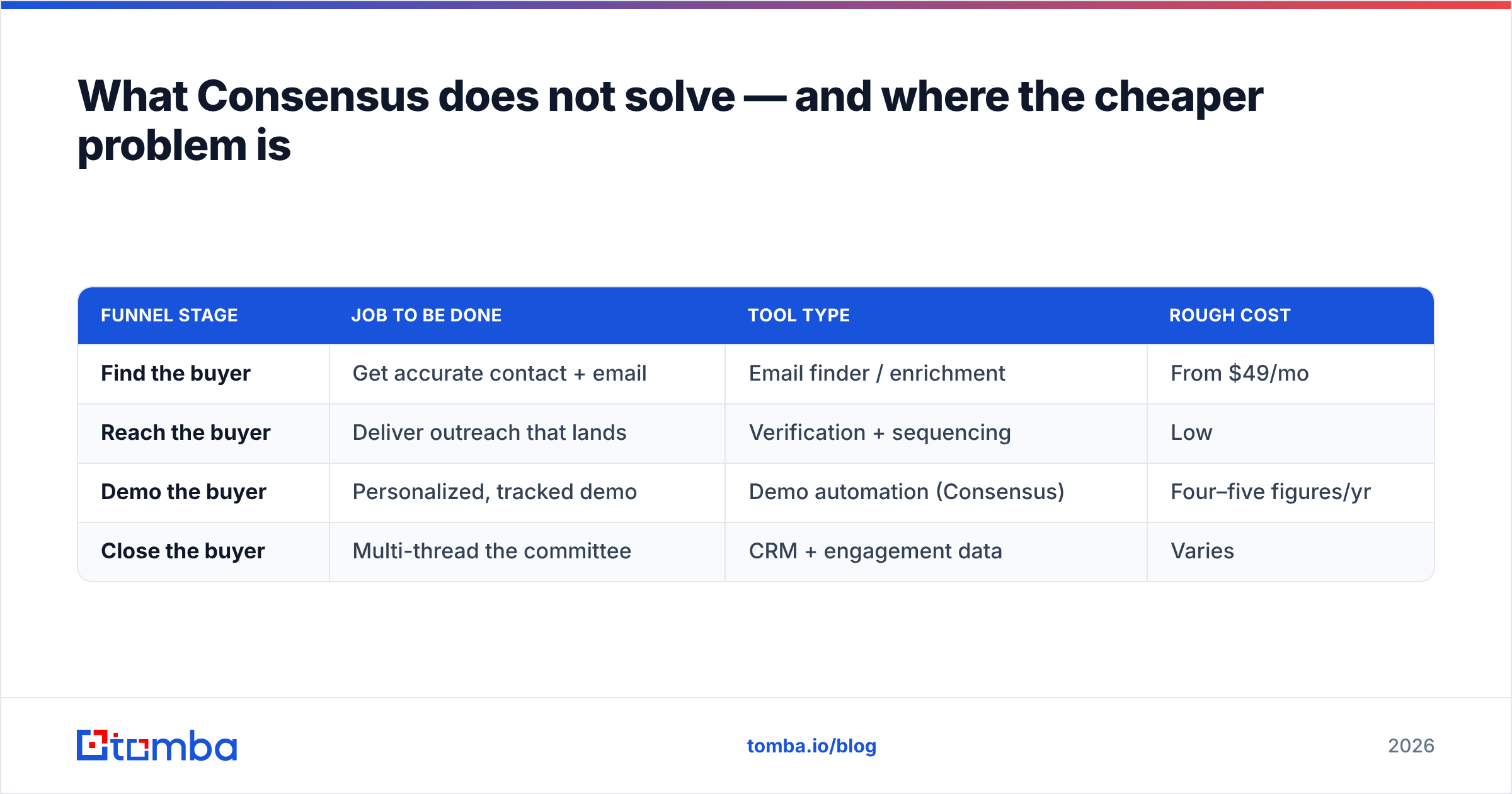
| Funnel stage | Job to be done | Tool type | Rough cost |
|---|---|---|---|
| Find the buyer | Get accurate contact + email | Email finder / enrichment | From $49/mo |
| Reach the buyer | Deliver outreach that lands | Verification + sequencing | Low |
| Demo the buyer | Personalized, tracked demo | Demo automation (Consensus) | Four–five figures/yr |
| Close the buyer | Multi-thread the committee | CRM + engagement data | Varies |
The point is sequencing your spend. A demo automation platform is a strong investment once your funnel is full. If the top of the funnel is thin, fixing contact accuracy for $49–$99/mo returns more than a five-figure demo contract ever will. The demo has nothing to work with if buyers never show up.
How does Consensus compare to alternatives?#
Consensus is the category leader in demo automation, but it is not the only option. "Worth it" depends on which alternative you weigh it against:
- Direct demo automation rivals (e.g. Reprise, Navattic, Storylane, Walnut) compete on interactive demos and sometimes list pricing more openly — worth a bake-off if transparency matters to you.
- DIY video libraries (Loom, Vidyard) cover a slice of the value at a tiny fraction of the price, minus the branching logic and deep analytics.
- Doing nothing is a real option for teams whose SEs are not the bottleneck.
If your reason for looking at Consensus is "our reps waste too much time on repeat demos," any of these might solve it. If your reason is "we need committee-level engagement analytics on enterprise deals," Consensus is hard to beat — and you will pay for that edge.
The verdict#
Here is where the Consensus pricing reviews pros and cons debate lands. It is a strong, well-reviewed demo automation platform. Its biggest downsides are the ones you would expect from enterprise software: opaque, quote-only pricing, a real onboarding lift, and a cost that only makes sense above a certain deal volume. For a busy pre-sales org drowning in demo requests, the pros clearly outweigh the cons. For a lean team with short cycles, it is more platform than the problem requires.
Whichever way you land, remember what it does not do. Demo automation optimizes the middle of your funnel. It cannot fill the top. Before you commit a five-figure budget to demoing buyers better, make sure you can find and reach them at all.
Start there. Tomba's Email Finder gives you accurate, verified contact data on the decision-makers at your target accounts, with public pricing that starts free and scales to $49/mo — so your pipeline is full before you ever pay a demo platform to impress it. Fix the cheap problem first, then decide if the expensive one is worth solving.
Related guides#
Ready to find emails that actually work?
Join 150,000+ professionals who stopped guessing and started sending. Free credits on signup — no credit card required.
Get the Tomba newsletter
Practical outbound tactics and product updates — once every two weeks.
About the author