The Consultative Sales Process: A 2026 Playbook That Closes
A no-fluff guide to the consultative sales process: the 6 stages, the discovery questions that work, and how to run it without slowing your pipeline.
The Consultative Sales Process: A 2026 Playbook That Closes
Buyers do not want a pitch. They want a diagnosis. The consultative sales process flips the old script: instead of leading with your product, you lead with the buyer's problem, and you earn the right to recommend a solution by understanding their situation better than they do.
This guide breaks down exactly how to run it — the six stages, the questions that actually surface pain, the metrics that tell you it is working, and the mistakes that quietly kill deals. No theory-for-theory's-sake. Just the playbook.
TL;DR#
- Consultative selling means diagnosing before prescribing. You act like a doctor, not a vendor — questions first, recommendations second.
- It runs in six repeatable stages: research, connect, discover, diagnose, recommend, and commit. Each has an exit criterion.
- Discovery is where deals are won or lost. Ask about impact and consequences, not just features and budget.
- It scales with good data. You cannot personalize outreach to 200 accounts without accurate contact and company intelligence up front.
- It is measurable. Track discovery-to-proposal conversion, average deal size, and win rate — consultative reps beat feature-dumpers on all three.
What is a consultative sales process?#
A consultative sales process is a structured, buyer-centric approach where the seller diagnoses a prospect's problem before proposing any solution. Think of a good doctor: they do not sell you medication the moment you walk in. They ask where it hurts, run tests, rule things out, and only then write a prescription you trust because they clearly understood your case.
Transactional selling optimizes for the pitch. Consultative selling optimizes for the diagnosis. The product still gets sold — often at a higher price and a higher win rate — but it arrives as the logical conclusion of a conversation the buyer helped build.
This matters more in 2026 than ever. B2B buyers now complete a large share of their research before they ever talk to a rep, and they can smell a canned demo instantly. Your edge is no longer information. It is interpretation: helping the buyer make sense of their own situation.

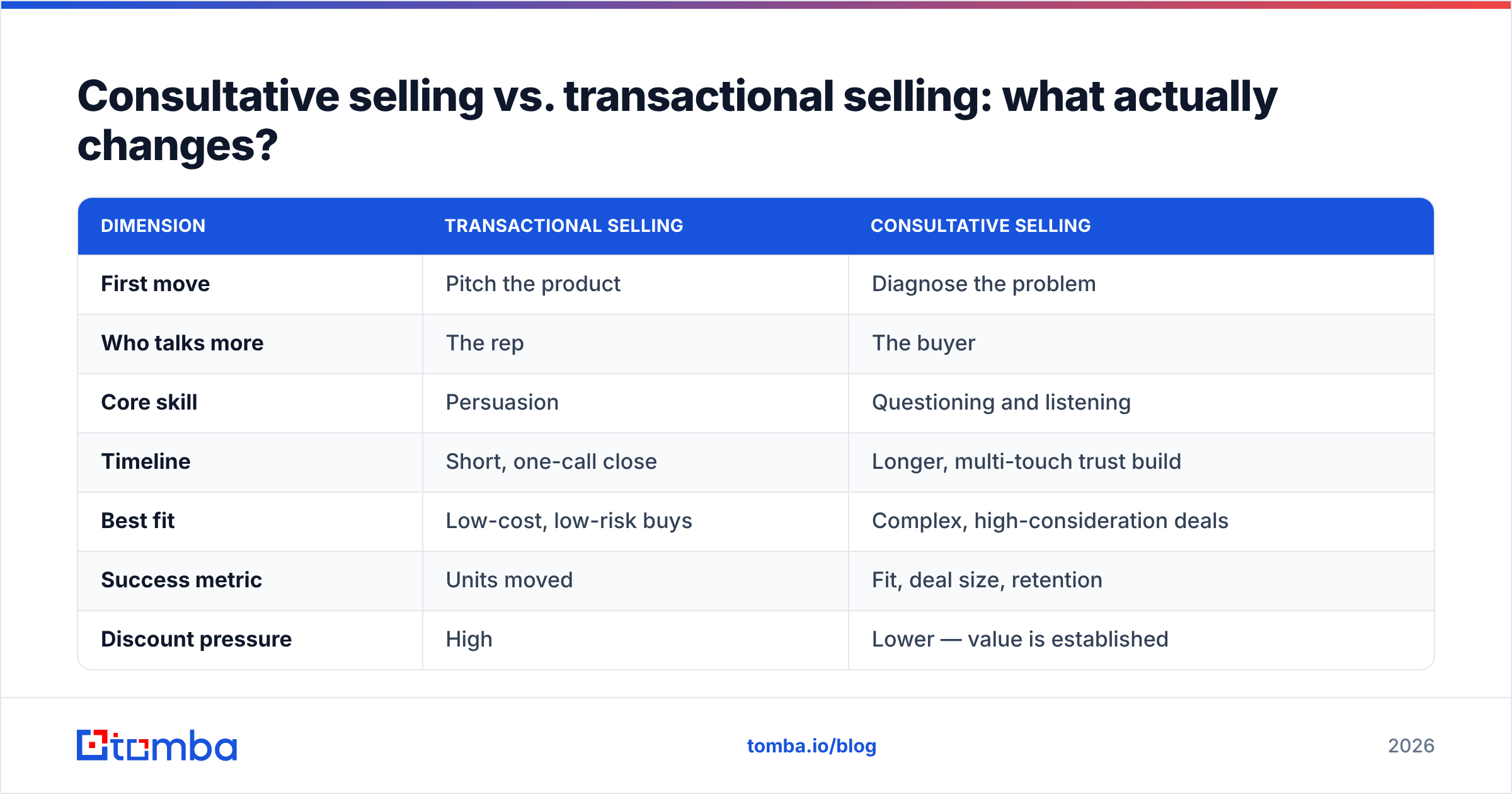
Consultative selling vs. transactional selling: what actually changes?#
The difference is not "be nicer." It is a different order of operations and a different definition of a good call.
| Dimension | Transactional selling | Consultative selling |
|---|---|---|
| First move | Pitch the product | Diagnose the problem |
| Who talks more | The rep | The buyer |
| Core skill | Persuasion | Questioning and listening |
| Timeline | Short, one-call close | Longer, multi-touch trust build |
| Best fit | Low-cost, low-risk buys | Complex, high-consideration deals |
| Success metric | Units moved | Fit, deal size, retention |
| Discount pressure | High | Lower — value is established |
The consultative model wins when the purchase is complex, the buyer faces real risk, and multiple stakeholders are involved. If you sell a $19/month tool with a free trial, transactional is fine. If you sell anything that changes how a team works, consultative is the only approach that survives procurement.
What are the stages of the consultative sales process?#
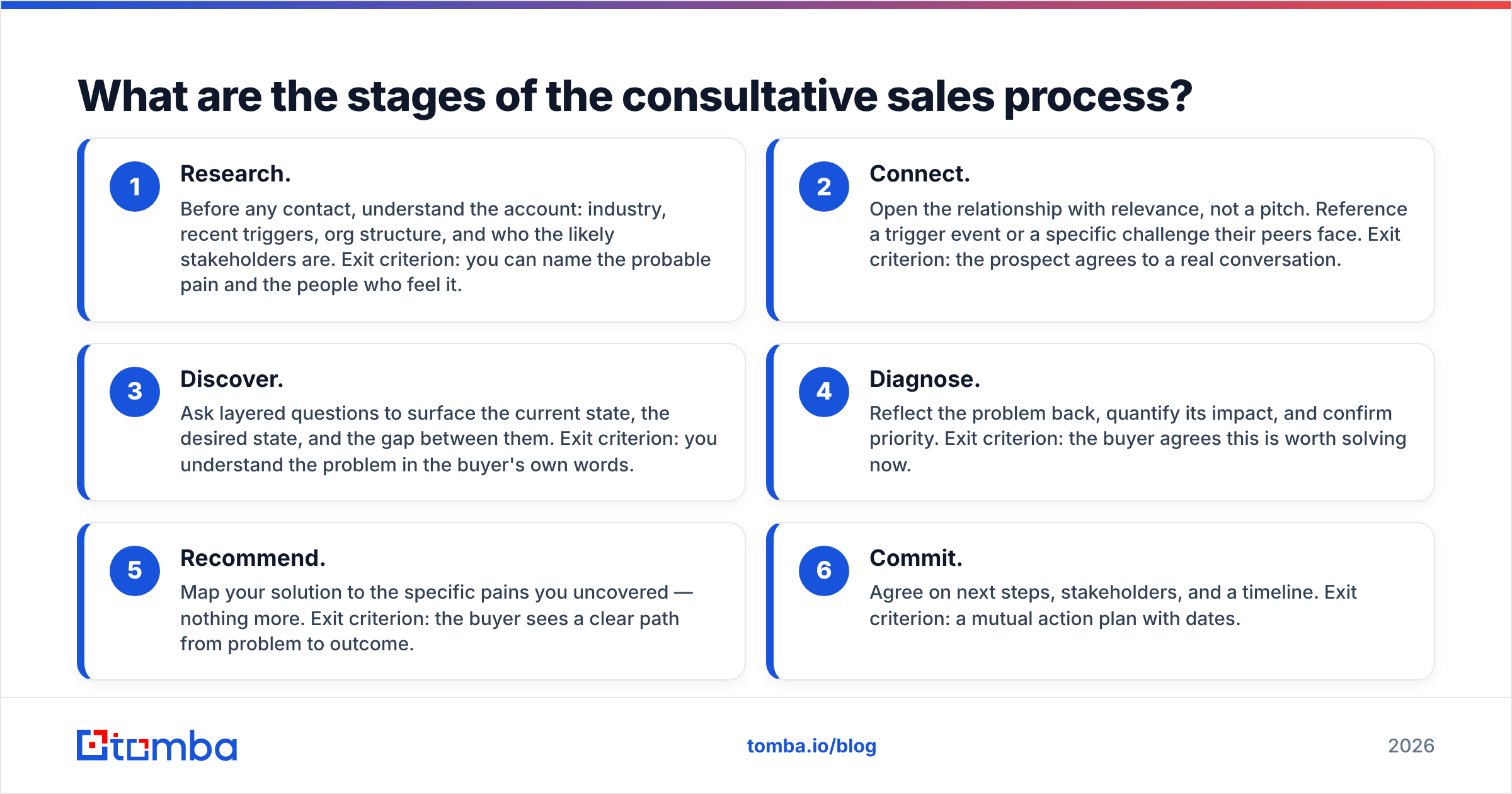
Here is the process as six stages. Each has a job and an exit criterion — you do not advance until the criterion is met.
- Research. Before any contact, understand the account: industry, recent triggers, org structure, and who the likely stakeholders are. Exit criterion: you can name the probable pain and the people who feel it.
- Connect. Open the relationship with relevance, not a pitch. Reference a trigger event or a specific challenge their peers face. Exit criterion: the prospect agrees to a real conversation.
- Discover. Ask layered questions to surface the current state, the desired state, and the gap between them. Exit criterion: you understand the problem in the buyer's own words.
- Diagnose. Reflect the problem back, quantify its impact, and confirm priority. Exit criterion: the buyer agrees this is worth solving now.
- Recommend. Map your solution to the specific pains you uncovered — nothing more. Exit criterion: the buyer sees a clear path from problem to outcome.
- Commit. Agree on next steps, stakeholders, and a timeline. Exit criterion: a mutual action plan with dates.
Notice that the pitch does not appear until stage five, and even then it is narrow. Four of the six stages happen before you talk about your product at all. That ratio is the whole point.
How do you run great discovery calls?#
Discovery is where consultative selling lives or dies. Weak reps ask surface questions ("What's your budget?"). Strong reps ask questions that make the buyer think — and often reveal a problem the buyer had not fully articulated.
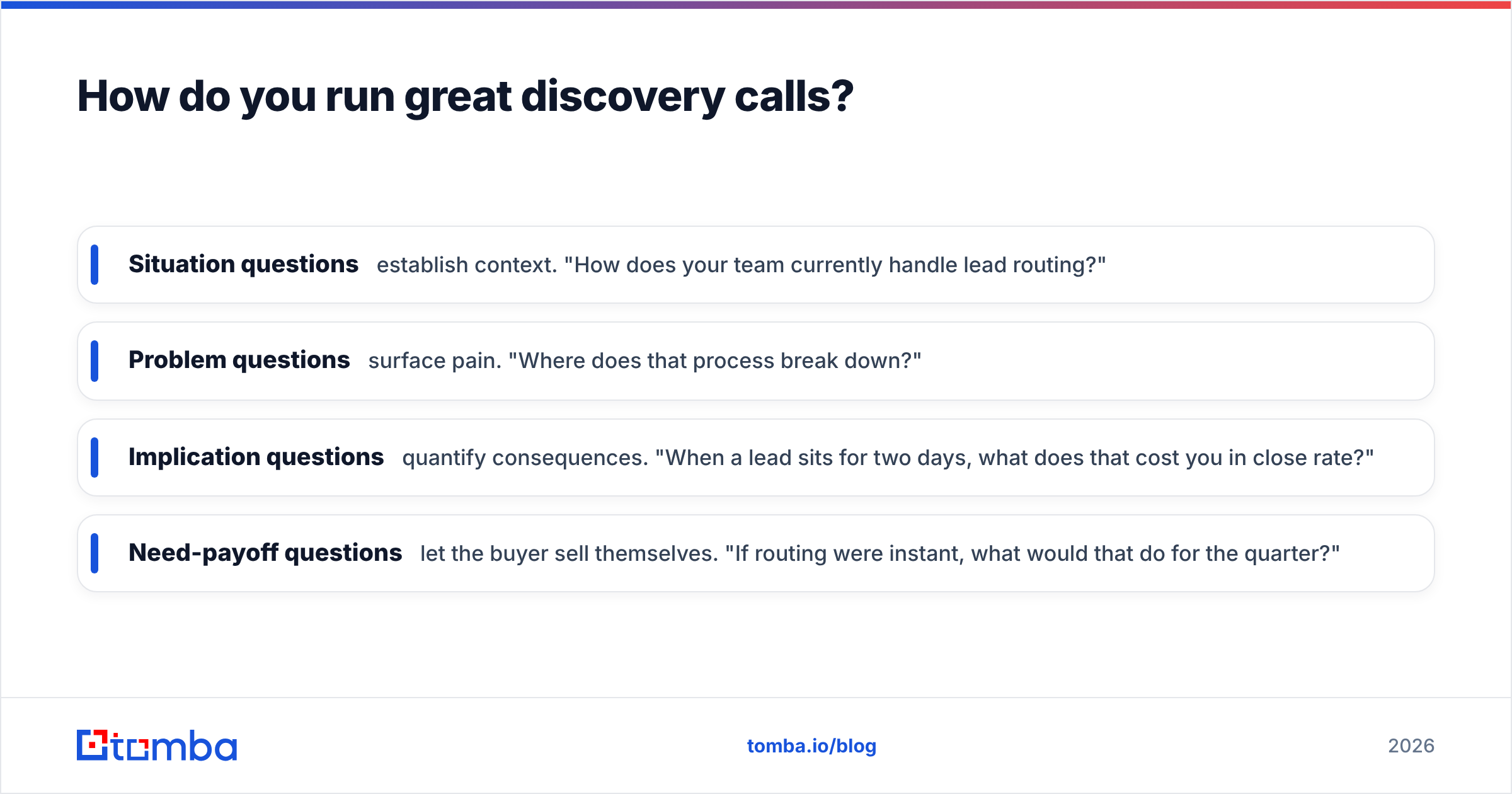
Use a layered questioning model. The classic frameworks — SPIN, from Neil Rackham's research, and its modern descendants — all move from facts to impact:
- Situation questions establish context. "How does your team currently handle lead routing?"
- Problem questions surface pain. "Where does that process break down?"
- Implication questions quantify consequences. "When a lead sits for two days, what does that cost you in close rate?"
- Need-payoff questions let the buyer sell themselves. "If routing were instant, what would that do for the quarter?"
The implication questions are the ones that move deals. They convert a mild annoyance into a quantified business problem — and a quantified problem justifies a budget.
A practical rule: aim for the buyer to talk roughly 60–70% of the discovery call. If you are talking more than they are, you are pitching, not discovering. Record your calls, review the talk ratio, and coach against it. Tools like Gong exist precisely because this ratio predicts win rate.
What data do you need to sell consultatively at scale?#
Here is the tension nobody mentions: consultative selling is personal, but pipeline targets are not. You cannot run deep, tailored discovery on ten accounts a week if you spend three of those days hunting for the right contact and their email address.
That is where the process meets your data stack. To personalize at volume, you need three things before the first touch:
- The right person. Not a generic info@ inbox — the specific stakeholder who owns the problem. A domain search turns a company name into the actual people and roles you should be talking to.
- A verified way to reach them. Bouncing emails destroy sender reputation and waste your best openers. Run addresses through an email verifier so your consultative message actually lands.
- Context to make the connect stage relevant. Enriched company and role data lets you reference the trigger event that earns the reply. Data enrichment fills the gaps your CRM leaves blank.
Get this layer right and your reps spend their time diagnosing, not data-entry. Get it wrong and even a great consultative framework starves for lack of accounts to run it on. If your team is comparing options here, the honest move is to weigh accuracy and price together — check the Tomba pricing tiers against whatever you use today and test both on the same list.
What metrics prove the consultative process is working?#
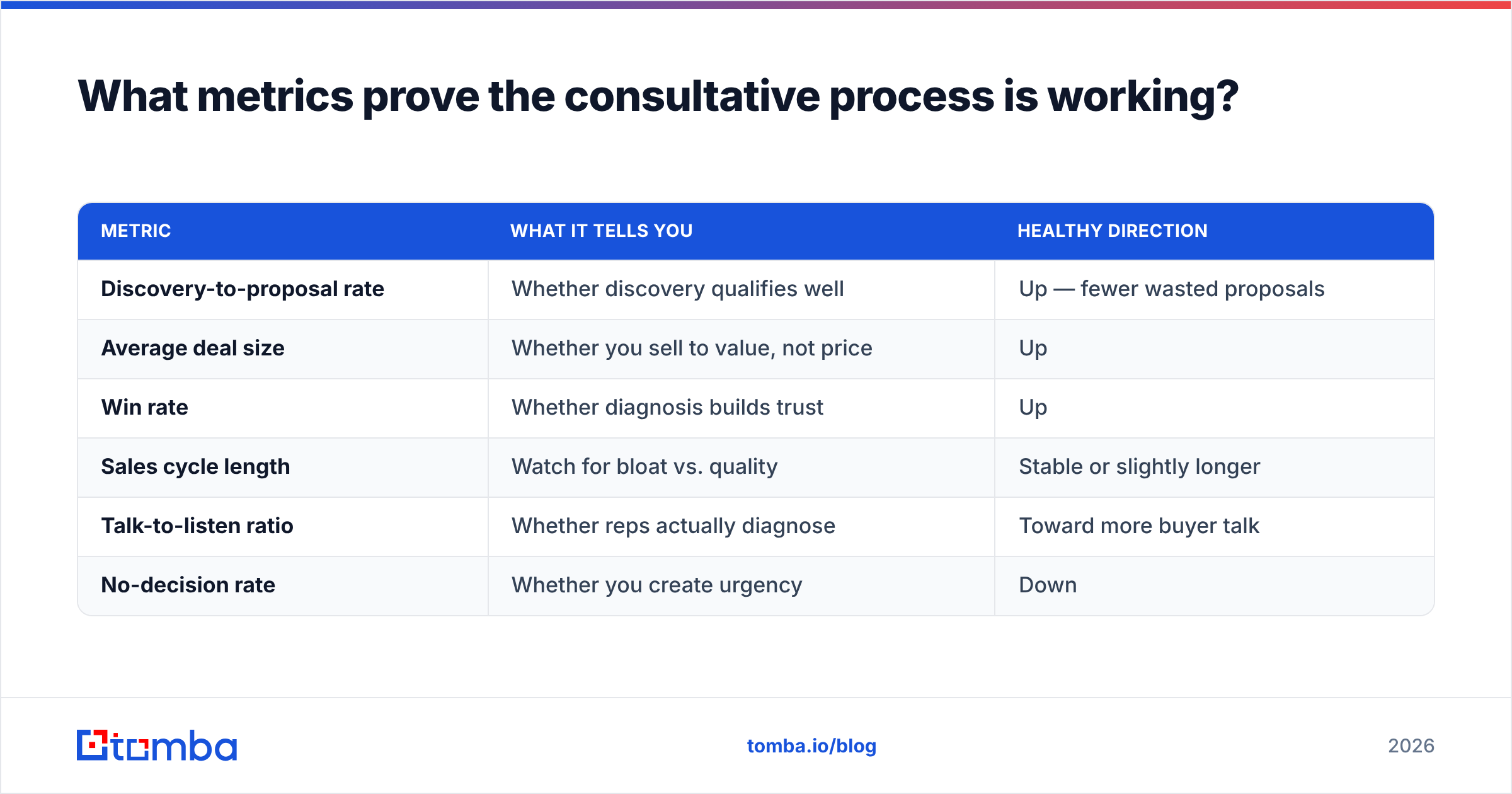
Consultative selling is not a vibe. It shows up in the numbers, and if it does not, something is off. Track these.
| Metric | What it tells you | Healthy direction |
|---|---|---|
| Discovery-to-proposal rate | Whether discovery qualifies well | Up — fewer wasted proposals |
| Average deal size | Whether you sell to value, not price | Up |
| Win rate | Whether diagnosis builds trust | Up |
| Sales cycle length | Watch for bloat vs. quality | Stable or slightly longer |
| Talk-to-listen ratio | Whether reps actually diagnose | Toward more buyer talk |
| No-decision rate | Whether you create urgency | Down |
The counterintuitive one is sales cycle length. Consultative deals sometimes run slightly longer than a hard-close transactional deal — and that is fine if win rate and deal size climb. A longer cycle that ends in a bigger, stickier win beats a fast cycle that ends in churn three months later. If you want to benchmark your own numbers, G2's sales software category and analyst reports from firms like Forrester publish useful baselines by segment.
What are the most common consultative selling mistakes?#
Even teams that buy into the philosophy trip on execution. The usual failure modes:
- Fake discovery. Asking questions you already plan to ignore, then pitching the same deck regardless of answers. Buyers notice. Your questions have to actually change your recommendation.
- Happy ears. Hearing "this sounds interesting" as a buying signal. Confirm priority and consequences explicitly before you advance the deal.
- Pitching too early. The moment a buyer mentions a pain, the untrained rep launches into a feature. Resist. One more question almost always beats one more feature.
- No quantified impact. If you cannot state the cost of the buyer's problem in their terms, you have no business case — just a nice chat.
- Skipping the mutual action plan. Ending a strong call without agreed next steps and dates is how "great meetings" turn into ghosting.
- Under-researching the account. Walking in cold forces you to spend discovery on facts you could have looked up, burning the buyer's patience.
Most of these trace back to one root cause: the rep is anxious to sell and skips the diagnosis. The fix is process discipline, not personality. Hold the exit criteria for each stage and the mistakes largely disappear.
How do you coach a team onto the consultative process?#
Rolling this out across a team is a change-management project, not a memo. A few moves that work:
- Make the stages visible in your pipeline. Map your CRM stages to the six stages above so a "proposal sent" deal cannot skip "diagnose." Structure enforces behavior when willpower fades.
- Coach from recordings, not memory. Review real discovery calls for talk ratio and question quality. Specific feedback on a real call beats generic advice every time.
- Build a living question bank. Collect the implication questions that actually moved deals and make them shared property. Your best rep's instinct becomes your team's playbook.
- Reward diagnosis, not just closing. If comp and praise only follow signatures, reps will short-circuit discovery under pressure. Recognize great qualification and honest "not a fit" calls too.
Consistency compounds. A team that runs the same six stages produces forecastable pipeline, cleaner data, and coachable reps — which is worth as much as any individual heroics.
The bottom line#
The consultative sales process wins because it aligns with how modern B2B buyers actually decide: they trust the seller who understands their problem, not the one with the loudest pitch. Diagnose first, prescribe second, and quantify the impact in between. Run it as six disciplined stages with real exit criteria, coach it from recordings, and measure it with win rate and deal size — not activity theater.
But a great process needs accounts to run on. The reps who consistently hit quota are not just better at discovery; they never run out of the right people to have discovery with. Before your next campaign, load your target accounts into the Tomba Email Finder to get verified, on-target contacts by domain, name, or company — so your team spends its hours diagnosing problems, not chasing bounced emails. Start free with 25 searches and see how much faster the consultative process moves when the data underneath it is clean.
Related guides#
Ready to find emails that actually work?
Join 150,000+ professionals who stopped guessing and started sending. Free credits on signup — no credit card required.
Get the Tomba newsletter
Practical outbound tactics and product updates — once every two weeks.
About the author