Consultative Selling Is Very Prominent In Complex B2B Sales
Consultative selling wins where deals are complex, buyers are educated, and trust decides the outcome. Here's exactly where it dominates in 2026 — and how to run it without the fluff.
TL;DR
- Consultative selling is very prominent in complex, high-value B2B deals — enterprise software, financial services, healthcare, and professional services. These deals have many stakeholders and a long buying cycle.
- It swaps "pitch the product" for "diagnose the problem." That is why it wins with buyers who are already informed and tired of scripts.
- The method is only as good as your pre-call research. Bad contact data and shallow homework turn "consultative" into "annoying."
- It beats transactional selling on deal size and retention. But it is slower and costs more per deal, so match it to the right segment.
- Teams that scale it pair a real discovery framework with clean, enriched prospect data. Every conversation then starts informed.
What is consultative selling, in plain terms?#
Consultative selling means you act like a doctor, not a vendor. You diagnose before you prescribe. Instead of leading with features and price, you lead with questions. You listen for the real problem. Only then do you position a solution — and sometimes you tell the buyer not to buy yet.
Here is an everyday analogy. A good physiotherapist does not sell you a knee brace the moment you limp in. They watch you move, ask where it hurts, and rule things out. Then they recommend the smallest fix for the real cause. A bad one sells you the brace at the door. Consultative selling is that physiotherapist model applied to revenue.
In technical terms, it is a buyer-centric sales method. It is built on structured discovery, active listening, sharing insight, and tailored advice. It sits opposite "product selling," where the rep's job is to demo features and handle objections until someone signs.
Where consultative selling is very prominent in B2B#
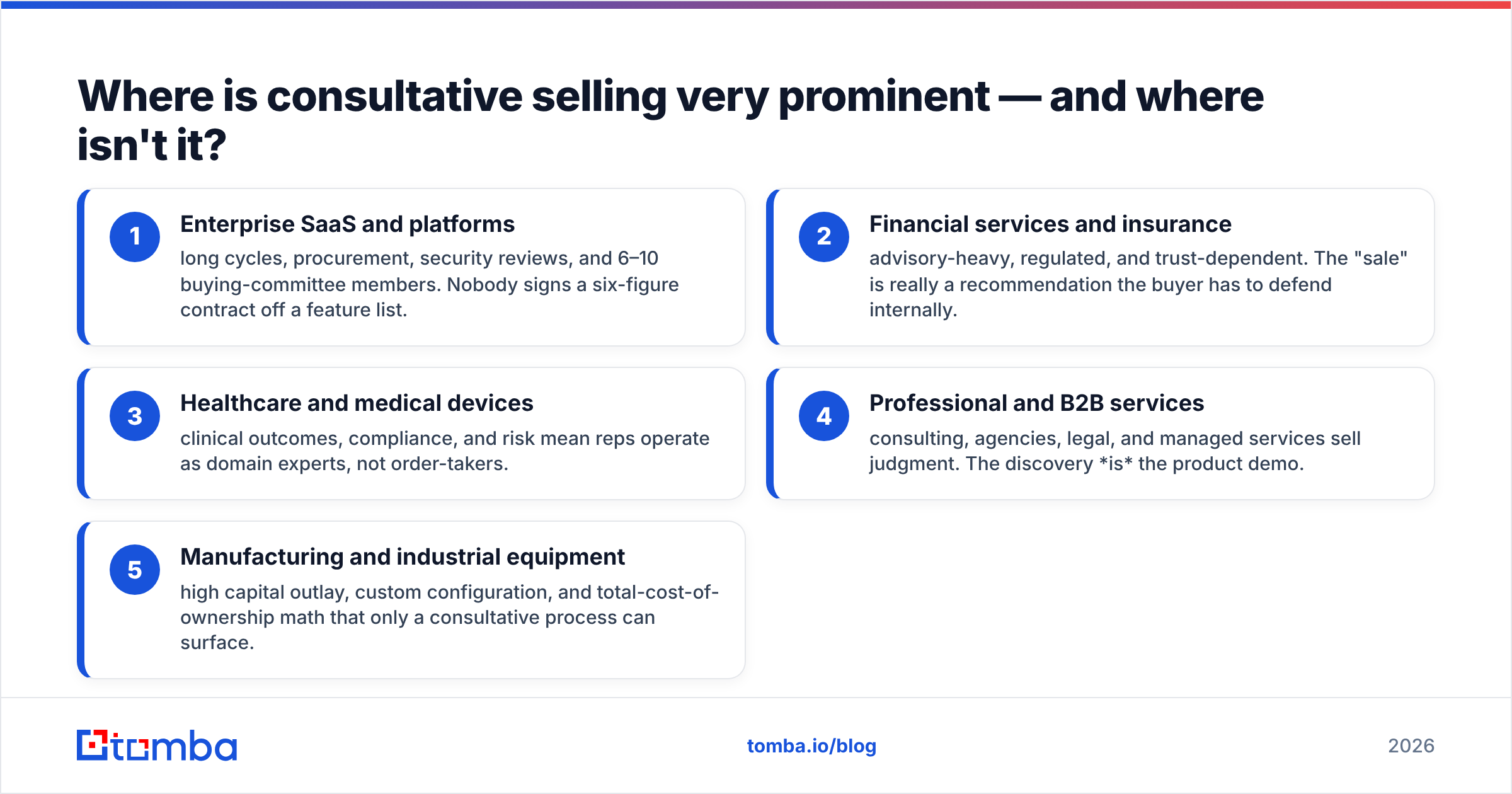
Consultative selling is very prominent in deals that are complex, expensive, and multi-stakeholder. The more a purchase reshapes how the buyer works, the more they need a guide, not a catalog. Here is where it wins:
- Enterprise SaaS and platforms — long cycles, procurement, security reviews, and 6–10 buying-committee members. Nobody signs a six-figure contract off a feature list.
- Financial services and insurance — advisory-heavy, regulated, and trust-dependent. The "sale" is really a recommendation the buyer has to defend internally.
- Healthcare and medical devices — clinical outcomes, compliance, and risk mean reps work as domain experts, not order-takers.
- Professional and B2B services — consulting, agencies, legal, and managed services sell judgment. The discovery is the product demo.
- Manufacturing and industrial equipment — high capital outlay, custom configuration, and total-cost math that only a consultative process can surface.
Where is it overkill? Low-ticket, self-serve, high-velocity deals. If someone can evaluate and buy your $19/month tool in an afternoon, a 45-minute discovery call is friction, not value. According to Gartner's B2B buying research, buyers now spend only about 17% of their journey with sales reps across all vendors. So consultative time has to go where it changes the outcome. Do not spray it across every lead.
Why consultative selling is very prominent in 2026#
Buyers show up already educated, and old-school pitching insults them. Three shifts made the consultative approach the default for serious B2B.
- Information parity. Prospects have read the reviews, watched the demos, and priced the alternatives before your first call. A feature dump tells them nothing new. Insight — a view they have not considered — is the only thing left to sell.
- Committee buying. The average complex deal now involves a buying group, not a single champion. Consultative reps arm an internal champion to sell on their behalf between meetings.
- Trust scarcity. Inboxes are full of automated outreach. A rep who clearly did their homework and asks sharp questions stands out, because so few do.
That last point is where execution makes or breaks the method. "Consultative" collapses the moment you open with a generic question. You could have answered it yourself with 30 seconds of research. That brings us to the unglamorous foundation.
What does consultative selling actually require to work?#
Good discovery on top of good data. The method is famous; the prerequisite is not. You cannot have an informed, tailored talk with a contact you barely researched — or, worse, with the wrong contact entirely.
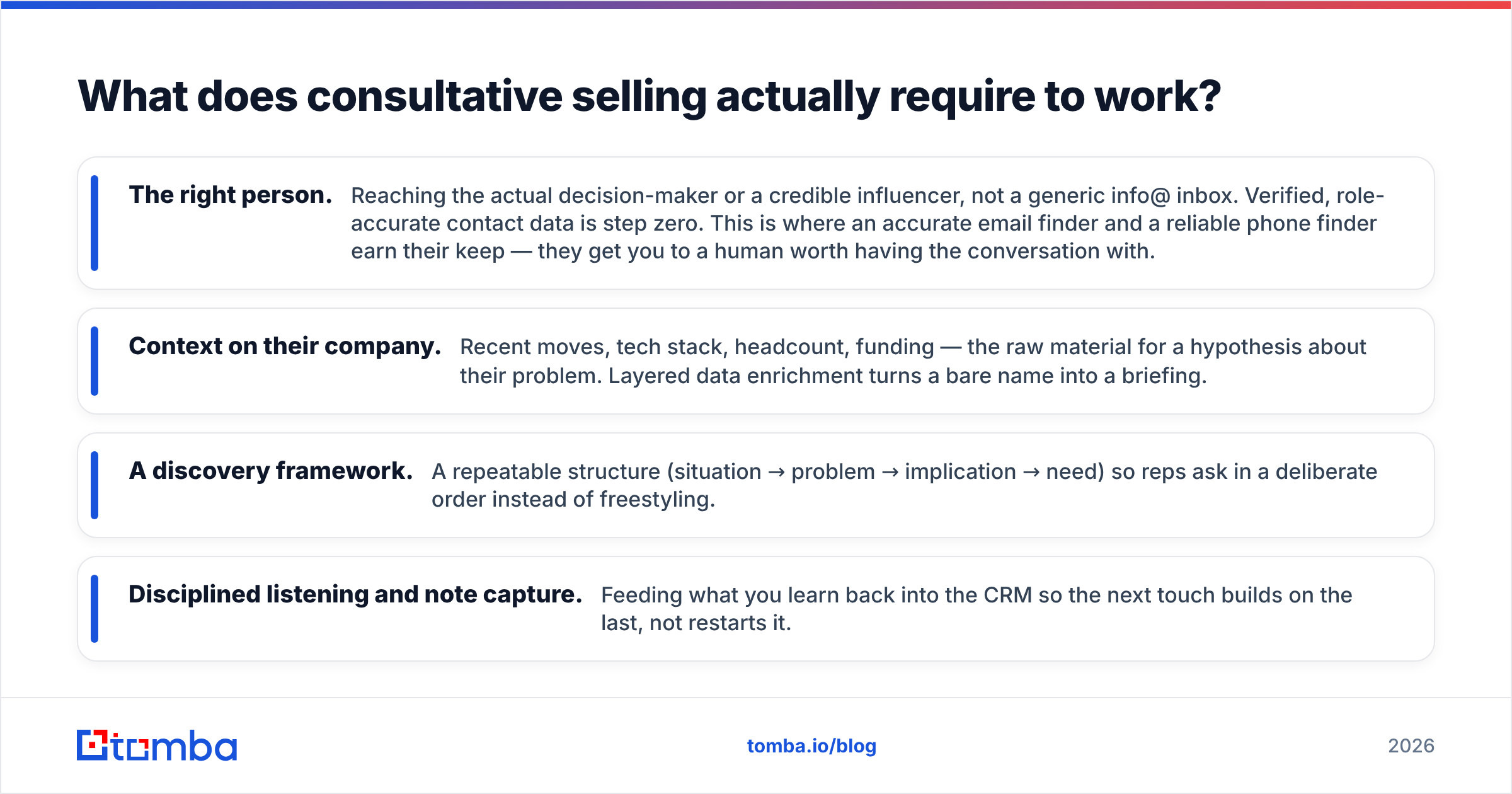
A working consultative motion needs four inputs before the call ever happens:
- The right person. Reach the real decision-maker or a credible influencer, not a generic info@ inbox. Verified, role-accurate contact data is step zero. This is where an accurate email finder and a reliable phone finder earn their keep. They get you to a human worth the conversation.
- Context on their company. Recent moves, tech stack, headcount, and funding are the raw material for a hypothesis about their problem. Layered data enrichment turns a bare name into a briefing.
- A discovery framework. A repeatable structure (situation → problem → implication → need). Reps then ask in a deliberate order instead of freestyling.
- Disciplined listening and note capture. Feed what you learn back into the CRM so the next touch builds on the last, not restarts it.
Skip the data layer and you get reps who "wing" discovery, ask lazy questions, and burn the credibility the method depends on. The best-run teams treat prospect intelligence as part of the sales process, not a chore that happens beforehand.
How does consultative selling compare to product and transactional selling?#
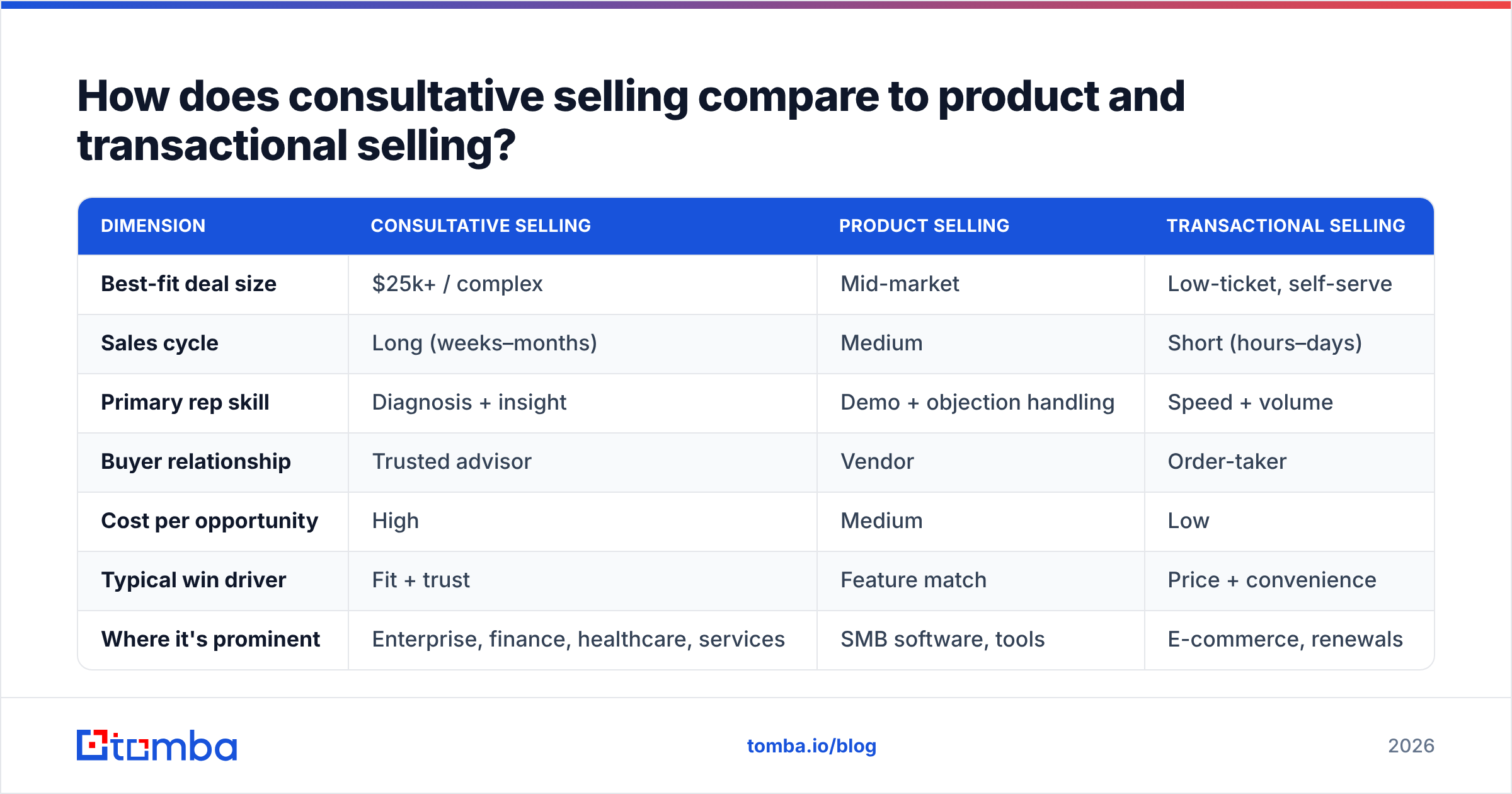
Here is the honest trade-off. Consultative selling wins on deal size, trust, and retention. It loses on speed and cost per opportunity. Pick it by segment, not by dogma.
| Dimension | Consultative selling | Product selling | Transactional selling |
|---|---|---|---|
| Best-fit deal size | $25k+ / complex | Mid-market | Low-ticket, self-serve |
| Sales cycle | Long (weeks–months) | Medium | Short (hours–days) |
| Primary rep skill | Diagnosis + insight | Demo + objection handling | Speed + volume |
| Buyer relationship | Trusted advisor | Vendor | Order-taker |
| Cost per opportunity | High | Medium | Low |
| Typical win driver | Fit + trust | Feature match | Price + convenience |
| Where it's prominent | Enterprise, finance, healthcare, services | SMB software, tools | E-commerce, renewals |
The takeaway is not "consultative is best." It is that consultative selling is very prominent in the top-left of that table — big, slow, trust-sensitive deals. It is a waste of everyone's time in the bottom-right. Mature revenue orgs run both motions and route leads to the right one.
What does a consultative sales conversation look like step by step?#
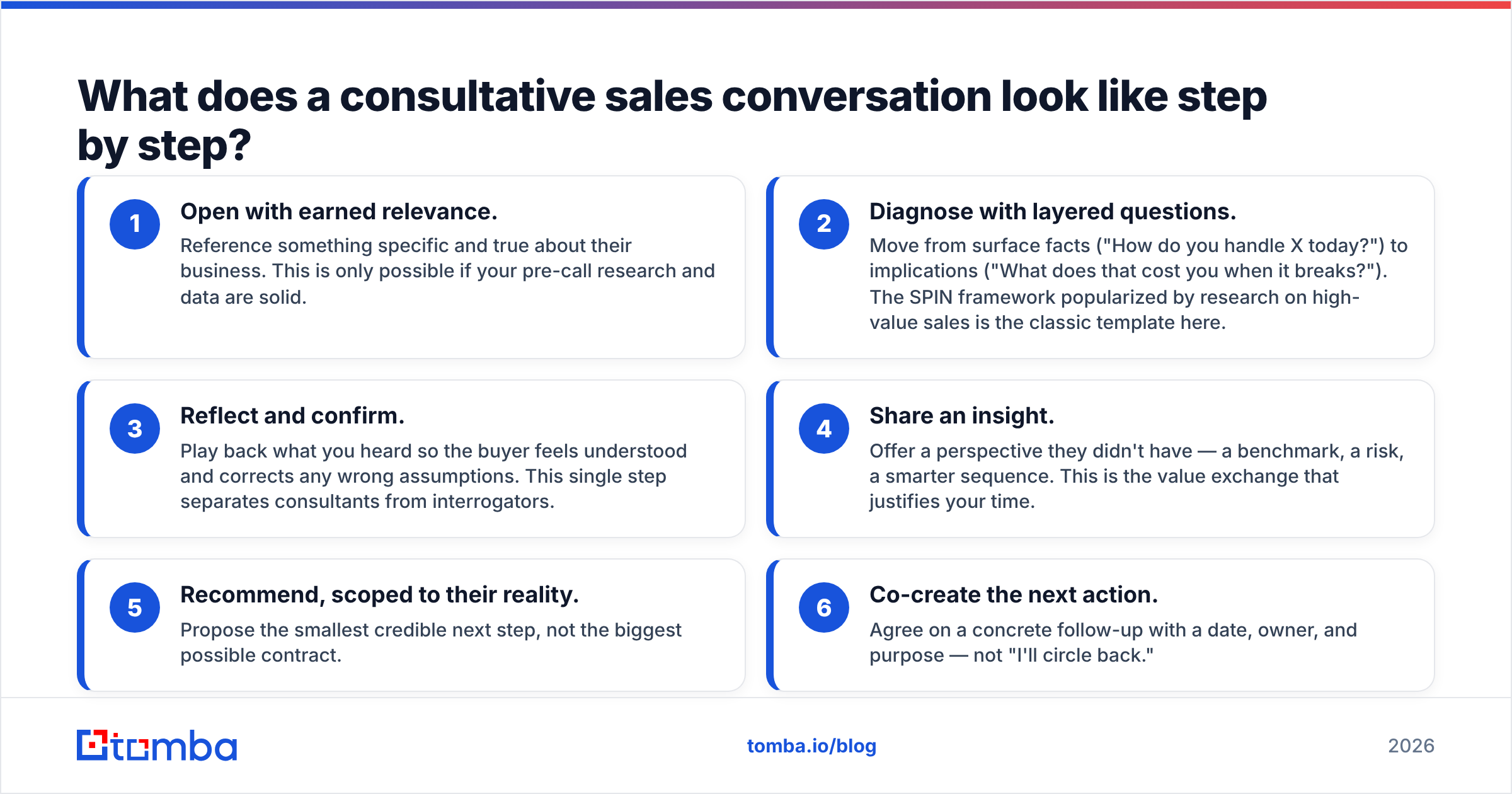
It follows a deliberate arc from context to commitment. Here is the structure top reps run. Think of it as the recipe under the improvisation.
- Open with earned relevance. Reference something specific and true about their business. This works only if your pre-call research and data are solid.
- Diagnose with layered questions. Move from surface facts ("How do you handle X today?") to implications ("What does that cost you when it breaks?"). The SPIN framework popularized by research on high-value sales is the classic template here.
- Reflect and confirm. Play back what you heard. The buyer feels understood and can correct wrong assumptions. This single step separates consultants from interrogators.
- Share an insight. Offer a view they did not have — a benchmark, a risk, a smarter sequence. This is the value exchange that justifies your time.
- Recommend, scoped to their reality. Propose the smallest credible next step, not the biggest possible contract.
- Co-create the next action. Agree on a concrete follow-up with a date, owner, and purpose — not "I'll circle back."
Run correctly, the buyer leaves feeling they got free consulting, not a sales call. That feeling is the entire competitive advantage.
How do you measure whether consultative selling is working?#
Watch leading indicators of quality, not just closed revenue. The cycle is long, so waiting for the win/loss result is too slow. Track these instead:
- Discovery depth — qualified pains uncovered per opportunity. Shallow calls are a red flag long before the deal stalls.
- Multi-threading — how many buying-committee members a rep talks to. Single-threaded deals in complex sales usually die.
- Engagement quality — not just response rate, but whether replies are substantive. Consultative outreach should earn thoughtful answers, not one-word brush-offs.
- Advance rate — the share of conversations that produce a genuine, agreed next step.
- Win rate by segment — where consultative selling is very prominent in a market, it should out-convert product pitches. If it does not, the discovery is probably theater.
Modern sales orgs, per HubSpot's sales research, now weigh relationship and trust signals alongside pipeline math. In complex deals those signals predict the outcome earlier than stage progression does.
What are the most common ways consultative selling goes wrong?#
It fails when reps perform the motions without the substance. Watch four failure modes:
- Fake discovery. Asking questions to check a box, then pitching the same deck regardless of the answers. Buyers spot this instantly.
- Bad targeting. Running a beautiful process against the wrong contact or a dead email. Empathy cannot fix reaching the wrong person. This is why verified contact data upstream matters so much.
- Insight-free calls. Great questions, but no perspective offered in return. Discovery has to be a two-way exchange or it feels like an interrogation.
- No next step. Ending warm conversations without a concrete, dated advance, so momentum evaporates between meetings.
The fix for the first and third is training. The fix for the second is infrastructure. Give reps clean, enriched, accurate data so their effort lands on real, reachable, right-fit people. That is the unsexy multiplier behind every high-performing consultative team.
Where should you start?#
Start by fixing the input, then the technique. A consultative process is only as sharp as the intelligence feeding it. You need the right contact, verified, with enough context to open a conversation that earns trust in the first two minutes. Get reps to real decision-makers with accurate emails and phone numbers. Enrich each record so discovery starts informed. Then give them a repeatable question framework to run.
If your team is leaning into consultative selling — and in complex B2B, you should be — build the data foundation first. Tomba's Email Finder gets your reps to the actual person behind the account with verified, role-accurate contact data. Every consultative conversation then starts with the right human instead of a guess. Pair it with enrichment and phone lookup, and "consultative" turns from a slogan into a repeatable, well-informed motion. See Tomba pricing to match a plan to your team's volume. Then let the method do what it does best: win the deals that trust decides.
Related guides#
Ready to find emails that actually work?
Join 150,000+ professionals who stopped guessing and started sending. Free credits on signup — no credit card required.
Get the Tomba newsletter
Practical outbound tactics and product updates — once every two weeks.
About the author