Consultative Selling Principles: The 2026 Practitioner's Guide
Consultative selling isn't soft skills fluff. It's a repeatable diagnostic process that closes bigger deals. Here are the seven principles that actually move pipeline in 2026.
Most reps think they sell consultatively. Then you listen to their calls and hear a 90-second monologue about features before the buyer has said what hurts. Consultative selling is not a personality trait or a friendly tone — it is a disciplined process for diagnosing a problem before prescribing a solution. This guide breaks down the principles that separate the reps who get treated as vendors from the ones who get treated as advisors.
TL;DR#
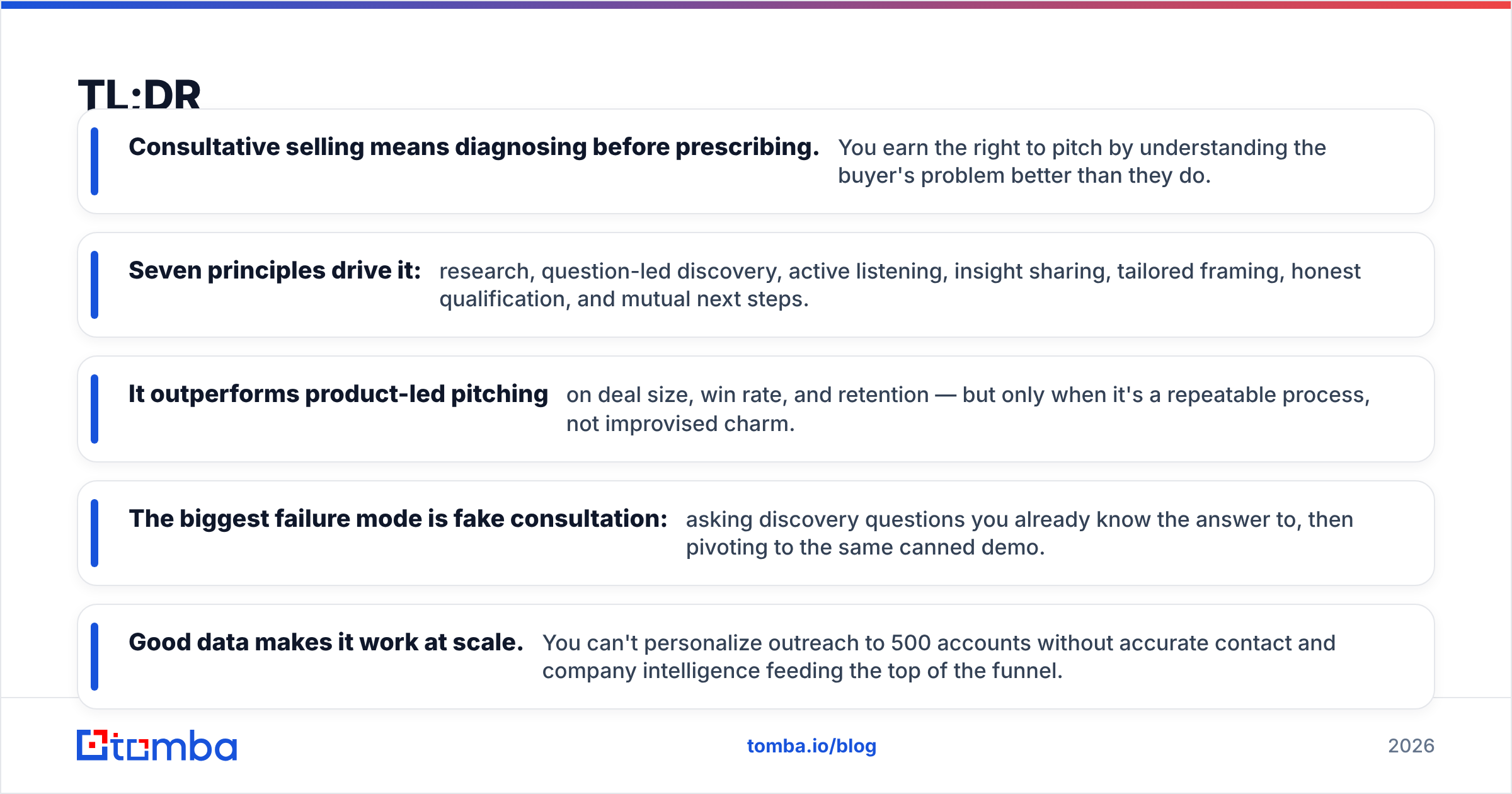
- Consultative selling means diagnosing before prescribing. You earn the right to pitch by understanding the buyer's problem better than they do.
- Seven principles drive it: research, question-led discovery, active listening, insight sharing, tailored framing, honest qualification, and mutual next steps.
- It outperforms product-led pitching on deal size, win rate, and retention — but only when it's a repeatable process, not improvised charm.
- The biggest failure mode is fake consultation: asking discovery questions you already know the answer to, then pivoting to the same canned demo.
- Good data makes it work at scale. You can't personalize outreach to 500 accounts without accurate contact and company intelligence feeding the top of the funnel.
What is consultative selling, really?#
Consultative selling is an approach where the seller acts as a problem-solving advisor rather than a product pusher. Think of it like the difference between a pharmacy clerk and a doctor. The clerk hands you whatever you point at. The doctor asks where it hurts, runs a diagnosis, and only then recommends a treatment — sometimes recommending you don't need the expensive option at all. That last part is what builds trust.
The methodology traces back to Mack Hanna's 1970 book Consultative Selling and has since absorbed ideas from SPIN Selling, Solution Selling, and the Challenger Sale. The through-line across all of them: buyers don't want to be sold to, they want help making a good decision. In 2026, with buyers self-educating through most of the journey before ever talking to sales, the reps who add insight — not just information — are the ones who get the meeting.
Here's the core mental model, laid out as the sequence a strong rep actually follows:
- Research the account before the first touch so your questions are sharp, not generic.
- Diagnose the problem through open questions instead of assuming you know it.
- Quantify the impact of that problem in the buyer's own numbers.
- Share an insight the buyer didn't already have, reframing how they see the issue.
- Prescribe selectively, mapping only the relevant parts of your solution to what you diagnosed.
- Qualify honestly, walking away when there's no real fit.
- Agree on a mutual next step that both sides commit to.
Skip step two and you're pitching. Skip step six and you're spamming.

Why does consultative selling beat feature pitching?#
The short answer: it closes bigger deals with less discounting and keeps them closed longer. When a buyer feels understood, price becomes a smaller part of the conversation because you've anchored on value, not specs. Feature pitching invites feature comparison, and feature comparison is a race to the cheapest option.
There's also a trust dividend. According to research summarized by HubSpot's sales statistics, buyers overwhelmingly prefer reps who understand their needs over reps who lead with product. And Gartner's B2B buying research shows buyers now spend only a fraction of their journey with any single sales rep — which means the minutes you do get have to deliver disproportionate value. A diagnostic conversation does that; a demo dump does not.
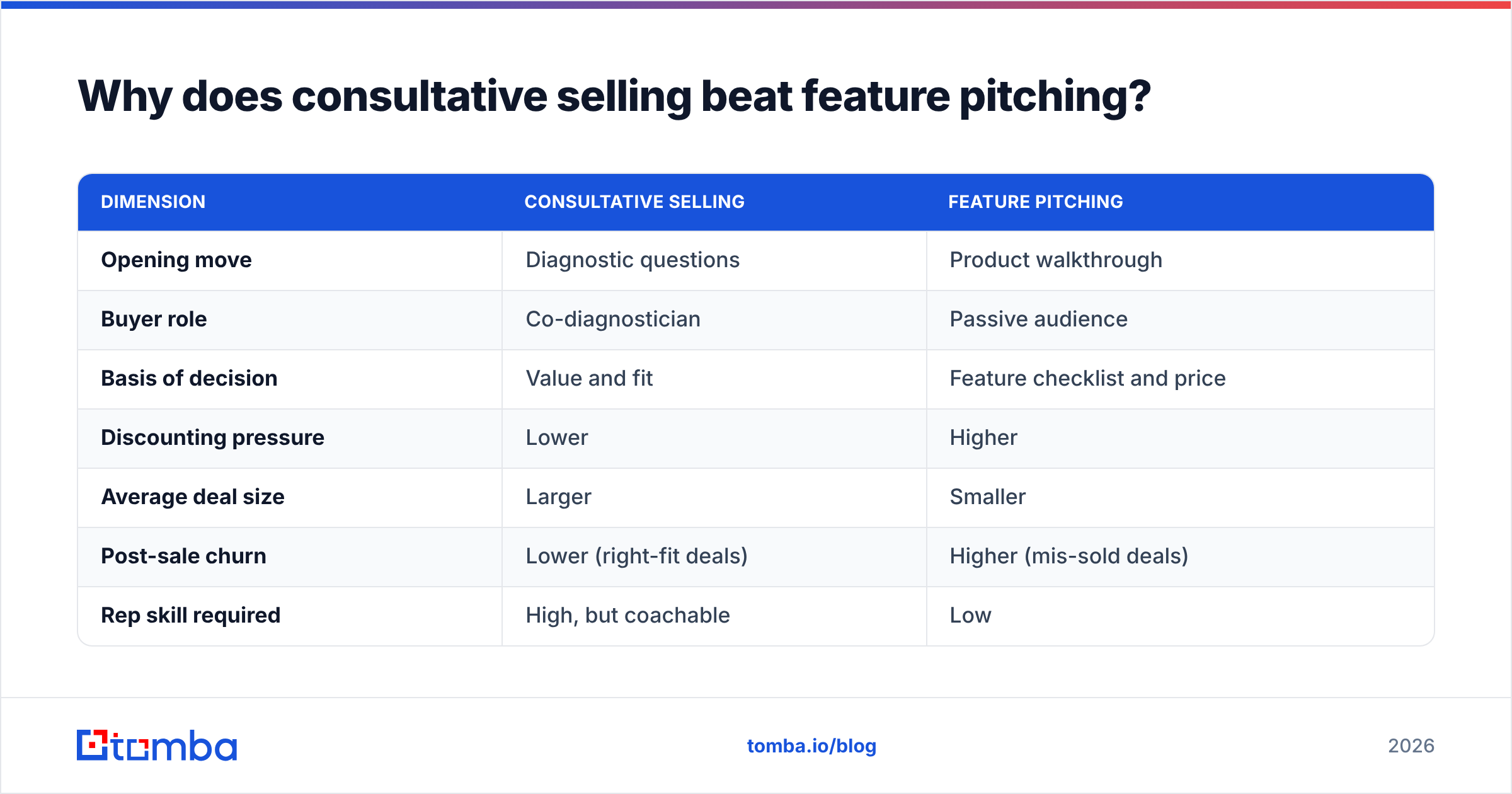
Here's how the two approaches stack up on the metrics that matter:
| Dimension | Consultative Selling | Feature Pitching |
|---|---|---|
| Opening move | Diagnostic questions | Product walkthrough |
| Buyer role | Co-diagnostician | Passive audience |
| Basis of decision | Value and fit | Feature checklist and price |
| Discounting pressure | Lower | Higher |
| Average deal size | Larger | Smaller |
| Post-sale churn | Lower (right-fit deals) | Higher (mis-sold deals) |
| Rep skill required | High, but coachable | Low |
| Scales with | Data + process | Volume of activity |
The last row matters most for revenue teams. Consultative selling scales when you pair a repeatable process with clean data feeding it — not when you simply dial more.
What are the seven consultative selling principles?#
1. Do the homework before you dial#
Generic discovery questions ("So, tell me about your business") signal that you didn't prepare. Strong consultative reps walk in already knowing the company's headcount trajectory, tech stack, recent funding, and likely pain points, so their questions are precise. That precision is what earns the buyer's attention in the first two minutes.
This is where good data enrichment earns its keep. Before a call you want firmographics, role, and context — so your first question lands as "I saw you just opened a second sales pod in EMEA; how are you handling territory data across the two?" instead of "What keeps you up at night?"
2. Lead with questions, not claims#
The SPIN framework — Situation, Problem, Implication, Need-payoff — is still the cleanest questioning structure available. You move the buyer from describing their situation, to naming a problem, to feeling the implication of that problem, to articulating the payoff of solving it. When the buyer says the value out loud, you no longer have to argue for it.
3. Listen actively and quantify#
Listening isn't nodding. It's reflecting back what you heard in numbers: "So the manual list-building is costing each rep about six hours a week — across your eight reps that's roughly a full-time headcount." Quantifying the pain turns a vague annoyance into a business case that survives the trip to the buyer's CFO.
4. Bring an insight, not just empathy#
The Challenger Sale research made this point sharply: the best-performing reps teach buyers something about their own business. Maybe it's a benchmark ("teams your size usually see bounce rates under 3%; yours suggests a list-hygiene gap"), maybe it's a risk they hadn't considered. The insight reframes the problem in a way that favors your solution — honestly, because it's true.
5. Prescribe selectively#
Once you've diagnosed, resist the urge to demo everything. Map only the parts of your product that address what you found. A doctor who diagnoses a sprained wrist doesn't also prescribe heart medication "just in case." Selective prescription reads as confidence and keeps the conversation focused on the buyer's actual problem.
6. Qualify out loud and honestly#
Telling a prospect "I don't think we're the right fit for this piece — here's who is" is the single most trust-building move in the playbook. It also protects your win rate and your churn number. Every deal you talk yourself into that shouldn't close becomes a support headache and a bad renewal six months later.
7. Close on a mutual next step#
End every consultative conversation with a specific, mutually agreed action: who does what by when. Not "I'll follow up" — that's a soft close that leaks pipeline. "You'll pull last quarter's bounce data, I'll build a tailored ROI model, we reconvene Thursday." Commitment on both sides keeps the deal moving.
How is consultative selling different from other methodologies?#
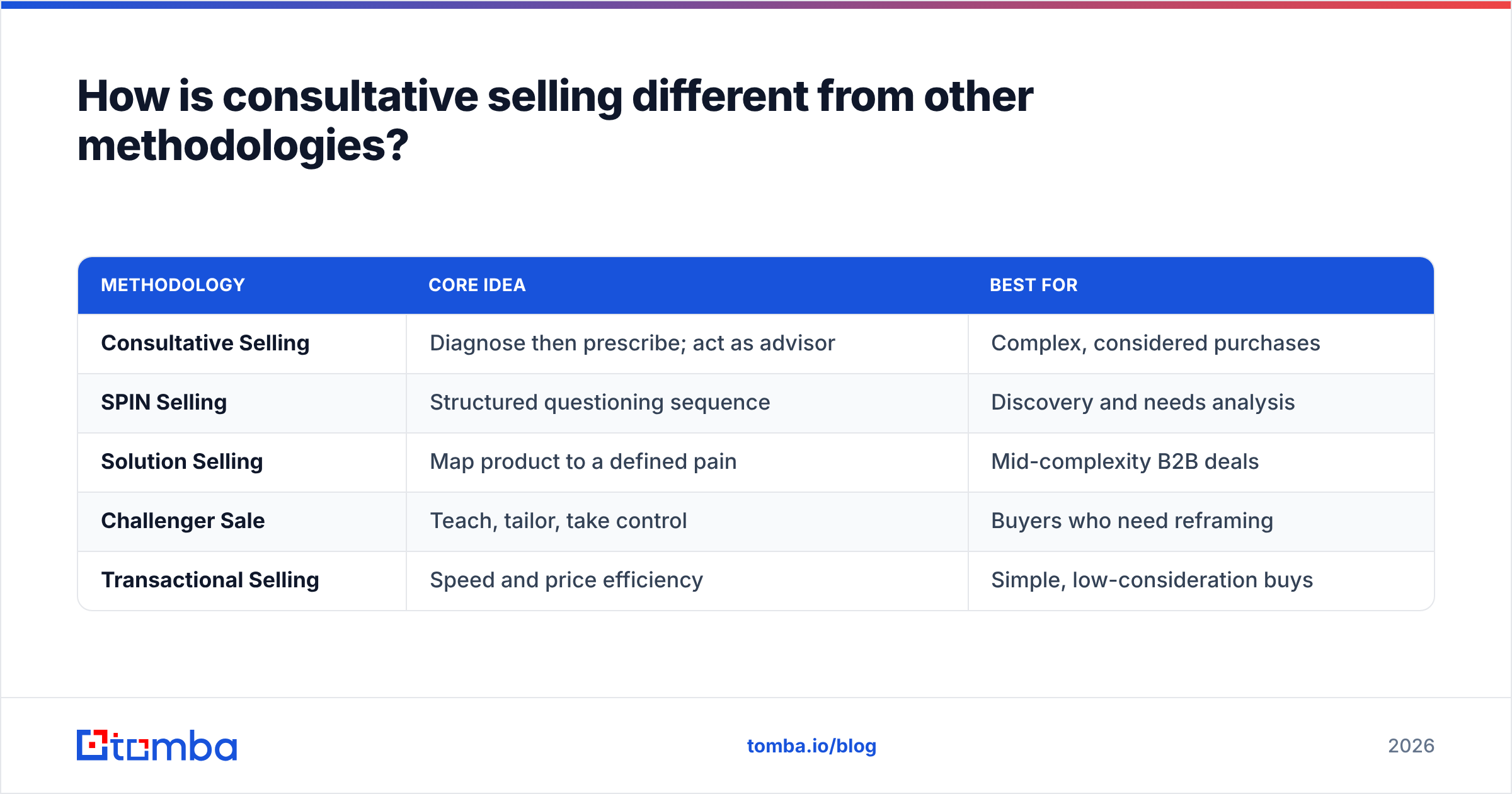
People conflate these, so here's the clean separation. Consultative selling is the umbrella philosophy; the others are named frameworks that operationalize parts of it.
| Methodology | Core idea | Best for |
|---|---|---|
| Consultative Selling | Diagnose then prescribe; act as advisor | Complex, considered purchases |
| SPIN Selling | Structured questioning sequence | Discovery and needs analysis |
| Solution Selling | Map product to a defined pain | Mid-complexity B2B deals |
| Challenger Sale | Teach, tailor, take control | Buyers who need reframing |
| Transactional Selling | Speed and price efficiency | Simple, low-consideration buys |
If your deal is complex, multi-stakeholder, and consequential, consultative is the right posture. If someone is buying a $9/month utility with a free trial, don't run SPIN on them — that's over-engineering a snack order.
What does a consultative sales process look like end to end?#
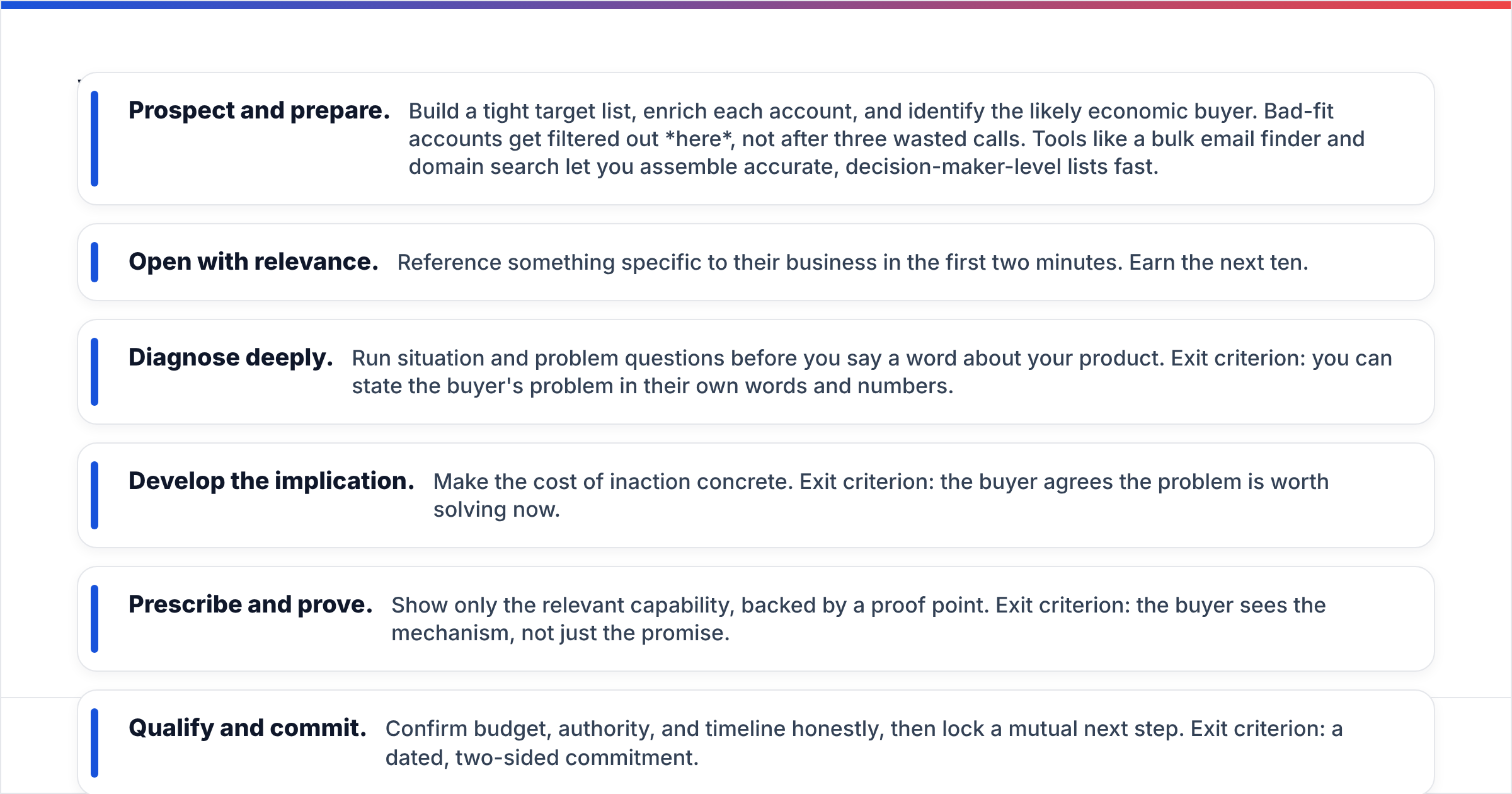
A repeatable consultative motion has clear stages, each with an exit criterion. This is the version that survives contact with a real pipeline:
- Prospect and prepare. Build a tight target list, enrich each account, and identify the likely economic buyer. Bad-fit accounts get filtered out here, not after three wasted calls. Tools like a bulk email finder and domain search let you assemble accurate, decision-maker-level lists fast.
- Open with relevance. Reference something specific to their business in the first two minutes. Earn the next ten.
- Diagnose deeply. Run situation and problem questions before you say a word about your product. Exit criterion: you can state the buyer's problem in their own words and numbers.
- Develop the implication. Make the cost of inaction concrete. Exit criterion: the buyer agrees the problem is worth solving now.
- Prescribe and prove. Show only the relevant capability, backed by a proof point. Exit criterion: the buyer sees the mechanism, not just the promise.
- Qualify and commit. Confirm budget, authority, and timeline honestly, then lock a mutual next step. Exit criterion: a dated, two-sided commitment.
Notice how much of the leverage sits at the very top. If your prospecting data is wrong — stale titles, bounced emails, wrong company — every downstream stage inherits the error. Consultative selling is only as good as the accounts you point it at.
What are the most common consultative selling mistakes?#
Fake discovery. Asking questions you already know the answer to, then pivoting to the identical demo regardless of the reply. Buyers feel the bait-and-switch instantly. If discovery doesn't change your pitch, it wasn't discovery.
Diagnosing without quantifying. "That sounds frustrating" is empathy, not a business case. If you can't put a number on the pain, the deal dies in the buyer's internal budget review.
Prescribing everything. Feature-dumping after good discovery wastes the trust you just built. Selective prescription is a discipline, not a limitation.
Skipping honest qualification. Chasing bad-fit deals to hit an activity target inflates your pipeline and destroys your close rate. Track your win rate by qualified opportunities, not raw leads, and the incentive corrects itself.
Weak data at the top. You cannot personalize at scale off a list that's 30% wrong. Verify contacts before outreach — an email verifier keeps your bounce rate low and your sender reputation intact, which protects the deliverability of every consultative message you send. Peers like G2's reviews of sales intelligence tools make the same point: data quality is the quiet variable behind every high-performing outbound team.
How do you scale consultative selling across a team?#
Individual charm doesn't scale; a documented process does. Codify your discovery questions, your qualification criteria, and your mutual-next-step language into a playbook every rep runs. Then feed that playbook with reliable data so reps spend their prep time thinking about the buyer, not chasing down a valid email address.
The math is simple. If a rep can only have ten genuinely prepared conversations a week, the quality of those ten accounts decides the quarter. Accurate targeting — right person, right company, verified contact — is the multiplier. That's the unglamorous infrastructure behind every "trusted advisor" you admire.
Where should you start?#
Start at the top of the funnel, because that's where the leverage compounds. Consultative selling rewards preparation, and preparation begins with knowing exactly who to talk to and how to reach them. Use the Tomba Email Finder to build accurate, decision-maker-level contact lists so your reps spend their energy on diagnosis instead of data cleanup. Verify before you send, enrich before you dial, and let the process — not luck — carry the deal. Check the Tomba pricing to match a plan to your team's volume; the free tier is enough to test the workflow on your next batch of target accounts before you commit.
Diagnose first. Pitch last. Point it at the right accounts. That's the whole game.
Related guides#
Ready to find emails that actually work?
Join 150,000+ professionals who stopped guessing and started sending. Free credits on signup — no credit card required.
Get the Tomba newsletter
Practical outbound tactics and product updates — once every two weeks.
About the author