Consultative Selling Questions: 30 That Actually Close Deals
The consultative selling questions top reps use to uncover real pain, build trust, and win bigger deals — plus a repeatable framework and a cheat-sheet you can run on your next call.
Consultative selling lives or dies on the quality of your questions. Pitch too early and you sound like every other rep in the buyer's inbox. Ask the right sequence of questions and you become the person who understood the problem before the vendor even mattered.
This guide gives you the exact consultative selling questions that move deals forward — organized by call stage, backed by a simple framework, and ready to drop into your next conversation.
TL;DR#
- Consultative selling questions are open-ended, layered prompts that surface a buyer's real problem, cost of inaction, and decision process — instead of pushing features.
- The best reps talk less and ask more: aim for a question-to-pitch ratio that keeps the buyer speaking for most of the call.
- Use a staged flow: rapport → situation → problem → impact → vision → commitment.
- Skip the discovery and you get the classic "no budget" surprise late in the cycle.
- Pair strong questions with clean contact data so you spend time selling, not chasing wrong numbers.
What is consultative selling, really?#
Consultative selling is a diagnostic approach: you act like a doctor, not a vending machine. A vending machine takes a request and dispenses a product. A doctor asks where it hurts, how long it's been hurting, and what happens if it's left untreated — then prescribes.
That difference is entirely about questions. In transactional selling you lead with what you sell. In consultative selling you lead with what the buyer is trying to fix, and you earn the right to recommend anything only after you understand the situation.
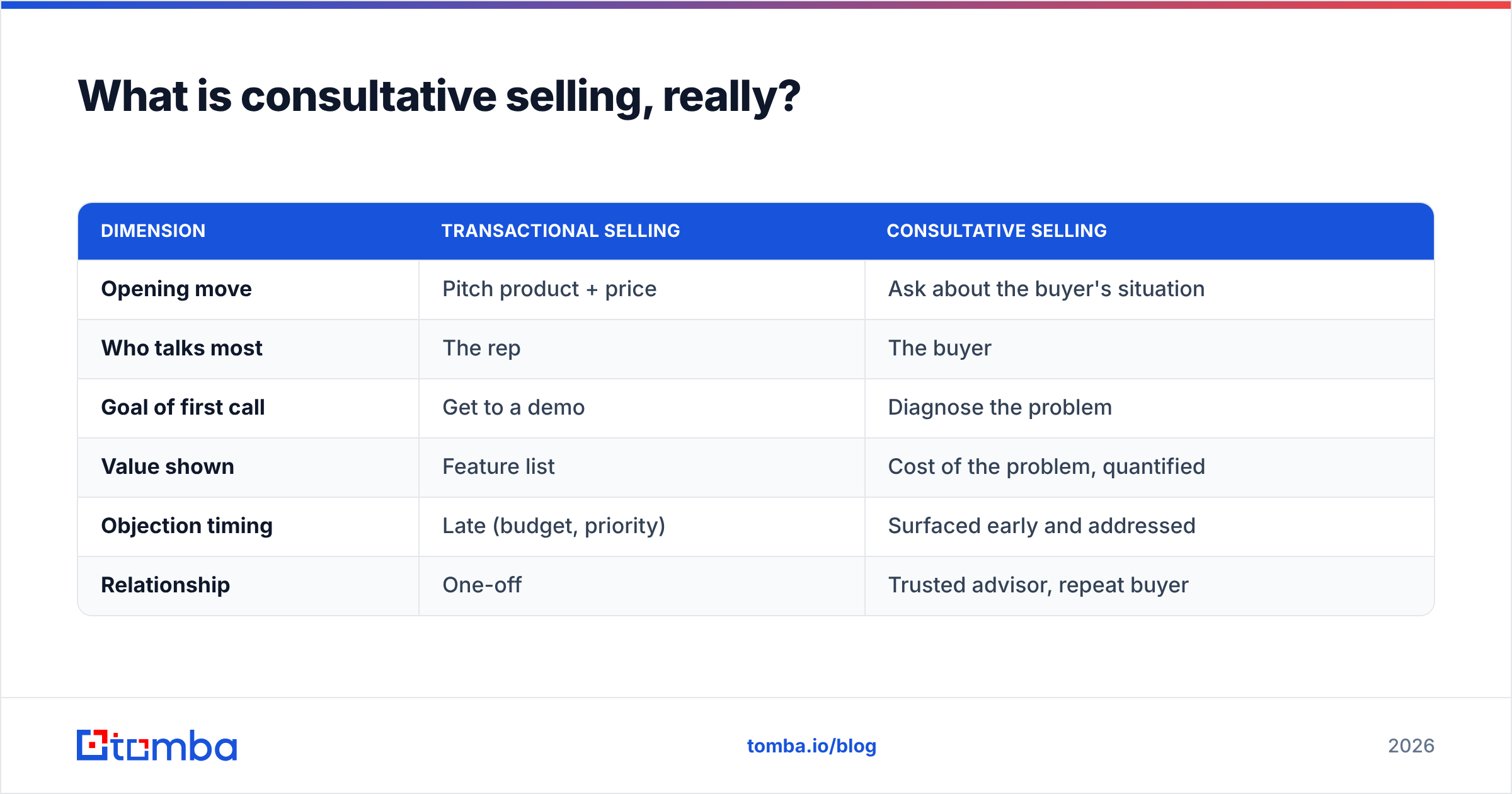
Here's how the two approaches diverge in practice:
| Dimension | Transactional selling | Consultative selling |
|---|---|---|
| Opening move | Pitch product + price | Ask about the buyer's situation |
| Who talks most | The rep | The buyer |
| Goal of first call | Get to a demo | Diagnose the problem |
| Value shown | Feature list | Cost of the problem, quantified |
| Objection timing | Late (budget, priority) | Surfaced early and addressed |
| Relationship | One-off | Trusted advisor, repeat buyer |
The payoff is measurable. Deals sourced through genuine discovery tend to have higher win rates and larger average contract values, because you've tied your solution to a problem the buyer already agreed is expensive.
Why do good questions beat a good pitch?#
Because people trust conclusions they reach themselves. When a buyer says out loud, "We're losing about 15 hours a week to this," they've just built your business case for you. No slide deck lands as hard as the buyer's own words.
Strong consultative selling questions do three jobs at once:
- They gather intel you can't get from a website or a data provider.
- They build trust — thoughtful questions signal that you've done this before.
- They create urgency by making the cost of inaction concrete.
Research from firms like Gartner on B2B buying consistently shows that buyers value sellers who help them make sense of a complex decision far more than sellers who simply present options. Questions are how you provide that sense-making.
The consultative selling question framework#
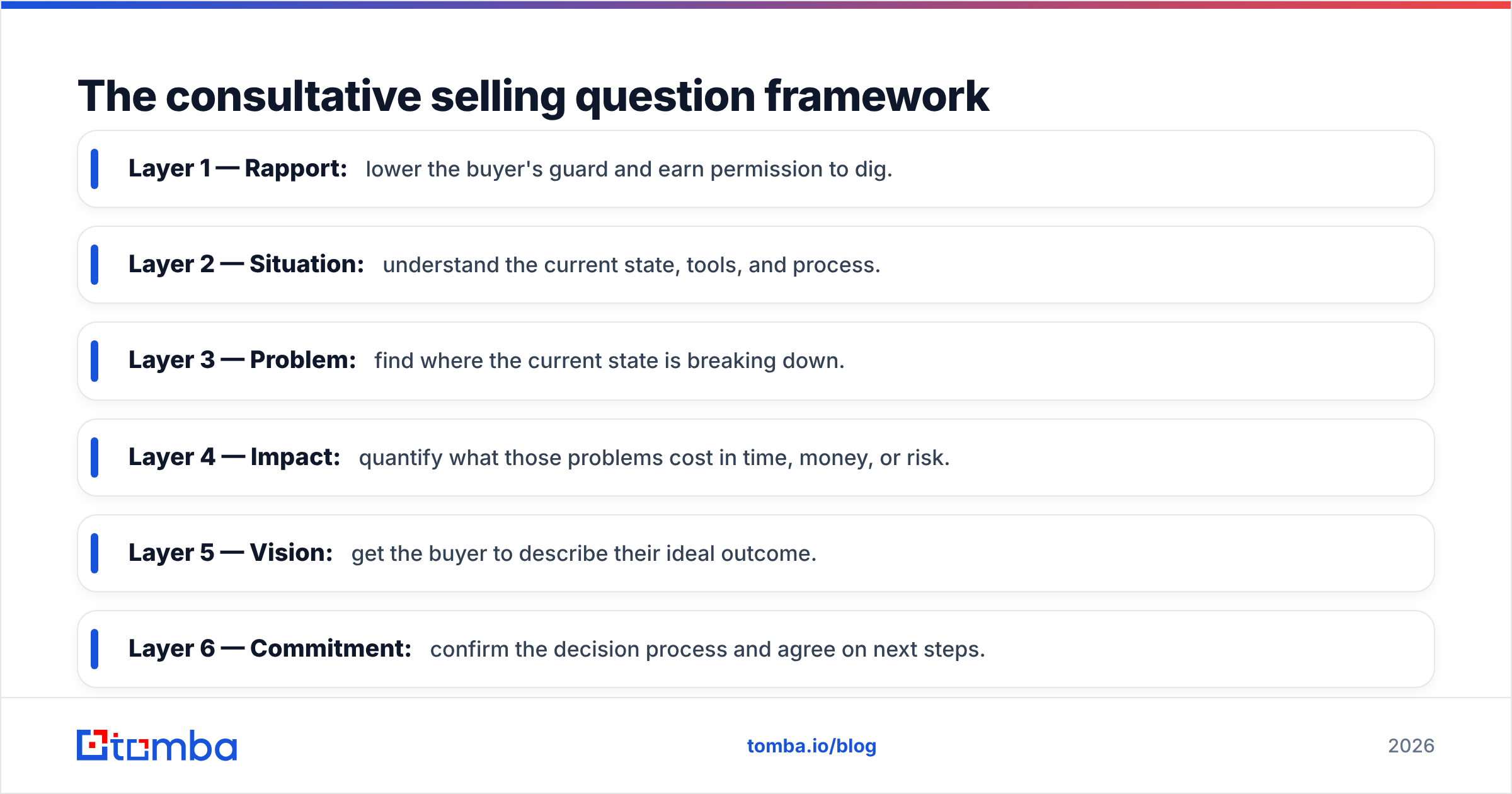
Think of a discovery call as six layers. You don't rush through them — you go deep on each before moving up. Skipping a layer is what causes deals to stall.
- Layer 1 — Rapport: lower the buyer's guard and earn permission to dig.
- Layer 2 — Situation: understand the current state, tools, and process.
- Layer 3 — Problem: find where the current state is breaking down.
- Layer 4 — Impact: quantify what those problems cost in time, money, or risk.
- Layer 5 — Vision: get the buyer to describe their ideal outcome.
- Layer 6 — Commitment: confirm the decision process and agree on next steps.
The sections below give you ready-to-use questions for each layer. Steal them, then rephrase in your own voice — reading them off a script defeats the purpose.
Rapport and permission questions#
- "Before I dive in — what made you take this call today?"
- "How much do you already know about what we do, so I don't repeat things you've heard?"
- "Would it be alright if I ask a few questions about how things work on your side first?"
That last one matters more than it looks. Asking permission to ask questions frames the whole call as collaborative rather than an interrogation.
Situation questions#
- "Walk me through how your team handles [process] today."
- "What tools are in the stack for this right now?"
- "Who touches this workflow from start to finish?"
- "How long has it been running this way?"
Keep these light. Situation questions are necessary but low-value — the buyer already knows this information, so linger here and you'll bore them. Get the lay of the land, then move up.
Problem and pain questions#
This is where consultative selling questions start earning their keep:
- "Where does that process tend to break down?"
- "What's the most frustrating part of doing it the current way?"
- "When something slips through, how do you usually find out?"
- "If you could wave a wand and fix one thing about this, what would it be?"
Notice these are open-ended. A closed question ("Is data accuracy a problem?") gets a yes/no and stalls. An open question ("What happens when the data's wrong?") gets a story — and stories are where the real pain lives.
Impact and cost-of-inaction questions#
Buyers rarely act on a problem until they feel its weight. Your job is to make the invisible cost visible:
- "Roughly how many hours a week does the team lose to this?"
- "What does one bad [lead / meeting / deal] actually cost you?"
- "If nothing changes over the next two quarters, what happens?"
- "Who else in the org feels this pain, and how loudly?"
This is the layer most reps skip, and it's the single biggest reason deals die at "we decided to hold off." Without a quantified impact, there's no urgency, and without urgency, "no decision" always wins.

Vision and solution questions#
Now — and only now — you start steering toward outcomes:
- "In a perfect world, what would this look like six months from now?"
- "If you solved this, what would it free your team up to do?"
- "What's stopped you from fixing it already?"
- "How are you measuring success on this initiative?"
That last one is gold. When the buyer names their success metric, you know exactly how to frame your solution — and exactly what your champion will report upward.
Commitment and process questions#
Great discovery is wasted if you never learn how the buyer actually buys:
- "Besides you, who needs to weigh in on a decision like this?"
- "What does your evaluation process usually look like?"
- "If we're a fit, what would need to be true for you to move forward?"
- "What's the timeline you're working against?"
Ask these early, not on the closing call. Discovering a hidden committee of five in week six is how quarters slip.
How should you sequence and phrase the questions?#
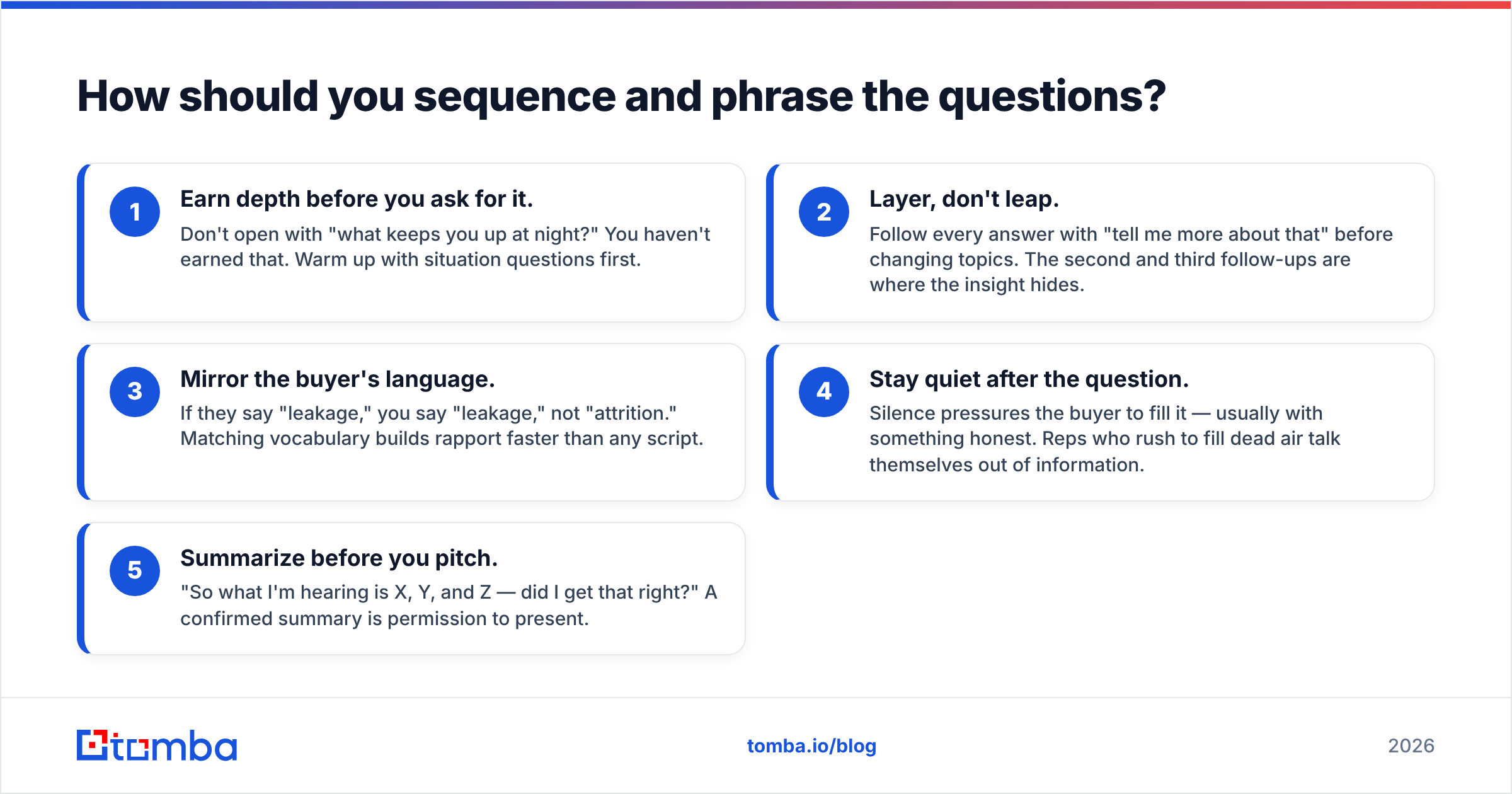
The order matters as much as the content. A few rules that separate consultative reps from interrogators:
- Earn depth before you ask for it. Don't open with "what keeps you up at night?" You haven't earned that. Warm up with situation questions first.
- Layer, don't leap. Follow every answer with "tell me more about that" before changing topics. The second and third follow-ups are where the insight hides.
- Mirror the buyer's language. If they say "leakage," you say "leakage," not "attrition." Matching vocabulary builds rapport faster than any script.
- Stay quiet after the question. Silence pressures the buyer to fill it — usually with something honest. Reps who rush to fill dead air talk themselves out of information.
- Summarize before you pitch. "So what I'm hearing is X, Y, and Z — did I get that right?" A confirmed summary is permission to present.
Tools like Gong that analyze recorded calls consistently find the same pattern: top performers ask more questions, talk less, and let the buyer carry the conversation. It's not charisma — it's discipline.
What separates a good question from a great one?#
A good question gets information. A great question gets the buyer to think differently. Compare these pairs:
| Weak question | Stronger consultative version |
|---|---|
| "Do you have budget for this?" | "How does your team usually fund a project like this when it becomes a priority?" |
| "Are you happy with your current tool?" | "What would have to change for your current setup to stop being 'good enough'?" |
| "Is this a priority?" | "Where does fixing this rank against everything else on your plate this quarter?" |
| "Can I send you a proposal?" | "If the proposal reflected everything we discussed, what would make it an easy yes?" |
The right-hand column doesn't corner the buyer — it invites reflection. That reflection is what makes them see you as an advisor rather than a vendor working an angle.
Where does clean data fit into consultative selling?#
You can't ask great questions of the wrong person. Consultative selling assumes you're talking to someone who actually owns the problem — and getting to that person starts with accurate contact data.
This is the unglamorous half of the discipline. Before the artful discovery call comes the work of finding the right decision-maker, confirming they're reachable, and enriching what you know so you walk in prepared. If you're spending your prospecting hours bouncing off dead inboxes and wrong numbers, you never get to the conversation where questions matter.
A tight pre-call stack usually looks like this:
- Find the right contact with an email finder so you're reaching the person who owns the budget, not a gatekeeper.
- Confirm reachability with an email verifier to keep your response rate high and your sender reputation clean.
- Add phone coverage using a phone finder for the multi-channel follow-up consultative deals often need.
- Enrich the record with data enrichment so you know the company's size, stack, and recent moves before you ever ask a question.
Do this well and every discovery call starts from a position of preparation — which, not coincidentally, is exactly what buyers reward with trust. Platforms like HubSpot have documented for years that reps who research before outreach see materially better connect and conversion rates.
A cheat-sheet you can run on your next call#
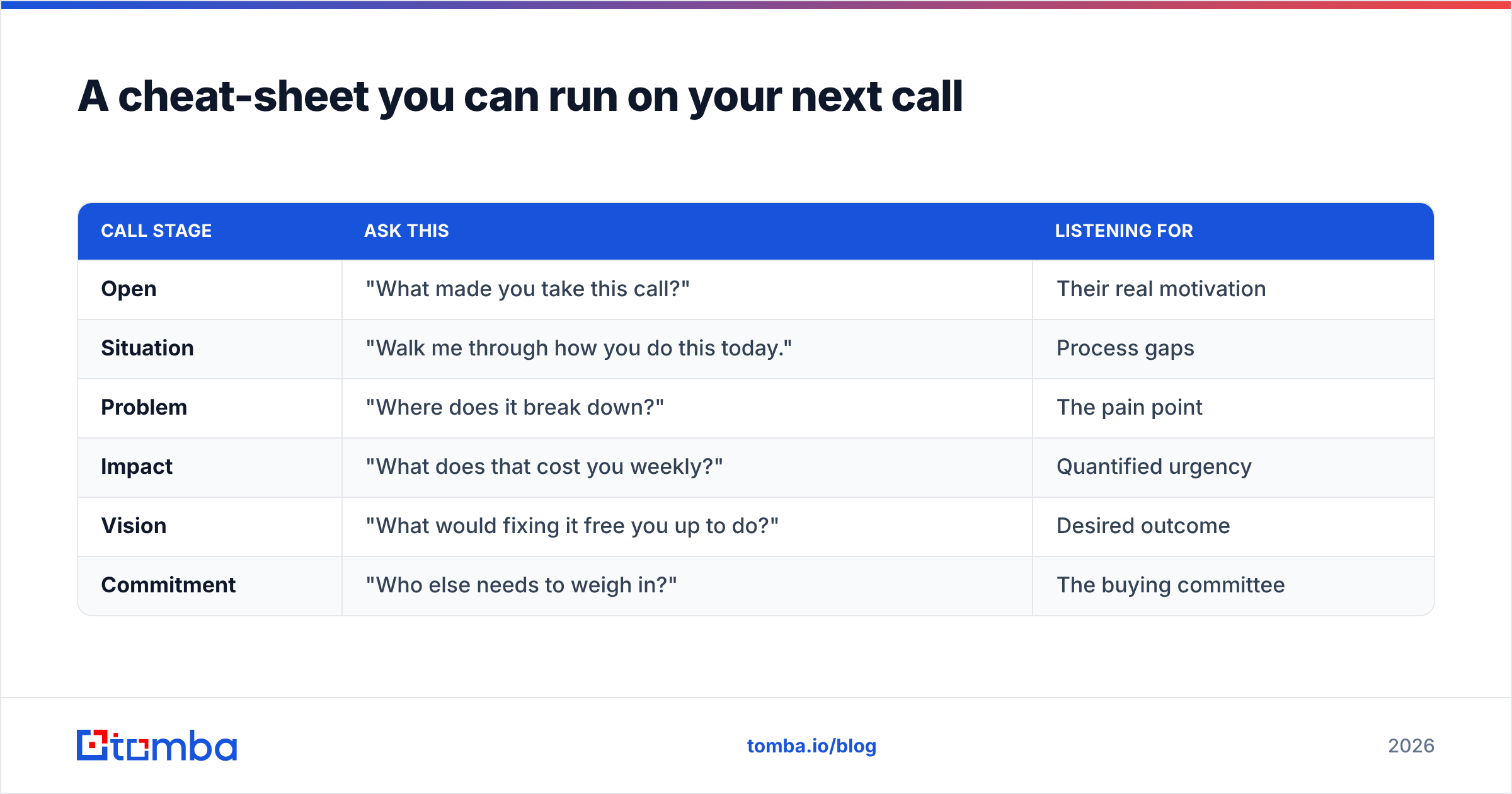
Print this, keep it beside your notes, and work top to bottom:
| Call stage | Ask this | Listening for |
|---|---|---|
| Open | "What made you take this call?" | Their real motivation |
| Situation | "Walk me through how you do this today." | Process gaps |
| Problem | "Where does it break down?" | The pain point |
| Impact | "What does that cost you weekly?" | Quantified urgency |
| Vision | "What would fixing it free you up to do?" | Desired outcome |
| Commitment | "Who else needs to weigh in?" | The buying committee |
Six questions, six layers. If you can't answer all six columns by the end of a call, you have a follow-up to book — not a proposal to send.
Common mistakes to avoid#
- Interrogating instead of conversing. Rapid-fire questions with no reactions feel like a deposition. React, summarize, and empathize between questions.
- Pitching on the first "pain" signal. One problem is not enough context. Keep peeling.
- Skipping the impact layer. Without cost quantified, you have interest but no urgency.
- Ignoring the buying process. Great discovery plus a mystery committee equals a stalled deal.
- Bad data upstream. Perfect questions asked to the wrong contact still lose.
The bottom line#
Consultative selling questions aren't a trick to extract a "yes." They're a structured way to help a buyer understand their own problem well enough to want it solved — with you. Master the six layers, quantify the cost of inaction, and let the buyer do most of the talking. The close takes care of itself when the discovery is done right.
And it all starts before the call: with the right person, the right email, and the right context in front of you. Start free with the Tomba Email Finder to reach the decision-makers who actually own the problem — 25 free searches a month, and simple Tomba pricing from $49/mo when you're ready to scale your pipeline. Better questions deserve better prospects to ask them.
Related guides#
Ready to find emails that actually work?
Join 150,000+ professionals who stopped guessing and started sending. Free credits on signup — no credit card required.
Get the Tomba newsletter
Practical outbound tactics and product updates — once every two weeks.
About the author