Consultative Selling Strategy: How to Win Complex B2B Deals
A consultative selling strategy trades the hard pitch for real diagnosis. Here's the framework, the questions, and the data stack that make it close bigger deals.
Most reps lose deals they never had. They open with a demo, dump every feature, and wonder why a "great call" goes dark for three weeks and ends in "we decided to hold off." A consultative selling strategy fixes the root cause: you stop selling a product and start diagnosing a problem, the way a good doctor doesn't prescribe until they've examined the patient.
This guide breaks down what consultative selling actually is in 2026, the exact stages and questions that make it work, how it compares to the transactional and solution-selling models it replaced, and the data workflow that keeps your pipeline full of the right conversations.
TL;DR#
- Consultative selling means leading with diagnosis, not pitch — you earn the right to recommend by understanding the buyer's situation first.
- It wins complex, high-consideration B2B deals where the buyer's biggest risk is choosing wrong, not paying too much.
- The core loop is research → diagnose → reframe → co-create → validate, and questions do most of the heavy lifting.
- Your biggest enemy in 2026 isn't a competitor — it's buyer indecision and the status quo. Consultative selling is built to beat both.
- The approach only scales when your targeting and contact data are clean; garbage prospects make even perfect discovery worthless.
What Is a Consultative Selling Strategy?#
A consultative selling strategy is a sales approach where the rep acts as a trusted advisor who diagnoses the buyer's problem before proposing any solution. Instead of pushing a predefined pitch, you ask structured questions, surface costs the buyer hasn't quantified, and only then connect your product to outcomes they actually care about.
Think of it like renovating a house. A bad contractor shows up with a catalog of kitchens and asks which one you want. A good one walks the whole house, asks how you cook, how many people live there, and what you hate about the current layout — then proposes something you didn't know you needed. The second contractor charges more and wins more, because the recommendation is obviously built for you.
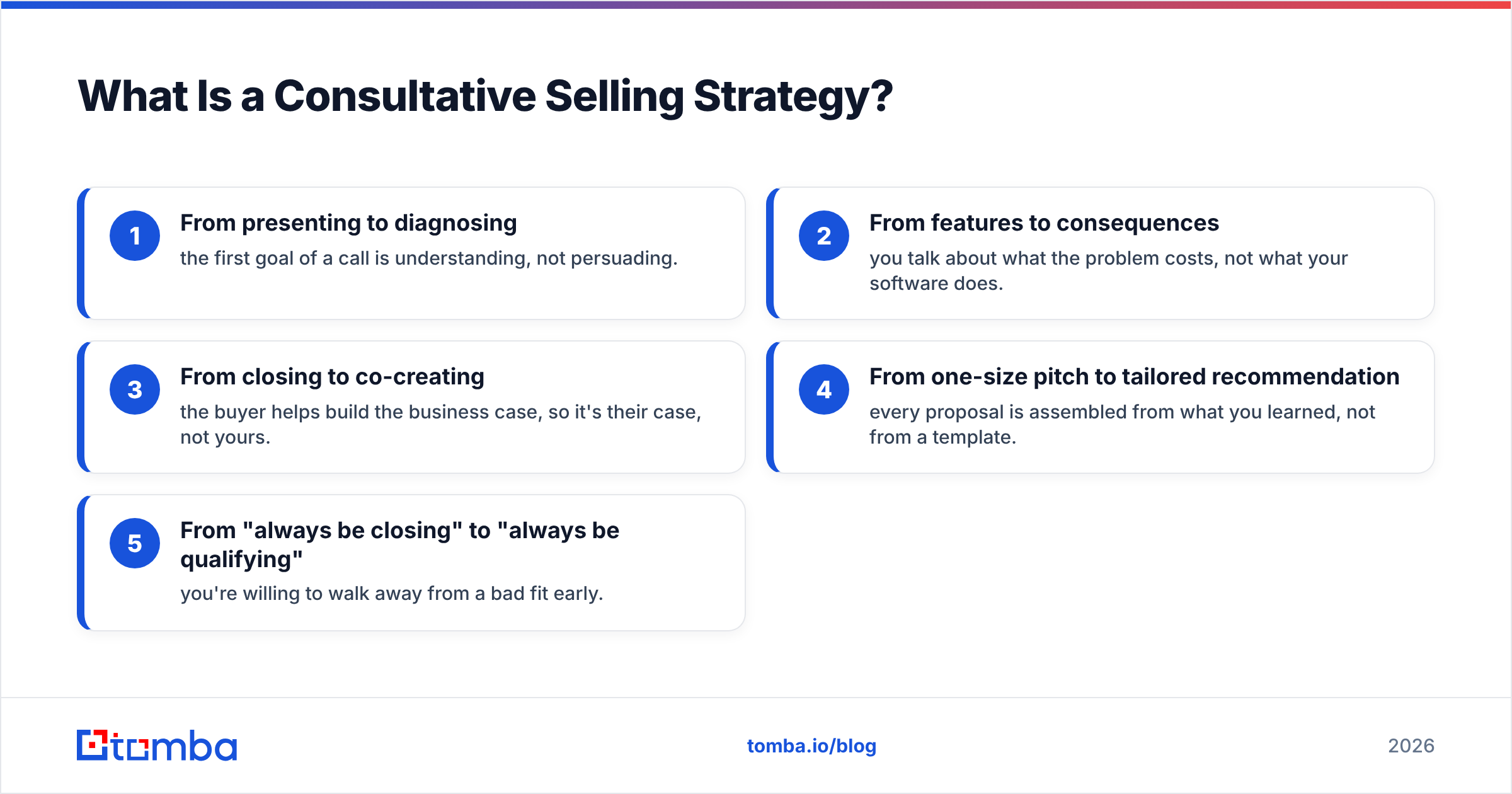
The mindset shift is simple but hard to execute:
- From presenting to diagnosing — the first goal of a call is understanding, not persuading.
- From features to consequences — you talk about what the problem costs, not what your software does.
- From closing to co-creating — the buyer helps build the business case, so it's their case, not yours.
- From one-size pitch to tailored recommendation — every proposal is assembled from what you learned, not from a template.
- From "always be closing" to "always be qualifying" — you're willing to walk away from a bad fit early.
Why Does Consultative Selling Beat the Hard Pitch in 2026?#
Because the modern B2B buyer is drowning in options and terrified of making the wrong call. Research from Gartner has repeatedly shown that buyers now spend the majority of their journey researching independently and that "no decision" — not a competitor — is the outcome sellers lose to most often. When everyone's pitch sounds the same, the rep who helps the buyer think wins.
A hard pitch optimizes for the seller's timeline. A consultative approach optimizes for the buyer's confidence. And confidence is what actually moves a deal through a five-person buying committee.
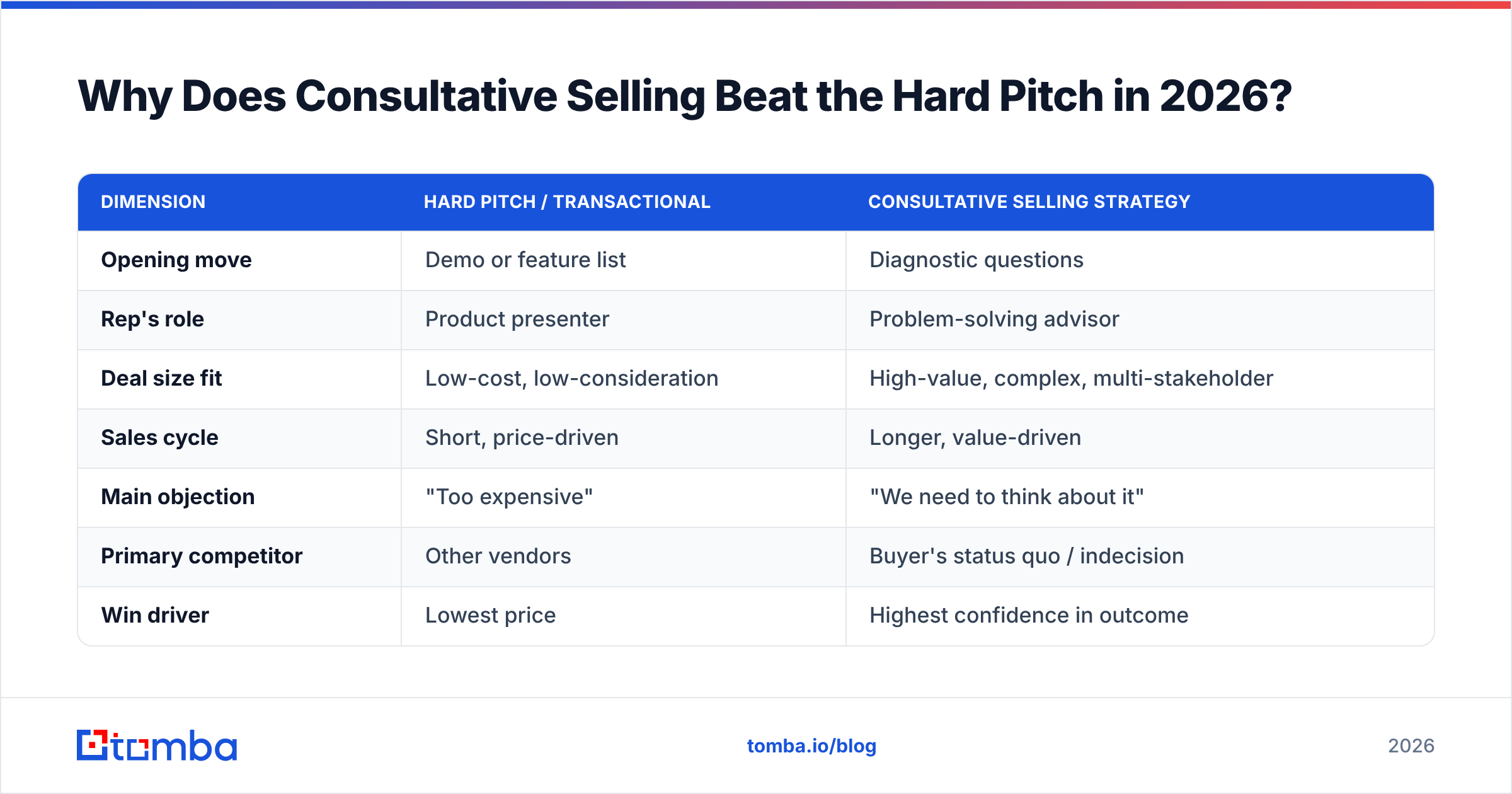
Here's how the two models stack up on the dimensions that decide real deals:
| Dimension | Hard Pitch / Transactional | Consultative Selling Strategy |
|---|---|---|
| Opening move | Demo or feature list | Diagnostic questions |
| Rep's role | Product presenter | Problem-solving advisor |
| Deal size fit | Low-cost, low-consideration | High-value, complex, multi-stakeholder |
| Sales cycle | Short, price-driven | Longer, value-driven |
| Main objection | "Too expensive" | "We need to think about it" |
| Primary competitor | Other vendors | Buyer's status quo / indecision |
| Win driver | Lowest price | Highest confidence in outcome |
| Churn risk after close | High (bought on price) | Low (bought on fit) |
The takeaway: if you sell anything complex, expensive, or high-stakes, the transactional playbook actively works against you. It attracts price shoppers and repels the thoughtful buyers who become your best long-term accounts.
What Are the Stages of a Consultative Sales Process?#
A consultative selling strategy isn't improvisation — it's a repeatable process that happens to feel like a natural conversation. Five stages carry most of the weight.
1. Research Before You Reach Out#
You cannot diagnose what you haven't studied. Before any first touch, know the account's industry pressures, recent triggers (funding, hiring, product launches), and the specific person's role in the buying decision. This is where prospecting quality decides everything downstream — a well-researched message to the right person out-converts a generic blast every time. Use a reliable email finder to reach the decision-maker directly instead of routing through a gatekeeper inbox, and pull a direct line with a phone finder when the deal justifies a call.
2. Diagnose the Real Problem#
Open with questions that map the buyer's current state, desired state, and the gap between them. You're not looking for a symptom ("our open rates dropped") — you're looking for the business consequence ("we missed pipeline targets two quarters running"). The rep who quantifies that gap controls the conversation.
3. Reframe and Add Insight#
This is the part most reps skip. After you understand the problem, offer a perspective the buyer didn't have — a benchmark, a risk they underweighted, a pattern you've seen at similar companies. This is where you earn "trusted advisor" status. Anyone can ask questions; insight is what makes them keep talking to you.
4. Co-Create the Solution#
Build the recommendation with the buyer, out loud. "Given what you told me about X and Y, here's what I'd prioritize — does that match how you see it?" When the buyer edits your proposal, they adopt it. A business case they helped write survives the committee; one you handed them does not.
5. Validate and De-Risk#
Complex deals die from perceived risk. Close the gap with proof: references from similar accounts, a scoped pilot, clear success metrics, and a mutual action plan. You're not asking for a signature — you're removing every reason to say "let's wait."
What Questions Power Consultative Selling?#
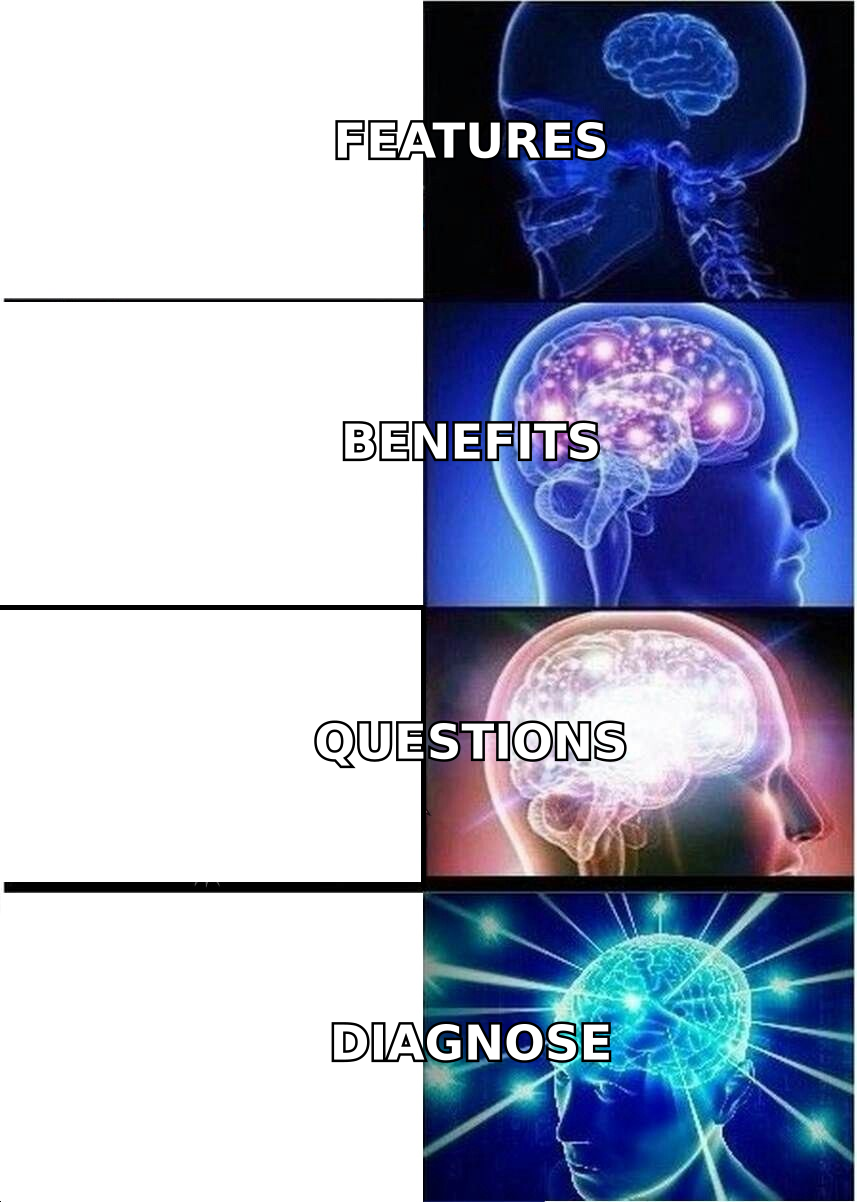
Questions are the entire engine. The best consultative reps talk less than half the time on discovery calls and spend that talk-time on questions, not statements. Structure them in a deliberate sequence:
- Situation questions establish the landscape. "How is your team handling outbound today?" Use these sparingly — buyers hate being interviewed about facts you could have researched.
- Problem questions surface pain. "Where does the current process break down most often?"
- Implication questions turn pain into cost. "When leads slip through, what does that do to quota attainment?" This is the highest-leverage category — it makes the problem feel expensive.
- Payoff questions let the buyer sell themselves. "If you could cut that leakage in half, what would that be worth to the team?"
This is the classic SPIN sequence, and it still works because it mirrors how humans actually build conviction — from context, to problem, to consequence, to desire. Vendors like HubSpot publish extensive playbooks on the same structure. The framework matters less than the discipline of not jumping to your solution before the buyer feels the cost of inaction.
A practical rule: for every claim you want to make about your product, find the question that makes the buyer say it instead. "Our tool improves data accuracy" lands with a shrug. "How much time does your team lose to bounced emails each week?" makes them do the math themselves.
How Does Consultative Selling Compare to Solution and Value Selling?#
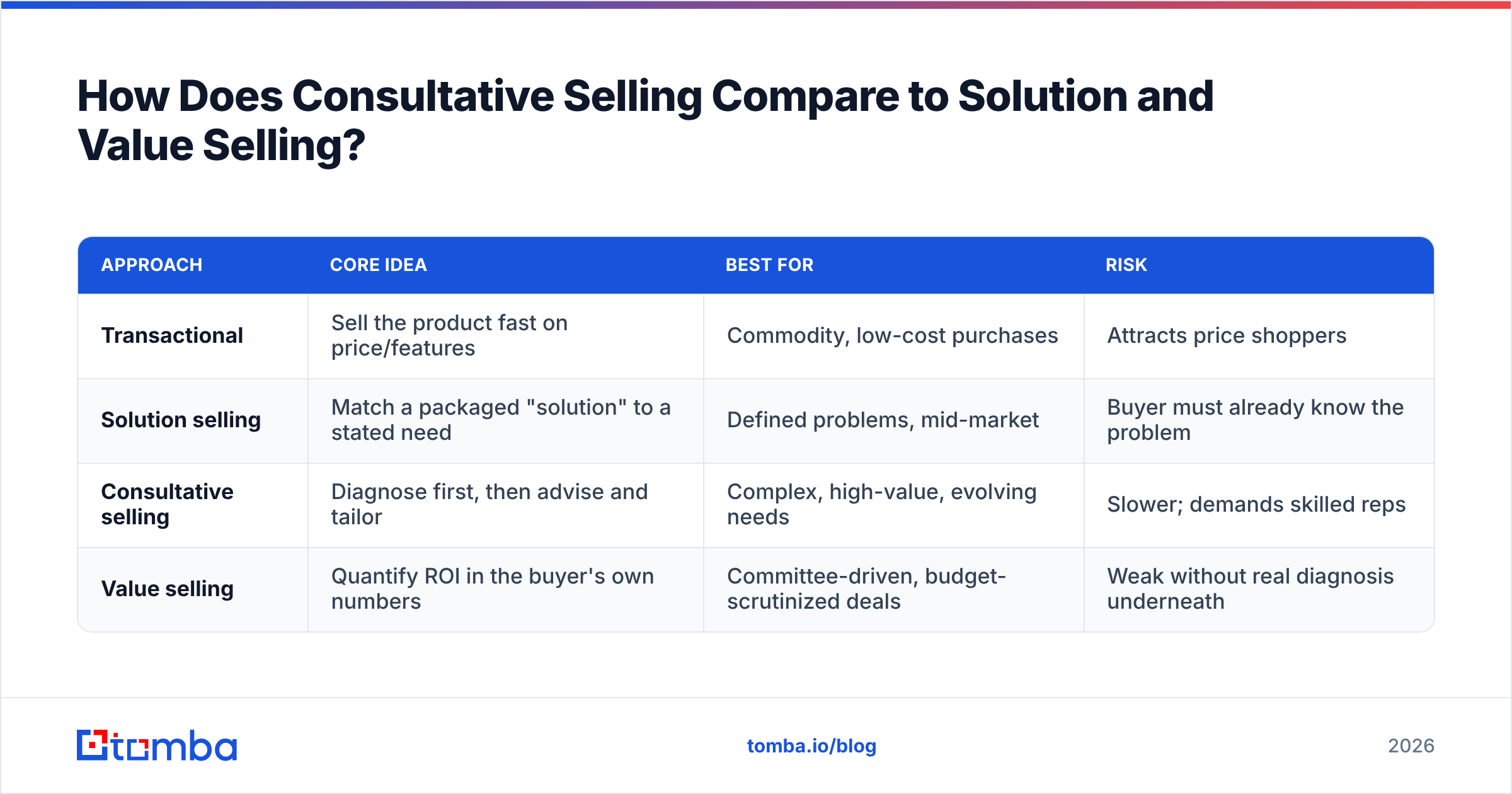
These terms get used interchangeably, but the distinctions matter when you're choosing a methodology for your team.
| Approach | Core Idea | Best For | Risk |
|---|---|---|---|
| Transactional | Sell the product fast on price/features | Commodity, low-cost purchases | Attracts price shoppers |
| Solution selling | Match a packaged "solution" to a stated need | Defined problems, mid-market | Buyer must already know the problem |
| Consultative selling | Diagnose first, then advise and tailor | Complex, high-value, evolving needs | Slower; demands skilled reps |
| Value selling | Quantify ROI in the buyer's own numbers | Committee-driven, budget-scrutinized deals | Weak without real diagnosis underneath |
The honest view: consultative selling is the foundation, and value selling is what you layer on top once you've diagnosed the problem. Solution selling sits in between and works fine when the buyer already knows exactly what's broken. In 2026, fewer and fewer buyers do — which is why the diagnostic muscle is the one worth building first. You can go deeper on aligning process to methodology in the broader discipline of revenue operations, which keeps these motions consistent across a team.
What Does Consultative Selling Look Like Day to Day?#
A quick before-and-after makes it concrete.
Transactional rep, first call: "Thanks for taking the time. Let me share my screen and walk you through the platform. So here's our dashboard, and over here you can see our reporting suite, and one thing customers love is..."
Consultative rep, first call: "Before I show you anything, I want to make sure whatever I demo is actually relevant. Can you walk me through how your team is handling this today, and where it's costing you the most? ... Got it. When that happens, who feels it first — you, or the revenue team?"
The second call earns a second meeting. The first one earns a "send me some info."
Over a quarter, the difference compounds. Consultative reps run fewer, longer, higher-quality conversations. Their pipelines are smaller by count but healthier by value, and their close rates on qualified deals are dramatically higher because they disqualified the bad fits early instead of dragging them to a "closed lost" three months later.
What Data and Tools Make Consultative Selling Scale?#
Here's the uncomfortable truth: consultative selling only pays off if you're having these conversations with the right people. World-class discovery aimed at a junior manager who can't buy is wasted effort. The strategy is a multiplier on targeting — and a multiplier of zero is still zero.
That makes three data capabilities non-negotiable:
- Accurate contact data so you reach the actual decision-maker, not a role account that never gets read. Reliable find email addresses workflows keep your outreach landing where it counts.
- Enrichment so you walk into every call already knowing the account's size, stack, and triggers. Automated data enrichment turns a name into a briefing.
- Verification so bounce rates stay low and your sender reputation — the thing that determines whether any of this reaches an inbox — stays intact. Clean lists protect your response rate at the top of the funnel.
Tools like Salesforce or your CRM of choice hold the conversation history; a good data layer keeps that CRM populated with contacts worth talking to. The methodology is the art. The data is the fuel. Skimp on either and the engine stalls.
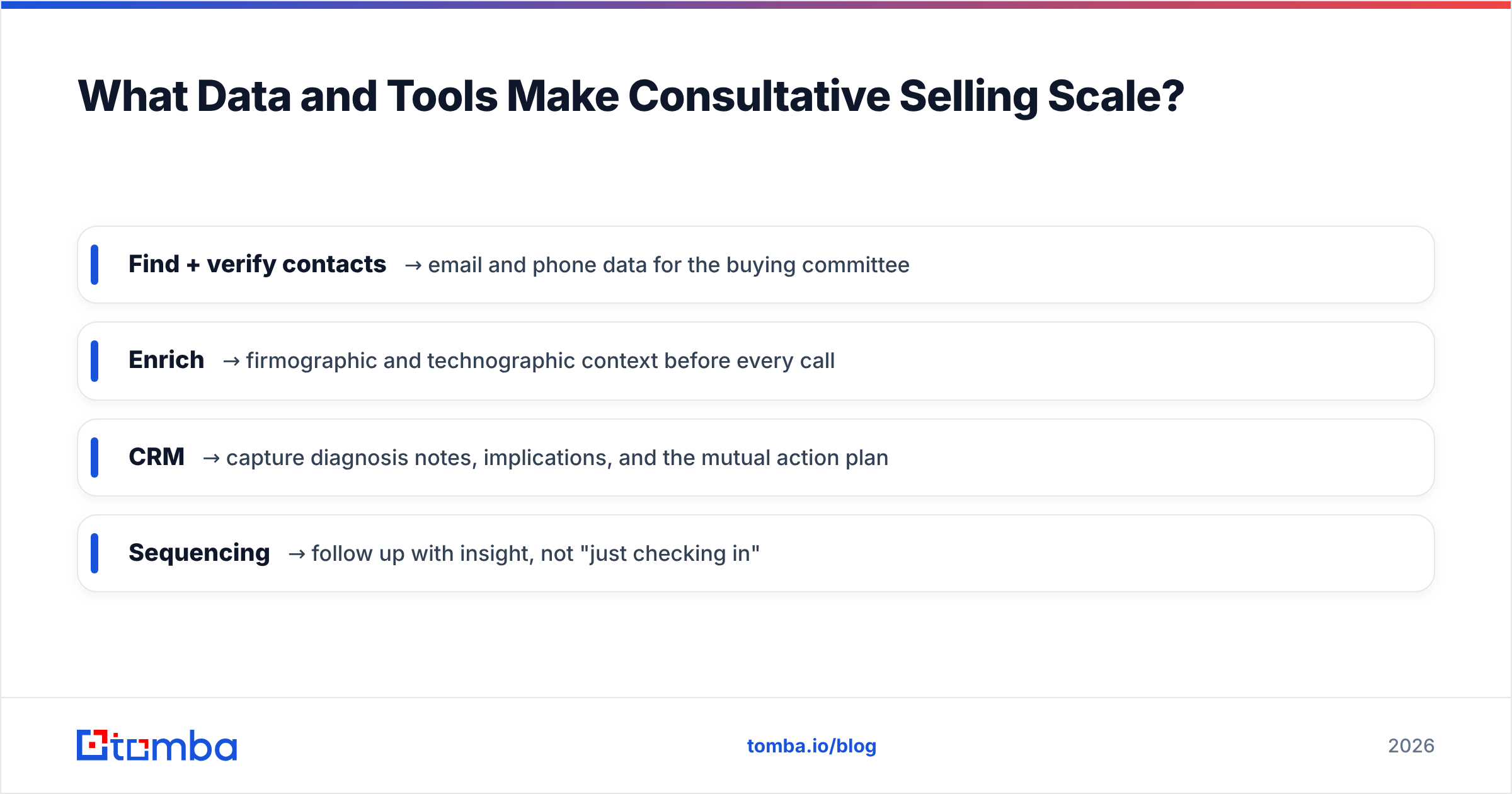
A simple stack for a consultative team looks like this:
- Find + verify contacts → email and phone data for the buying committee
- Enrich → firmographic and technographic context before every call
- CRM → capture diagnosis notes, implications, and the mutual action plan
- Sequencing → follow up with insight, not "just checking in"
Get the data foundation right and your reps spend their energy on the conversation instead of hunting for who to email. You can compare plans and credit volumes on the Tomba pricing page to match the tier to your team's outbound volume.
Common Mistakes That Kill a Consultative Approach#
Even teams that buy into the philosophy trip over the same execution errors:
- Faking discovery. Asking three questions then launching into the pitch anyway. Buyers feel the bait-and-switch instantly.
- Interrogating instead of conversing. Twenty rapid-fire questions with no insight in return feels like a deposition. Trade — give a benchmark, then ask.
- Diagnosing the wrong person. Perfect discovery with someone who has no budget authority. Map the committee first.
- Skipping the implication. Surfacing a problem but never quantifying its cost, so it never feels urgent enough to fund.
- No mutual action plan. Great conversation, no agreed next step, deal drifts. Always leave with a dated commitment on both sides.
Avoid these five and you'll outperform most of the field, because most of the field is still demoing on the first call.
Ready to Have Better Conversations With the Right Buyers?#
A consultative selling strategy is only as good as the pipeline you point it at. Before you can diagnose a decision-maker's problem, you have to reach the decision-maker — reliably, at scale, without burning your sender reputation on bad addresses. That's the foundation the whole approach sits on.
Tomba's Email Finder helps you find verified, professional email addresses by name, company, or domain, so every consultative conversation starts with the right person in the room instead of a guess. Start free with 25 searches, and put your discovery skills to work on prospects who can actually say yes. Diagnose first — but reach the right patient first of all.
Related guides#
Ready to find emails that actually work?
Join 150,000+ professionals who stopped guessing and started sending. Free credits on signup — no credit card required.
Get the Tomba newsletter
Practical outbound tactics and product updates — once every two weeks.
About the author