Consultative Selling vs Solution Selling: The 2026 Playbook
Consultative selling and solution selling sound identical, but they win deals in very different ways. Here's how each method works, where they overlap, and which one fits your 2026 pipeline.
Consultative selling vs solution selling is one of the most common debates in B2B sales. Both methods put the buyer's problem first. But they start the conversation in different ways. This guide shows how each one works, where they overlap, and which fits your 2026 pipeline.
TL;DR
- Consultative selling leads with diagnosis: you act as an advisor, ask deep questions, and let the buyer's problem define the pitch.
- Solution selling leads with a defined problem-to-product fit: you map a known pain to a packaged solution and prove ROI.
- They overlap heavily — most modern reps blend both — but they differ in where the conversation starts and who does the framing.
- Consultative wins in complex, high-trust, multi-stakeholder deals. Solution selling wins in faster cycles where the pain is already obvious.
- Neither works without accurate contact data and a repeatable discovery process. The method is the frame; the pipeline fuel is still good prospecting.
What is consultative selling?#
Consultative selling is a buyer-first approach where the rep behaves like a trusted advisor instead of a product pusher. You ask questions before you present anything. The answers — not your feature list — decide what you recommend.
Think of it like a good doctor. A bad doctor hears "my back hurts" and immediately sells you surgery. A good one asks how long, when it started, what makes it worse, and what you've already tried. Only after the diagnosis does treatment come up. Consultative selling runs the same loop: diagnose thoroughly, prescribe narrowly.
The mechanics look like this:
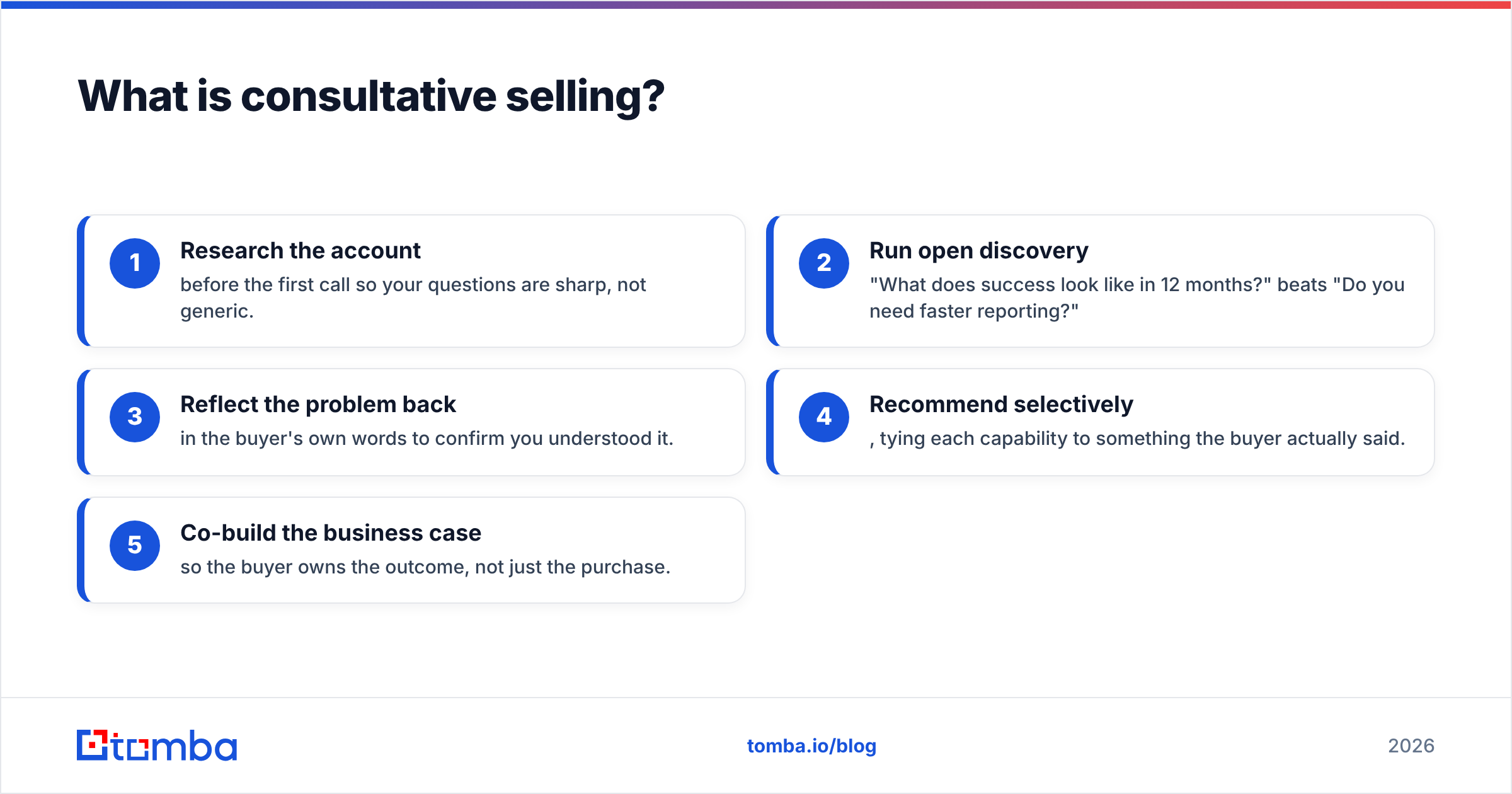
- Research the account before the first call so your questions are sharp, not generic.
- Run open discovery — "What does success look like in 12 months?" beats "Do you need faster reporting?"
- Reflect the problem back in the buyer's own words to confirm you understood it.
- Recommend selectively, tying each capability to something the buyer actually said.
- Co-build the business case so the buyer owns the outcome, not just the purchase.
The strength here is trust. When a rep understands the problem better than the competition does, price sensitivity drops and deals get stickier. The weakness is speed. Consultative cycles take longer and demand reps who can genuinely think, not just recite.
What is solution selling?#
Solution selling starts from a known, nameable problem and connects it to a defined solution with a provable return. It emerged in the 1980s, popularized by Michael Bosworth. Later books like The New Solution Selling formalized it. For a generation of software companies, it became the default B2B motion.
The core idea is simple: buyers don't want products, they want outcomes. So instead of demoing 40 features, you isolate the one or two pains that matter. Then you show exactly how your product removes them and quantify the result. A solution seller walks in with a hypothesis — "companies your size usually bleed hours on manual data entry" — and validates or adjusts it.
Solution selling leans on frameworks like pain chains, value propositions, and ROI calculators. It's more prescriptive than consultative selling, so it's faster to train and easier to scale across a team. The trade-off is that it can feel scripted. When the buyer's real problem doesn't match the seller's pain map, savvy buyers notice fast.
Consultative selling vs solution selling: what's the real difference?#
Here's the honest answer: they share more DNA than the debate suggests. Both are anti-"feature dump," both center the buyer's problem, and both require real discovery. The difference is who frames the problem and when.
- Consultative selling treats the problem as unknown until the buyer reveals it. The rep is a diagnostician.
- Solution selling treats the problem as largely known going in. The rep is a matchmaker between a defined pain and a defined fix.
Put simply: consultative selling discovers the problem, solution selling confirms it.
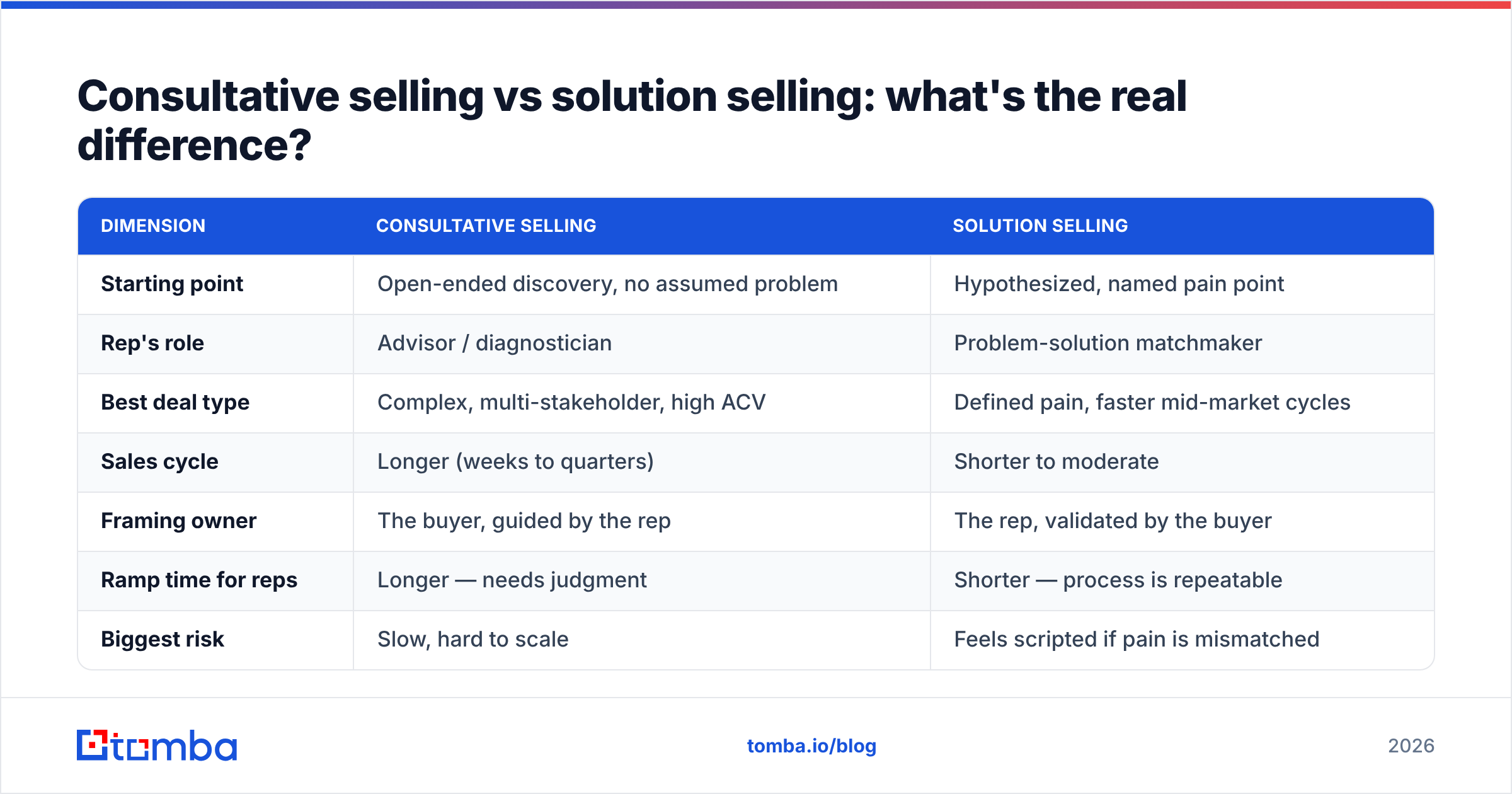
| Dimension | Consultative Selling | Solution Selling |
|---|---|---|
| Starting point | Open-ended discovery, no assumed problem | Hypothesized, named pain point |
| Rep's role | Advisor / diagnostician | Problem-solution matchmaker |
| Best deal type | Complex, multi-stakeholder, high ACV | Defined pain, faster mid-market cycles |
| Sales cycle | Longer (weeks to quarters) | Shorter to moderate |
| Framing owner | The buyer, guided by the rep | The rep, validated by the buyer |
| Ramp time for reps | Longer — needs judgment | Shorter — process is repeatable |
| Biggest risk | Slow, hard to scale | Feels scripted if pain is mismatched |
| Ideal product fit | Platform / bespoke / services | Packaged software with clear ROI |
Which method actually wins more deals in 2026?#
Neither wins outright — fit decides. The consultative selling vs solution selling choice has no single winner. The right question isn't "which is better." It's "which matches my deal complexity, buyer sophistication, and cycle length."
Choose consultative selling when:
- Deals are large, cross-functional, and involve 4+ stakeholders (Gartner has reported the typical B2B buying group now sits around 6–10 people).
- The buyer doesn't yet know the root cause of their pain.
- Your product is configurable or services-heavy, so the recommendation genuinely varies per account.
- Trust and long-term relationship drive renewals and expansion.
Choose solution selling when:
- The pain is common and well-understood across your market.
- Your product solves it in a repeatable, demonstrable way.
- You need a motion the whole team can learn quickly and run consistently.
- Cycles are shorter and volume matters more than bespoke depth.
In practice, most high-performing 2026 sales orgs run a hybrid. They use consultative discovery to earn trust and surface the real problem. Then they apply solution-selling rigor to quantify value and drive the deal to close. The methods aren't rivals — they're two gears in the same transmission.
How do you actually run a hybrid motion?#
A hybrid motion works only if the front of your funnel is healthy. You can't diagnose a buyer you never reached. And you can't personalize discovery without knowing who the stakeholders are. That's where prep and data quality quietly decide everything.
Here's a practical sequence:
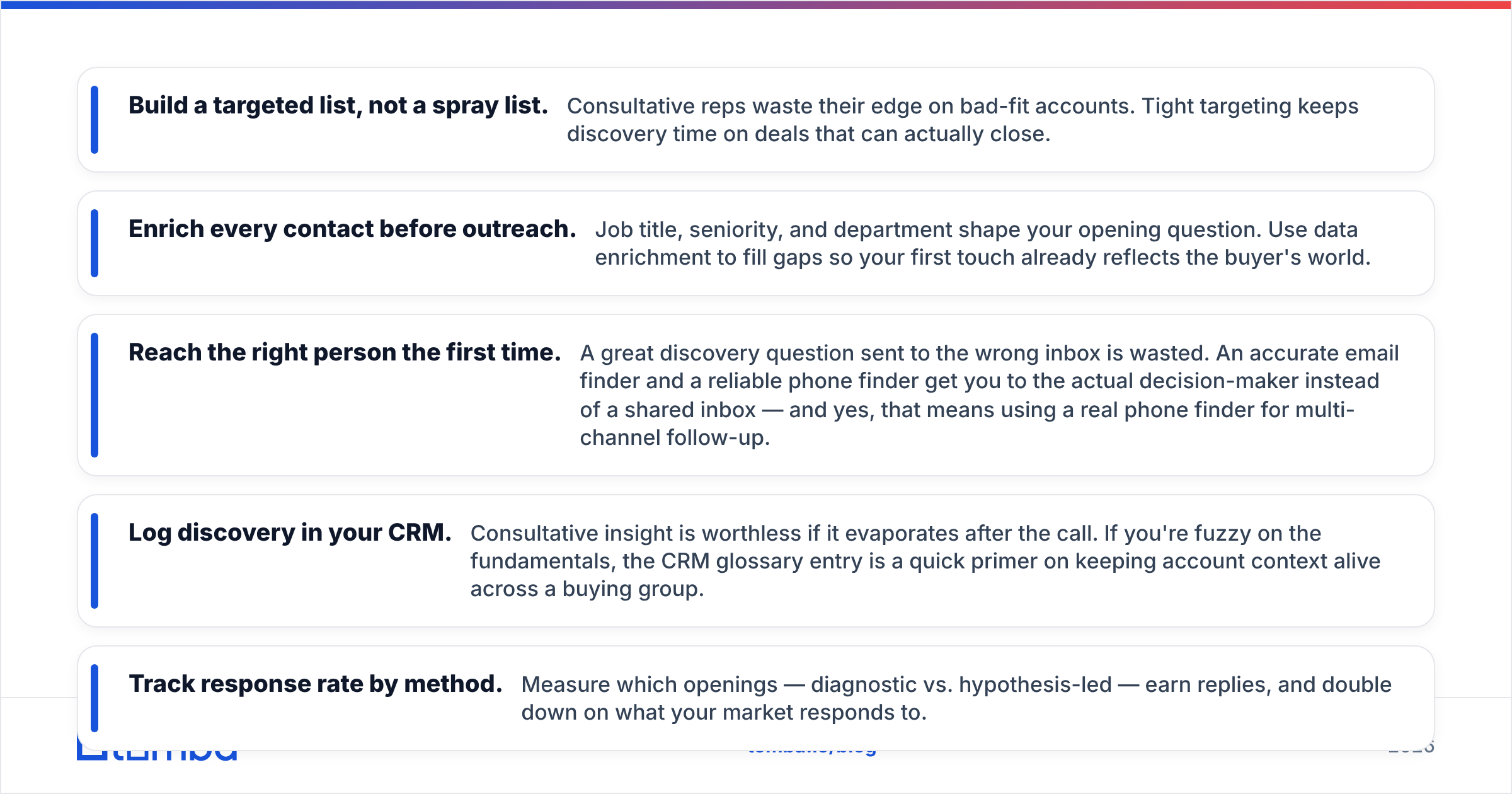
- Build a targeted list, not a spray list. Consultative reps waste their edge on bad-fit accounts. Tight targeting keeps discovery time on deals that can actually close.
- Enrich every contact before outreach. Job title, seniority, and department shape your opening question. Use data enrichment to fill gaps so your first touch already reflects the buyer's world.
- Reach the right person the first time. A great discovery question sent to the wrong inbox is wasted. An accurate email finder and a reliable phone finder get you to the actual decision-maker instead of a shared inbox — so use a real phone finder for multi-channel follow-up.
Once you can reach the right people, protect what you learn from them:
- Log discovery in your CRM. Consultative insight is worthless if it evaporates after the call. If you're fuzzy on the fundamentals, the CRM glossary entry is a quick primer on keeping account context alive across a buying group.
- Track response rate by method. Measure which openings — diagnostic vs. hypothesis-led — earn replies, and double down on what your market responds to.
The takeaway: methodology is the how you talk, but data is the whether you reach. A brilliant consultative script dies against a bounced email.
What questions define each approach?#
The fastest way to feel the difference is to compare the opening moves. Same buyer, two very different first questions.
Consultative openers (discover the problem):
- "Walk me through how your team handles this today, start to finish."
- "If nothing changes in the next year, what happens?"
- "Who else feels this pain, and how do they describe it?"
Solution-selling openers (confirm a known problem):
- "Most ops leaders we talk to lose about a day a week to manual data cleanup — is that true for you?"
- "When leads sit uncontacted for 48 hours, do you see the same drop in conversion we see elsewhere?"
- "You mentioned reporting delays — how much is that costing you per quarter?"
Notice the consultative questions hand the buyer a blank canvas. The solution-selling questions hand them a hypothesis to react to. Both are legitimate. The mistake is leading with a hypothesis so rigid that you steamroll a buyer whose real problem is somewhere else entirely.
Common mistakes with both methods#
Even experienced reps trip on the same rocks:
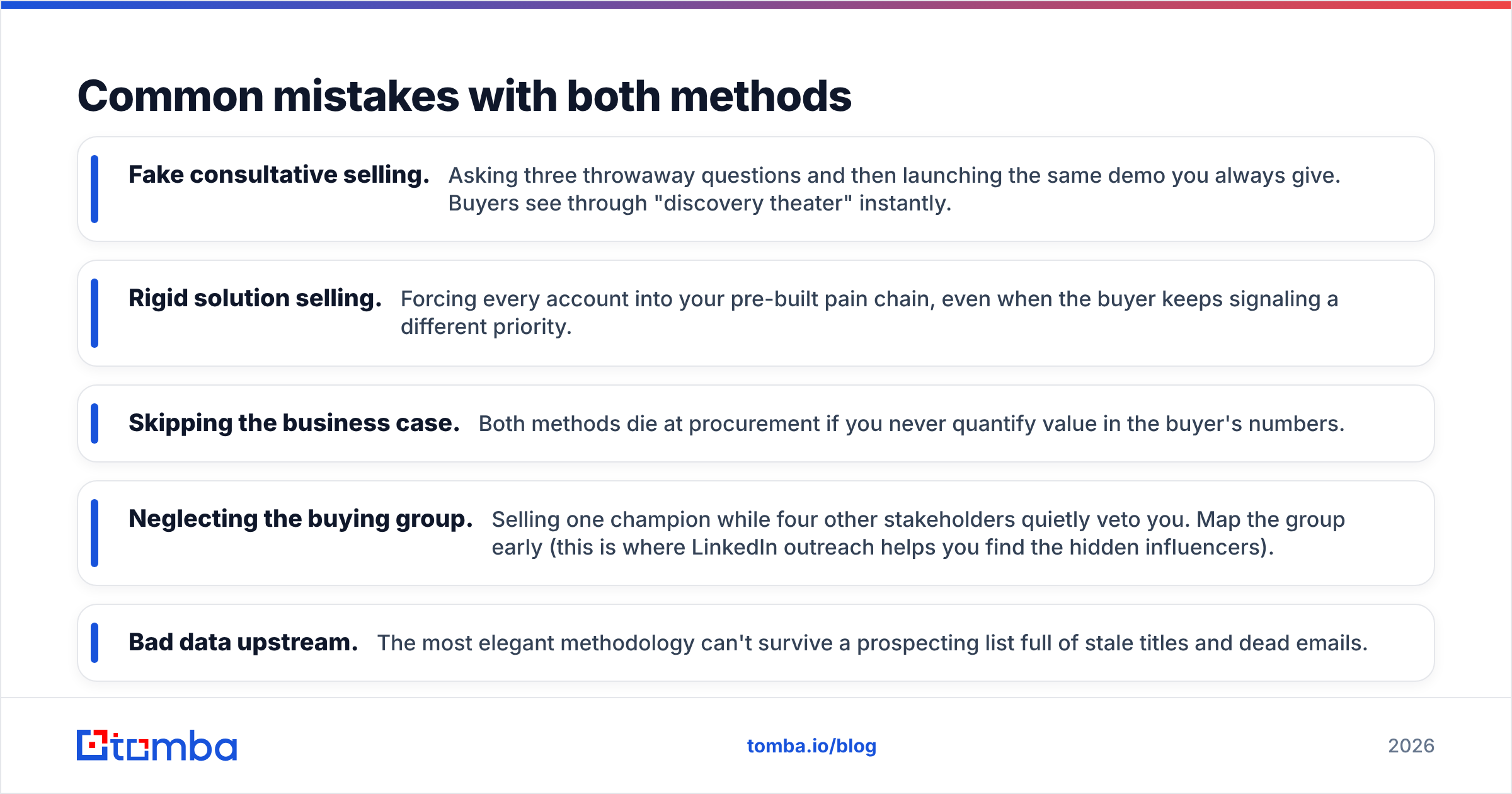
- Fake consultative selling. Asking three throwaway questions and then launching the same demo you always give. Buyers see through "discovery theater" instantly.
- Rigid solution selling. Forcing every account into your pre-built pain chain, even when the buyer keeps signaling a different priority.
- Skipping the business case. Both methods die at procurement if you never quantify value in the buyer's numbers.
- Neglecting the buying group. Selling one champion while four other stakeholders quietly veto you. Map the group early (this is where LinkedIn outreach helps you find the hidden influencers).
- Bad data upstream. The most elegant methodology can't survive a prospecting list full of stale titles and dead emails.
For a broader look at how modern buyers actually make decisions, HubSpot's sales research and G2's category reviews are useful, vendor-neutral reference points when you're pressure-testing your own approach.
Consultative vs solution selling: quick decision guide#
Use this as a gut check before your next opportunity:
| If this is true... | Lean toward |
|---|---|
| Buyer can't articulate the root cause | Consultative |
| Pain is obvious and industry-wide | Solution |
| 5+ stakeholders, six-figure deal | Consultative |
| Repeatable mid-market motion | Solution |
| Product is configurable / services | Consultative |
| Product is packaged with clear ROI | Solution |
| New rep who needs to ramp fast | Solution (then layer consultative) |
| Long-term account you'll expand | Consultative |
When two rows conflict, default to opening consultative — earn the diagnosis — then switch into solution-selling rigor to close. It's easier to add structure to trust than to add trust to a script.
The bottom line#
So how should you settle consultative selling vs solution selling? Stop treating it as a contest. The two methods aren't competing religions; they're complementary skills. Consultative selling wins the right to be trusted by diagnosing before prescribing. Solution selling wins the deal by proving a defined problem meets a defined return. The best 2026 reps move fluidly between the two, reading the buyer instead of clinging to a label.
But every methodology assumes one thing you can't fake: you actually reached the right person, with the right context, at the right time. That's a data problem, not a technique problem. Start by building clean, accurate, decision-maker-level lists, then let your chosen method do its job.
Ready to put the right names in front of your discovery calls? Use the Tomba Email Finder to reach verified decision-makers by name, company, or domain — so your consultative and solution-selling motions land in a real inbox instead of a bounce. Pair it with Tomba data enrichment to walk into every first call already knowing who you're advising. See Tomba pricing to start on the free tier and scale as your pipeline grows.
Related guides#
Ready to find emails that actually work?
Join 150,000+ professionals who stopped guessing and started sending. Free credits on signup — no credit card required.
Get the Tomba newsletter
Practical outbound tactics and product updates — once every two weeks.
About the author