Consultative Selling vs Traditional Selling: Which Wins in 2026?
Traditional selling pushes product; consultative selling diagnoses problems. Here's how the two methods compare on win rate, cycle length, and buyer trust—and how to choose the right motion for your 2026 pipeline.
Most reps think they run a consultative process. Watch their calls and you'll usually see a traditional pitch wearing a discovery costume. The difference between the two methods is not cosmetic—it changes who talks, what closes, and how long deals sit in your pipeline.
TL;DR#
- Traditional selling leads with the product, controls the conversation, and pushes toward a close. It scales, it's fast to train, and it still works for simple, transactional buys.
- Consultative selling leads with diagnosis, lets the buyer talk 60%+ of the time, and closes by co-designing a solution. It wins bigger, stickier deals but demands more skill and patience.
- On complex B2B deals, consultative approaches correlate with higher win rates, larger contract values, and better retention. On low-ticket, high-volume motions, traditional often wins on cost-per-deal.
- Neither is "dead." The right answer depends on deal size, sales cycle, and how informed your buyer already is when they reach you.
- Both fail without accurate contact data. If you're calling the wrong person, method doesn't matter.
What is traditional selling?#
Traditional selling—sometimes called product-led or transactional selling—puts the offer at the center. The rep opens with a hook, runs through features and benefits, handles objections, and asks for the close. The seller drives; the buyer reacts.
It's the model most of us picture when we hear "sales": the confident pitch, the assumptive close, the "what would it take to earn your business today?" It's built on volume and persuasion. Give a trained rep a script, a list, and a quota, and the system produces predictable output.
Traditional selling isn't obsolete. It's genuinely efficient when the product is simple, the price is low, the buyer already knows they want the category, and the decision is made by one person. Think renewals, add-on licenses, or commodity purchases where a long discovery call would just annoy everyone.
What is consultative selling?#
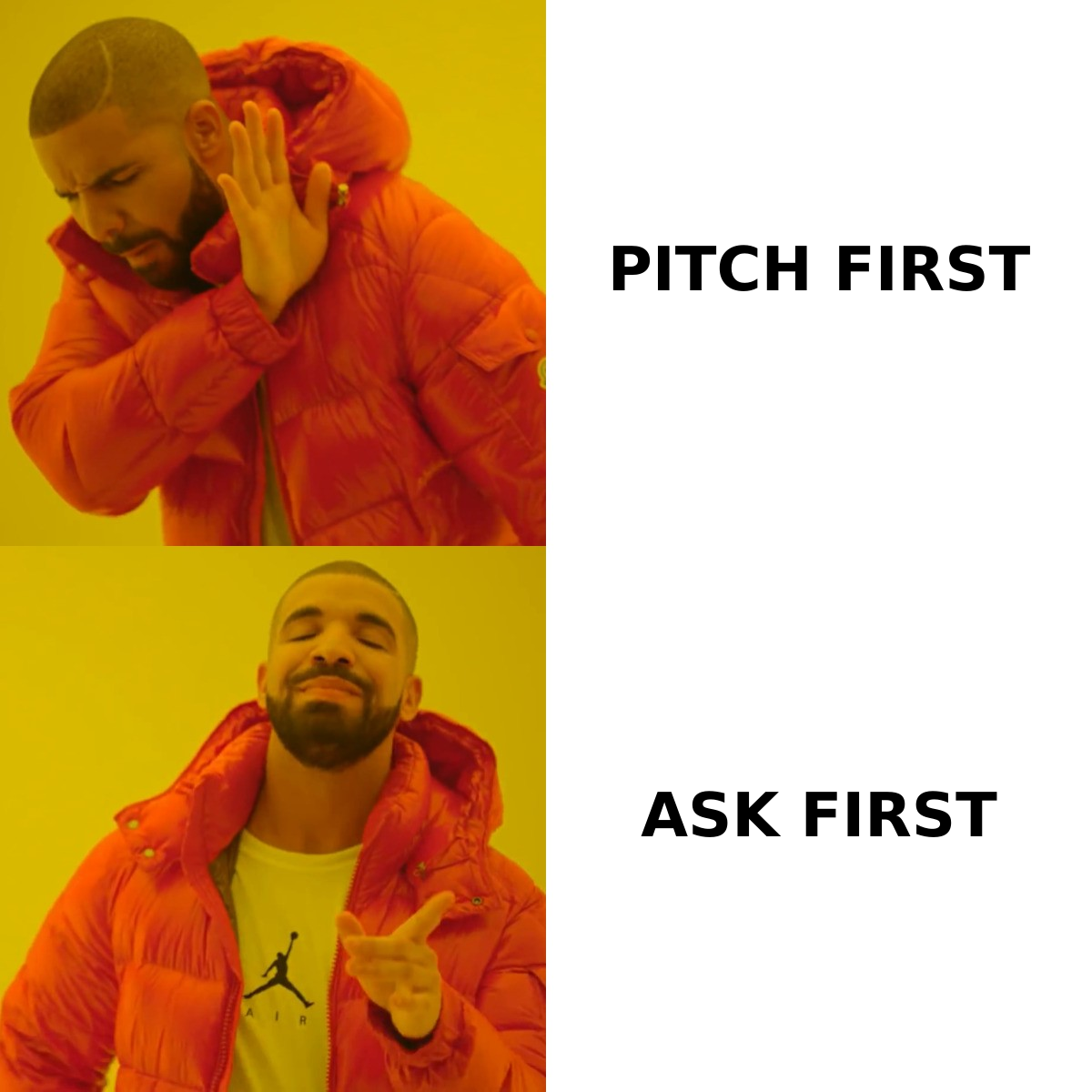
Consultative selling flips the sequence. Instead of leading with the product, the rep leads with questions. The goal of the first call isn't to present—it's to diagnose. You uncover the buyer's situation, quantify the cost of their problem, and only then map your solution to what you learned.
The seller acts less like a vendor and more like an advisor. HubSpot describes the approach as building trust through problem-solving rather than pressure, and the mechanics back that up: the buyer does most of the talking, the rep does most of the listening, and the "pitch" becomes a tailored recommendation the buyer helped build.
This matters more every year because buyers arrive better informed. Gartner's research on B2B buying shows buyers spend only a fraction of the purchase journey with sales reps and most of it researching independently. By the time they talk to you, a feature dump adds little. A sharp diagnosis of a problem they've half-articulated adds a lot.
Consultative selling is harder. It requires business acumen, real listening, and the discipline to walk away from a bad fit. But on complex deals, that effort compounds into trust—and trust is what shortens the gap between "interesting" and "signed."
Consultative selling vs traditional selling: the core differences#
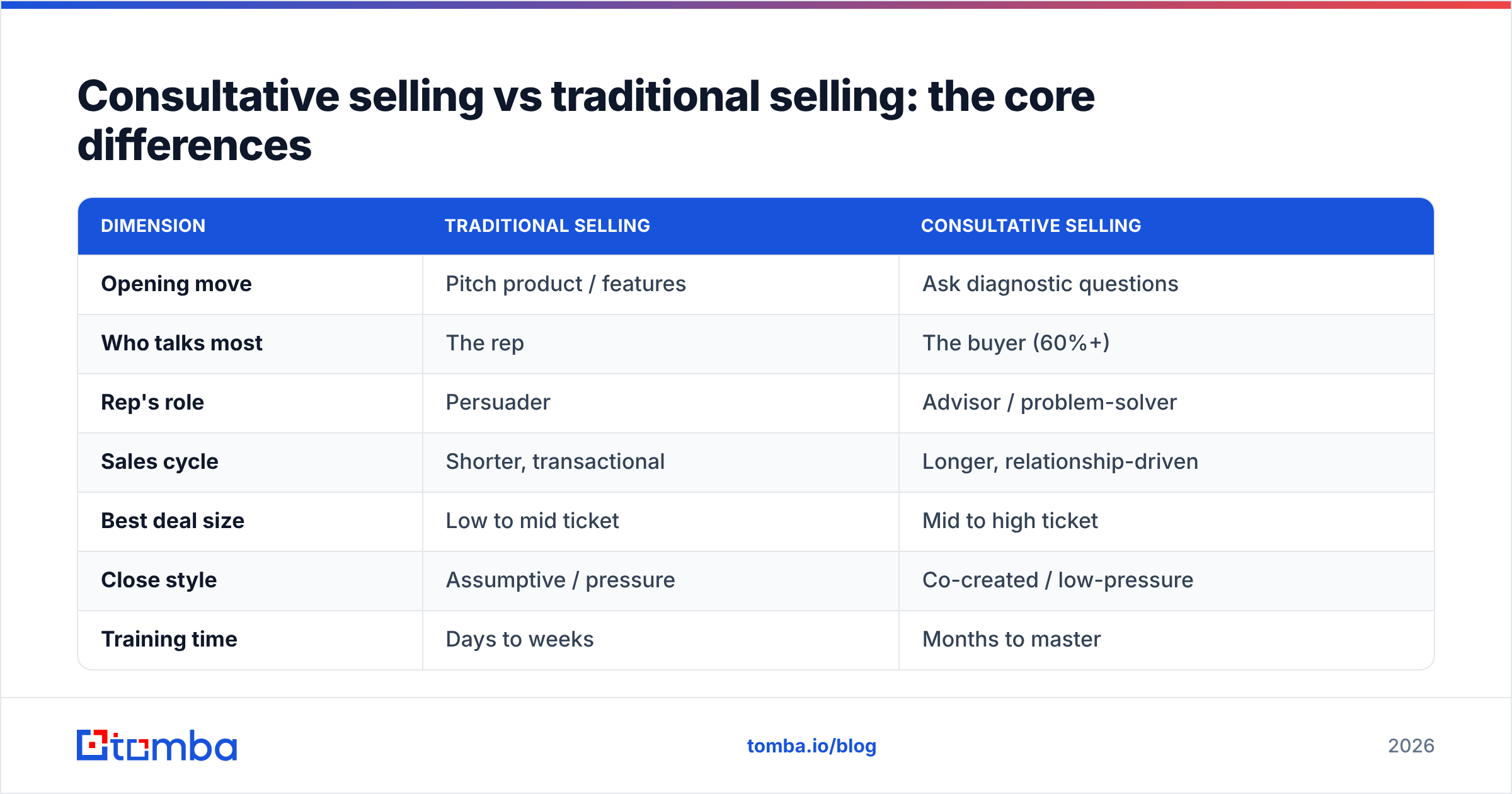
The two models diverge on almost every dimension of a sales conversation. Here's the honest side-by-side.
| Dimension | Traditional selling | Consultative selling |
|---|---|---|
| Opening move | Pitch product / features | Ask diagnostic questions |
| Who talks most | The rep | The buyer (60%+) |
| Rep's role | Persuader | Advisor / problem-solver |
| Sales cycle | Shorter, transactional | Longer, relationship-driven |
| Best deal size | Low to mid ticket | Mid to high ticket |
| Close style | Assumptive / pressure | Co-created / low-pressure |
| Training time | Days to weeks | Months to master |
| Fails when | Buyer needs education | Deal is simple / commodity |
| Key metric | Volume, activity | Win rate, deal value, retention |
Read that table as a spectrum, not a binary. Most effective reps borrow from both: consultative discovery up front, traditional efficiency when it's time to close a qualified, ready buyer.
Which approach has better sales outcomes?#
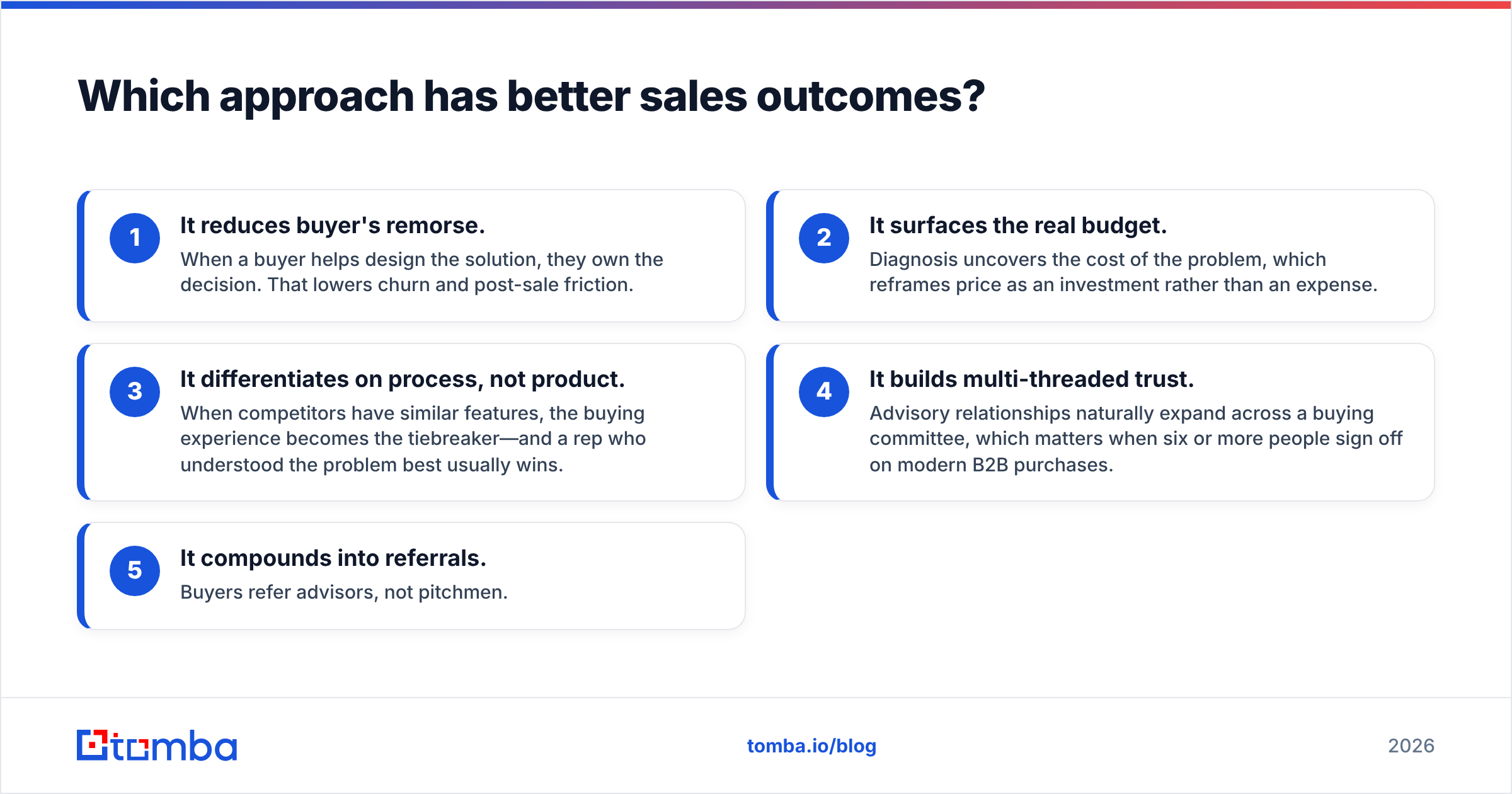
Consultative selling generally wins on the metrics that matter for complex B2B—win rate, average contract value, and retention. Traditional selling wins on speed and cost-per-deal for simple, high-volume motions. The mismatch happens when teams apply the wrong one.
Here's why consultative tends to outperform on bigger deals:
- It reduces buyer's remorse. When a buyer helps design the solution, they own the decision. That lowers churn and post-sale friction.
- It surfaces the real budget. Diagnosis uncovers the cost of the problem, which reframes price as an investment rather than an expense.
- It differentiates on process, not product. When competitors have similar features, the buying experience becomes the tiebreaker—and a rep who understood the problem best usually wins.
- It builds multi-threaded trust. Advisory relationships naturally expand across a buying committee, which matters when six or more people sign off on modern B2B purchases.
- It compounds into referrals. Buyers refer advisors, not pitchmen.
But don't over-rotate. If your product costs $20/month and sells itself, forcing a 45-minute discovery call raises your cost of acquisition and irritates a buyer who just wanted to swipe a card. Measure your motion by win rate and cost-per-deal together, not one in isolation.

When should you use each method?#
Match the method to the buy. Use this quick decision guide.
Lean traditional when:
- The purchase is low-cost and low-risk
- One person decides
- The buyer already knows the category and just needs a nudge
- Your motion depends on volume (SMB, self-serve upsell, renewals)
Lean consultative when:
- The deal is high-value or strategic
- A buying committee is involved
- The problem is complex or poorly defined
- Switching costs are high and trust drives the decision
- You're selling into a crowded category where product parity is real
In practice, most B2B teams run a hybrid: consultative in discovery and solution design, then a crisp, confident close once the buyer is qualified and bought-in. The mistake is running a traditional pitch on a consultative deal—leading with features to a committee that hasn't agreed on the problem yet.
How do you actually run a consultative sales call?#
Switching from pitch to diagnosis is a skill, not a slogan. A repeatable structure helps reps who were trained on traditional scripts.
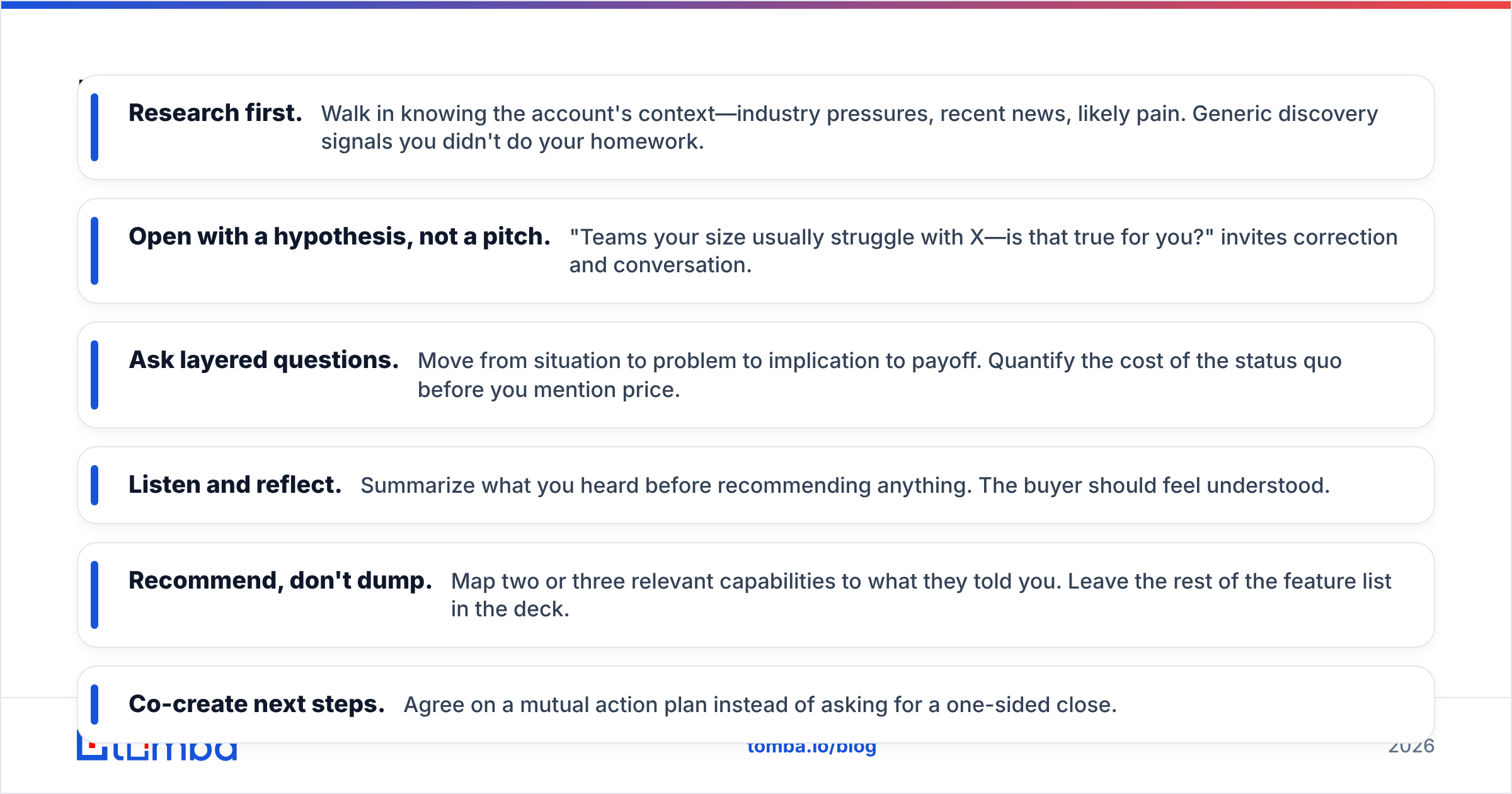
- Research first. Walk in knowing the account's context—industry pressures, recent news, likely pain. Generic discovery signals you didn't do your homework.
- Open with a hypothesis, not a pitch. "Teams your size usually struggle with X—is that true for you?" invites correction and conversation.
- Ask layered questions. Move from situation to problem to implication to payoff. Quantify the cost of the status quo before you mention price.
- Listen and reflect. Summarize what you heard before recommending anything. The buyer should feel understood.
- Recommend, don't dump. Map two or three relevant capabilities to what they told you. Leave the rest of the feature list in the deck.
- Co-create next steps. Agree on a mutual action plan instead of asking for a one-sided close.
The upstream work makes all of this possible. You can't diagnose an account you can't reach, and you can't personalize outreach without knowing who to contact. That's where clean prospecting data becomes the quiet backbone of any consultative motion—reps who spend their time on qualified conversations, not on chasing bad numbers, run better calls.
What tools support each selling style?#
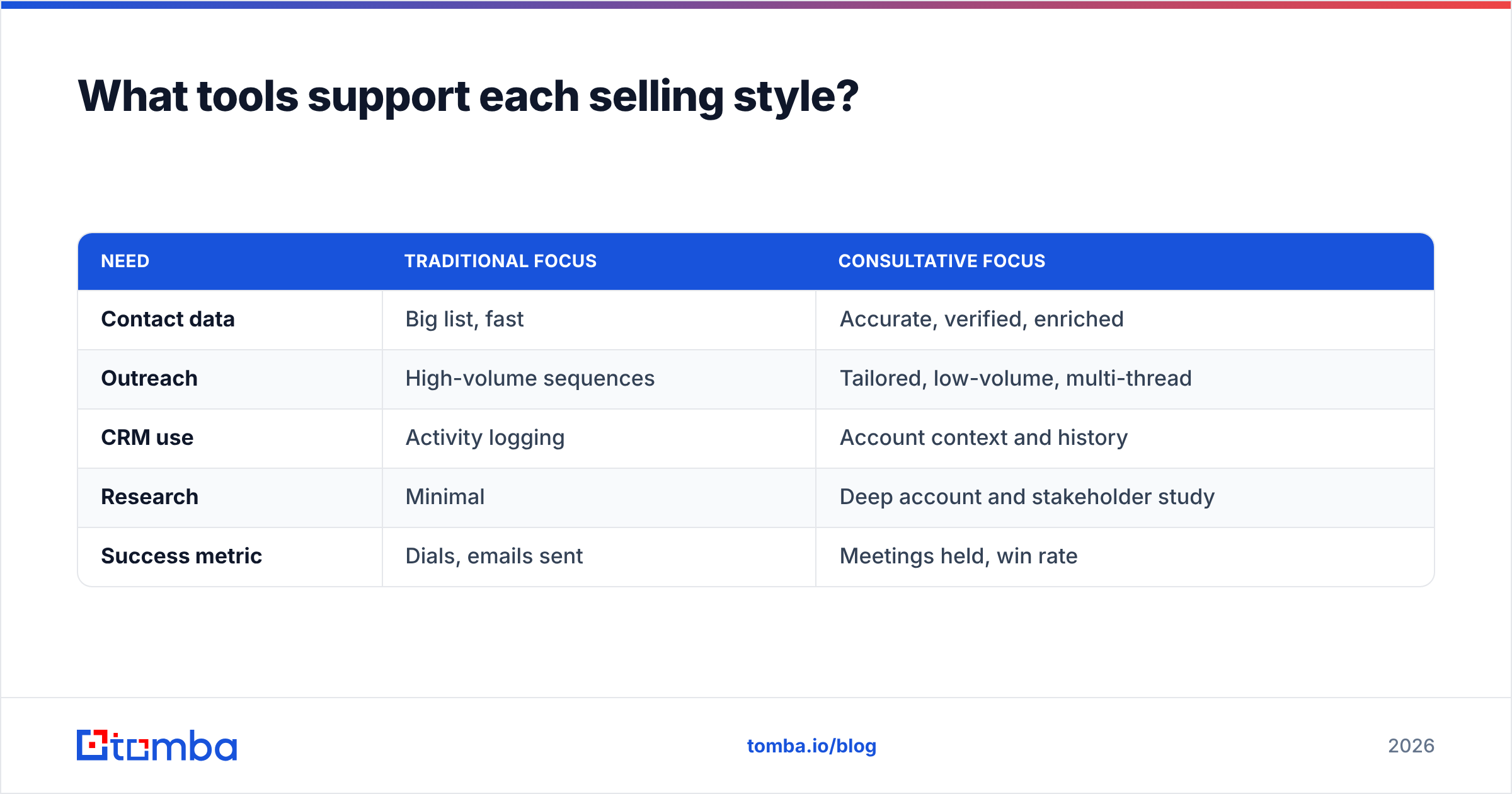
Traditional selling optimizes for throughput: dialers, sequencers, and CRMs that keep activity high. Consultative selling optimizes for relevance: research tools, enrichment, and accurate contact data so every conversation starts informed. A modern stack usually blends both.
| Need | Traditional focus | Consultative focus |
|---|---|---|
| Contact data | Big list, fast | Accurate, verified, enriched |
| Outreach | High-volume sequences | Tailored, low-volume, multi-thread |
| CRM use | Activity logging | Account context and history |
| Research | Minimal | Deep account and stakeholder study |
| Success metric | Dials, emails sent | Meetings held, win rate |
Whichever end you sit on, the input is the same: you need to reach the right person. A verified email finder gets you to the decision-maker directly, a phone finder supports the conversation-first motion consultative reps prefer, and data enrichment fills in the account context that makes a diagnostic opener land instead of flop. Understanding your CRM as the shared record of that context ties it all together.
For a broader view of how buyers rate the categories of tools involved, G2's sales software listings are a useful neutral reference before you commit budget.
Is traditional selling dead?#
No—and anyone who says so is selling you a course. Traditional selling is alive and profitable wherever the buy is simple and the buyer is ready. What's dead is defaulting to a product pitch for every deal regardless of complexity. The market punished that habit as buyers gained access to information and grew allergic to pressure.
The honest verdict: traditional selling lost its monopoly, not its usefulness. It's now one tool in a range, best deployed on transactional deals and in the closing moments of consultative ones. Treating it as your entire playbook is what fails in 2026.
Consultative vs traditional selling: the bottom line#
If you sell complex, high-value solutions to buying committees, build your process around consultative selling—diagnose before you prescribe, and let the buyer help design the outcome. If you sell simple products at volume, keep traditional efficiency and don't apologize for it. Most teams need both, sequenced correctly: consultative discovery, traditional close.
But method is downstream of data. The sharpest discovery script is worthless if you're calling a disconnected number or emailing an address that bounces. Before you argue about selling styles, make sure your reps are reaching real, verified decision-makers.
That's where Tomba's Email Finder earns its place in the stack. Find accurate, verified professional emails by name, company, or domain—so every consultative call starts with the right person on the line, not a guess. Start free with 25 searches a month, then scale on the Starter plan at $49/mo when your pipeline demands it. Better data doesn't just feed traditional volume; it makes consultative conversations possible in the first place.
Related guides#
Ready to find emails that actually work?
Join 150,000+ professionals who stopped guessing and started sending. Free credits on signup — no credit card required.
Get the Tomba newsletter
Practical outbound tactics and product updates — once every two weeks.
About the author