Consultative Selling vs Transactional Selling: 2026 Guide
Consultative selling builds trust and bigger deals; transactional selling closes fast at volume. Here's how to tell which model fits your product, cycle, and buyer — with a side-by-side breakdown.
Consultative selling and transactional selling are not two names for the same job. One is built to uncover a problem and shape a solution over weeks; the other is built to move a known product to a ready buyer in minutes. Pick the wrong one for your deal, and you either over-engineer a $200 sale or under-serve a $200,000 one.
This guide breaks down the real differences, when each model wins, and how to run a hybrid motion without confusing your buyers or your reps.
TL;DR#
- Consultative selling = diagnose first, sell second. Best for complex, high-value, multi-stakeholder deals with long cycles.
- Transactional selling = speed and volume. Best for low-cost, low-complexity products where the buyer already knows what they want.
- The deciding factors are deal size, buyer sophistication, cycle length, and margin — not personal preference.
- Most modern teams run a hybrid: transactional efficiency at the top of funnel, consultative depth on qualified opportunities.
- Both models die without accurate contact data. Clean, verified prospect lists are the fuel either engine burns.
What is consultative selling?#
Consultative selling is an approach where the rep acts less like a vendor and more like a trusted advisor. Think of it like visiting a good doctor: they don't hand you medication the second you walk in — they ask questions, run tests, and diagnose before prescribing anything. The sale is the prescription, and it only comes after the diagnosis.
In practice, a consultative rep spends most of the early conversation asking open-ended discovery questions, mapping the buyer's business problem, and quantifying the cost of inaction. The pitch is customized to what they learned. This is the model behind most B2B SaaS, enterprise software, professional services, and any deal where the buyer needs to trust you before they'll commit budget.
The upside is bigger deals, higher win rates on qualified opportunities, stronger retention, and pricing power. The cost is time: consultative cycles run weeks to quarters, and reps need real product and industry knowledge.

What is transactional selling?#
Transactional selling optimizes for one thing: closing a known purchase as efficiently as possible. The buyer already understands the product, has a clear need, and mostly cares about price, availability, and convenience. Your job is to remove friction, not to educate.
This is the model behind e-commerce, most SMB self-serve software, commoditized supplies, and high-volume inside sales. Reps handle many conversations per day, scripts are tighter, and success is measured in throughput and conversion rate rather than relationship depth.
The upside is scale and low cost-per-deal. The downside is thin margins, weak differentiation, and near-zero switching cost — if a competitor is cheaper tomorrow, your buyer leaves without a second thought.
Consultative selling vs transactional selling: what actually differs?#
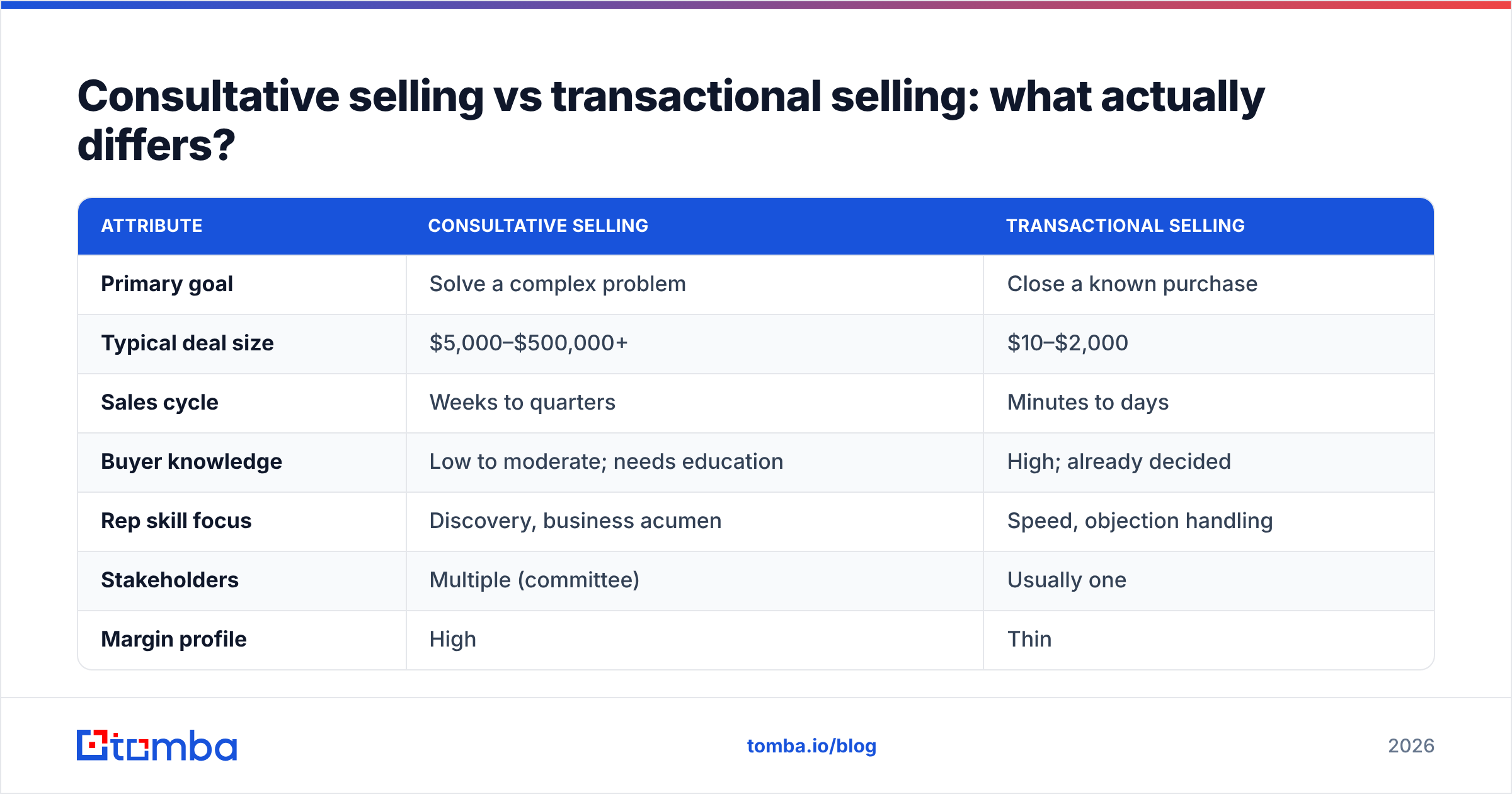
Here is the side-by-side breakdown. The differences compound: a longer cycle changes how you comp reps, which changes who you hire, which changes your whole motion.
| Attribute | Consultative Selling | Transactional Selling |
|---|---|---|
| Primary goal | Solve a complex problem | Close a known purchase |
| Typical deal size | $5,000–$500,000+ | $10–$2,000 |
| Sales cycle | Weeks to quarters | Minutes to days |
| Buyer knowledge | Low to moderate; needs education | High; already decided |
| Rep skill focus | Discovery, business acumen | Speed, objection handling |
| Stakeholders | Multiple (committee) | Usually one |
| Margin profile | High | Thin |
| Success metric | Win rate, ACV, retention | Volume, conversion rate |
| Relationship | Long-term advisor | One-time or repeat convenience |
| Best channel | Calls, demos, tailored email | Self-serve, ads, high-volume outreach |
Notice that neither column is "better." A team selling $49/month software that closes in a day would bleed money running white-glove enterprise motions. A team selling six-figure platforms that skips discovery will lose to any competitor who takes the time to understand the buyer.
When should you use consultative selling?#
Reach for consultative selling when at least three of these are true:
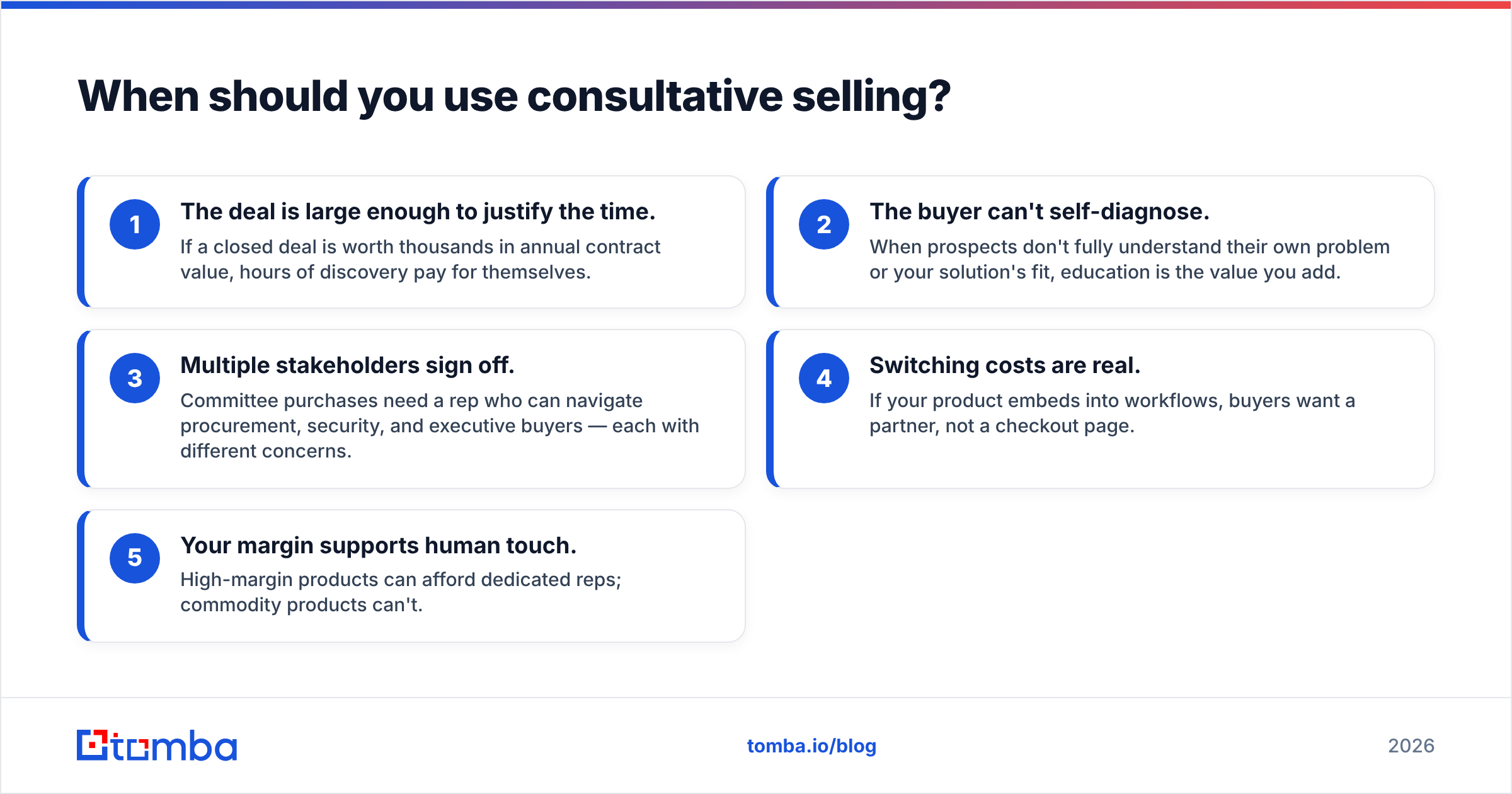
- The deal is large enough to justify the time. If a closed deal is worth thousands in annual contract value, hours of discovery pay for themselves.
- The buyer can't self-diagnose. When prospects don't fully understand their own problem or your solution's fit, education is the value you add.
- Multiple stakeholders sign off. Committee purchases need a rep who can navigate procurement, security, and executive buyers — each with different concerns.
- Switching costs are real. If your product embeds into workflows, buyers want a partner, not a checkout page.
- Your margin supports human touch. High-margin products can afford dedicated reps; commodity products can't.
The mistake teams make is applying consultative depth to deals that don't need it — spending three calls on a purchase the buyer would have completed in one click. That's not thoroughness; it's friction that lowers conversion.
When should you use transactional selling?#
Transactional selling wins when speed and volume beat depth:
- The product is simple and self-explanatory. If a buyer can evaluate it from a pricing page, don't force a demo.
- The price point is low. Sub-$1,000 deals rarely support a long consultative cycle economically.
- Demand already exists. When buyers arrive searching for exactly what you sell, your job is to convert, not create demand.
- You need scale. High-volume markets reward tight scripts, fast follow-up, and automation over bespoke relationships.
The efficiency of a transactional motion depends entirely on reach and data quality. You're playing a numbers game, so the size and accuracy of your contact list directly caps your revenue. This is where a fast bulk email finder earns its keep — feeding reps verified contacts so they spend time selling, not researching.
Is a hybrid model the real answer?#
For most B2B teams in 2026, yes. Pure models are increasingly rare because buyers expect both self-serve convenience and expert guidance depending on deal size. The modern playbook layers the two:
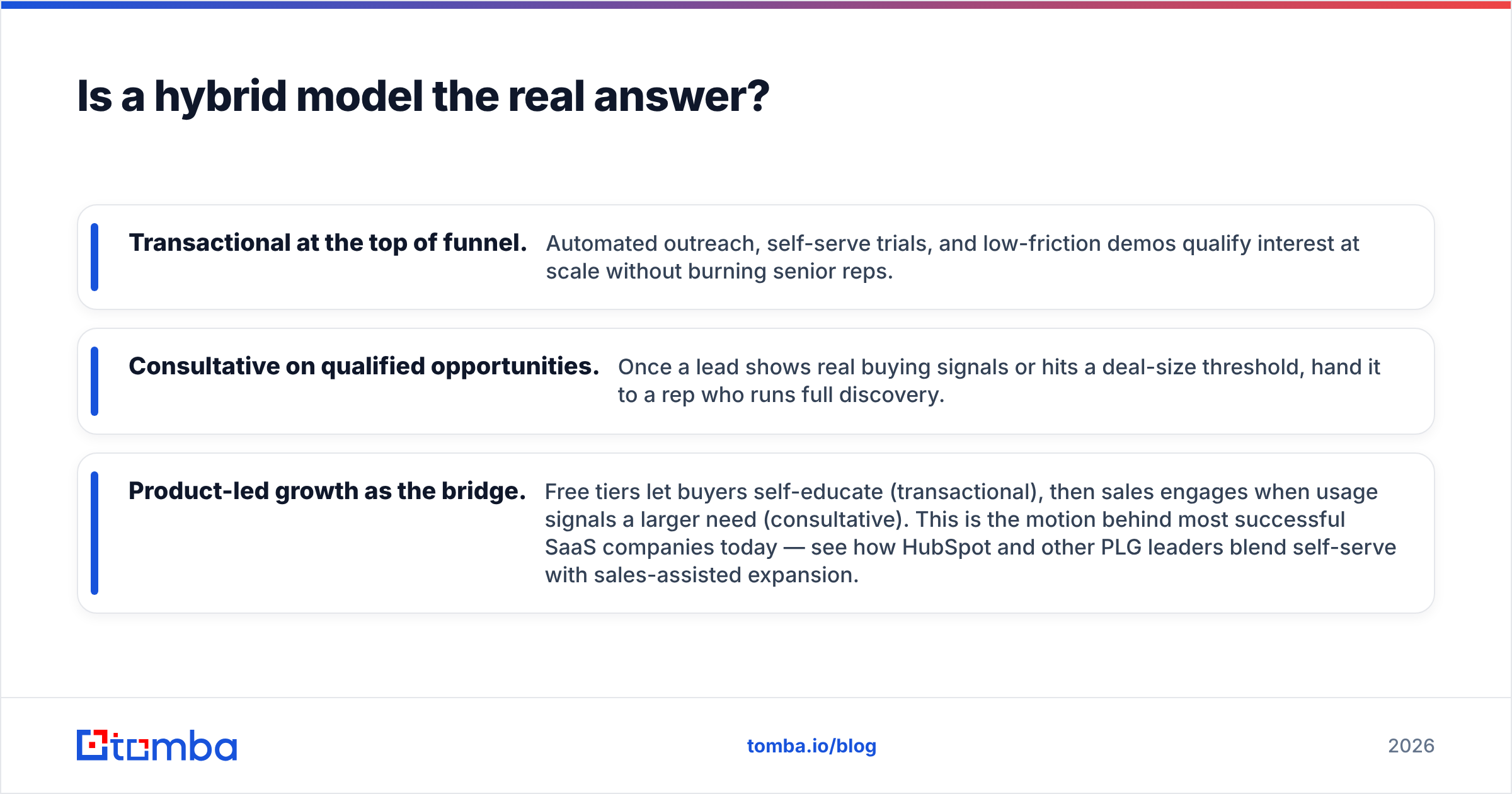
- Transactional at the top of funnel. Automated outreach, self-serve trials, and low-friction demos qualify interest at scale without burning senior reps.
- Consultative on qualified opportunities. Once a lead shows real buying signals or hits a deal-size threshold, hand it to a rep who runs full discovery.
- Product-led growth as the bridge. Free tiers let buyers self-educate (transactional), then sales engages when usage signals a larger need (consultative). This is the motion behind most successful SaaS companies today — see how HubSpot and other PLG leaders blend self-serve with sales-assisted expansion.
The trap in a hybrid model is the handoff. If a lead gets consultative treatment on a transactional-sized deal — or gets rushed through checkout when they needed guidance — you lose. Route by deal size, buying signals, and stakeholder count, not by whoever grabs the lead first. A clear sales process and pipeline with defined stage gates keeps the two motions from colliding.

How does data quality change the equation?#
Both models collapse without accurate contact data — but they fail differently.
In a transactional motion, bad data is a throughput killer. If 30% of your list bounces, you've cut your effective volume by nearly a third and torched your sender reputation in the process. When you're playing a numbers game, garbage numbers lose. That's why email verification before any send is non-negotiable at volume.
In a consultative motion, bad data is an embarrassment. Reaching the wrong stakeholder, mispronouncing a name pulled from a stale record, or emailing someone who left the company two years ago undermines the "trusted advisor" credibility the whole model depends on. Precision matters more than volume here — you need the right person, current title, and a reliable way to reach them.
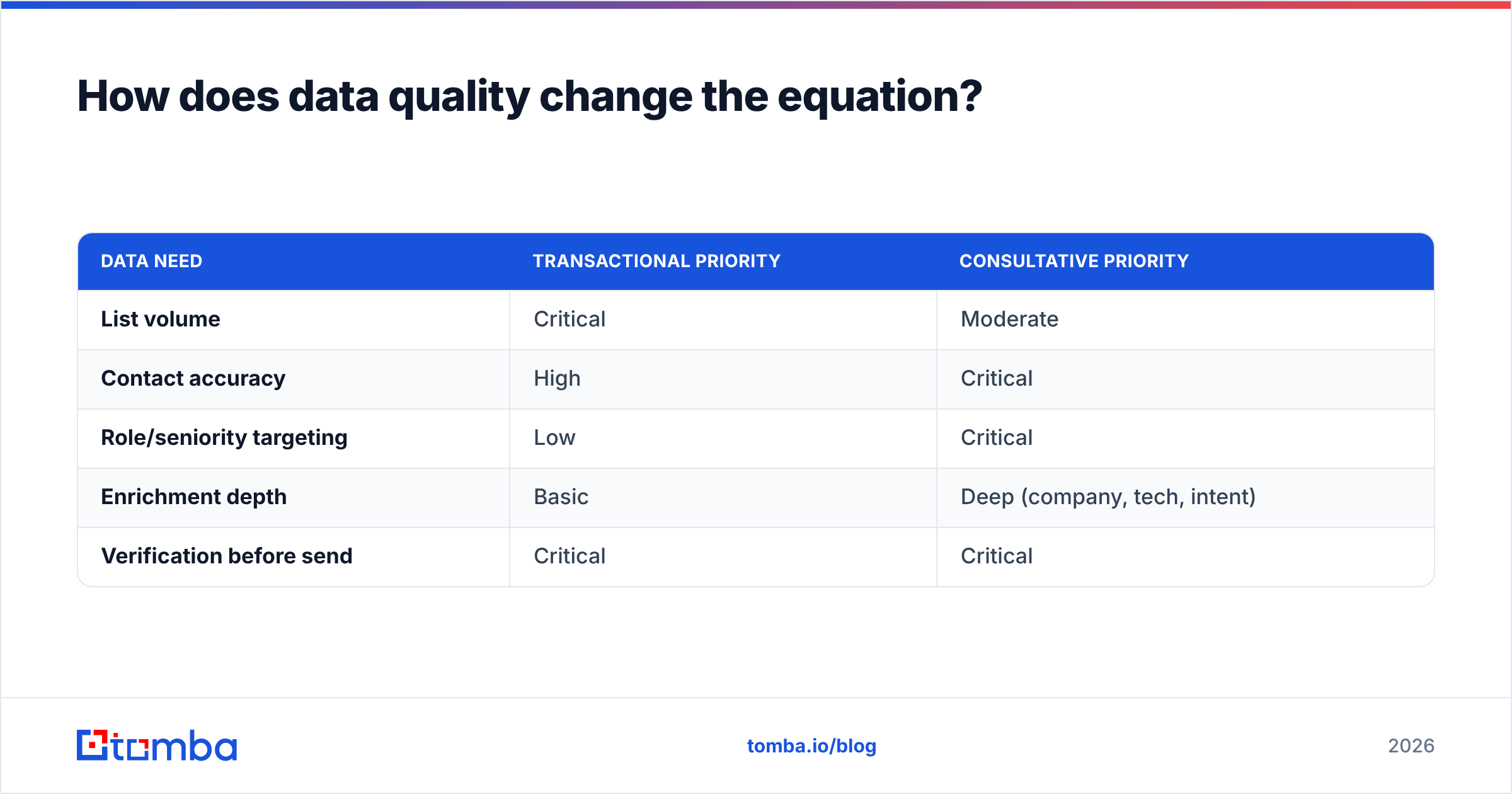
Here's how the data needs split:
| Data need | Transactional priority | Consultative priority |
|---|---|---|
| List volume | Critical | Moderate |
| Contact accuracy | High | Critical |
| Role/seniority targeting | Low | Critical |
| Enrichment depth | Basic | Deep (company, tech, intent) |
| Verification before send | Critical | Critical |
For consultative deals, deeper contact enrichment — company size, tech stack, role — helps reps walk in already understanding the buyer's context. For transactional deals, you mostly need a big, clean, verified list and the speed to work it. Either way, start with a reliable way to find email addresses that won't bounce.
What skills does each model demand from reps?#
Hiring for the wrong model is expensive. The profiles barely overlap:
- Consultative reps need business acumen, patience, and genuine curiosity. They win by asking better questions than competitors and connecting your product to the buyer's P&L. Look for people who can hold a strategic conversation with a VP.
- Transactional reps need energy, resilience, and pace. They win by handling more conversations, recovering fast from rejection, and executing a tight script cleanly. Look for people who thrive on activity metrics.
Comp plans should match. Consultative reps are usually rewarded on deal size and win rate with longer ramp expectations. Transactional reps are rewarded on volume and conversion with faster feedback loops. Mixing the incentives — paying transactional reps like consultative closers — quietly breaks both motions.
Industry research from firms like Gartner consistently shows that buyer expectations, not seller preference, should drive which motion you run. Buyers of complex products want guidance; buyers of simple ones want to be left alone to buy.
Which model has better long-term economics?#
It depends on your market, but the general pattern is clear: consultative selling produces higher lifetime value and margins; transactional selling produces higher volume and lower cost-per-deal.
Consultative wins on:
- Larger contracts and expansion revenue
- Stronger retention (relationships create switching costs)
- Pricing power (differentiation beyond price)
Transactional wins on:
- Lower cost of sale per transaction
- Faster cash cycles
- Easier scaling with automation
The strategic question isn't which is universally better — it's which matches your product's price, complexity, and buyer. A $50 product forced into consultative selling has terrible unit economics. A $50,000 product sold transactionally leaves enormous value on the table and invites competitors to out-consult you.
How do you transition from transactional to consultative (or back)?#
Teams often need to shift as they move upmarket or add lower-priced tiers. A few practical moves:
Moving upmarket (transactional to consultative):
- Rebuild discovery: train reps to ask before they pitch.
- Lengthen the cycle deliberately — resist the urge to rush.
- Invest in enrichment so reps arrive informed.
- Change comp to reward deal size over raw activity.
Adding a self-serve tier (consultative to hybrid):
- Build a frictionless buying path for small deals.
- Set clear thresholds for when sales engages.
- Automate top-of-funnel outreach and verification so reps focus on qualified deals.
In both directions, the data layer is what makes the transition survivable. Whether you're scaling volume or targeting precision, you need current, verified contacts — and a way to keep them fresh as people change jobs. Compare full capabilities and Tomba pricing against what your motion actually requires before committing to a stack.
The bottom line#
Consultative selling and transactional selling aren't rivals — they're tools for different jobs. Match the model to your deal size, buyer sophistication, cycle length, and margin, and most teams end up running a deliberate hybrid: transactional efficiency to qualify at scale, consultative depth to close what matters.
Whichever motion you run, it starts with reaching the right person at the right company without bouncing. Tomba's Email Finder gives you verified professional emails by name, domain, or company — with a free tier (25 searches/month) to test accuracy, and Starter plans from $49/month when you're ready to scale. Feed your consultative reps precise, enriched contacts and your transactional team a clean, high-volume list from the same source. Start free and see how much time your reps get back to actually sell.
Related guides#
Ready to find emails that actually work?
Join 150,000+ professionals who stopped guessing and started sending. Free credits on signup — no credit card required.
Get the Tomba newsletter
Practical outbound tactics and product updates — once every two weeks.
About the author