Consulting Sales in 2026: How to Sell High-Value Engagements
Consulting sales is won on trust, diagnosis, and pipeline discipline, not slick pitches. Here's the 2026 playbook for filling your pipeline and closing bigger engagements.
Consulting sales is the discipline of turning expertise into signed engagements, and it fails for a predictable reason: most consultants pitch before they diagnose, and chase before they qualify. In 2026, buyers are more skeptical, budgets are tighter, and the firms winning six-figure retainers are the ones treating selling as a repeatable process, not a personality trait.
This guide breaks down how consulting sales actually works today, what makes it different from product sales, and the pipeline system that lets solo consultants and boutique firms compete with the big brands.
TL;DR#
- Consulting sales sells trust and outcomes, not features. The buyer is purchasing your judgment, so proof of expertise beats persuasion every time.
- Diagnosis before prescription. The best consultants run a structured discovery conversation before ever quoting a price or scoping a deliverable.
- Pipeline math is unforgiving. With long cycles and low deal volume, you need enough qualified conversations at the top to survive the drop-off to signature.
- Warm access wins. Referrals and accurate contact data beat cold volume — reaching the right decision-maker matters more than reaching many people.
- Value pricing protects margins. Anchor on the business impact of the problem, not the hours you'll bill, and you stop competing on rate.
What is consulting sales, and how is it different?#
Consulting sales is the process of identifying organizations with a problem you can solve, earning their trust, and converting that trust into a paid engagement. The product being sold is intangible: judgment, a methodology, and an outcome the client can't produce internally.
Think of it like hiring a surgeon versus buying a scalpel. Nobody shops for the cheapest scalpel when their company is bleeding — they want the person most likely to fix the problem. That single dynamic changes everything about how you sell.
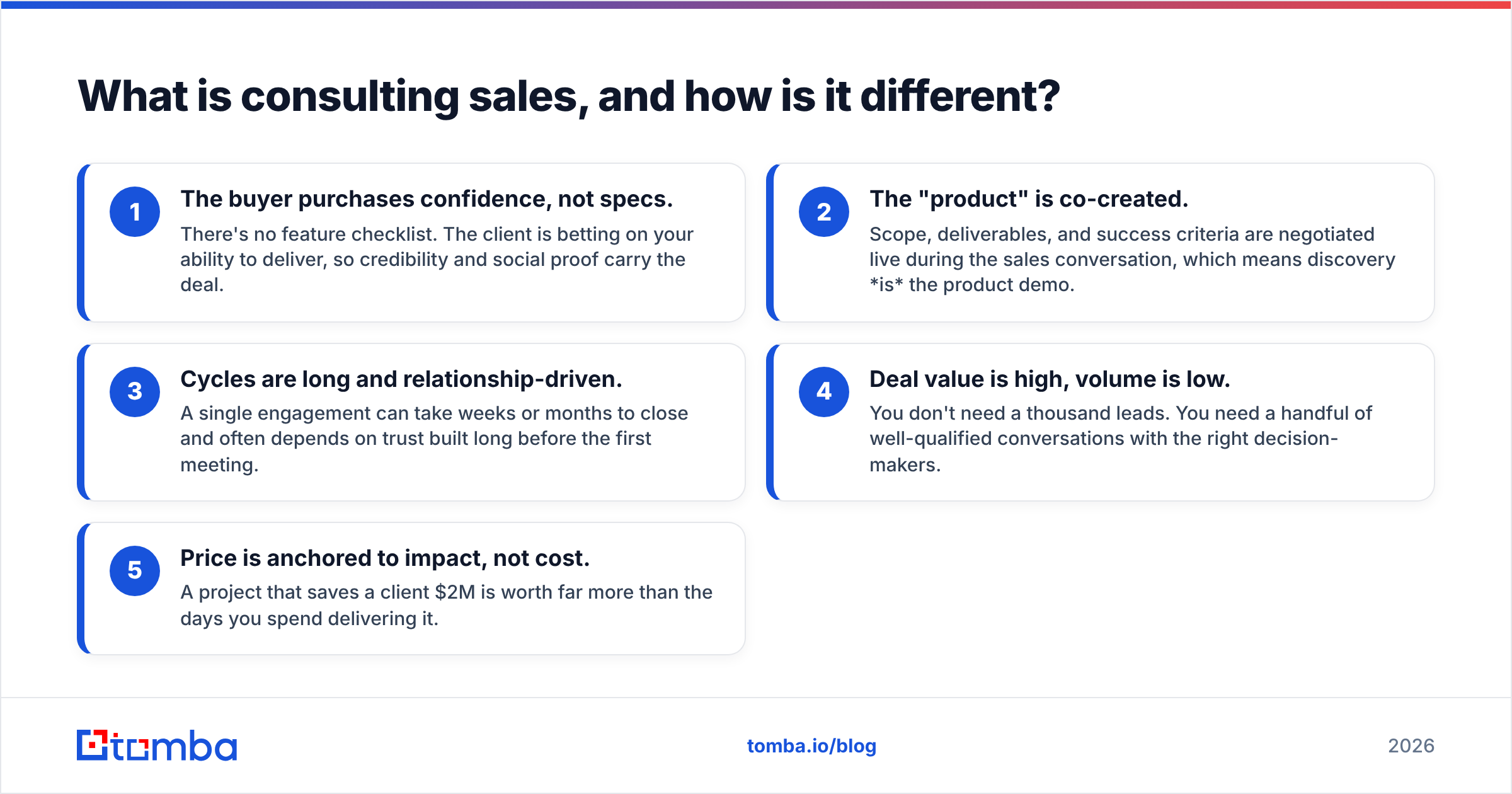
Here's how consulting sales differs from selling a SaaS product or a physical good:
- The buyer purchases confidence, not specs. There's no feature checklist. The client is betting on your ability to deliver, so credibility and social proof carry the deal.
- The "product" is co-created. Scope, deliverables, and success criteria are negotiated live during the sales conversation, which means discovery is the product demo.
- Cycles are long and relationship-driven. A single engagement can take weeks or months to close and often depends on trust built long before the first meeting.
- Deal value is high, volume is low. You don't need a thousand leads. You need a handful of well-qualified conversations with the right decision-makers.
- Price is anchored to impact, not cost. A project that saves a client $2M is worth far more than the days you spend delivering it.
Because volume is low and each deal is large, precision matters more than reach. That's the throughline of everything below.

Why do most consulting sales pipelines stall?#
Most consulting pipelines stall because the consultant is brilliant at delivery and improvising at sales. Without a defined process, three failures repeat:
- Pitching before diagnosing. You hear "we need help with X" and immediately scope X, when the real problem is Y. Buyers can tell when you've stopped listening.
- Chasing unqualified deals. A friendly conversation feels like progress, but interest without budget, authority, or urgency is just an expensive way to fill your calendar.
- No top-of-funnel system. Referrals are wonderful until they dry up. If your only lead source is word of mouth, your revenue is at the mercy of other people's timing.
According to HubSpot's sales research, the majority of prospects are not ready to buy on first contact, and follow-up discipline is what separates closers from hopefuls. In consulting, where cycles are longer, that gap is even wider.
The fix is to treat your pipeline like a manufacturing line: known inputs, known conversion rates, and a predictable output of signed work.
What does a modern consulting sales pipeline look like?#
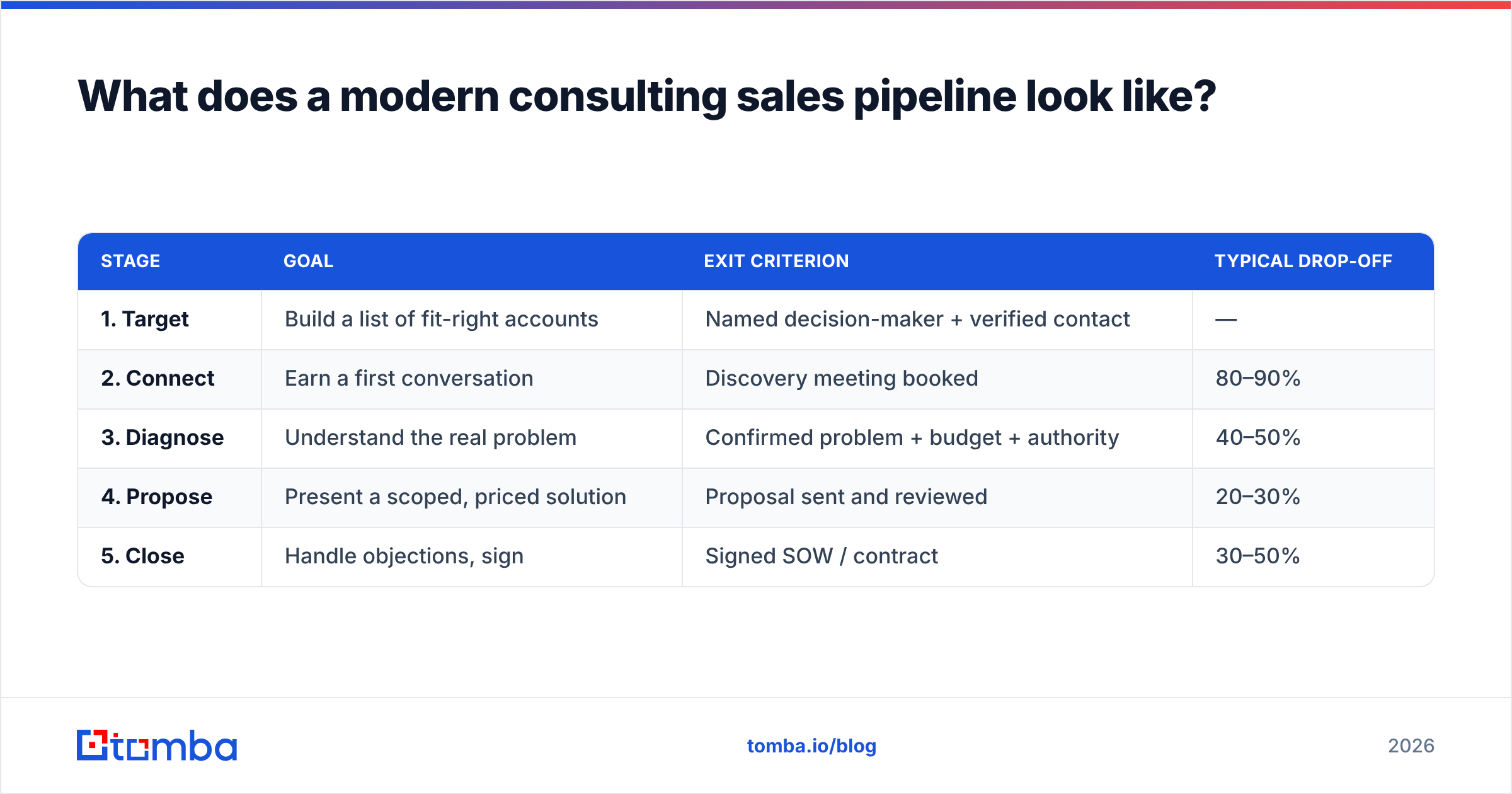
A modern consulting sales pipeline has five stages, each with a clear entry and exit criterion. The point isn't bureaucracy — it's knowing exactly where a deal is and what has to happen next.
| Stage | Goal | Exit criterion | Typical drop-off |
|---|---|---|---|
| 1. Target | Build a list of fit-right accounts | Named decision-maker + verified contact | — |
| 2. Connect | Earn a first conversation | Discovery meeting booked | 80–90% |
| 3. Diagnose | Understand the real problem | Confirmed problem + budget + authority | 40–50% |
| 4. Propose | Present a scoped, priced solution | Proposal sent and reviewed | 20–30% |
| 5. Close | Handle objections, sign | Signed SOW / contract | 30–50% |
Two lessons fall out of this table immediately. First, the biggest leak is almost always at Connect — getting the right person to take a first call. Second, the compounding drop-off means your top of funnel has to be wide enough to survive it. If you close 40% of proposals, and only half of diagnoses become proposals, and only one in ten outreach attempts becomes a diagnosis, you need a lot of accurate contacts to hit one signature.
That math is why data quality is a sales problem, not an admin problem.
How do you fill the top of a consulting funnel?#
You fill the top of a consulting funnel by combining warm referrals with precise, targeted outbound — and refusing to rely on either one alone.
Referrals are the highest-converting source, so engineer them. Ask every happy client for two introductions at the moment of a delivered win. Stay visible to past clients with useful content so you're top of mind when they change roles or budgets open.
Targeted outbound is what makes referrals scale-proof. The mistake is treating it like spray-and-pray volume. In consulting, you want a short list of accounts that fit your ideal profile, the specific human who owns the problem, and a way to reach them directly.
That last part is where most outbound dies. You identify the right VP of Operations at the right company, and then… you're stuck with a generic info@ inbox or a LinkedIn message lost in a sea of pitches. The path from "I know who to talk to" to "I'm in their inbox" is a data problem, and it's solvable.
- Find the decision-maker's direct contact. An email finder turns a name and company domain into a verified professional email, so your outreach lands with the person who can actually say yes.
- Enrich the account before you write. Data enrichment fills in role, company size, and context so your first message references their reality, not a template.
- Reach out across channels. For high-value accounts, layer a call on top of email — a phone finder gives you a direct line instead of a switchboard.
The goal is not more messages. It's the right message to the right person, reliably.

How should consultants run the discovery conversation?#
Consultants should run discovery as a structured diagnosis, not a pitch waiting to happen. This single conversation is where deals are won or lost, and the temptation to talk about yourself is the enemy.
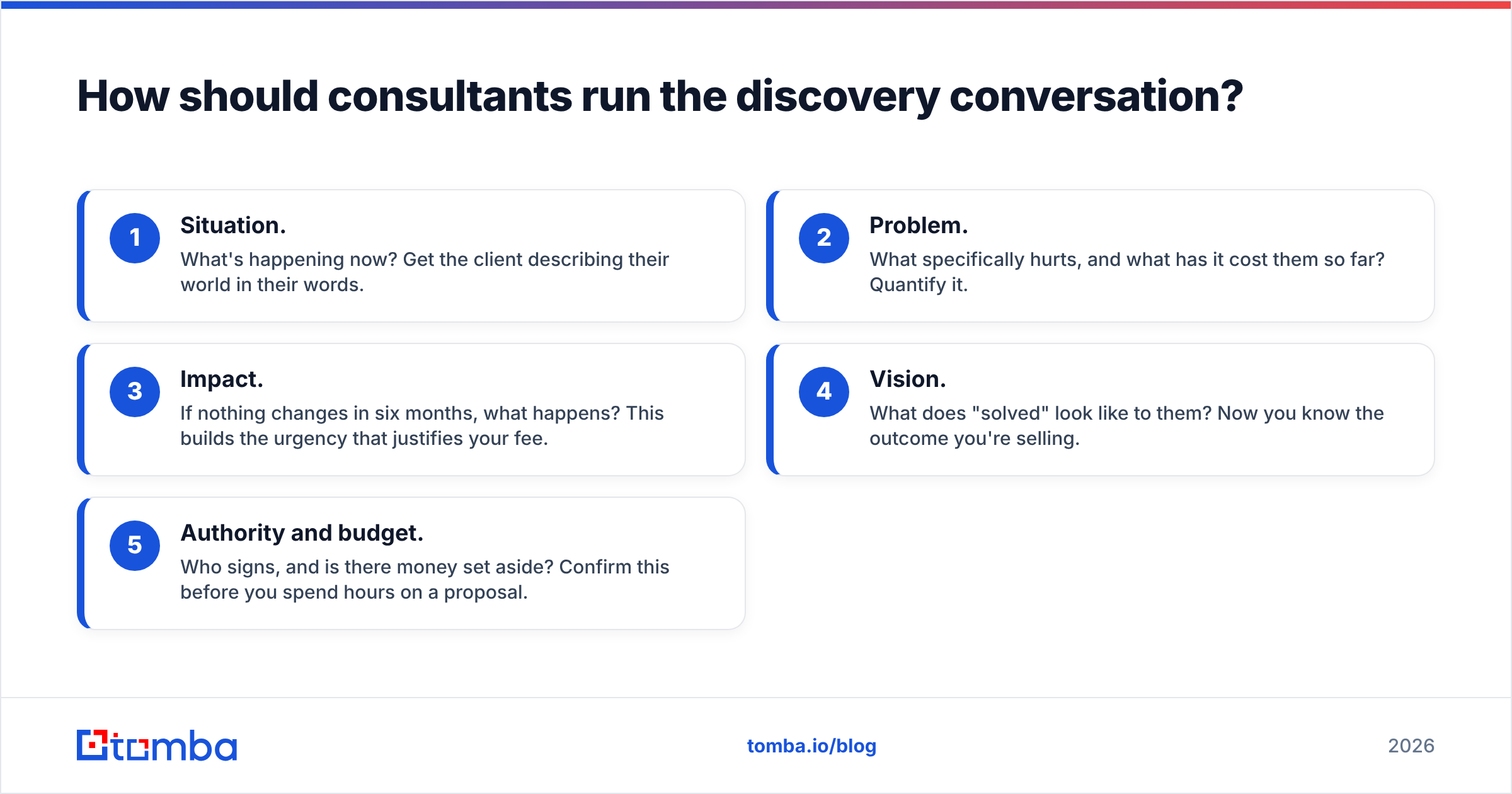
Use a simple diagnostic arc:
- Situation. What's happening now? Get the client describing their world in their words.
- Problem. What specifically hurts, and what has it cost them so far? Quantify it.
- Impact. If nothing changes in six months, what happens? This builds the urgency that justifies your fee.
- Vision. What does "solved" look like to them? Now you know the outcome you're selling.
- Authority and budget. Who signs, and is there money set aside? Confirm this before you spend hours on a proposal.
A useful rule: you should be talking roughly 30% of the time. The client should be doing the diagnosis out loud while you guide. When you finally do prescribe, you're echoing their own words back with a plan attached — which is exactly why it lands.
Skipping this stage is the number-one cause of lost consulting deals. If you can't articulate the client's problem better than they can, you haven't earned the right to propose.
How do you price and propose consulting work?#
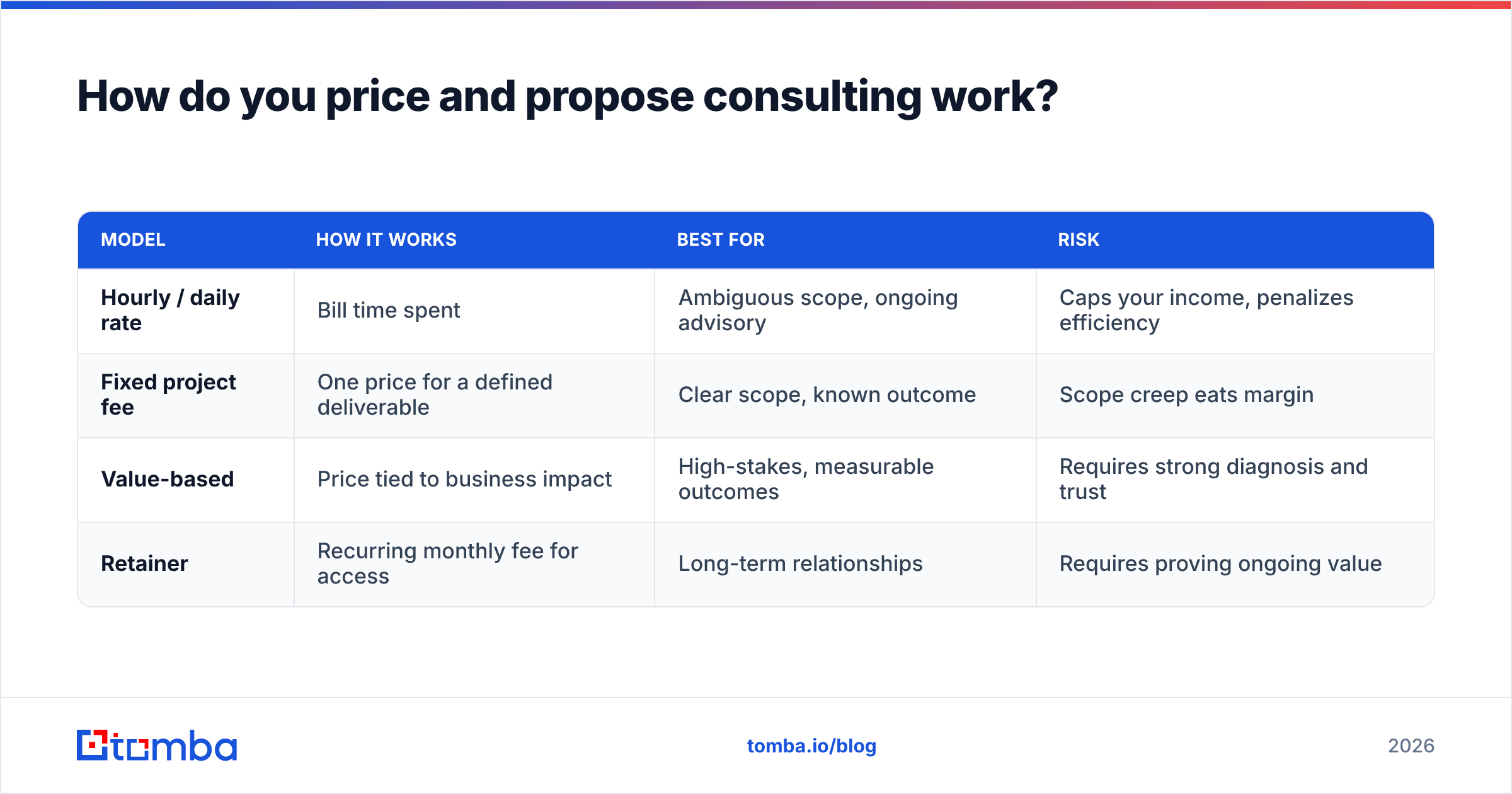
You price consulting work by anchoring to the value of the outcome, not the hours you'll spend. This is the difference between a commodity and a trusted advisor.
Consider three common pricing models:
| Model | How it works | Best for | Risk |
|---|---|---|---|
| Hourly / daily rate | Bill time spent | Ambiguous scope, ongoing advisory | Caps your income, penalizes efficiency |
| Fixed project fee | One price for a defined deliverable | Clear scope, known outcome | Scope creep eats margin |
| Value-based | Price tied to business impact | High-stakes, measurable outcomes | Requires strong diagnosis and trust |
| Retainer | Recurring monthly fee for access | Long-term relationships | Requires proving ongoing value |
For most high-value engagements, a fixed project fee or value-based price wins. When your discovery has quantified a $2M problem, a $150K engagement is an easy yes — the client isn't comparing it to your daily rate, they're comparing it to the cost of doing nothing.
Your proposal should be short and outcome-led: restate the problem in their language, present the outcome, then the approach, then the investment. Lead with impact, not methodology. And always present pricing as an investment against a return, ideally with two or three options so the choice becomes "which," not "whether."
For a deeper look at the underlying relationship management that keeps these deals organized, the concept of a CRM is worth understanding early — even a lightweight one beats tracking six-figure deals in your head.
What tools and metrics actually matter?#
The tools that matter in consulting sales are the ones that protect your two scarcest resources: time and trust. You don't need a bloated tech stack. You need clean data, a place to track deals, and a way to follow up consistently.
Track these metrics religiously:
- Qualified conversations per month — the true leading indicator of future revenue.
- Diagnosis-to-proposal rate — if it's low, your qualification is weak.
- Proposal win rate — if it's low, your discovery or pricing needs work.
- Average engagement value — the number you grow by selling outcomes, not hours.
- Time-to-close — helps you forecast and spot stalled deals early.
The data foundation underneath all of this is contact accuracy. A pipeline built on bounced emails and wrong numbers isn't a pipeline — it's a to-do list of dead ends. Vendor-neutral review sites like G2 are a reasonable place to compare data tools, and analyst firms like Gartner publish useful frameworks on B2B buying behavior that map cleanly onto consulting cycles.
How do you keep a consulting pipeline full long-term?#
You keep a consulting pipeline full by treating business development as a non-negotiable weekly habit, even when you're busy delivering. The classic consulting trap is the feast-famine cycle: you sell, you deliver for three months while selling nothing, then you resurface to an empty pipeline.
Break it with three commitments:
- Block selling time weekly. Even four focused hours during a busy delivery month keeps the top of funnel alive.
- Systematize follow-up. Most consulting deals close after multiple touches over weeks or months. A tracked cadence beats relying on memory.
- Keep your target list fresh and accurate. Contacts go stale — people change jobs constantly. Periodically re-verify and enrich your list so the accounts you're nurturing still point to real, reachable humans.
The consultants who never worry about revenue aren't better closers. They're more consistent. They've turned an anxious scramble into a boring, repeatable system — and boring is exactly what you want when the deals are large.
Start filling your consulting pipeline with the right contacts#
Every stage of consulting sales — from targeting the right accounts to reaching the decision-maker who signs — depends on knowing exactly who to contact and how to reach them. Guessing email addresses or getting stuck at a general inbox is where most outbound quietly fails.
Tomba's Email Finder turns a name and company domain into a verified, direct professional email, so your outreach reaches the person who owns the problem instead of a switchboard. You can start on the free tier (25 searches a month) to test it against your target list, then scale up as your pipeline grows — see Tomba pricing for the Starter ($49/mo), Growth, and Pro plans. Fill the top of your funnel with real contacts, and the rest of the process finally has something to work with.
Related guides#
Ready to find emails that actually work?
Join 150,000+ professionals who stopped guessing and started sending. Free credits on signup — no credit card required.
Get the Tomba newsletter
Practical outbound tactics and product updates — once every two weeks.
About the author