How to Build a Consulting Sales Pipeline That Closes in 2026
Most consultants track a to-do list and call it a pipeline. Here's how to build a real consulting sales pipeline with defined stages, honest metrics, and the tools that keep revenue predictable in 2026.
Most consultants don't have a sales pipeline. They have a mental list of "people I should follow up with," a few unanswered emails, and a vague hope that referrals keep showing up. That works right up until a big project ends and the calendar goes quiet — the classic feast-or-famine cycle that keeps independent consultants and boutique firms permanently anxious.
A consulting sales pipeline fixes that by turning "hope" into a repeatable system: defined stages, honest conversion math, and a clear next action for every prospect. This guide shows you how to build one that actually closes, whether you're a solo advisor or running a 20-person practice.
TL;DR#
- A consulting sales pipeline is a staged view of every prospect from first contact to signed engagement — not a CRM full of dead contacts.
- Use 6 stages: Target → Contact → Discovery → Proposal → Negotiation → Closed. Each has a clear entry and exit rule.
- Track 4 numbers only: stage conversion rate, average deal size, sales-cycle length, and pipeline coverage (3x your quarterly target).
- Feed the top of the funnel with clean, verified contact data — a pipeline is only as good as the people in it.
- Review weekly, kill dead deals fast, and protect discovery: that's where consulting deals are won or lost.
What is a consulting sales pipeline?#
A consulting sales pipeline is a visual, stage-by-stage map of every potential client moving toward a signed engagement. Think of it like a hospital triage board: every patient (prospect) has a status, a next action, and someone responsible for them. Nobody gets lost, and the most urgent cases are obvious at a glance.
The difference between a pipeline and a contact list is movement. A contact list is static — names sitting in a spreadsheet. A pipeline is dynamic: each prospect is either advancing, stalling, or dropping out, and you can see it happening.
For consultants specifically, the pipeline has quirks that product sales teams don't face:
- Deals are relationship-heavy. A single champion leaving the client can kill a $80k engagement overnight.
- The product is trust. You're selling an outcome you can't fully demo, so proof and discovery matter more than features.
- Cycles are long and lumpy. A six-week close and a six-month close can sit side by side.
- Referrals distort the funnel. Warm intros skip stages, so your math has to account for two very different entry paths.

Why do most consultants fail at pipeline management?#
The honest answer: consultants are practitioners first and salespeople second. You got into consulting because you're good at the work, not because you love chasing deals. So the pipeline gets neglected until the current project ends — and by then it's too late to fill.
Here are the failure patterns worth naming:
- The referral trap. Referrals feel great, so you stop doing outbound entirely. When the referral well dries up, you have nothing in the pipe and a 3-month lead time to fix it.
- Happy ears. Every "this sounds interesting" gets logged as a hot lead. Your pipeline looks full, but it's full of prospects who will never sign.
- No exit rules. Deals sit in "Proposal Sent" for four months because nobody decides when to mark them dead.
- Dirty top-of-funnel. You waste discovery calls on prospects who were never a fit because you never qualified them or verified their contact details.
According to HubSpot's sales research, a large share of leads are never followed up with more than once — and for consultants, where a single deal can be a quarter of annual revenue, that leakage is brutal.
What are the stages of a consulting sales pipeline?#
Keep it to six stages. More than that and you'll spend more time updating the CRM than selling. Each stage needs an entry rule (what makes a prospect belong here) and an exit rule (what has to be true to advance).
- Target — A named person at a named company who fits your ideal client profile. Entry: they match your ICP. Exit: you've found a valid way to reach them.
- Contact — You've reached out (email, LinkedIn, intro) and are working toward a first conversation. Exit: a discovery call is booked.
- Discovery — The diagnostic conversation. You understand their problem, budget range, timeline, and decision process. Exit: you've confirmed fit and mutual interest.
- Proposal — You've sent a scoped proposal with pricing. Exit: they've read it and responded.
- Negotiation — Terms, scope, and price are being finalized. Exit: verbal or written yes.
- Closed — Signed contract (Won) or a clear no / indefinite stall (Lost).
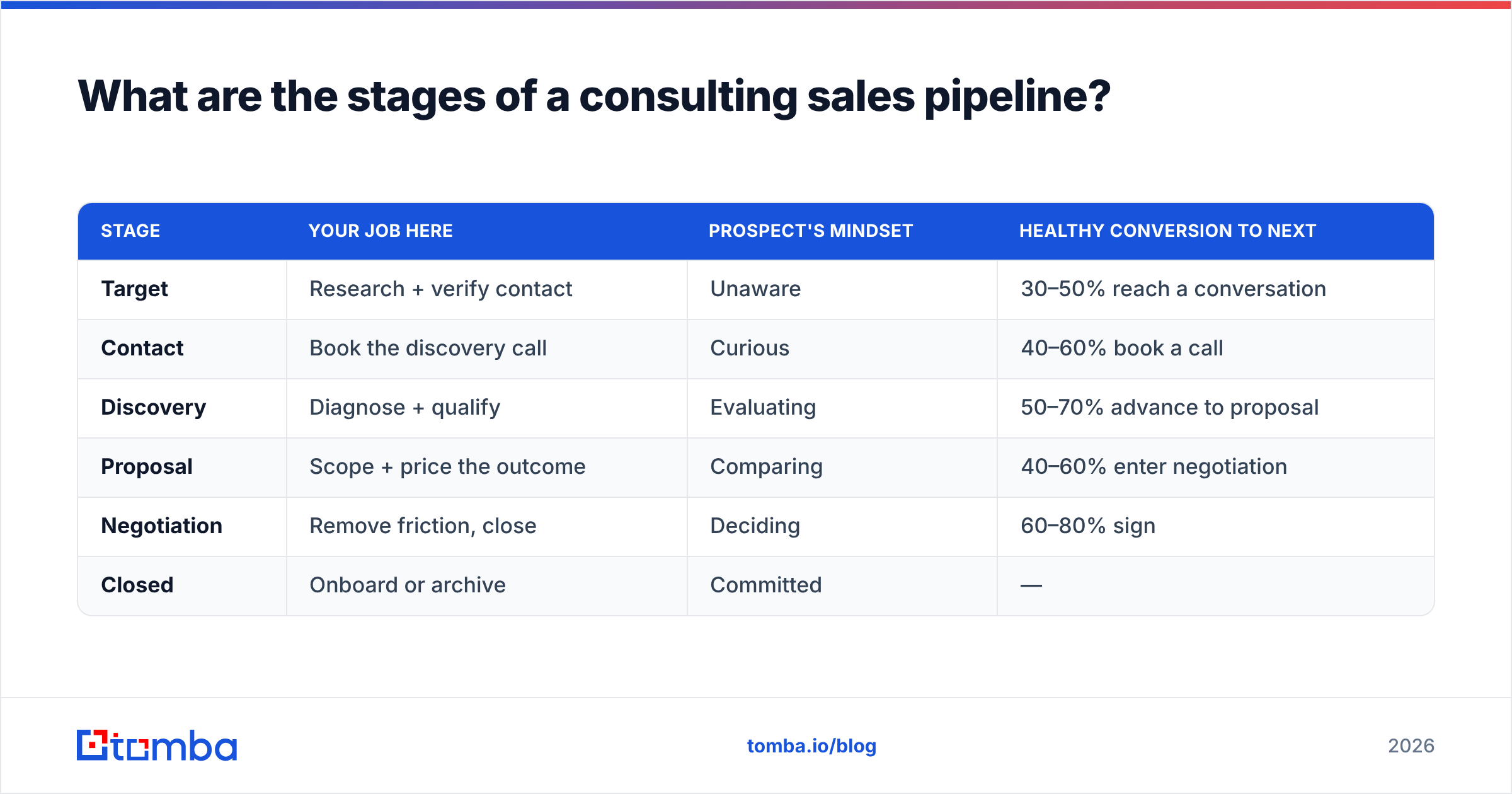
Here's how those stages map to what you actually do and a healthy conversion benchmark:
| Stage | Your job here | Prospect's mindset | Healthy conversion to next |
|---|---|---|---|
| Target | Research + verify contact | Unaware | 30–50% reach a conversation |
| Contact | Book the discovery call | Curious | 40–60% book a call |
| Discovery | Diagnose + qualify | Evaluating | 50–70% advance to proposal |
| Proposal | Scope + price the outcome | Comparing | 40–60% enter negotiation |
| Negotiation | Remove friction, close | Deciding | 60–80% sign |
| Closed | Onboard or archive | Committed | — |
The numbers will vary by niche, but the shape holds: the biggest drop is usually at the very top (finding and reaching the right people) and at proposal (where price meets value). Fix those two and your whole pipeline improves.
How many prospects do you actually need in your pipeline?#
The rule of thumb is 3x pipeline coverage: to close a given amount of revenue in a quarter, you need roughly three times that amount in active, qualified pipeline. If you want to sign $150k this quarter and your typical deal is $30k, you need around 15 qualified deals in motion — not 5.
Work backward from your revenue goal:
- Revenue target ÷ average deal size = deals you must close
- Deals to close ÷ your close rate = qualified deals you need in the pipe
- Qualified deals ÷ discovery-to-qualified rate = discovery calls needed
- Discovery calls ÷ contact-to-call rate = outreach volume required
That last number is the one most consultants dramatically underestimate. If you close 25% of qualified deals and only 40% of discovery calls qualify, hitting five signed deals means dozens of quality conversations — which means hundreds of well-targeted outreach touches. This is exactly why a clean, verified list of prospects at the top matters more than any clever closing tactic.
How do you fill the top of the consulting pipeline?#
Your pipeline is only as good as the people entering it. Garbage in, garbage out. Filling the top well means two things: targeting the right accounts, and reaching the right person with accurate contact data.
Consultants typically blend a few sources:
- Referrals and reactivation — your warmest channel, but unpredictable.
- Targeted outbound — you pick accounts that fit your ICP and reach the decision-maker directly.
- Content and inbound — slower to build, compounding over time.
- Events and communities — high-trust, low-volume.
For outbound, the bottleneck is almost always contact data. You can have a perfect list of 200 dream-fit companies and still stall if you can't reach a real human. This is where a good email finder earns its keep — you paste a name and company domain and get a verified professional email instead of guessing at firstname@company.com and burning your sender reputation on bounces.
When you're targeting a whole account, company email search surfaces the people and patterns at a domain so you can find the actual buyer, not just the info@ inbox. And because consulting deals so often move by phone, having verified B2B phone numbers for warm follow-up keeps momentum after a strong first email.
Before any of it hits your sequence, verify. Bounced emails wreck your response rate and can get your domain flagged. Running your list through an email verifier first is the single cheapest way to protect deliverability and keep your data clean as it enters the pipeline.
Which metrics should a consultant track?#
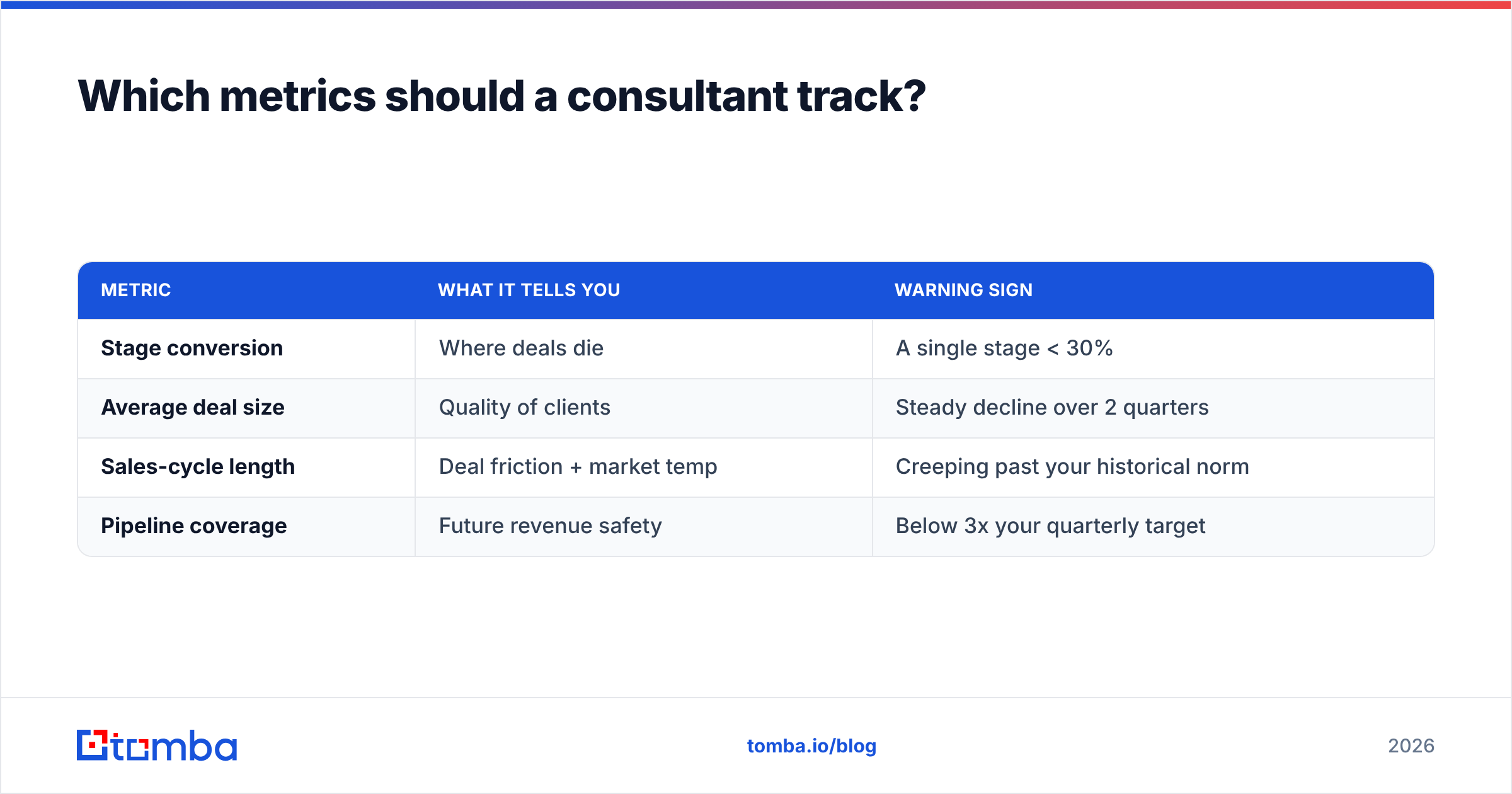
Resist the urge to track everything. Four numbers tell you almost everything about pipeline health:
- Stage conversion rate — where deals leak. If Discovery → Proposal drops off a cliff, your qualification is weak.
- Average deal size — trending up means you're winning better clients; down means you're discounting or chasing small fish.
- Sales-cycle length — how long from first contact to signed. Lengthening cycles are an early warning of a soft market or vague proposals.
- Pipeline coverage — that 3x ratio. Below it, this quarter is fine but next quarter is in danger.
| Metric | What it tells you | Warning sign |
|---|---|---|
| Stage conversion | Where deals die | A single stage < 30% |
| Average deal size | Quality of clients | Steady decline over 2 quarters |
| Sales-cycle length | Deal friction + market temp | Creeping past your historical norm |
| Pipeline coverage | Future revenue safety | Below 3x your quarterly target |
Review these weekly for 20 minutes. Not to obsess — to catch problems while there's still time to fix them. Gartner's research on sales analytics consistently finds that the teams who inspect their pipeline on a regular cadence forecast far more accurately than those who eyeball it.
What tools do you need to run a consulting pipeline?#
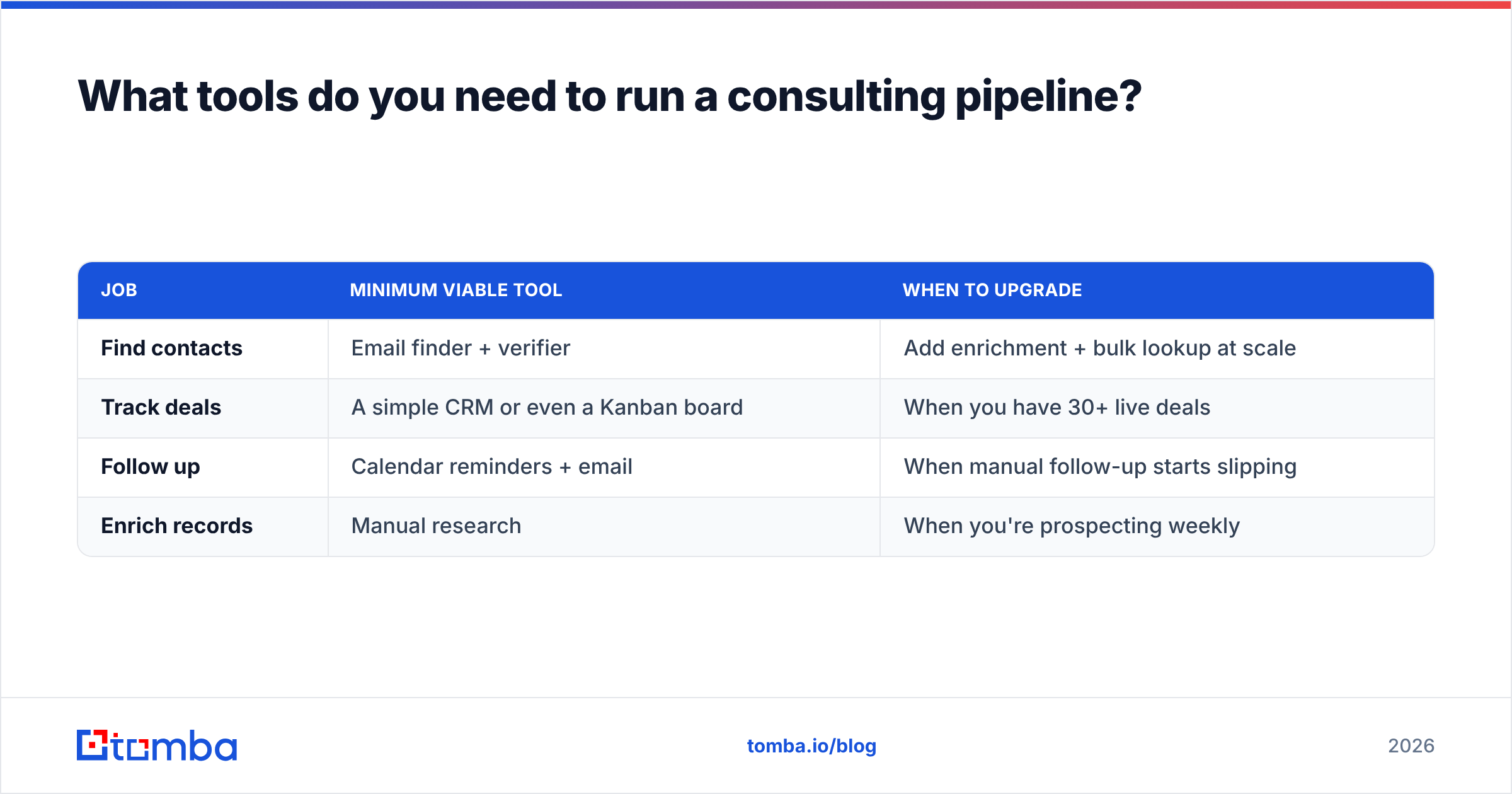
You need less than the software vendors want you to buy. A working stack has three jobs: find the right people, track the deals, and follow up consistently.
| Job | Minimum viable tool | When to upgrade |
|---|---|---|
| Find contacts | Email finder + verifier | Add enrichment + bulk lookup at scale |
| Track deals | A simple CRM or even a Kanban board | When you have 30+ live deals |
| Follow up | Calendar reminders + email | When manual follow-up starts slipping |
| Enrich records | Manual research | When you're prospecting weekly |
For a solo consultant, a lightweight CRM plus disciplined weekly reviews beats an expensive platform you never fully configure. As you scale, data enrichment fills in the firmographic and role details that let you prioritize the accounts most likely to close — so your limited selling hours go to the best-fit deals.
The point is sequence, not spend: get the process right on cheap tools first, then buy software to remove friction from a process that already works. Buying a $500/month platform to fix a broken process just gives you an expensive broken process.
How Tomba fits a lean consulting stack#
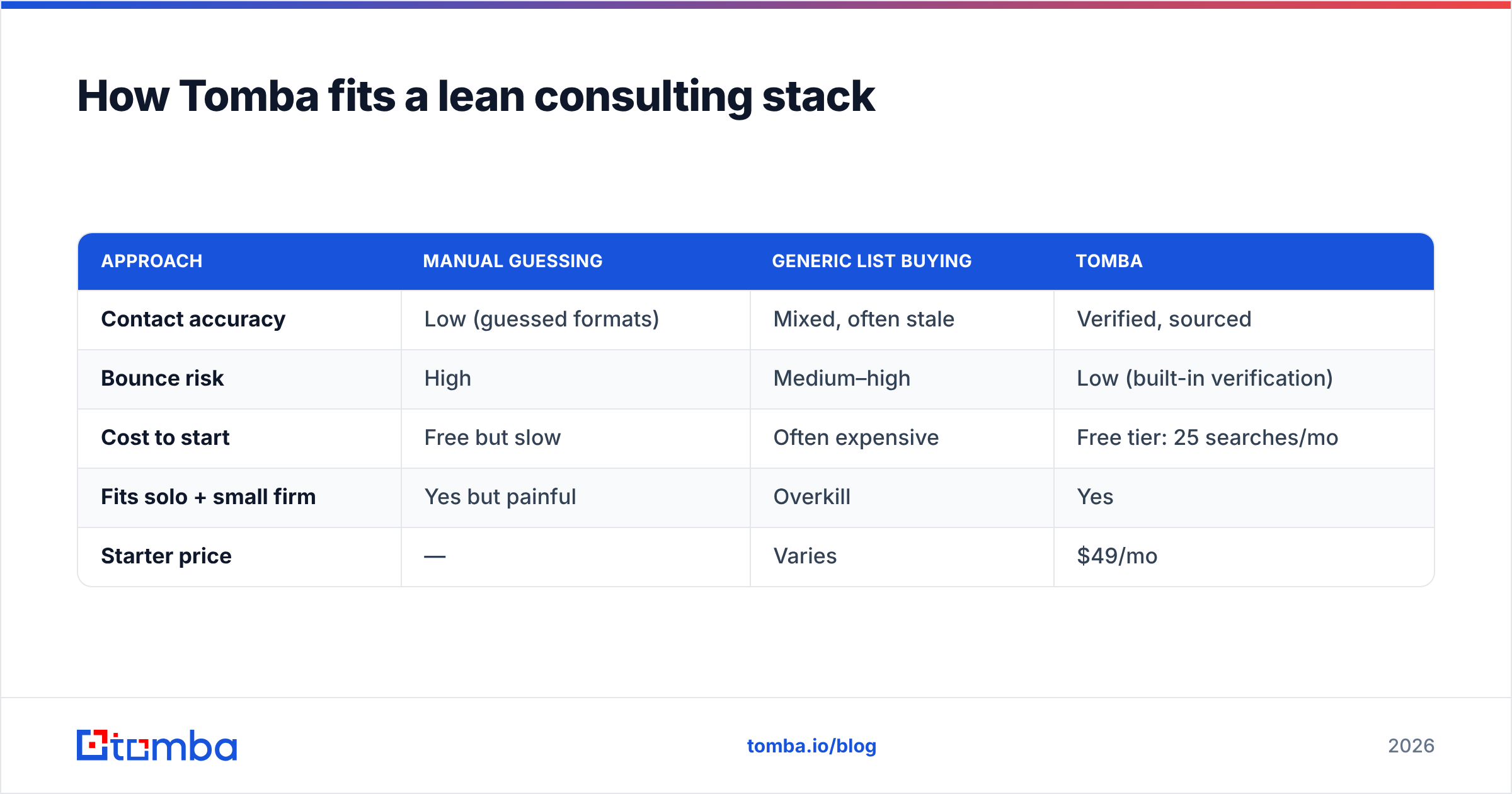
Tomba sits at the top of the pipeline — the find-and-verify layer — and stays out of your way everywhere else. Here's the honest positioning against how consultants usually work:
| Approach | Manual guessing | Generic list buying | Tomba |
|---|---|---|---|
| Contact accuracy | Low (guessed formats) | Mixed, often stale | Verified, sourced |
| Bounce risk | High | Medium–high | Low (built-in verification) |
| Cost to start | Free but slow | Often expensive | Free tier: 25 searches/mo |
| Fits solo + small firm | Yes but painful | Overkill | Yes |
| Starter price | — | Varies | $49/mo |
Tomba's pricing starts with a free tier of 25 searches a month — enough for a solo consultant to test a targeted outreach round before paying anything. Starter is $49/mo, Growth $99/mo, and Pro $249/mo as your prospecting volume grows. You can compare it against alternatives on G2 if you want third-party reviews before committing.
A simple weekly pipeline routine#
The system only works if you run it. Block 45 minutes every Monday:
- Advance or archive (15 min). Move every deal forward one stage or kill it. No deal sits in the same stage for two reviews without a reason.
- Check coverage (5 min). Are you at 3x for next quarter? If not, the rest of the hour is about adding targets.
- Add new targets (15 min). Find and verify 10–20 new ICP-fit contacts to backfill the top.
- Set next actions (10 min). Every active deal leaves the review with a specific next step and a date.
That's it. The consultants who never hit a dry quarter aren't better closers — they just never stop feeding and grooming the pipe.
The bottom line#
A consulting sales pipeline isn't bureaucracy — it's insurance against the feast-or-famine cycle that makes independent consulting stressful. Six clear stages, four honest metrics, 3x coverage, and a clean top-of-funnel. Get those right and revenue stops being a surprise.
The one thing that quietly determines whether the whole system works is data quality at the top. If half your outreach bounces or reaches the wrong person, no amount of process discipline saves you. Start there: build a targeted list of dream-fit accounts and reach the real decision-makers with verified contacts using the Tomba Email Finder. It's free to try for your first 25 searches — enough to fill next quarter's pipeline before this one runs dry.
Related guides#
Ready to find emails that actually work?
Join 150,000+ professionals who stopped guessing and started sending. Free credits on signup — no credit card required.
Get the Tomba newsletter
Practical outbound tactics and product updates — once every two weeks.
About the author