How to Build a Consulting Sales Pitch That Actually Closes in 2026
A great consulting sales pitch sells outcomes, not hours. Here is the exact structure, discovery flow, and follow-up system that turns first calls into signed engagements.
Most consulting pitches lose the deal in the first five minutes — not because the consultant lacks skill, but because they lead with credentials instead of the client's problem. A consulting sales pitch is not a resume read aloud. It is a structured argument that a specific, expensive problem is worth solving now, and that you are the lowest-risk way to solve it.
This guide breaks down the exact structure, discovery flow, pricing framing, and follow-up system that turns exploratory calls into signed engagements in 2026.
TL;DR#
- Lead with the client's problem, not your bio. The first 90 seconds should prove you understand their pain better than they've articulated it themselves.
- Sell outcomes, not hours. Frame your fee against the cost of the problem staying unsolved, not against a day rate.
- Discovery is the pitch. The questions you ask do more selling than any slide. Diagnose before you prescribe.
- De-risk the decision. A clear scope, a phased start, and social proof lower the perceived risk of saying yes.
- Follow up like a professional, not a stalker. A tight recap, a one-page proposal, and value-added touches beat "just checking in."
What Is a Consulting Sales Pitch, Really?#
A consulting sales pitch is the conversation (and supporting materials) that moves a prospect from "we might have a problem" to "we want to hire you to fix it." Think of it like a doctor's appointment. You don't want a physician who walks in and immediately lists their medical school honors — you want one who asks the right questions, names what's wrong, and explains the treatment with calm authority. The pitch is the diagnosis-and-treatment conversation, not the diploma on the wall.
That distinction matters because consulting is a trust purchase. The client is buying a future outcome they cannot inspect in advance. Everything in your pitch should reduce the uncertainty of that bet.

The best pitches share a spine: problem → cost of inaction → your approach → proof → clear next step. Everything else — the deck, the case studies, the pricing — hangs off that spine.
Why Do Most Consulting Pitches Fail?#
Three failure modes account for the majority of lost deals:
- Premature prescription. The consultant proposes a solution before they understand the problem. It signals a canned offering rather than a tailored fix.
- Feature dumping. Listing methodologies, frameworks, and past logos without connecting any of it to the buyer's specific situation.
- Talking to the wrong problem. Solving the pain the buyer mentioned instead of the deeper business pain driving it (e.g., "we need a new process" is usually really "our revenue is flat and leadership is nervous").
According to research summarized by HubSpot's sales statistics, buyers consistently rank "understanding my needs" above product knowledge when choosing a vendor. For consultants, whose product is their understanding, this is decisive.
The fix for all three is the same: slow down and diagnose. Which brings us to the core of the pitch.
What Is the Ideal Consulting Sales Pitch Structure?#
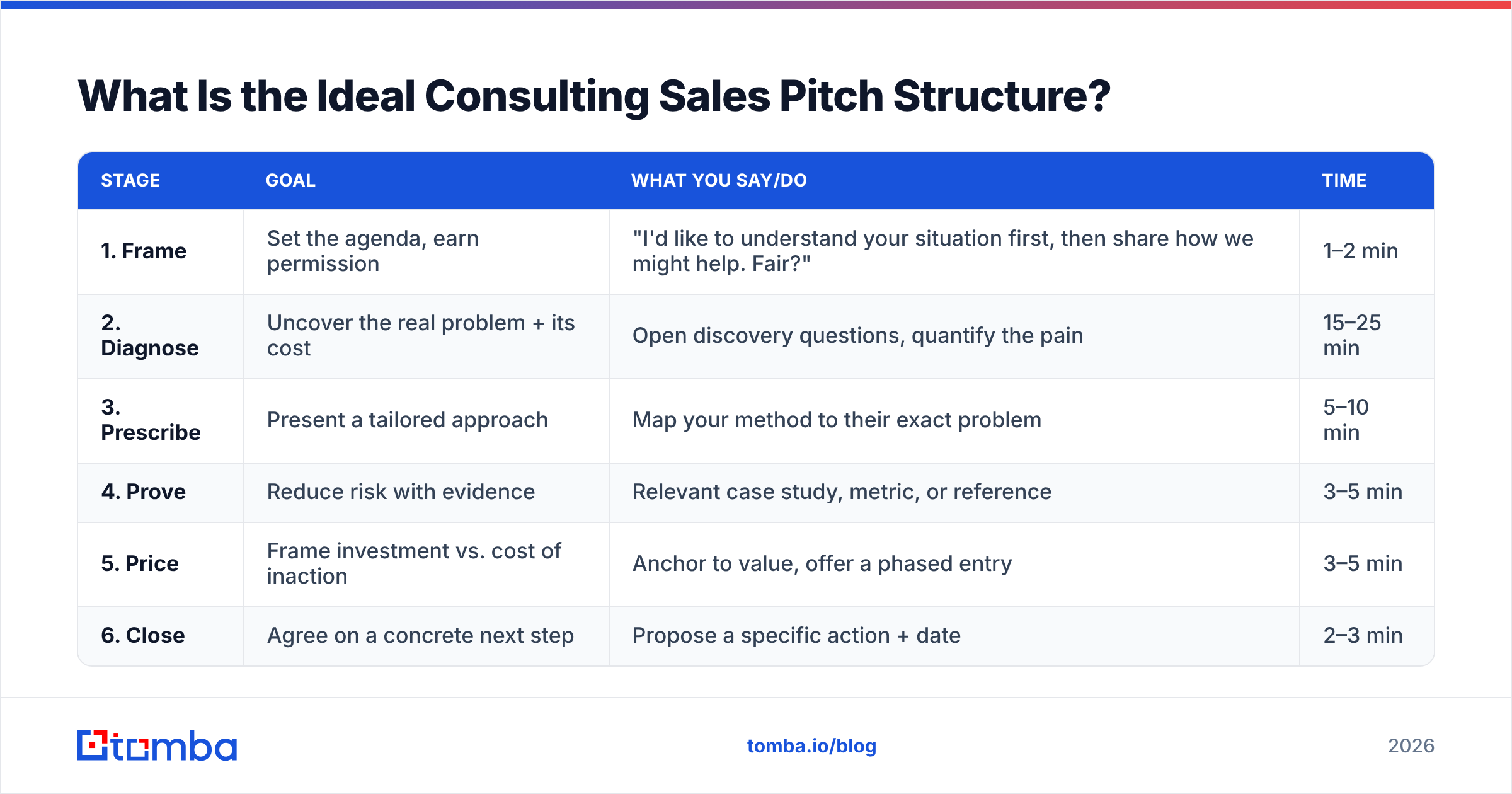
Use this six-part structure as a flexible spine, not a rigid script. Each part has one job.
| Stage | Goal | What you say/do | Time |
|---|---|---|---|
| 1. Frame | Set the agenda, earn permission | "I'd like to understand your situation first, then share how we might help. Fair?" | 1–2 min |
| 2. Diagnose | Uncover the real problem + its cost | Open discovery questions, quantify the pain | 15–25 min |
| 3. Prescribe | Present a tailored approach | Map your method to their exact problem | 5–10 min |
| 4. Prove | Reduce risk with evidence | Relevant case study, metric, or reference | 3–5 min |
| 5. Price | Frame investment vs. cost of inaction | Anchor to value, offer a phased entry | 3–5 min |
| 6. Close | Agree on a concrete next step | Propose a specific action + date | 2–3 min |
Notice that discovery (stage 2) is the longest block. That's intentional. The pitch that wins is mostly listening.
Stage 1: Frame the Conversation#
Open by setting expectations and asking permission to run discovery first. This positions you as a consultant, not a vendor waiting to present. A simple line — "Before I show you anything, I want to make sure it's actually relevant. Can I ask a few questions about where things stand?" — puts you in control while signaling respect.
Stage 2: Diagnose Before You Prescribe#
Great discovery questions do the selling. They demonstrate expertise, surface the cost of the problem, and get the buyer to articulate the pain in their own words (which is far more persuasive than you stating it). A working set:
- Situation: "Walk me through how this works today."
- Problem: "Where does it break down most often?"
- Impact: "What is that costing you — in revenue, time, or risk?"
- Consequence of inaction: "If nothing changes over the next 12 months, what happens?"
- Success criteria: "If we fixed this, what would 'great' look like to you specifically?"
The impact and consequence questions are where fees get justified. A problem quantified at $2M in lost pipeline makes a $120K engagement look obvious.
Stage 3: Prescribe a Tailored Approach#
Now — and only now — present your approach. Mirror their exact language back to them. If they said "our SDRs waste hours on bad lists," your approach should explicitly name that. The formula is: "Here's what I heard, here's how we'd fix it, here's the sequence." Keep it high-level; you're selling the destination and the safety of the route, not every turn.
Stage 4: Prove It With Evidence#
One tightly relevant case study beats five generic ones. Match the industry, company size, or problem type as closely as possible, and lead with the metric: "We did this for a 40-person B2B SaaS team and cut their sales-cycle length by 22% in one quarter." If you can offer a reference call, do — it's the single strongest risk-reducer you have.
How Do You Price a Consulting Pitch Without Scaring the Client?#
Price to value, not to time. The moment you quote a day rate, you invite the buyer to negotiate hours instead of buying an outcome. Instead, anchor the fee against the cost of the problem you quantified during discovery.

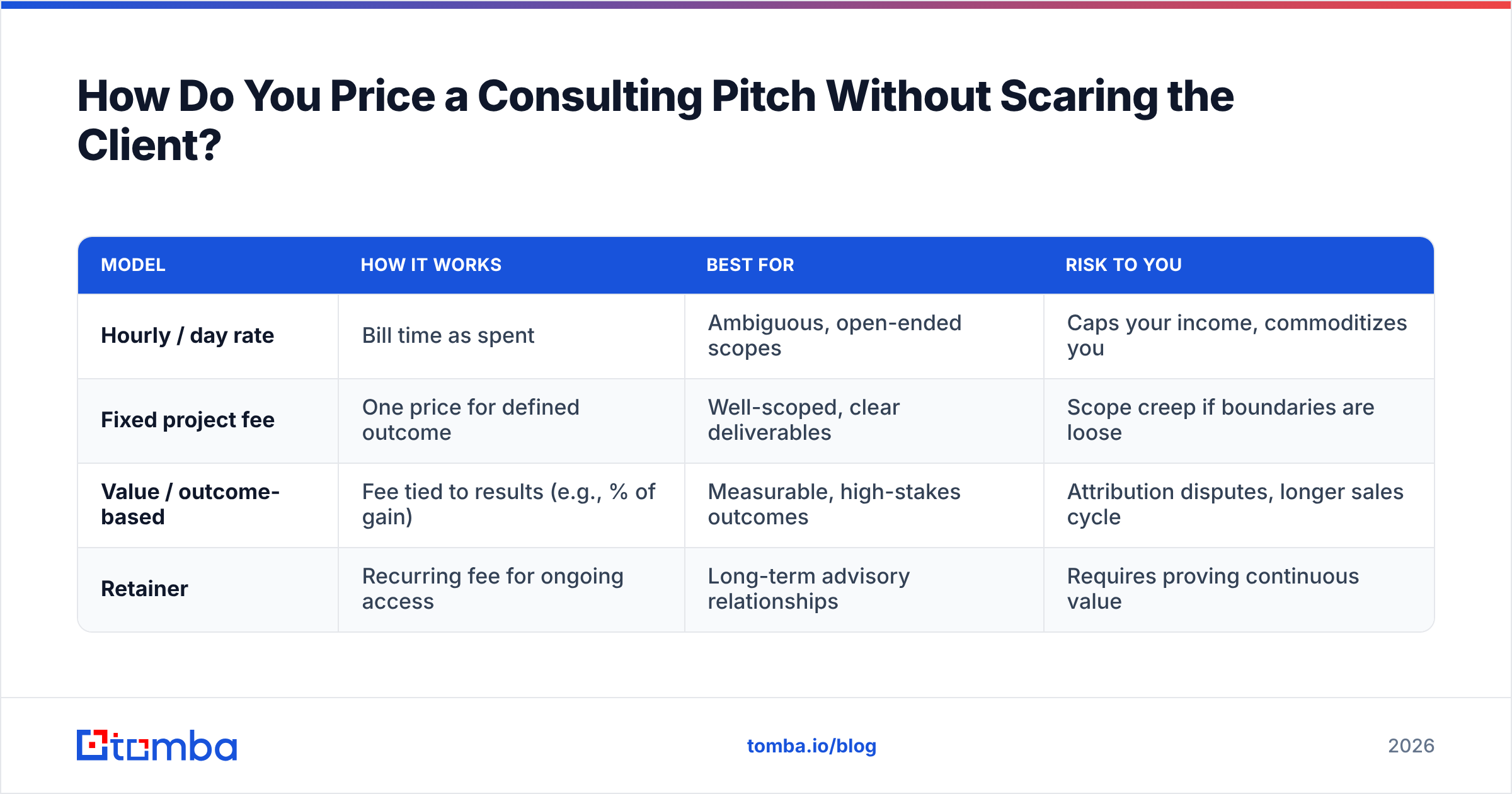
Here's how three common pricing models compare for consulting engagements:
| Model | How it works | Best for | Risk to you |
|---|---|---|---|
| Hourly / day rate | Bill time as spent | Ambiguous, open-ended scopes | Caps your income, commoditizes you |
| Fixed project fee | One price for defined outcome | Well-scoped, clear deliverables | Scope creep if boundaries are loose |
| Value / outcome-based | Fee tied to results (e.g., % of gain) | Measurable, high-stakes outcomes | Attribution disputes, longer sales cycle |
| Retainer | Recurring fee for ongoing access | Long-term advisory relationships | Requires proving continuous value |
For most first engagements, a fixed project fee with a phased entry works best. Offer a smaller, well-defined "phase one" — an audit, a strategy sprint, a pilot — that de-risks the decision and creates a natural on-ramp to a larger engagement. A buyer who won't sign a $150K annual contract will happily approve a $15K diagnostic that proves your value.
When you present the number, frame it in one sentence: "Given that this is costing you roughly $2M a year, the investment for the full engagement is $180K." Then stop talking. Silence after a price is a professional skill.
What Does a Strong Consulting Pitch Deck Include?#
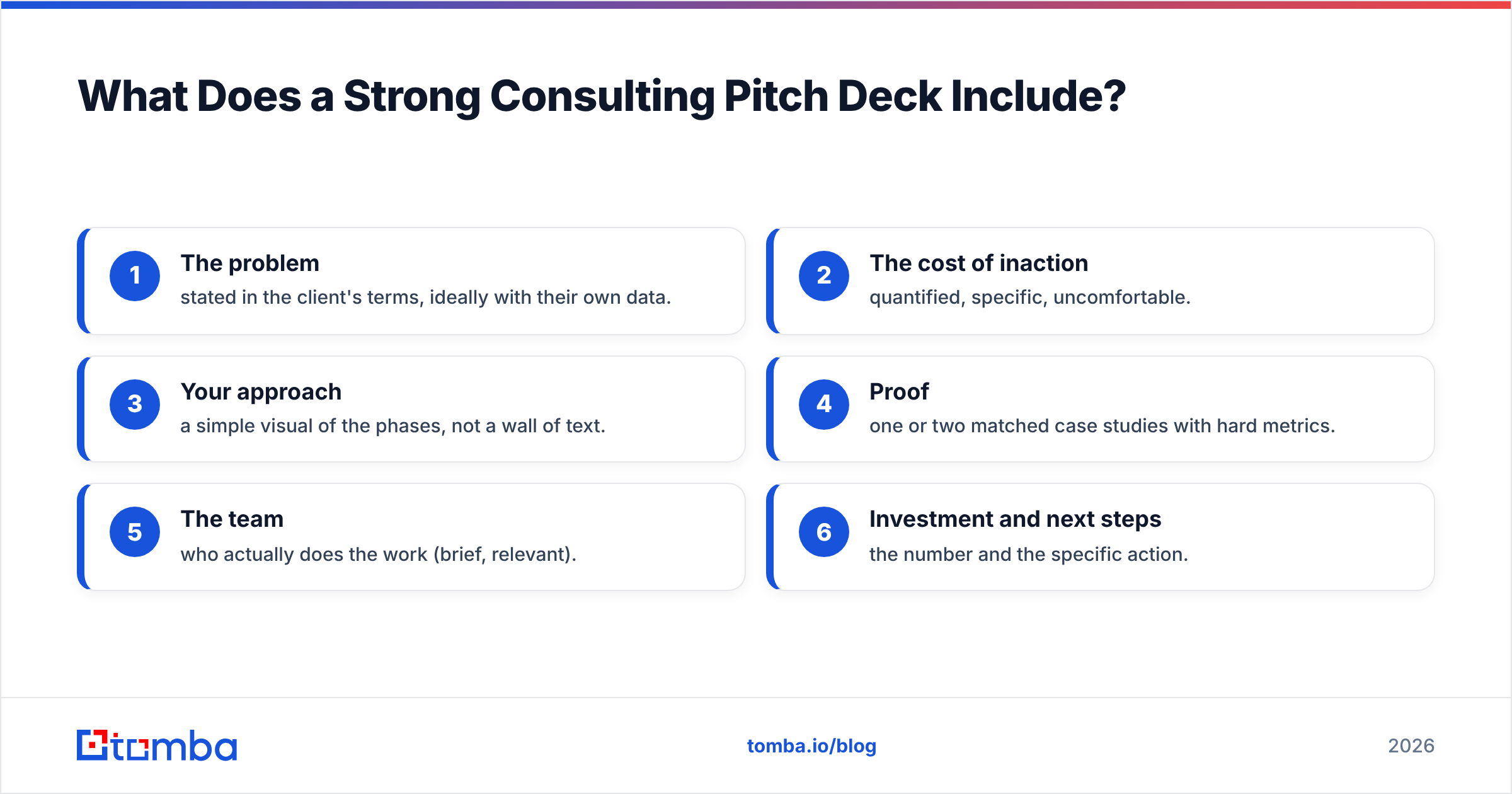
If you use a deck, keep it lean. It supports the conversation; it is not the conversation. A tight deck has these slides:
- The problem — stated in the client's terms, ideally with their own data.
- The cost of inaction — quantified, specific, uncomfortable.
- Your approach — a simple visual of the phases, not a wall of text.
- Proof — one or two matched case studies with hard metrics.
- The team — who actually does the work (brief, relevant).
- Investment and next steps — the number and the specific action.
Six to eight slides is plenty. If your deck runs 30 slides, you're presenting, not diagnosing — and you've likely lost the room. As Gartner's research on the B2B buying journey shows, buyers spend most of their time in independent research and internal discussion, not in your presentation. Your job is to arm the internal champion, not to overwhelm them.
How Do You Fill the Pipeline That Feeds the Pitch?#
The best pitch in the world is worthless without qualified people to deliver it to. This is where many independent consultants and boutique firms stall: they're excellent in the room but starved for rooms to be in.
Consistent consulting sales starts upstream, with targeted outbound to the specific decision-makers who own the problem you solve. That means building an accurate list of the right titles at the right companies — VPs, founders, heads of operations — and reaching them with a message tied to the pain you diagnose so well on calls.
This is a data problem before it's a messaging problem. Generic, scraped lists produce bounce rates that torch your sender reputation and waste your time. Accurate, verified contact data does the opposite. A tool like Tomba's email finder lets you find and verify professional email addresses by company or role, so your outreach lands with the people who can actually sign a statement of work. Pair it with an email verifier step before any send to keep your deliverability clean, and use domain search to map every relevant contact inside a target account.
The principle is simple and, once you see it, obvious: consulting is a trust business, and trust starts with reaching real people with a relevant message — never a purchased cold list.
How Should You Handle Objections During the Pitch?#
Objections are buying signals, not rejections. The prospect is telling you what's standing between them and yes. Handle the common ones with a consistent pattern: acknowledge, reframe, redirect.
- "You're too expensive." → "Compared to what? If this problem is costing $2M a year, the real question is the return, not the price." Then walk them back to the value math.
- "We could do this internally." → "You could. The question is whether it happens fast enough, and what it costs your team to learn what we already know." Reframe around speed and opportunity cost.
- "We need to think about it." → "Totally fair. What specifically do you need to feel confident? Let's address that now." Surface the real hesitation instead of letting it fester.
- "Send me some info." → Agree, but attach a next step: "I'll send a one-pager today. Can we hold 20 minutes Thursday to walk through it?"
Never argue. Your calm, curious response to an objection is itself proof that you'll be steady when their project hits turbulence.
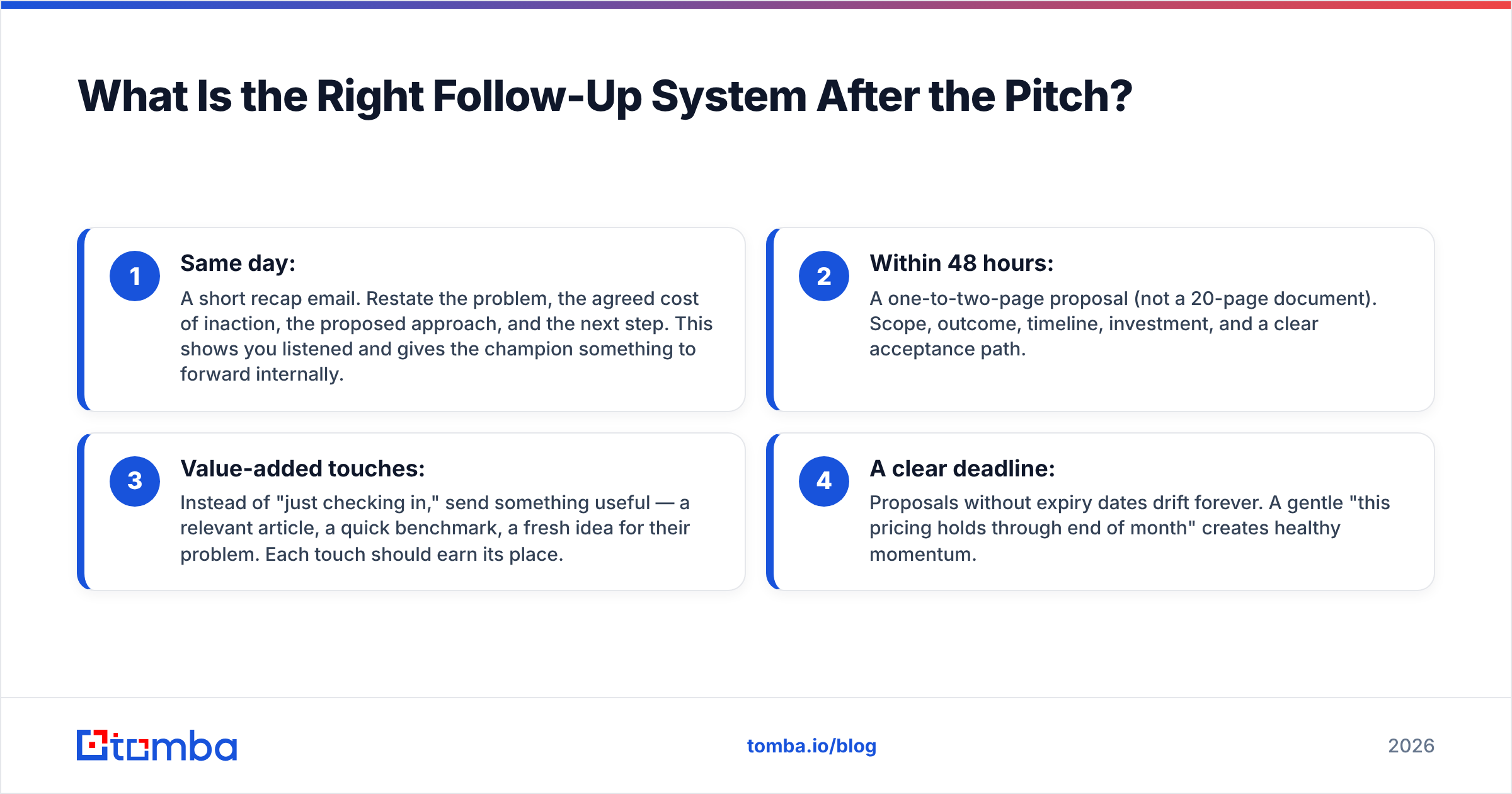
What Is the Right Follow-Up System After the Pitch?#
Most consulting deals are won or lost in the follow-up, not the meeting. The professional standard is a same-day recap and a proposal within 48 hours — while the conversation is still warm.
Your follow-up sequence:
- Same day: A short recap email. Restate the problem, the agreed cost of inaction, the proposed approach, and the next step. This shows you listened and gives the champion something to forward internally.
- Within 48 hours: A one-to-two-page proposal (not a 20-page document). Scope, outcome, timeline, investment, and a clear acceptance path.
- Value-added touches: Instead of "just checking in," send something useful — a relevant article, a quick benchmark, a fresh idea for their problem. Each touch should earn its place.
- A clear deadline: Proposals without expiry dates drift forever. A gentle "this pricing holds through end of month" creates healthy momentum.
To scale this without losing the personal touch, plug your verified contacts and notes into your CRM and let integrations handle the busywork. A steady, well-organized follow-up cadence is what separates consultants who close from those who "stay in touch" indefinitely.
Consulting Sales Pitch Checklist#
Before your next pitch, run this list:
- I know the specific business problem and its dollar cost.
- My opening frames the conversation around discovery, not my bio.
- I have five diagnostic questions ready and will listen more than I talk.
- My approach mirrors the client's exact language.
- I have one matched, metric-led case study.
- My pricing is anchored to value, with a phased entry option.
- I have a concrete next step and date to propose at the close.
- My same-day recap and 48-hour proposal are ready to go.
Close More Consulting Deals With Better Pipeline#
A sharp consulting sales pitch closes the deals in front of you. But sustainable growth comes from never running out of qualified conversations. If your calendar has gaps, the problem is upstream — you need more of the right decision-makers to pitch.
Start there. Use the Tomba Email Finder to build accurate, verified lists of the exact titles who own the problems you solve, then reach them with a message tied to the pain you diagnose so well in the room. It offers a free tier of 25 searches a month to test the data quality, with paid Tomba plans starting at $49/mo when you're ready to scale outreach. Fill the pipeline with real people, bring the structured pitch above, and let your diagnosis do the closing.
Related guides#
Ready to find emails that actually work?
Join 150,000+ professionals who stopped guessing and started sending. Free credits on signup — no credit card required.
Get the Tomba newsletter
Practical outbound tactics and product updates — once every two weeks.
About the author