Contact Enrichment Tools in 2026: The Complete Buyer's Guide
Contact enrichment tools turn a bare email or name into a full, sales-ready profile. Here's how they work, what accuracy really costs, and how the top platforms compare in 2026.
Your CRM is only as good as the data inside it. And right now, a chunk of that data is quietly rotting — people change jobs, phone numbers get disconnected, and job titles drift. Contact enrichment tools exist to fix that gap: you feed them a thin record (an email, a name, a company domain), and they hand back a complete, current profile you can actually sell to.
This guide breaks down what these tools do, how accuracy is measured, what you should pay, and how the leading platforms stack up in 2026 — written from the buyer's chair, not the vendor's.
TL;DR#
- Contact enrichment tools append missing fields (email, phone, title, company, social profiles) to partial records so your team stops selling to ghosts.
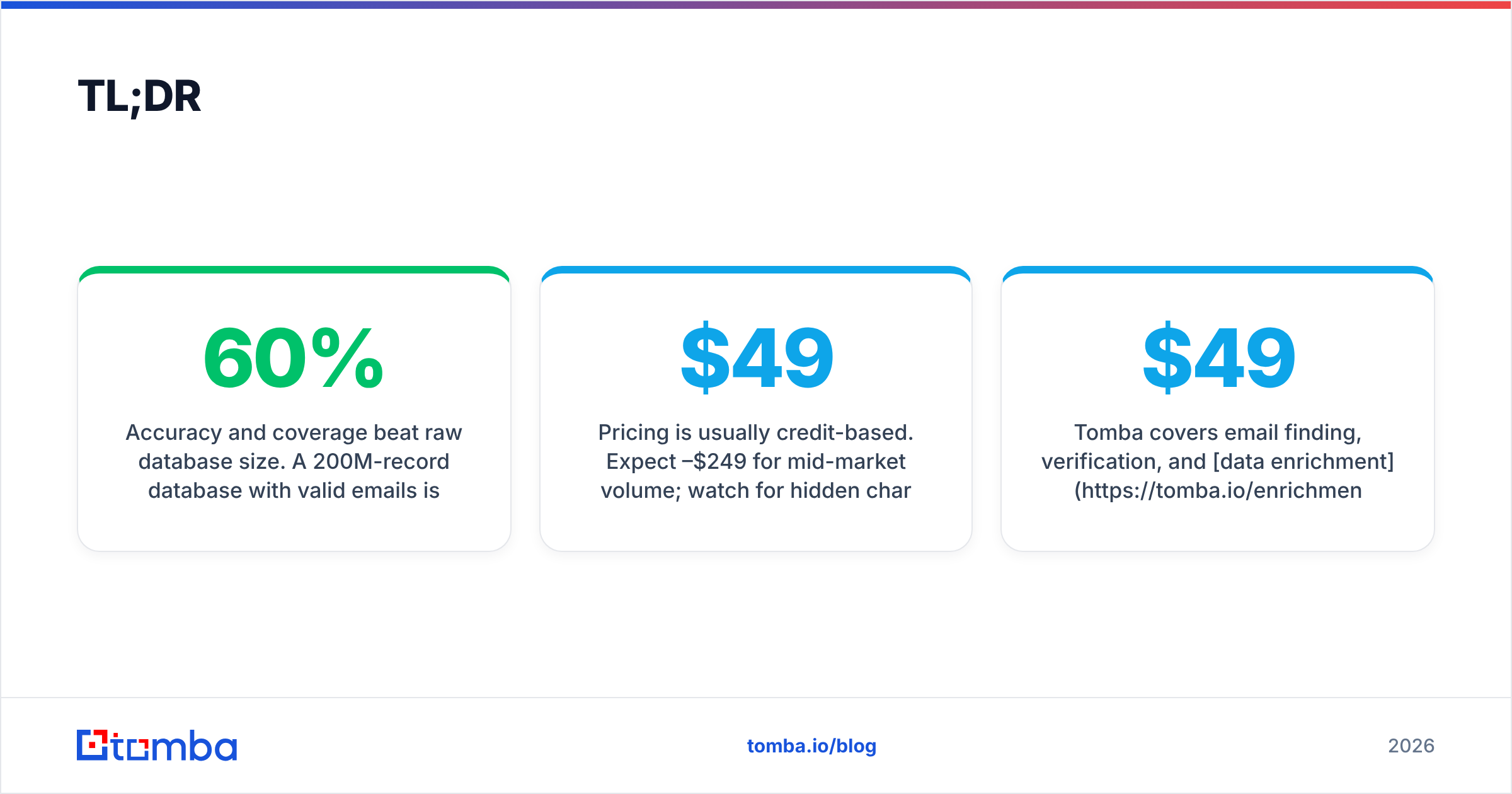
- Accuracy and coverage beat raw database size. A 200M-record database with 60% valid emails is worse than a smaller one that's 95% deliverable.
- Pricing is usually credit-based. Expect $49–$249/mo for mid-market volume; watch for hidden charges on phone numbers and re-enrichment.
- Real-time API enrichment (on form submit, on CRM create) prevents decay far better than quarterly bulk cleans.
- Tomba covers email finding, verification, and data enrichment in one stack, starting at $49/mo — a practical fit for teams that want accuracy without enterprise pricing.
What are contact enrichment tools?#
A contact enrichment tool is software that takes an incomplete contact record and fills in the blanks using external data sources. Think of it like a research assistant who takes a business card with only a name scribbled on it and comes back with the person's verified work email, direct dial, current title, company size, and LinkedIn URL — in under a second.
Under the hood, enrichment works by matching your input against a large database and live data signals, then returning structured fields. The common inputs and outputs look like this:
- From an email → full name, job title, company, seniority, social profiles, location.
- From a name + company → verified professional email and phone number.
- From a company domain → all discoverable contacts, firmographics (industry, headcount, revenue), and tech stack.
- From a phone number or social handle → reverse lookup to a person and their employer.
Enrichment is the connective tissue of modern revenue operations. Without it, reps waste hours manually researching prospects, marketing scores leads on stale attributes, and your CRM slowly fills with dead records.
Why does contact data decay so fast?#
Because people and companies never stop moving. Industry estimates from data vendors and firms like Gartner consistently peg B2B data decay at roughly 20–30% per year. That means up to a third of the contacts you collected last January are wrong by December.
The main drivers:
- Job changes — the average B2B professional switches roles every ~2–3 years, invalidating both the email and the title.
- Company events — acquisitions, rebrands, and domain migrations break email addresses overnight.
- Phone churn — direct dials get reassigned; mobile numbers change with carriers.
- Data entry rot — typos, duplicate records, and half-filled forms compound over time.
Enrichment counters decay in two ways: one-time cleanup of your existing database, and ongoing enrichment at the point of capture so records start clean and stay clean.
How do you measure a contact enrichment tool's accuracy?#
Accuracy is the whole game, and it's where marketing claims and reality diverge most. Four metrics matter more than database size:
- Match rate — of the records you submit, what percentage get any enrichment back? A low match rate means you're paying for coverage you don't get.
- Email deliverability — of the emails returned, how many actually land? This is verified against SMTP, not just guessed. Weak email deliverability tanks your sender reputation.
- Phone accuracy — direct dials and mobiles are far harder to source than emails; treat vendor phone claims skeptically.
- Freshness — how recently was the record confirmed? A 95% "accurate" database that hasn't been re-verified in 18 months is misleading.
A practical test: before you commit, run a sample of 100 known contacts through any tool's free tier and check the results against reality. Then run the returned emails through an independent email verifier to confirm the deliverability claim. Vendors that stand behind their data won't flinch at this.
Pay special attention to catch-all domains — servers that accept any address, making standard verification return "unknown." A serious tool offers a dedicated catch-all verifier so you're not gambling on those sends.
What features separate the best contact enrichment tools?#
Not every tool does everything, and you rarely need everything. Map features to your actual workflow:
- Bulk enrichment — upload a CSV or list and enrich thousands of rows at once. Essential for cleaning an existing database.
- Real-time API — enrich on the fly when a lead fills a form or a record is created in your CRM. This is the highest-ROI feature because it stops decay at the source. A capable email finder API is the backbone here.
- Native CRM integrations — direct sync to HubSpot, Salesforce, and Pipedrive means no manual export/import loops.
- Waterfall enrichment — query multiple data sources in sequence and take the first valid result, maximizing match rate.
- Compliance controls — GDPR/CCPA handling, opt-out suppression, and documented data sources matter if you sell into regulated markets or the EU.
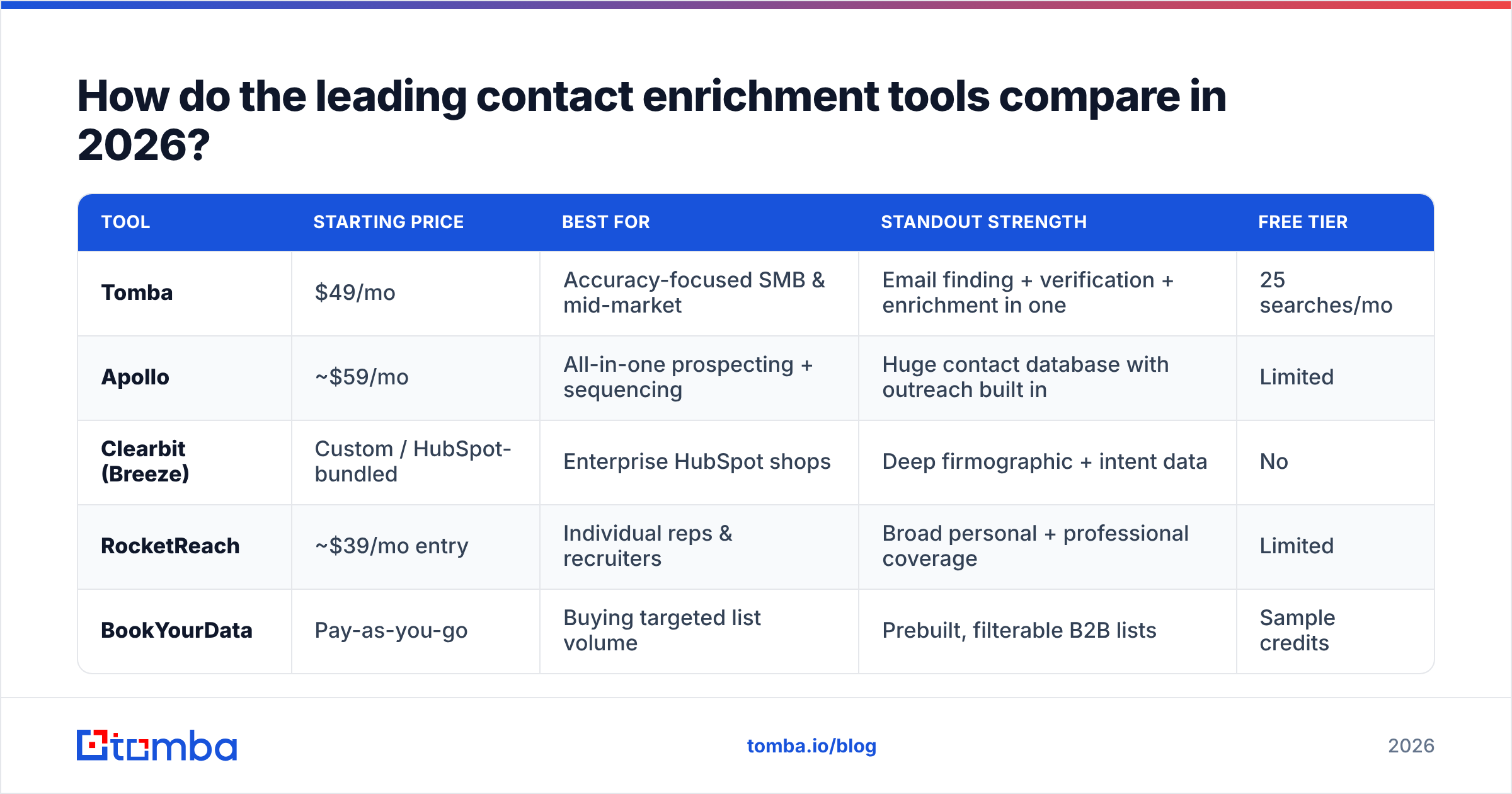
How do the leading contact enrichment tools compare in 2026?#
Here's a neutral snapshot of widely used platforms. Prices and specifics change, so always confirm on the vendor's own page before buying — links go to official sources.
| Tool | Starting price | Best for | Standout strength | Free tier |
|---|---|---|---|---|
| Tomba | $49/mo | Accuracy-focused SMB & mid-market | Email finding + verification + enrichment in one | 25 searches/mo |
| Apollo | ~$59/mo | All-in-one prospecting + sequencing | Huge contact database with outreach built in | Limited |
| Clearbit (Breeze) | Custom / HubSpot-bundled | Enterprise HubSpot shops | Deep firmographic + intent data | No |
| RocketReach | ~$39/mo entry | Individual reps & recruiters | Broad personal + professional coverage | Limited |
| BookYourData | Pay-as-you-go | Buying targeted list volume | Prebuilt, filterable B2B lists | Sample credits |
A few honest observations:
- Apollo wins on breadth — database plus sequencer in one — but bundling means you pay for outreach features even if you only need data.
- Clearbit, now folded into HubSpot's Breeze Intelligence, is excellent if you're already deep in the HubSpot ecosystem, but pricing is opaque and enterprise-oriented. Consider a Clearbit alternative if you want transparent, self-serve pricing.
- RocketReach offers wide coverage at a low entry point; a RocketReach alternative may make sense if you need higher verified-email accuracy.
- BookYourData is a strong option when you want to buy targeted, filterable lists outright rather than enrich records you already own — a different buying model that suits list-driven campaigns.
- Tomba focuses on getting the core data right — accurate emails, real verification, and enrichment — at a price that doesn't require a sales call. See full Tomba pricing for the exact tiers.

What should contact enrichment tools actually cost?#
Most tools price by credits, where one credit typically equals one enriched record or one revealed data point (an email or a phone). The traps to watch:
- Phone numbers cost more. Many vendors charge extra credits for a direct dial versus an email. Budget accordingly.
- Re-enrichment counts. If you enrich the same record again in six months to fight decay, that's usually a fresh charge.
- Match-fail billing. Confirm whether you're charged for attempts or only successful matches. Only-on-success is far friendlier.
- Annual lock-in. Steep monthly-vs-annual gaps can trap you before you've validated data quality.
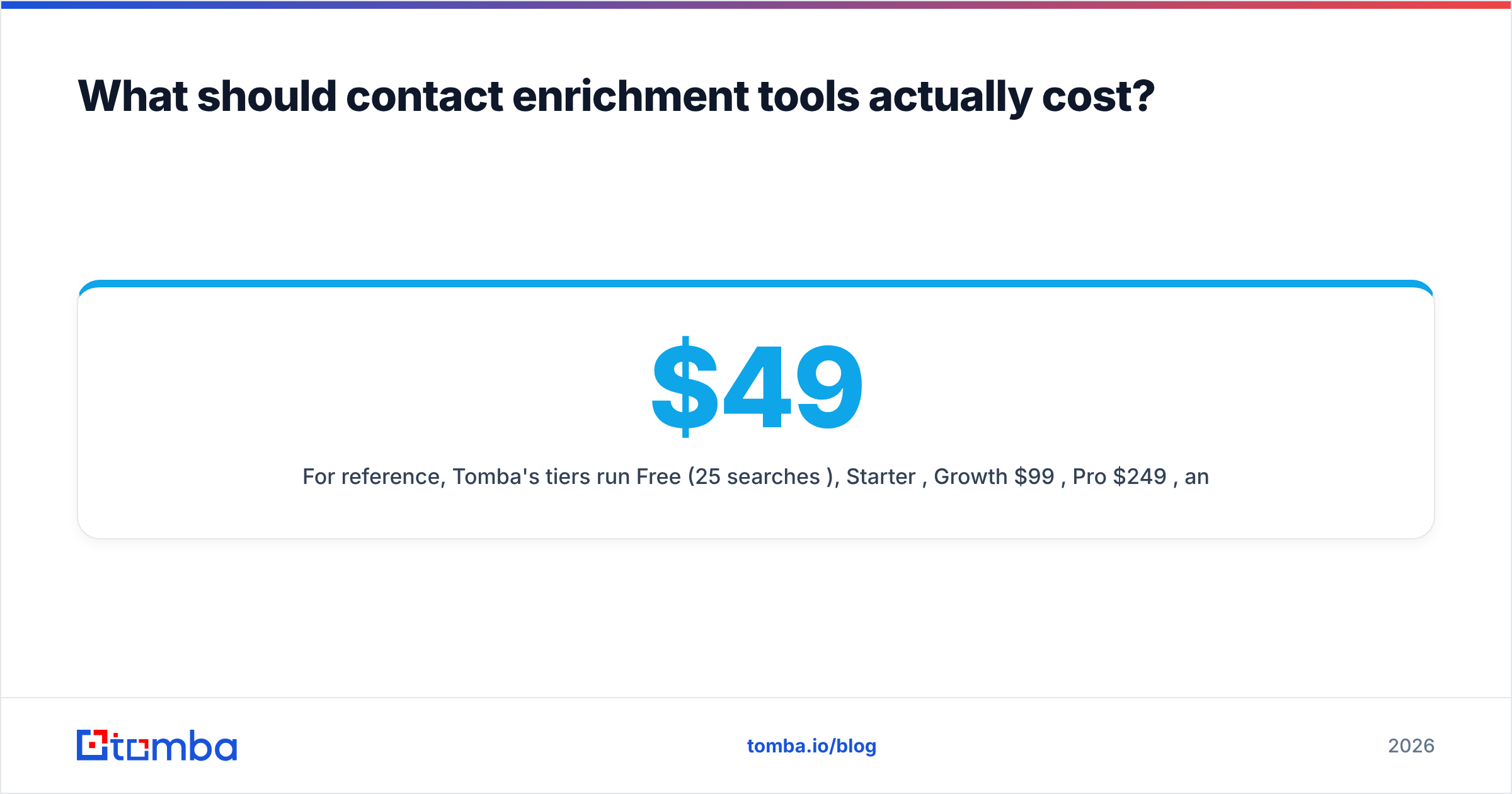
For reference, Tomba's tiers run Free (25 searches/mo), Starter $49/mo, Growth $99/mo, Pro $249/mo, and Enterprise custom — credit-based and self-serve, so you can start on the free tier and scale only when the data proves out. Run your 100-contact accuracy test on the free tier before you upgrade.
How do you roll out enrichment without breaking your CRM?#
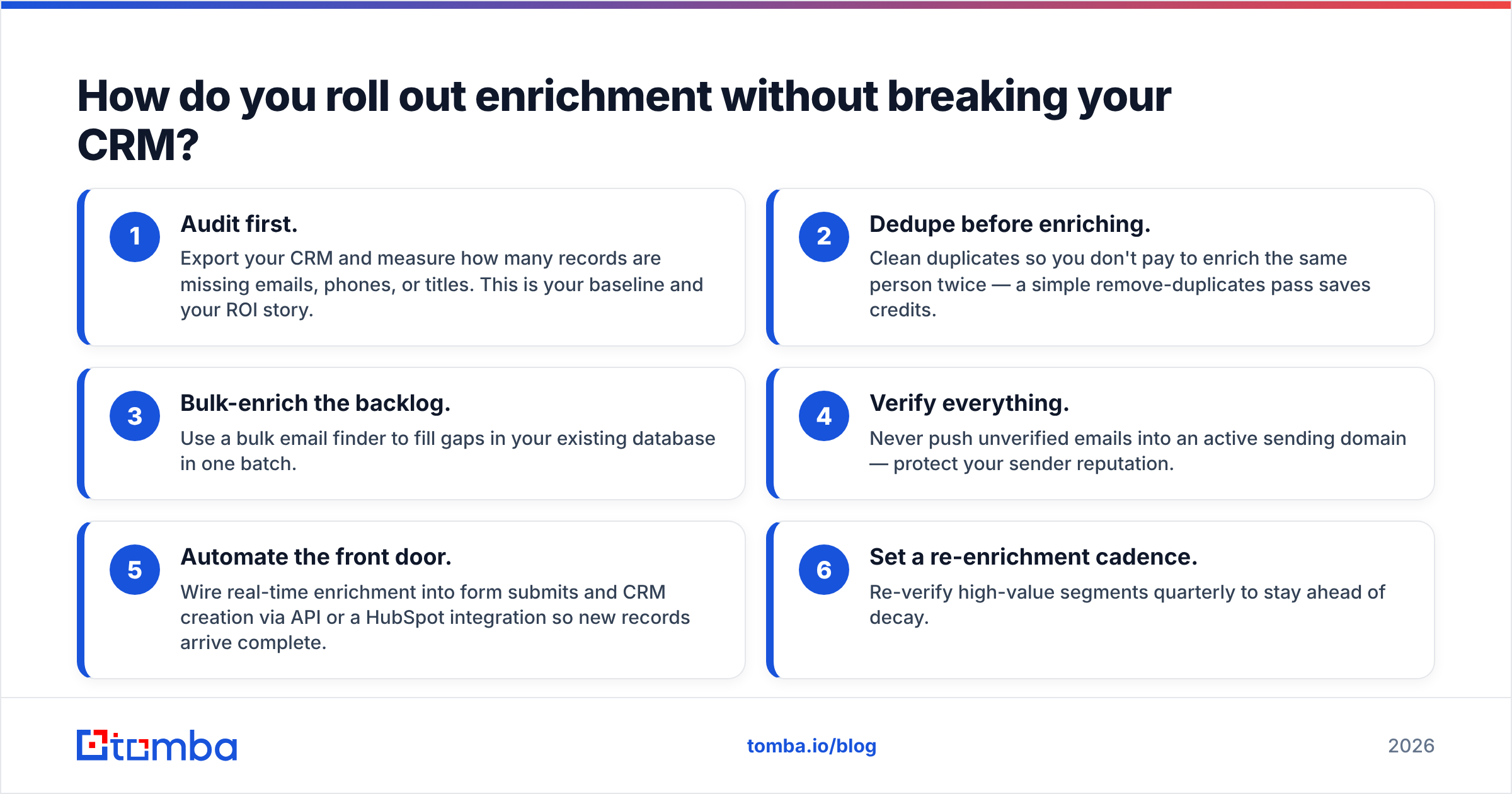
Enrichment done carelessly creates duplicates and overwrites good data. A safe sequence:
- Audit first. Export your CRM and measure how many records are missing emails, phones, or titles. This is your baseline and your ROI story.
- Dedupe before enriching. Clean duplicates so you don't pay to enrich the same person twice — a simple remove-duplicates pass saves credits.
- Bulk-enrich the backlog. Use a bulk email finder to fill gaps in your existing database in one batch.
- Verify everything. Never push unverified emails into an active sending domain — protect your sender reputation.
- Automate the front door. Wire real-time enrichment into form submits and CRM creation via API or a HubSpot integration so new records arrive complete.
- Set a re-enrichment cadence. Re-verify high-value segments quarterly to stay ahead of decay.
The teams that get the most from enrichment treat it as continuous plumbing, not a one-off spring clean.
Do you need a dedicated enrichment tool or an all-in-one platform?#
It depends on your stack and your budget.
- Choose an all-in-one (Apollo-style) if you want database, enrichment, and sequencing under one login and can accept paying for features you may not use.
- Choose a focused data tool (Tomba-style) if data quality is your priority, you already have an outreach platform you like, and you want transparent per-credit pricing.
- Choose a list vendor (BookYourData-style) if you'd rather buy targeted contacts outright than enrich records you own.
For most SMB and mid-market teams, a focused, accurate data layer plugged into their existing CRM and outreach tools delivers better ROI than a bloated suite — because the one thing every downstream tool depends on is clean, verified contact data.
Compare vendors on independent review sites like G2 before deciding, and always validate with your own sample rather than trusting star ratings alone.
The bottom line#
Contact enrichment tools are worth it — but only if the data is accurate, verified, and kept fresh. Database size is a vanity metric; match rate, deliverability, and freshness are what move pipeline. Test with a sample, watch for hidden phone and re-enrichment charges, and wire enrichment into the point of capture so records never go stale in the first place.
If you want accurate emails, real verification, and enrichment in one place without an enterprise contract, start with the Tomba Email Finder and its enrichment suite. The free tier gives you 25 searches to run your own accuracy test — enrich a real list, verify the results, and let the data quality make the decision for you. Clean data in, more replies out.
Related guides#
Ready to find emails that actually work?
Join 150,000+ professionals who stopped guessing and started sending. Free credits on signup — no credit card required.
Get the Tomba newsletter
Practical outbound tactics and product updates — once every two weeks.
About the author