Contact-Level ABM in 2026: The Complete Playbook Guide
Account-based marketing wins deals at the account level, but pipeline is built one human at a time. Here's how contact-level ABM works in 2026 — and how to run it without burning budget.
TL;DR
- Account-level ABM picks the logo. Contact-level ABM reaches the humans who actually sign. Most "ABM programs" stall for one reason: they target companies but never build the named-contact layer underneath.
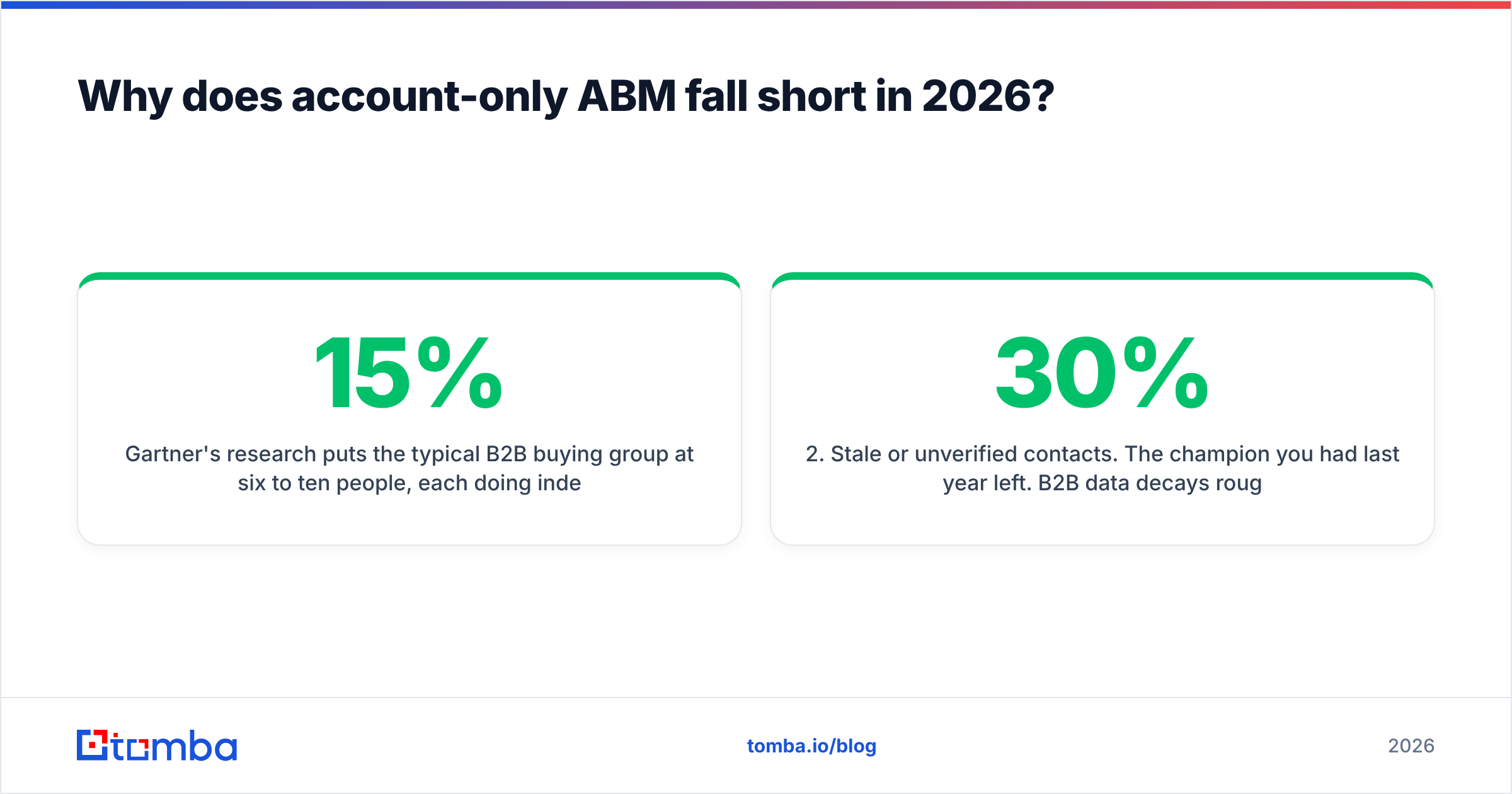
- A B2B deal now involves 6–10 buying-group members (Gartner). Engage just 1 of them and you are running account-based hope, not account-based marketing.
- Contact-level ABM means three moves: map the buying group per account, enrich each contact with a verified email and role, then sequence messaging by role. It is not one generic play blasted at a domain.
- The bottleneck is almost never strategy. It is clean, verified contact data: the right people, the right titles, the right inboxes.
- You can start this quarter. All you need is your target-account list, a domain-search and verification workflow, and a simple role-to-message map. No six-figure platform required.
What is contact-level ABM?#
Contact-level ABM is account-based marketing run at the level of the individual buyer, not the company. Same accounts, sharper focus.
Think of it like fishing. Account-level ABM tells you which lake holds the fish. Contact-level ABM tells you where each fish sits, what it eats, and which bait it takes. You still care about the lake. You just stop casting blind.
In practice, you keep a named list for every target account. That list holds the specific people in the buying group: the economic buyer, the champion, the technical evaluator, the blocker, and the end users. Each person gets a verified email, a checked title, and a message track matched to what their role cares about.
This matters because accounts don't buy — people do. A logo cannot reply to your email. A logo cannot forward your case study to procurement. A VP of RevOps can. The whole point of revenue operations is to make sure your go-to-market motion reaches those humans. You want a reliable path to real inboxes, not hope that a "targeted" campaign finds them.

Why does account-only ABM fall short in 2026?#
Account-only ABM falls short because a modern B2B purchase is a committee decision. And committees are made of contacts you have to name.
Gartner puts the typical B2B buying group at six to ten people. Each one does their own research before the group agrees. Say your ABM plan reaches the CEO's generic inbox and nobody else. You have covered maybe 10–15% of the decision. The other 85% never hears from you. Those are often the people who kill deals.
Here's the outcome most teams walk into:

They buy an intent tool. They load 500 dream accounts. They launch display ads to those domains and celebrate "ABM." Six weeks later the pipeline is flat. Nobody ever built the contact layer. The ads warmed a logo. No human was ever reachable.
The three failure modes of account-only ABM:
- No named buying group. You know the company is in-market. You don't know who to email.
- Stale or unverified contacts. The champion you had last year left. B2B data decays roughly 22–30% per year. A list built in 2024 is badly wrong by 2026.
- One message for the whole account. A CFO and a DevOps lead do not care about the same thing. Generic messaging converts like generic messaging.
Contact-level ABM vs account-level ABM: what's the difference?#
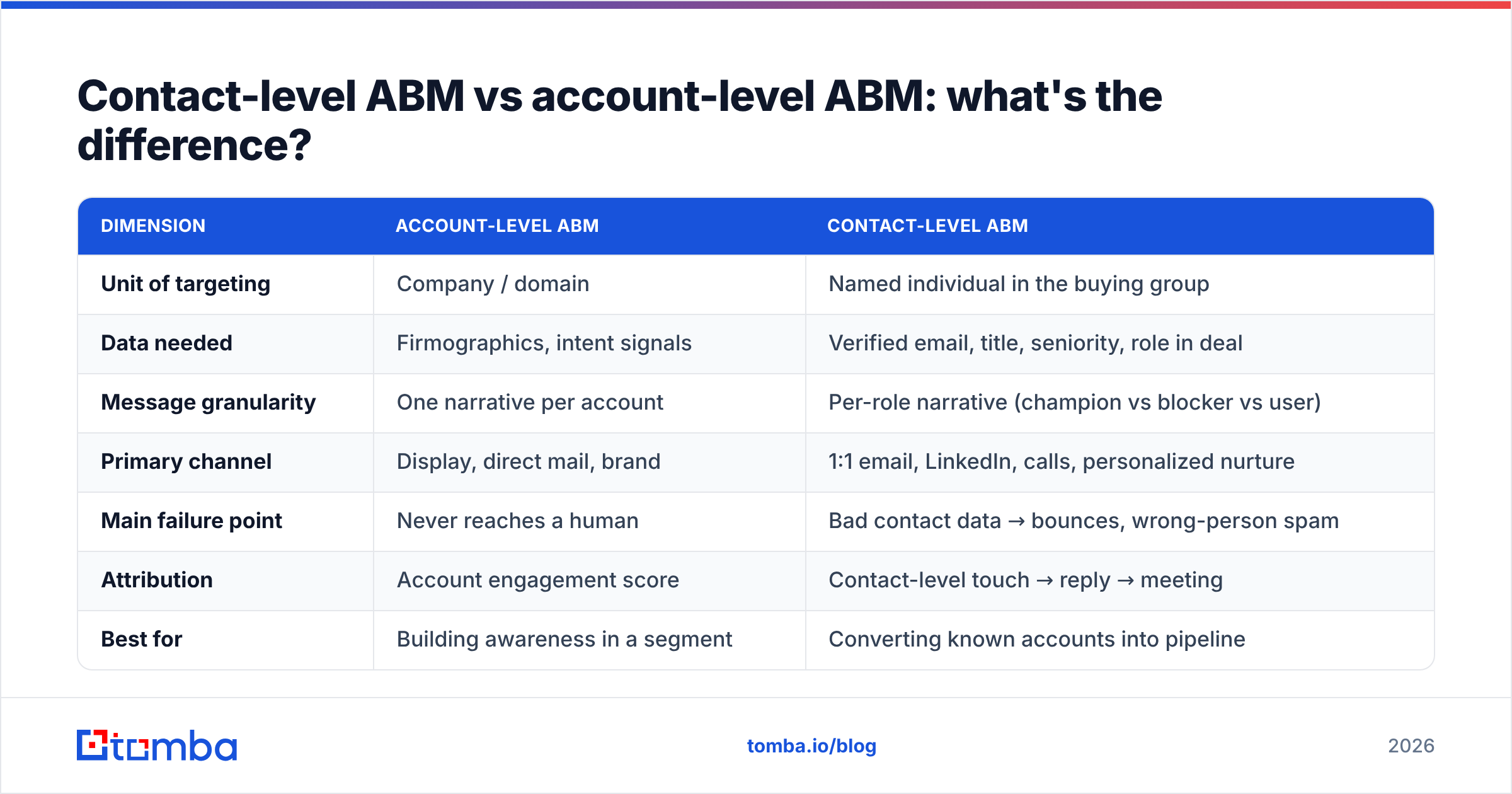
The two aren't rivals. Contact-level ABM is the execution layer that makes account selection pay off. Here's the honest side-by-side.
| Dimension | Account-Level ABM | Contact-Level ABM |
|---|---|---|
| Unit of targeting | Company / domain | Named individual in the buying group |
| Data needed | Firmographics, intent signals | Verified email, title, seniority, role in deal |
| Message granularity | One narrative per account | Per-role narrative (champion vs blocker vs user) |
| Primary channel | Display, direct mail, brand | 1:1 email, LinkedIn, calls, personalized nurture |
| Main failure point | Never reaches a human | Bad contact data → bounces, wrong-person spam |
| Attribution | Account engagement score | Contact-level touch → reply → meeting |
| Best for | Building awareness in a segment | Converting known accounts into pipeline |
| Realistic start cost | Intent platform ($$$) | Target list + email finder + verifier ($) |
The takeaway: account-level ABM is a filter. Contact-level ABM is the conversion engine. You need the filter to avoid wasting effort on bad-fit accounts. But the filter alone never generated a reply. The contact layer does.
How do you build a contact-level ABM program?#
You build it in five steps. Only one of them gets expensive, and only if you let it. Conclusion first: the whole thing lives or dies on contact data quality. Treat that as the load-bearing wall, not an afterthought.
1. Lock your target account list#
Start with accounts you already believe in. Use your ICP-fit list from sales, your closed-lost re-engage list, or accounts showing MQL-level intent. Keep it tight. Fifty accounts you can cover deeply beat 500 you can only spam.
2. Map the buying group per account#
For each account, define the roles you need to reach. A workable default committee:
- Economic buyer — controls budget (VP, C-level).
- Champion — feels the pain, wants a fix, sells for you inside the company.
- Technical evaluator — checks whether it actually works.
- End user — lives in the product daily.
- Blocker — security, legal, procurement, finance.
You don't need all five at every account. But naming the roles forces you to find real humans instead of emailing info@.
3. Find and verify the contacts#
This step quietly decides everything. For each named role you need a real, deliverable email address. Use domain search to pull the known contacts and email pattern for each company. Then find email addresses for the specific people your buying-group map calls for.
Then run every address through an email verifier before it enters a sequence. This part is non-negotiable. Unverified contact-level ABM isn't precision marketing. It's a bounce-rate generator. High bounces torch your sender reputation and quietly drop your whole domain into spam folders. Many enterprises use catch-all domains. For those, a dedicated catch-all verifier tells you which addresses are safe to send to instead of guessing.
4. Enrich each contact with role context#
An email address alone doesn't tell you how to write. Add title, seniority, department, and location. Now you can route each contact to the right message track. Data enrichment turns a bare address into a targeting profile. That's the difference between "Hi there" and "Hi Dana, saw RevOps owns your lead-routing rebuild."
5. Sequence messaging by role, not by account#
Now you write per role, not per company. The champion gets pain and proof. The economic buyer gets the business case and ROI. The technical evaluator gets docs, security posture, and an API reference. Same account, three distinct conversations. Time them for the same weeks so the buying group starts talking to each other.
What data quality does contact-level ABM require?#
It requires verified, current, role-tagged contacts. That bar is stricter than for any other outbound motion. ABM puts all your effort on a small, expensive set of accounts.
At broad-outbound scale, a 5% bad-data rate is annoying. Contact-level ABM is different. You might have only four contacts at a $200k-ACV account. One wrong or bounced address can mean you never reach the real decision-maker. And you spent a quarter cultivating that deal. A bad record costs far more when the record is rare and valuable.
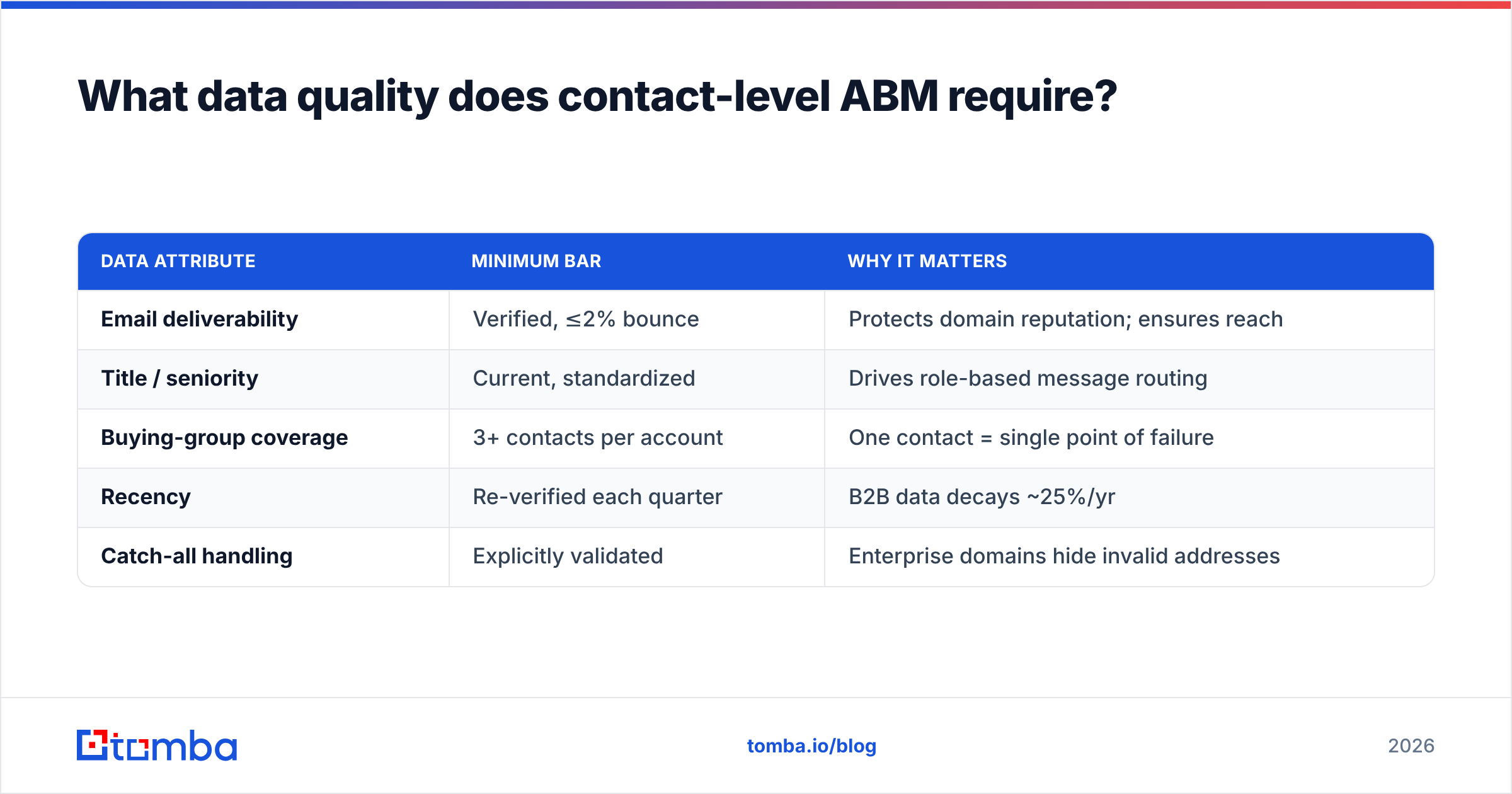
A practical data-quality bar for contact-level ABM:
| Data attribute | Minimum bar | Why it matters |
|---|---|---|
| Email deliverability | Verified, ≤2% bounce | Protects domain reputation; ensures reach |
| Title / seniority | Current, standardized | Drives role-based message routing |
| Buying-group coverage | 3+ contacts per account | One contact = single point of failure |
| Recency | Re-verified each quarter | B2B data decays ~25%/yr |
| Catch-all handling | Explicitly validated | Enterprise domains hide invalid addresses |
For programs running hundreds of accounts, doing this by hand doesn't scale. A bulk email finder plus scheduled re-verification keeps the whole set fresh. You won't need a full-time data VA. Curious how the records are sourced and scored? Tomba documents its data sources openly.
Want a broader view? Gartner's B2B buying journey research and HubSpot's account-based marketing guide are both solid, vendor-neutral primers. Both explain why the committee — not the company — is the real unit of the sale.
How do you measure contact-level ABM?#
Measure at the contact level first. Then roll up to the account. Account-only metrics hide the one thing this method is built to fix: whether you reach the right humans.
Track these tiers:
- Coverage — % of target accounts with 3+ verified, role-mapped contacts. This is your leading indicator. Low coverage guarantees low pipeline, no matter how good the messaging.
- Reach — % of named contacts your emails actually land with (the inverse of bounce plus spam). If reach is low, stop and fix data before you spend on creative.
- Engagement — replies and meetings per role. Watch which roles engage. If champions reply but economic buyers never do, your business-case track is weak.
- Multi-threading — average engaged contacts per opportunity. Deals with 3+ engaged contacts close at much higher win rates than single-threaded ones.
- Pipeline & velocity — sourced and influenced pipeline, plus time-to-close for ABM accounts versus your baseline.
The mindset shift is simple. An account "engagement score" that can't name the person who engaged is a vanity metric. Contact-level attribution tells you the champion opened three emails and booked a call. That's something a rep can act on.
Do you need an expensive ABM platform to start?#
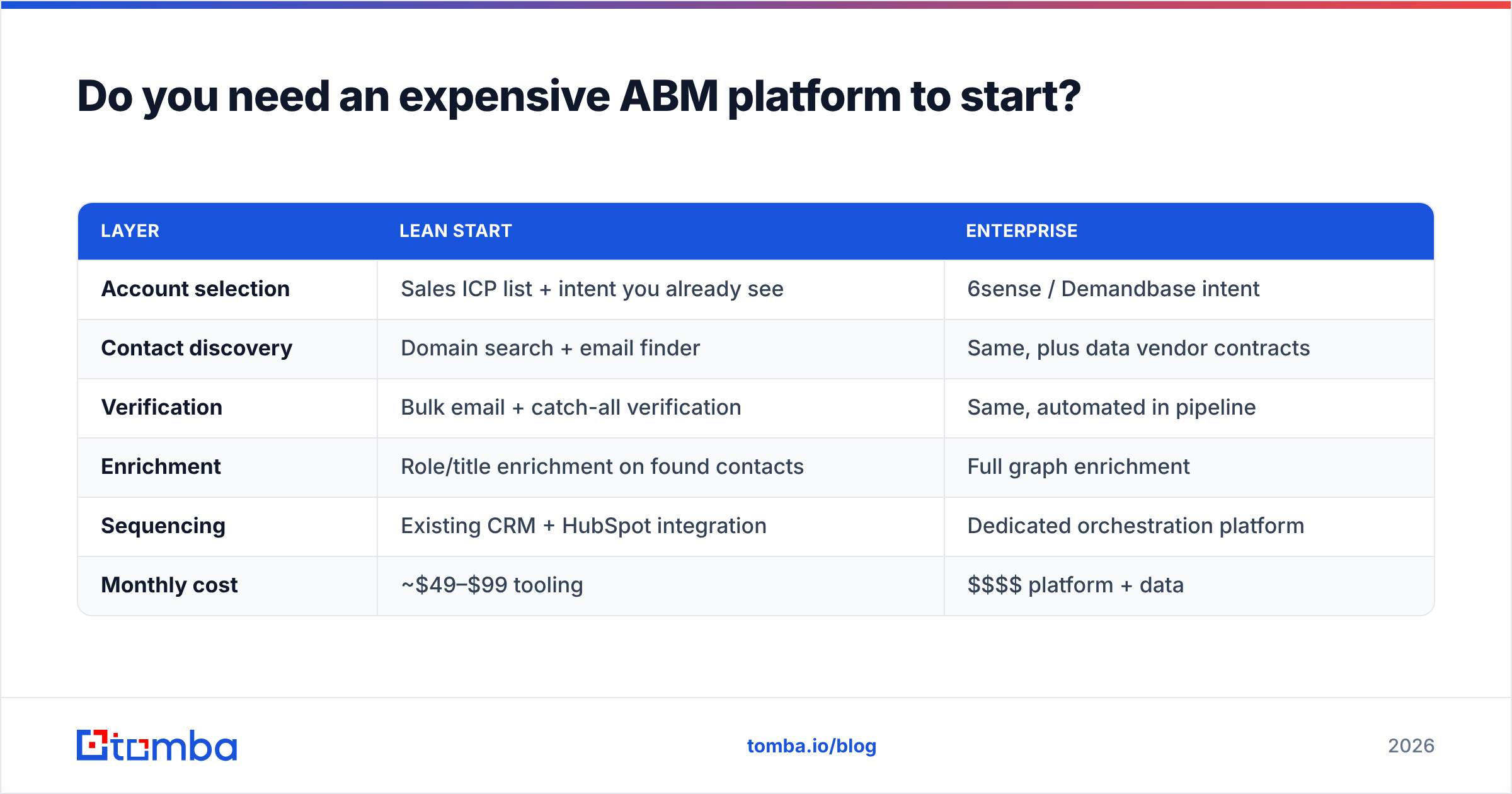
No. The strategy is free. The execution needs good contact data and a way to sequence. You can run a credible contact-level ABM pilot with three things: a target list you already have, a find-and-verify workflow, and any email or CRM you already use.
Here's a lean starting stack versus the enterprise version:
| Layer | Lean start | Enterprise |
|---|---|---|
| Account selection | Sales ICP list + intent you already see | 6sense / Demandbase intent |
| Contact discovery | Domain search + email finder | Same, plus data vendor contracts |
| Verification | Bulk email + catch-all verification | Same, automated in pipeline |
| Enrichment | Role/title enrichment on found contacts | Full graph enrichment |
| Sequencing | Existing CRM + HubSpot integration | Dedicated orchestration platform |
| Monthly cost | ~$49–$99 tooling | $$$$ platform + data |
Most teams over-buy the platform and under-invest in the contact layer. Then they wonder why the expensive tool didn't book meetings. Reverse it. Nail contact coverage and verification first — see Tomba pricing for where a lean data layer starts. Add orchestration only once the motion is proven. And compare tooling honestly on a review site like G2 before you sign anything annual.
Common mistakes that kill contact-level ABM#
Learn these before you spend a quarter learning them the hard way:
- Skipping verification. This is the fastest way to wreck a program. High bounces on a concentrated send flag your domain. That suppresses every future email, including to the accounts you care about most.
- Single-threading. One contact per account is fragile. One resignation, one "not my area," or one ignored email ends the whole play.
- Same message to every role. Account-level personalization ("Hi Acme!") is not personalization. Role is where relevance lives.
- Set-and-forget data. A contact list is a depreciating asset. Re-verify each quarter or it quietly rots.
- Vanity account scoring. If your dashboard can't name the engaged human, it can't guide a rep's next move.
Frequently asked questions#
Is contact-level ABM just prospecting with extra steps? No. The difference is the account filter. Prospecting starts from a persona and finds anyone who fits. Contact-level ABM starts from a chosen account and finds the specific people inside it, then coordinates messaging across the buying group.
How many contacts per account do I need? Aim for at least three engaged roles. Ideally cover the economic buyer, the champion, and the evaluator. Single-threaded deals are fragile.
What's the biggest hidden cost? Bad data. Not the tooling line item. It's the deals you never reach because the one contact you had was wrong, gone, or bounced.
Can I run this without a dedicated ABM tool? Yes. A target list, an email finder, a verifier, and your existing CRM are enough to prove the motion before you buy a platform.
Ready to build the contact layer?#
Contact-level ABM only works when the humans behind your target logos are real, current, and reachable. That's the wall everything else leans on. It's also the cheapest part to get right if you start now.
Point the Tomba Email Finder at your target-account list. Map the buying group per account. Verify every address before it enters a sequence. You'll turn a list of logos into a list of named, reachable buyers. That's the difference between account-based hope and account-based marketing that books meetings. Start free with 25 searches and build your first ten accounts today.
Related guides#
Ready to find emails that actually work?
Join 150,000+ professionals who stopped guessing and started sending. Free credits on signup — no credit card required.
Get the Tomba newsletter
Practical outbound tactics and product updates — once every two weeks.
About the author