Contact Level Advertising: The 2026 Playbook for B2B Teams
Contact level advertising puts your ads in front of named buyers from your CRM instead of broad lookalike audiences. Here is how it works, what it costs, and when it actually beats account-based ads.
Contact level advertising is the practice of serving paid ads to specific, named individuals from your own contact records rather than to broad interest-based or lookalike audiences. Instead of buying impressions against "VPs of Marketing at SaaS companies," you upload a list of the exact 800 people you already want to reach and pay only to influence them. It sits one layer deeper than account-based advertising, and when your contact data is clean, it is one of the most efficient paid channels a B2B team can run.
This guide breaks down what the tactic is, how the major ad platforms support it, what it costs, where it beats account-based ads, and the data-quality work that decides whether it succeeds or quietly burns your budget.
TL;DR#
- Contact level advertising targets known individuals by email or profile, not anonymous audiences — it is the paid-media twin of your outbound list.
- It works by uploading hashed contact lists to platforms like LinkedIn, Google, and Meta, which match them to real user accounts.
- Match rates make or break it. A list matches at 30–70% depending on data freshness, so verified, enriched contact data is the single biggest lever.
- It complements — not replaces — account-based advertising and cold email; the same clean contact list feeds all three.
- Budget realistically: expect higher CPMs than broad targeting, offset by far less wasted spend on the wrong people.
What is contact level advertising?#
Contact level advertising means running paid campaigns aimed at a defined list of individual people you have identified by name, email, or professional profile. The audience is not inferred from behavior or job-title filters — it is a literal roster of humans you chose.
Think of it like the difference between billboards and personalized mail. A billboard on the highway reaches everyone who drives past and hopes a few are buyers. Contact level advertising is closer to a hand-addressed envelope: you already know who you want in the room, and you are paying the postage to reach exactly them. Technically, it works by matching your contact identifiers to a platform's logged-in user base so your creative only spends impressions on people already in your target set.
This is why it lives inside the modern revenue operations and GTM stack. The same contact list that powers a sales sequence can be pushed into an ad platform, so a prospect sees your LinkedIn ad on Monday, gets a relevant email Wednesday, and recognizes your name when an SDR calls Friday. That coordinated pressure is the entire point.

How is it different from account-based advertising?#
Account-based advertising targets companies. Contact level advertising targets people inside those companies. The distinction sounds small but changes everything about precision, cost, and measurement.
With account-based ads, you tell the platform "show this to anyone at Acme Corp." That reaches the CFO you care about and also the summer intern, the warehouse staff, and three departments that will never buy. With contact level targeting, you name the seven people on the buying committee and only pay to reach them.
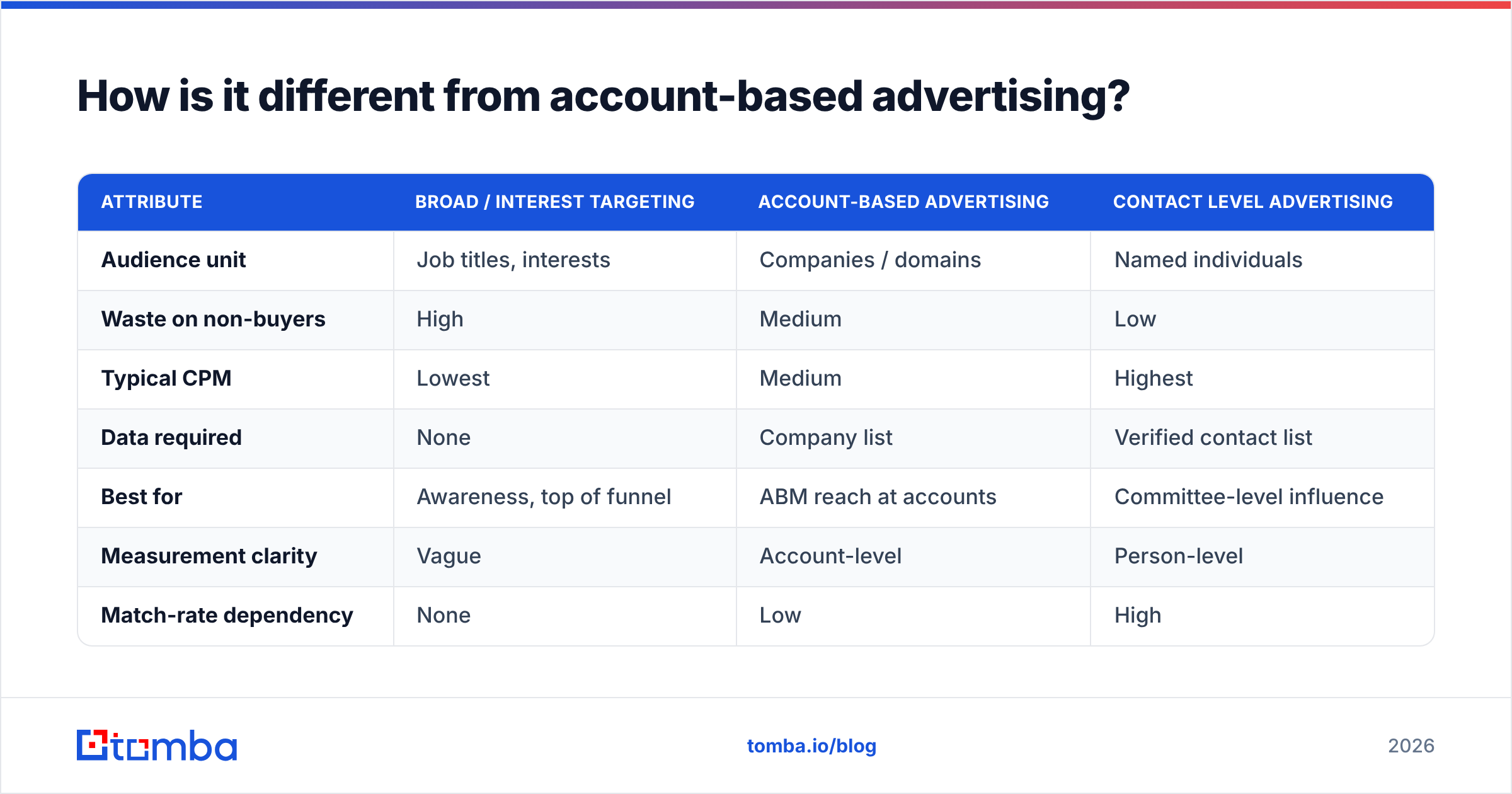
Here is how the two approaches — plus broad targeting — stack up:
| Attribute | Broad / Interest Targeting | Account-Based Advertising | Contact Level Advertising |
|---|---|---|---|
| Audience unit | Job titles, interests | Companies / domains | Named individuals |
| Waste on non-buyers | High | Medium | Low |
| Typical CPM | Lowest | Medium | Highest |
| Data required | None | Company list | Verified contact list |
| Best for | Awareness, top of funnel | ABM reach at accounts | Committee-level influence |
| Measurement clarity | Vague | Account-level | Person-level |
| Match-rate dependency | None | Low | High |
Neither is strictly "better." Broad targeting fills the top of the funnel cheaply. Account-based ads warm up whole organizations. Contact level advertising concentrates spend on the individuals who actually sign, which is why it usually delivers the tightest cost-per-opportunity once you have committee-level data.
How does contact level advertising work on the major platforms?#
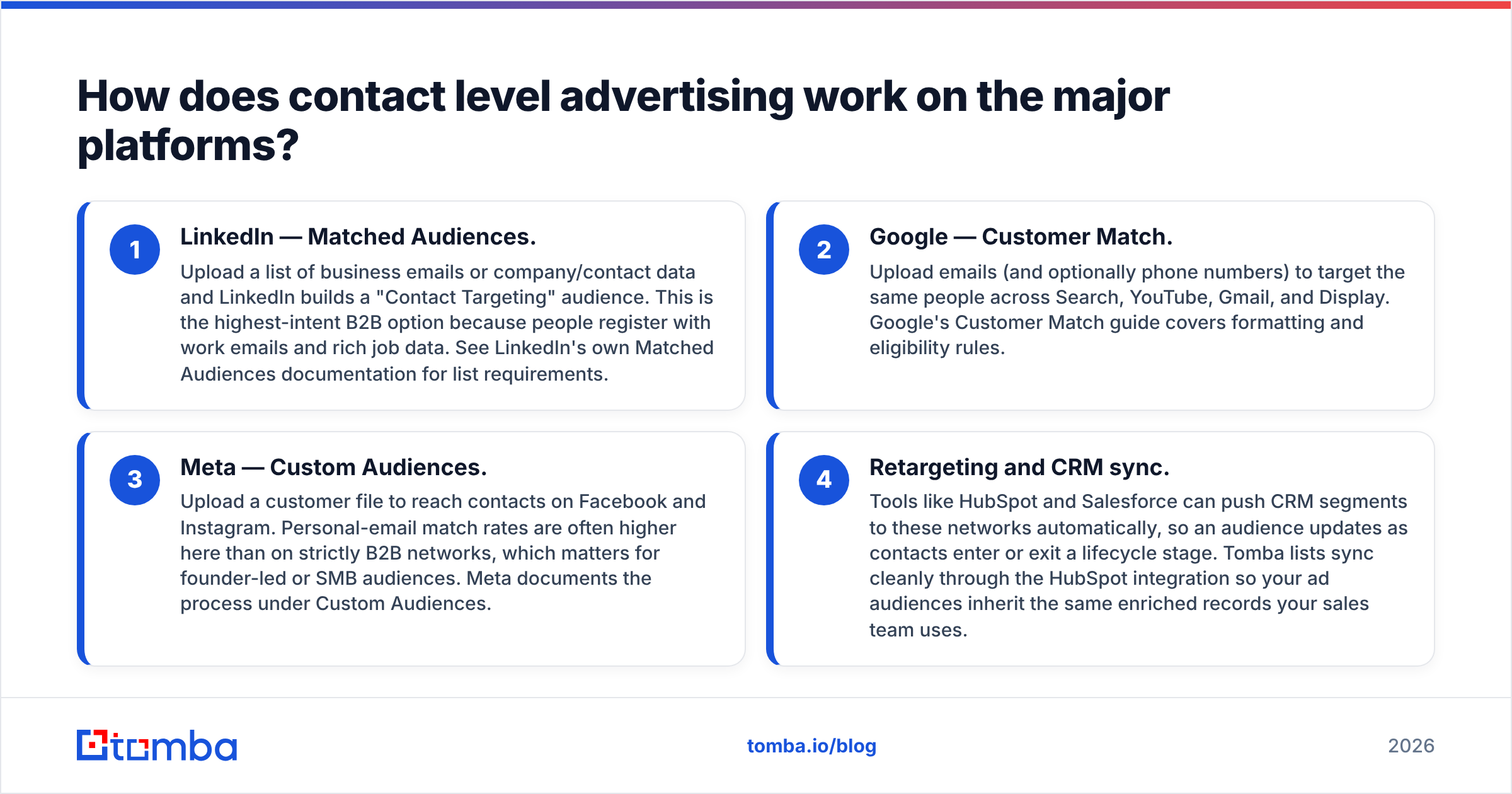
Every major ad network supports uploading a first-party contact list and matching it to real users. The mechanics are similar: you provide hashed identifiers (usually email addresses), the platform matches them against logged-in accounts, and you get an addressable audience — never the raw match list back.
LinkedIn — Matched Audiences. Upload a list of business emails or company/contact data and LinkedIn builds a "Contact Targeting" audience. This is the highest-intent B2B option because people register with work emails and rich job data. See LinkedIn's own Matched Audiences documentation for list requirements.
Google — Customer Match. Upload emails (and optionally phone numbers) to target the same people across Search, YouTube, Gmail, and Display. Google's Customer Match guide covers formatting and eligibility rules.
Meta — Custom Audiences. Upload a customer file to reach contacts on Facebook and Instagram. Personal-email match rates are often higher here than on strictly B2B networks, which matters for founder-led or SMB audiences. Meta documents the process under Custom Audiences.
Retargeting and CRM sync. Tools like HubSpot and Salesforce can push CRM segments to these networks automatically, so an audience updates as contacts enter or exit a lifecycle stage. Tomba lists sync cleanly through the HubSpot integration so your ad audiences inherit the same enriched records your sales team uses.
The common thread: you supply the identity, the platform supplies the reach. Whichever network you choose, the quality of your uploaded list determines how many of your target people you actually get to touch.
What match rate should you expect, and why does it decide everything?#
Match rate is the percentage of your uploaded contacts a platform can tie to a real, active user account. It is the number that quietly decides whether a contact level campaign is a scalpel or a money pit.
Upload 1,000 contacts at a 35% match rate and you are advertising to 350 people — the other 650 slots are dead. Upload the same 1,000 at 65% and you reach 650. Same creative, same budget, nearly double the addressable audience, purely from cleaner data.
Match rates fall for predictable reasons:
- Stale emails. People change jobs; the address bounces and never matches.
- Wrong email type. A B2B network needs work emails; a personal-email list will underperform there and vice versa.
- Formatting and duplicates. Trailing spaces, role accounts (info@, sales@), and duplicate rows all reduce usable matches.
- Unverified catch-all domains. Addresses that were guessed but never validated inflate list size without adding reach.
This is where the pre-work pays off. Running your list through an email verifier before upload removes dead and risky addresses, and data enrichment fills missing work emails so more of your target people actually match. A verified, enriched list of 700 contacts frequently outperforms a raw list of 2,000.
When should you use contact level advertising?#
Reach for contact level advertising when you can name your buyers and the deal is worth the higher CPM. It shines in a handful of clear situations:
- Named-account ABM. You have a target list of 200 dream accounts and know the 5–8 people on each committee. Contact ads keep your brand in front of exactly those humans without spraying the whole org.
- Multi-threaded deals. Enterprise purchases involve champions, economic buyers, and blockers. Serving tailored creative to each role warms the full committee, not just your champion.
- Event and webinar pull. Push ads to registrants and no-shows to drive attendance and follow-up.
- Pipeline acceleration. Layer ads onto open opportunities so stalled deals keep seeing your value prop between sales touches.
- Re-engaging churned or dormant contacts. A tightly scoped win-back audience is cheap because the list is small and specific.
It is a poor fit when you cannot yet name the buyer — early-stage demand generation, brand awareness, or entering a market where you have no contact data. In those cases, start broad, capture contacts, and graduate winning segments into contact level campaigns as your data matures.
How much does contact level advertising cost?#
Expect a higher cost per thousand impressions (CPM) than broad targeting, but a lower cost per qualified opportunity. You are paying a premium for precision, and on high-value B2B deals that trade is almost always worth it.
Three cost drivers matter most: the platform (LinkedIn commands the highest B2B CPMs, often several multiples of Meta), your audience size (tiny audiences can get expensive per person as the platform struggles to deliver), and your data quality (a low match rate means you paid to build a list you can barely use).
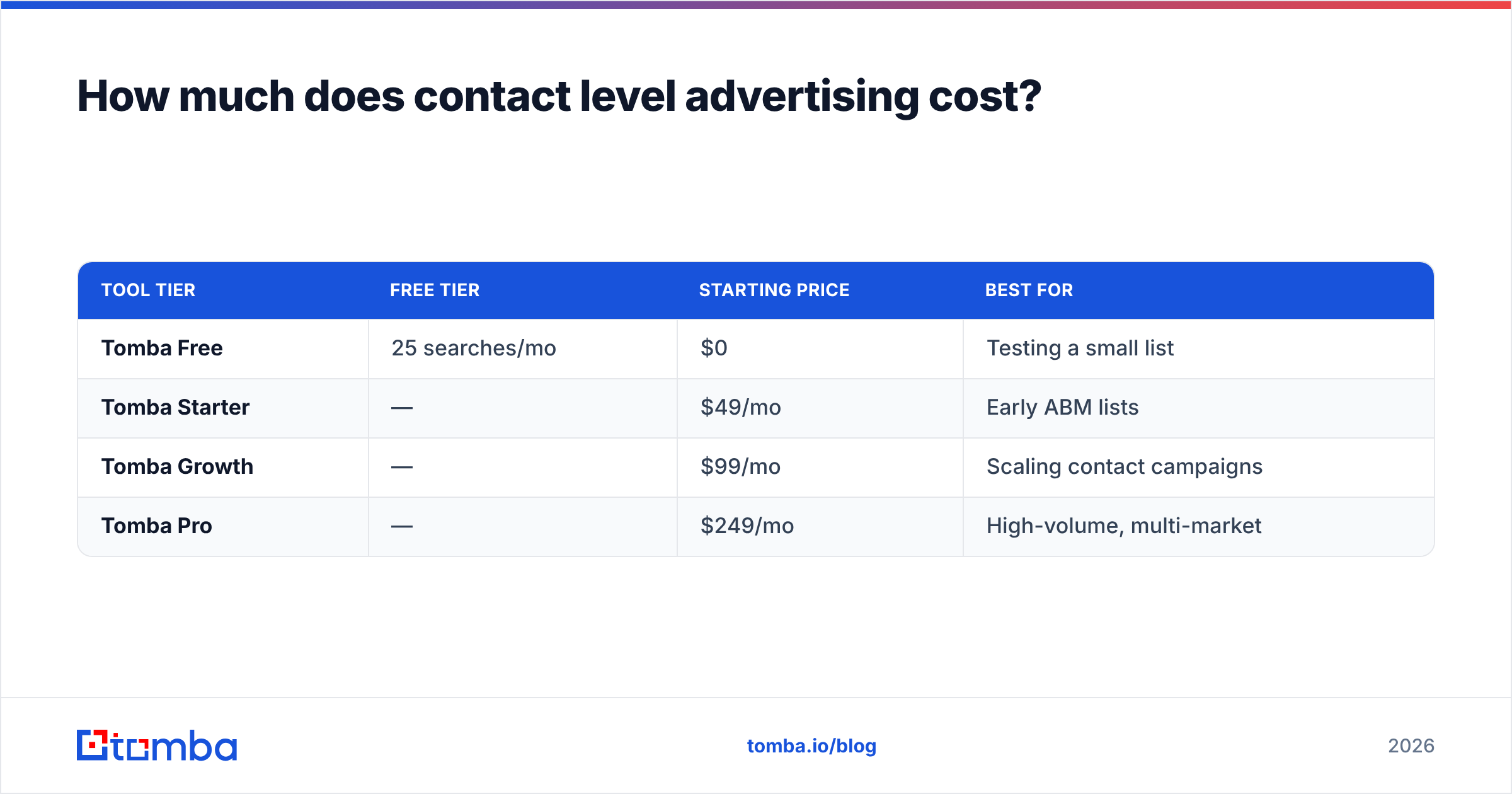
The real budget math is not the CPM — it is cost per reachable, correct contact. Here is how the tooling side compares if you need to build and clean that list first:
| Tool tier | Free tier | Starting price | Best for |
|---|---|---|---|
| Tomba Free | 25 searches/mo | $0 | Testing a small list |
| Tomba Starter | — | $49/mo | Early ABM lists |
| Tomba Growth | — | $99/mo | Scaling contact campaigns |
| Tomba Pro | — | $249/mo | High-volume, multi-market |
You can review full Tomba pricing for exact credit allowances, but the principle holds across any vendor: spending a little to verify and enrich a list routinely saves far more in wasted ad impressions than it costs.
How do you build a contact list that actually matches?#
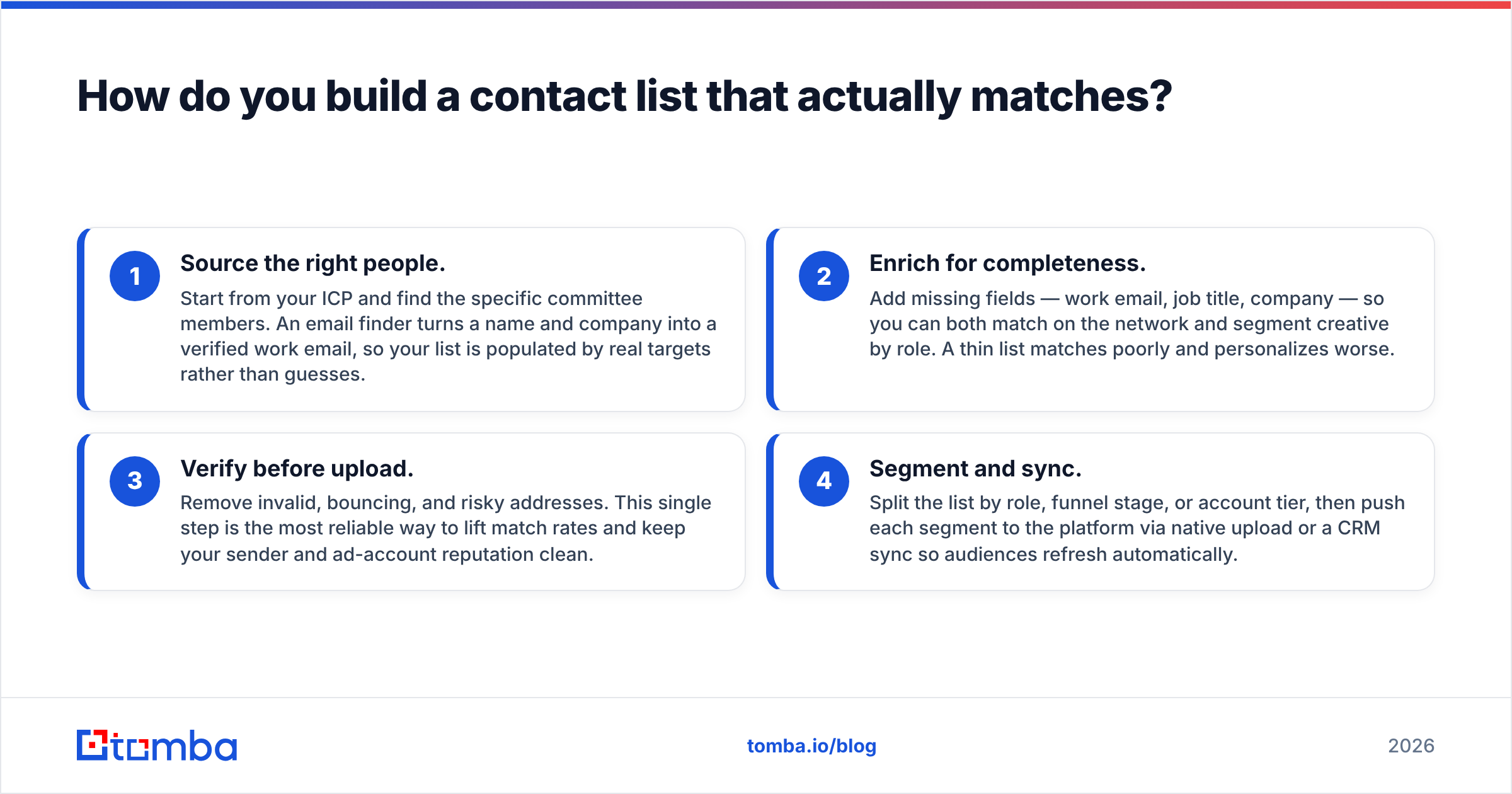
A high-matching audience is built in four steps, and each one protects your ad budget downstream.
- Source the right people. Start from your ICP and find the specific committee members. An email finder turns a name and company into a verified work email, so your list is populated by real targets rather than guesses.
- Enrich for completeness. Add missing fields — work email, job title, company — so you can both match on the network and segment creative by role. A thin list matches poorly and personalizes worse.
- Verify before upload. Remove invalid, bouncing, and risky addresses. This single step is the most reliable way to lift match rates and keep your sender and ad-account reputation clean.
- Segment and sync. Split the list by role, funnel stage, or account tier, then push each segment to the platform via native upload or a CRM sync so audiences refresh automatically.
For teams building at scale, a B2B database plus bulk verification turns list-building from a manual chore into a repeatable pipeline. The goal is boring and important: every row you upload should be a real person you can legitimately reach.
What are the risks and compliance considerations?#
Contact level advertising uses personal data, so treat consent and privacy as first-class requirements, not afterthoughts. You are uploading identifiable individuals to third-party platforms, which brings a few obligations.
- Lawful basis. Under GDPR, CCPA, and similar regimes, you need a legitimate reason to process and target these contacts. Legitimate interest often applies to B2B outreach, but document your reasoning and honor opt-outs.
- Platform policies. Each network requires that you have the right to use the data you upload and prohibits targeting sensitive categories. Read the terms — violations can suspend an ad account.
- List hygiene as risk control. Suppress anyone who unsubscribed or requested deletion. A verified, well-governed list is also a compliant one.
- Transparency. Keep your privacy policy current about how you use contact data for advertising.
Good data hygiene and good compliance are the same discipline viewed from two angles. The verification and suppression work that lifts your match rate also keeps you on the right side of privacy rules.
The bottom line#
Contact level advertising is one of the highest-leverage paid tactics in B2B — but only for teams whose contact data is clean, current, and complete. The strategy, the platforms, and the budget all matter less than the list you feed them. Get a 65% match rate instead of 35% and every other number in the campaign improves at once.
That is where the groundwork lives. Build your target audience with the Tomba Email Finder to source verified work emails, enrich the gaps, and validate every address before it ever reaches an ad platform. Start on the free tier, prove the match-rate lift on a single segment, and scale the contact-level channel from there. Your ad budget will thank you.
Related guides#
Ready to find emails that actually work?
Join 150,000+ professionals who stopped guessing and started sending. Free credits on signup — no credit card required.
Get the Tomba newsletter
Practical outbound tactics and product updates — once every two weeks.
About the author