Contact-Level Intent Data: The Complete 2026 Playbook
Account-level intent tells you a company is shopping. Contact-level intent tells you which person to email today. Here's how to buy, build, and act on it in 2026.
Most intent data tells you a company is in-market. It rarely tells you who to email. That gap — between "Acme is researching CRMs" and "Dana, the RevOps lead at Acme, opened three comparison pages yesterday" — is the whole game. Contact-level intent data tries to close it.
This guide breaks down what contact-level intent data actually is, how it differs from the account-level signals you're probably already paying for, where it comes from, what it costs, and how to turn it into pipeline without burning your domain reputation.
TL;DR#
- Account-level intent flags in-market companies. Contact-level intent flags the specific person showing buying behavior — a far shorter path to a reply.
- Contact-level signals come from a mix of publisher co-ops, first-party website de-anonymization, engagement tracking, and social/job-change triggers.
- It is more accurate and more actionable, but noisier on privacy and pricier per record. Blending both tiers beats picking one.
- Intent data is worthless without clean contact data behind it. You still need a verified email and phone number to act on the signal.
- Start narrow: one high-intent segment, one tight play, measured against reply rate — not vanity "surge" dashboards.
What Is Contact-Level Intent Data?#
Contact-level intent data is behavioral signal tied to an individual buyer rather than to their employer. Instead of "someone at Acme Corp researched data-enrichment vendors this week," you get "this named contact, in this role, engaged with this topic, on this date."
Think of it like the difference between knowing a house has its lights on versus knowing which person is standing at the window waving at you. Account-level intent points you at the building. Contact-level intent points you at the buyer.
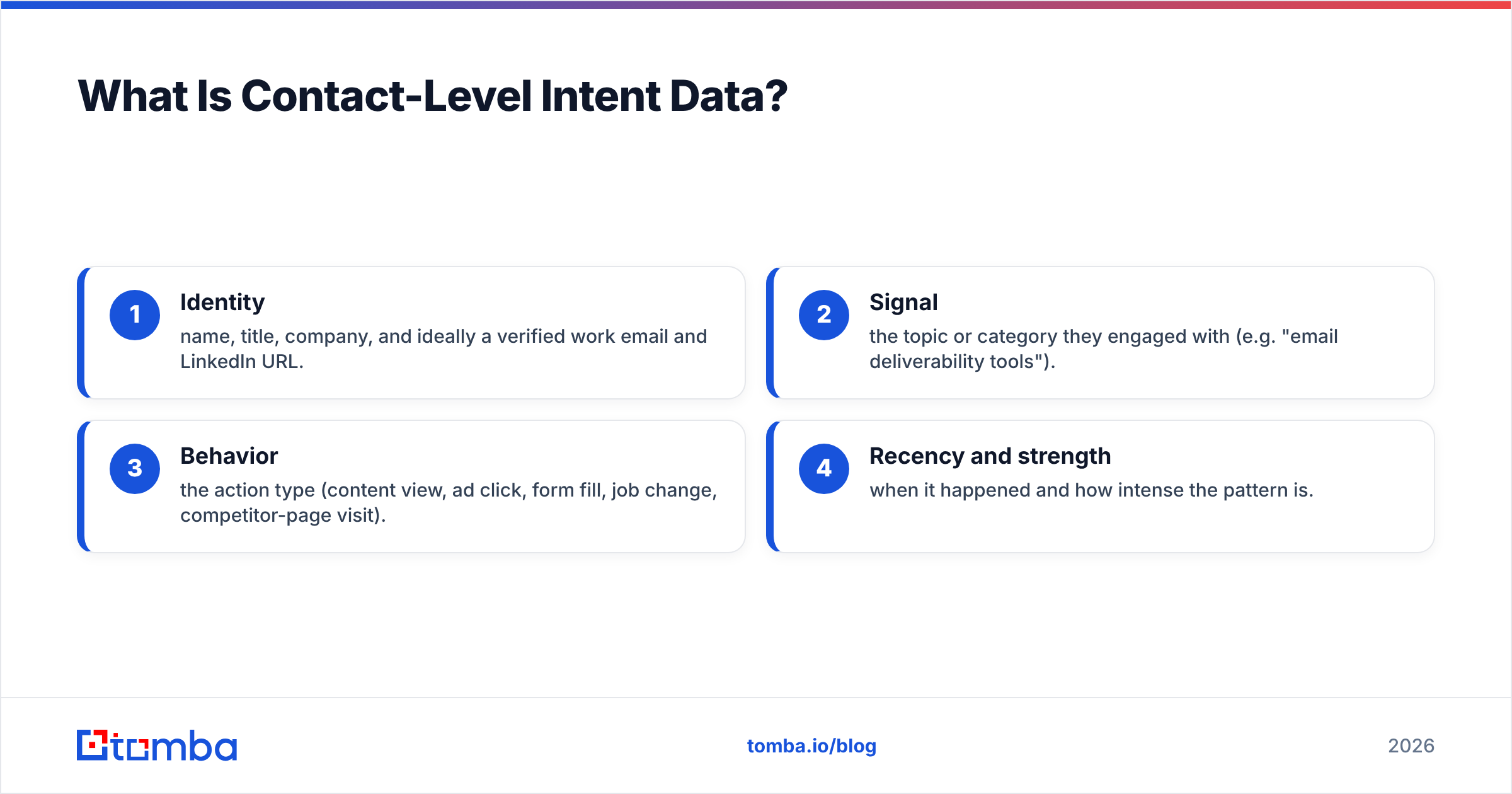
Technically, a contact-level record usually bundles four things:
- Identity — name, title, company, and ideally a verified work email and LinkedIn URL.
- Signal — the topic or category they engaged with (e.g. "email deliverability tools").
- Behavior — the action type (content view, ad click, form fill, job change, competitor-page visit).
- Recency and strength — when it happened and how intense the pattern is.
That last pair matters more than buyers expect. A single page view is noise. The same person hitting three comparison pages, a pricing page, and a review site inside 48 hours is a signal you can act on today.

How Is It Different From Account-Level Intent Data?#
The distinction is resolution. Account-level intent, popularized by providers like Bombora and used inside platforms tracked on G2, aggregates signals to the company. It answers which accounts to prioritize. Contact-level intent answers which person to contact and what to say.
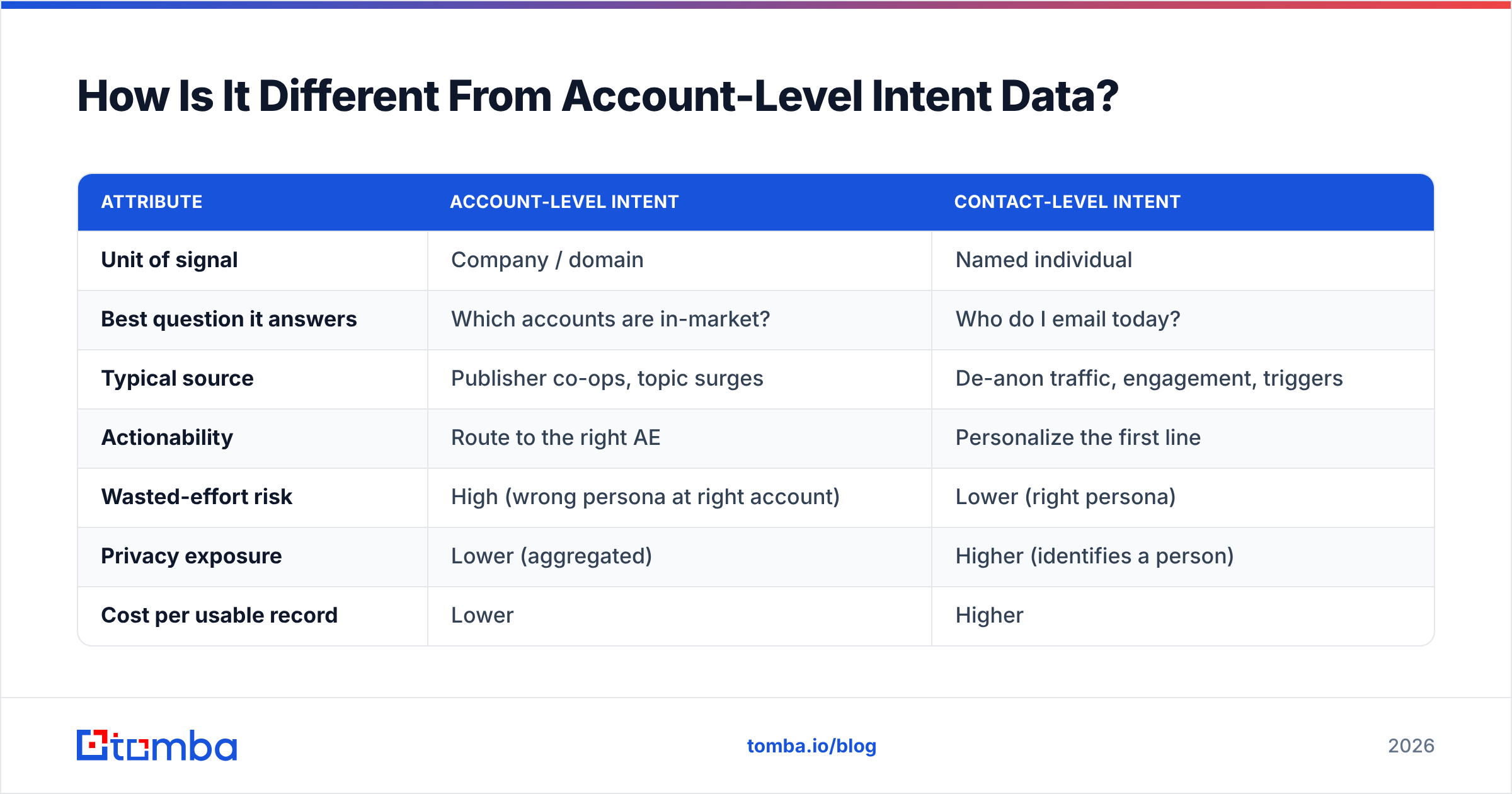
Here's the practical trade-off, side by side:
| Attribute | Account-Level Intent | Contact-Level Intent |
|---|---|---|
| Unit of signal | Company / domain | Named individual |
| Best question it answers | Which accounts are in-market? | Who do I email today? |
| Typical source | Publisher co-ops, topic surges | De-anon traffic, engagement, triggers |
| Actionability | Route to the right AE | Personalize the first line |
| Wasted-effort risk | High (wrong persona at right account) | Lower (right persona) |
| Privacy exposure | Lower (aggregated) | Higher (identifies a person) |
| Cost per usable record | Lower | Higher |
| Data hygiene needed | Medium | High — needs a verified contact |
Neither tier is "better" in the abstract. Account-level is cheaper and safer and great for territory planning. Contact-level is sharper and more expensive and great for the actual outreach. The mistake teams make is treating them as competitors instead of a funnel: use account-level to narrow, then contact-level to act.
Where Does Contact-Level Intent Data Come From?#
Four sources dominate in 2026, and each has a different accuracy and freshness profile.
- First-party website de-anonymization. You match anonymous visitors to identities using reverse-IP, cookies, and identity graphs. This is your highest-intent, lowest-volume source — these people already found you. Tools like website visitor reveal turn anonymous sessions into named contacts you can enrich.
- Publisher and co-op engagement. Networks track content consumption across thousands of B2B sites and, where consent allows, resolve engagement to a contact. Broad coverage, but the identity resolution is where quality varies wildly.
- Trigger events. Job changes, funding rounds, new-tool adoption, and hiring signals. A VP of Sales who started last month is buying a stack — that's contact-level intent without a single page view.
- Engagement and social signals. Opens, clicks, ad interactions, LinkedIn activity, and community participation tied back to a person.
The uncomfortable truth: the signal is only half the product. A contact-level record that says "Dana researched CRMs" is useless if the attached email bounces. That's why serious intent workflows sit on top of a strong B2B database and a verification layer — the signal tells you who, the contact data lets you reach them.

Is Contact-Level Intent Data Accurate Enough to Trust?#
Accuracy depends almost entirely on the identity-resolution step, and it degrades in a predictable order. First-party de-anonymized traffic is the most reliable because you control the source. Third-party co-op data is the most variable because you're trusting someone else's match logic.
Three checks separate usable contact-level data from expensive noise:
- Is the contact real and reachable? Run every record through an email verifier before it enters a sequence. Intent means nothing if the message never lands.
- Is the signal fresh? Buying windows are short. A 6-week-old surge is a cold lead wearing a hot label.
- Is the persona right? Contact-level data can resolve to the intern, not the decision-maker. Filter by seniority and function, not just company match.
Vendors will quote you match rates north of 90%. Treat those as marketing numbers until you've run a sample against your own verification. Analysts at Gartner have repeatedly flagged that intent-data quality claims outrun independent validation — so validate.
How Much Does Contact-Level Intent Data Cost?#
Pricing splits into two buckets: the intent signal itself, and the contact data you need to act on it. Many teams under-budget the second and wonder why their "intent program" stalls.
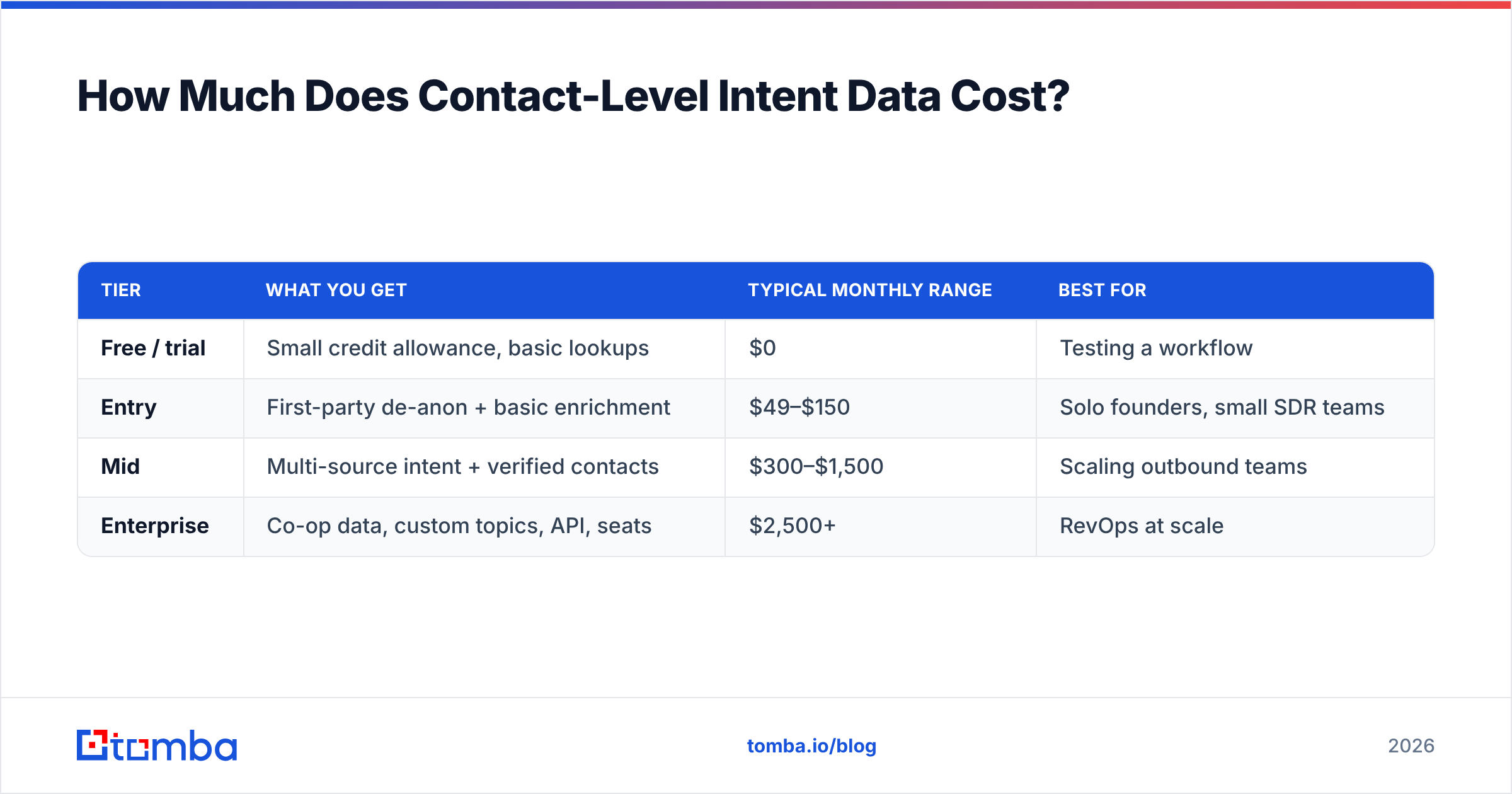
Here's a rough shape of the market in 2026. Exact numbers vary by volume and contract, so treat these as orientation, not quotes:
| Tier | What you get | Typical monthly range | Best for |
|---|---|---|---|
| Free / trial | Small credit allowance, basic lookups | $0 | Testing a workflow |
| Entry | First-party de-anon + basic enrichment | $49–$150 | Solo founders, small SDR teams |
| Mid | Multi-source intent + verified contacts | $300–$1,500 | Scaling outbound teams |
| Enterprise | Co-op data, custom topics, API, seats | $2,500+ | RevOps at scale |
For the contact-data layer specifically, transparent, usage-based pricing keeps costs sane. Tomba, for example, starts free with 25 searches per month and moves to a $49/mo Starter plan, $99/mo Growth, and $249/mo Pro — full details on the Tomba pricing page. The point isn't the exact figure; it's that you should be able to see cost-per-verified-contact, because that's the number that actually maps to pipeline.
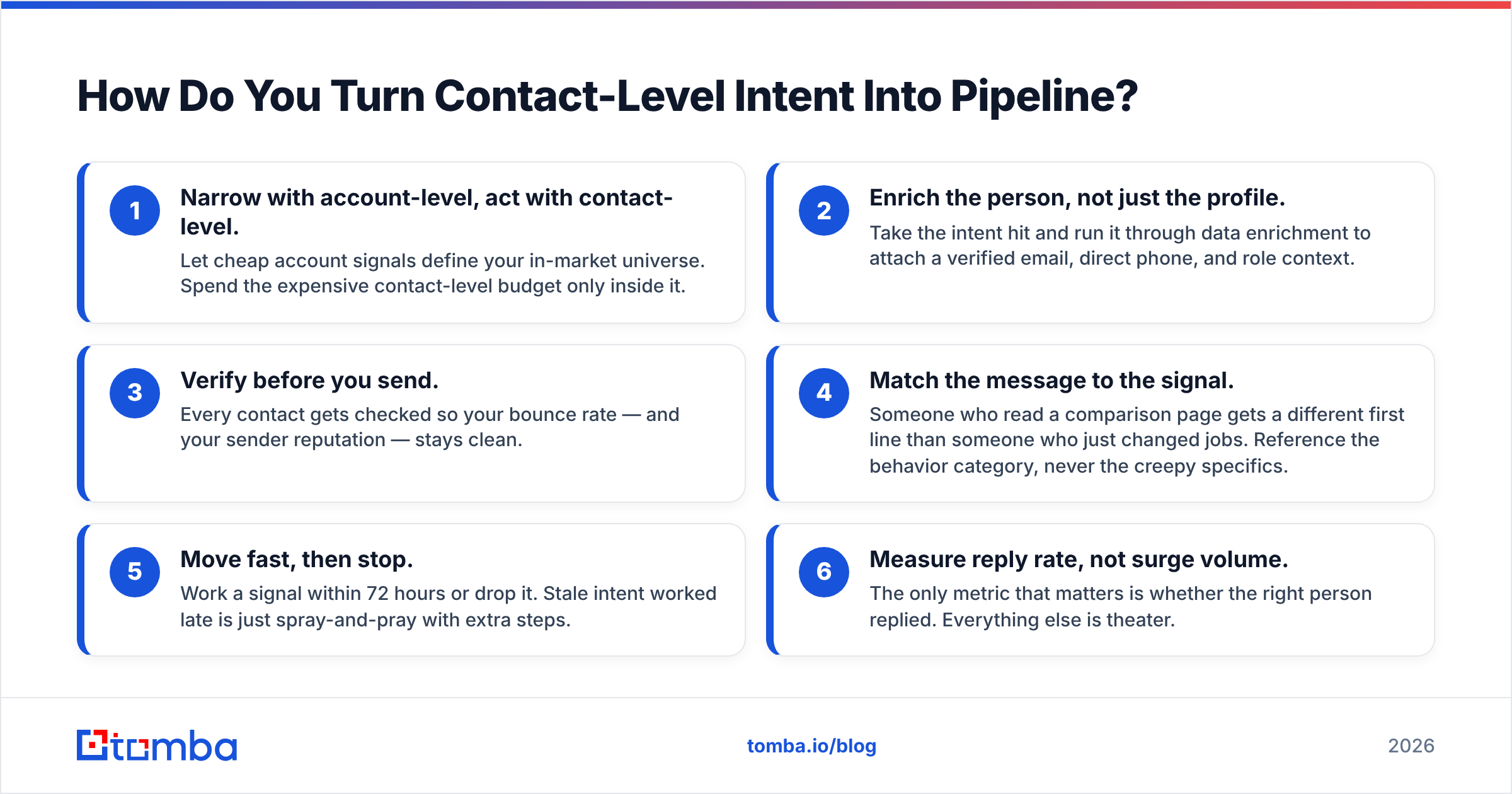
How Do You Turn Contact-Level Intent Into Pipeline?#
Signal without a play is a dashboard nobody opens. Here's a workflow that consistently converts.
- Narrow with account-level, act with contact-level. Let cheap account signals define your in-market universe. Spend the expensive contact-level budget only inside it.
- Enrich the person, not just the profile. Take the intent hit and run it through data enrichment to attach a verified email, direct phone, and role context.
- Verify before you send. Every contact gets checked so your bounce rate — and your sender reputation — stays clean.
- Match the message to the signal. Someone who read a comparison page gets a different first line than someone who just changed jobs. Reference the behavior category, never the creepy specifics.
- Move fast, then stop. Work a signal within 72 hours or drop it. Stale intent worked late is just spray-and-pray with extra steps.
- Measure reply rate, not surge volume. The only metric that matters is whether the right person replied. Everything else is theater.
A concrete example: a contact-level record flags a newly promoted Head of Growth engaging with "cold email deliverability." You enrich to get a verified email and mobile, send a two-line note referencing deliverability (the topic, not the tracking), and follow up by phone using a phone finder. That's a warm-ish conversation instead of a cold interruption.
What Are the Privacy and Compliance Risks?#
Contact-level data identifies a real person, which raises the stakes versus aggregated account signals. Under GDPR, CCPA, and their 2026 successors, you need a lawful basis to process personal data and to email B2B prospects in many jurisdictions.
Practical guardrails:
- Source matters. Prefer providers who document consent and data provenance. Ask where the data comes from — a vendor that won't answer is a vendor to skip. Tomba publishes its data sources for exactly this reason.
- Honor suppression and opt-outs at the contact level, not just the account.
- Reference topics, not surveillance. "Saw you're exploring deliverability tooling" is fine. "I saw you visited our pricing page at 2:14pm" is not.
- Keep records defensible. Log where each contact came from so you can respond to a data-subject request without a fire drill.
Compliance guidance from vendors like HubSpot is a reasonable starting point, but treat legal review as non-optional before you scale a contact-level program.
Should You Buy Contact-Level Intent Data or Build It?#
Both. Your highest-quality contact-level signal is your own website traffic — build that. Your broadest coverage comes from vendors — buy that. The winning stack de-anonymizes first-party visitors, layers in third-party intent to catch buyers who haven't reached you yet, and runs everything through a verification-and-enrichment layer so every signal resolves to a reachable human.
The failure mode is buying a shiny intent feed and skipping the contact-data foundation. You end up with a list of "hot" leads you can't actually email. Get the boring part right first: accurate, verified, enriched contacts. Then intent data has something to point at.
Turn Intent Signals Into Reachable Buyers#
Contact-level intent tells you who is ready. The Tomba Email Finder tells you how to reach them — turning a name, domain, or company into a verified professional email, backed by verification, enrichment, and phone data so your outreach lands the first time. Start free with 25 searches a month, wire it into your intent workflow, and stop letting good signals die on a bounced address. Find the buyer, verify the contact, send the message that fits the signal — that's the whole play.
Related guides#
Ready to find emails that actually work?
Join 150,000+ professionals who stopped guessing and started sending. Free credits on signup — no credit card required.
Get the Tomba newsletter
Practical outbound tactics and product updates — once every two weeks.
About the author