Contact List Building in 2026: A Practical B2B Playbook
A step-by-step guide to contact list building that stays clean, compliant, and actually converts — with sourcing tactics, a verification workflow, and a tool comparison.
Most B2B teams don't have a lead problem. They have a list problem. They pour money into a "5 million contacts" database, blast it, and watch bounce rates cross 20% while their domain reputation tanks. Contact list building isn't about volume — it's about assembling a targeted, verified, permission-aware set of people who could actually buy from you.
This guide walks through how to build contact lists that convert in 2026: where to source contacts, how to verify them before they cost you deliverability, and which tools do the heavy lifting.
TL;DR#
- Contact list building is the repeatable process of sourcing, verifying, enriching, and segmenting the people who match your ideal customer profile (ICP) — not buying a giant static file.
- Verification is non-negotiable. Unverified lists routinely carry 15–30% invalid addresses, which crater deliverability and can get your domain blacklisted.
- Targeted beats big. A 500-contact list matched to your ICP outperforms a 50,000-contact dump on reply rate, cost, and compliance risk every time.
- Compliance is a feature, not a footnote. GDPR, CAN-SPAM, and CASL all shape how you collect and store contact data — build the process around them from day one.
- Tools like Tomba Email Finder plus a verification step turn a raw name-and-company list into a send-ready one.
What is contact list building?#
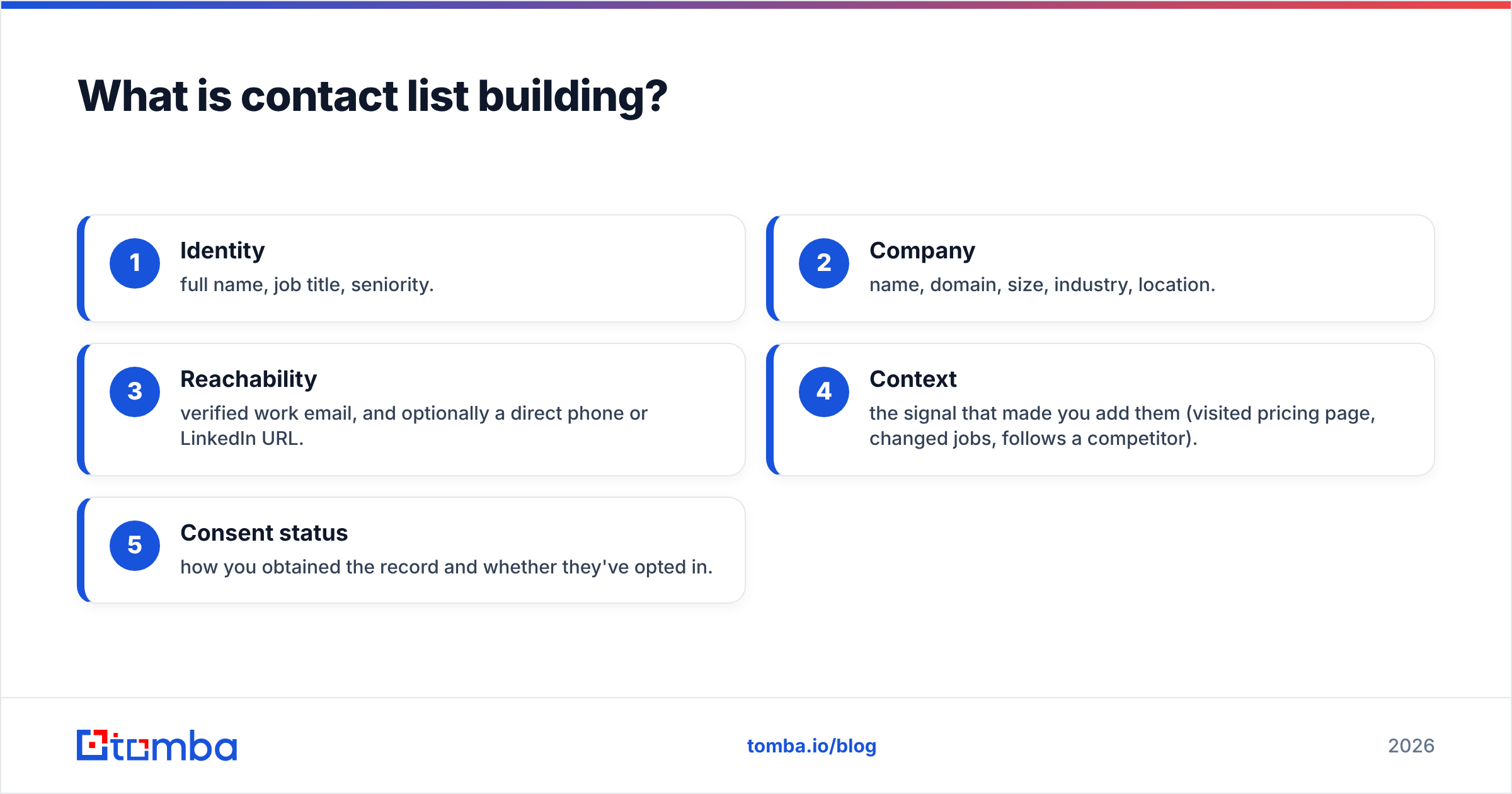
Contact list building is the process of finding, validating, and organizing contact records — name, email, company, role, and often phone or LinkedIn — for people who match a defined audience. Think of it like stocking a kitchen: you don't buy every ingredient in the store, you buy the specific, fresh items your recipes need. A contact list works the same way. The goal is a lean, current, relevant list, not a warehouse of expired data.
A modern contact record usually contains:
- Identity — full name, job title, seniority.
- Company — name, domain, size, industry, location.
- Reachability — verified work email, and optionally a direct phone or LinkedIn URL.
- Context — the signal that made you add them (visited pricing page, changed jobs, follows a competitor).
- Consent status — how you obtained the record and whether they've opted in.
That fifth field is what separates a durable list from a liability. If you can't explain how a contact got onto your list, you shouldn't be emailing them.
Why does list quality beat list size?#
Because every bad address you send to is a tax on your good ones. Mailbox providers judge your sender reputation on aggregate behavior. A list padded with invalid, catch-all, or spam-trap addresses drives up bounces and complaints, and providers respond by routing all your mail — including messages to real prospects — to spam.
Here's the math that most teams ignore. Say you buy a 50,000-contact list at "great value" and it's 25% invalid. You've paid for 12,500 dead records, you'll generate thousands of bounces on your first send, and you may burn the sending domain you spent months warming. Contrast that with a 2,000-contact list you built and verified: near-zero bounces, protected reputation, and replies from people who actually fit.
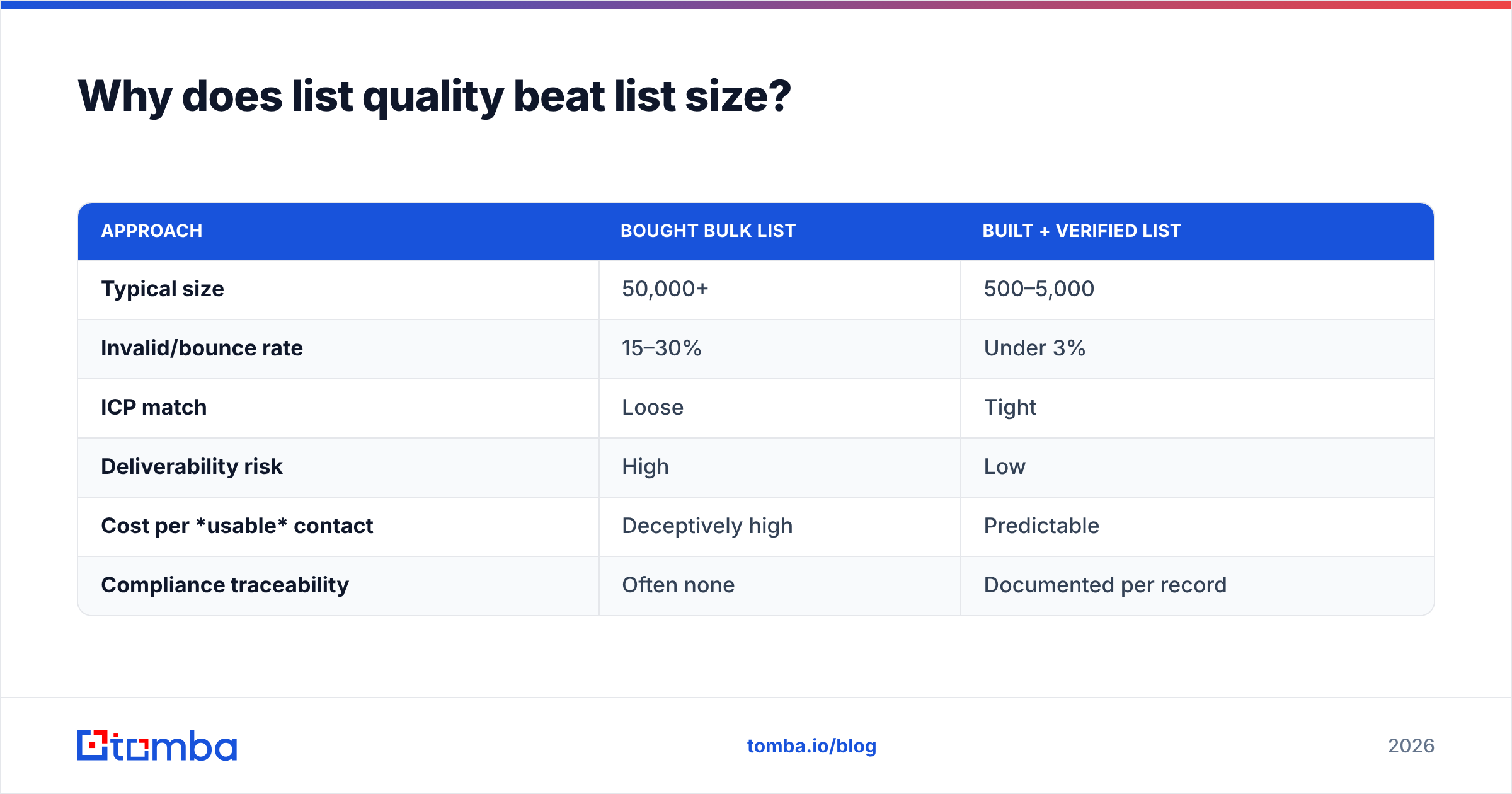
| Approach | Bought bulk list | Built + verified list |
|---|---|---|
| Typical size | 50,000+ | 500–5,000 |
| Invalid/bounce rate | 15–30% | Under 3% |
| ICP match | Loose | Tight |
| Deliverability risk | High | Low |
| Cost per usable contact | Deceptively high | Predictable |
| Compliance traceability | Often none | Documented per record |
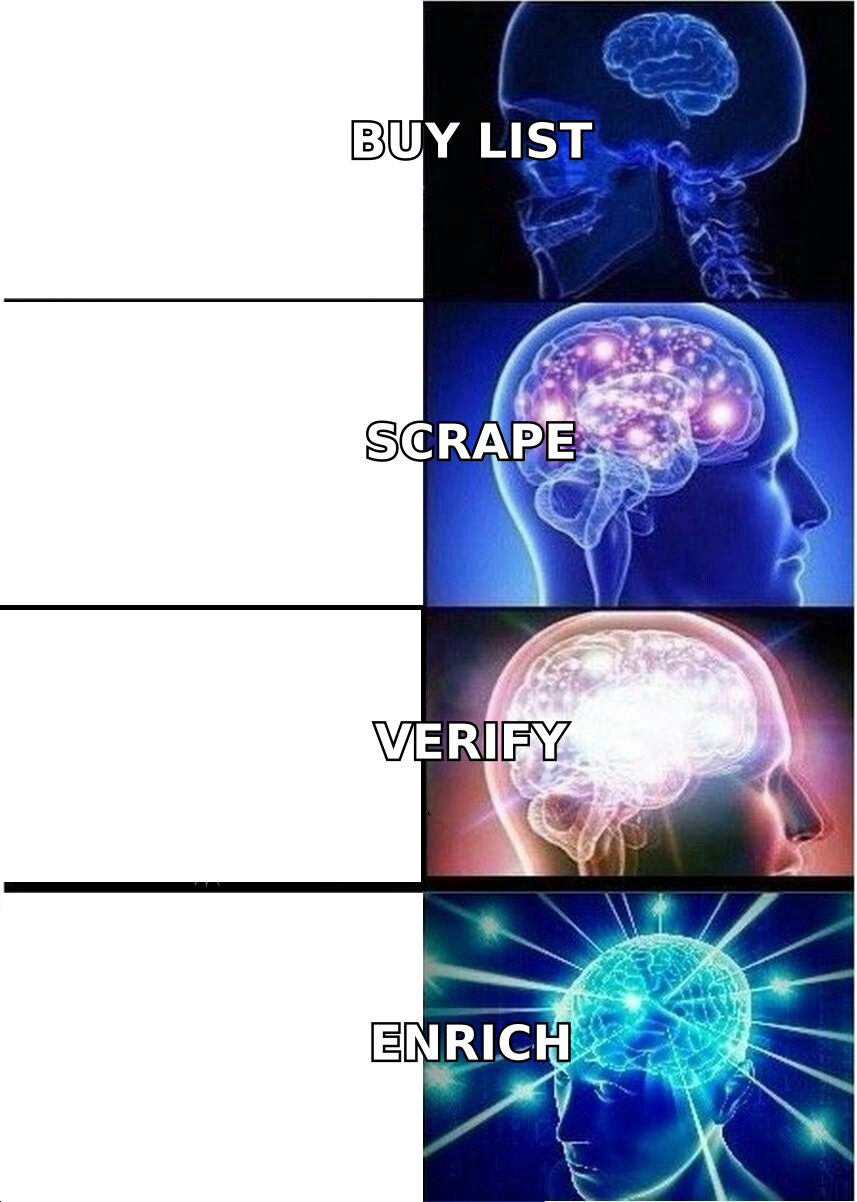
Bigger is not the flex. Deliverable is. This is why a modern workflow always ends in email verification before the first send.
How do you build a contact list step by step?#
There's a repeatable pipeline. Each stage feeds the next, and skipping any one of them shows up later as a bounce, a complaint, or a wasted rep hour.
1. Define the ICP before you touch a tool#
Write down firmographics (industry, headcount, revenue, region) and the specific personas (titles, seniority, department) you sell to. This is your filter for every later step. Without it, "contact list building" degrades into "collect random emails."
2. Source candidate accounts and people#
Pull a list of target companies from your CRM, a B2B database, industry directories, event attendee lists, or intent signals. Then identify the right people inside each account by role — not just whoever's email you can find first.
3. Find verified work emails#
For each person, resolve a professional email. A domain-first approach works well: run a domain search to pull known contacts and email patterns at a company, then use an email finder to resolve specific individuals by name. Avoid personal Gmail/Yahoo addresses for B2B outreach — they hurt targeting and compliance.
4. Verify every address#
Run the full list through verification to catch invalids, disposable domains, role accounts, and catch-all servers before you send. For ambiguous catch-all domains, a dedicated catch-all verifier reduces guesswork.
5. Enrich and segment#
Add the context fields — company size, tech stack, seniority — with data enrichment, then segment so your messaging matches each group. A CFO and an SDR at the same company do not get the same email.
6. Log consent and source#
Record where each contact came from and the legal basis for contacting them. This makes audits, suppression, and unsubscribes trivial instead of terrifying.
What are the best sources for building contact lists?#
There's no single best source — the strong lists blend several. Each source has a tradeoff between reach, freshness, and compliance risk.
- Your own audience — website visitors, trial signups, newsletter subscribers, webinar registrants. Highest intent, lowest risk, smallest volume. Tools like website visitor reveal turn anonymous traffic into named accounts.
- Email finders and domain search — resolve verified work emails at target companies at scale. Best balance of reach and quality for outbound.
- LinkedIn and social — rich for titles and job changes. Pair a LinkedIn finder with verification to turn profiles into reachable contacts.
- Purchased/partner lists — fast volume, but treat every record as unverified until proven otherwise, and check the provider's compliance posture. Reputable data vendors such as BookYourData sell verified B2B records and are a legitimate option when you still run your own verification pass on top.
- Events and communities — conference attendee lists, Slack groups, industry forums. Great for niche ICPs; mind the terms of use.
The rule across all of them: no source is exempt from verification. Even a "verified" purchased list drifts as people change jobs — roughly 30% of B2B contact data decays every year.
How do the tools compare?#
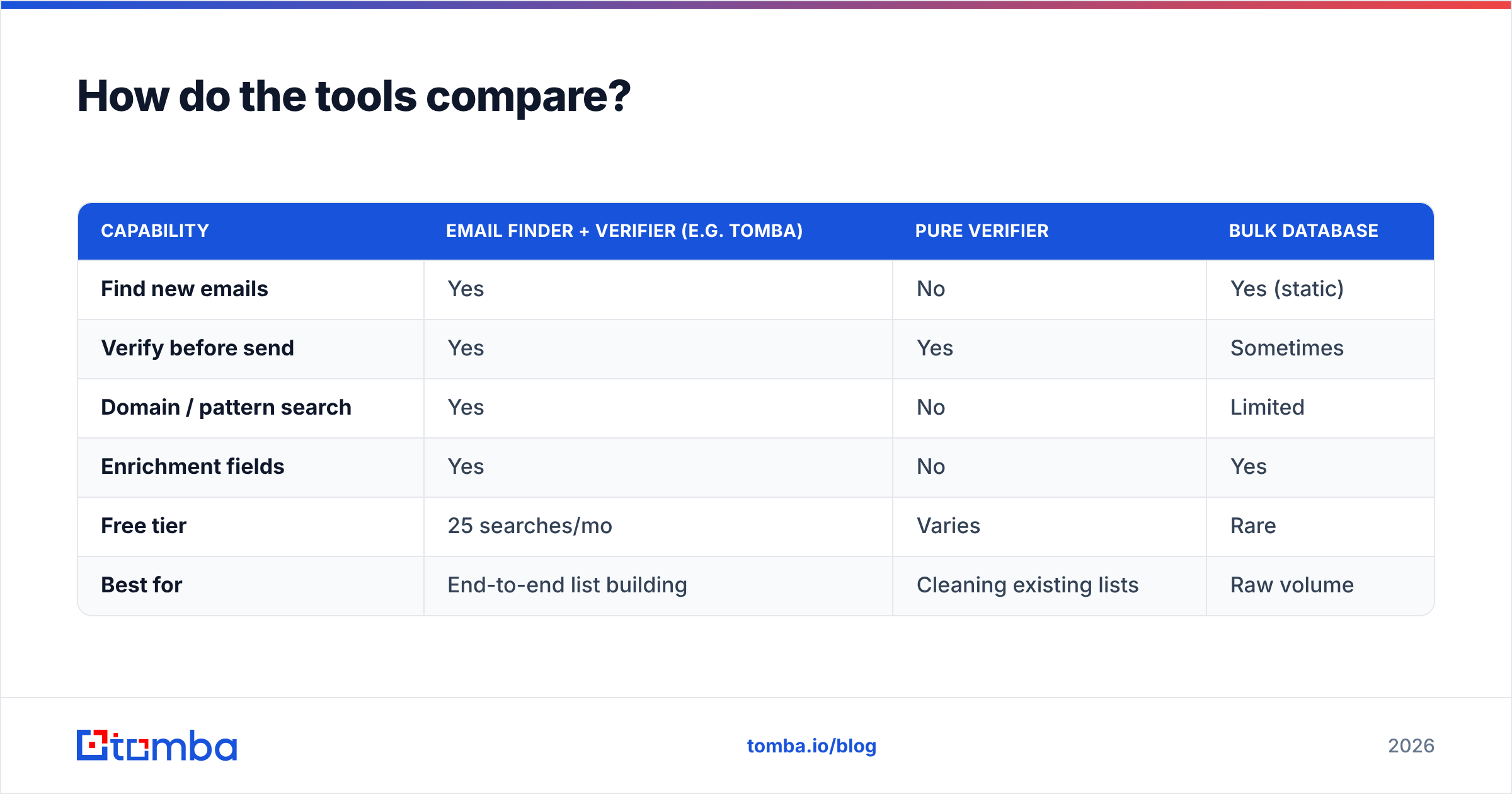
Contact list building tools cluster into three buckets: finders (get the email), verifiers (confirm it's real), and enrichment/database platforms (add context and volume). The strongest stacks combine all three, and many platforms bundle them.
| Capability | Email finder + verifier (e.g. Tomba) | Pure verifier | Bulk database |
|---|---|---|---|
| Find new emails | Yes | No | Yes (static) |
| Verify before send | Yes | Yes | Sometimes |
| Domain / pattern search | Yes | No | Limited |
| Enrichment fields | Yes | No | Yes |
| Free tier | 25 searches/mo | Varies | Rare |
| Best for | End-to-end list building | Cleaning existing lists | Raw volume |
For most teams, an integrated finder-plus-verifier is the practical center of gravity: you build and clean in one place instead of exporting CSVs between four tools. If you already own a big list and just need it scrubbed, a standalone verifier is enough. If you need thousands of net-new accounts fast, a database gets you volume — which you then verify anyway.
When you're comparing options, look past the headline contact count and check pricing per usable action. You can review Tomba pricing as one reference point: a free tier for testing, then Starter at $49/mo, Growth at $99/mo, and Pro at $249/mo as volume scales.

How do you keep a contact list clean over time?#
A contact list is perishable. Building it once and reusing it for a year guarantees decay. Treat maintenance as a recurring job, not a one-off.
- Re-verify quarterly. Run existing lists back through verification on a schedule to catch job changes and dead mailboxes. Bulk tools like bulk verify make this cheap.
- Suppress hard bounces immediately. One hard bounce means remove, not retry. Repeated sends to dead addresses are the fastest way to a blacklist.
- Honor unsubscribes instantly. Automate suppression so an opt-out on Monday can't be emailed on Tuesday.
- Deduplicate on import. Merge duplicate records so one person doesn't get three copies of your campaign.
- Monitor engagement. Contacts who never open across many sends are dead weight — sunset them to protect your sender reputation.
Clean lists protect email deliverability, which is the whole point. A pristine list that never lands in the inbox is worthless, and the two problems are linked: dirty lists cause deliverability collapse.
What about compliance and consent?#
Compliance shapes how you collect and store contact data, and getting it wrong is expensive. This isn't legal advice, but the fundamentals are consistent across major regimes.
- GDPR (EU/UK) requires a lawful basis to process personal data. For B2B cold outreach, "legitimate interest" is commonly relied on — but you must be relevant, offer easy opt-out, and honor deletion requests. Guidance from bodies like the UK's ICO is the authoritative reference.
- CAN-SPAM (US) allows cold email but demands a valid physical address, a working unsubscribe, and no deceptive headers or subject lines. The FTC's CAN-SPAM guide is the source of truth.
- CASL (Canada) is stricter, generally requiring consent — build Canadian outreach carefully.
The practical takeaway: record the source and legal basis of every contact, keep suppression airtight, and never scrape or buy data you can't justify. Compliance done well is also just good list hygiene — the same discipline that keeps you legal keeps you deliverable.
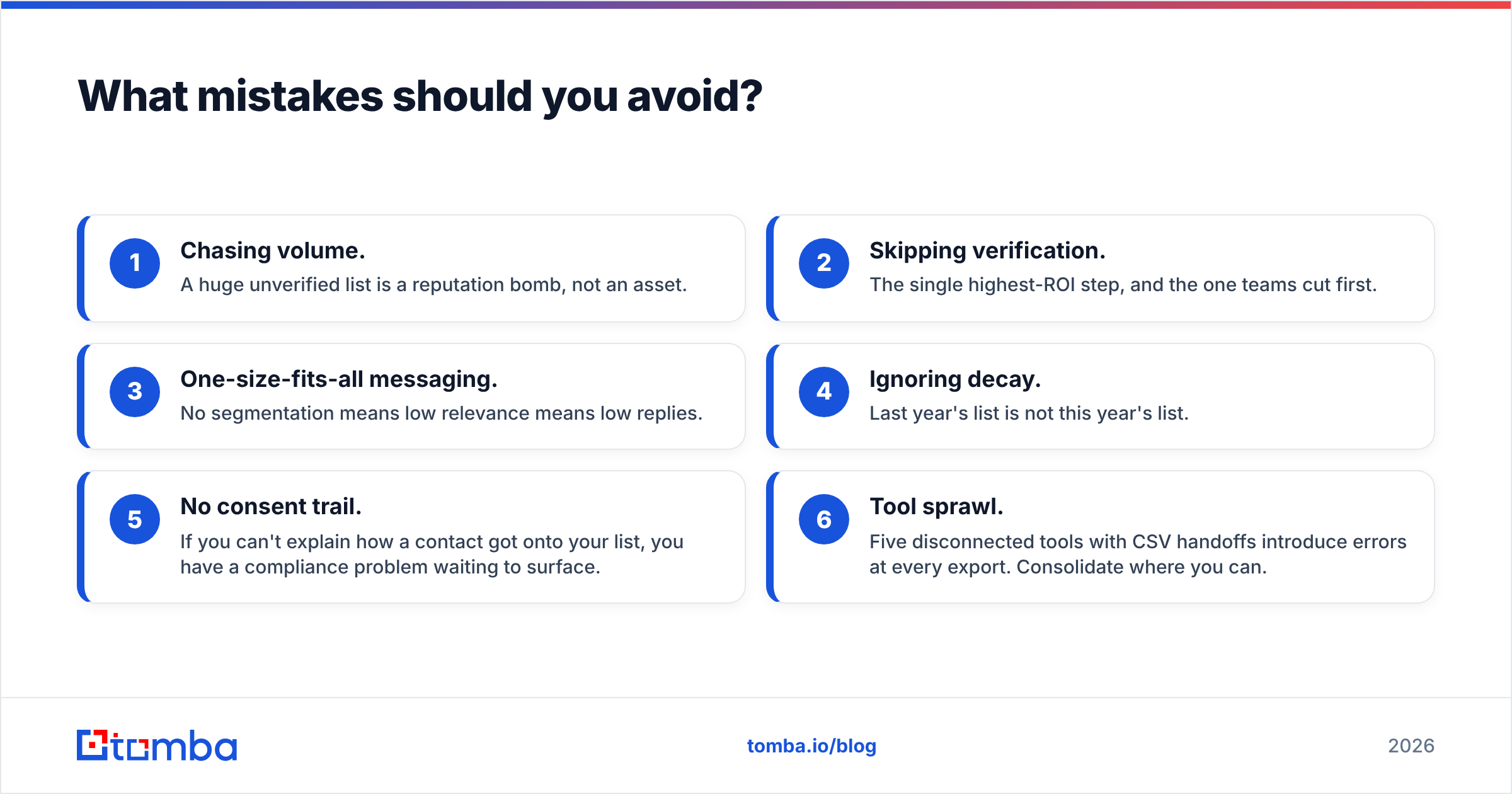
What mistakes should you avoid?#
The failure modes are predictable, which means they're avoidable.
- Chasing volume. A huge unverified list is a reputation bomb, not an asset.
- Skipping verification. The single highest-ROI step, and the one teams cut first.
- One-size-fits-all messaging. No segmentation means low relevance means low replies.
- Ignoring decay. Last year's list is not this year's list.
- No consent trail. If you can't explain how a contact got onto your list, you have a compliance problem waiting to surface.
- Tool sprawl. Five disconnected tools with CSV handoffs introduce errors at every export. Consolidate where you can.
Contact list building FAQ#
How many contacts do I need to start? Fewer than you think. A focused list of a few hundred ICP-matched, verified contacts will outperform tens of thousands of random ones on reply rate and cost per meeting.
Is buying a list ever okay? It can be, if you verify it yourself, confirm the vendor's compliance posture, and treat it as a starting point rather than a send-ready asset. Reputable providers exist — you still own the verification step.
How often should I clean my list? Quarterly at minimum, and always before a major campaign. B2B data decays around 30% a year.
What's the difference between finding and verifying? Finding resolves an email address for a person; verifying confirms that address is real, deliverable, and not a trap. You need both, in that order.
Build lists that land, not bounce#
Contact list building is a pipeline, not a purchase: define your ICP, source the right people, resolve verified work emails, clean the list, enrich it, and keep it fresh. Do that and your outreach compounds instead of corroding your domain.
If you want the sourcing and verification steps in one place, start with the Tomba Email Finder. Find professional emails by domain, name, or company, verify them before you send, and enrich each record with the context your reps need — so the list you build actually converts. The free tier gives you 25 searches a month to test it against your own ICP before you scale up. Build the list once, keep it clean, and let deliverability stop being a mystery.
Related guides#
Ready to find emails that actually work?
Join 150,000+ professionals who stopped guessing and started sending. Free credits on signup — no credit card required.
Get the Tomba newsletter
Practical outbound tactics and product updates — once every two weeks.
About the author