ContactOut vs Apollo.io: Full 2026 Comparison & Verdict
ContactOut and Apollo.io both promise verified B2B contacts, but they solve different problems. Here's a data-first breakdown of accuracy, pricing, and coverage so you can pick the right one.
Choosing between ContactOut vs Apollo.io often starts with the wrong question. People ask, "Which tool has more contacts?" The better question is simpler: "Which tool fits how my team prospects?" One is a LinkedIn-first contact finder. The other is a full sales platform with a database bolted on. Treat them as the same, and you pay for features you never open.
This is a neutral, data-first look at ContactOut vs Apollo.io for 2026. We cover where each one wins, where each one quietly costs you, and when a leaner email finder is the smarter pick.
TL;DR — ContactOut vs Apollo.io at a glance#
- ContactOut is a LinkedIn-native contact finder. It pulls personal emails, work emails, and phone numbers straight off LinkedIn profiles. It suits recruiters and LinkedIn-heavy SDRs.
- Apollo.io is an all-in-one platform. You get a 275M+ contact database, sequencing, a dialer, and CRM enrichment in one place. It suits teams that want prospecting and outreach in one login.
- Accuracy is close on well-known B2B domains. Both slip on niche companies and catch-all servers. There, verification matters more than database size.
- Pricing favors Apollo for volume outreach and ContactOut for deep LinkedIn work. But the cost per verified email is often lower with a focused tool like Tomba Email Finder.
- Verdict: pick Apollo for an end-to-end stack. Pick ContactOut for LinkedIn sourcing. Add a dedicated finder and verifier when accuracy and cost per lead are the whole game.
What is ContactOut?#
ContactOut is a contact-intelligence tool built around LinkedIn. You install its Chrome extension, open a profile or a search result, and it surfaces work emails, personal emails, and phone numbers. It also offers a web search portal and an API, so teams can pull data outside the browser.
Its reputation rests on personal email coverage. These are the Gmail and Outlook addresses that most work-email databases miss. Recruiters chasing passive candidates find that genuinely useful, since those people ignore their work inbox. The trade-off is focus: ContactOut is a sourcing layer. It is not a place to run sequences, log calls, or manage a pipeline.
What is Apollo.io?#
Apollo.io is a go-to-market platform. At its core sits a large contact and company database (Apollo cites 275M+ contacts). Around it are tools to build lists, filter by intent signals, send email sequences, dial prospects, and sync enriched data back to your CRM. You can see the full scope on apollo.io.
Apollo's pitch is consolidation. You get one subscription instead of a finder, a sequencer, and a dialer stitched together. That helps a scaling outbound team. But it also means you buy — and maintain — a lot of surface area. If you only need clean emails, you pay for a sales engine you may barely touch.
ContactOut vs Apollo.io: side-by-side comparison#
Here is the honest, feature-by-feature view. Prices reflect publicly listed tiers as of early 2026. They shift often, so confirm on each vendor's page before you buy.
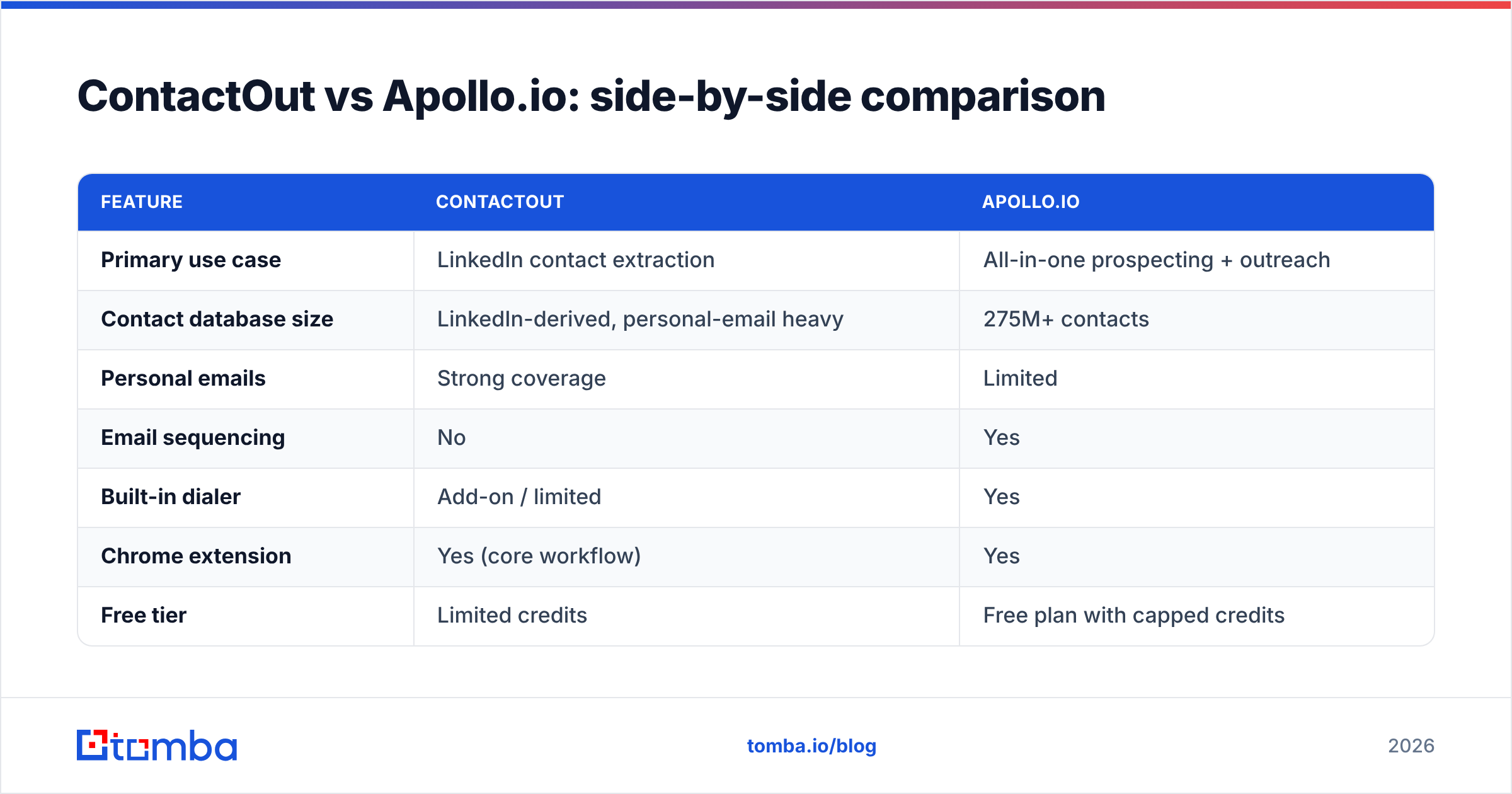
| Feature | ContactOut | Apollo.io |
|---|---|---|
| Primary use case | LinkedIn contact extraction | All-in-one prospecting + outreach |
| Contact database size | LinkedIn-derived, personal-email heavy | 275M+ contacts |
| Personal emails | Strong coverage | Limited |
| Email sequencing | No | Yes |
| Built-in dialer | Add-on / limited | Yes |
| Chrome extension | Yes (core workflow) | Yes |
| Free tier | Limited credits | Free plan with capped credits |
| Entry paid price | ~$79/mo (annual) | ~$49/mo per user (Basic) |
| Best for | Recruiters, LinkedIn SDRs | Full-funnel outbound teams |
| Verification depth | Basic | Basic, bulk-oriented |
Two things stand out. First, Apollo's lower entry price buys the whole engagement stack. That makes it look cheaper per feature — but only if you use those features. Second, neither tool leads with verification rigor. Both give you emails. Neither is built to verify them. That gap is where bounced sends and burned domains come from.
Is ContactOut or Apollo.io more accurate?#
Accuracy is the metric that really decides ROI. It splits by scenario rather than crowning one winner.
On large, well-documented companies, both tools do well. The email patterns are public, the data is refreshed often, and confidence is high. On mid-market and niche firms, coverage thins out for both. Here a database's headline count stops mattering. A 275M-contact database is worthless on the 40 accounts in your territory if those 40 aren't covered.
The bigger issue is the catch-all problem. Many corporate mail servers accept every address at the domain. So a finder reports "valid" when the mailbox may not exist. Without a dedicated catch-all verifier, that shows up later as bounces and lost deliverability.

The takeaway is simple. Treat any finder's output — ContactOut, Apollo, or otherwise — as a candidate, not a confirmed address. Run it through an email verifier before it hits a sequence. Skip that step, and you torch your sender reputation fast.
How do ContactOut and Apollo.io price out?#
Pricing is where "which is cheaper" gets slippery. The two tools bill for different things.
ContactOut meters credits by revealed emails and phones. Plans scale up the reveal quota. If your workflow is "browse LinkedIn, grab the contact," you pay roughly in line with how many people you look up. Personal-email access usually sits on higher tiers.
Apollo.io bundles a credit allowance with the platform. The Basic plan looks cheap per seat. But export limits, better data, and advanced filters push you up-tier fast. Per-seat pricing then multiplies across a team. The engagement tools are the value. Ignore them, and you subsidize a dialer you don't dial.
Here is a rough cost comparison, with a dedicated finder for reference:
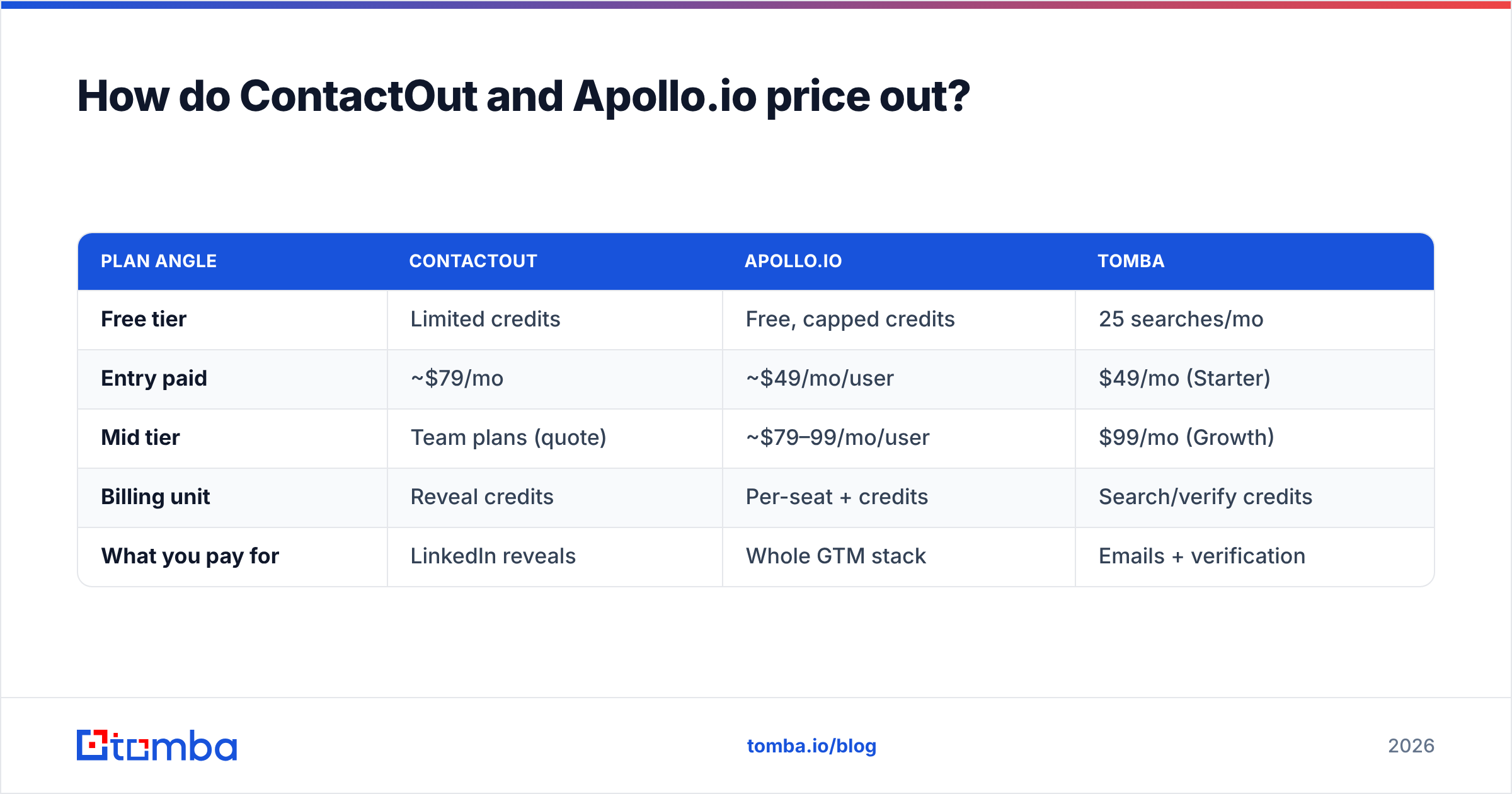
| Plan angle | ContactOut | Apollo.io | Tomba |
|---|---|---|---|
| Free tier | Limited credits | Free, capped credits | 25 searches/mo |
| Entry paid | ~$79/mo | ~$49/mo/user | $49/mo (Starter) |
| Mid tier | Team plans (quote) | ~$79–99/mo/user | $99/mo (Growth) |
| Billing unit | Reveal credits | Per-seat + credits | Search/verify credits |
| What you pay for | LinkedIn reveals | Whole GTM stack | Emails + verification |
If your real need is "verified emails at a predictable cost," a focused finder and verifier often wins. Priced on Tomba pricing, it can land cheaper per usable contact than either platform, because you skip sequencing and a database you'll never touch.
When should you pick ContactOut?#
Pick ContactOut when LinkedIn is your home base and personal emails matter.
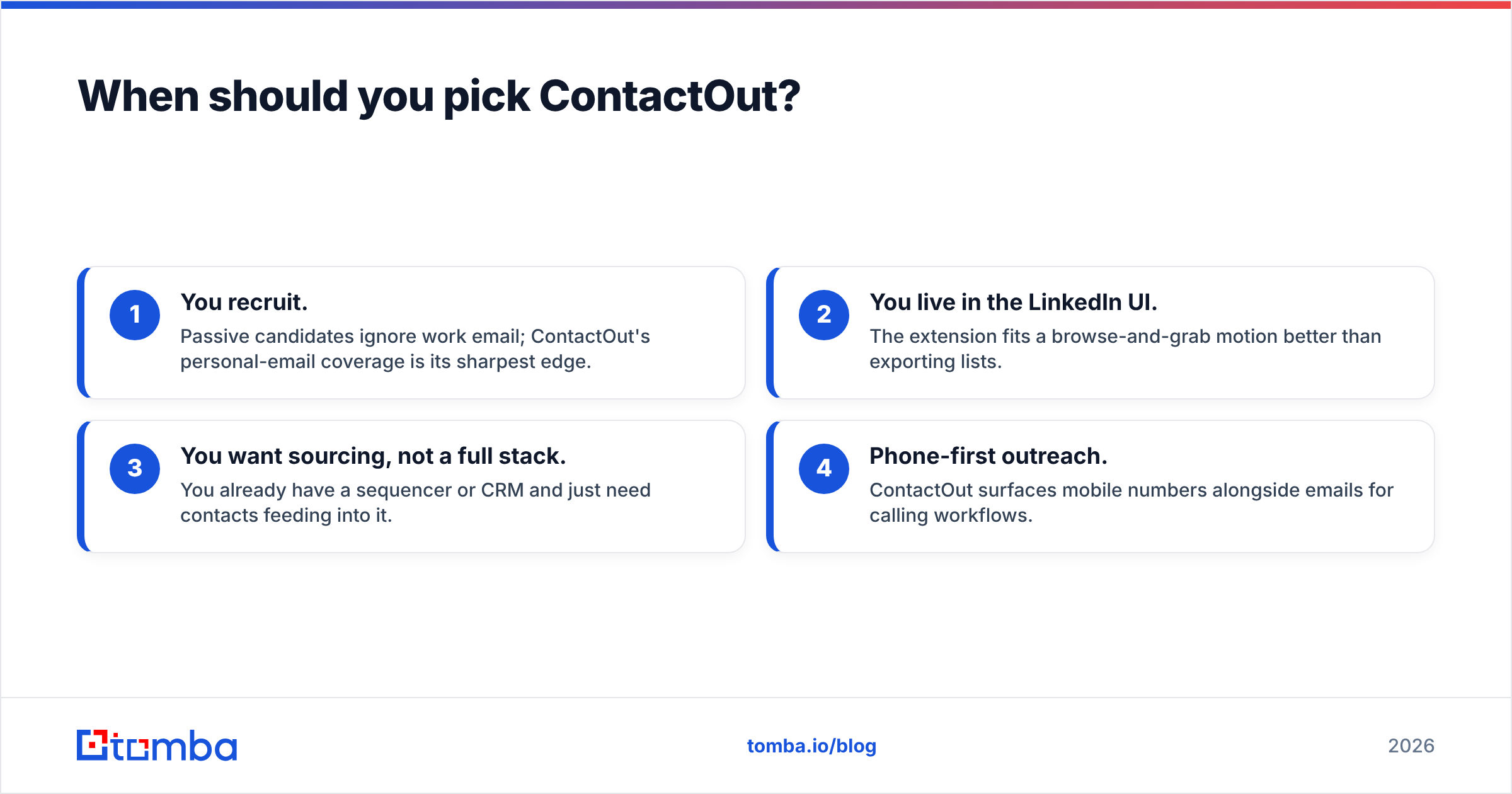
- You recruit. Passive candidates ignore work email. ContactOut's personal-email coverage is its sharpest edge.
- You live in LinkedIn. The extension fits a browse-and-grab motion better than exporting lists.
- You want sourcing, not a full stack. You already have a sequencer or CRM, and you just need contacts feeding into it.
- Phone-first outreach. ContactOut surfaces mobile numbers next to emails for calling workflows.
It is a weaker fit if you need built-in sequencing, intent data, or a large filterable database to build lists from scratch.
When should you pick Apollo.io?#
Pick Apollo.io when you want prospecting and outreach under one roof.
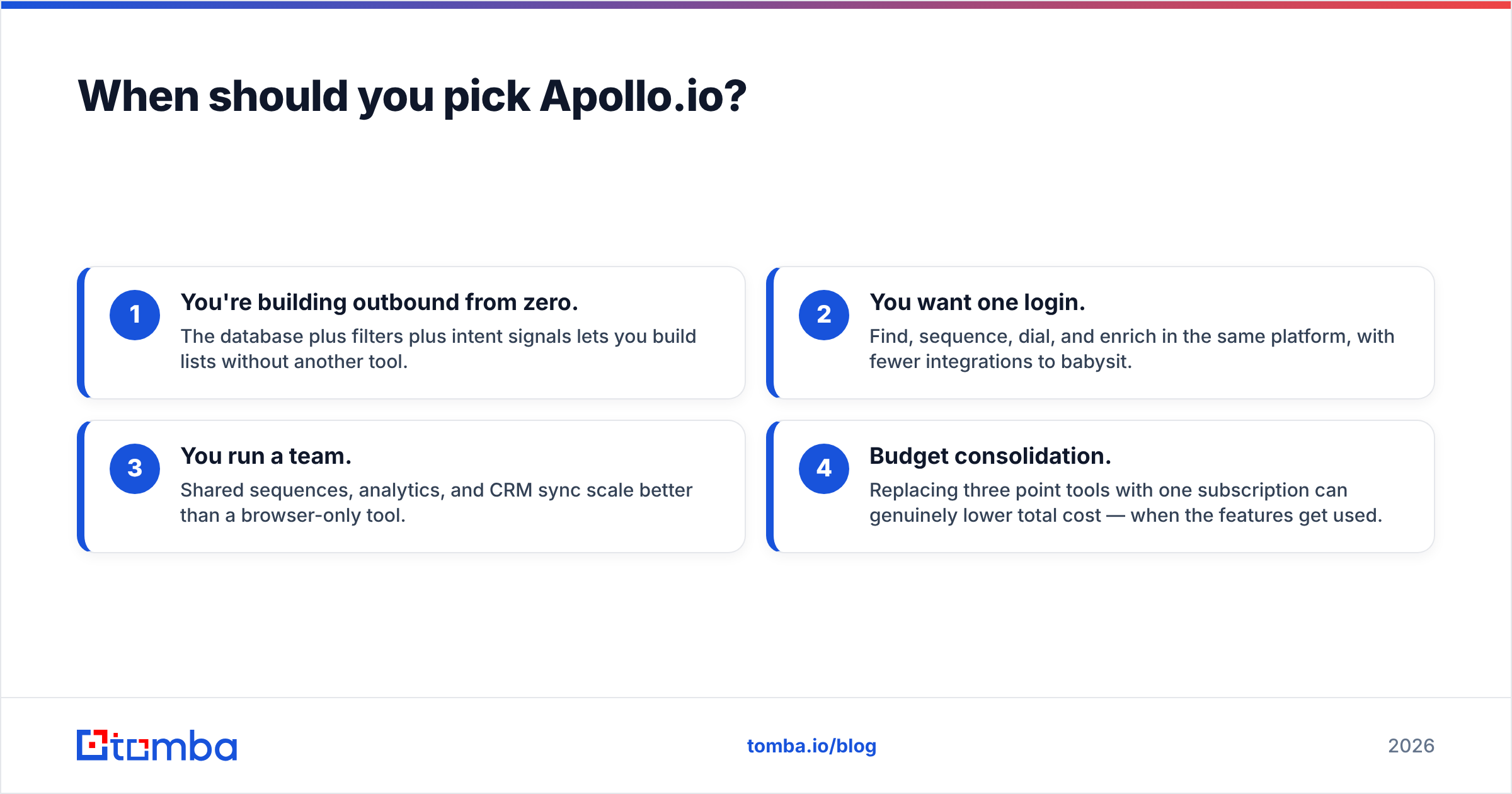
- You're building outbound from zero. The database, filters, and intent signals let you build lists without another tool.
- You want one login. Find, sequence, dial, and enrich in the same place, with fewer integrations to babysit.
- You run a team. Shared sequences, analytics, and CRM sync scale better than a browser-only tool.
- Budget consolidation. Swapping three point tools for one subscription can lower total cost — when the features get used.
Apollo is overkill if you only need clean emails. And its data on niche accounts still benefits from an outside verification pass.
Where does a dedicated email finder fit?#
Both ContactOut and Apollo answer "who do I contact?" Neither is built to answer "will this email land?" That is a verification problem. It is where a specialist tool earns its place — often alongside, not instead of, the platform you already run.
A focused workflow looks like this:
- Find the address by name and company with an email finder, or in bulk with a bulk email finder for whole lists.
- Verify every result, including catch-all domains, before you send. Then bounces never reach your mailbox.
- Enrich the record with firmographics and roles via data enrichment when you need more than an address.
- Automate it through the Tomba API, so verification runs inside your pipeline instead of as a manual step.
You can compare accuracy and coverage across tools directly:

The point isn't to replace your platform. It's that a verification layer protects the deliverability every finder — ContactOut and Apollo included — quietly leaves exposed. Independent reviews on G2 show the same pattern across the category: strong discovery, uneven verification.
ContactOut vs Apollo.io: the verdict#
There is no universal winner. There's a winner for your motion.
- Pick ContactOut if you source on LinkedIn and need personal emails and mobile numbers, and you already have somewhere to send them.
- Pick Apollo.io if you want an all-in-one GTM platform and will actually use the sequencing, dialer, and CRM sync.
- Pair either with a dedicated finder and verifier if cost per verified email and deliverability are what you're optimizing for.
The mistake is common. Don't buy a platform to solve a data-quality problem. And don't buy a sourcing tool, then skip verification. Match the tool to the job, and layer verification on top either way.
Get verified emails without the platform tax#
Maybe your goal is clean, deliverable B2B emails at a fair price — not another dashboard to learn. If so, start with a tool built for exactly that. The Tomba Email Finder finds addresses by name, company, or domain search. It verifies them against catch-all servers. And it plugs into your outreach through the API. The free tier gives you 25 searches a month, so you can test accuracy on your own accounts. Paid plans start at $49/mo. Run your next list through it before your next send. Let ContactOut or Apollo do what each does best, while your bounce rate stays near zero.
Related guides#
Ready to find emails that actually work?
Join 150,000+ professionals who stopped guessing and started sending. Free credits on signup — no credit card required.
Get the Tomba newsletter
Practical outbound tactics and product updates — once every two weeks.
About the author