ContactOut vs Dun Bradstreet: B2B Data Compared 2026
ContactOut finds contacts; Dun & Bradstreet ranks companies. This head-to-head breaks down accuracy, pricing, coverage, and which one your GTM team actually needs in 2026.
The ContactOut vs Dun Bradstreet choice confuses a lot of buyers. You are comparing two tools that barely play the same sport. ContactOut is a people-first contact finder. It pulls emails and phone numbers off LinkedIn. Dun & Bradstreet is a decades-old business-intelligence giant. It tells you if a company is creditworthy, growing, or a risk. Miss that split, and teams can overspend by five figures a year.
This guide shows where each tool earns its price. It also shows where a leaner tool covers the gap.
TL;DR — ContactOut vs Dun Bradstreet#
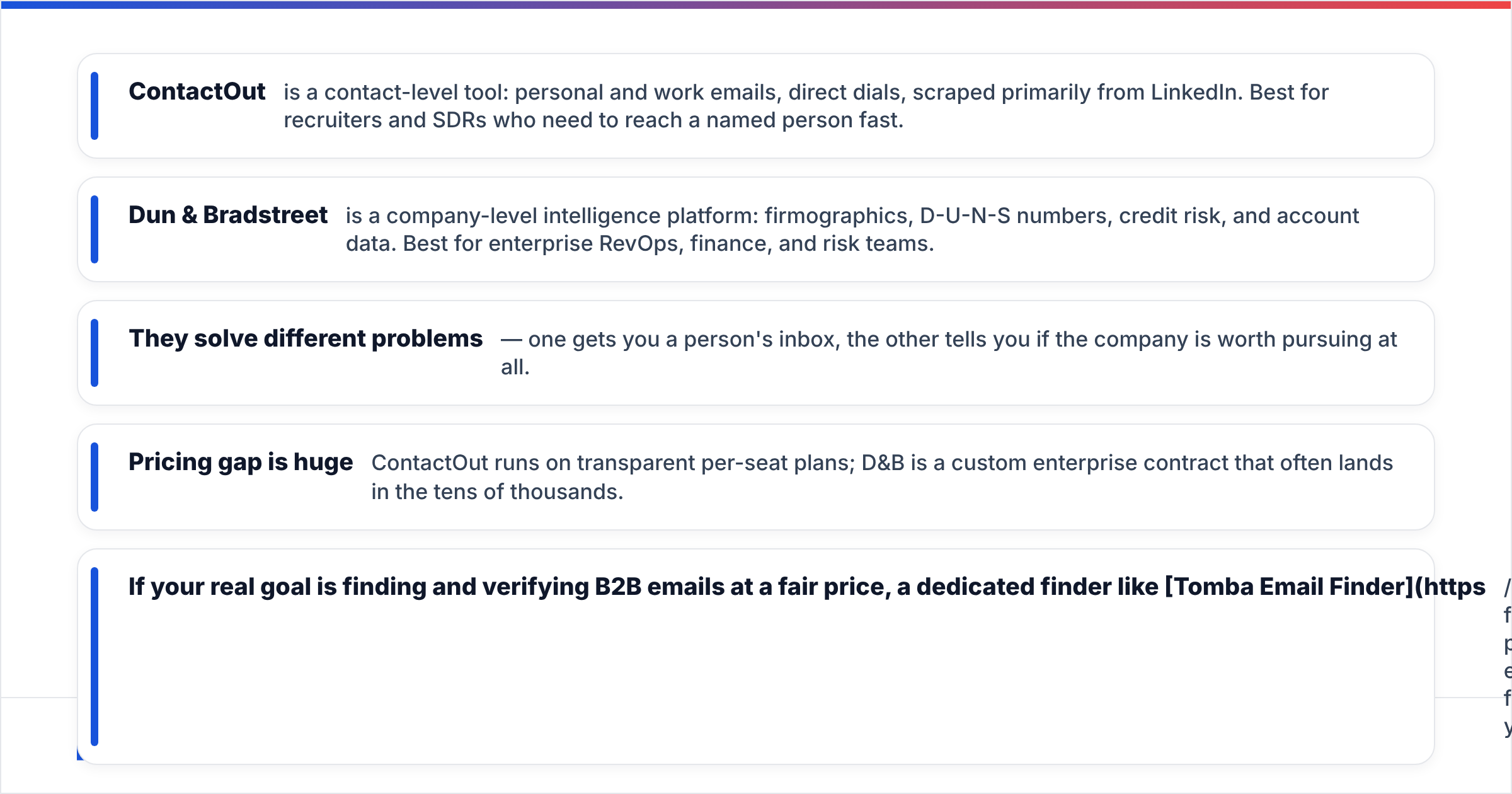
- ContactOut is a contact-level tool: personal and work emails, direct dials, scraped primarily from LinkedIn. Best for recruiters and SDRs who need to reach a named person fast.
- Dun & Bradstreet is a company-level intelligence platform: firmographics, D-U-N-S numbers, credit risk, and account data. Best for enterprise RevOps, finance, and risk teams.
- They solve different problems — one gets you a person's inbox, the other tells you if the company is worth pursuing at all.
- Pricing gap is huge: ContactOut runs on transparent per-seat plans; D&B is a custom enterprise contract that often lands in the tens of thousands.
- If your real goal is finding and verifying B2B emails at a fair price, a dedicated finder like Tomba Email Finder beats paying enterprise rates for contact data you don't need.
What is ContactOut and who is it for?#
ContactOut is a contact-discovery tool that lives mostly inside your browser. You open a LinkedIn profile. The extension surfaces the person's work email, personal email, and phone number. Then you export to your CRM or a spreadsheet. It also ships a search portal and an API for programmatic lookups.
The core promise is reach. It gets you past the LinkedIn wall to a real, usable email or direct dial. That makes it a favorite with recruiters chasing passive candidates. Sales teams doing high-volume, people-level prospecting like it too.
What ContactOut is not is a company-analysis engine. It won't tell you a firm's annual revenue with confidence. It won't give you a credit rating or flag a fresh risk signal. It answers "how do I reach this person," not "should I bother reaching this company."
What is Dun & Bradstreet and who is it for?#
Dun & Bradstreet is the opposite altitude. It's one of the oldest names in commercial data. It's famous for the D-U-N-S number — a unique nine-digit ID assigned to businesses worldwide. Its Data Cloud powers credit decisions, supplier risk checks, master data management, and account-based marketing at large enterprises.
Say a Fortune 500 finance team wants to extend credit terms. Or a procurement team needs to vet a supplier. D&B is the reference. Its strength is depth and legitimacy at the company level: firmographics, hierarchies (which subsidiary rolls up to which parent), payment behavior, and risk scores.
The tradeoff is that D&B is heavyweight. It's sold as an enterprise contract, implemented over weeks, and priced to match. For a three-person startup that just needs to email 200 prospects, it's radically over-scoped. You can read more about the company's scope on the official Dun & Bradstreet site.
ContactOut vs Dun Bradstreet: The Core Difference#
Here's the one-sentence version: ContactOut helps you reach a person, Dun & Bradstreet helps you evaluate a company.
Think of it like house-hunting. ContactOut is the phone number of the person selling the house. It gets you a conversation. Dun & Bradstreet is the property survey and the seller's financial history. It tells you whether the deal is sound. You might want both, but you'd never confuse one for the other.
That distinction drives every downstream decision — budget, team, workflow. Buy ContactOut expecting risk data, and you'll be disappointed. Buy D&B expecting cheap direct dials, and you'll overpay by a lot.
How do ContactOut and Dun & Bradstreet compare on features and price?#
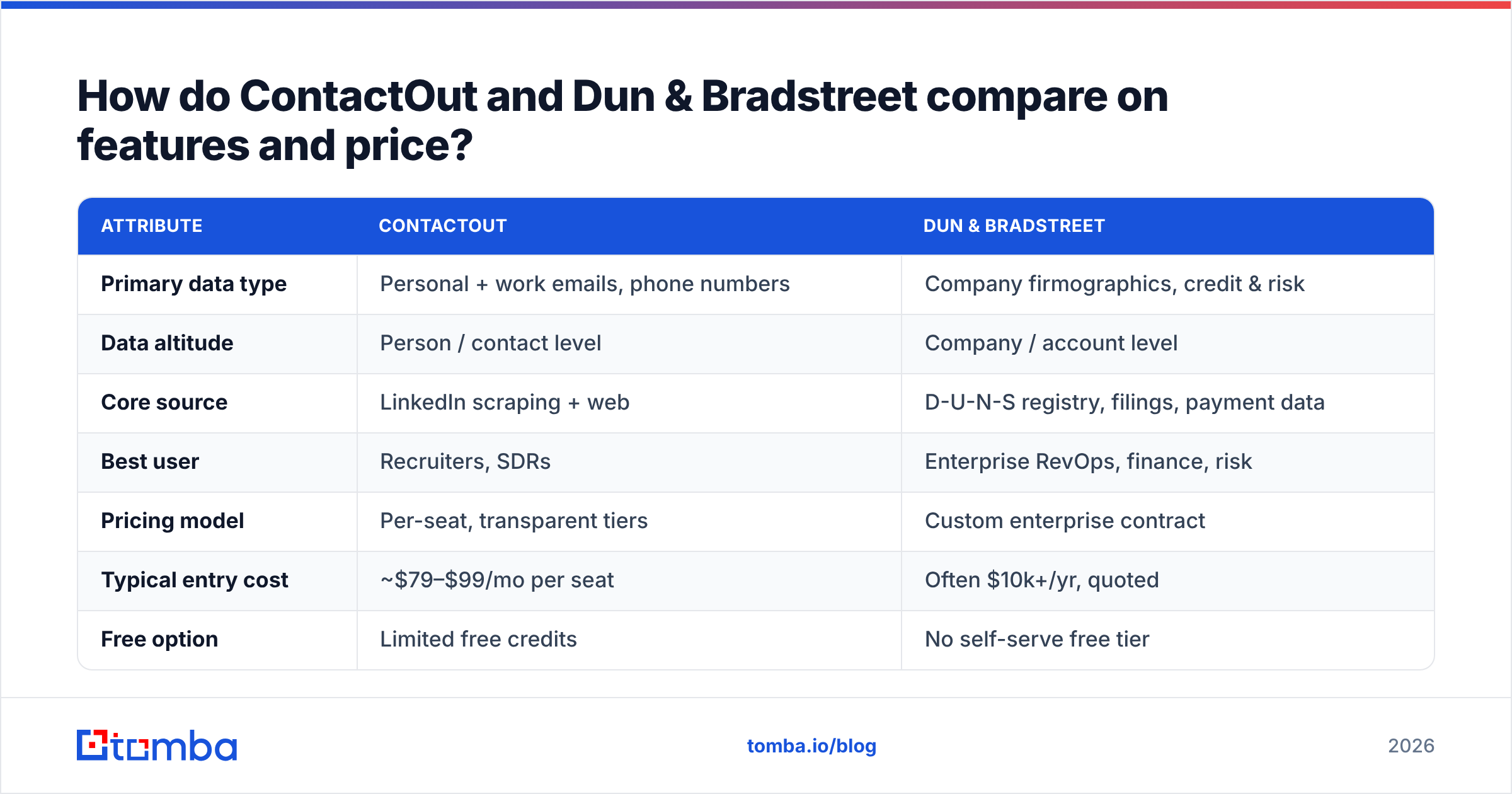
The table below lines up the two tools on the attributes that change a buying decision.
| Attribute | ContactOut | Dun & Bradstreet |
|---|---|---|
| Primary data type | Personal + work emails, phone numbers | Company firmographics, credit & risk |
| Data altitude | Person / contact level | Company / account level |
| Core source | LinkedIn scraping + web | D-U-N-S registry, filings, payment data |
| Best user | Recruiters, SDRs | Enterprise RevOps, finance, risk |
| Pricing model | Per-seat, transparent tiers | Custom enterprise contract |
| Typical entry cost | ~$79–$99/mo per seat | Often $10k+/yr, quoted |
| Free option | Limited free credits | No self-serve free tier |
| Setup time | Minutes (Chrome extension) | Weeks (enterprise onboarding) |
| Email verification | Basic | Not the focus |
| API access | Yes | Yes (enterprise) |
Two things jump out. First, the use cases barely overlap. You'd only compare them if you weren't sure what problem you're solving. Second, the cost structures are on different planets. ContactOut is a tool you expense. D&B is a line item Procurement negotiates.

Which is more accurate for finding B2B emails?#
For raw email discovery, ContactOut is the more relevant of the two. Email and phone are its whole reason to exist. D&B treats contact-level email as a secondary attribute layered on top of company records.
But "more relevant than D&B" is a low bar for email accuracy. LinkedIn-scraped tools face a structural problem. Profiles go stale, people change jobs, and personal emails drift. A 2023 Dun & Bradstreet data study has long noted how fast B2B records decay. Contact data can lose real accuracy every year without re-verification. That's true for any scraped source, ContactOut included.
This is why serious outbound teams pair discovery with a dedicated email verifier that checks deliverability in real time. They also add a catch-all verifier for domains that accept every address. Finding an address is half the job. Confirming it won't bounce and torch your sender reputation is the other half. Neither ContactOut nor D&B was built to be your verification layer.
If accuracy on the actual email is your priority, the smarter setup is a purpose-built finder plus verifier. Not a company-intelligence subscription, and not a LinkedIn scraper alone.
When should you choose ContactOut over Dun & Bradstreet?#
Pick ContactOut when:
- You already know the account and just need to reach specific people inside it.
- You live in LinkedIn — recruiting or social selling where the profile is your starting point.
- You need phone numbers, not just email, for a call-heavy motion.
- Budget is per-seat, not enterprise, and you want to start this week.
Pick Dun & Bradstreet when:
- You're evaluating companies, not contacting people — credit, risk, supplier vetting.
- You need canonical firmographics and corporate hierarchies for a large TAM.
- Compliance and data lineage matter — regulated industries lean on D&B's legitimacy.
- You have enterprise budget and a data team to operationalize it.
Notice that neither list is "I need to send cold emails cheaply and accurately." That job belongs to a third category of tool.
Where does Tomba fit between the two?#
Tomba sits in the practical middle where most GTM teams live. It finds and verifies real, reachable B2B emails. You don't need an enterprise contract or a LinkedIn-only workflow.
Instead of scraping one social network or selling you a risk platform, Tomba works from the company domain outward. Run a domain search to pull every discoverable address at a target company. Use the bulk email finder to enrich a whole list. Confirm deliverability before you hit send. When you need firmographic context, data enrichment fills in the gaps — without a five-figure floor.
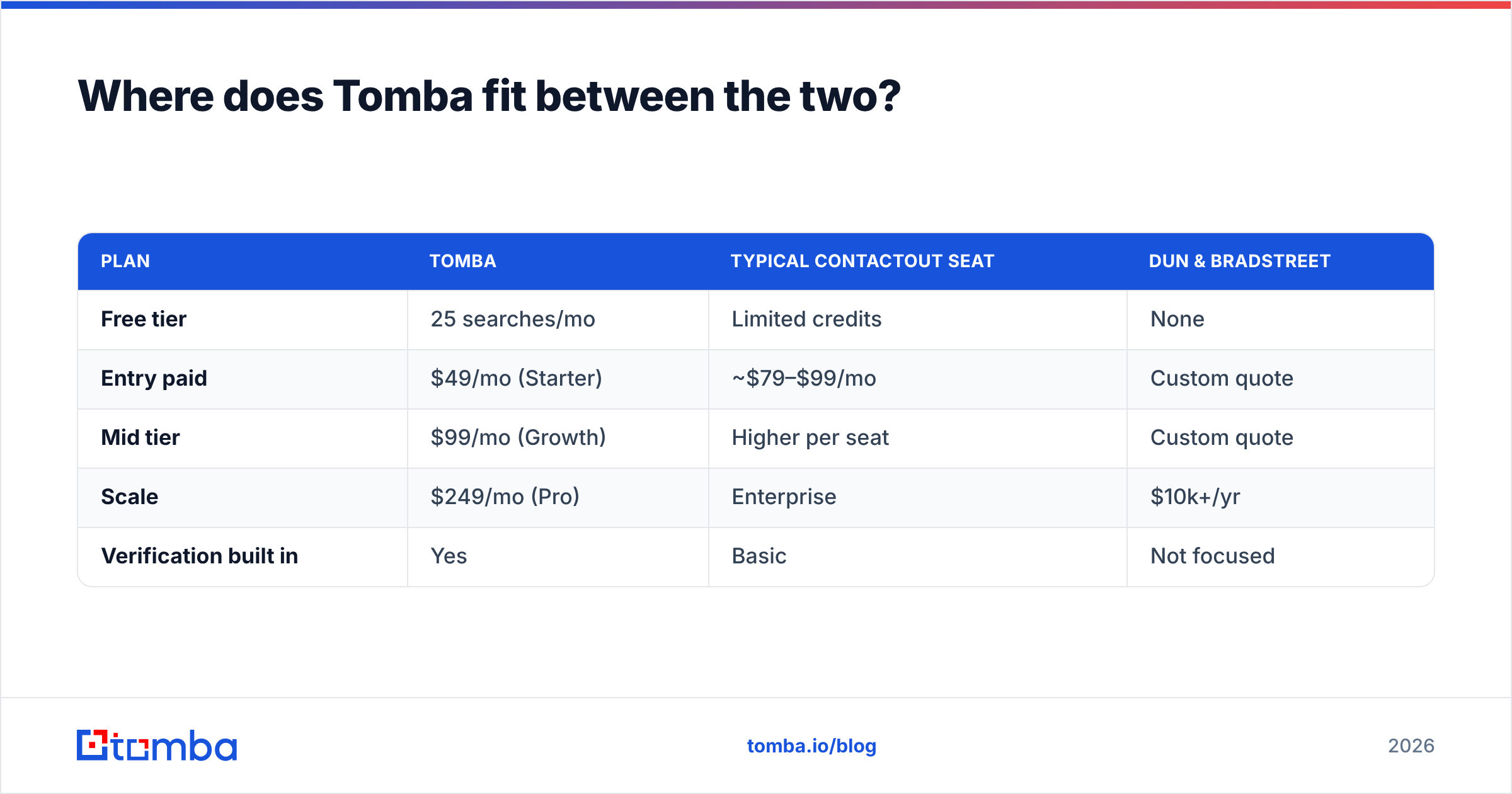
Here's how the three stack up on the job most teams hire for — reliable outbound at a sane price:
- ContactOut — strong for LinkedIn-based people search; weaker on verification and priced per seat.
- Dun & Bradstreet — unmatched for company risk and firmographics; overkill and overpriced for email outreach.
- Tomba — built for email finding and verification, transparent Tomba pricing from a Free tier up to Enterprise, with an email finder API when you need scale.
| Plan | Tomba | Typical ContactOut seat | Dun & Bradstreet |
|---|---|---|---|
| Free tier | 25 searches/mo | Limited credits | None |
| Entry paid | $49/mo (Starter) | ~$79–$99/mo | Custom quote |
| Mid tier | $99/mo (Growth) | Higher per seat | Custom quote |
| Scale | $249/mo (Pro) | Enterprise | $10k+/yr |
| Verification built in | Yes | Basic | Not focused |
For most sales and marketing teams, the honest answer is simple. You don't need D&B's risk cloud. And you don't want to bet deliverability on scraped LinkedIn data alone. You need accurate emails, verified, at a price that scales with your pipeline — not your procurement cycle.
Is Dun & Bradstreet worth it in 2026?#
For its intended buyer, yes. That's the nuance. Say you're a bank, an insurer, or an enterprise procurement team. You make credit and risk decisions across thousands of accounts. Then D&B's data lineage and D-U-N-S standardization are genuinely hard to replicate. It earns its contract there.
For a startup, agency, or mid-market sales team, the job is booking meetings. There, D&B is the wrong shape of tool. You'd pay enterprise rates for company data when your bottleneck is reaching people. The money is better spent on a finder-plus-verifier stack, with light enrichment on top.
The mistake to avoid is treating "we need better data" as one decision. Company risk data and contact deliverability are two different purchases. Buying one to solve the other is how the tens-of-thousands invoices happen.
The Verdict: ContactOut vs Dun Bradstreet#
Neither tool "wins," because they were built to win different games. ContactOut wins for reaching named people off LinkedIn. Dun & Bradstreet wins for evaluating companies at enterprise scale. If those are literally your needs, buy accordingly.
But maybe you clicked this comparison because you need dependable B2B emails for outbound. Most people do. Then the right pick is neither the scraper nor the risk platform. It's a dedicated email tool.
Start free with Tomba Email Finder. Find professional emails by name, domain, or company. Verify them before you send. Scale on transparent pricing that starts at $49/mo instead of a custom enterprise quote. You get the reach ContactOut promises and the reliability D&B buyers expect — without paying for a platform you'll never fully use. Create a free account and run your first 25 searches today.
Related guides#
Ready to find emails that actually work?
Join 150,000+ professionals who stopped guessing and started sending. Free credits on signup — no credit card required.
Get the Tomba newsletter
Practical outbound tactics and product updates — once every two weeks.
About the author