ContactOut vs Fac Intelligence: Data Accuracy Compared 2026
ContactOut and Fac Intelligence both promise clean B2B contact data — but they win at different jobs. Here is the honest, side-by-side breakdown on accuracy, coverage, pricing, and workflow fit.
Choosing between ContactOut and Fac Intelligence usually comes down to one question your CSV export never answers: how many of these emails actually land? Both tools sell "verified B2B contact data," but they were built for different buyers, priced on different logic, and score differently the moment you push them into a real sequence.
This is the neutral, receipts-first comparison — what each tool is genuinely good at, where each one quietly costs you deliverability, and which one fits your motion in 2026.
TL;DR — ContactOut vs Fac Intelligence#
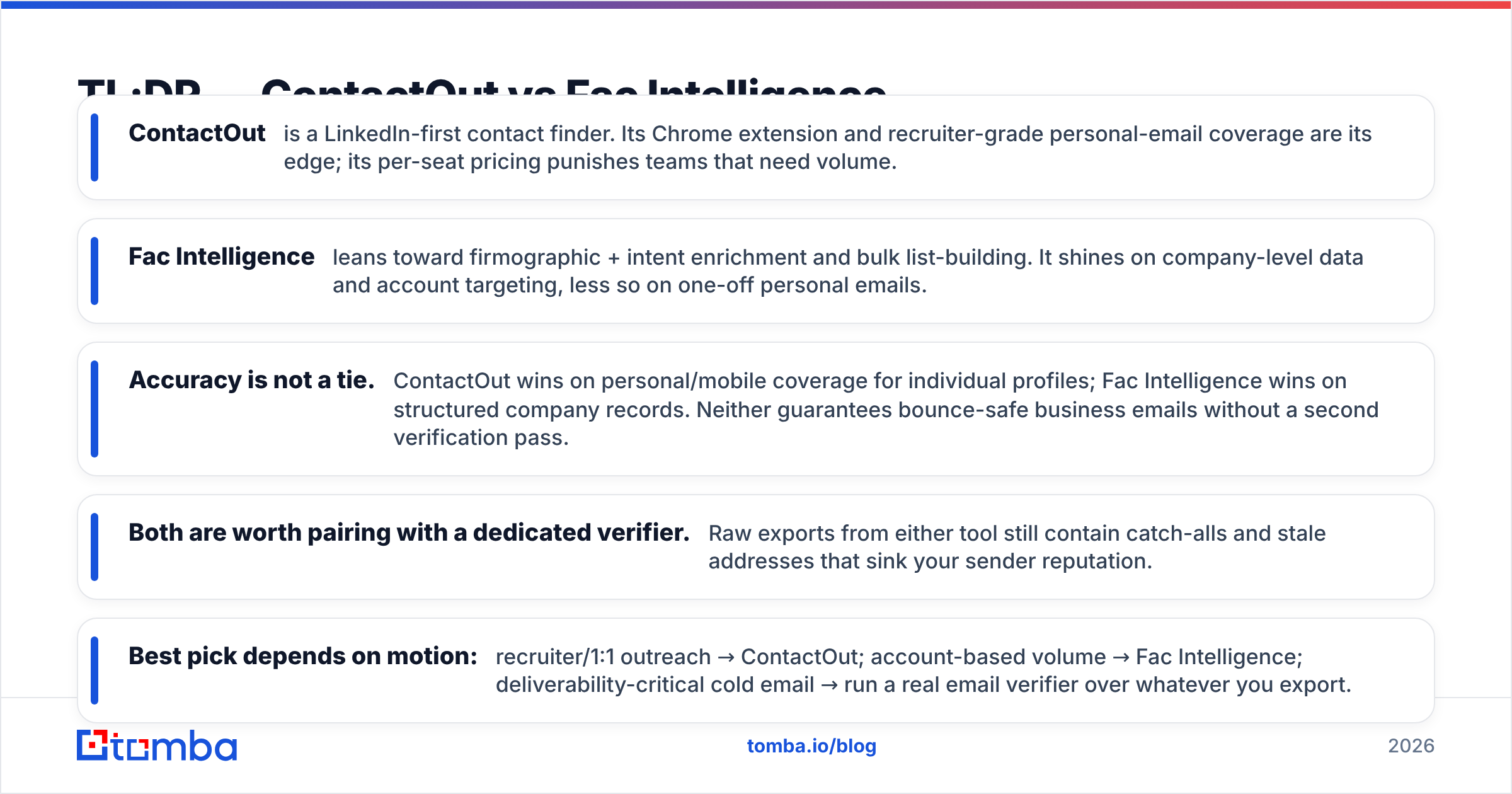
- ContactOut is a LinkedIn-first contact finder. Its Chrome extension and recruiter-grade personal-email coverage are its edge; its per-seat pricing punishes teams that need volume.
- Fac Intelligence leans toward firmographic + intent enrichment and bulk list-building. It shines on company-level data and account targeting, less so on one-off personal emails.
- Accuracy is not a tie. ContactOut wins on personal/mobile coverage for individual profiles; Fac Intelligence wins on structured company records. Neither guarantees bounce-safe business emails without a second verification pass.
- Both are worth pairing with a dedicated verifier. Raw exports from either tool still contain catch-alls and stale addresses that sink your sender reputation.
- Best pick depends on motion: recruiter/1:1 outreach → ContactOut; account-based volume → Fac Intelligence; deliverability-critical cold email → run a real email verifier over whatever you export.

What is ContactOut?#
ContactOut is a contact-intelligence platform best known for its browser extension that surfaces personal emails and phone numbers directly on LinkedIn and GitHub profiles. Recruiters adopted it first, and that DNA still shows: it over-indexes on personal Gmail/Outlook addresses and mobile numbers, which is exactly what talent teams need to reach passive candidates.
For sales teams, that same strength is a double-edged sword. Personal emails have higher deliverability but weaker professional intent, and blasting someone's private inbox with a B2B pitch is a fast way to earn spam complaints. ContactOut's business-email coverage exists but is thinner than its personal-email coverage, so results vary widely by industry and seniority.
Its data model is profile-centric: you find a person, then pull their contacts. That is great for surgical, one-at-a-time prospecting and painful for building a 5,000-row list in an afternoon.
What is Fac Intelligence?#
Fac Intelligence sits closer to the "B2B data platform" category — think firmographics, technographics, and account-level enrichment rather than single-profile lookups. It is built for teams that start from a target account list ("mid-market fintechs in the EU using AWS") and want contacts within those accounts, plus the company context to prioritize them.
That makes Fac Intelligence stronger at breadth: bulk exports, company records, and enrichment fields that feed account scoring and territory planning. The tradeoff is depth on any single individual. Personal mobiles and private emails — ContactOut's home turf — are not the pitch here. You are buying structured, list-scale B2B data and intelligence to run account-based plays.
If your GTM motion is ABM or outbound-at-scale, that shape fits. If you are a recruiter chasing one hard-to-reach VP, it does not.
ContactOut vs Fac Intelligence: the core comparison#
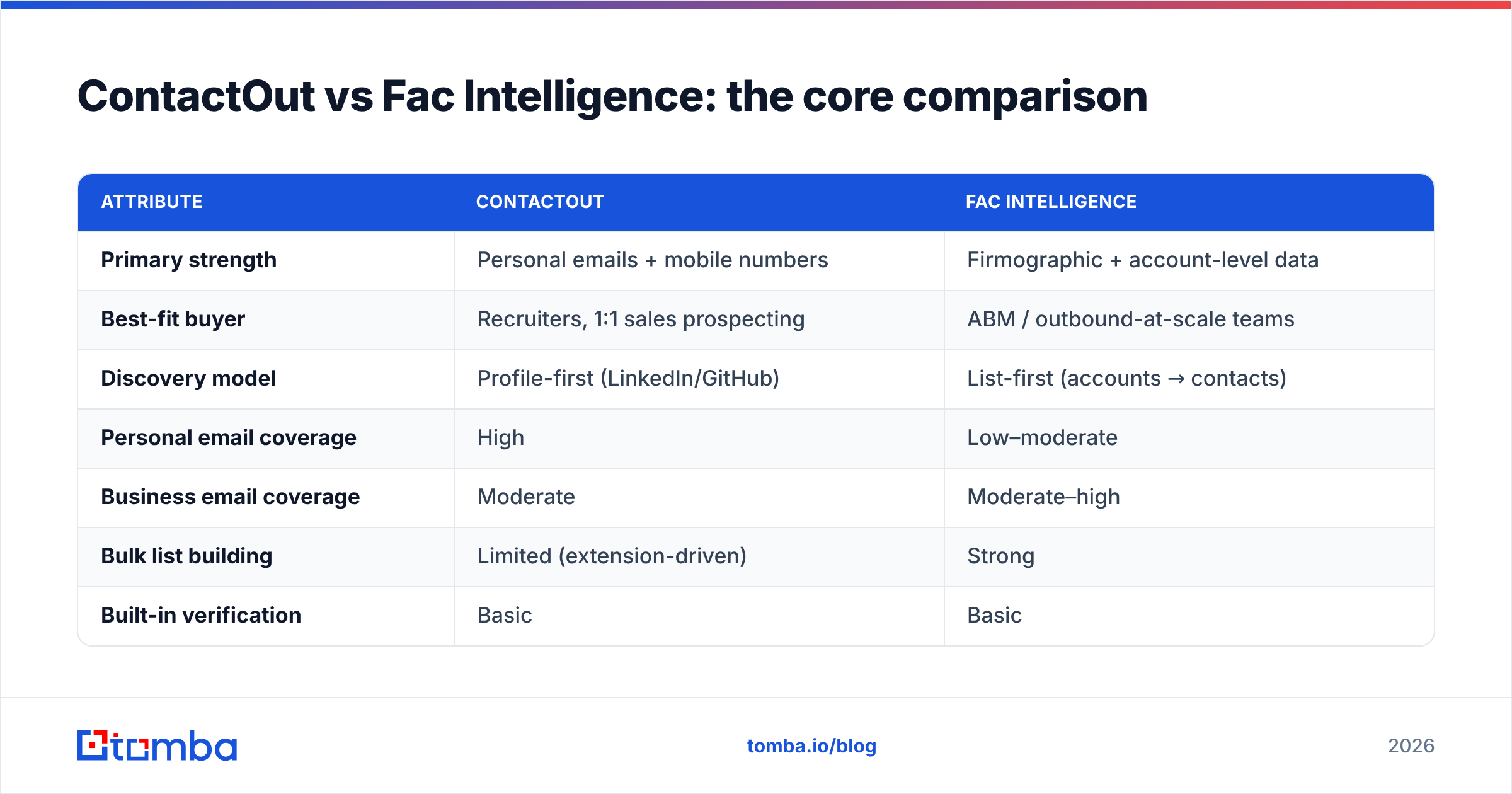
Here is the head-to-head on the attributes that actually change your results. Treat vendor-published accuracy numbers as marketing until you test on your own ICP — the ranges below reflect typical field performance, not lab claims.
| Attribute | ContactOut | Fac Intelligence |
|---|---|---|
| Primary strength | Personal emails + mobile numbers | Firmographic + account-level data |
| Best-fit buyer | Recruiters, 1:1 sales prospecting | ABM / outbound-at-scale teams |
| Discovery model | Profile-first (LinkedIn/GitHub) | List-first (accounts → contacts) |
| Personal email coverage | High | Low–moderate |
| Business email coverage | Moderate | Moderate–high |
| Bulk list building | Limited (extension-driven) | Strong |
| Built-in verification | Basic | Basic |
| Pricing model | Per-seat, credit-tiered | Quote / volume-based |
| Free tier | Limited trial | Demo-gated |
The pattern is clear: these tools are not really competitors so much as specialists. ContactOut answers "how do I reach this person?" Fac Intelligence answers "who are all the people at these accounts?"
Which tool has better data accuracy?#
Neither one is bounce-safe on export — and that is the point most comparison posts skip. Accuracy has two dimensions: coverage (do they have a contact at all?) and validity (is that contact still deliverable?). ContactOut and Fac Intelligence both optimize for coverage, because coverage is what demos well. Validity decays silently.
Here is why raw accuracy claims mislead you:
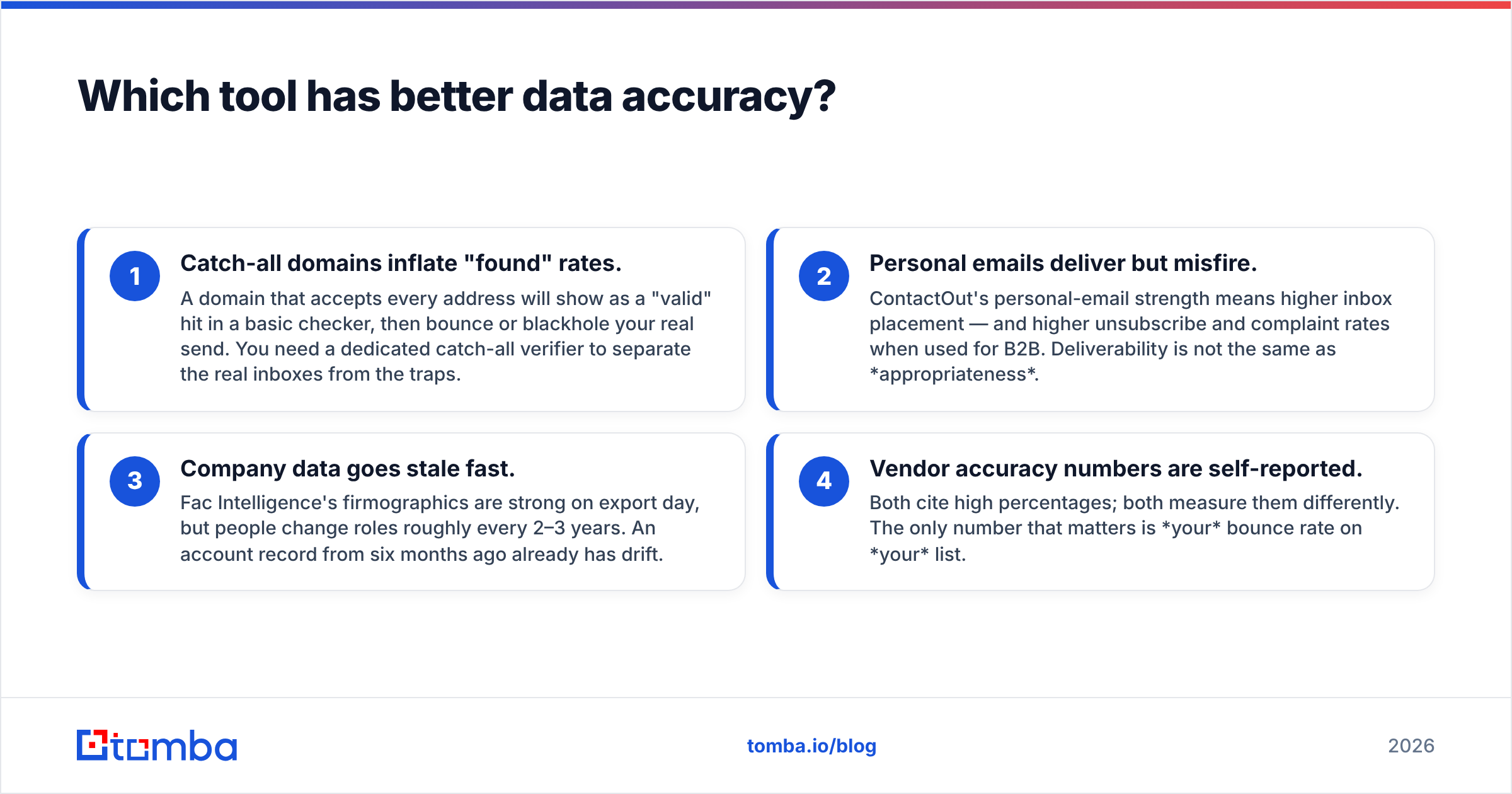
- Catch-all domains inflate "found" rates. A domain that accepts every address will show as a "valid" hit in a basic checker, then bounce or blackhole your real send. You need a dedicated catch-all verifier to separate the real inboxes from the traps.
- Personal emails deliver but misfire. ContactOut's personal-email strength means higher inbox placement — and higher unsubscribe and complaint rates when used for B2B. Deliverability is not the same as appropriateness.
- Company data goes stale fast. Fac Intelligence's firmographics are strong on export day, but people change roles roughly every 2–3 years. An account record from six months ago already has drift.
- Vendor accuracy numbers are self-reported. Both cite high percentages; both measure them differently. The only number that matters is your bounce rate on your list.

The practical takeaway: whichever tool you pick, treat its output as raw material, not a finished list. A verification pass before you load anything into your sequencer is the single highest-ROI step in the whole workflow — it protects your sender reputation, which is far harder to rebuild than a list is to re-scrape.
How does pricing compare?#
Pricing is where the two diverge hardest, and where buyers get surprised.
ContactOut uses per-seat, credit-tiered pricing. That works for a solo recruiter or a two-person sales team doing precise, low-volume outreach. It scales badly: every rep needs a seat, and credit caps mean high-volume users hit overage or upgrade walls quickly. The extension-driven model also means the value is tied to a human clicking profiles — you are paying for seats, not throughput.
Fac Intelligence typically runs on quote-based, volume pricing. That is standard for the account-data category, but it means opaque entry costs, annual commitments, and a sales call before you see a real number. Great if you are buying at scale with budget approved; frustrating if you want to test on a small list this week.
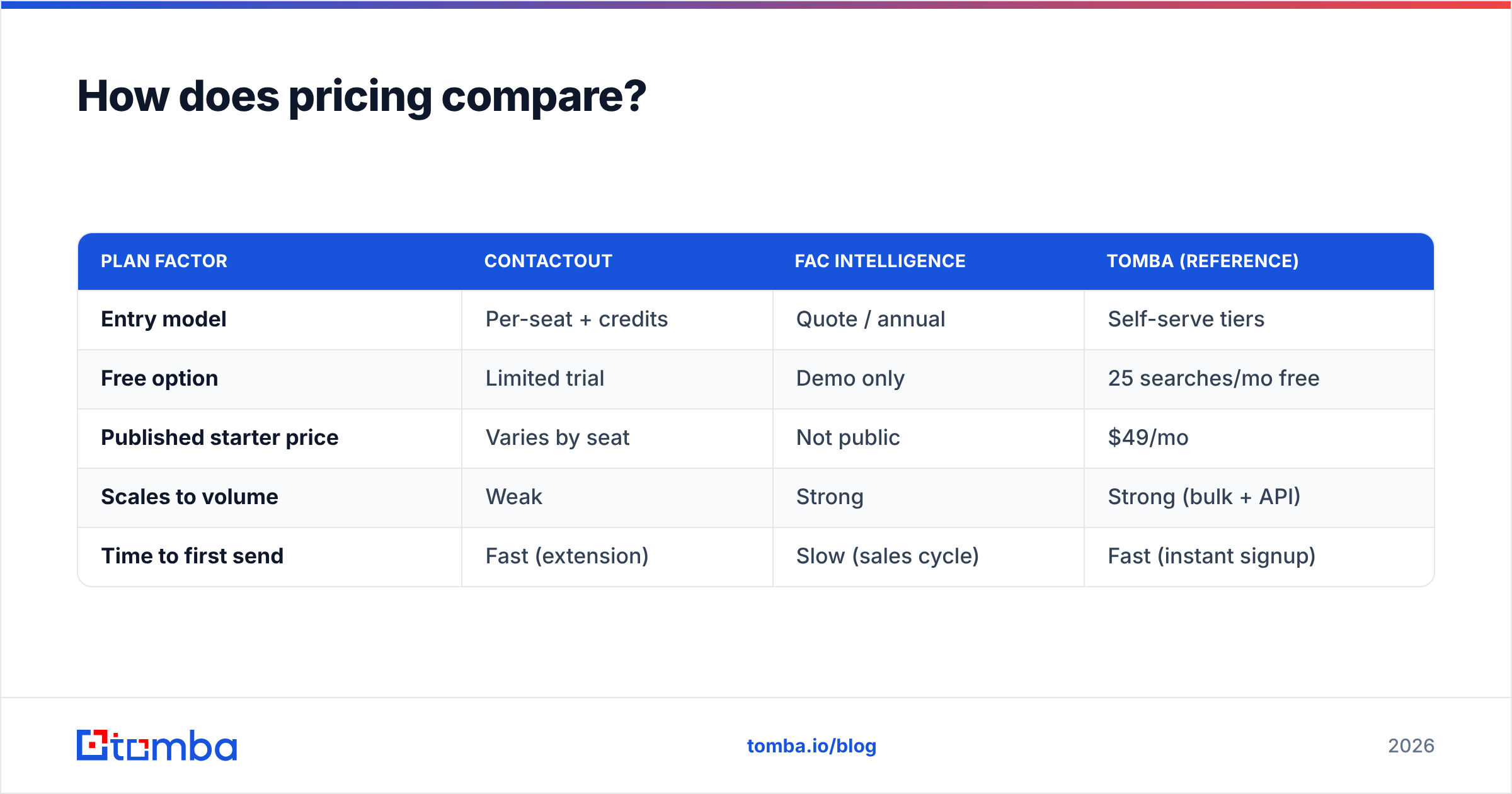
Neither publishes the kind of transparent, self-serve tiers that let you start small and grow. If predictable, published pricing matters to you, that is worth weighing. For reference, tools like Tomba list Tomba pricing openly — a free tier at 25 searches/month, Starter at $49/month, Growth at $99/month, and Pro at $249/month — so you can model cost before committing.
| Plan factor | ContactOut | Fac Intelligence | Tomba (reference) |
|---|---|---|---|
| Entry model | Per-seat + credits | Quote / annual | Self-serve tiers |
| Free option | Limited trial | Demo only | 25 searches/mo free |
| Published starter price | Varies by seat | Not public | $49/mo |
| Scales to volume | Weak | Strong | Strong (bulk + API) |
| Time to first send | Fast (extension) | Slow (sales cycle) | Fast (instant signup) |
What about workflow and integrations?#
A tool is only as good as how cleanly it drops data into your stack. ContactOut's extension is friction-light for manual prospecting but hard to automate — it assumes a person in the loop. Fac Intelligence is built for bulk export and enrichment, so it slots better into RevOps pipelines, but its integrations are geared toward CRM sync rather than real-time enrichment inside your outreach tool.
For teams that want programmatic access — enriching leads on signup, verifying at the point of capture, or running nightly list hygiene — you want an API-first option. That is where a dedicated email finder API or a bulk email finder changes the economics: you stop paying per seat and start paying per result, and the whole flow runs without a human clicking anything.
A realistic modern stack often looks like: source contacts from whichever specialist tool fits (ContactOut for people, Fac Intelligence for accounts), then pipe everything through one verification and enrichment layer before it touches your sequencer or CRM. That last layer is what protects deliverability and keeps your CRM from filling with dead records.
Which should you choose in 2026?#
Pick ContactOut if: you are a recruiter or a 1:1 salesperson who needs personal emails and mobile numbers for hard-to-reach individuals, you work in the browser, and your volume is low enough that per-seat pricing pencils out.
Pick Fac Intelligence if: you run ABM or high-volume outbound, you start from account lists, and you value firmographic depth and bulk export over single-profile precision — and you have budget cleared for a quote-based contract.
Pick neither as your only tool if: deliverability is mission-critical. Both are discovery tools, not verification tools. Their exports still contain catch-alls, role accounts, and stale addresses that a real verifier catches before your sends do.
The honest answer for most cold-email teams is a combination: use the specialist for sourcing, then standardize on a single, transparent, API-friendly platform for finding, verifying, and enriching the addresses you actually send to. That is where consolidating on something like Tomba's email finder plus its verifier removes the two biggest hidden costs of the ContactOut-vs-Fac-Intelligence decision: per-seat lock-in and silent bounce damage.
For deeper vendor research before you commit, cross-check user reviews on G2 and Capterra, and read each tool's own documentation on how they source data — the ContactOut site is the authoritative source for its current coverage and terms.
Frequently asked questions#
Is ContactOut better than Fac Intelligence? For personal emails and mobile numbers on individual profiles, yes. For account-level firmographics and bulk list building, Fac Intelligence is the stronger fit. They win at different jobs, so "better" depends on your motion.
Do I still need an email verifier if I use either tool? Yes. Both optimize for coverage over validity, and neither reliably filters catch-all domains. A verification pass before sending is the cheapest way to protect your sender reputation and keep bounce rates under 3%.
Which is cheaper? ContactOut is cheaper to start for one seat; Fac Intelligence is quote-based and typically requires an annual commitment. Neither publishes fully transparent tiers, which makes small-scale testing awkward compared with self-serve platforms.
Can I use these tools for cold email at scale? Fac Intelligence is built for scale; ContactOut is not, because its value is tied to per-seat, extension-driven usage. For programmatic scale, an API-first finder plus a bulk verifier is a better architecture.
The bottom line#
ContactOut and Fac Intelligence are both credible — just narrow. ContactOut owns the personal-contact, recruiter-grade niche; Fac Intelligence owns account-level breadth. What neither owns is the deliverability layer that decides whether your outreach lands, and that gap costs teams more than the subscription ever does.
If you want one platform that finds professional emails by name, company, or domain, verifies them before you send, and exposes it all through a clean API and self-serve pricing, start with the Tomba Email Finder. Run it free for your first 25 searches, test it against your own ICP, and let your bounce rate — not a vendor's accuracy chart — make the call.

Related guides#
Ready to find emails that actually work?
Join 150,000+ professionals who stopped guessing and started sending. Free credits on signup — no credit card required.
Get the Tomba newsletter
Practical outbound tactics and product updates — once every two weeks.
About the author