ContactOut vs HitHorizons: B2B Data Tools Compared for 2026
ContactOut chases person-level emails and phones; HitHorizons maps company financials across Europe. Here's which B2B data tool actually fits your outreach in 2026 — and where a purpose-built email finder beats both.
You typed "ContactOut vs HitHorizons" into a search bar expecting a clean head-to-head. Here's the twist most comparison pages bury: these two tools barely compete. One hands you a person's email and mobile number; the other hands you a company's revenue band and legal registration. Picking between them without understanding that gap is how teams waste a budget on data they can't actually action.
This guide breaks down what each platform does, where they overlap, what they cost, and — critically — when neither is the right buy for a cold-outreach motion.
TL;DR: ContactOut vs HitHorizons at a glance#
- ContactOut is a people-data and contact-finder tool built on LinkedIn. It's for reps who need a decision-maker's personal email and phone to start a conversation.
- HitHorizons is a company-data and business-intelligence database covering ~75M+ European companies with firmographics, financials, and legal identifiers. It's for research, credit, TAM sizing, and account planning — not for messaging individuals.
- They solve different jobs. ContactOut answers "how do I reach this person?" HitHorizons answers "is this company real, big, and worth pursuing?"
- Pricing is opaque on both. ContactOut gates volume behind sales-led tiers; HitHorizons sells credits and API access with quote-based enterprise plans.
- If your core need is verified B2B email at scale, a dedicated email finder like Tomba Email Finder with transparent Tomba pricing is usually the cleaner, cheaper pick than bolting one of these onto the wrong job.

What is ContactOut and who is it for?#
ContactOut is a contact-intelligence platform that layers on top of LinkedIn (via a Chrome extension and a web portal) to surface personal emails, work emails, and mobile phone numbers for the profiles you view. Its pitch is reach: get past the connection wall and message a prospect directly.
The typical ContactOut buyer is an SDR, recruiter, or founder doing person-by-person prospecting. You're on a lead's profile, you click the extension, and you get contact details plus an option to push them into a list or your CRM. It shines when the workflow is LinkedIn-first — you already know who you want, you just need a way to email or call them.
Strengths worth naming:
- Personal + work email coverage for individuals, which matters for hard-to-reach senior contacts.
- Mobile numbers on many profiles, useful for cold calling motions.
- Browser-native workflow that fits how recruiters and reps already work inside LinkedIn.
The trade-offs: coverage skews toward profiles with strong LinkedIn footprints, credit consumption can climb fast on high-volume days, and pricing beyond the free trial is sales-gated, so you rarely know your real cost until you're on a call.
What is HitHorizons and who is it for?#
HitHorizons is a completely different animal: a company-level business database. It aggregates firmographic and financial data on tens of millions of businesses, with a strong tilt toward European coverage — think legal names, registration IDs (like national business numbers), industry codes, employee bands, turnover estimates, and corporate hierarchy.
The HitHorizons buyer is usually in market research, credit risk, compliance, procurement, or strategy. You use it to answer questions like: Is this German GmbH a real, sizeable entity? What's its estimated revenue? Who's the parent company? How big is my addressable market in the Benelux manufacturing sector? Its API and search tools are built for enrichment and analysis, not for messaging a named human.
Where HitHorizons is strong:
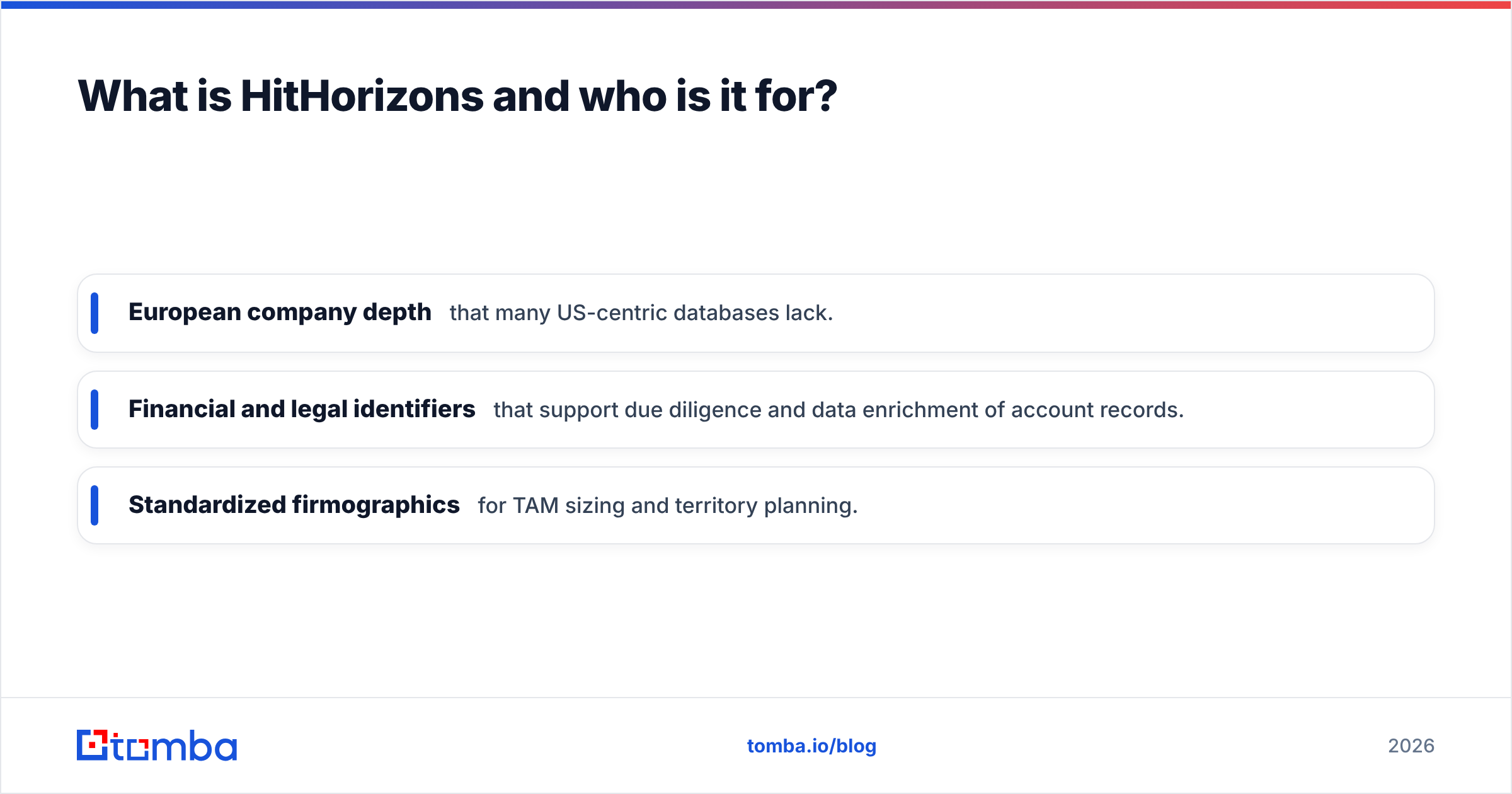
- European company depth that many US-centric databases lack.
- Financial and legal identifiers that support due diligence and data enrichment of account records.
- Standardized firmographics for TAM sizing and territory planning.
Where it won't help: it does not exist to give you Jane Doe's mobile number so you can book a demo. If your goal is direct outreach to individuals, HitHorizons is upstream of that — it tells you which accounts matter, not how to reach the humans inside them.
ContactOut vs HitHorizons: side-by-side comparison#
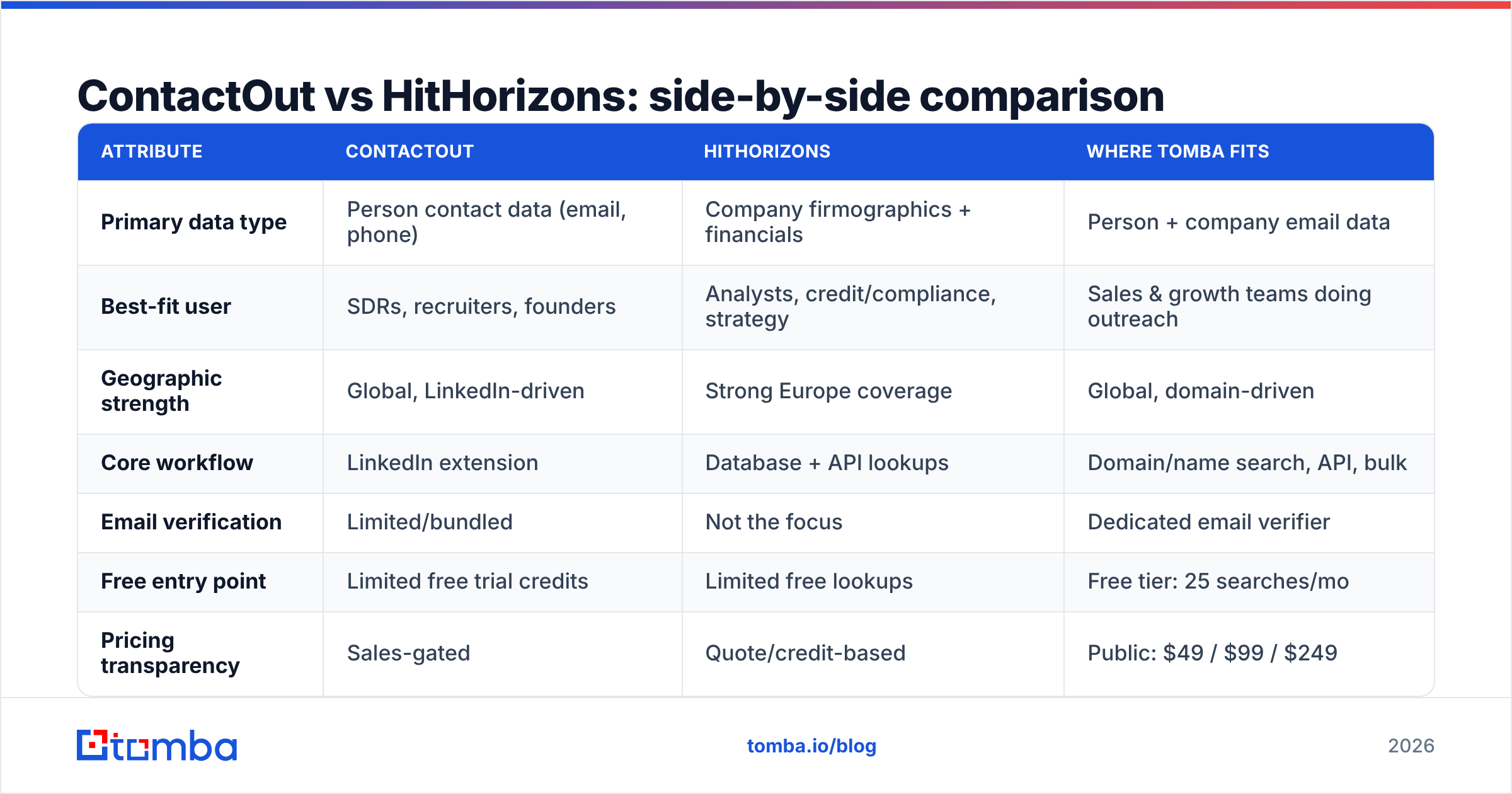
Here's the core distinction in one table. Read it as "different tools for different stages," not "winner vs loser."
| Attribute | ContactOut | HitHorizons | Where Tomba fits |
|---|---|---|---|
| Primary data type | Person contact data (email, phone) | Company firmographics + financials | Person + company email data |
| Best-fit user | SDRs, recruiters, founders | Analysts, credit/compliance, strategy | Sales & growth teams doing outreach |
| Geographic strength | Global, LinkedIn-driven | Strong Europe coverage | Global, domain-driven |
| Core workflow | LinkedIn extension | Database + API lookups | Domain/name search, API, bulk |
| Email verification | Limited/bundled | Not the focus | Dedicated email verifier |
| Free entry point | Limited free trial credits | Limited free lookups | Free tier: 25 searches/mo |
| Pricing transparency | Sales-gated | Quote/credit-based | Public: $49 / $99 / $249 |
| Outreach readiness | High (direct contacts) | Low (needs a finder on top) | High (verified send-ready email) |
The pattern is clear: ContactOut is outreach-ready but LinkedIn-bound and opaque on price; HitHorizons is analysis-ready but a poor fit for messaging individuals; and a focused email finder covers the "reach real people at scale, with verification, at a known price" middle that both leave partly open.
Is ContactOut better than HitHorizons?#
Neither is "better" — they're aimed at different KPIs. Ask what you're actually optimizing:
- If your metric is meetings booked from named prospects, ContactOut is closer to the job. It gives you the person's email and phone so you can start a sequence today.
- If your metric is account-list quality, credit risk, or market sizing, HitHorizons wins outright. Firmographics and financials are its entire reason to exist.
- If your metric is verified email volume for cold outreach, honestly, both are awkward fits. ContactOut's pricing scales unpredictably, and HitHorizons doesn't hand you send-ready inboxes at all.
A concrete example: say you're running an outbound campaign into 2,000 mid-market SaaS companies. HitHorizons can help you qualify and prioritize those accounts. ContactOut can help you reach individuals on the ones you've already found on LinkedIn. But to generate 2,000 verified, deliverable email addresses efficiently — mapped by company email search across each domain — you want a purpose-built finder feeding your sequencer.
How much do ContactOut and HitHorizons cost?#
This is where buyers get frustrated, and it's worth being blunt.
ContactOut offers a limited free trial, then moves you to paid tiers that are largely sales-gated. Public pricing pages tease credit-based plans, but real annual costs for team volume typically require a conversation with their team. Expect per-seat pricing plus credit ceilings that meter how many contacts you can reveal.
HitHorizons sells through a mix of free lookups, credit packs, and API/enterprise agreements. Because its data is used for research and enrichment, pricing is usually structured around API volume or dataset access and quoted per use case rather than published as flat SaaS tiers.
The common thread: you often can't self-serve a predictable monthly number on either. That's a real cost in itself — procurement time, negotiation, and the risk of over-buying credits you never burn.
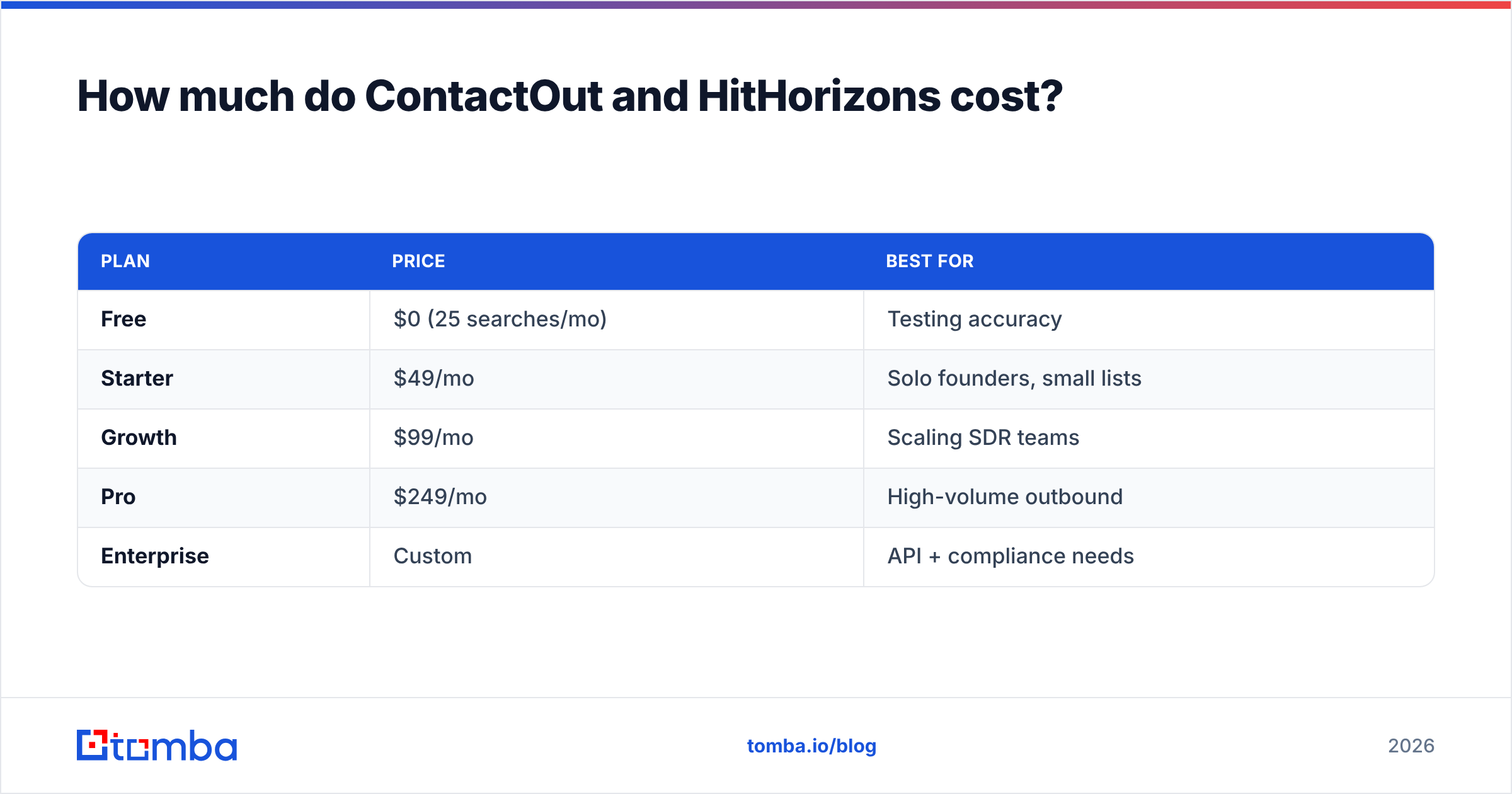
Contrast that with a transparent alternative. Tomba publishes its plans openly:
| Plan | Price | Best for |
|---|---|---|
| Free | $0 (25 searches/mo) | Testing accuracy |
| Starter | $49/mo | Solo founders, small lists |
| Growth | $99/mo | Scaling SDR teams |
| Pro | $249/mo | High-volume outbound |
| Enterprise | Custom | API + compliance needs |
You can read the full Tomba plans without a sales call, which makes budgeting a five-minute exercise instead of a procurement project.
When should you use a dedicated email finder instead?#
Choose a focused email-finder-plus-verifier stack when your primary bottleneck is reaching people at scale with deliverable data. That's most cold-outbound and demand-gen teams.
Signals you've outgrown a LinkedIn-only tool like ContactOut or a company-database like HitHorizons for outreach:
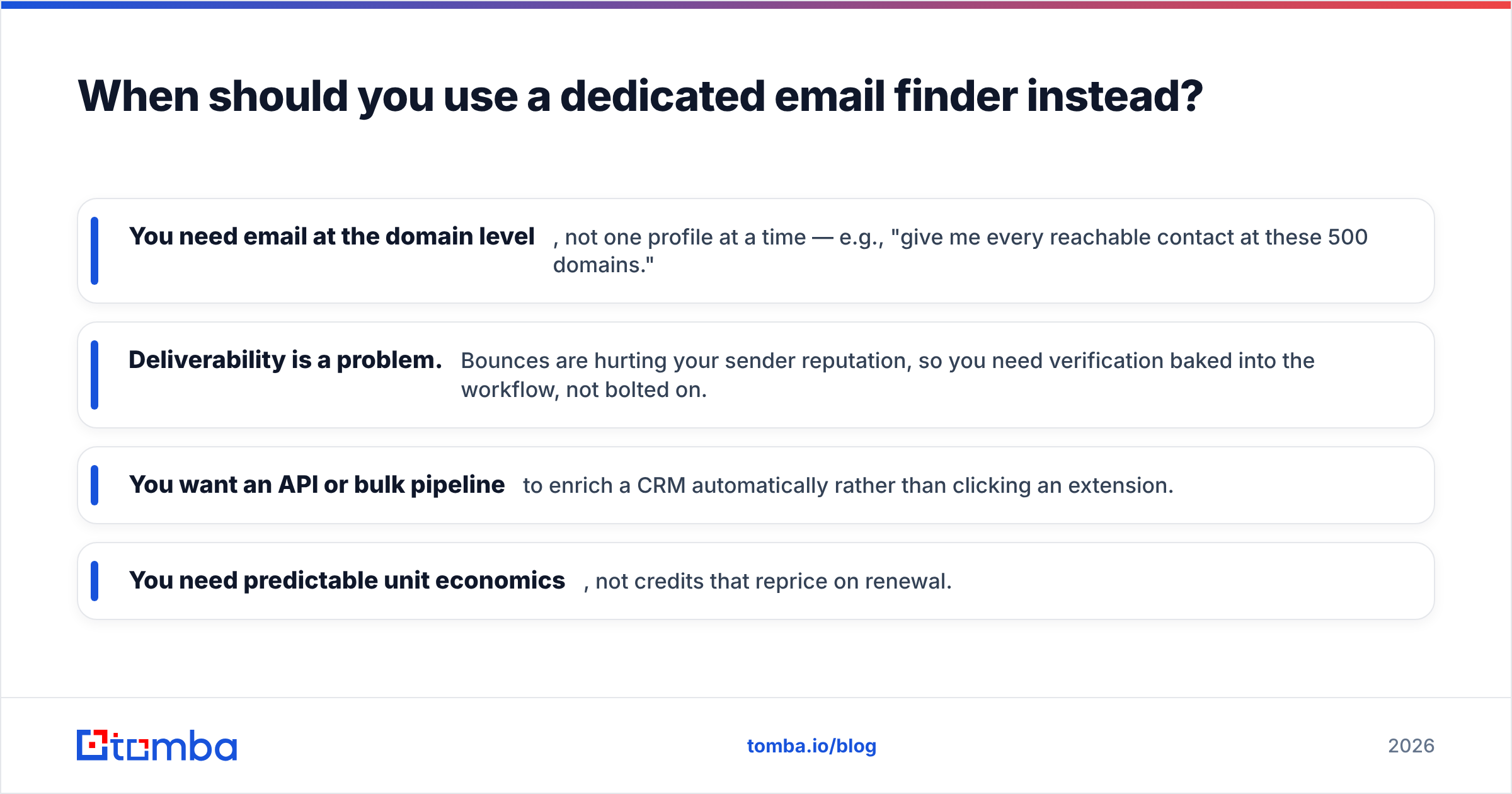
- You need email at the domain level, not one profile at a time — e.g., "give me every reachable contact at these 500 domains."
- Deliverability is a problem. Bounces are hurting your sender reputation, so you need verification baked into the workflow, not bolted on.
- You want an API or bulk pipeline to enrich a CRM automatically rather than clicking an extension.
- You need predictable unit economics, not credits that reprice on renewal.
This is the lane where Tomba is built to compete directly. Its B2B database and finder return work emails by name or domain, a separate email verifier scrubs the list before you send, and bulk plus API access let you industrialize the whole thing. You still might use HitHorizons upstream to decide which accounts matter — the two aren't mutually exclusive — but the finding-and-verifying step belongs to a specialist.
ContactOut vs HitHorizons vs Tomba: which should you choose?#
A simple decision framework:
- Choose ContactOut if your team lives inside LinkedIn, works prospect-by-prospect, and needs personal mobile numbers more than bulk email — and you're comfortable with sales-gated pricing.
- Choose HitHorizons if you're doing European market research, credit/compliance checks, or TAM analysis, and you need company financials and legal identifiers rather than individual contacts.
- Choose a dedicated email finder if your job is scaled, verified outreach — finding many reachable people across many domains, keeping bounce rates low, and knowing your cost up front.
Many mature go-to-market teams actually run a combination: a company-intelligence source to prioritize accounts, and a finder-plus-verifier to reach the humans inside them. What you want to avoid is buying one tool to do the other's job — paying for firmographics when you needed inboxes, or burning contact credits when you needed a market map.
If you're comparing more tools in this space, it's worth also scanning dedicated Clearbit alternatives and RocketReach alternatives, since those overlap more directly with the contact-finding side of ContactOut.
Frequently asked questions#
Is ContactOut a competitor to HitHorizons? Not really. ContactOut is a person-level contact finder; HitHorizons is a company-level data provider. They can be complementary — one qualifies accounts, the other reaches people — but they don't replace each other.
Does HitHorizons provide email addresses? HitHorizons focuses on company firmographics, financials, and legal identifiers, not individual send-ready emails. For personal or role-based emails you'll need a dedicated email finder on top.
Which is cheaper, ContactOut or HitHorizons? Both are largely quote- or credit-based, so there's no clean published answer. If predictable pricing matters, a finder with public tiers (Tomba starts at $49/mo) is easier to budget than either.
Can I just use one tool for everything? For outreach at scale, a finder-plus-verifier covers finding and deliverability in one place. For market research and credit, HitHorizons is purpose-built. Trying to force either into the other's role is where teams overspend.
The bottom line#
ContactOut and HitHorizons aren't rivals so much as neighbors solving adjacent problems — direct contact data versus company intelligence. Map the tool to the job: LinkedIn-first person outreach leans ContactOut; European company research and financials lean HitHorizons.
But if what you actually need is verified, deliverable B2B email at scale — with an API, bulk workflows, and pricing you can read without a sales call — start with a specialist. Spin up the free tier of the Tomba Email Finder (25 searches a month, no card), test the accuracy on your own domains, and see whether the "reach real people, verified, at a known price" job is better handled by a tool built for exactly that.
Sources worth checking directly: ContactOut, HitHorizons, and peer reviews on G2.
Related guides#
Ready to find emails that actually work?
Join 150,000+ professionals who stopped guessing and started sending. Free credits on signup — no credit card required.
Get the Tomba newsletter
Practical outbound tactics and product updates — once every two weeks.
About the author