ContactOut vs LeadMine (2026): Which Email Finder Wins?
ContactOut sells LinkedIn-first personal emails. LeadMine sells simple B2B search. We compare accuracy, pricing, and API depth — plus where a third option beats both.
TL;DR
- ContactOut is a LinkedIn-first tool. Its edge is personal/consumer emails and phone numbers scraped alongside LinkedIn profiles — useful for recruiters, occasionally useful for sales.
- LeadMine is a lightweight B2B search-and-verify tool with a small database and a clean single-lookup workflow. It is cheap and simple, and that is roughly the whole pitch.
- Neither is a great fit if you prospect by domain rather than by person — that is where a domain-search-first tool like Tomba usually wins on cost per verified contact.
- Pricing shape matters more than sticker price: ContactOut gates volume behind seats and annual terms; LeadMine sells small credit packs; Tomba starts at $49/mo for Starter with a free 25-search tier.
- Whatever you pick, verify before you send. An unverified list is a deliverability problem disguised as a lead list.
What are ContactOut and LeadMine, actually?#
They solve the same surface problem — "get me this person's work email" — from opposite directions.
ContactOut lives in your browser. You install the Chrome extension, browse LinkedIn (or GitHub, or a company site), and it surfaces emails and phone numbers next to the profile. Its database is built around people, and it advertises coverage of personal email addresses, not just corporate ones. That single design choice explains most of its behavior: it is beloved by recruiters, who need to reach candidates who ignore work inboxes, and it is more expensive per contact than pure B2B tools because personal data is harder to source and maintain.
LeadMine is a web app plus a light Chrome extension. You search by job title, company, industry, and location; it returns a list of people with a "find email" button and a built-in verifier. It is deliberately small — no sequencer, no CRM, no intent data, no dashboards you will never open. For a solo founder doing 200 lookups a month, that minimalism is a feature.
The real question is not "which is better" but which shape of prospecting you actually do:
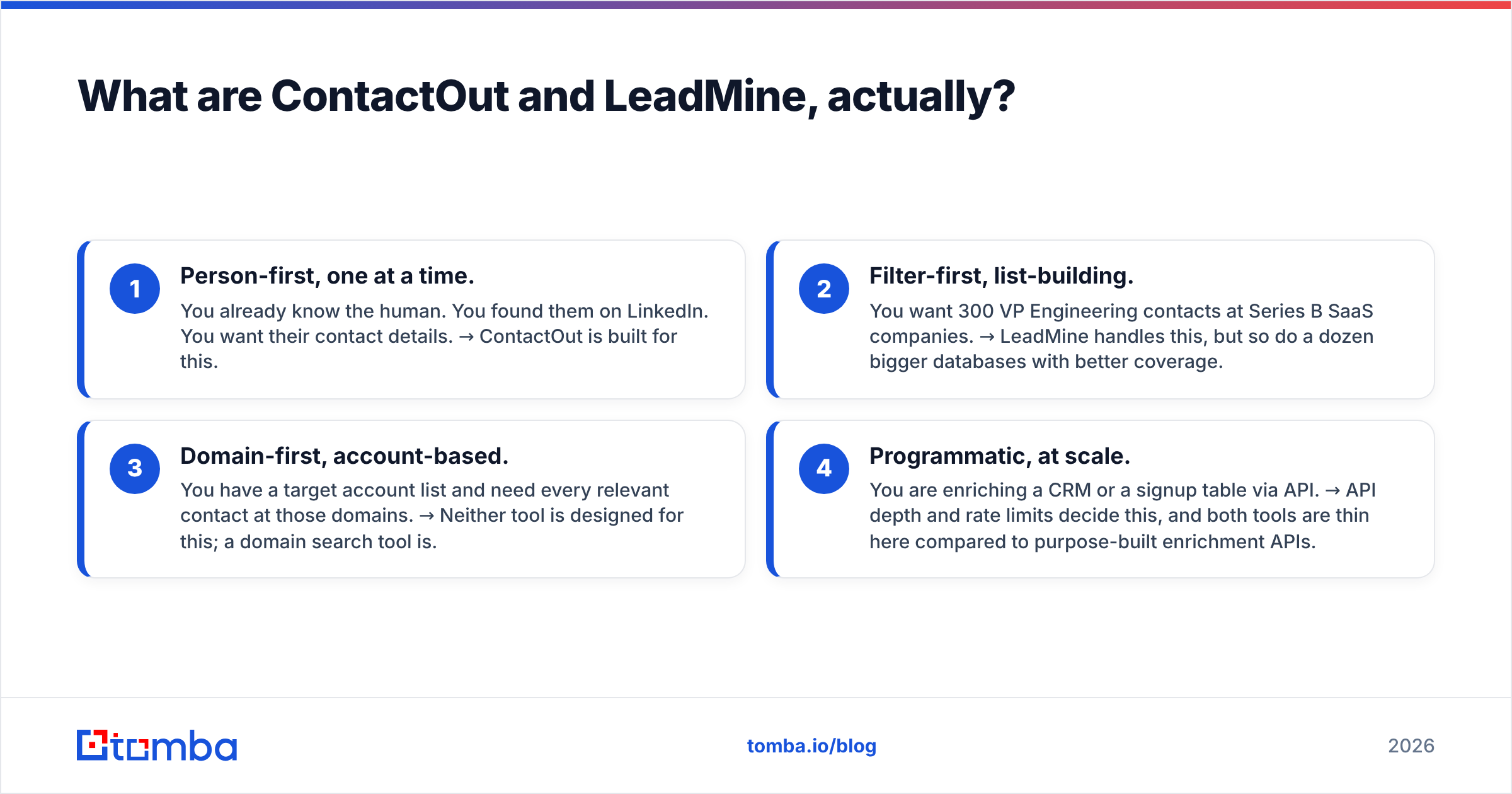
- Person-first, one at a time. You already know the human. You found them on LinkedIn. You want their contact details. → ContactOut is built for this.
- Filter-first, list-building. You want 300 VP Engineering contacts at Series B SaaS companies. → LeadMine handles this, but so do a dozen bigger databases with better coverage.
- Domain-first, account-based. You have a target account list and need every relevant contact at those domains. → Neither tool is designed for this; a domain search tool is.
- Programmatic, at scale. You are enriching a CRM or a signup table via API. → API depth and rate limits decide this, and both tools are thin here compared to purpose-built enrichment APIs.

How do ContactOut and LeadMine compare on features and price?#
Pricing on both tools moves, and both hide their real numbers behind demos or annual toggles, so treat these as directional and confirm on their sites before you buy. What does not move is the architecture of each plan — that is what you should be comparing.
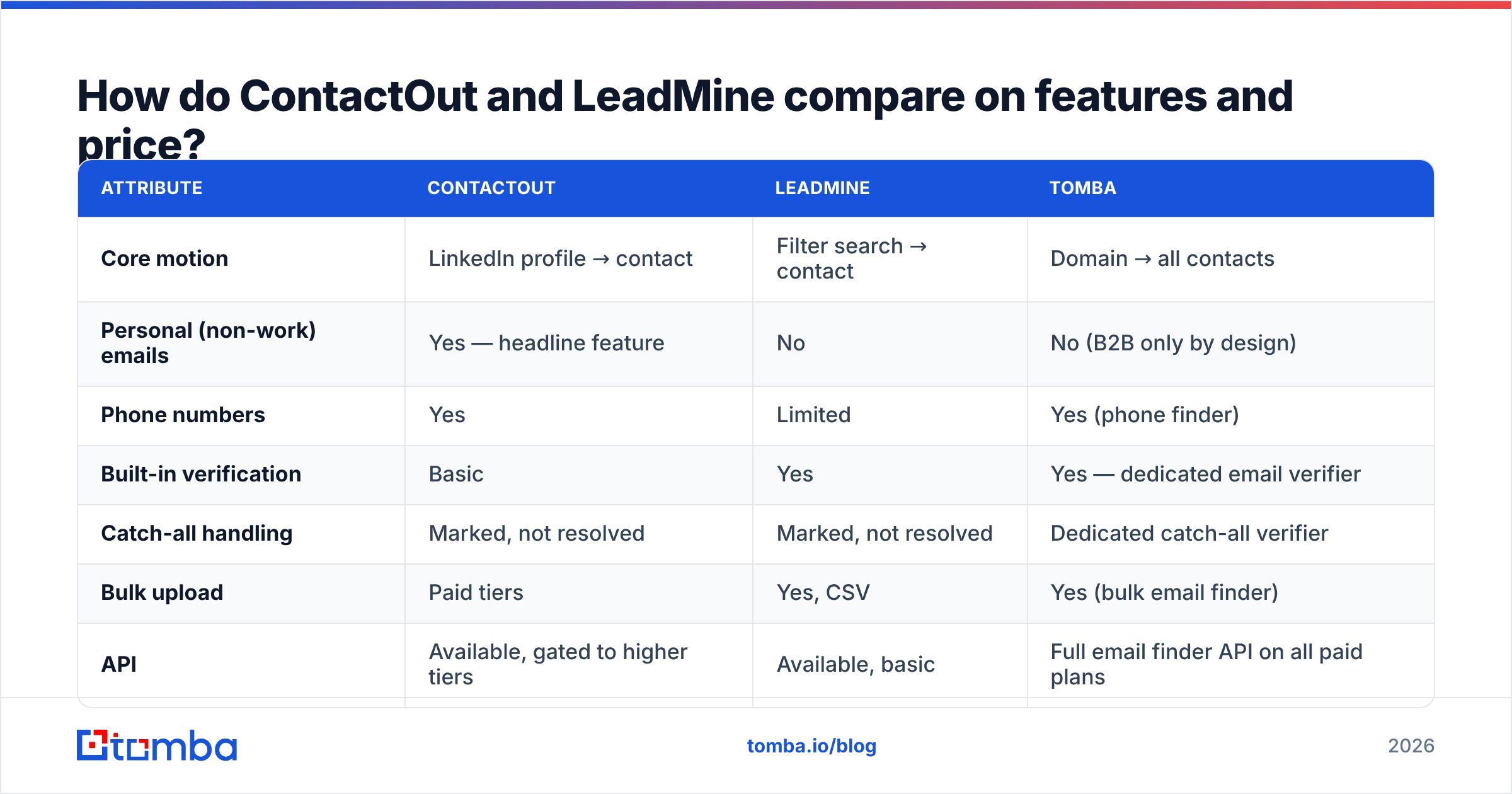
| Attribute | ContactOut | LeadMine | Tomba |
|---|---|---|---|
| Core motion | LinkedIn profile → contact | Filter search → contact | Domain → all contacts |
| Personal (non-work) emails | Yes — headline feature | No | No (B2B only by design) |
| Phone numbers | Yes | Limited | Yes (phone finder) |
| Built-in verification | Basic | Yes | Yes — dedicated email verifier |
| Catch-all handling | Marked, not resolved | Marked, not resolved | Dedicated catch-all verifier |
| Bulk upload | Paid tiers | Yes, CSV | Yes (bulk email finder) |
| API | Available, gated to higher tiers | Available, basic | Full email finder API on all paid plans |
| Free tier | Limited monthly credits | Small free trial credits | 25 searches/mo, no card |
| Entry paid price | Roughly $49–$99/mo, seat-based | Low double digits, credit packs | $49/mo Starter |
| Best for | Recruiters, exec search | Solo founders, light B2B lists | Outbound teams, dev-led enrichment |
Read that table as three different products, not three competitors in a horse race.
ContactOut's price is defensible if you need personal emails. If you are a recruiter chasing engineers who never check their work inbox, paying a premium for a Gmail address is rational. If you are a B2B SDR emailing work inboxes, you are paying for a capability you will never use — and one that carries its own risk, because personal-inbox outreach is a much harder sell to a privacy-conscious buyer and a bigger GDPR headache in the EU.
LeadMine's price is defensible if your volume is genuinely small. Credit packs are honest pricing for low usage. But the database is the smallest of the three, and coverage gaps show up fastest in non-US markets and in companies under 50 employees — exactly the segment small teams tend to sell into. Nothing kills a prospecting week like a filter that returns 40 results when you needed 400.
Which one is more accurate?#
Accuracy is the only spec that matters, and it is the one nobody publishes honestly.
Here is what actually drives the number you care about — verified deliverable emails per 100 attempted lookups:
- Source freshness. A database built on a 2023 scrape decays roughly 25–30% a year as people change jobs. Tools that re-crawl and re-verify continuously beat tools that sell you a stale snapshot, regardless of raw database size.
- Pattern inference vs. observed data. Many tools "find" an email by guessing
first.last@domain.comfrom a known company pattern. That is fine — if they SMTP-verify the guess. It is malpractice if they return it unverified with a confidence score attached. - Catch-all domains. Roughly a quarter of B2B domains accept mail to any address, so SMTP verification returns "valid" for garbage. Tools that flag catch-alls but do not resolve them push the risk onto you. This is where a catch-all verifier that scores likelihood, rather than shrugging, changes your real bounce rate.
- Verification at the point of delivery. A contact verified when it entered the database six months ago is not a verified contact today. Re-verify at export.

In practice: ContactOut posts strong hit rates for LinkedIn-sourced profiles because it is matching against a person it can see, and weaker rates when you push it outside that surface. LeadMine's hit rate is respectable on US mid-market companies and drops noticeably outside them. Both, like everyone else, will hand you a catch-all and call it a win.
Do not trust anyone's self-reported accuracy — including ours. Run the same 100 contacts through each tool's free tier, export, and check the bounce rate in your sending tool. That test takes an afternoon and settles the argument permanently.
Is ContactOut better than LeadMine for cold outbound?#
For B2B cold email specifically: LeadMine is the better value, ContactOut is the better tool, and neither is the best answer.
LeadMine wins on cost-per-contact if you stay inside its coverage. ContactOut wins on the "I found the exact person and I need them now" workflow, which is the workflow senior AEs and recruiters actually live in. But cold outbound at any real volume is a list problem, not a lookup problem, and both tools make you assemble lists one person at a time.
Consider the actual sequence of an outbound motion:
- Build the account list — from a database, an intent signal, a conference attendee page, or your website's anonymous traffic.
- Map contacts to accounts — every relevant title at each domain, not one person you happened to find on LinkedIn.
- Verify — before a single email is sent, because email deliverability is destroyed by bounce rates above ~3%, and inbox providers do not grade on a curve.
- Enrich — role, seniority, tech stack, company size, so your copy is not generic.
- Send — from a warmed domain, at a sane volume.
ContactOut and LeadMine cover step two. That is one of five. Which is fine — just do not buy either expecting a pipeline.

What are the real alternatives to ContactOut and LeadMine?#
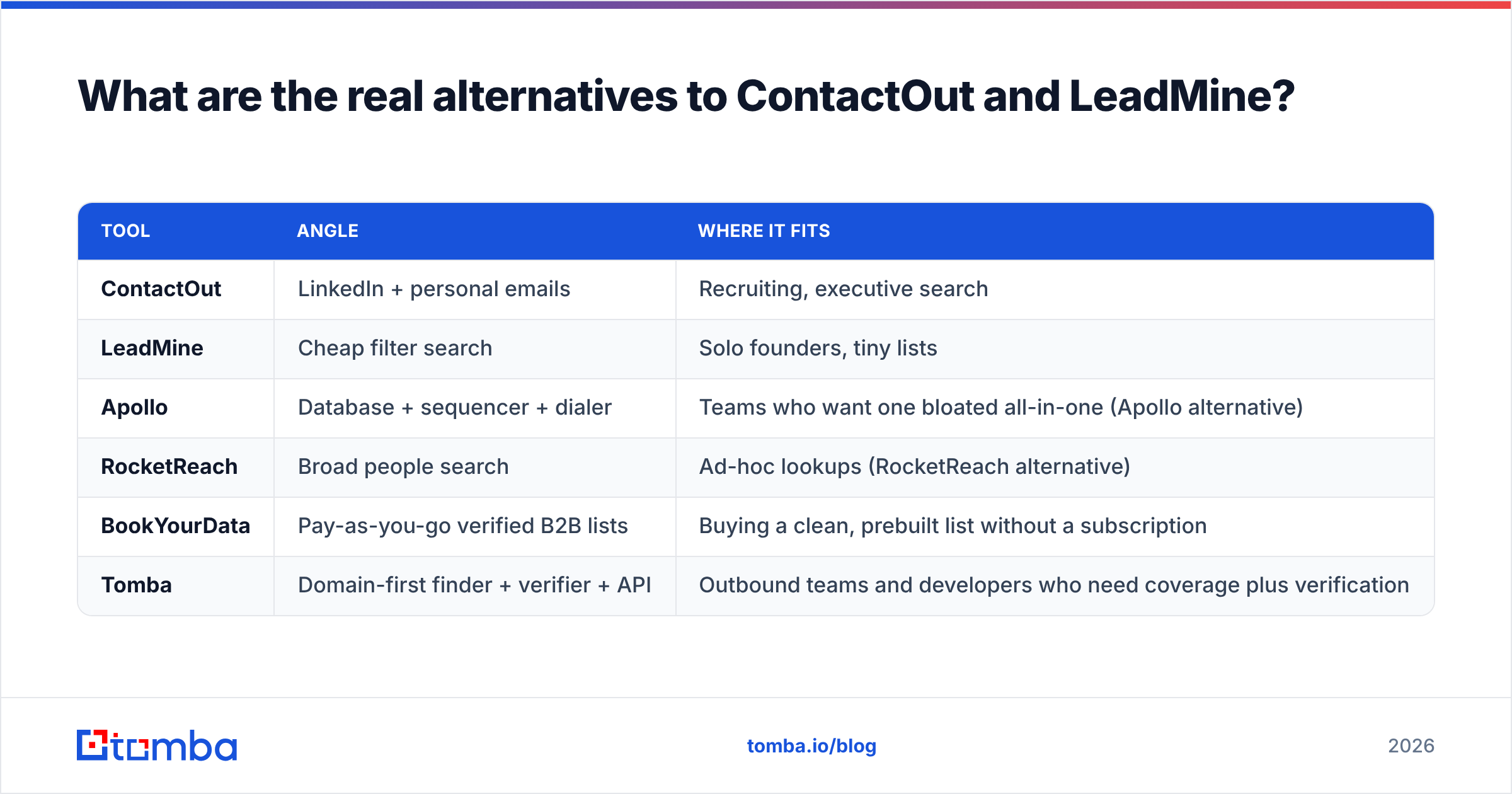
The honest map of this category:
| Tool | Angle | Where it fits |
|---|---|---|
| ContactOut | LinkedIn + personal emails | Recruiting, executive search |
| LeadMine | Cheap filter search | Solo founders, tiny lists |
| Apollo | Database + sequencer + dialer | Teams who want one bloated all-in-one (Apollo alternative) |
| RocketReach | Broad people search | Ad-hoc lookups (RocketReach alternative) |
| BookYourData | Pay-as-you-go verified B2B lists | Buying a clean, prebuilt list without a subscription |
| Tomba | Domain-first finder + verifier + API | Outbound teams and developers who need coverage plus verification |
A few honest notes on that list. BookYourData is a genuinely good option if what you want is to buy a list rather than run a search tool — its pay-as-you-go model and verified-on-delivery guarantee make it a clean fit for one-off campaigns, and it sidesteps the subscription math entirely. Apollo gives you everything, which is another way of saying you pay for a lot you will not use, and its data quality is famously uneven at the edges. RocketReach is fine and unremarkable.
Where Tomba differs is structural, not marketing: it starts from the domain, not the person. You give it stripe.com and it returns the contacts, patterns, sources, and confidence scores for that domain — then you verify them, in bulk, in the same tool. If your ICP is "companies that look like X," that is the correct primitive. If your ICP is "this specific human I found on LinkedIn," ContactOut's primitive is better and you should buy ContactOut.
What should you actually buy?#
Pick by motion, not by feature count.
- You recruit. Buy ContactOut. Personal emails and mobile numbers are worth the premium, and no B2B-only tool will serve you.
- You do 100–200 lookups a month and hate subscriptions. LeadMine's credit packs are honest and cheap. So is buying a one-off verified list from a pay-as-you-go provider.
- You run outbound against a target account list. Use a domain-first finder plus a real verifier. Volume and bounce control are the two variables that decide whether your campaign works.
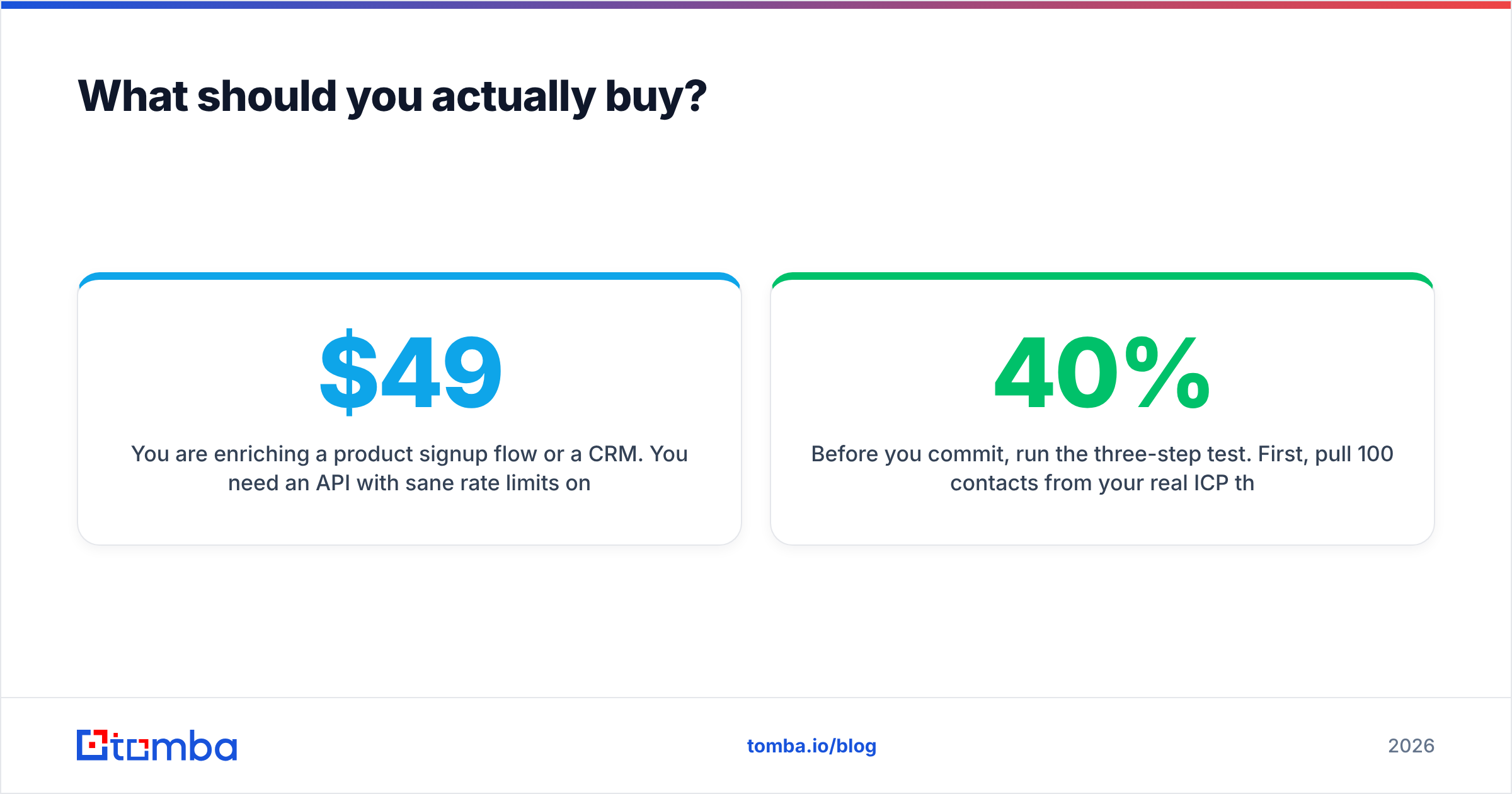
- You are enriching a product signup flow or a CRM. You need an API with sane rate limits on the entry plan, not a Chrome extension. Check that carefully — several tools in this category gate the API behind their top tier, which turns a $49 problem into a $500 one.
Before you commit, run the three-step test. First, pull 100 contacts from your real ICP through each tool's free tier — Tomba's free tier gives you 25 searches with no card, which is enough to sanity-check coverage. Second, verify all of them with a neutral third-party verifier. Third, compare deliverable-contact counts, not raw "found" counts. Tools lose 20–40% of their headline hit rate at that second step, and the spread between them at step three is nothing like the spread at step one.
For further reading on how buyers rate these tools in the wild, G2's lead intelligence category is a reasonable sanity check on review volume, and ContactOut's own site is clear about its recruiting focus if you read past the sales copy. HubSpot's research on email bounce rates and list hygiene is the best free primer on why the verification step is not optional.
The bottom line#
ContactOut vs LeadMine is a choice between a specialist and a budget generalist. ContactOut is the right buy for recruiters and anyone who needs to reach a human outside their work inbox. LeadMine is the right buy for someone doing genuinely small volumes who wants a clean, cheap search box. Both are honest products that know what they are.
But if your job is outbound — target accounts, mapped contacts, verified addresses, clean sending reputation — you are trying to solve a domain problem with a person tool, and you will feel that friction every single week.
That is the gap Tomba was built for. Start with the Tomba Email Finder: give it a domain and a name, get a verified address with the sources it was found on and a confidence score you can actually act on. Every paid plan includes the API, bulk processing, and the verifier — no upsell to unlock the thing you bought it for. The free tier is 25 searches a month, no card required, which is enough to run the 100-contact bake-off above and decide with data instead of a comparison table someone on the internet wrote.
Related guides#
Ready to find emails that actually work?
Join 150,000+ professionals who stopped guessing and started sending. Free credits on signup — no credit card required.
Get the Tomba newsletter
Practical outbound tactics and product updates — once every two weeks.
About the author