ContactOut vs PlusVibe (2026): Which One Do You Actually Need?
ContactOut finds the contacts. PlusVibe sends the emails. Comparing them head-to-head only makes sense once you know which half of your outbound stack is actually broken — here's the honest breakdown.
TL;DR#
- ContactOut and PlusVibe are not competitors. ContactOut is a contact-data tool (emails and phone numbers, mostly sourced off LinkedIn profiles). PlusVibe is a cold-email sending platform (sequences, inbox rotation, warmup, unibox). Buying one does not remove the need for the other.
- If your reply rate is bad because your list is bad, you have a data problem — ContactOut, Tomba, or a similar finder is the fix.
- If your emails are accurate but landing in spam or never getting sent at scale, you have a sending problem — PlusVibe, Instantly, or Smartlead is the fix.
- The cheapest working stack is usually "one finder + one sender", not one all-in-one that does both mediocrely.
- Verify every address before it enters a sequence. A 3% bounce rate quietly kills the domain you just spent 3 weeks warming.
What are ContactOut and PlusVibe, actually?#
Search "ContactOut vs PlusVibe" and you get comparison pages that pretend these two tools do the same job. They don't. This is the single most useful thing to understand before you spend a dollar on either.
ContactOut is a contact-data provider. Its best-known surface is a Chrome extension that sits on LinkedIn profiles and surfaces a work email, a personal email, and sometimes a phone number. It's popular with recruiters, who live inside LinkedIn Recruiter all day and want a one-click reveal. It also ships a searchable contact database and an API. Its output is rows: name, title, company, email, phone.
PlusVibe is a cold-email sending platform. You connect mailboxes, warm them up, load a list, write a sequence, and it drips messages out with rotation, throttling, spintax, and a unified inbox for replies. Its output is sent emails and booked meetings. It does not build your list for you in any meaningful sense — it assumes you're arriving with one.
So the honest framing of ContactOut vs PlusVibe is: fuel vs engine. You can't compare a barrel of diesel to a truck and declare a winner. You can only ask which one you're currently missing.
Which problem do you actually have?#
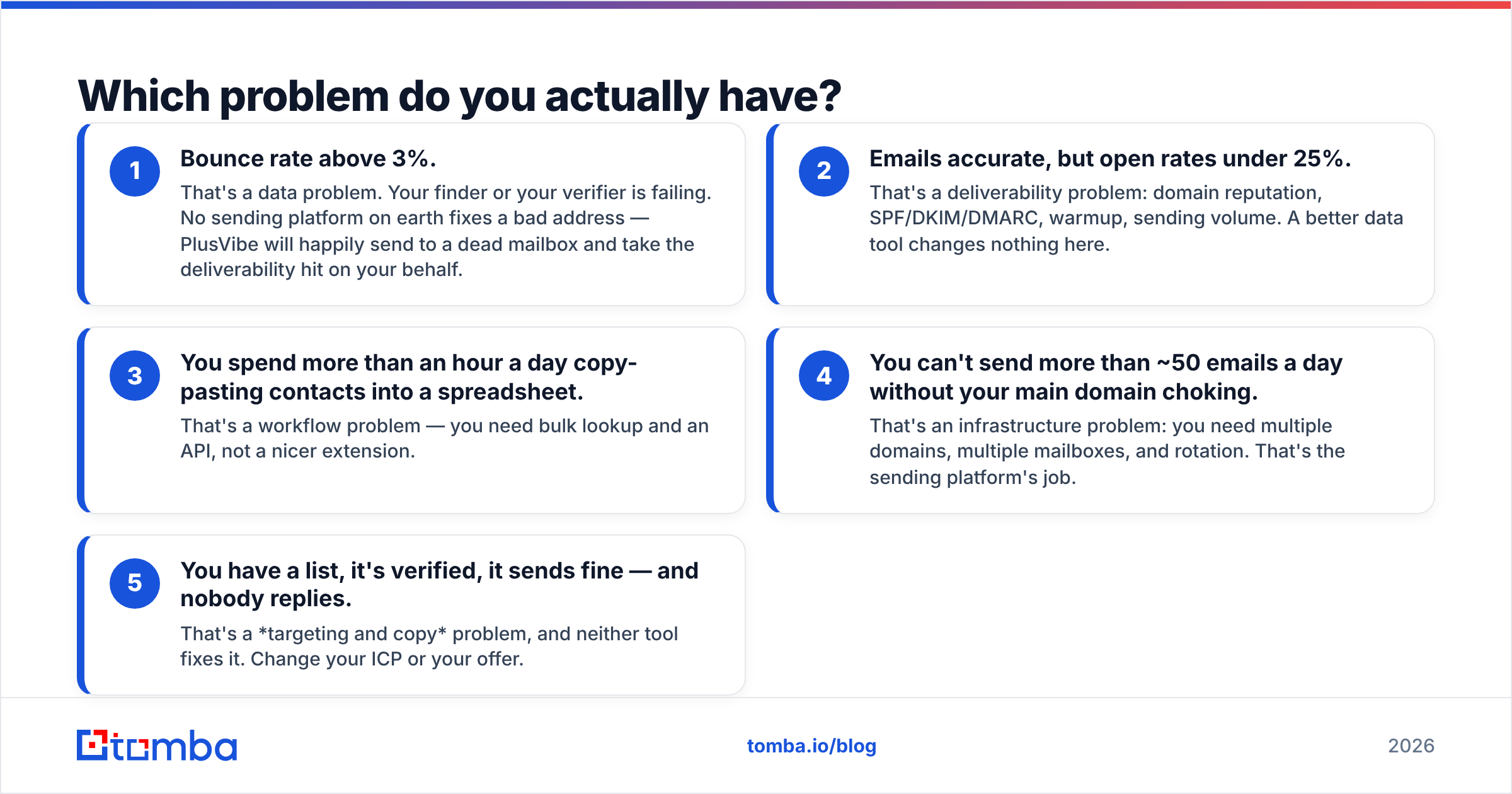
Before comparing feature grids, diagnose. Run through this list and be brutally honest:
- Bounce rate above 3%. That's a data problem. Your finder or your verifier is failing. No sending platform on earth fixes a bad address — PlusVibe will happily send to a dead mailbox and take the deliverability hit on your behalf.
- Emails accurate, but open rates under 25%. That's a deliverability problem: domain reputation, SPF/DKIM/DMARC, warmup, sending volume. A better data tool changes nothing here.
- You spend more than an hour a day copy-pasting contacts into a spreadsheet. That's a workflow problem — you need bulk lookup and an API, not a nicer extension.
- You can't send more than ~50 emails a day without your main domain choking. That's an infrastructure problem: you need multiple domains, multiple mailboxes, and rotation. That's the sending platform's job.
- You have a list, it's verified, it sends fine — and nobody replies. That's a targeting and copy problem, and neither tool fixes it. Change your ICP or your offer.
Most teams that ask "ContactOut or PlusVibe?" actually have problem 1 and problem 4 at the same time, and are hoping one purchase solves both. It won't.

How do ContactOut and PlusVibe compare side by side?#
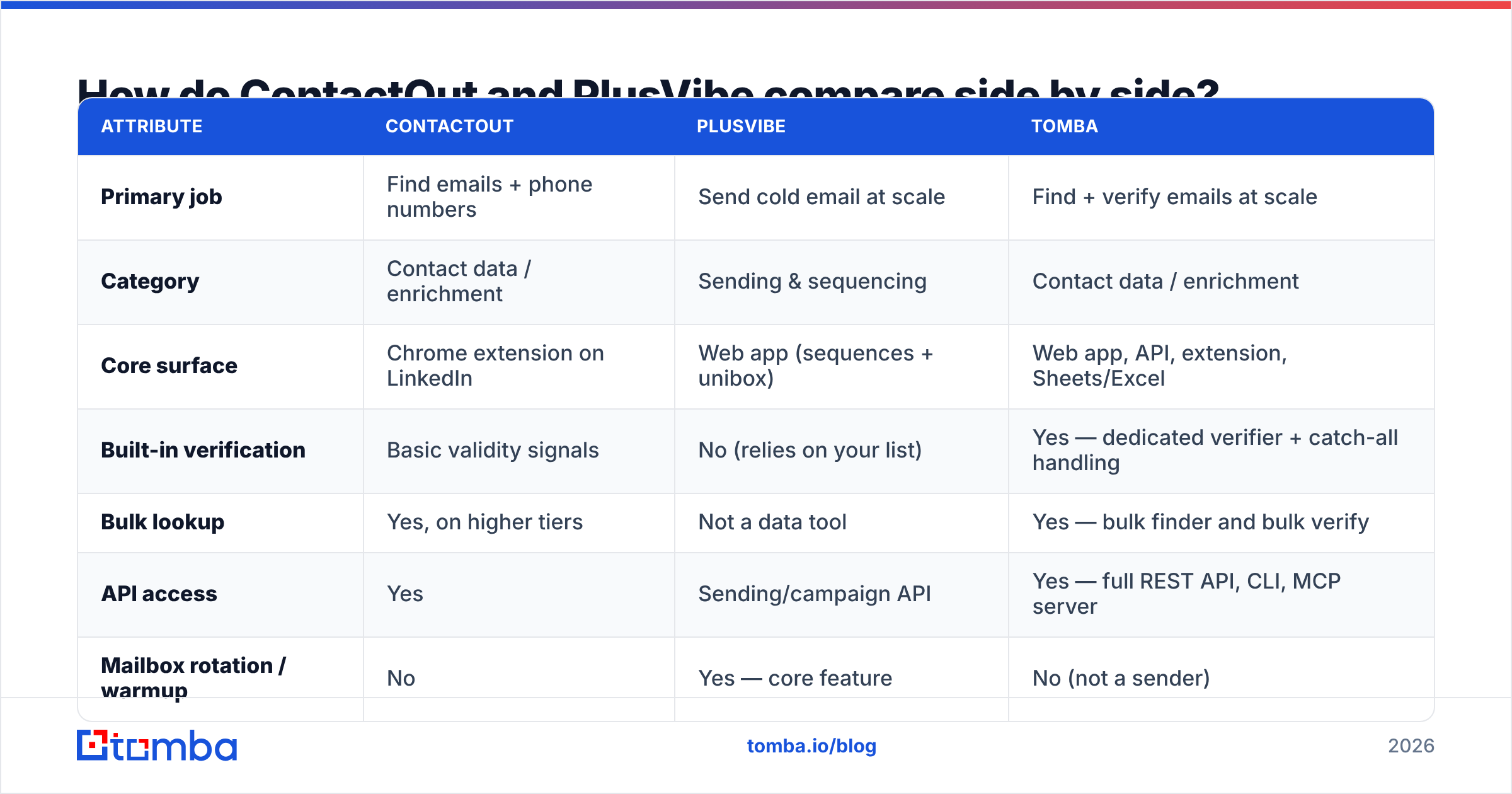
Here's the head-to-head on the attributes that actually determine whether a tool earns its seat in your stack. Pricing moves constantly in this category — treat the figures below as directional and confirm on each vendor's own page before you buy.
| Attribute | ContactOut | PlusVibe | Tomba |
|---|---|---|---|
| Primary job | Find emails + phone numbers | Send cold email at scale | Find + verify emails at scale |
| Category | Contact data / enrichment | Sending & sequencing | Contact data / enrichment |
| Core surface | Chrome extension on LinkedIn | Web app (sequences + unibox) | Web app, API, extension, Sheets/Excel |
| Built-in verification | Basic validity signals | No (relies on your list) | Yes — dedicated verifier + catch-all handling |
| Bulk lookup | Yes, on higher tiers | Not a data tool | Yes — bulk finder and bulk verify |
| API access | Yes | Sending/campaign API | Yes — full REST API, CLI, MCP server |
| Mailbox rotation / warmup | No | Yes — core feature | No (not a sender) |
| Free tier | Limited monthly credits | Trial-based | 25 searches/month, no card |
| Entry paid price | Varies by seat/role tier | Entry plans in the low tens of $/mo | $49/mo (Starter) |
| Best for | Recruiters living in LinkedIn | Agencies running many inboxes | Teams that need clean data via API or bulk |
| Does it replace the other? | No | No | Replaces the data half only |
The last row is the whole article. ContactOut does not send. PlusVibe does not find. Any post that declares an overall "winner" between them is either confused or selling you something.
Is ContactOut worth it in 2026?#
Short answer: yes, if you live inside LinkedIn and you're a recruiter. Less so if you're a growth or RevOps team building lists programmatically.
What it does well:
- LinkedIn-native workflow. The extension is fast, it renders inside Recruiter and Sales Navigator, and reveals feel instant. If your entire prospecting motion is "browse profiles, grab the contact," there's very little friction.
- Personal emails and phone numbers. ContactOut's differentiator has always been personal (non-work) contact info, which is genuinely useful in recruiting, where a candidate's work address is the worst place to pitch them.
- Team features for recruiting orgs. Lists, shared credits, ATS pushes.
Where it gets awkward:
- It's priced and packaged for seats, not volume. If you want 20,000 verified emails for a Q3 campaign, a per-seat LinkedIn extension is a clumsy way to get there. You want a bulk email finder and an API.
- Verification is not its identity. Contact-data tools that surface an address don't always tell you whether that mailbox is currently accepting mail, whether the domain is catch-all, or whether the person left the company four months ago. That's a separate discipline — see email verification — and if you skip it, you pay for it in bounces.
- LinkedIn dependency. A workflow anchored to one platform's UI inherits that platform's rate limits, account risk, and layout changes.
If ContactOut is on your shortlist, it's worth looking at the ContactOut alternative landscape too — several tools cover the same reveal use case with better bulk and API economics.
Is PlusVibe worth it in 2026?#
Short answer: yes, if you're running multi-inbox outbound and your current tool is choking.
PlusVibe sits in the same competitive bracket as Instantly, Smartlead, and Saleshandy: unlimited-ish mailbox connections, automated warmup, rotation across inboxes, spintax, a unified reply inbox, and campaign analytics. It's typically priced aggressively against the incumbents, which is the main reason it appears on shortlists.
What it does well:
- Mailbox rotation at volume. Connect many mailboxes across many domains, spread the send, keep any one domain under its safe daily ceiling. This is the single most important feature for anyone sending more than a few hundred emails a week.
- Warmup included. Rather than paying separately for a warmup service, it's bundled.
- Unibox. All replies from all mailboxes in one place, so your SDR isn't tab-hopping between twelve Google Workspace accounts.
Where it gets awkward:
- It assumes a clean list. Every sending platform does. Feed it a CSV scraped off a webinar registration page from 2023 and it will send to every dead address in there, and your carefully warmed domains will absorb the damage. Sending platforms measure your bounce rate; they don't prevent it.
- Deliverability is not a feature you buy. Warmup helps. Rotation helps. But authentication, list hygiene, sending volume ramps, and copy that doesn't read like a template are what actually determine whether you hit the inbox. Read up on email deliverability before blaming any tool.
- Category churn. The sending-platform market moves fast. Check recent G2 reviews for whichever tool you pick — the feature gaps between them close and re-open every few quarters.
What does a working outbound stack actually look like?#
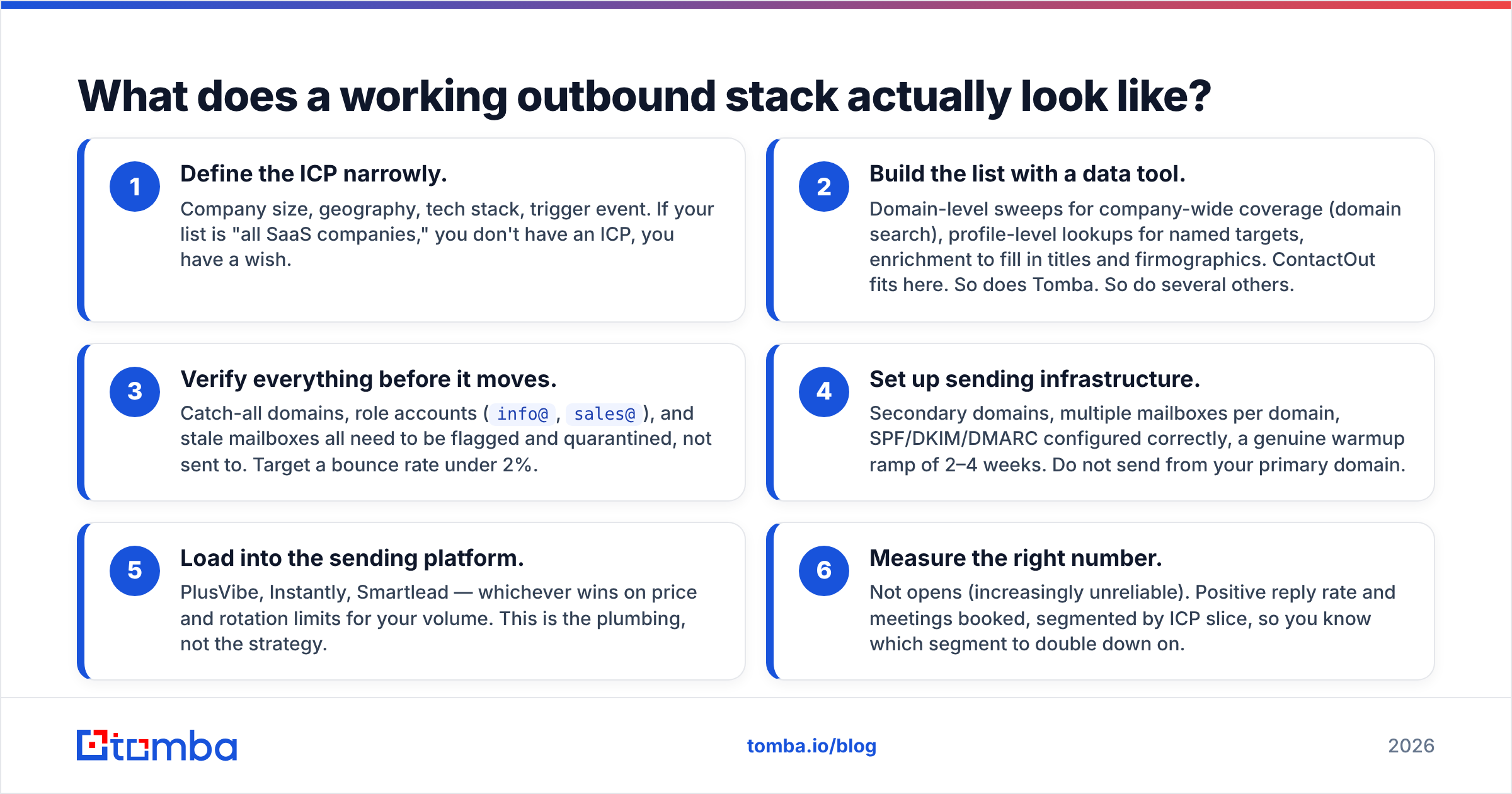
Here's the structure that most consistently works, in order. Notice that the sending platform is the last thing you buy, not the first.
- Define the ICP narrowly. Company size, geography, tech stack, trigger event. If your list is "all SaaS companies," you don't have an ICP, you have a wish.
- Build the list with a data tool. Domain-level sweeps for company-wide coverage (domain search), profile-level lookups for named targets, enrichment to fill in titles and firmographics. ContactOut fits here. So does Tomba. So do several others.
- Verify everything before it moves. Catch-all domains, role accounts (
info@,sales@), and stale mailboxes all need to be flagged and quarantined, not sent to. Target a bounce rate under 2%. - Set up sending infrastructure. Secondary domains, multiple mailboxes per domain, SPF/DKIM/DMARC configured correctly, a genuine warmup ramp of 2–4 weeks. Do not send from your primary domain.
- Load into the sending platform. PlusVibe, Instantly, Smartlead — whichever wins on price and rotation limits for your volume. This is the plumbing, not the strategy.
- Measure the right number. Not opens (increasingly unreliable). Positive reply rate and meetings booked, segmented by ICP slice, so you know which segment to double down on.
Skip step 3 and steps 4–6 are wasted. That's the part nobody selling you a sending platform wants to emphasise.
Where does Tomba fit in this comparison?#
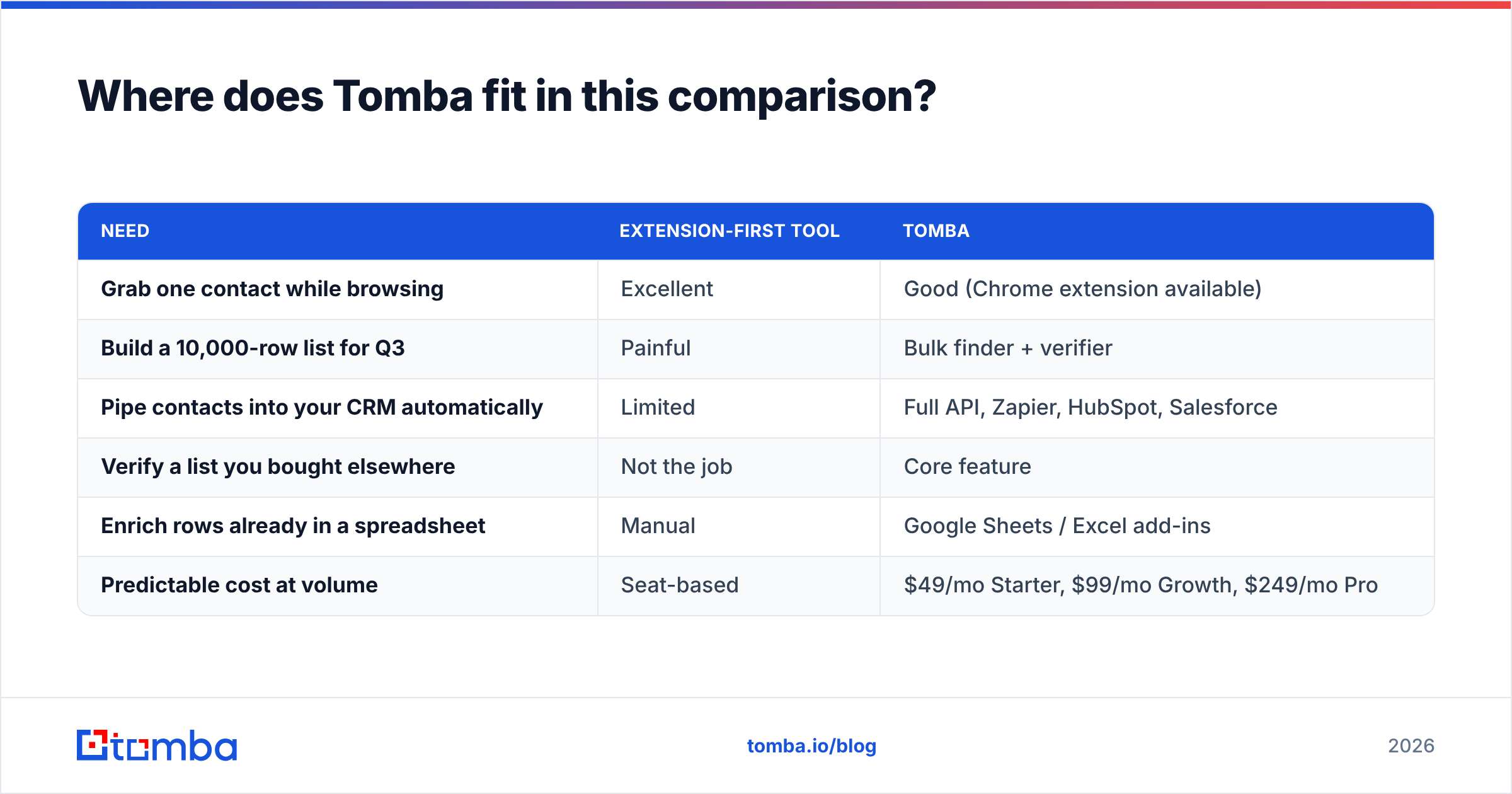
Tomba competes with ContactOut, not PlusVibe. It's a data layer — email finder, verifier, domain search, catch-all handling, phone lookup, enrichment — and it's built for teams that want that data programmatically rather than one profile at a time.
The practical differences versus a LinkedIn-extension-first tool:
| Need | Extension-first tool | Tomba |
|---|---|---|
| Grab one contact while browsing | Excellent | Good (Chrome extension available) |
| Build a 10,000-row list for Q3 | Painful | Bulk finder + verifier |
| Pipe contacts into your CRM automatically | Limited | Full API, Zapier, HubSpot, Salesforce |
| Verify a list you bought elsewhere | Not the job | Core feature |
| Enrich rows already in a spreadsheet | Manual | Google Sheets / Excel add-ins |
| Predictable cost at volume | Seat-based | $49/mo Starter, $99/mo Growth, $249/mo Pro |
Tomba's pricing is credit-based rather than seat-based, which matters if two people need access but you only run campaigns quarterly. There's a free tier at 25 searches a month if you want to sanity-check accuracy against a list of contacts you already know are correct — which, incidentally, is the only benchmarking method worth trusting. Vendor-published accuracy stats are marketing. Test 100 known addresses yourself.
Worth naming honestly: there are good tools in the adjacent lane too. If you want pre-built, human-verified lists rather than a lookup engine, BookYourData is a solid option in that category and solves a slightly different problem — you're buying finished lists rather than running lookups.
So which should you buy: ContactOut or PlusVibe?#
Decide by symptom, not by feature grid.
- You're a recruiter sourcing candidates on LinkedIn. ContactOut. PlusVibe is irrelevant to you — you're probably not running 12-inbox rotation for candidate outreach.
- You're an agency running cold email for 10 clients. PlusVibe (or a peer). You already have a data source; you need sending infrastructure that doesn't collapse at volume.
- You're a founder or small B2B sales team doing outbound for the first time. Buy a data tool first, verify aggressively, send from a single warmed secondary domain with a simple sequencer. Add PlusVibe when volume genuinely exceeds what one or two mailboxes can carry.
- You're a RevOps team wiring outbound into a CRM. You need an API-first data provider (Tomba, or an enrichment vendor) plus a sending platform. ContactOut's extension-centric model will fight you.
- Your bounce rate is over 5% right now. Neither. Fix your list first. Run everything through a verifier, quarantine the catch-alls, and re-test. Then talk about tools.
The version of this decision that ruins quarters is buying the sending platform first, pouring a dirty list into it, torching three domains, and concluding that "cold email doesn't work anymore." Cold email works fine. Bad data doesn't.
The bottom line#
ContactOut vs PlusVibe isn't a fight — it's a division of labour. One of them fills the top of your list, the other pushes it out the door. Diagnose which half is broken before you spend, and if the honest answer is "my data is the problem," start there.
If that's you, run a real test rather than reading another comparison table: the Tomba Email Finder gives you 25 free searches a month with no card required. Take 25 contacts whose addresses you can independently confirm, run them through, and count the hits. Then feed the verified output into whichever sending platform you're evaluating — PlusVibe included. That's a stack that works, and it costs you a coffee's worth of time to validate.
Related guides#
Ready to find emails that actually work?
Join 150,000+ professionals who stopped guessing and started sending. Free credits on signup — no credit card required.
Get the Tomba newsletter
Practical outbound tactics and product updates — once every two weeks.
About the author