Content Marketing B2B Lead Generation: The 2026 Playbook
Most B2B content programs produce traffic, not pipeline. Here's the honest breakdown of which content formats actually generate leads, what they cost, and how to connect them to a real outbound motion.
TL;DR
- Content marketing generates B2B leads on a 6–12 month lag, and most teams kill the program at month 4 — right before compounding starts.
- Only three content types reliably produce pipeline: bottom-funnel comparison pages, gated benchmark data, and product-led free tools. Everything else is brand.
- "MQL" is the wrong scoreboard. Track content-influenced pipeline and content-sourced closed-won, or you'll optimize for downloads nobody follows up on.
- The biggest lever is not more content — it's turning the anonymous traffic your content already earns into named, contactable people.
- Budget reality: a functional content-to-pipeline motion costs roughly $8k–$25k/month all-in. Below that, run fewer, deeper assets.
What does content marketing b2b lead generation actually mean?#
Content marketing b2b lead generation is the practice of publishing assets — articles, tools, data reports, videos — that attract buyers with a live problem, then converting a defined share of that attention into contactable, qualified people your sales team can work.
The definition matters because most teams get the second half wrong. They publish, watch sessions climb, and call it lead gen. It isn't. A session is not a lead. A newsletter subscriber is not a lead. A lead is a named human at a named company who has shown a buying signal and whom you can actually reach.
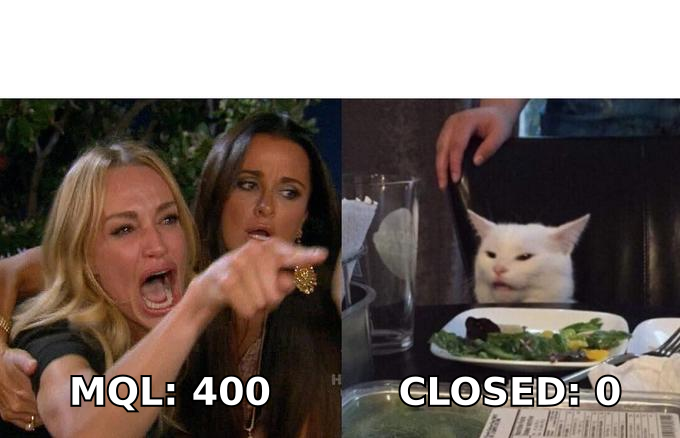
That last clause — "whom you can actually reach" — is where 80% of B2B content programs quietly break. You generate 30,000 monthly sessions from a killer comparison post. You know from analytics that 400 of those sessions came from companies in your ICP. You have zero contact information for any of them. The content worked; the conversion layer didn't exist.
So think about the whole system in four stages:
- Attract — rank for or distribute to problems your buyer already has.
- Identify — figure out who is reading, not just how many.
- Convert — give them a reason to raise a hand, or find them yourself.
- Route — hand them to sales with context, fast enough that the intent is still warm.
Most teams staff stage 1 heavily and stages 2–4 not at all. That's why the CFO thinks content doesn't work.
Which content formats actually generate B2B leads?#
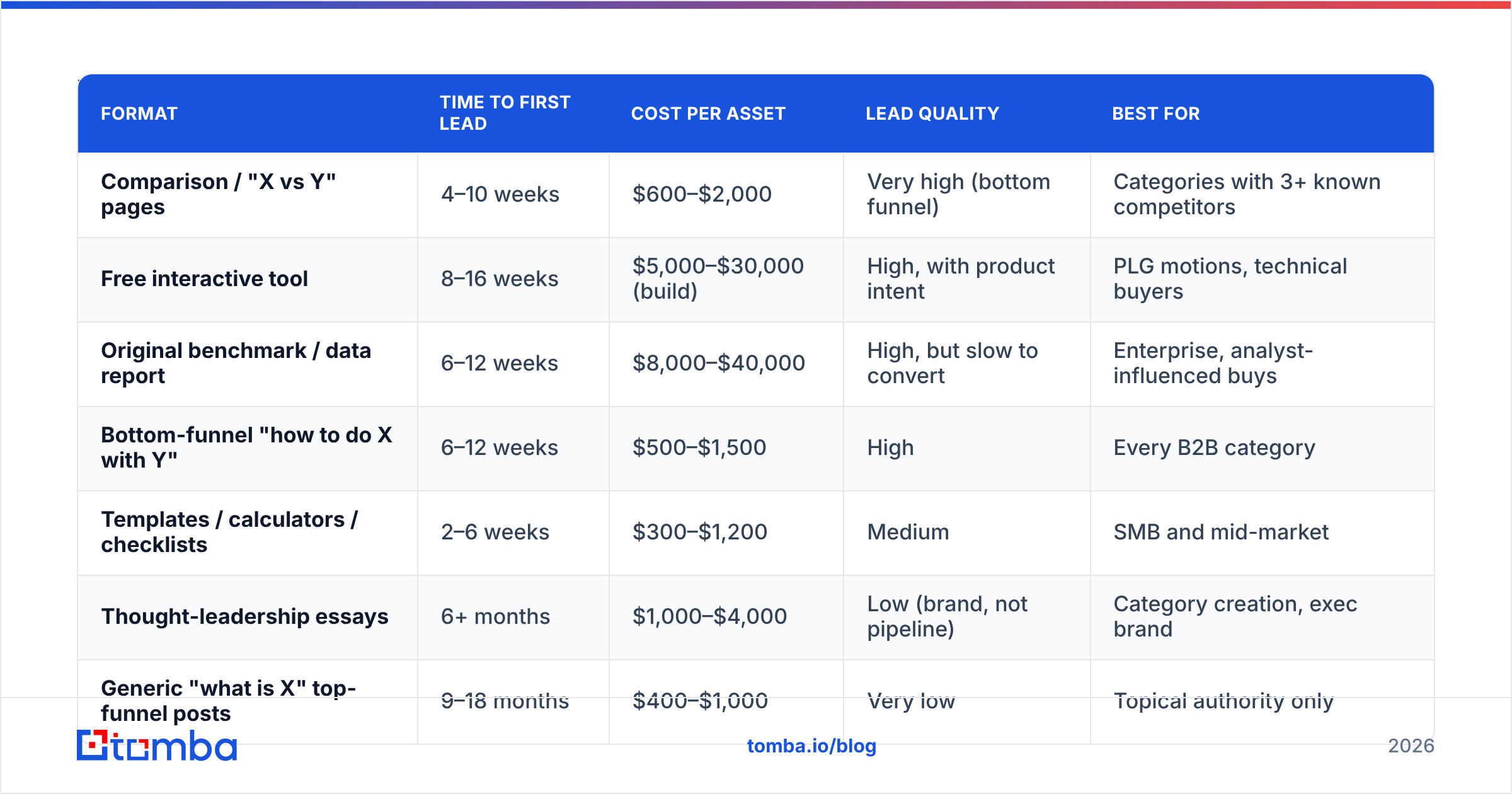
Not all content is lead-generating content, and pretending otherwise is how budgets get cut. Here's the honest ranking by pipeline contribution per dollar, based on what consistently shows up in B2B SaaS attribution data.
| Format | Time to first lead | Cost per asset | Lead quality | Best for |
|---|---|---|---|---|
| Comparison / "X vs Y" pages | 4–10 weeks | $600–$2,000 | Very high (bottom funnel) | Categories with 3+ known competitors |
| Free interactive tool | 8–16 weeks | $5,000–$30,000 (build) | High, with product intent | PLG motions, technical buyers |
| Original benchmark / data report | 6–12 weeks | $8,000–$40,000 | High, but slow to convert | Enterprise, analyst-influenced buys |
| Bottom-funnel "how to do X with Y" | 6–12 weeks | $500–$1,500 | High | Every B2B category |
| Templates / calculators / checklists | 2–6 weeks | $300–$1,200 | Medium | SMB and mid-market |
| Thought-leadership essays | 6+ months | $1,000–$4,000 | Low (brand, not pipeline) | Category creation, exec brand |
| Generic "what is X" top-funnel posts | 9–18 months | $400–$1,000 | Very low | Topical authority only |
The pattern is obvious once you see it: the closer a piece of content sits to a purchase decision, the faster and better it converts. A "best email finders" roundup converts at 3–8%. A "what is B2B sales" explainer converts at 0.2%. Both may get 10,000 views. Only one pays rent.
That doesn't mean top-funnel is worthless — it builds the topical authority that makes your bottom-funnel pages rank at all. It means you should sequence it: build 15–25 bottom-funnel money pages first, then backfill top-funnel to support them. Most teams do it backwards, publish 60 top-funnel posts, and wonder why nothing converts.
Why do most B2B content programs fail to produce pipeline?#
Three failure modes, in order of how often we see them.
Failure 1: The gate is the only conversion path. You put your best report behind a form. 2% of readers fill it. The other 98% — including the ones with real budget who refuse to give up their email for a PDF — vanish. Gating is a tax on reach, and in 2026 it converts worse than it did in 2019 because buyers are trained to bounce. HubSpot's own research team has been publishing on the decline of gated-content conversion for years; the pattern holds.
Failure 2: No identification layer. Your content works. You just can't see who it worked on. This is the biggest and most fixable gap. Between IP-to-company matching, website visitor reveal, and enrichment of the sparse data you do capture, you can turn a fraction of anonymous readers into named accounts and named people. If a director of ops at a 400-person company read your integration comparison three times this week, that is a sales signal — and it's invisible to a team measuring only form fills.
Failure 3: Content and outbound live in different buildings. Marketing publishes. Sales cold-emails a list from a different source. Nobody feeds the reading behavior into the sequence. The result: your SDR sends a generic intro to someone who spent 12 minutes on your pricing page last Tuesday. That's an unforced error worth six figures a year at most companies.
The fix for all three is architectural, not creative. You don't need better content. You need a path from "someone read this" to "someone on my team knows their name, their role, and what they read."
How do you turn content readers into contactable leads?#
Here's the operational chain. Each link is a real, separate job — skip one and the chain breaks.
- Capture the account, not just the contact. Use visitor identification to resolve anonymous sessions to companies. A website visitor reveal tool tells you that Acme Corp read your comparison page four times. You don't have a person yet — but you have a target.
- Find the person. Once you know the company and the role you need (VP Demand Gen, Head of RevOps), use a domain search to pull the verified contacts at that domain and identify the right buyer. This is where content marketing stops being passive.
- Verify before you send. Content-sourced lists rot fast — people change jobs. Run every address through an email verifier before it enters a sequence. Bouncing on your warmest leads is the most expensive mistake in this whole workflow.
- Enrich for context. Company size, funding stage, tech stack, headcount growth. Data enrichment turns a name into a reason to reach out.
- Route with the content signal attached. The SDR's first line should reference the problem the content was about — not the content itself ("saw you downloaded our ebook" is creepy and low-status). Reference the problem: "Most teams running Salesforce + Outreach hit a sync issue at around 50 reps — is that where you are?"
- Measure to closed-won. Content-sourced pipeline and content-influenced pipeline are two different numbers. Report both. If you only report MQLs, you will be asked to explain yourself within two quarters.
This is the part almost nobody writes about, because it's unglamorous plumbing. It's also the difference between a content program that gets defunded and one that gets doubled.
What should you actually measure?#
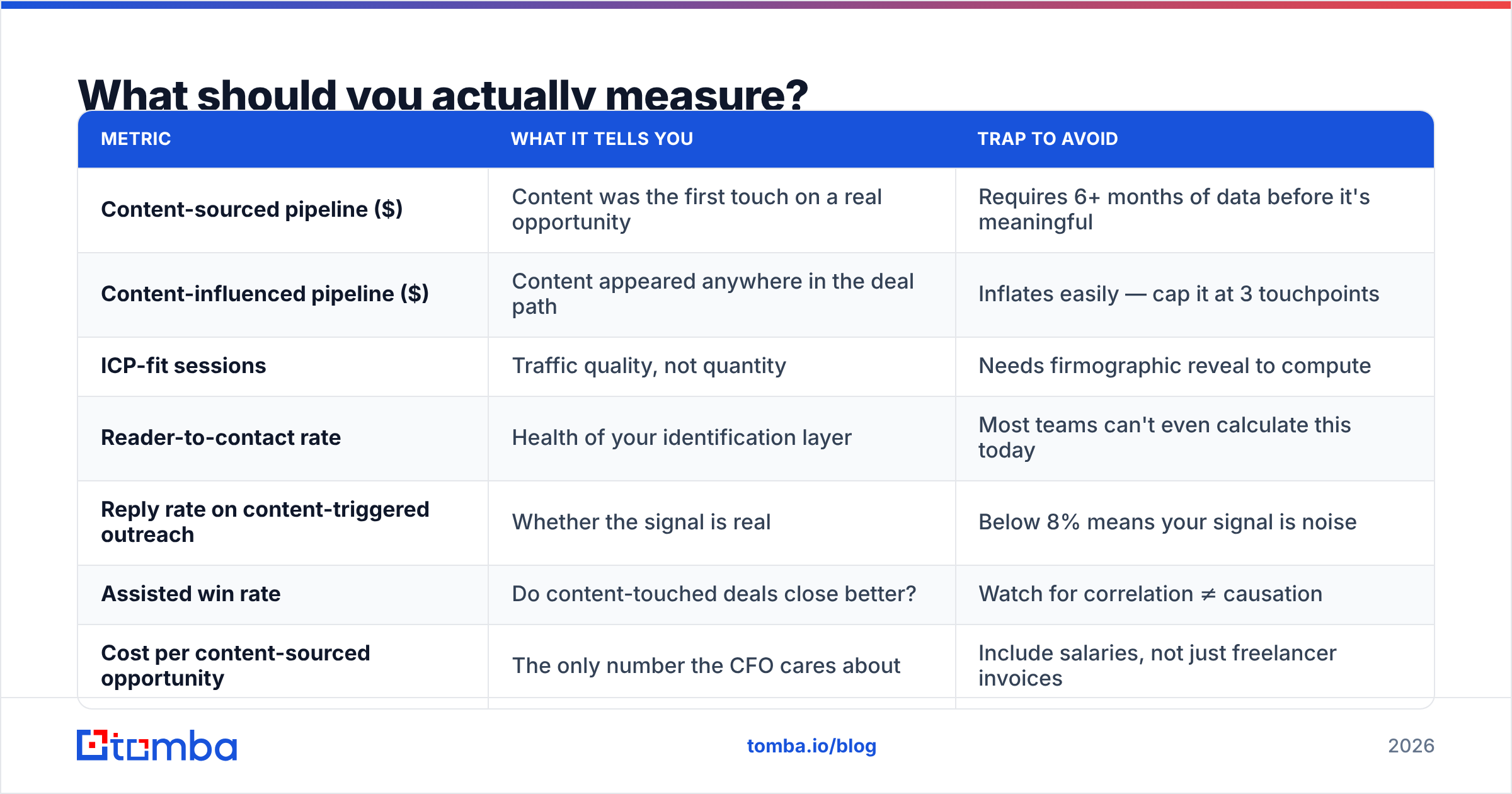
Kill the vanity metrics. Here's the replacement scoreboard, mapped to what each metric actually tells you.
| Metric | What it tells you | Trap to avoid |
|---|---|---|
| Content-sourced pipeline ($) | Content was the first touch on a real opportunity | Requires 6+ months of data before it's meaningful |
| Content-influenced pipeline ($) | Content appeared anywhere in the deal path | Inflates easily — cap it at 3 touchpoints |
| ICP-fit sessions | Traffic quality, not quantity | Needs firmographic reveal to compute |
| Reader-to-contact rate | Health of your identification layer | Most teams can't even calculate this today |
| Reply rate on content-triggered outreach | Whether the signal is real | Below 8% means your signal is noise |
| Assisted win rate | Do content-touched deals close better? | Watch for correlation ≠ causation |
| Cost per content-sourced opportunity | The only number the CFO cares about | Include salaries, not just freelancer invoices |
A benchmark worth internalizing: in most B2B SaaS categories, a healthy content program lands between $800 and $3,000 cost per content-sourced opportunity — not per lead. If your number is $8,000, you're either too early (fine, wait) or producing the wrong formats (not fine, change now).
Gartner and Forrester both publish on B2B buying-group behavior — the headline finding that keeps replicating is that buyers complete the majority of their research before ever contacting a vendor. Your content is the sales call now. Treat it that way.
Is content marketing better than paid ads or outbound for B2B leads?#
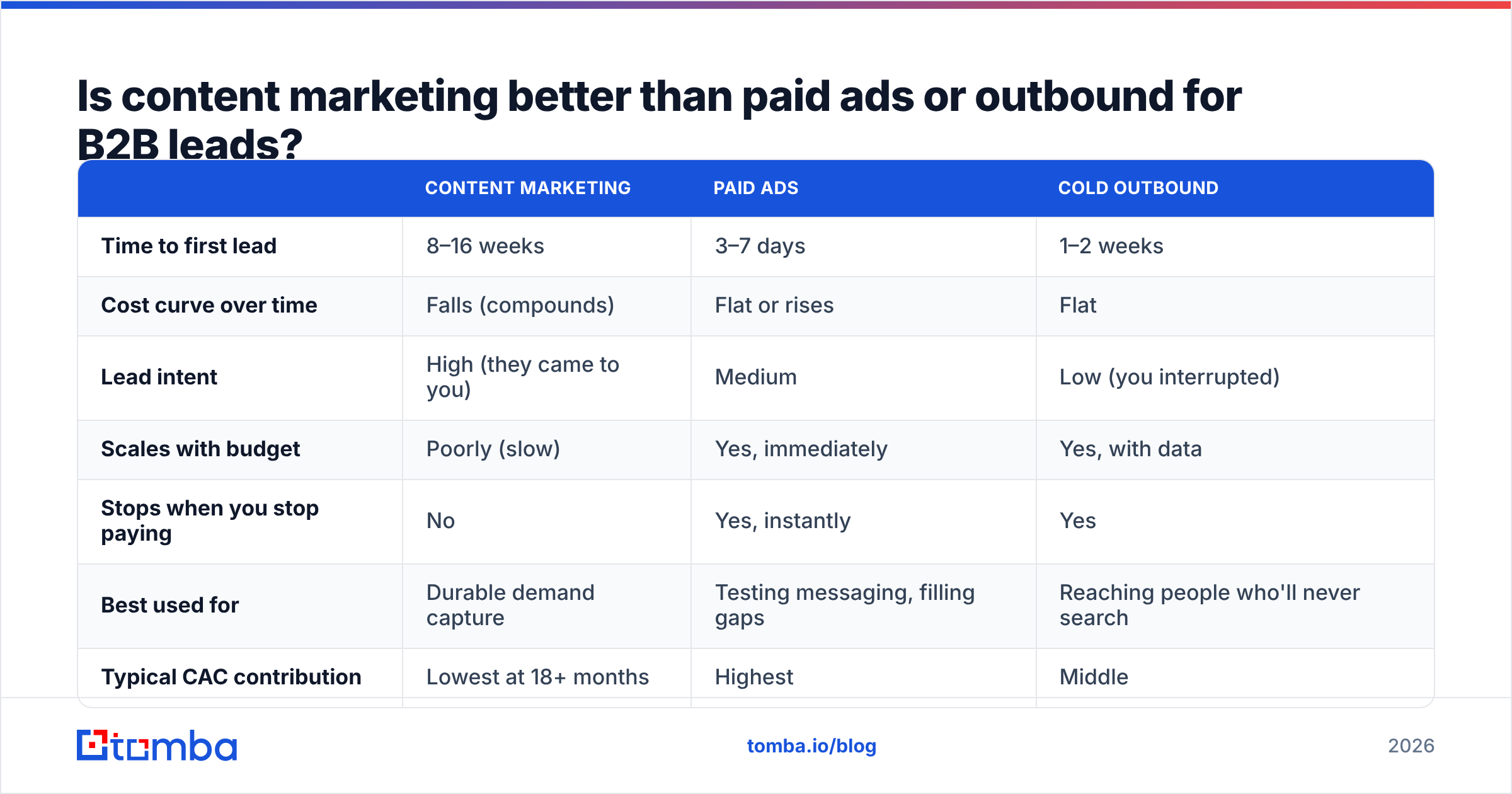
Wrong question. They're different instruments, and the mature answer is that content makes the other two cheaper.
| Content marketing | Paid ads | Cold outbound | |
|---|---|---|---|
| Time to first lead | 8–16 weeks | 3–7 days | 1–2 weeks |
| Cost curve over time | Falls (compounds) | Flat or rises | Flat |
| Lead intent | High (they came to you) | Medium | Low (you interrupted) |
| Scales with budget | Poorly (slow) | Yes, immediately | Yes, with data |
| Stops when you stop paying | No | Yes, instantly | Yes |
| Best used for | Durable demand capture | Testing messaging, filling gaps | Reaching people who'll never search |
| Typical CAC contribution | Lowest at 18+ months | Highest | Middle |
The real play is a loop, not a choice. Content earns organic attention. Visitor identification names the accounts. Outbound reaches the ones who never filled a form. Paid retargets the ones who did but went quiet. Each channel makes the next one convert better.
If you're choosing where to spend your next dollar and you already have 10+ bottom-funnel pages ranking, spend it on the identification and contact layer, not on post number 11. The ROI difference is not close. Ten pages with a working reader-to-contact pipeline outperform forty pages that just sit there earning impressions.
What does a realistic 2026 content-to-pipeline stack look like?#
Keep it boring. The stack that works is unglamorous and stable.
- Research & topic selection — Ahrefs or Semrush for keyword and SERP data; G2 review mining for the objections your buyers actually voice. G2 category pages are the best free source of bottom-funnel comparison ideas in B2B.
- Production — a subject-matter writer plus one editor. Two well-researched pieces a month beats eight thin ones. Non-negotiable.
- Distribution — LinkedIn for reach, a newsletter for retention, syndication only if the partner has your exact ICP. Don't syndicate to generic marketing lists.
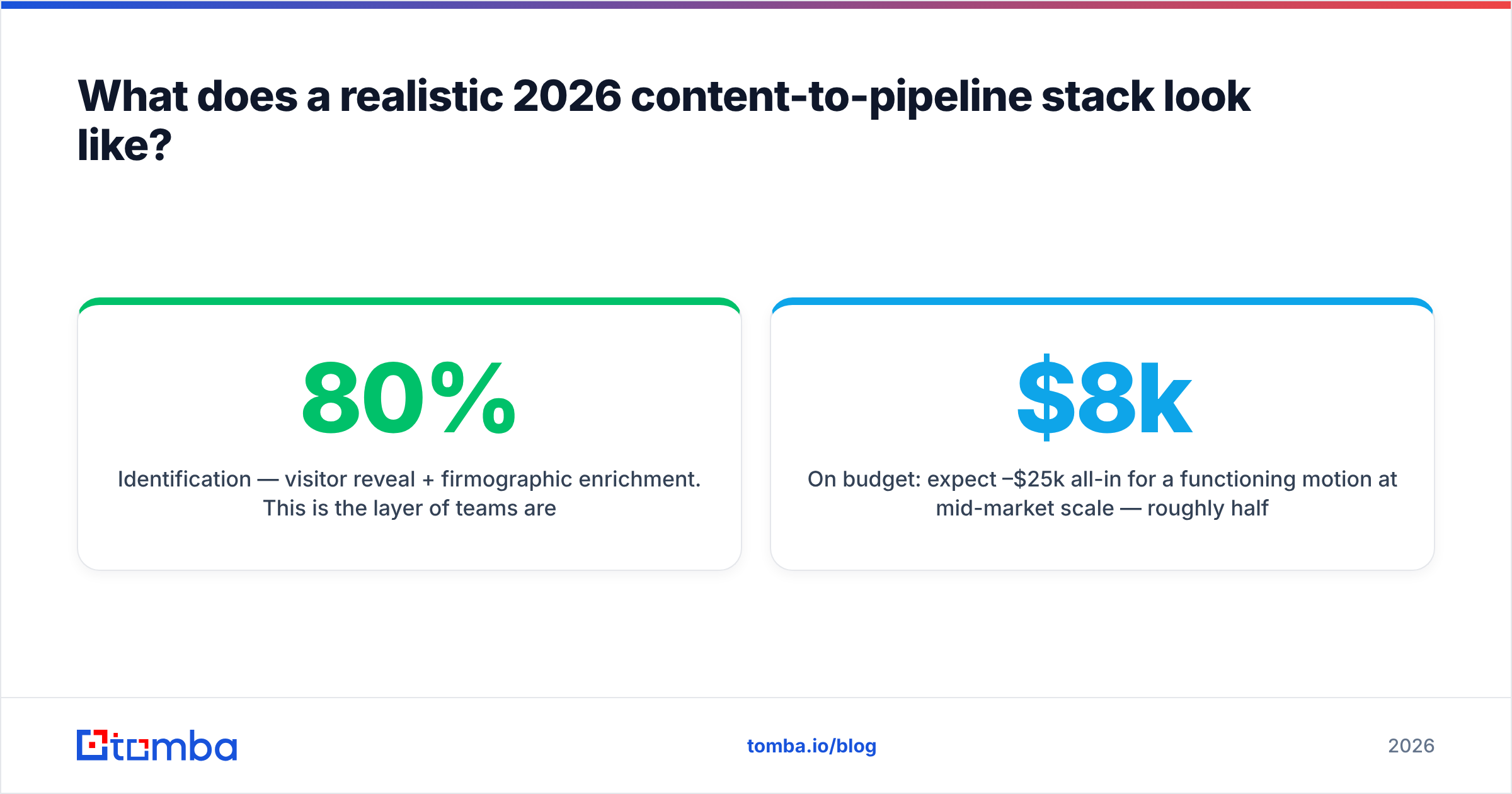
- Identification — visitor reveal + firmographic enrichment. This is the layer 80% of teams are missing.
- Contact data — an email finder and verification stack, so a named account becomes a named, reachable person.
- Engagement — a sequencer (Instantly, Smartlead, Saleshandy — pick one, they're commoditized) plus your CRM.
- Measurement — multi-touch attribution in the CRM, not in your analytics tool. Analytics tools count sessions; CRMs count money.
On budget: expect $8k–$25k/month all-in for a functioning motion at mid-market scale — roughly half on production, a quarter on data and tooling, a quarter on distribution. Tooling costs are the cheapest slice, which is why it's absurd how many teams over-invest in production and under-invest in the layer that turns readers into revenue. Tomba pricing starts free at 25 searches/month, with Starter at $49/mo and Growth at $99/mo — an amount that is, bluntly, less than the cost of one thin blog post.
For teams comparing options, BookYourData is a solid choice when you want pre-built, pay-as-you-go B2B lists rather than domain-by-domain discovery; it's a different shape of the same job and worth evaluating alongside a finder-first approach. Match the tool to your motion: list-buy for volume plays, finder-plus-verifier for precision plays driven by content signals.
What's the fastest way to fix a content program that isn't producing leads?#
Do these five things, in this order, over the next 90 days.
- Audit for money pages. Count how many of your published pages target a bottom-funnel, purchase-intent query. If it's under 10, that's your entire problem. Write those before anything else.
- Add an identification layer. You cannot fix what you can't see. Get reader-to-account resolution live in week one.
- Build the contact bridge. Named account → named person → verified email → sequence. Automate it, don't do it by hand.
- Rewrite your CTAs. Replace "download our ebook" with a next step that's genuinely useful — a free tool, a teardown, a template that solves the exact problem the article described.
- Change the report. Stop reporting MQLs to leadership. Report content-sourced pipeline, even if the number is embarrassing in month one. An honest small number beats a dishonest big one, and it buys you the runway to grow it.
Ninety days won't produce a compounding organic engine — nothing does. But it will produce the machinery that makes the next twelve months of content pay off, which is the only thing standing between most programs and their next budget cut.
Where to start#
If your content is already earning traffic and you're not converting it into named, reachable people, the gap isn't your writing — it's your contact layer. Tomba's Email Finder closes that gap: give it a company domain and a role, get back verified professional email addresses you can put straight into a sequence, with the email verification built in so you're not burning sender reputation on stale data. The free tier gives you 25 searches a month to test whether your content-sourced accounts are worth pursuing before you commit a dollar.
Publish less. Convert more of what you publish. That's the whole 2026 playbook.
Related guides#
Ready to find emails that actually work?
Join 150,000+ professionals who stopped guessing and started sending. Free credits on signup — no credit card required.
Get the Tomba newsletter
Practical outbound tactics and product updates — once every two weeks.
About the author