Content Syndication Lead Generation: A 2026 Buyer's Guide
Content syndication promises MQLs at scale, but you're paying $30-$60 for a name that downloaded a PDF. Here's what the leads are really worth, how to vet vendors, and how to fix the data before it hits your CRM.
TL;DR
- Content syndication lead generation means paying a publisher or network to promote your gated asset to their audience and hand you the contact details of everyone who downloads it. Typical cost: $30-$60 per lead, often more for senior titles.
- The channel works, but the leads are cold. Someone downloading a buyer's guide is expressing topic interest, not purchase intent. Treat them as MQLs at best.
- The biggest failure mode is data quality: role-based inboxes, typo'd emails, and stale contacts that bounce and shred your sender reputation before the first sequence lands.
- Always negotiate lead specs (title, company size, geo), a replacement clause for bad records, and a verification step before anything touches your CRM or your sending domain.
- A cheap enrichment and verification layer — running the vendor's list through an email verifier and re-finding the missing contacts — recovers more pipeline than switching vendors does.
What is content syndication lead generation?#
Content syndication is renting someone else's audience. You give a publisher, media network, or lead-gen agency a gated asset — a whitepaper, benchmark report, webinar, ROI calculator — and they push it to their subscriber base through newsletters, on-site placements, telemarketing follow-ups, or their own outbound. Every person who fills out the form becomes a lead you own, delivered to you as a CSV or pushed straight into your marketing automation platform.
The mechanics are simple. The economics are where people get burned.
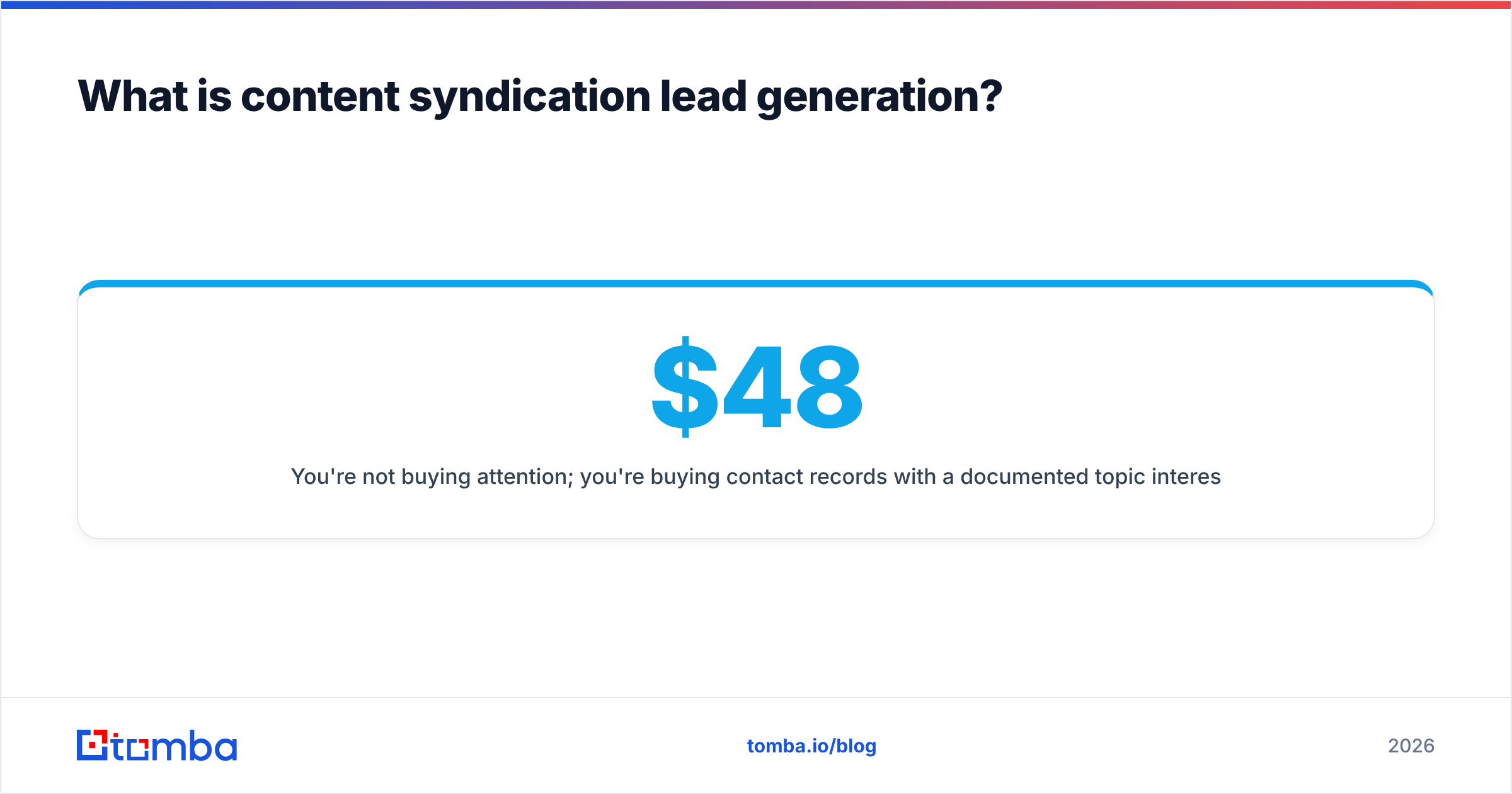
You're not buying attention; you're buying contact records with a documented topic interest attached. The vendor charges per lead (CPL) on a guaranteed-volume contract: "500 leads at $48 CPL, IT decision-makers, 500+ employees, North America." That's $24,000 committed before a single person reads your report. Compare that to organic content, where the same $24,000 buys you a year of writing and the leads keep arriving after the invoice clears.
The honest framing, per HubSpot's own analysis of syndication programs, is that syndication is a reach accelerator, not a demand creator. It gets your asset in front of people who would never have found your site. It does not manufacture intent that wasn't there.
How does content syndication actually work?#
There are four delivery models, and vendors rarely tell you which one they're using unless you ask directly.
- Publisher email blasts — the vendor sends your gated asset to their own opt-in list. Highest volume, lowest intent. The person clicked a subject line, not your brand.
- Programmatic content networks — your asset appears as a recommended download across a network of B2B sites. Broad reach, wildly variable quality, heavy bot risk if the network isn't audited.
- Telequalified / HQL (high-quality lead) programs — a human calls the downloader and confirms budget, authority, need, and timeline before the lead is released. CPL jumps to $80-$200. Far fewer leads, dramatically better conversion.
- Intent-triggered syndication — the vendor layers third-party intent data on top and only promotes to accounts already researching your category. This is where the channel is heading in 2026, and where the price premium is most defensible.
The delivery model determines everything downstream. A $35 CPL from a publisher blast and a $150 CPL from a telequalified program are not the same product wearing different price tags.
Wait — the image above renders as: 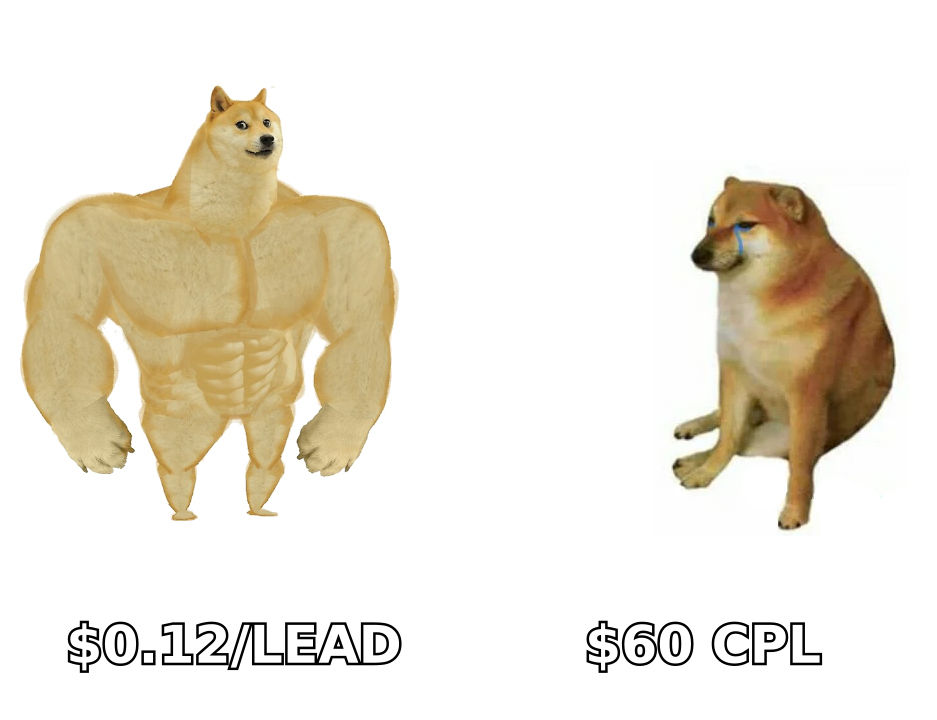
What do content syndication leads actually cost?#
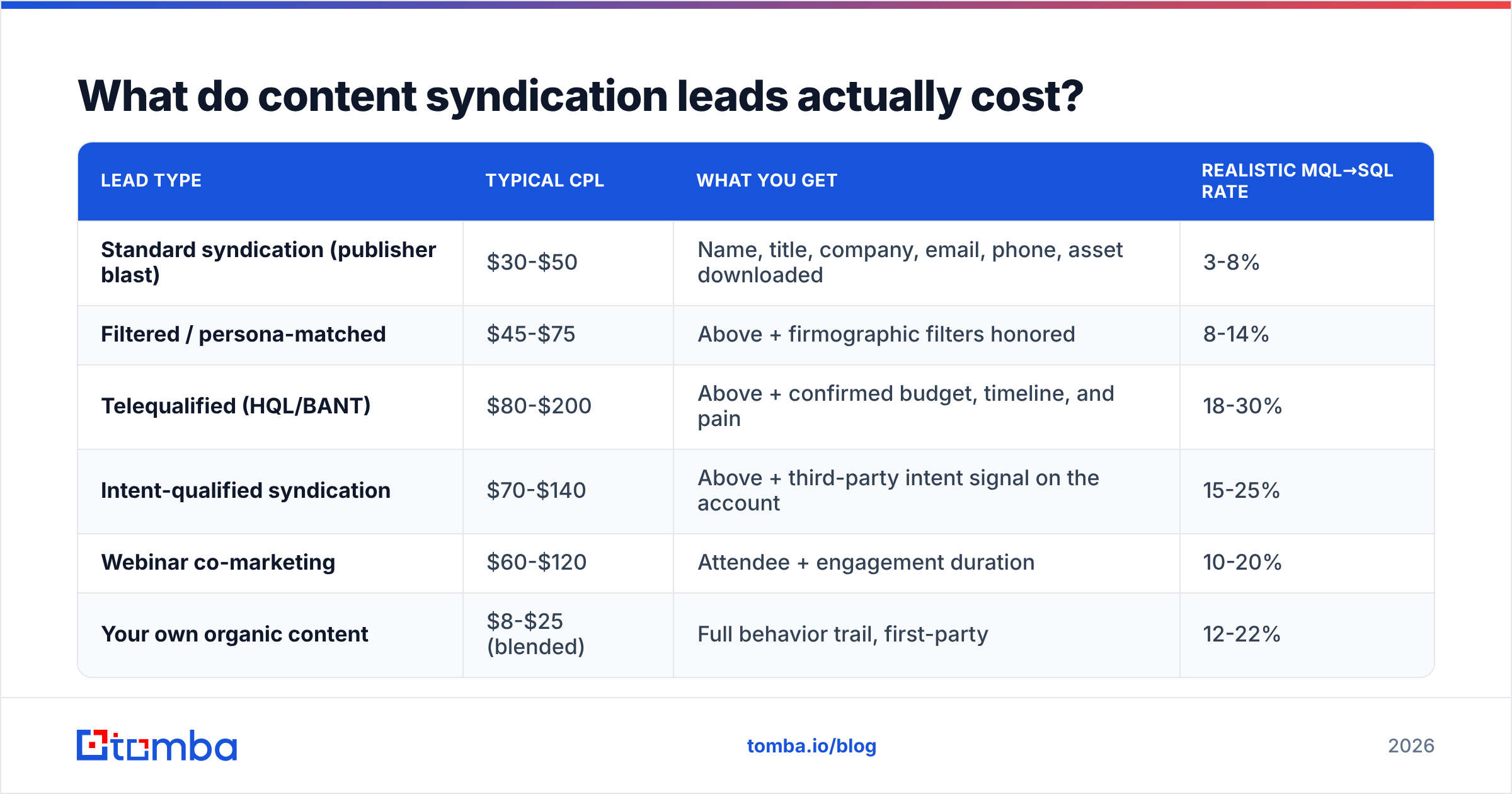
Here's the market as of 2026. Prices vary by geography (EMEA runs 20-40% higher than North America for the same specs) and by seniority (C-level costs roughly double manager-level).
| Lead type | Typical CPL | What you get | Realistic MQL→SQL rate |
|---|---|---|---|
| Standard syndication (publisher blast) | $30-$50 | Name, title, company, email, phone, asset downloaded | 3-8% |
| Filtered / persona-matched | $45-$75 | Above + firmographic filters honored | 8-14% |
| Telequalified (HQL/BANT) | $80-$200 | Above + confirmed budget, timeline, and pain | 18-30% |
| Intent-qualified syndication | $70-$140 | Above + third-party intent signal on the account | 15-25% |
| Webinar co-marketing | $60-$120 | Attendee + engagement duration | 10-20% |
| Your own organic content | $8-$25 (blended) | Full behavior trail, first-party | 12-22% |
The last row is the one nobody in a syndication sales call will show you. Organic content has a higher upfront cost and a slower ramp, but the blended CPL over 18 months usually beats syndication and the leads convert better because they chose you. Syndication is what you buy when you need pipeline this quarter and your organic engine isn't there yet.
Two numbers to compute before signing anything:
- Cost per SQL, not cost per lead. At $45 CPL and a 5% MQL→SQL rate, you're paying $900 per sales-accepted lead. At $150 CPL and a 25% rate, you're paying $600. The expensive program is the cheap one.
- Payback against ACV. If your average contract value is $12,000 and you close 20% of SQLs, a $900 SQL is fine. If your ACV is $3,000, syndication almost never pencils out.
Is content syndication better than outbound prospecting?#
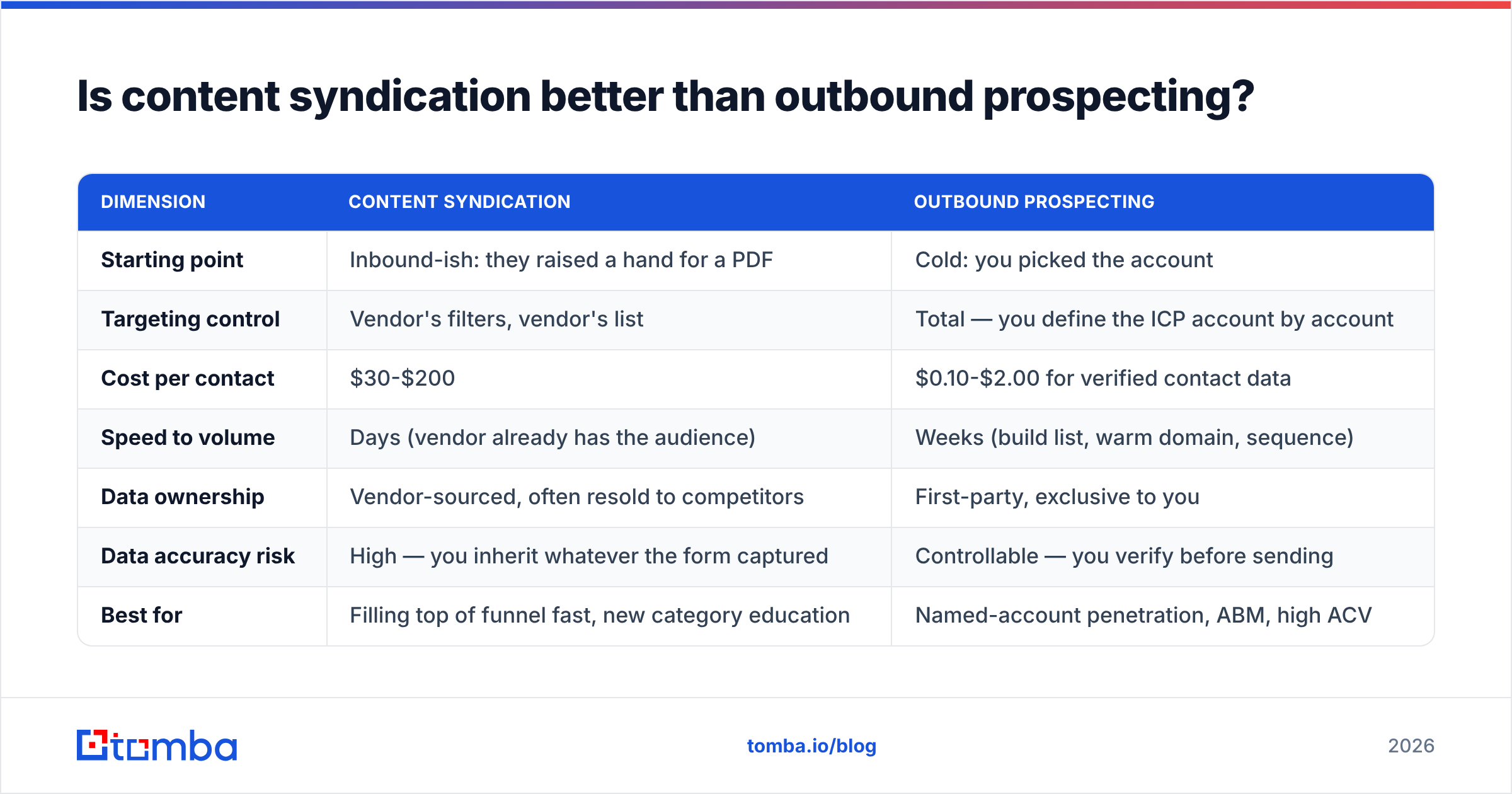
They solve different problems, and the smartest teams run both — using outbound to work the syndication leads.
| Dimension | Content syndication | Outbound prospecting |
|---|---|---|
| Starting point | Inbound-ish: they raised a hand for a PDF | Cold: you picked the account |
| Targeting control | Vendor's filters, vendor's list | Total — you define the ICP account by account |
| Cost per contact | $30-$200 | $0.10-$2.00 for verified contact data |
| Speed to volume | Days (vendor already has the audience) | Weeks (build list, warm domain, sequence) |
| Data ownership | Vendor-sourced, often resold to competitors | First-party, exclusive to you |
| Data accuracy risk | High — you inherit whatever the form captured | Controllable — you verify before sending |
| Best for | Filling top of funnel fast, new category education | Named-account penetration, ABM, high ACV |
The critical asymmetry: with outbound you control the data. With syndication you inherit it. A downloader who typed j.smith@acme.co instead of j.smith@acme.com is a lead you paid $48 for and a hard bounce you paid for twice — once in cash, once in sender reputation.
That's why most teams that succeed with syndication treat the vendor CSV as raw material, not as a finished lead. You run it through verification, re-find the broken records, enrich the thin ones, and only then let it touch your sending domain.
Why do so many content syndication programs fail?#
Five patterns, in order of how often I see them wreck a program.
- The leads bounce. Publisher lists rot at roughly 22-30% per year as people change jobs. If a vendor's list was refreshed 14 months ago, a meaningful slice of what you buy is already dead. Bounce rates above 3% put you in Google and Microsoft's penalty box, and now your organic email is suffering because of a purchased list.
- No intent, treated like intent. Marketing hands sales a lead labeled "downloaded our Kubernetes security guide." Sales calls and says "I understand you're evaluating Kubernetes security." The prospect has no memory of downloading anything. Trust between the two teams dies right there.
- Spec drift. You bought "Director+ at 1,000+ employee companies." You received a lot of "Specialist" and "Coordinator" titles at 200-person shops. Without a written replacement clause, you eat it.
- Resold leads. The same downloader gets syndicated to you and to three of your competitors in the same week. Nothing in most contracts prevents this. Ask explicitly about exclusivity windows.
- No follow-up choreography. The lead arrives 6-11 days after the download, gets dumped in a nurture drip, and the first human touch happens three weeks later. By then the asset is forgotten.

How do you vet a content syndication vendor?#
Ask these before you get to pricing. A good vendor answers all of them without flinching; a bad one deflects on at least three.
- "Where does the audience come from?" Owned newsletter, partner network, or programmatic placements? If they can't name the properties, walk.
- "When was this list last verified, and by whom?" "Continuously" is not an answer. You want a method and a date.
- "What's your replacement policy?" You want: any lead that hard-bounces, fails spec, or is a role-based inbox (
info@,sales@) gets replaced free within 30 days. Get it in the contract, not the email thread. - "Is this lead exclusive to us, and for how long?" Even a 14-day exclusivity window materially changes conversion.
- "Can I see a 25-lead sample before committing?" Verify the sample yourself. If 15% bounce on a curated sample, the full delivery will be worse.
- "How is consent captured?" For EMEA leads especially — you need the opt-in language, timestamp, and IP, or you're the one holding the GDPR liability. G2's vendor category is a reasonable starting point for shortlisting, but reviews there won't tell you about list hygiene.
On the data side, it's worth knowing that not all "purchased" B2B data is equal. Compliant, permission-based providers like BookYourData build lists with verification baked into the delivery, which is a fundamentally different product from a publisher reselling a 2023 newsletter export. If you're going to pay for contacts, pay someone whose business model depends on those contacts being real.
How do you fix syndication leads before they hit your CRM?#
This is the step that separates a program that returns 4x from one that returns 0.6x. Treat every vendor CSV as untrusted input.
The four-step cleanup pipeline:
- Deduplicate against your existing database. You'd be surprised how often you pay full CPL for a contact already sitting in your CRM as a closed-lost. Strip them, and invoice the vendor for the difference if your contract allows.
- Verify every address. Run the full file through bulk verify before a single email sends. Segment into valid, invalid, and catch-all. Invalid records go back to the vendor under your replacement clause — that's real money recovered, not a hygiene chore.
- Re-find the broken records. A typo'd or outdated email doesn't mean the person is worthless. You have their name, title, and company. Feed that into an email finder and you'll recover a meaningful share of the file at a fraction of the CPL you already paid.
- Enrich what's thin. Syndication forms capture the minimum viable fields. Layer on company size, tech stack, seniority, and a direct dial via data enrichment so sales isn't opening a call blind.
Only now does the lead get a score, a route, and a sequence.
What does a good syndication follow-up sequence look like?#
Speed and honesty. The two things most programs get wrong.
- Hour 0-24: reference the asset explicitly. "You grabbed our 2026 benchmark report — page 14 has the number most people flag." Not "I saw you were interested in our solution." Never overstate the intent.
- Day 2: give, don't ask. Send one adjacent resource with no CTA. You're establishing that emails from you are worth opening.
- Day 4-5: the soft qualifier. A single question that's easy to answer: "Is [problem the asset addressed] actually on your roadmap this year, or was this research for later?" A "later" reply is a win — it's a real signal you can score against.
- Day 8: relevant proof. One customer story matched to their segment.
- Day 12-14: the honest exit. "Sounds like the timing isn't right — I'll stop here. Want me to check back in Q1?" Breakup emails routinely outperform every message before them.
- Ongoing: route the non-responders to nurture, not to the graveyard. Around 30-40% of syndication leads convert on a later campaign, not this one. Their MQL status is a starting position, not a verdict.
For the mechanics of what "content syndication" means in the broader publishing sense — republishing content across third-party properties for reach rather than for leads — Wikipedia's entry on web syndication is a clean primer. The B2B lead-gen version borrowed the name and bolted a form onto it.
When should you skip content syndication entirely?#
Skip it if:
- Your ACV is under about $5,000 and your sales cycle is short. The CPL math doesn't survive contact with a low ACV.
- You're selling into a very narrow ICP (say, fewer than 3,000 target accounts globally). At that size you should be running named-account outbound with verified contact data, not renting a publisher's broad list.
- Your sending domain is new or already fragile. A purchased list is the fastest way to torch a domain you haven't warmed properly.
- You don't have a verification and enrichment step in place yet. Buying leads you can't clean is buying bounces.
- Your sales team has no capacity to call within 48 hours. Syndication leads decay fast; if they sit for two weeks, you've bought expensive CSV files.
Run it if you have a real ICP filter, a decent ACV, an SDR team that can act on delivery day, a written replacement clause, and a cleanup pipeline standing between the vendor and your CRM.
The verdict#
Content syndication lead generation is a legitimate channel with a data problem attached. The vendor sells you volume; what determines your ROI is what you do in the 48 hours between the CSV landing and the first email sending. Verify, re-find, enrich, dedupe, then sequence — and hold the vendor to their replacement clause when the file falls short of spec.
If you're about to run a syndication list through your sending domain, verify and rebuild it first. Tomba's Email Finder recovers the contacts your vendor got wrong — feed it a name and a company domain and get back a verified, deliverable address with a confidence score, so the $48 you already spent on a bad record doesn't become a bounce that costs you the next thousand sends. The free tier covers 25 searches a month if you want to test a sample file first; paid plans start at $49/mo. Full Tomba pricing is public, and there's an email verification API if you'd rather clean the file automatically the moment it hits your marketing automation platform.
Related guides#
Ready to find emails that actually work?
Join 150,000+ professionals who stopped guessing and started sending. Free credits on signup — no credit card required.
Get the Tomba newsletter
Practical outbound tactics and product updates — once every two weeks.
About the author