Contextual Email: The 2026 Guide to Signal-Based Outreach
Personalization tokens stopped working years ago. Contextual email — outreach built on a real, timely reason to write — is what still earns replies in 2026. Here's the signal stack, the workflow, and an honest tool comparison.
TL;DR
- A contextual email is built around a specific, verifiable reason you are writing this person this week — a hiring signal, a product launch, a tech-stack change, a funding round, a published article. "Personalization" (name, company, job title) is not context. It is mail-merge.
- Token personalization is dead as a differentiator. Every sequencer on the market ships
{{first_name}}. Prospects pattern-match it in under a second. - The workflow that still works in 2026: signal → segment → verified contact → one-line context hook → single ask. Skip any step and the sequence collapses back into spam.
- Contextual email is a data problem before it is a copy problem. If your contact data is stale or unverified, your best hook never lands in an inbox.
- Below: the signal taxonomy, a tool comparison across data providers and sequencers, three rewrite examples, and the metrics that tell you whether context is actually working.
What is a contextual email?#
A contextual email is an outbound message whose opening premise could only have been written to one recipient, because it references something that is true about them right now.
Think of it like knocking on a neighbor's door. "Hi, you live in house number 12" is personalization — accurate, useless, faintly creepy. "I saw the moving truck outside, do you need a hand with the couch?" is context. Same door, same knock, completely different reception.
The technical definition: contextual email uses a trigger event or observable state as the reason-to-contact, rather than firmographic attributes as the reason-to-merge. The trigger does the work that a clever subject line used to do — it makes the message relevant instead of merely addressed.
Three properties separate real context from decoration:
- Recency. The signal is days or weeks old, not quarters. A funding round from 14 months ago is trivia, not a trigger.
- Consequence. The signal implies a job the prospect now has to do. Hiring three SDRs implies a ramp problem. Migrating to a new CRM implies a data-hygiene problem.
- Verifiability. You can point to where you saw it. If you cannot cite it in one sentence, the prospect will read it as a guess — and a wrong guess is worse than no guess.
Miss any one of the three and you are back in mail-merge territory. A message that says "I noticed you're in fintech" satisfies none of them.
Why did personalization tokens stop working?#
Because they became free.
When merge fields were novel, a first name in the subject line was a signal of effort. Now every sequencing platform ships them, every AI writer generates a "custom" opener, and buyers have received thousands of them. HubSpot's own sales research has tracked the steady erosion of cold-email response rates as tooling commoditized: the tactic that separates you this year gets absorbed into everyone's default template by next year.
Here is what a prospect actually experiences when they open a token-personalized email:
- Line 1 references their company name. So did the last six emails.
- Line 2 compliments something generic — "impressive growth," "love what you're building."
- Line 3 pivots hard into a pitch with no logical bridge from lines 1–2.
- Line 4 asks for 15 minutes.
The tokens are all filled correctly. The email is still deleted, because nothing in it explains why now. Buyers have learned that "Hi {{first_name}}, saw {{company}} is scaling" is a template, and templates get archived without guilt.
AI made this worse, not better. LLM-generated openers scaled the appearance of research without the substance of it, so the market got flooded with emails that sound personal and say nothing. The floor rose; the ceiling didn't move. That's the whole story of 2024–2026 outbound in one sentence.
Contextual email works precisely because it is still expensive. It requires you to know something, and knowing something does not scale for free.
What signals make an email contextual?#
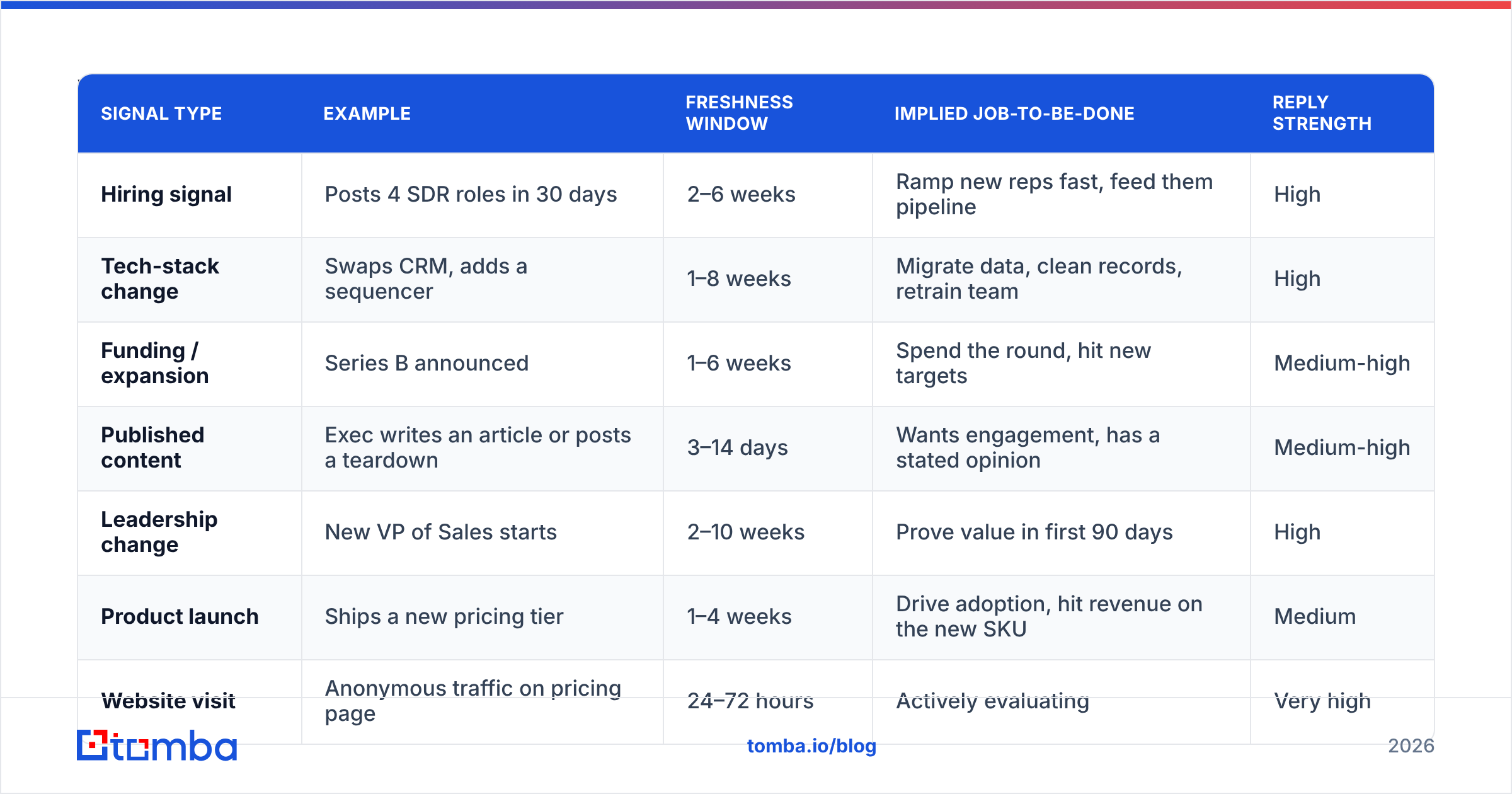
Not all triggers are equal. Some imply an urgent job-to-be-done; others are noise dressed as intent. Here is the working taxonomy, ranked by how reliably each converts to a reply.
| Signal type | Example | Freshness window | Implied job-to-be-done | Reply strength |
|---|---|---|---|---|
| Hiring signal | Posts 4 SDR roles in 30 days | 2–6 weeks | Ramp new reps fast, feed them pipeline | High |
| Tech-stack change | Swaps CRM, adds a sequencer | 1–8 weeks | Migrate data, clean records, retrain team | High |
| Funding / expansion | Series B announced | 1–6 weeks | Spend the round, hit new targets | Medium-high |
| Published content | Exec writes an article or posts a teardown | 3–14 days | Wants engagement, has a stated opinion | Medium-high |
| Leadership change | New VP of Sales starts | 2–10 weeks | Prove value in first 90 days | High |
| Product launch | Ships a new pricing tier | 1–4 weeks | Drive adoption, hit revenue on the new SKU | Medium |
| Website visit | Anonymous traffic on pricing page | 24–72 hours | Actively evaluating | Very high |
| Firmographic only | "You're a 200-person SaaS in NYC" | N/A | None | Very low |
The bottom row is the one most teams are actually running. It is not a signal. It is a filter — useful for building a list, useless for opening an email.
Two operational notes on the top rows. First, website-visit signals decay fastest. A prospect on your pricing page is worth contacting today, not Thursday; tools like website visitor reveal exist to compress that window. Second, content signals are the most underused. If a director of demand gen publishes a piece arguing that attribution is broken, you have both a topic and an opinion to respond to — no guessing required. An author finder turns a byline into a contactable person in one step.
How do you build a contextual email workflow?#
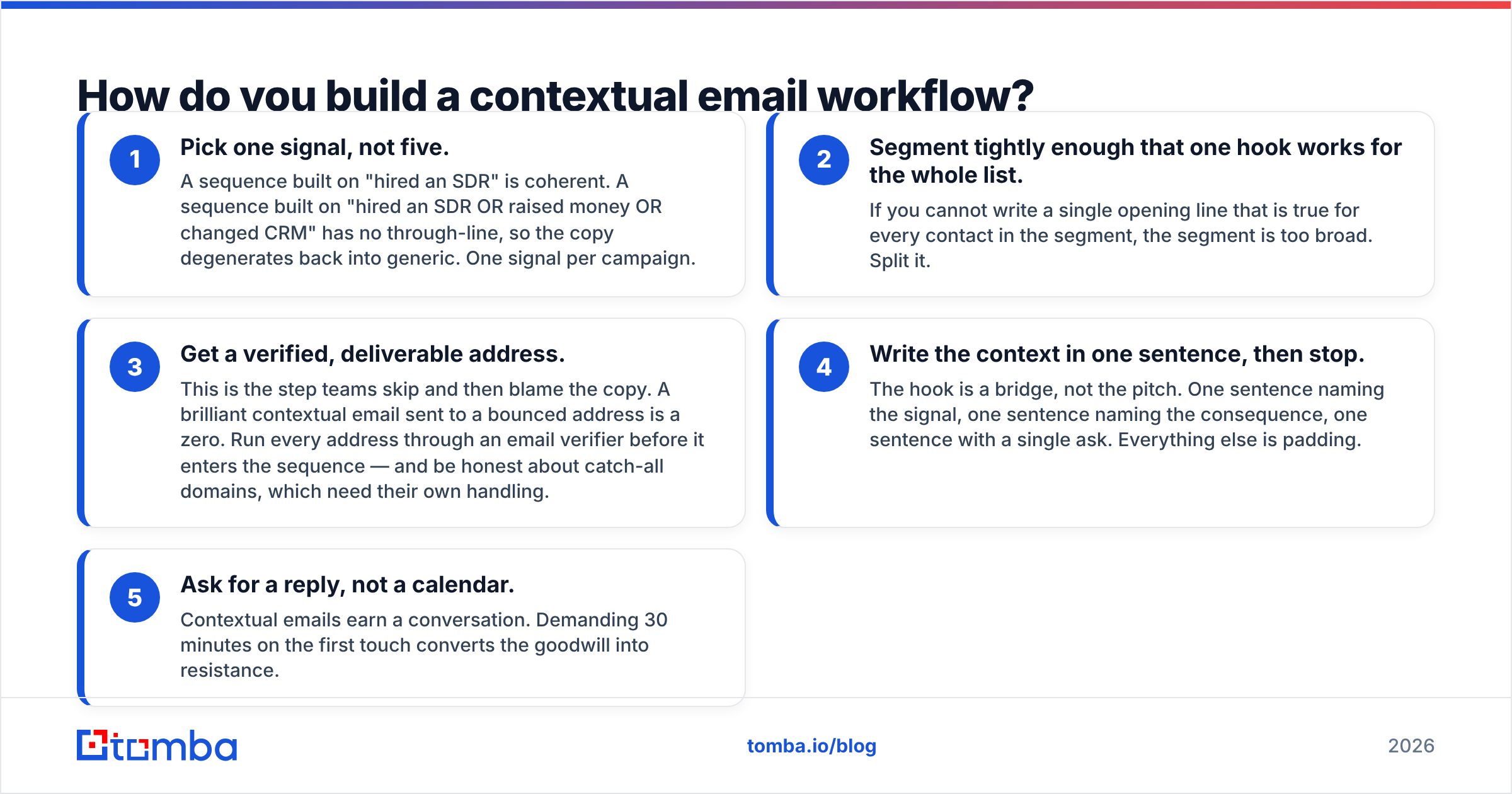
Five steps, in order. The order matters more than the tooling.
- Pick one signal, not five. A sequence built on "hired an SDR" is coherent. A sequence built on "hired an SDR OR raised money OR changed CRM" has no through-line, so the copy degenerates back into generic. One signal per campaign.
- Segment tightly enough that one hook works for the whole list. If you cannot write a single opening line that is true for every contact in the segment, the segment is too broad. Split it.
- Get a verified, deliverable address. This is the step teams skip and then blame the copy. A brilliant contextual email sent to a bounced address is a zero. Run every address through an email verifier before it enters the sequence — and be honest about catch-all domains, which need their own handling.
- Write the context in one sentence, then stop. The hook is a bridge, not the pitch. One sentence naming the signal, one sentence naming the consequence, one sentence with a single ask. Everything else is padding.
- Ask for a reply, not a calendar. Contextual emails earn a conversation. Demanding 30 minutes on the first touch converts the goodwill into resistance.
That's it. The failure mode is almost never "we didn't have a clever enough template." It's "we blasted a broad list with a hook that was only true for 12% of it."
What does contextual actually look like in practice?#
Three rewrites. Same prospect, same offer, escalating levels of context.
Level 0 — token personalization (delete):
Hi Sarah, I saw that Acme is doing impressive work in the fintech space. We help companies like yours improve pipeline efficiency. Do you have 15 minutes Thursday?
Nothing here is false. Nothing here is a reason to reply.
Level 1 — firmographic "context" (still weak):
Hi Sarah, noticed Acme has grown to about 200 people and is expanding in fintech. Teams your size usually struggle with lead data quality. Worth a chat?
Better shaped, still a guess. "Usually struggle" is the tell — you are pattern-matching, not observing.
Level 2 — real contextual email (works):
Hi Sarah — you posted four SDR openings in the last three weeks, and the JD mentions reps are expected to self-source 60% of their pipeline. That usually means new hires burn their first month fighting a stale list instead of selling. When we onboarded a similar team, verified-contact ramp time dropped from six weeks to two. Want the one-page teardown of how they did it? No call needed.
Notice what's happening structurally. The signal is cited (four job posts, specific JD language). The consequence is named (ramp friction). The proof is one line. The ask is lower friction than a meeting — a document, not a calendar invite. That last move is what separates contextual outreach from contextual-flavored spam.
The uncomfortable truth: level 2 takes maybe four minutes of research per prospect the first time you do it, and about 40 seconds once your data pipeline surfaces the signal automatically. That's the entire economic argument for the tooling below.
Which tools support contextual email in 2026?#
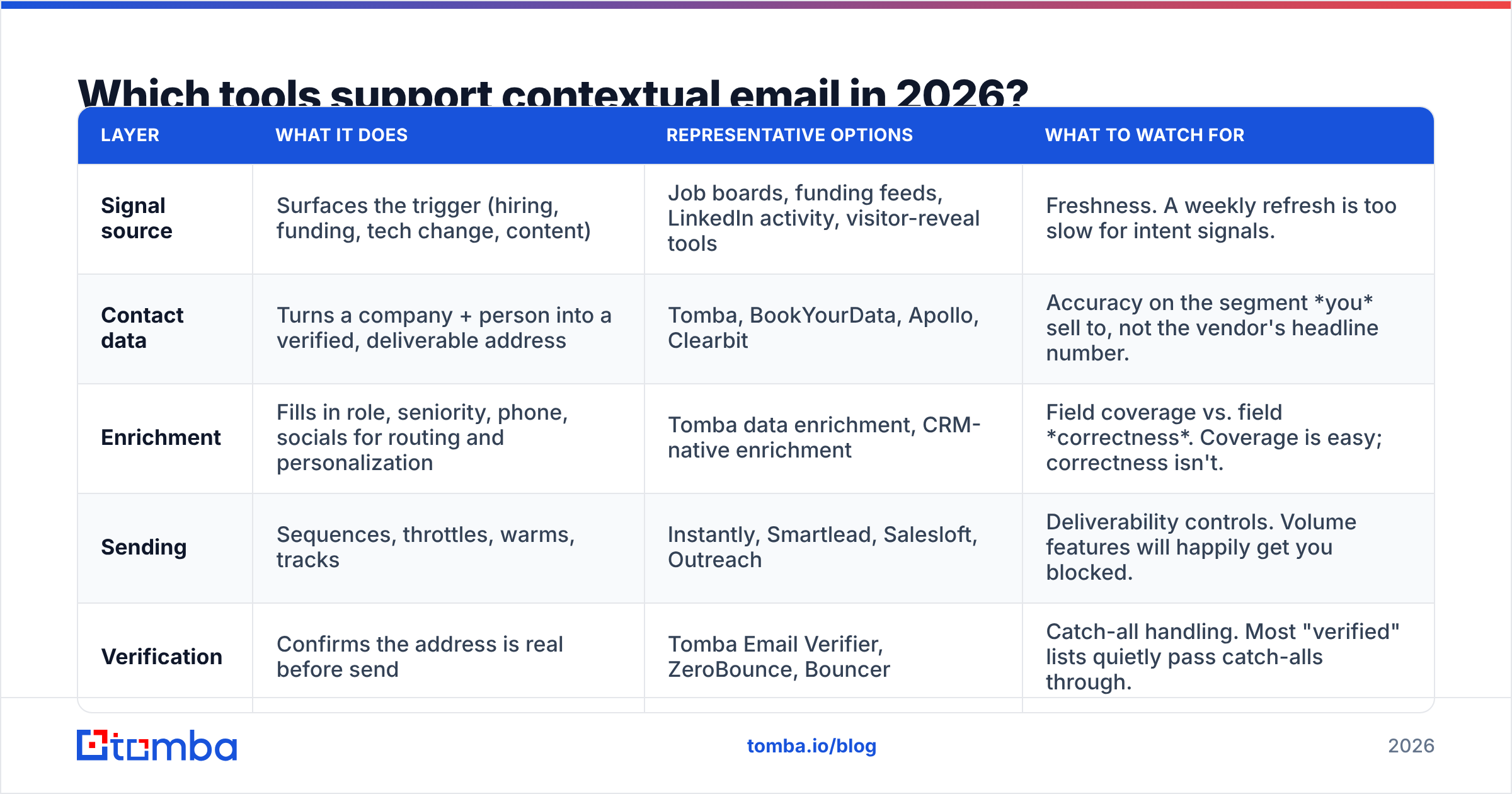
The stack splits into three layers: signal sources, contact data, and sending. Most teams over-invest in layer three and wonder why replies are flat.
| Layer | What it does | Representative options | What to watch for |
|---|---|---|---|
| Signal source | Surfaces the trigger (hiring, funding, tech change, content) | Job boards, funding feeds, LinkedIn activity, visitor-reveal tools | Freshness. A weekly refresh is too slow for intent signals. |
| Contact data | Turns a company + person into a verified, deliverable address | Tomba, BookYourData, Apollo, Clearbit | Accuracy on the segment you sell to, not the vendor's headline number. |
| Enrichment | Fills in role, seniority, phone, socials for routing and personalization | Tomba data enrichment, CRM-native enrichment | Field coverage vs. field correctness. Coverage is easy; correctness isn't. |
| Sending | Sequences, throttles, warms, tracks | Instantly, Smartlead, Salesloft, Outreach | Deliverability controls. Volume features will happily get you blocked. |
| Verification | Confirms the address is real before send | Tomba Email Verifier, ZeroBounce, Bouncer | Catch-all handling. Most "verified" lists quietly pass catch-alls through. |
A few honest observations.
Signal tools are commoditizing; data quality is not. Everyone can see the same job posting. What separates campaigns is whether you can reach the right person about it before the window closes — and that comes down to whether the address is correct on the first attempt. Vendor-claimed accuracy percentages are close to meaningless in the abstract; test on 100 contacts from your own ICP and count the bounces.
Buy data where the buyers actually are. For teams that want pre-built, human-verified lists with hard bounce guarantees, providers like BookYourData are a legitimate and well-reviewed choice — you'll find consistently strong practitioner reviews on G2. For teams that want to find addresses on demand from a domain, a name, or a byline — i.e. teams running signal-triggered campaigns where the target list is generated fresh every week — a real-time email finder is a better structural fit, because the list doesn't exist until the signal fires. Different problems, different tools; a lot of teams end up running both.
Sequencer choice matters less than you think. Contextual campaigns are low-volume by nature. If you're sending 80 highly-specific emails a week, the marginal value of an enterprise sequencer over a mid-market one is close to zero. Spend the budget on data instead.
On pricing, be realistic about credit consumption: a contextual workflow burns finder credits on discovery and verifier credits on hygiene. Tomba's plans start free at 25 searches/month and move to $49/month (Starter), $99/month (Growth), and $249/month (Pro) — model your actual weekly signal volume against that before committing, rather than buying the tier a sales rep suggests.
How do you measure whether context is working?#
Stop optimizing open rates. Apple Mail Privacy Protection turned them into noise years ago, and Gartner's ongoing coverage of B2B buying behavior keeps reinforcing the same point: buyers are self-educating long before they reply, so shallow engagement metrics tell you almost nothing about pipeline. Track these instead:
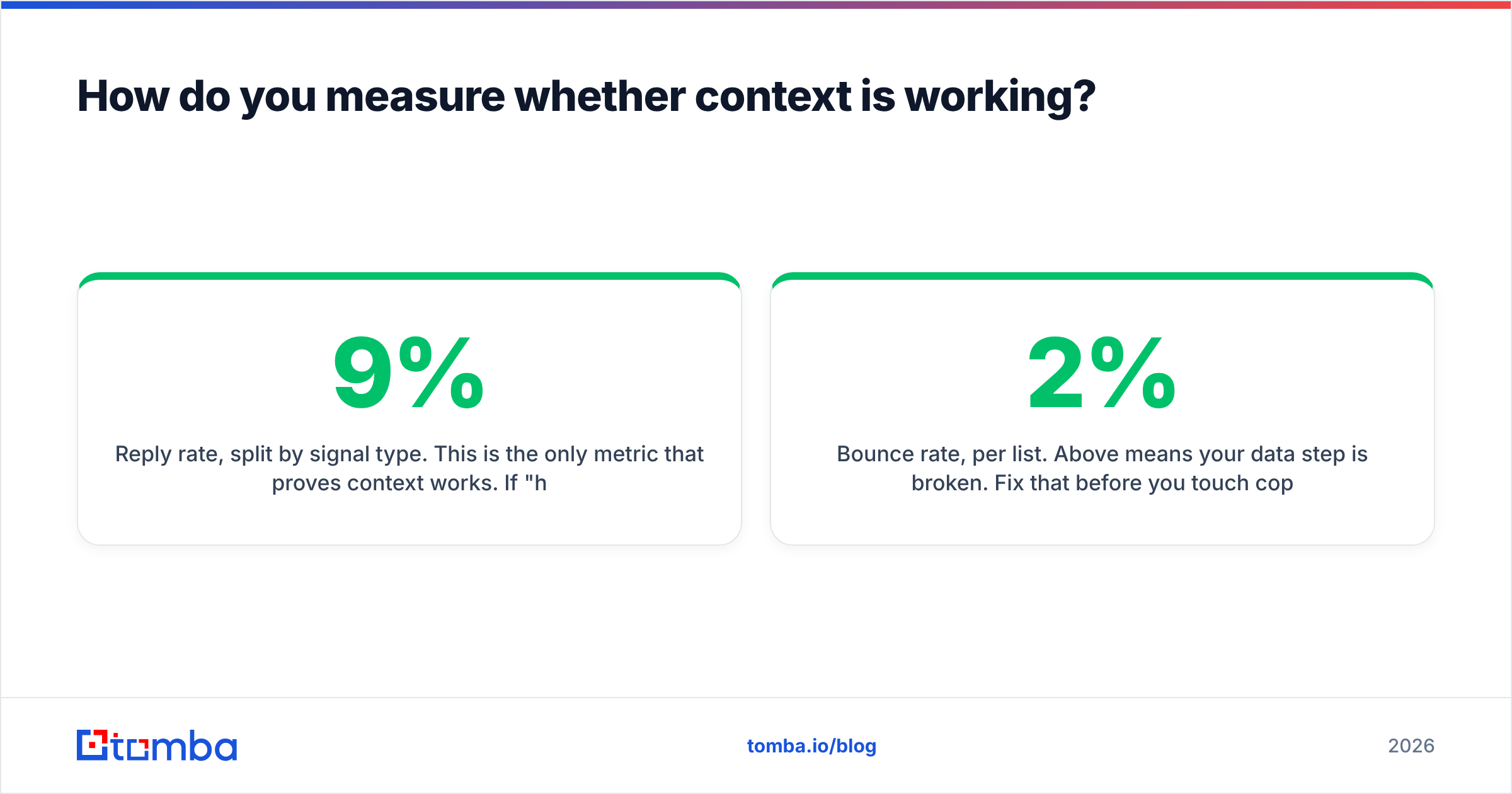
- Reply rate, split by signal type. This is the only metric that proves context works. If "hiring signal" replies at 9% and "funding signal" replies at 2%, you have learned something actionable. If you only track blended response rate, you have learned nothing.
- Positive reply rate. "Not interested" is still a reply. Segment it out or you'll optimize toward annoyance.
- Bounce rate, per list. Above 2% means your data step is broken. Fix that before you touch copy — no hook survives a 12% bounce rate.
- Time-from-signal-to-send. The single most predictive operational metric in contextual outbound. Teams sending within 72 hours of a trigger routinely outperform teams sending within 3 weeks by a multiple, using identical copy.
- Meetings per 100 sends, not per 1,000. Contextual campaigns are meant to be small. If your denominator is in the thousands, you're not doing contextual email — you're doing spam with better adjectives.
One diagnostic that cuts through everything: pull ten emails at random from your last campaign and ask, could this exact message have been sent to a different company without changing a word? If yes for more than two of them, your "contextual" program is a mail-merge with extra steps.
Get the data layer right first#
Contextual email fails at the data layer far more often than at the copy layer. The signal is public, the hook is writable, the sequencer is table stakes — but if the address is wrong, stale, or a silent catch-all, none of that ever reaches a human.
Start there. Use the Tomba Email Finder to turn the companies your signals surface into verified, deliverable contacts — by domain, by name, or straight from a published byline — and run the results through verification before a single email leaves your sequencer. The free tier gives you 25 searches a month, which is more than enough to test a contextual campaign on a real segment and see the reply rate for yourself before you spend a dollar.
Context beats volume. But context only counts if it lands in an inbox.
Related guides#
Ready to find emails that actually work?
Join 150,000+ professionals who stopped guessing and started sending. Free credits on signup — no credit card required.
Get the Tomba newsletter
Practical outbound tactics and product updates — once every two weeks.
About the author