9 Best Contify Alternatives in 2026 (Free and Paid Tools)
Contify is a capable market and competitive intelligence platform, but the quote-only pricing and setup time push a lot of teams to shop around. Here are nine Contify alternatives compared on cost, data depth, and what they actually deliver to a rep.
TL;DR
- Contify is a market and competitive intelligence platform: it ingests news, filings, review sites, job posts, and social signals, then filters them into curated feeds for product, marketing, and sales teams.
- Most teams shop for Contify alternatives for three reasons: quote-only pricing, a setup period measured in weeks, and signal volume that nobody on the team ends up reading.
- The best alternative depends on the job. Competitive battlecards, market monitoring, account signals, and contact data are four different problems, and no single vendor is best at all four.
- Crayon and Klue win on battlecards. AlphaSense and Feedly win on research depth. Owler and Similarweb win on cheap account context. Tomba, BookYourData, and Cognism win when the intel needs to end in an actual email in a sequence.
- If your "intelligence" project keeps stalling because you have signals but no verified contacts to act on, fix the contact layer first. It's cheaper and it compounds faster.
What is Contify, and who actually buys it?#
Contify is a market and competitive intelligence platform. You give it a watchlist — competitors, customers, partners, regulators, topics — and it pulls signals from news sources, company websites, press releases, review sites, job boards, regulatory filings, and social channels. Its AI layer tags and deduplicates the noise, and the output lands in curated newsfeeds, weekly digests, a Slack channel, or your CRM.
The buyer is usually one of three people:
- A competitive intelligence or product marketing lead who needs battlecards and win/loss context.
- A strategy or market research analyst at a mid-to-large enterprise who tracks a category.
- A sales enablement manager who wants reps to know when a target account raises money, changes leadership, or opens a new office.
Contify does that job. It's a legitimate product with real customers, and it has stronger coverage of non-US and long-tail sources than a lot of competitors. The reason people search for Contify alternatives isn't usually "it doesn't work." It's that the value doesn't line up with the invoice, or the tool solves a different problem than the one that's actually blocking revenue.
Why do teams look for Contify alternatives?#

Four patterns show up over and over in G2 reviews and in the conversations we have with sales teams:
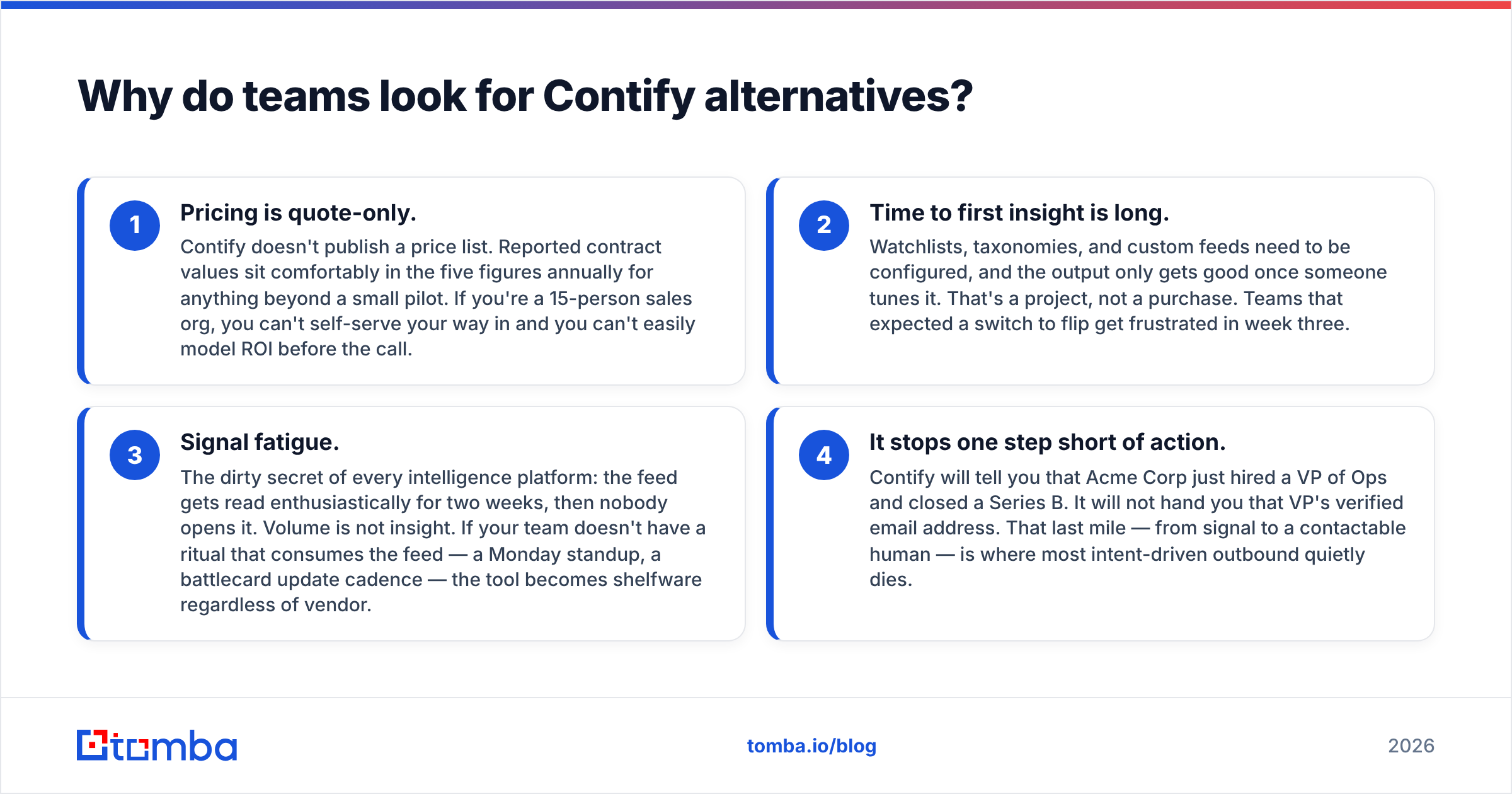
- Pricing is quote-only. Contify doesn't publish a price list. Reported contract values sit comfortably in the five figures annually for anything beyond a small pilot. If you're a 15-person sales org, you can't self-serve your way in and you can't easily model ROI before the call.
- Time to first insight is long. Watchlists, taxonomies, and custom feeds need to be configured, and the output only gets good once someone tunes it. That's a project, not a purchase. Teams that expected a switch to flip get frustrated in week three.
- Signal fatigue. The dirty secret of every intelligence platform: the feed gets read enthusiastically for two weeks, then nobody opens it. Volume is not insight. If your team doesn't have a ritual that consumes the feed — a Monday standup, a battlecard update cadence — the tool becomes shelfware regardless of vendor.
- It stops one step short of action. Contify will tell you that Acme Corp just hired a VP of Ops and closed a Series B. It will not hand you that VP's verified email address. That last mile — from signal to a contactable human — is where most intent-driven outbound quietly dies.
That fourth point is the one worth sitting with, because it changes which category of alternative you should even be evaluating.
What are the best Contify alternatives in 2026?#
Here's the honest map. Note that these tools are not interchangeable — three of them aren't even in the same category as Contify, which is exactly the point.
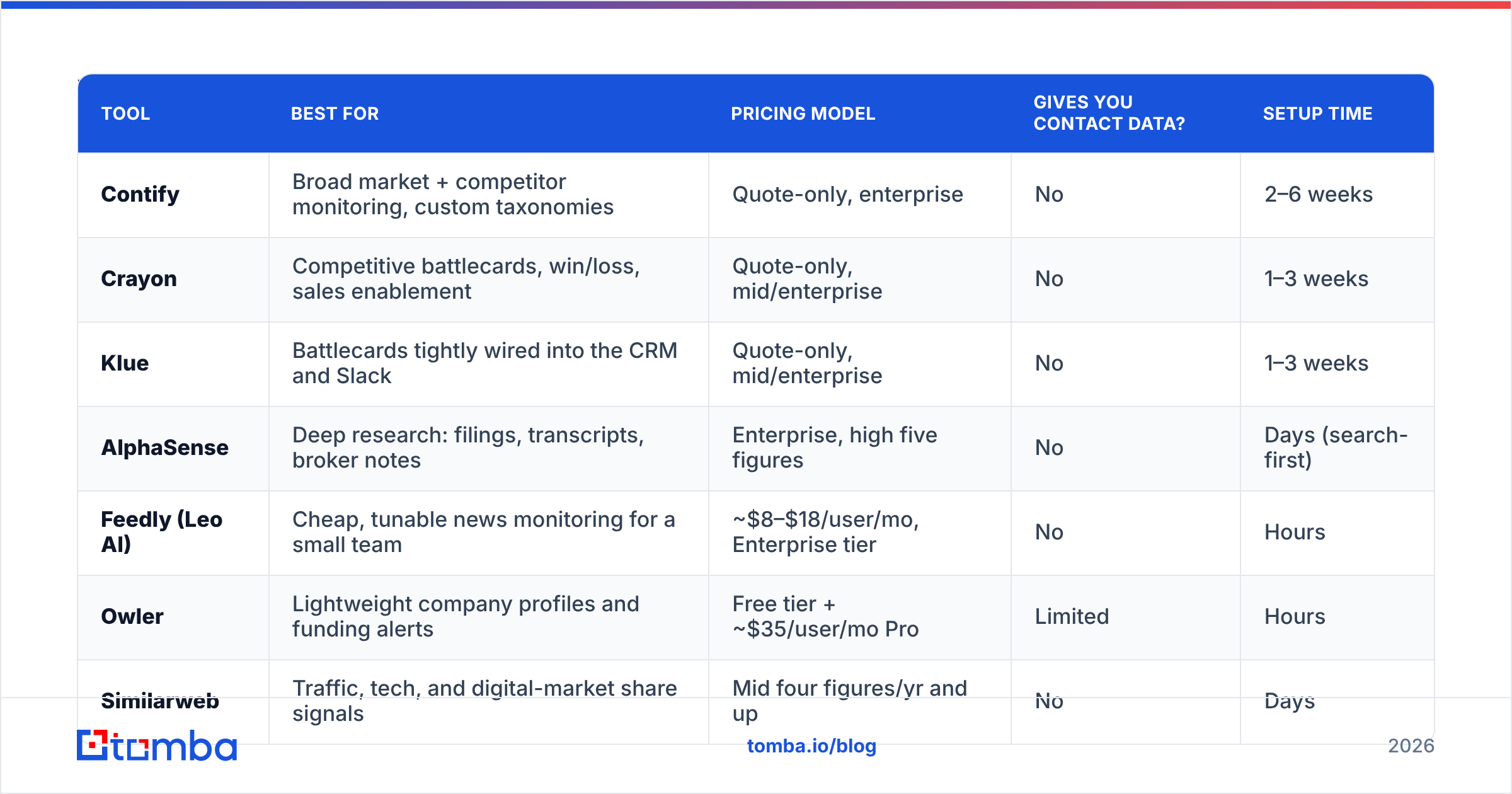
| Tool | Best for | Pricing model | Gives you contact data? | Setup time |
|---|---|---|---|---|
| Contify | Broad market + competitor monitoring, custom taxonomies | Quote-only, enterprise | No | 2–6 weeks |
| Crayon | Competitive battlecards, win/loss, sales enablement | Quote-only, mid/enterprise | No | 1–3 weeks |
| Klue | Battlecards tightly wired into the CRM and Slack | Quote-only, mid/enterprise | No | 1–3 weeks |
| AlphaSense | Deep research: filings, transcripts, broker notes | Enterprise, high five figures | No | Days (search-first) |
| Feedly (Leo AI) | Cheap, tunable news monitoring for a small team | ~$8–$18/user/mo, Enterprise tier | No | Hours |
| Owler | Lightweight company profiles and funding alerts | Free tier + ~$35/user/mo Pro | Limited | Hours |
| Similarweb | Traffic, tech, and digital-market share signals | Mid four figures/yr and up | No | Days |
| BookYourData | Prebuilt, filterable B2B contact lists with a verified guarantee | Pay-as-you-go credits | Yes | Minutes |
| Tomba | Turning any company/domain signal into a verified email | Free (25/mo), $49 Starter, $99 Growth, $249 Pro | Yes | Minutes |
Two of the "alternatives" — Feedly and Owler — are honestly downgrades in coverage. They're on this list because for a lot of teams, a $20/month feed plus a disciplined Monday review beats a $30,000/year platform that nobody opens. Be ruthless about that comparison.
Which Contify alternative fits your specific use case?#
Skip the feature grid. Pick by the job you're actually trying to do.
You need battlecards your reps will use mid-call. Go to Crayon or Klue. Both were built for product marketing teams whose output is a card in the seller's hands, not a research digest. Klue's Slack and CRM surfacing is the tightest; Crayon's competitive-content capture is broader. Contify can produce this, but you'll be assembling it.
You need defensible market research for a board deck. AlphaSense. It indexes earnings transcripts, broker research, and filings, and its search is genuinely good. It is also the most expensive option here by a distance, and it's overkill if your "market" is 400 mid-market SaaS companies rather than a public equities sector.
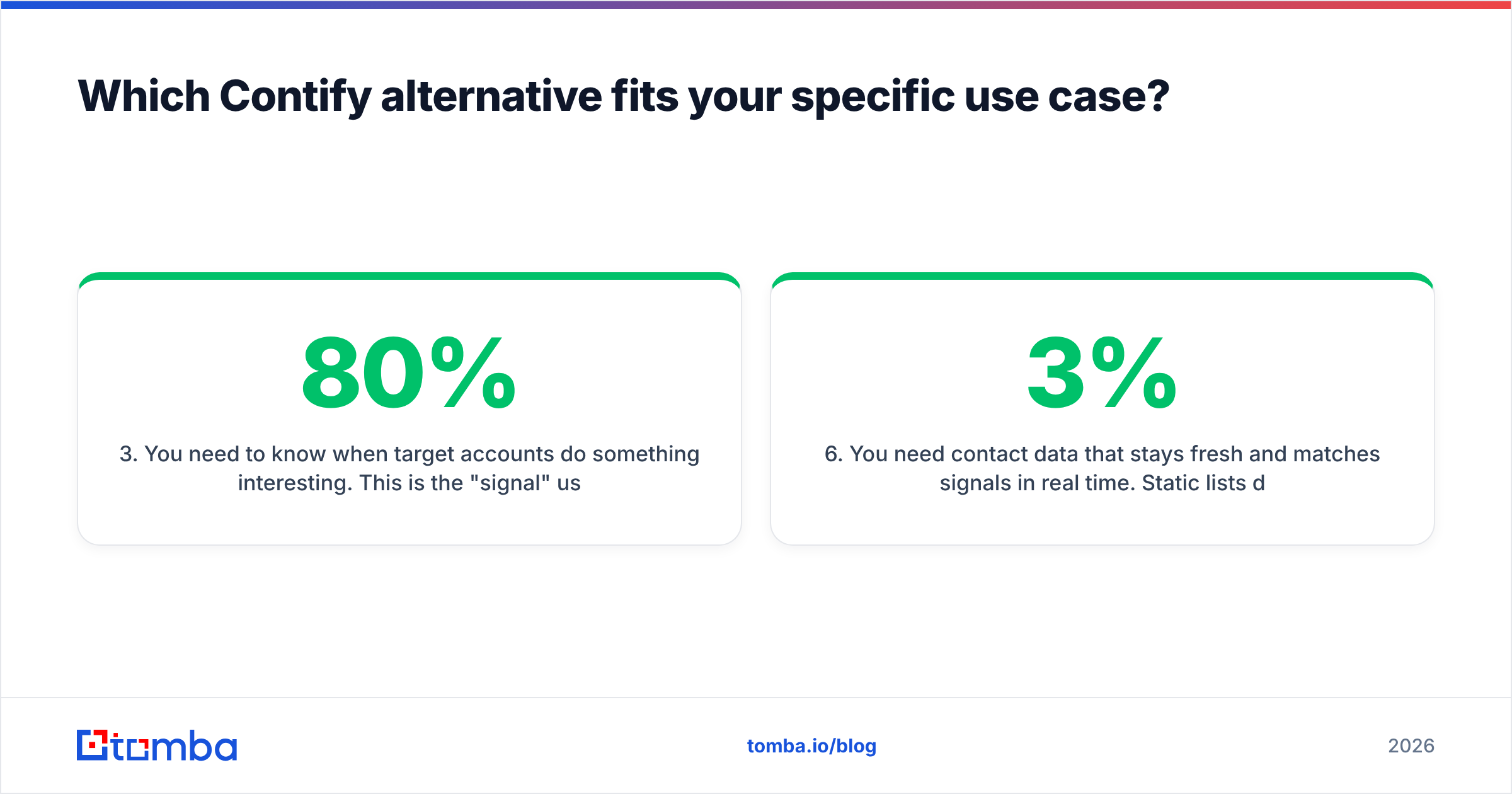
You need to know when target accounts do something interesting. This is the "signal" use case, and it's where cost discipline matters most. Owler alerts plus Similarweb plus a Feedly board covers 80% of what an enterprise platform gives you, at maybe 5% of the price. Then wire those signals into a real workflow.
You need to actually contact the humans behind the signal. This is where a market intelligence tool alone fails you. A funding announcement is worthless if you can't reach the Head of RevOps. This is a contact enrichment problem, not a monitoring problem.
You need a static, filterable list right now. BookYourData is a solid fit here — it's a credit-based, pay-as-you-go contact database with a strong verified-accuracy guarantee and no annual lock-in, which makes it a genuinely reasonable peer to consider alongside a build-your-own approach. Buy a slice, test it, don't commit a year.
You need contact data that stays fresh and matches signals in real time. Static lists decay at roughly 2–3% per month as people change jobs. If your motion is signal-triggered, you want a lookup at the moment of action, not a CSV from last quarter. That's an API problem.
Is market intelligence useful without contact data?#
Not really — and this is the part most "Contify alternatives" listicles refuse to say out loud.
Think of it like a smoke detector with no fire department. The alarm goes off, you know exactly which room, and then... nothing happens. The insight is real, the value is zero, because the last mile is missing.
Here's what the complete workflow actually looks like:
Signal → Company → People → Verified contact → Sequence.
Contify, Crayon, Klue, and AlphaSense all live in the first two boxes. They tell you who is doing something interesting. They do not tell you how to reach the person who cares about it. Owler gets you a company profile with maybe an executive name. Similarweb gets you a domain. None of them hands a rep a deliverable, verified address.
That's the gap Tomba fills. Once a signal identifies a company, a domain search returns the people at that domain with their roles and the company's email pattern; the email verifier then confirms the address is deliverable before it enters a sequence. It's the difference between "Acme raised a Series B" and "here is Acme's VP of Operations, verified, in your sequence, within four minutes of the news breaking."
For teams doing this at volume, the Tomba API is the piece that matters. Your monitoring tool fires a webhook, the API resolves the domain into verified contacts, and the records land in HubSpot or Salesforce without a human touching a spreadsheet. That's the loop that turns intelligence into pipeline.

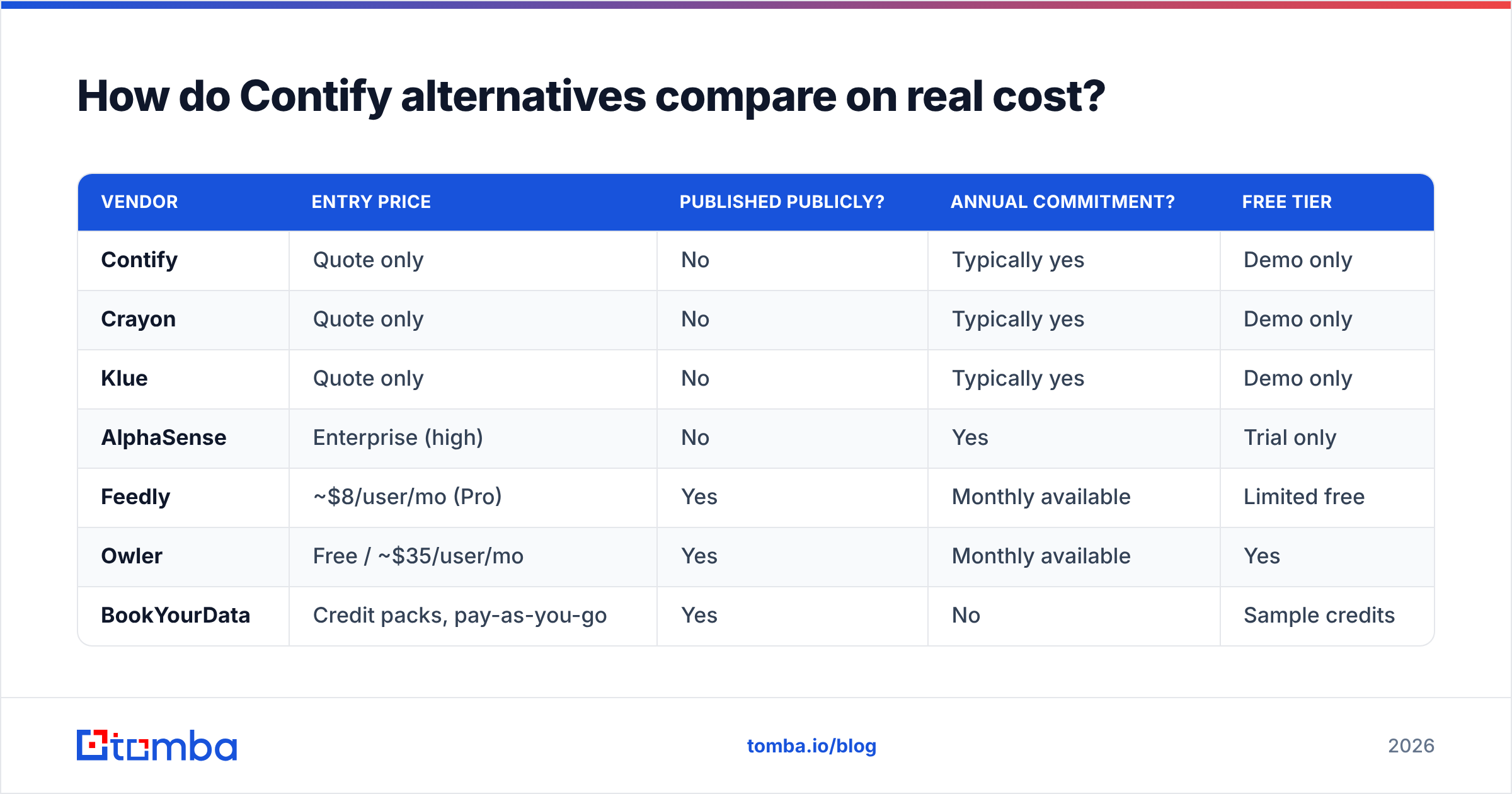
How do Contify alternatives compare on real cost?#
Pricing transparency is a real differentiator in this category, and it maps almost perfectly onto how much of a sales process each vendor requires from you.
| Vendor | Entry price | Published publicly? | Annual commitment? | Free tier |
|---|---|---|---|---|
| Contify | Quote only | No | Typically yes | Demo only |
| Crayon | Quote only | No | Typically yes | Demo only |
| Klue | Quote only | No | Typically yes | Demo only |
| AlphaSense | Enterprise (high) | No | Yes | Trial only |
| Feedly | ~$8/user/mo (Pro) | Yes | Monthly available | Limited free |
| Owler | Free / ~$35/user/mo | Yes | Monthly available | Yes |
| BookYourData | Credit packs, pay-as-you-go | Yes | No | Sample credits |
| Tomba | Free tier (25 searches/mo), $49 Starter | Yes (Tomba pricing) | No — monthly | Yes |
The pattern is obvious: the more a vendor hides its price, the more likely you're buying a project rather than a product. That's not automatically wrong — enterprise CI genuinely requires configuration — but you should go in knowing which one you're signing.
A practical rule of thumb: if your total ARR from the segment you're monitoring is under $2M, a five-figure intelligence contract is very hard to justify. Spend $200/month on monitoring and contact data, keep the other $28,000, and revisit in a year when the motion is proven.
How do you replace Contify without losing coverage?#
A migration that actually works, in five steps:
- Audit what you actually read. Pull the last 90 days of Contify digests. Which alerts changed a decision, a battlecard, or an outbound sequence? For most teams the honest answer is a small handful of signal types — funding, leadership change, product launch, hiring surge. Everything else is noise you were paying for.
- Rebuild those specific signals cheaply. Funding and leadership changes: Owler alerts plus a Feedly board. Hiring surges: a job-board watch. Product launches: the competitor's changelog RSS plus their G2 review feed. This takes an afternoon.
- Add the battlecard layer only if you have someone to own it. If no full-time product marketer owns competitive content, Crayon and Klue will become shelfware just like Contify did. Own it or skip it.
- Wire signals to contacts. This is the step teams skip. Every signal should terminate in a person you can email. Feed the company domain into a bulk email finder run, verify the results, push to CRM.
- Measure the loop, not the feed. The KPI is not "alerts received." It's "sequences triggered by a signal" and "meetings booked from signal-triggered outbound." If that number is zero, no vendor on this list will save you.
Frequently asked questions#
Is there a free Contify alternative? For monitoring, yes — Feedly's free tier plus Owler's free tier covers basic competitor and account alerts. For contact data, Tomba's free plan includes 25 searches per month, which is enough to test whether signal-to-contact enrichment actually moves your reply rate before you pay anything.
Which Contify alternative is best for a small sales team? Owler or Feedly for signals, plus a contact data layer. A 10-person team should not be spending five figures on curated newsfeeds.
Does Contify provide email addresses? No. It's a market and competitive intelligence platform, not a contact database. You'll need a separate email finder or a B2B contact provider to reach the people behind the signals it surfaces.
Is Crayon or Klue better than Contify? For battlecards and sales enablement, generally yes — they're purpose-built for it. For broad market monitoring across many source types and geographies, Contify's coverage is often deeper. Different tools, different jobs.
Where to start#
If your Contify renewal is coming up and you're not sure the platform earned its keep, run this test before you sign: for two weeks, track every signal your team acted on. Then ask whether each of those actions ended in an email to a real, verified human — or in a slide.
If the honest answer is "a slide," the missing piece isn't better intelligence. It's the contact layer that converts intelligence into pipeline.
Start with the Tomba Email Finder. Point it at any company domain from your watchlist, get verified, deliverable addresses for the people who actually own the problem you sell into, and push them straight into your sequences. The free tier gives you 25 searches a month to prove the loop works. Starter is $49/mo when it does.
Signals are cheap. Reaching the right person is the whole game.
Related guides#
Ready to find emails that actually work?
Join 150,000+ professionals who stopped guessing and started sending. Free credits on signup — no credit card required.
Get the Tomba newsletter
Practical outbound tactics and product updates — once every two weeks.
About the author