Contify Pricing Reviews, Pros and Cons: An Honest 2026 Look
Contify is a market and competitive intelligence platform with quote-only pricing. This roundup of Contify pricing reviews covers what buyers actually pay, where the product earns its keep, where it frustrates teams, and which cheaper tools cover part of the job.
Contify pricing reviews are hard to pin down, because the vendor publishes no price page. This guide gathers what buyers report paying, what reviewers praise, what they complain about, and which cheaper tools cover part of the job.
TL;DR
- Contify does not publish a price. Every plan is quote-only. Scope depends on tracked competitors, topics, users, and custom taxonomy work. Expect an annual contract, not a credit card checkout.
- Buyers consistently report five-figure annual spend. Review sites and buyer chatter put entry deals in the low-to-mid four figures per month. Enterprise builds climb well past that. Treat any number you read online — including here — as a starting point for negotiation, not a rate card.
- What it does well: curated competitor and market signal tracking, noise filtering, custom taxonomy, newsletter/dashboard distribution to non-analyst stakeholders.
- What frustrates users: setup and taxonomy tuning take real time, some feeds are noisy at first, and pricing opacity makes budget approval slow.
- It is not a prospecting tool. Contify tells you what's happening in your market. It won't hand you a verified contact to email — that's a different, far cheaper part of the stack.
What is Contify, and what problem does it actually solve?#
Contify is a market and competitive intelligence (M&CI) platform. It ingests news, company websites, regulatory filings, review sites, job boards, social posts, and internal sources. It then filters that firehose down to signals that matter to your business — a competitor's pricing page change, a target account's leadership hire, a new funding round in your category.
The core promise is curation. Anyone can set a Google Alert. The hard part is getting 400 alerts a week down to the 12 that a product marketer or CI analyst would act on. Contify sells that reduction, plus the plumbing to push what survives into a dashboard, a weekly newsletter, Slack, or your CRM.
If you're evaluating it, be precise about which job you're hiring it for:
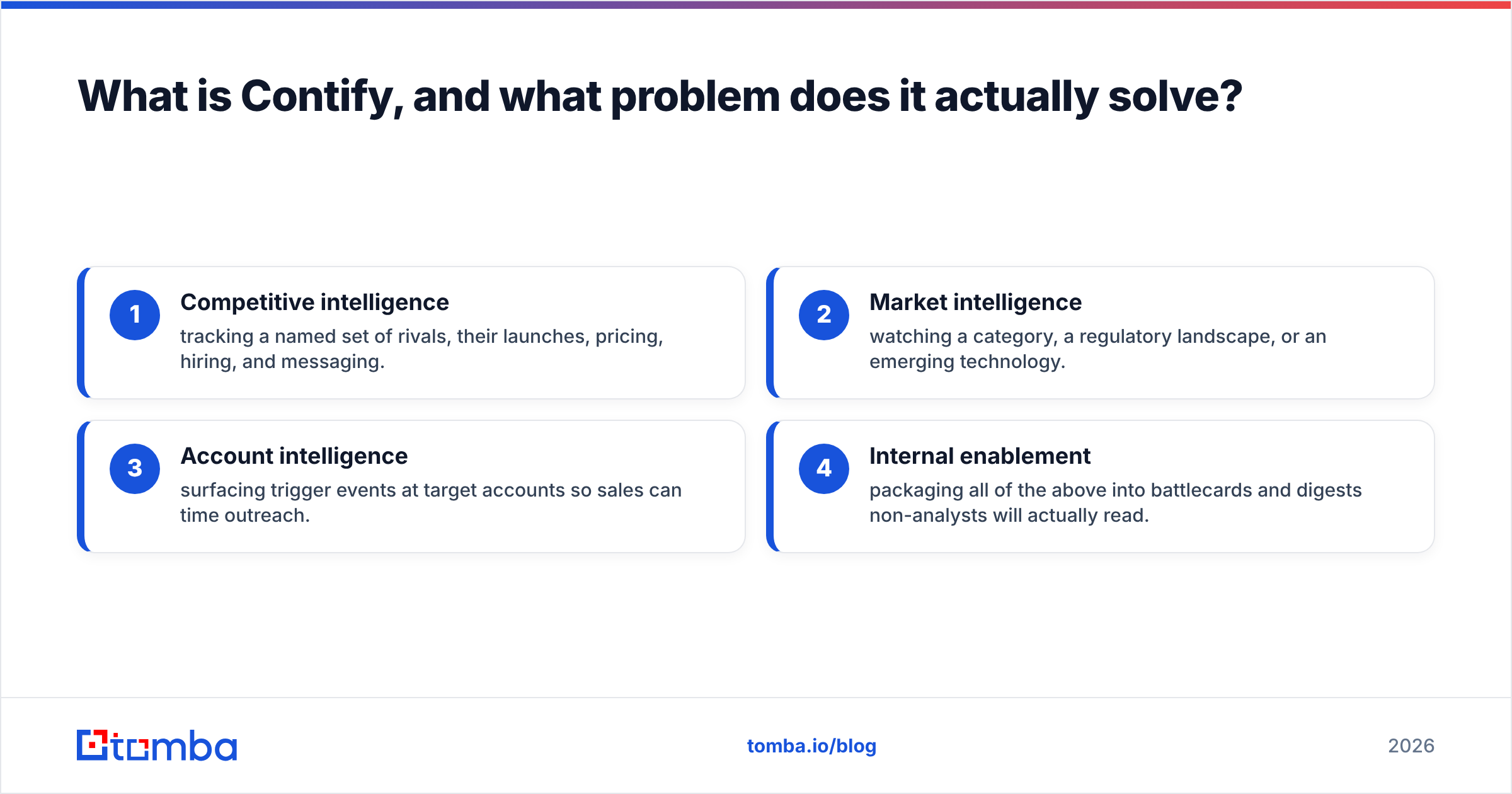
- Competitive intelligence — tracking a named set of rivals, their launches, pricing, hiring, and messaging.
- Market intelligence — watching a category, a regulatory landscape, or an emerging technology.
- Account intelligence — surfacing trigger events at target accounts so sales can time outreach.
- Internal enablement — packaging all of the above into battlecards and digests non-analysts will actually read.
Contify does 1, 2, and 4 well. It touches 3, but it is not a replacement for a prospecting data stack. That distinction is where most disappointed buyers go wrong.

How much does Contify cost in 2026?#
Short answer: nobody outside the sales call knows, and that's the point.
Contify runs a quote-only pricing model. There's no public rate card, no self-serve tier, and no free plan in the way an email finder or a CRM would offer one. You book a demo, they scope your requirements, and you get a proposal. Pricing is typically driven by a handful of variables:
- Number of tracked entities — competitors, target accounts, and topics you want monitored.
- Number of users / seats with dashboard access.
- Custom taxonomy work — how much of your industry vocabulary needs to be encoded so the filtering actually works.
- Sources — public web only, or paid/licensed sources and internal document ingestion.
- Integrations and API access — pushing intel into Slack, Teams, a CRM, or a data warehouse.
- Managed service layer — whether you want a human analyst team on top of the software.
Publicly reported buyer figures cluster in the low-to-mid four figures per month. Larger deployments run materially higher once custom taxonomy and managed analyst hours are added.
Software review aggregators like G2 and Capterra collect user-submitted commentary on cost. But most Contify pricing reviews stop short of a hard number, because the figure you get depends almost entirely on scope. Verify against your own quote. And get the renewal uplift cap in writing before you sign.
What to ask for in the quote:
- Per-entity cost at the margin. What does competitor #11 cost after your bundled ten?
- Seat expansion pricing. Intel tools spread. Budget for it now, not at renewal.
- Taxonomy revision policy. Is retuning your filters billable professional services, or included?
- Data export rights. Can you pull your archive out if you leave?
- Contract term and auto-renewal. Annual with a 60-day out is very different from annual with auto-renew.
Is Contify's pricing model good or bad for buyers?#
It depends entirely on your size.
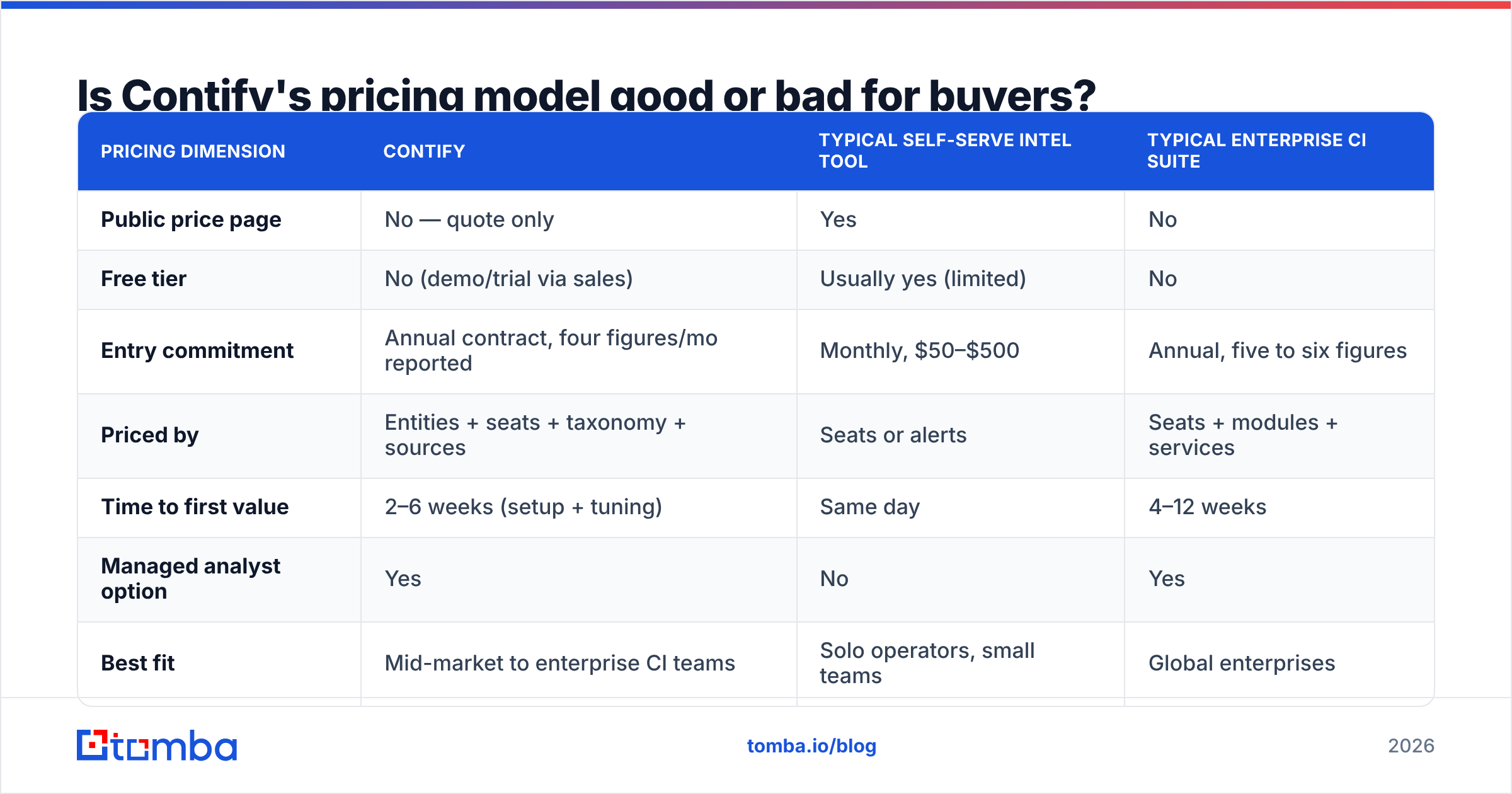
Quote-only pricing is a filter. It works in the vendor's favor when the buyer is large, has a defined CI function, and needs bespoke scoping. It works against you when you're a 20-person go-to-market team who wanted a $200/month tool. You spend three weeks in a procurement cycle only to learn you're not the ICP.
| Pricing dimension | Contify | Typical self-serve intel tool | Typical enterprise CI suite |
|---|---|---|---|
| Public price page | No — quote only | Yes | No |
| Free tier | No (demo/trial via sales) | Usually yes (limited) | No |
| Entry commitment | Annual contract, four figures/mo reported | Monthly, $50–$500 | Annual, five to six figures |
| Priced by | Entities + seats + taxonomy + sources | Seats or alerts | Seats + modules + services |
| Time to first value | 2–6 weeks (setup + tuning) | Same day | 4–12 weeks |
| Managed analyst option | Yes | No | Yes |
| Best fit | Mid-market to enterprise CI teams | Solo operators, small teams | Global enterprises |
The honest read: Contify sits in the mid-market-to-enterprise band. If your annual intel budget is under roughly $10K, you will probably find the conversation short. The math starts to work when you have a named CI owner, several stakeholder groups asking "what did the competition just do," and an analyst who hand-builds a weekly deck today.
What do Contify pricing reviews actually say?#
Pull the recurring themes out of public review sites and buyer conversations, and the pattern is consistent enough to summarize.
Praised repeatedly:
- Signal-to-noise once tuned. The custom taxonomy is the differentiator. Users who invested in setup report a genuinely usable feed instead of an alert dump.
- Stakeholder distribution. Newsletters and dashboards that non-analysts open. This is underrated — most CI programs die because nobody reads the output.
- Responsive support and onboarding. Named CSMs and hands-on setup show up in reviews often enough to be credible.
- Breadth of sources. Beyond news: job postings, review sites, pricing pages, and social all feed the picture.
Criticized repeatedly:
- Ramp time. "Great after two months of tuning" is a common shape of review. If you need value in week one, this is a mismatch.
- Early-stage noise. Before taxonomy tuning, feeds can be as noisy as the alerts you were trying to escape.
- UI/UX friction. Functional, not delightful. Some reviewers describe the interface as dated relative to newer AI-native tools.
- Pricing opacity. This is the most cited friction in the buying process. The price isn't unfair. The problem is that you can't self-qualify before spending a week in demos.
- Overlap anxiety. Teams already running Crayon, Klue, or a homegrown Slack-alert system struggle to articulate the incremental value to finance.
Treat all review-site sentiment with normal skepticism: happy enterprise buyers rarely post, and vendors nudge their fans. But the ramp-time and pricing-opacity themes appear too consistently to dismiss.
What are the pros and cons of Contify?#
| Contify | |
|---|---|
| Pro — curation quality | Custom taxonomy genuinely reduces noise once configured |
| Pro — distribution | Dashboards, newsletters, Slack/Teams push that stakeholders read |
| Pro — source breadth | News, filings, job posts, pricing pages, review sites, social |
| Pro — services option | Human analyst layer available when software alone isn't enough |
| Con — no public pricing | Slows internal budget approval; can't self-qualify |
| Con — ramp time | Weeks, not days, before the feed is trustworthy |
| Con — annual commitment | Little room to test cheaply and walk away |
| Con — not a contact-data tool | Surfaces the trigger event; won't give you the person to contact |
That last row is the one that trips up sales-led buyers. Contify will tell you that Acme Corp just hired a VP of Engineering and opened a data-infrastructure job req.
It will not reliably hand you that VP's verified work email so an SDR can send a timely note. Those are two different data problems, solved by two different categories of tool. The second one costs a fraction of the first.
Who should buy Contify, and who should not?#
Buy Contify if:
- You have a named CI or product marketing owner who will own taxonomy tuning. Without one, the tool underperforms and the renewal dies.
- You track 10+ competitors or a fast-moving regulated category where missing a signal has real cost.
- You need to distribute intelligence to sales, product, and exec stakeholders in a format they'll consume.
- Your budget can absorb a five-figure annual line item without a fight.
Do not buy Contify if:
- You're a startup or small team wanting a competitor tracker for a few hundred dollars a month. You'll be out-scoped.
- Your actual need is outbound prospecting — finding companies and reaching the right person. That's a lead-gen stack, not an M&CI platform.
- You want immediate value with no setup investment. The tuning is not optional; it's the product.
- You need a month-to-month escape hatch. Annual contracts are the norm here.

What are the cheaper alternatives — and what do they actually replace?#
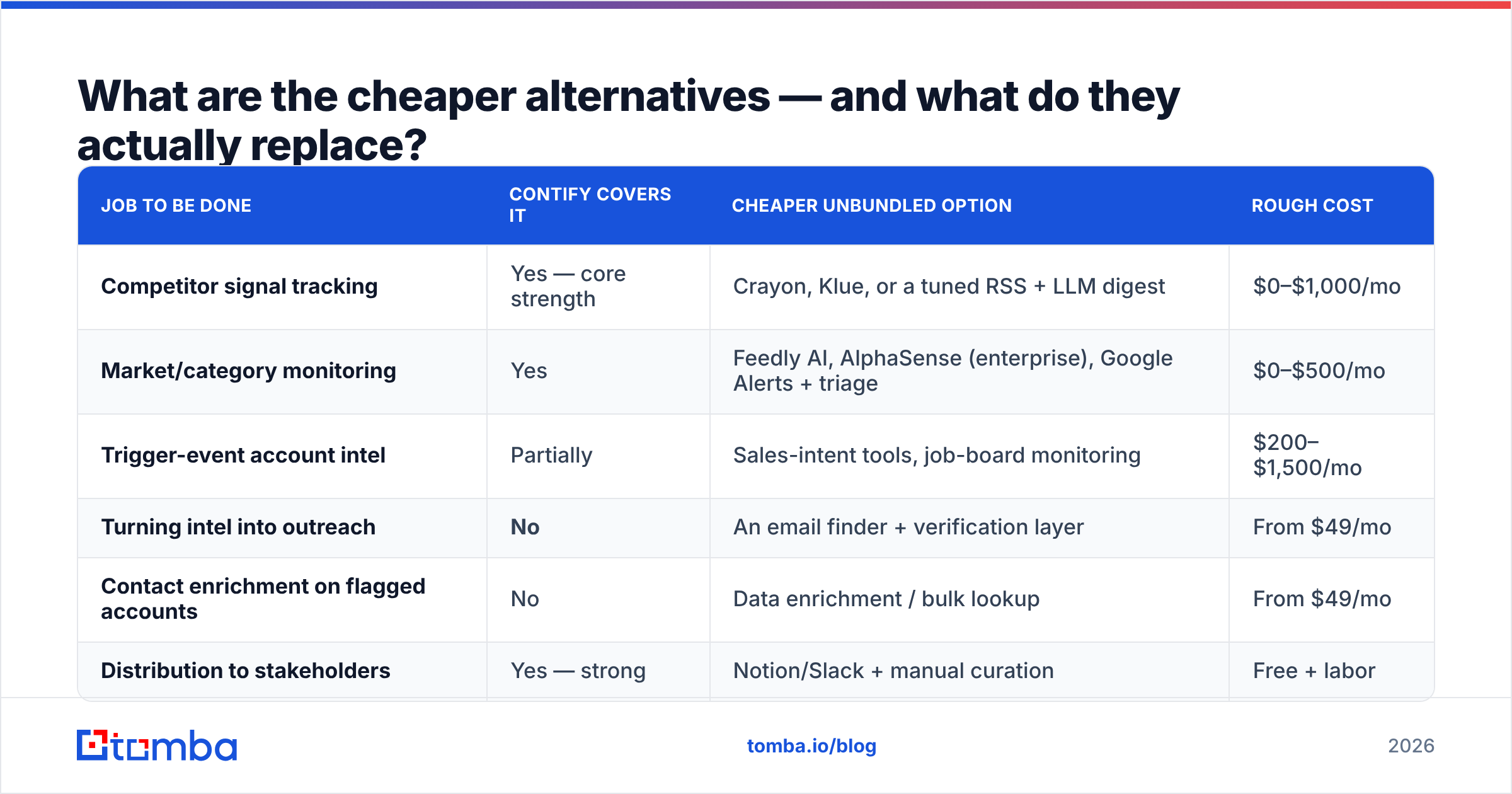
There's no single one-to-one swap, because "Contify" bundles three jobs. Unbundle them and the costs collapse.
| Job to be done | Contify covers it | Cheaper unbundled option | Rough cost |
|---|---|---|---|
| Competitor signal tracking | Yes — core strength | Crayon, Klue, or a tuned RSS + LLM digest | $0–$1,000/mo |
| Market/category monitoring | Yes | Feedly AI, AlphaSense (enterprise), Google Alerts + triage | $0–$500/mo |
| Trigger-event account intel | Partially | Sales-intent tools, job-board monitoring | $200–$1,500/mo |
| Turning intel into outreach | No | An email finder + verification layer | From $49/mo |
| Contact enrichment on flagged accounts | No | Data enrichment / bulk lookup | From $49/mo |
| Distribution to stakeholders | Yes — strong | Notion/Slack + manual curation | Free + labor |
The practical takeaway for most go-to-market teams: you probably need less market-intelligence software and more contact-data accuracy than you think. A signal is only worth what you do with it. Say Contify flags that a target account just raised a Series B, and you still can't reach the buyer within a week. You paid five figures for a headline you could have read on TechCrunch.
For a sanity check on what "competitive intelligence" should deliver as a discipline, read Gartner's market research on CI and the vendor's own positioning at contify.com side by side. The gap between the two is where your negotiating leverage lives.
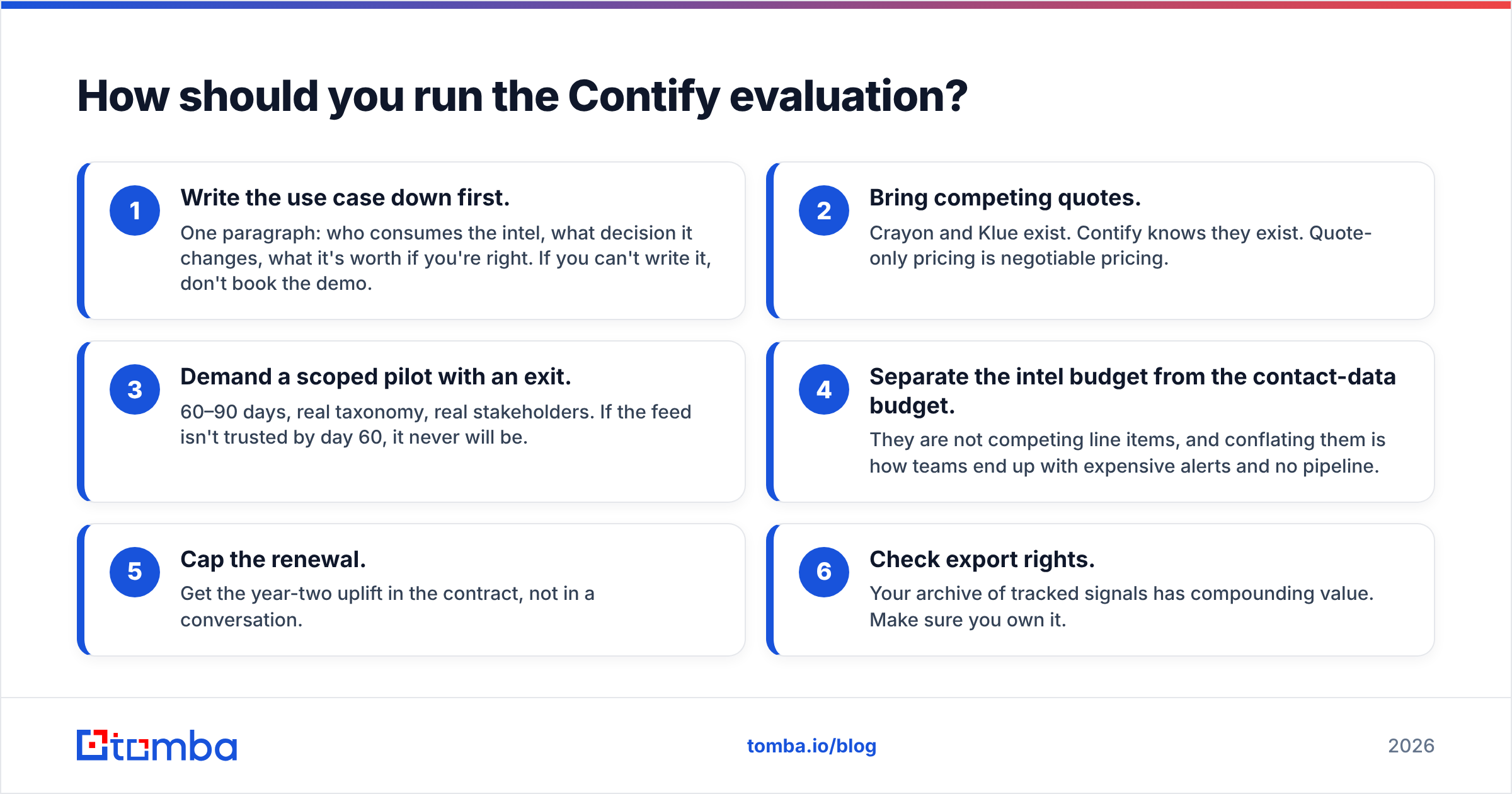
How should you run the Contify evaluation?#
Treat it like any opaque-priced enterprise purchase.
- Write the use case down first. One paragraph: who consumes the intel, what decision it changes, what it's worth if you're right. If you can't write it, don't book the demo.
- Bring competing quotes. Crayon and Klue exist. Contify knows they exist. Quote-only pricing is negotiable pricing.
- Demand a scoped pilot with an exit. 60–90 days, real taxonomy, real stakeholders. If the feed isn't trusted by day 60, it never will be.
- Separate the intel budget from the contact-data budget. They are not competing line items. Conflating them is how teams end up with expensive alerts and no pipeline.
- Cap the renewal. Get the year-two uplift in the contract, not in a conversation.
- Check export rights. Your archive of tracked signals has compounding value. Make sure you own it.
The bottom line on Contify pricing reviews, pros and cons#
Contify is a legitimate, well-reviewed market and competitive intelligence platform. The price is opaque and quote-only, and it lands squarely in mid-market-to-enterprise territory. If you have a real CI function and the patience to tune it, it earns its cost. If you're a lean go-to-market team hoping it doubles as a prospecting engine, you will overpay for a job it was never designed to do.
And that's the split most teams miss. Intelligence tells you when and why. Contact data tells you who and how to reach them. The second half is where revenue actually happens, and it costs a rounding error compared to an M&CI contract.
If your real bottleneck is turning a market signal into a conversation, start there. Tomba Email Finder finds verified professional email addresses by domain, name, or company. The moment an intel signal fires, you have the right person's inbox — not a headline.
Pair it with the email verifier to protect your sender reputation, and domain search to map an account's org chart in one query. The free tier gives you 25 searches a month to test it, and paid plans start at $49/mo. Check the current Tomba pricing and see how far a fraction of an enterprise intel budget actually goes.
Related guides#
Ready to find emails that actually work?
Join 150,000+ professionals who stopped guessing and started sending. Free credits on signup — no credit card required.
Get the Tomba newsletter
Practical outbound tactics and product updates — once every two weeks.
About the author