Conversation Intelligence in 2026: What It Is and Who Needs It
Conversation intelligence records, transcribes, and scores every sales call. Here's what the category actually delivers in 2026, what it costs, where it quietly fails, and which teams should skip it.
TL;DR
- Conversation intelligence is software that records, transcribes, and analyzes sales calls and meetings, then turns them into searchable text, coaching signals, and CRM fields.
- The real value is not "AI insights." It is (1) rep coaching at scale, (2) automatic CRM hygiene, and (3) evidence for deal reviews that no longer depends on a rep's memory.
- Expect $100–$200 per user per month at the enterprise tier, usually with an annual contract and a platform fee on top. Budget for the seats you will actually review, not every seat in the org.
- It fails quietly when adoption is optional, when your calls are short and transactional, or when your CRM data was already garbage going in — a transcript engine cannot fix a contact record that was never right.
- Teams under ~5 reps almost always get more revenue from better targeting and clean contact data than from analyzing the calls they are already booking.
What is conversation intelligence?#
Conversation intelligence (CI) is a category of sales technology that captures spoken and written sales conversations — Zoom calls, phone calls, sometimes email threads — and converts them into structured, queryable data.
Think of it like a flight recorder for revenue. A black box does not fly the plane. It just makes sure that when something goes wrong, you can replay exactly what happened instead of arguing about it. CI does the same for a deal: instead of a rep saying "they seemed excited," you have the timestamp where the buyer said "we already have budget approved for Q3."
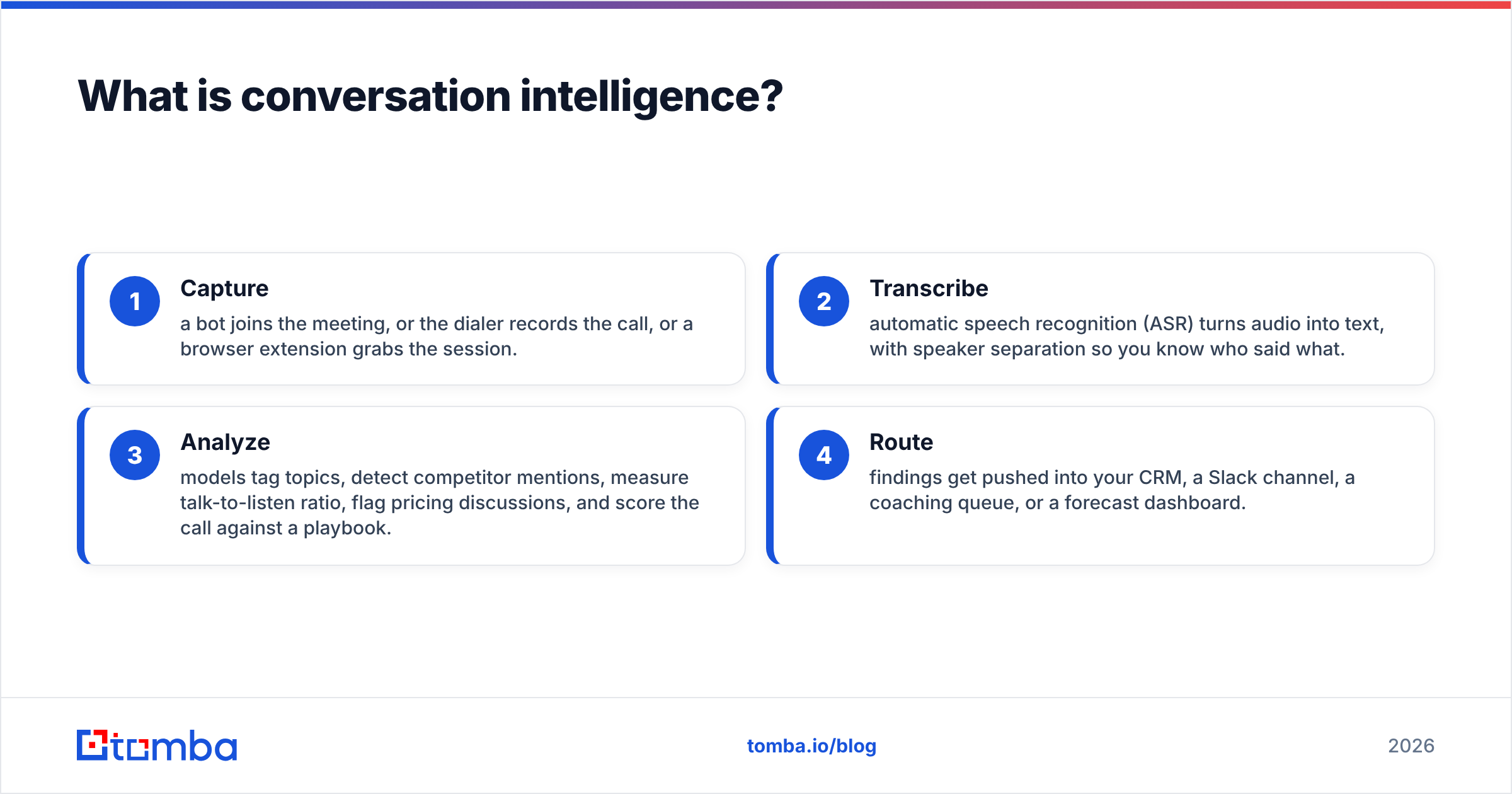
Mechanically, most platforms run the same four-step pipeline:
- Capture — a bot joins the meeting, or the dialer records the call, or a browser extension grabs the session.
- Transcribe — automatic speech recognition (ASR) turns audio into text, with speaker separation so you know who said what.
- Analyze — models tag topics, detect competitor mentions, measure talk-to-listen ratio, flag pricing discussions, and score the call against a playbook.
- Route — findings get pushed into your CRM, a Slack channel, a coaching queue, or a forecast dashboard.
Everything vendors market as "AI revenue intelligence" is built on top of those four steps. The differentiator is rarely the transcription — ASR is close to commoditized in 2026 — it is what happens in steps three and four.
What does conversation intelligence actually do for a sales team?#
Four jobs, in descending order of how much value teams actually report:
- Coaching at scale. A manager with eight reps cannot sit in on 400 calls a quarter. They can review 20 flagged moments. CI is the filter that decides which 20.
- CRM hygiene without nagging. Next steps, competitor mentions, and stated timelines get written to the opportunity record automatically. This is the single most-loved feature in most rollouts, because it removes the chore reps hate most.
- Deal risk detection. No decision-maker on the last three calls. No pricing conversation past week six. A single champion doing all the talking. These are the patterns that predict a deal slipping — and they are invisible in a pipeline report.
- Market feedback. Every objection your buyers raise, aggregated. Product and marketing get a transcript search instead of a survey.
Notice what is not on that list: closing deals by itself. CI is an observability layer. It tells you what happened. It does not generate pipeline, it does not find the buyer, and it does not fix a bad list.
Is conversation intelligence worth the cost?#
Depends entirely on how many calls you have and whether anyone will act on the output.
The honest arithmetic: a mid-market CI platform at roughly $1,400 per rep per year needs to produce measurable lift. If your reps run 12 discovery calls a month and your average contract value is $8,000, a two-point improvement in win rate pays for itself several times over. If your reps run three calls a month, the same spend buys you a very expensive transcript archive.
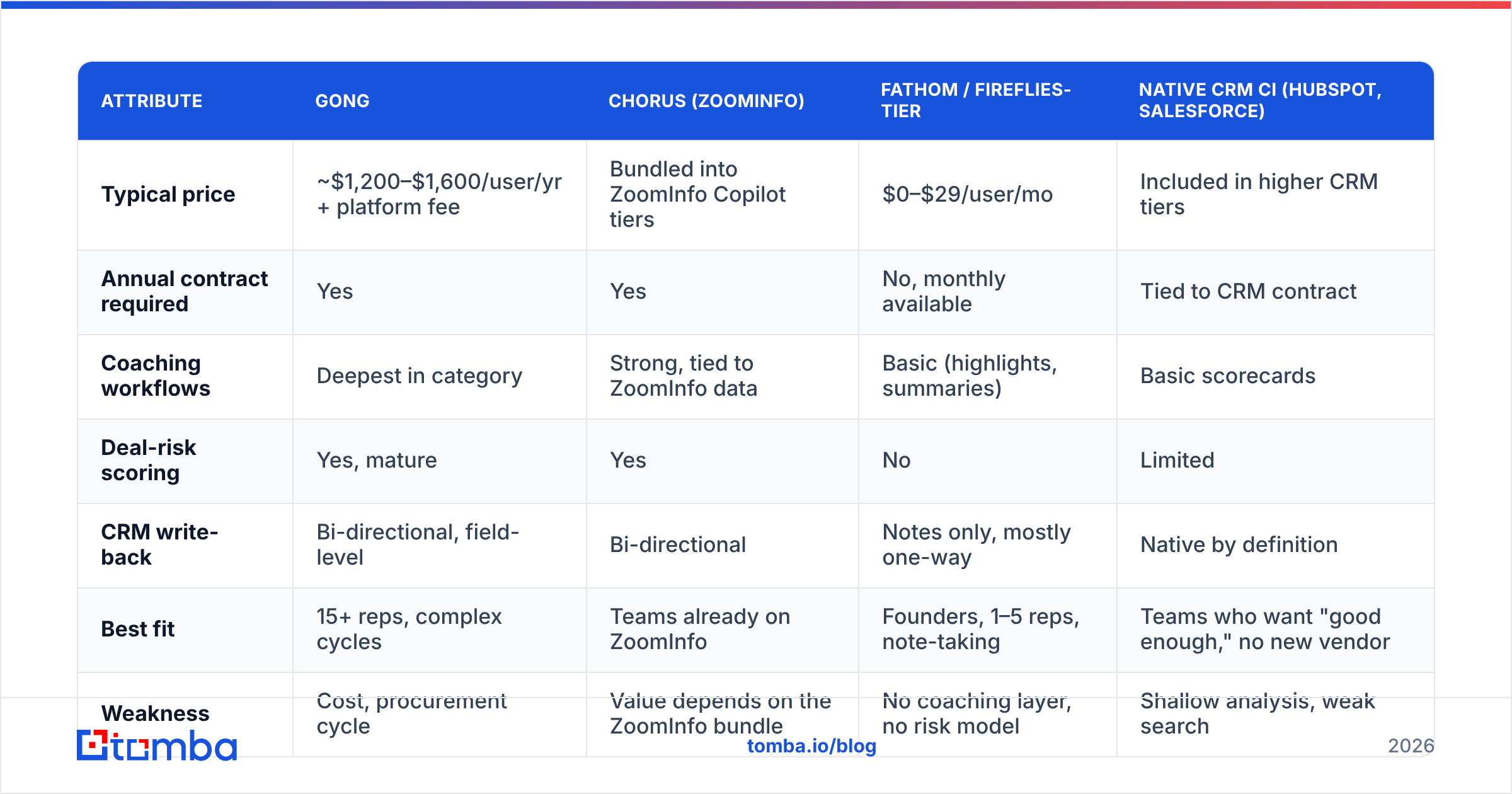
Here is how the main options in the category compare on the attributes that actually drive the buying decision:
| Attribute | Gong | Chorus (ZoomInfo) | Fathom / Fireflies-tier | Native CRM CI (HubSpot, Salesforce) |
|---|---|---|---|---|
| Typical price | ~$1,200–$1,600/user/yr + platform fee | Bundled into ZoomInfo Copilot tiers | $0–$29/user/mo | Included in higher CRM tiers |
| Annual contract required | Yes | Yes | No, monthly available | Tied to CRM contract |
| Coaching workflows | Deepest in category | Strong, tied to ZoomInfo data | Basic (highlights, summaries) | Basic scorecards |
| Deal-risk scoring | Yes, mature | Yes | No | Limited |
| CRM write-back | Bi-directional, field-level | Bi-directional | Notes only, mostly one-way | Native by definition |
| Best fit | 15+ reps, complex cycles | Teams already on ZoomInfo | Founders, 1–5 reps, note-taking | Teams who want "good enough," no new vendor |
| Weakness | Cost, procurement cycle | Value depends on the ZoomInfo bundle | No coaching layer, no risk model | Shallow analysis, weak search |
Two things fall out of that table. First, the cheap tier and the expensive tier are not competing for the same job — one is a note-taker, the other is a management system. Second, if you are already paying for a CRM with a CI module you have never enabled, turn it on before you run a procurement cycle. You can find independent user-reported pricing and satisfaction data on the G2 conversation intelligence category rather than relying on vendor decks.
How is conversation intelligence different from revenue intelligence?#
The terms get used interchangeably by vendors, and that is not an accident — "revenue intelligence" is the bigger, more expensive box.
- Conversation intelligence analyzes what was said. Inputs: audio, video, transcripts.
- Revenue intelligence analyzes what happened across the whole funnel. Inputs: conversations, plus CRM activity, email volume, engagement data, pipeline history, and buying-committee coverage.
Every serious CI vendor has repositioned as a revenue intelligence platform, because forecast accuracy sells to a CRO and call transcripts sell to a sales manager. The CRO writes bigger checks.
Practically: if the pitch you are hearing includes forecast submission, pipeline inspection, and deal-desk workflows, you are buying revenue intelligence and should evaluate it against your forecasting process, not your coaching process. Gong's own product pages make this shift explicit, and it changes who needs to be in the room for the demo.
What are the real limitations nobody puts on the pricing page?#
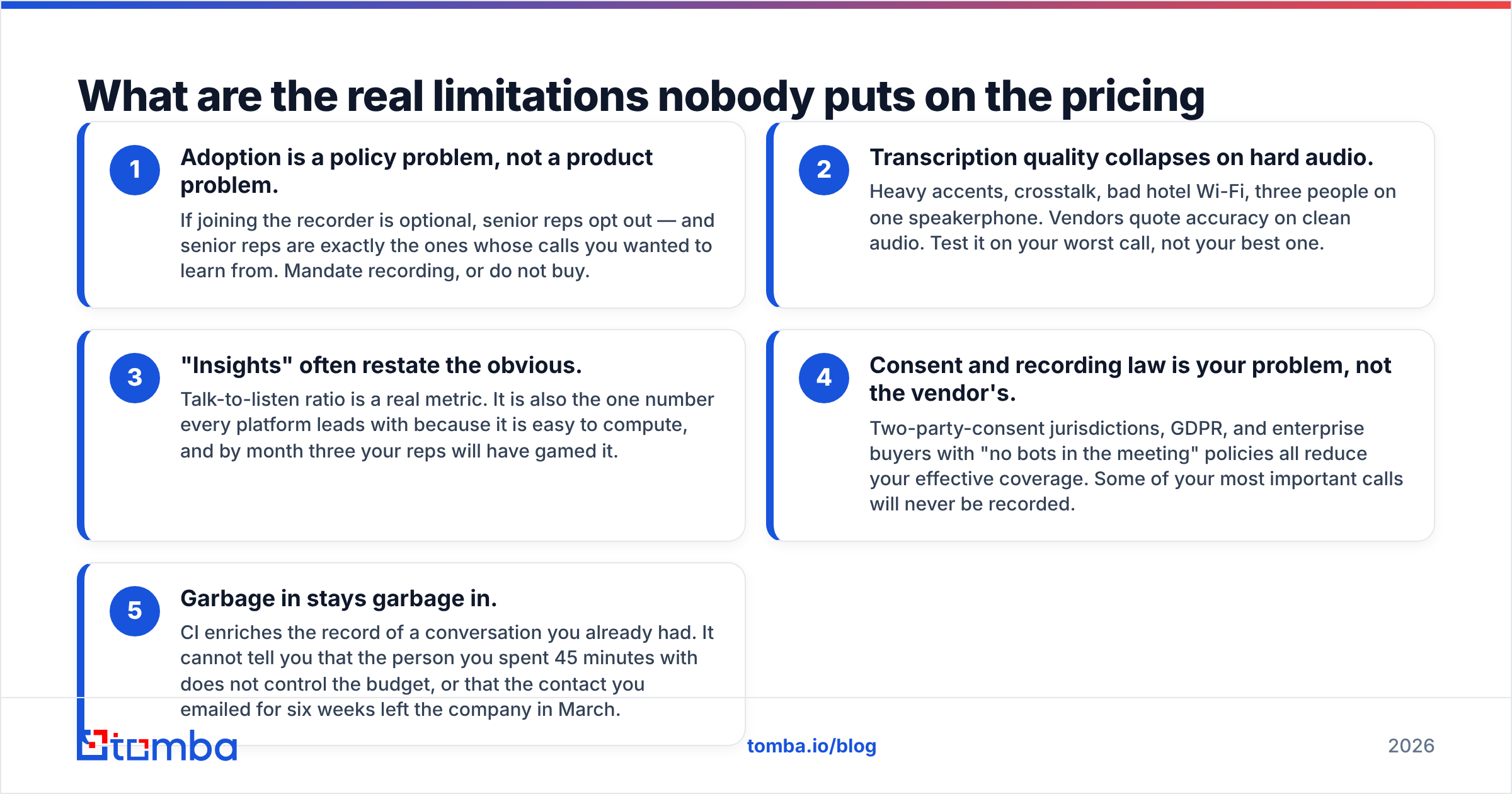
Five, and they cost real money:
- Adoption is a policy problem, not a product problem. If joining the recorder is optional, senior reps opt out — and senior reps are exactly the ones whose calls you wanted to learn from. Mandate recording, or do not buy.
- Transcription quality collapses on hard audio. Heavy accents, crosstalk, bad hotel Wi-Fi, three people on one speakerphone. Vendors quote accuracy on clean audio. Test it on your worst call, not your best one.
- "Insights" often restate the obvious. Talk-to-listen ratio is a real metric. It is also the one number every platform leads with because it is easy to compute, and by month three your reps will have gamed it.
- Consent and recording law is your problem, not the vendor's. Two-party-consent jurisdictions, GDPR, and enterprise buyers with "no bots in the meeting" policies all reduce your effective coverage. Some of your most important calls will never be recorded.
- Garbage in stays garbage in. CI enriches the record of a conversation you already had. It cannot tell you that the person you spent 45 minutes with does not control the budget, or that the contact you emailed for six weeks left the company in March.
That last point is where most teams misdiagnose the problem.
Where does conversation intelligence fit in the sales stack?#
Under it, honestly. Conversation intelligence is a downstream system. It only ever sees the meetings you managed to book.
A working stack, in order of what has to be right first:
- Targeting — the accounts and personas you decided to go after. Wrong here, and nothing downstream matters.
- Contact data — verified, current email addresses and phone numbers for those people. This is the layer that decides whether you get a call at all. An email verifier and a real data enrichment step belong here, not as an afterthought.
- Outreach — sequences, calls, LinkedIn, whatever your motion is.
- Conversation intelligence — the layer that finally kicks in once someone picks up.
- Forecasting and coaching — what management does with all of the above.
Teams buy CI when their real bottleneck is two layers up. If your reps are running six meetings a month instead of twenty, no amount of call analysis fixes that. You have a pipeline problem — a targeting and contact-data problem — dressed up as a coaching problem.
The tell: look at your connect rate and your bounce rate before you look at your talk-to-listen ratio. If more than 3–5% of your outbound is bouncing, your contact data is silently deleting a chunk of your pipeline every single week, and no CI dashboard will surface it.
How do you evaluate a conversation intelligence vendor?#
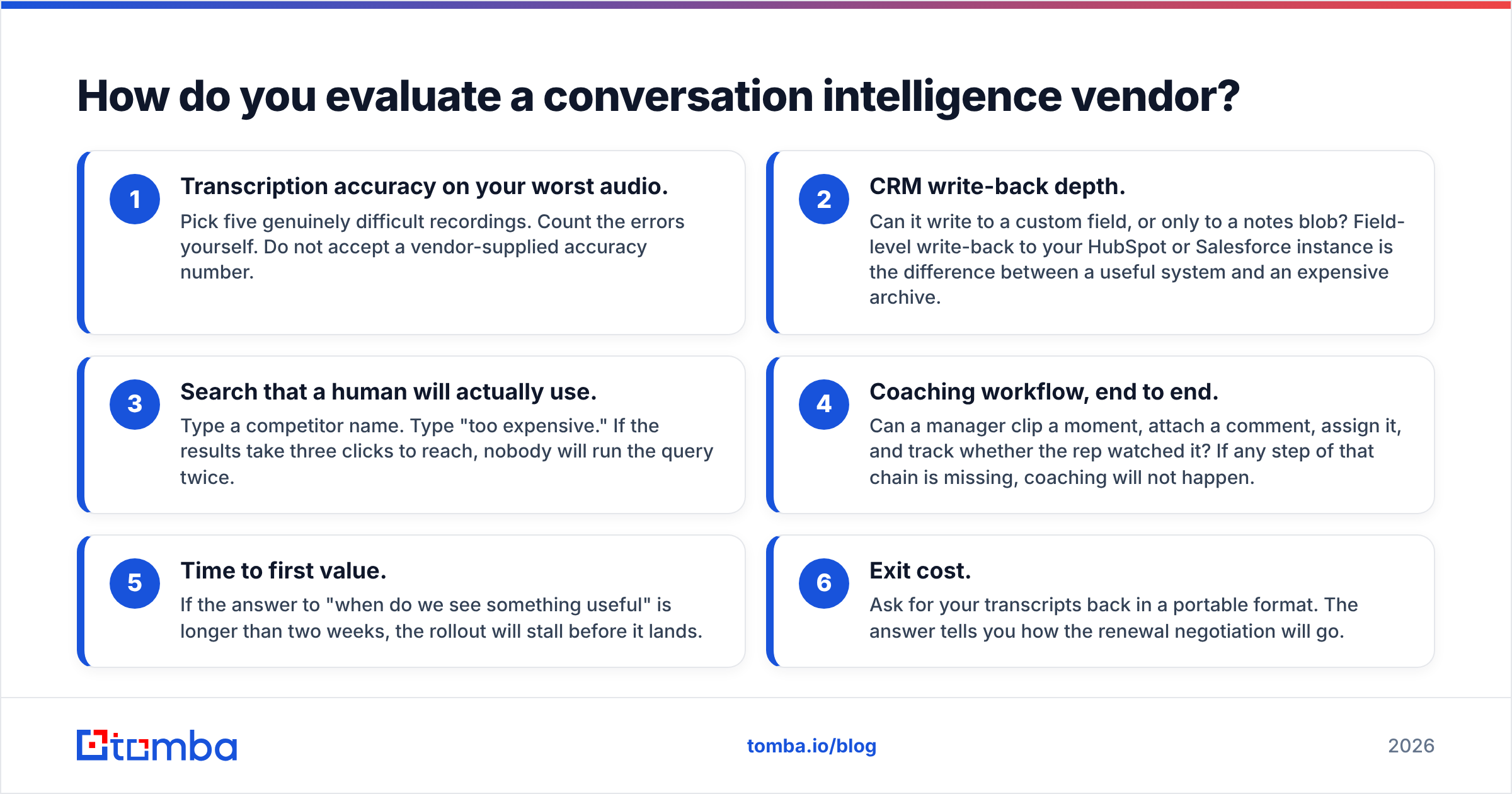
Run a 30-day pilot with real calls, not the vendor's demo library. Score on six things:
- Transcription accuracy on your worst audio. Pick five genuinely difficult recordings. Count the errors yourself. Do not accept a vendor-supplied accuracy number.
- CRM write-back depth. Can it write to a custom field, or only to a notes blob? Field-level write-back to your HubSpot or Salesforce instance is the difference between a useful system and an expensive archive.
- Search that a human will actually use. Type a competitor name. Type "too expensive." If the results take three clicks to reach, nobody will run the query twice.
- Coaching workflow, end to end. Can a manager clip a moment, attach a comment, assign it, and track whether the rep watched it? If any step of that chain is missing, coaching will not happen.
- Time to first value. If the answer to "when do we see something useful" is longer than two weeks, the rollout will stall before it lands.
- Exit cost. Ask for your transcripts back in a portable format. The answer tells you how the renewal negotiation will go.
Push on procurement, too. Nearly every vendor in this category discounts hard on multi-year terms and pilots convert at high rates, which means your leverage is highest before you sign. HubSpot's sales research and other public benchmarks are useful for sanity-checking the ROI claims you will be shown.
Who should skip conversation intelligence in 2026?#
Skip it if any of these describe you:
- Fewer than five reps. Use a $20/month note-taker and put the rest of the budget into list quality and volume. You do not have enough calls to find a statistical pattern, and your VP of Sales is sitting three feet away from the team anyway.
- Transactional, sub-15-minute cycles. Nothing to analyze. The script is the script.
- No one owns coaching. CI without a coaching owner becomes a compliance archive that gets opened during a QBR and never again.
- Your bounce rate is above 5%. Fix the top of the funnel first. Every dollar spent analyzing calls you did not book is a dollar in the wrong place.
If you are in the fourth bucket, the fix is upstream and it is cheap. Get verified, current contact data into your sequences and your call volume rises on its own — no new coaching platform required. That is the unglamorous version of "revenue intelligence" that actually moves the number.
Get the top of the funnel right first#
Conversation intelligence is a genuinely good product category once you have conversations worth intelligencing. Before you sign a five-figure annual contract to analyze the meetings you already have, make sure you are booking every meeting you could.
That starts with reaching the right person at the right address. Tomba's Email Finder returns verified professional email addresses by name and domain, with SMTP-level verification built in so your sequences hit real inboxes instead of bounce traps. Start free with 25 searches a month, or move to a paid plan at $49/mo when your volume grows — full Tomba pricing is public, with no annual lock-in and no platform fee.
Fill the pipeline first. Then buy the black box.
Related guides#
Ready to find emails that actually work?
Join 150,000+ professionals who stopped guessing and started sending. Free credits on signup — no credit card required.
Get the Tomba newsletter
Practical outbound tactics and product updates — once every two weeks.
About the author