Conversation Intelligence Platform: The 2026 Buyer's Guide
Conversation intelligence promises coaching at scale and forecast accuracy. Here's what these platforms actually do, what they cost per seat in 2026, where they quietly fail, and how to tell if your team is ready for one.
TL;DR
- A conversation intelligence platform records, transcribes, and analyzes sales calls and meetings, then turns them into coaching signals, deal risk alerts, and CRM data you didn't have to type.
- Real 2026 pricing lands between roughly $100 and $170 per user per month for the enterprise players, plus a platform fee — budget $30k–$100k+ annually for a mid-size team, not the sticker price you see on review sites.
- The technology is mature. The failure mode is organizational: teams buy it, nobody watches the calls, and it becomes a $60k tape recorder.
- It analyzes conversations you already have. It does not create them — pipeline still comes from targeting, contact data, and outreach volume.
- Buy it when you have 8+ reps, a repeatable sales motion, and a manager who will actually run coaching sessions. Skip it below that and spend the money on data and reps.
What is a conversation intelligence platform?#
A conversation intelligence platform is software that captures your sales conversations — Zoom calls, Teams meetings, dialer calls, sometimes emails — transcribes them, and applies AI to extract patterns: who talked how much, which competitors got named, whether next steps were set, how the deal is trending, and where each rep is losing control of the call.
Think of it as a game-film room for revenue teams. A football coach doesn't improve a quarterback by watching from the sideline once a week and offering vibes. They watch the tape, frame by frame, and point at the exact moment the read went wrong. Conversation intelligence does that for a discovery call — except it also watches all 3,000 calls your team ran last quarter and tells you which twelve are worth your time.
Technically, the stack looks like this:
- Capture — a bot joins the meeting, or the platform integrates natively with the dialer/VoIP layer to record audio and video.
- Transcribe — ASR (automatic speech recognition) converts speech to text with speaker diarization, so you know who said what. Accuracy on clean English audio is now routinely in the 90%+ range; accented speech, crosstalk, and industry jargon still drag it down.
- Analyze — LLMs and trained classifiers tag topics, objections, competitor mentions, pricing discussions, talk ratios, monologue length, question rate, and sentiment.
- Score and alert — deals get risk scores based on engagement signals (has a decision-maker joined? has anyone spoken in 21 days? was pricing ever discussed?).
- Sync — call summaries, next steps, MEDDIC/BANT fields, and activity data get written back to your CRM so reps stop hand-typing notes at 6pm.
The step most buyers underrate is step 5. The coaching features sell the deal; the CRM hygiene is what most teams end up actually loving.
Why did conversation intelligence become a category?#
Because manual call review does not scale, and everyone knew it.
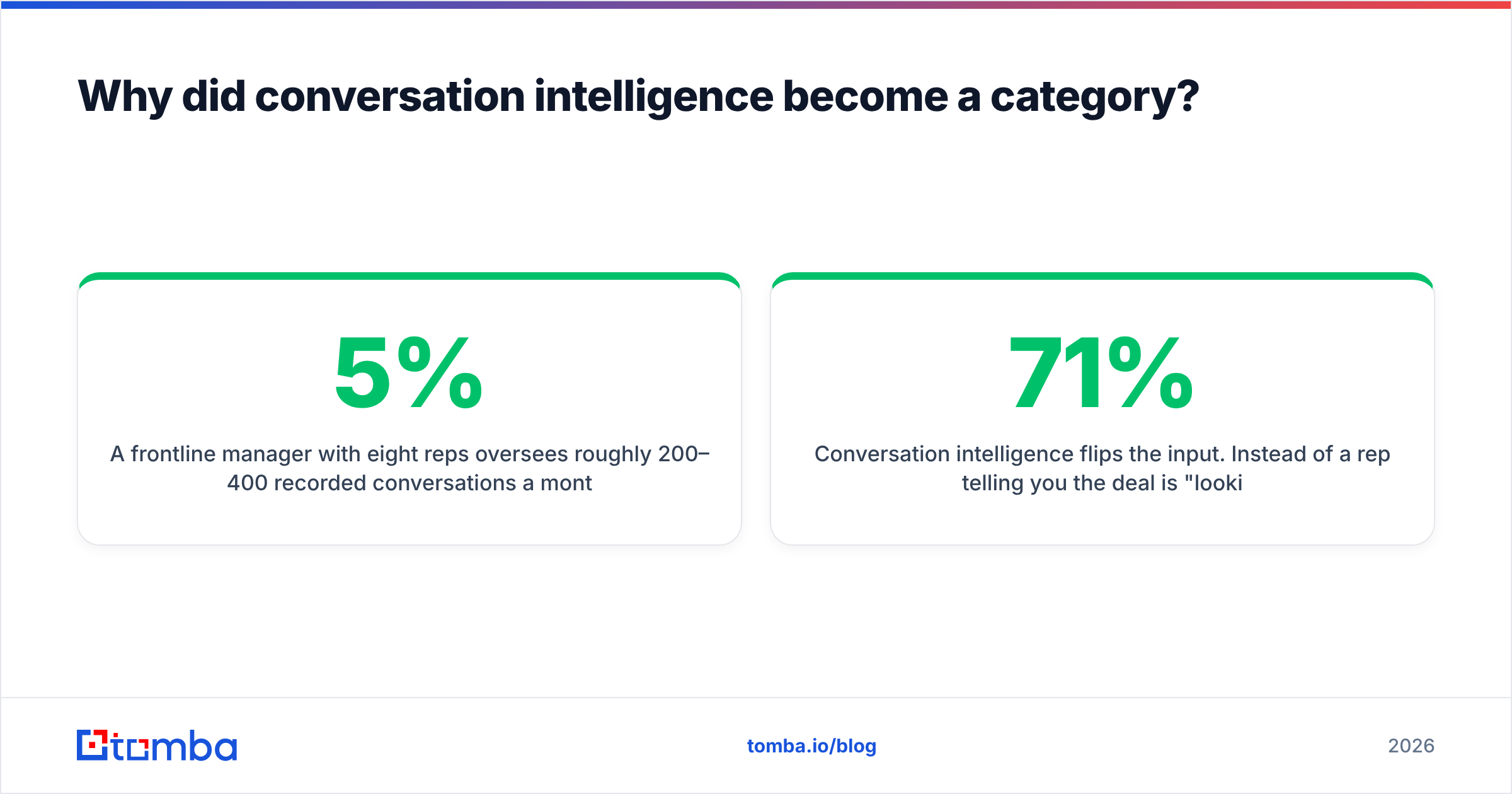
A frontline manager with eight reps oversees roughly 200–400 recorded conversations a month. Listening to even 5% of them at 1.5x speed eats an entire working week. So in practice, managers reviewed the calls they happened to sit on, coached from memory, and forecasted from rep optimism. Gartner and Forrester have both been pointing at the same gap for years: revenue leaders make high-stakes decisions on self-reported data that nobody audits.
Conversation intelligence flips the input. Instead of a rep telling you the deal is "looking good," the platform tells you that the champion hasn't spoken in three weeks, that a competitor was named twice on the last call, and that the rep talked for 71% of a discovery meeting where they were supposed to be listening.
Three forces made this economically viable around 2020–2023 and mainstream by 2026:
- Remote selling. Nearly every meeting became a recordable digital event. The capture problem solved itself.
- Cheap, accurate ASR. Transcription went from a per-minute cost center to a rounding error.
- LLMs that summarize. Pre-LLM tools gave you keyword counts. Post-LLM tools give you a coherent "here's what happened and what to do next" paragraph a manager will actually read.
Which conversation intelligence platforms actually matter in 2026?#
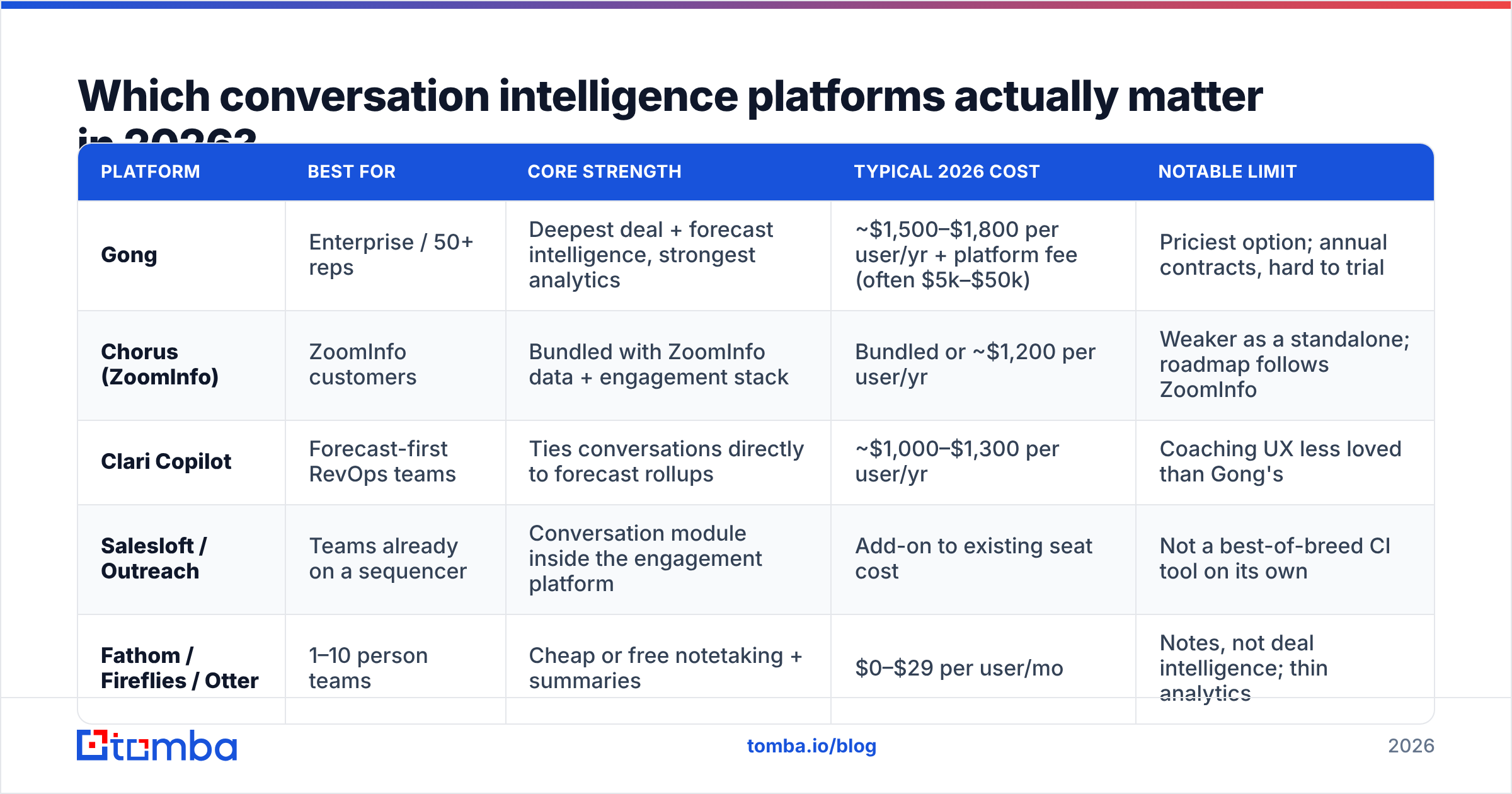
The market splits into three tiers: enterprise revenue-intelligence suites, mid-market call coaching tools, and lightweight AI notetakers that bolt onto anything.
| Platform | Best for | Core strength | Typical 2026 cost | Notable limit |
|---|---|---|---|---|
| Gong | Enterprise / 50+ reps | Deepest deal + forecast intelligence, strongest analytics | ~$1,500–$1,800 per user/yr + platform fee (often $5k–$50k) | Priciest option; annual contracts, hard to trial |
| Chorus (ZoomInfo) | ZoomInfo customers | Bundled with ZoomInfo data + engagement stack | Bundled or ~$1,200 per user/yr | Weaker as a standalone; roadmap follows ZoomInfo |
| Clari Copilot | Forecast-first RevOps teams | Ties conversations directly to forecast rollups | ~$1,000–$1,300 per user/yr | Coaching UX less loved than Gong's |
| Salesloft / Outreach | Teams already on a sequencer | Conversation module inside the engagement platform | Add-on to existing seat cost | Not a best-of-breed CI tool on its own |
| Fathom / Fireflies / Otter | 1–10 person teams | Cheap or free notetaking + summaries | $0–$29 per user/mo | Notes, not deal intelligence; thin analytics |
The honest read: if you have fewer than ten sellers, the $20/month notetaker gives you 70% of the daily value (summaries, searchable transcripts, CRM push) at 3% of the cost. The enterprise suites earn their price on the analytics layer — cross-deal pattern detection, win/loss themes, forecast calibration — and that layer only produces signal when you have enough calls to make the statistics real.
Check current positioning on G2's conversation intelligence category before you shortlist; the mid-tier reshuffles roughly every two quarters.
How much does a conversation intelligence platform really cost?#
More than the per-seat number, and that's the part buyers get burned on.
Most enterprise vendors don't publish pricing. What surfaces from user reports, review sites, and procurement chatter looks like this:
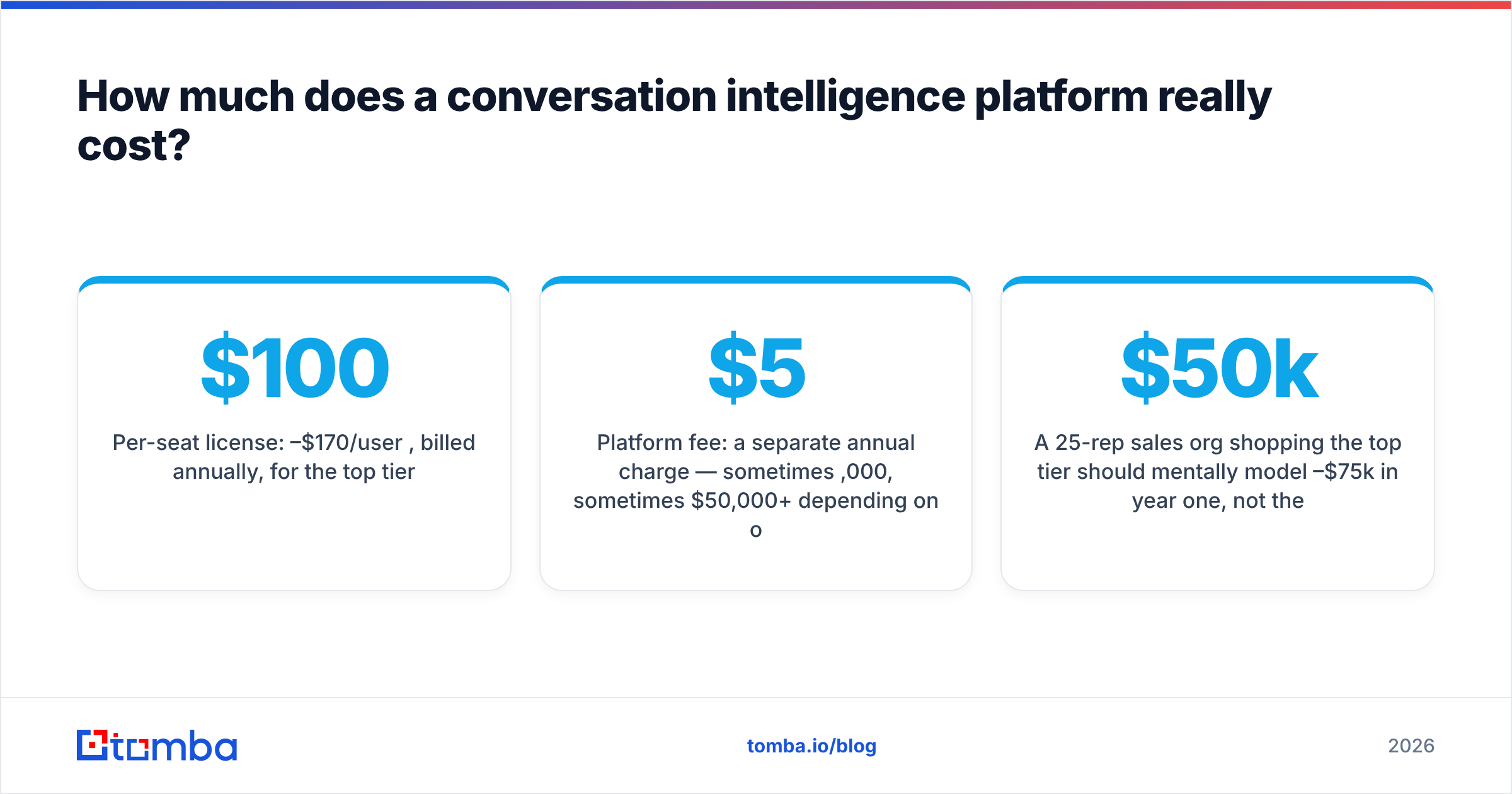
- Per-seat license: $100–$170/user/month, billed annually, for the top tier.
- Platform fee: a separate annual charge — sometimes $5,000, sometimes $50,000+ depending on org size — that exists before a single seat is counted.
- Minimum seat counts: many contracts start at 10–20 seats even if you only have 8 reps.
- Add-ons: forecasting modules, revenue AI agents, extra languages, and long-term recording retention are frequently priced separately.
- Implementation: onboarding, CRM field mapping, and admin training. Sometimes free, sometimes a five-figure services line.
A 25-rep sales org shopping the top tier should mentally model $50k–$75k in year one, not the $1,500 × 25 = $37,500 they computed in the meeting. Ask for the fully-loaded number in writing before you get emotionally attached to a demo.
Also ask two unglamorous questions: what happens to your recordings if you churn, and what does year-two renewal look like. Multi-year lock-ins with escalators are standard in this category.
What does conversation intelligence actually improve?#
Cut through the vendor case studies and you land on four durable use cases:
- Rep ramp time. New hires get a searchable library of real calls — how a senior rep handles the pricing objection, what a good discovery call sounds like. Teams commonly report ramp cutting by weeks, not months, and this is the benefit with the least controversy.
- Coaching specificity. Instead of "be more consultative," a manager can say "you asked two questions in 40 minutes; here are the three moments you should have paused." Specific beats motivational.
- Forecast hygiene. Deals with no next step scheduled, no economic buyer on any call, and no pricing conversation get flagged as risk regardless of what the rep entered in the CRM. This is where RevOps falls in love.
- Voice-of-customer feedback. Product and marketing get to search every call for a feature request or a competitor's name instead of relying on a rep's paraphrase in Slack. Marketers mining objection language for messaging is one of the highest-ROI uses nobody buys the tool for.
What it does not do — and where disappointment concentrates — is generate pipeline. It's an analysis layer on conversations you already booked. If your reps only run six meetings a week, the platform will produce beautifully rendered insights about a fundamentally starved funnel.
Is your team actually ready for one?#
Run this checklist honestly before you take a demo.
- Do you have at least 8–10 reps running recorded calls? Below that, the statistical layer has nothing to chew on and a $20 notetaker is the rational buy.
- Is there a named person who owns coaching? Adoption dies when the tool is bought by RevOps and used by nobody. Someone must run a weekly call review with the platform open.
- Is your sales motion repeatable? CI finds patterns. If every deal is a bespoke enterprise snowflake, there are fewer patterns to find.
- Is your CRM clean enough to receive the data? Garbage-in still applies. A platform that writes perfect summaries into fields nobody looks at has changed nothing.
- Have you handled consent? Recording laws vary by state and country — two-party consent states, GDPR, and internal legal all have opinions. Sort this out in week one, not after the first complaint.
- Are your reps bought in? Reps who experience CI as surveillance will find ways to keep the important conversations off the record. Frame it as coaching, show them the library, and let them use it on themselves first.
If you fail three or more of these, the platform will not save you. Fix the underlying process and revisit in two quarters.
How does conversation intelligence fit the rest of the GTM stack?#
It sits at the bottom of the funnel and is only as useful as what feeds it. The dependency chain is unforgiving:
Targeting → contact data → outreach → booked meeting → conversation → conversation intelligence.
Break any earlier link and the CI investment underperforms. This is the most common failure story we hear from teams that churned off an expensive platform: they bought analytics for a meeting volume that didn't justify it. A conversation intelligence platform tells you how your reps sell. It cannot tell you who they should be selling to, and it certainly cannot produce that person's email address.
That earlier part of the chain is where accuracy compounds fastest. If 30% of your outbound bounces because the contact data is stale, you don't have a coaching problem — you have a data problem wearing a coaching problem's coat. Getting verified contacts with an email finder and running lists through email verification before a sequence ever fires is the cheapest lever in the entire stack. Same for B2B phone numbers if your motion is call-first — a dialer connected to bad numbers generates a lot of very well-analyzed voicemail.
Layer on data enrichment so the CI platform's deal intelligence has firmographic context to work with (company size, tech stack, funding), and the two systems start reinforcing each other: better inputs produce more meetings, more meetings produce more signal, more signal produces better coaching.
What should you ask on the demo call?#
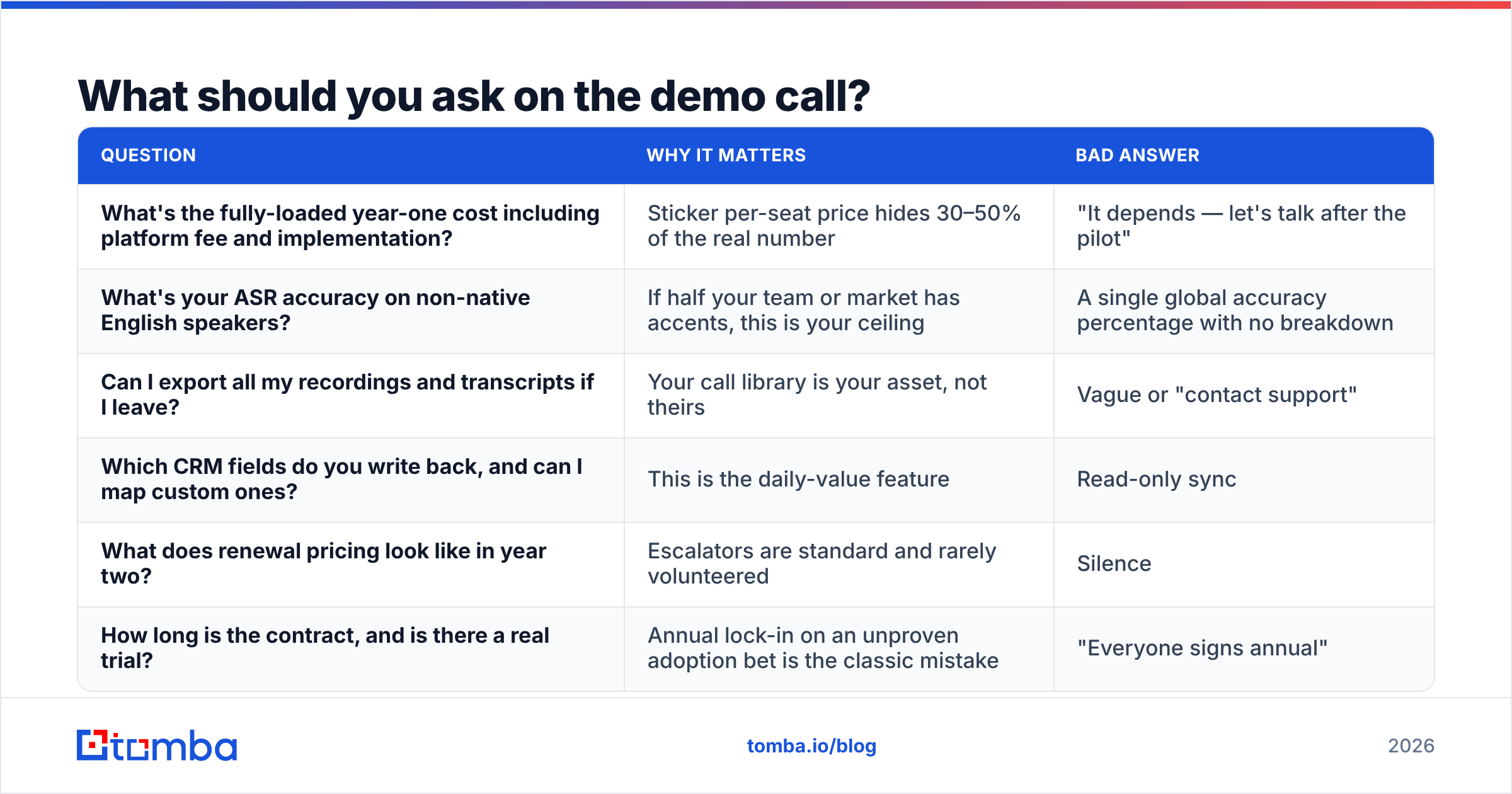
Vendors are excellent at demos. Force the conversation onto the boring stuff:
| Question | Why it matters | Bad answer |
|---|---|---|
| What's the fully-loaded year-one cost including platform fee and implementation? | Sticker per-seat price hides 30–50% of the real number | "It depends — let's talk after the pilot" |
| What's your ASR accuracy on non-native English speakers? | If half your team or market has accents, this is your ceiling | A single global accuracy percentage with no breakdown |
| Can I export all my recordings and transcripts if I leave? | Your call library is your asset, not theirs | Vague or "contact support" |
| Which CRM fields do you write back, and can I map custom ones? | This is the daily-value feature | Read-only sync |
| What does renewal pricing look like in year two? | Escalators are standard and rarely volunteered | Silence |
| How long is the contract, and is there a real trial? | Annual lock-in on an unproven adoption bet is the classic mistake | "Everyone signs annual" |
Ask for a reference customer at your size, in your segment, who has been live for more than 12 months. New logos love everything. Month-14 customers tell you the truth. HubSpot's own sales research library and vendor documentation like Gong's product docs are worth an hour of reading before the call so you can push past the pitch deck.
Verdict: who should buy, and who should wait?#
Buy a full conversation intelligence platform if: you have 15+ reps, a repeatable motion, a manager who runs structured coaching, and a forecasting process that currently runs on rep optimism. The forecast hygiene alone often justifies the spend, and the ramp-time reduction compounds with every hire.
Buy a lightweight notetaker if: you're under 10 reps. You get summaries, searchable transcripts, and CRM push for pocket change. Revisit the enterprise tier when headcount and call volume make the analytics layer statistically meaningful.
Wait if: your reps aren't running enough conversations to analyze. Spending $60k to study a starved funnel is the most expensive way to learn that you needed more pipeline. Fix the top of the funnel first — targeting, verified contact data, outreach volume — then buy the microscope.
Conversation intelligence is a genuinely good category that mature teams outgrow their skepticism about. It's just not a growth strategy. It's a quality strategy, and quality only pays when there's enough volume for it to act on.
Before you invest in analyzing conversations, make sure you can book them. Tomba's Email Finder locates verified professional email addresses by domain, name, or company — so your reps spend their week on calls worth recording instead of bounced sends. Start free with 25 searches a month, or scale up from $49/mo on the Starter plan; see Tomba pricing for the full breakdown. Feed the funnel first. The coaching layer works a lot better when there's something to coach.
Related guides#
Ready to find emails that actually work?
Join 150,000+ professionals who stopped guessing and started sending. Free credits on signup — no credit card required.
Get the Tomba newsletter
Practical outbound tactics and product updates — once every two weeks.
About the author