Conversational Marketing Sales: The 2026 Playbook That Converts
Chat widgets promise instant pipeline. Most deliver noise. Here's what conversational marketing sales actually does to response rates, what it costs, and the data layer that decides whether it works.
TL;DR
- Conversational marketing sales replaces the "fill out a form, wait for a rep" handoff with a real-time conversation — chat, chatbot, LinkedIn DM, SMS, or a live call booked in the moment.
- The lift is almost entirely a speed-to-lead effect. Responding in minutes instead of hours is what moves the number, not the widget itself.
- Chat only works when you already know who is on the other end. Without firmographic and contact enrichment behind it, a chat widget is an expensive way to talk to students and competitors.
- Budget realistically: $0–$79/mo for basic chat, $500–$2,500+/mo for a real conversational platform with routing, ABM targeting, and CRM sync.
- The winning 2026 stack is hybrid: chat for the 3% of visitors already in-market, outbound email for the 97% who are not — with one shared contact database underneath.
What is conversational marketing sales?#
Conversational marketing sales is a go-to-market motion where the first meaningful interaction with a buyer is a two-way conversation instead of a one-way form submission. Think of the difference between a vending machine and a shop assistant. The vending machine takes your input, processes it, and eventually dispenses something. The assistant asks what you're trying to do, disqualifies you in ten seconds if you're in the wrong shop, and walks you to the right shelf if you're not.
Mechanically, it collapses three steps that used to be separate:
- Capture — the visitor identifies themselves through the conversation rather than a 9-field form.
- Qualify — the bot or rep asks the two or three questions that actually determine fit (company size, use case, timeline).
- Route — the qualified buyer gets a calendar link, a live rep, or a warm handoff, all inside the same session.
The channel doesn't define it. A website chat widget is the classic surface, but conversational marketing sales also runs through LinkedIn messaging, WhatsApp, SMS, in-product messaging, and reply-driven cold email. What defines it is that the buyer sets the pace and the seller responds in something close to real time.
Why did conversational marketing take over the funnel?#
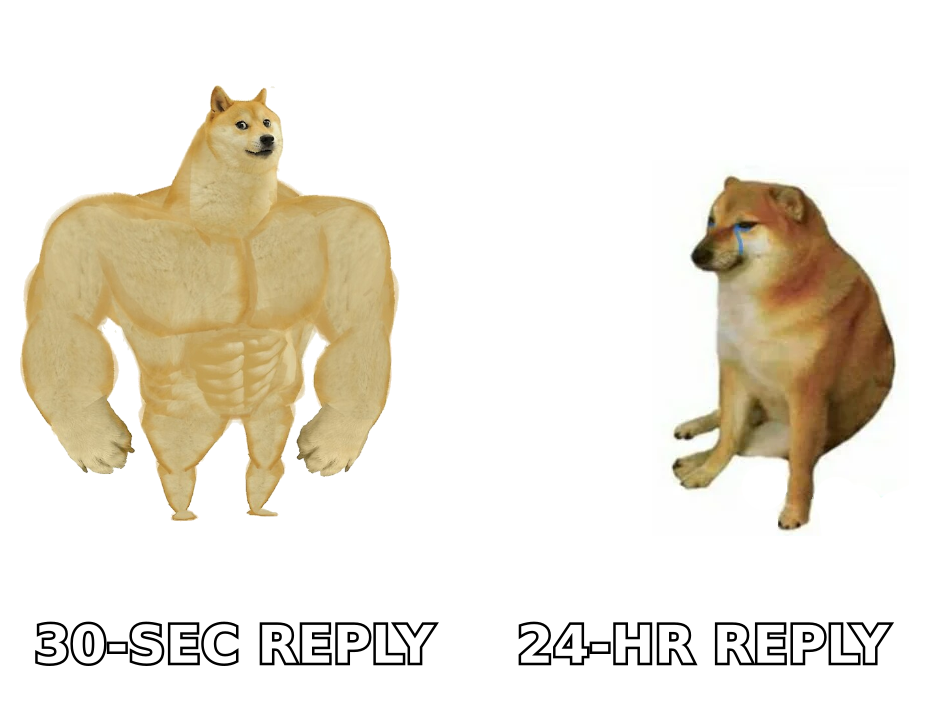
Because the form-first funnel was optimized for the marketer's convenience, not the buyer's. A B2B buyer who is ready to talk does not want a 24-hour wait and a templated "Thanks for your interest!" auto-reply. The classic Harvard Business Review lead-response study found that firms contacting a prospect within an hour were vastly more likely to have a meaningful qualifying conversation than those who waited even a few hours — and that gap has only widened as buyer patience has shrunk.
Three structural shifts pushed this from experiment to default:
- Buyers self-educate before they identify themselves. Gartner's B2B buying research has consistently found that buyers spend the minority of their journey with any potential supplier's sales rep. By the time they raise a hand, they've done the reading. They want answers, not a nurture sequence.
- Form conversion rates got worse, not better. More fields, more privacy friction, more gated-content fatigue. The people who still fill out a 9-field demo form are a self-selected minority.
- Chat got cheap. What used to be a $30k/year enterprise contract is now a $0 tier on half a dozen platforms, and LLM-powered bots handle the top-of-funnel triage that used to require an SDR.
How does conversational selling compare to the form-and-nurture funnel?#
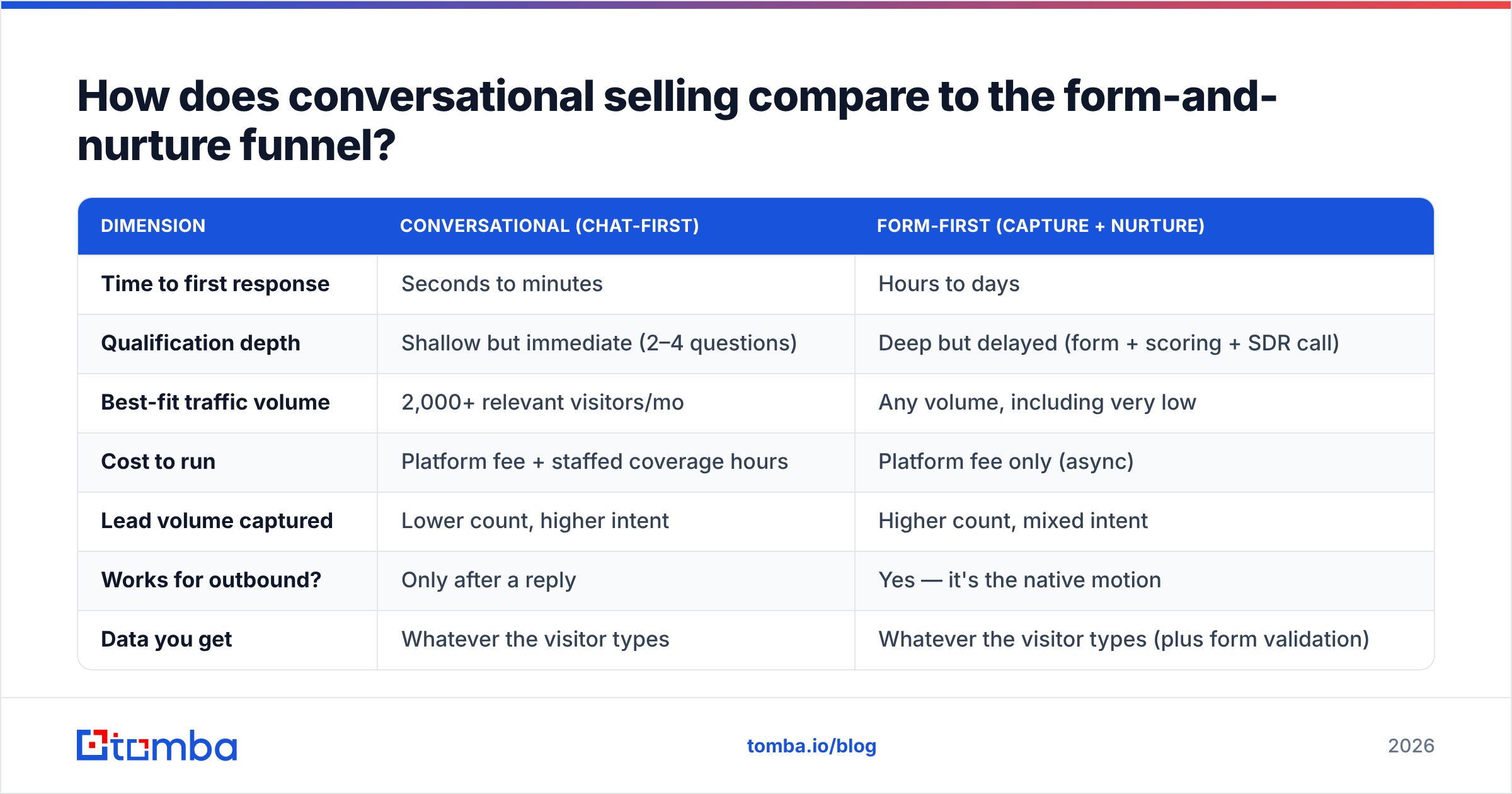
Here is the honest side-by-side. Neither column is universally correct — the right answer depends on your traffic volume and deal size.
| Dimension | Conversational (chat-first) | Form-first (capture + nurture) |
|---|---|---|
| Time to first response | Seconds to minutes | Hours to days |
| Qualification depth | Shallow but immediate (2–4 questions) | Deep but delayed (form + scoring + SDR call) |
| Best-fit traffic volume | 2,000+ relevant visitors/mo | Any volume, including very low |
| Cost to run | Platform fee + staffed coverage hours | Platform fee only (async) |
| Lead volume captured | Lower count, higher intent | Higher count, mixed intent |
| Works for outbound? | Only after a reply | Yes — it's the native motion |
| Data you get | Whatever the visitor types | Whatever the visitor types (plus form validation) |
| Attribution clarity | Strong (session-level) | Weak (multi-touch guesswork) |
| Failure mode | Nobody chats; reps sit idle | Leads rot in a nurture track |
The pattern that shows up over and over in real deployments: chat wins on conversion rate, forms win on volume. If you have 400 visitors a month, a chat widget will produce two conversations and a bored SDR. If you have 40,000, chat will out-earn the form by a wide margin because the 3% who are in-market get routed straight to a human while they're still warm.
What actually makes conversational marketing sales work?#
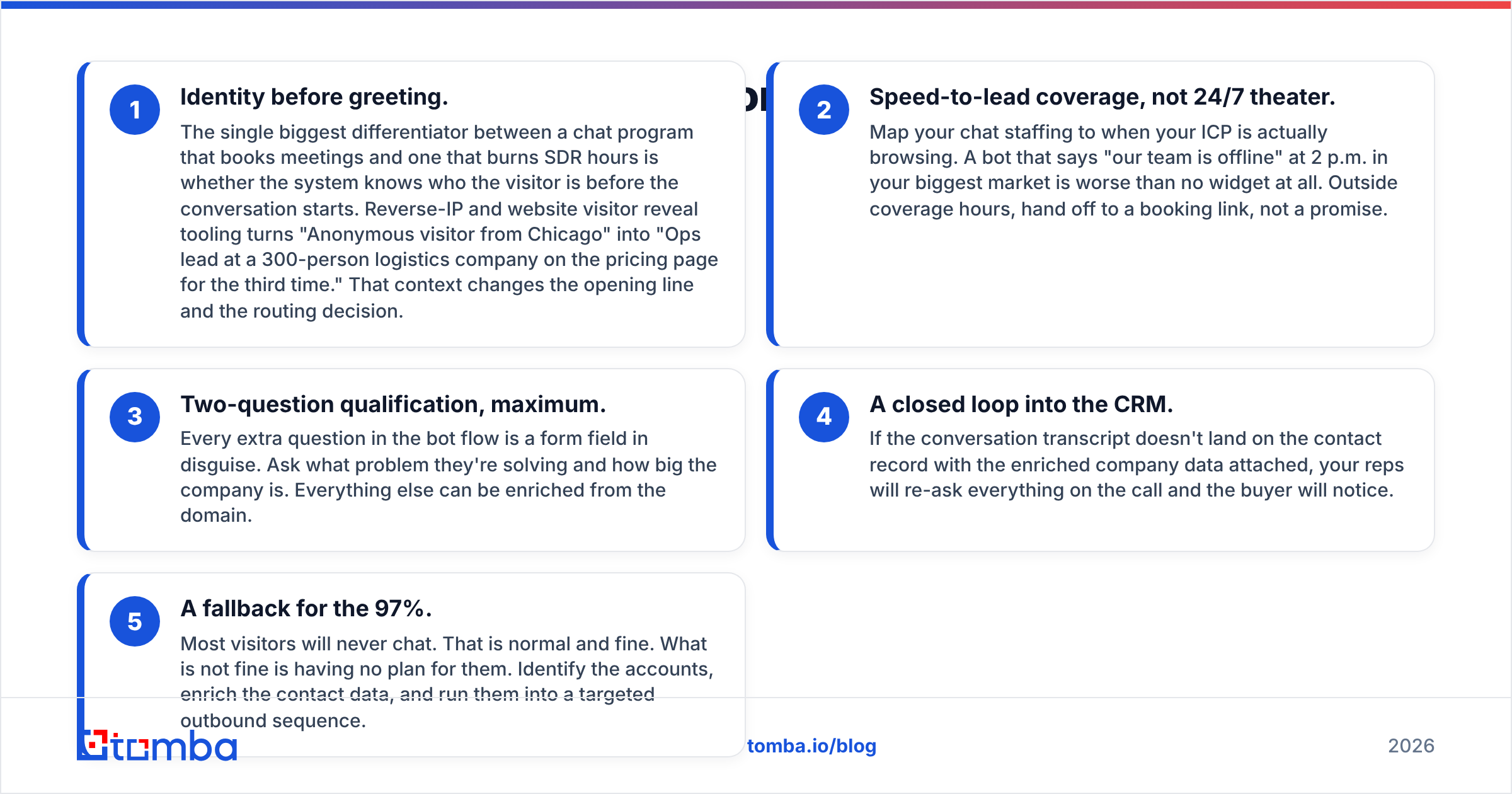
Not the widget. Four things, in this order:
- Identity before greeting. The single biggest differentiator between a chat program that books meetings and one that burns SDR hours is whether the system knows who the visitor is before the conversation starts. Reverse-IP and website visitor reveal tooling turns "Anonymous visitor from Chicago" into "Ops lead at a 300-person logistics company on the pricing page for the third time." That context changes the opening line and the routing decision.
- Speed-to-lead coverage, not 24/7 theater. Map your chat staffing to when your ICP is actually browsing. A bot that says "our team is offline" at 2 p.m. in your biggest market is worse than no widget at all. Outside coverage hours, hand off to a booking link, not a promise.
- Two-question qualification, maximum. Every extra question in the bot flow is a form field in disguise. Ask what problem they're solving and how big the company is. Everything else can be enriched from the domain.
- A closed loop into the CRM. If the conversation transcript doesn't land on the contact record with the enriched company data attached, your reps will re-ask everything on the call and the buyer will notice.
- A fallback for the 97%. Most visitors will never chat. That is normal and fine. What is not fine is having no plan for them. Identify the accounts, enrich the contact data, and run them into a targeted outbound sequence.
That fifth point is where most conversational programs quietly leak money. Chat only monetizes hand-raisers. The buyers who read three blog posts and left without typing a word are still your best pipeline source — they just require a different motion.
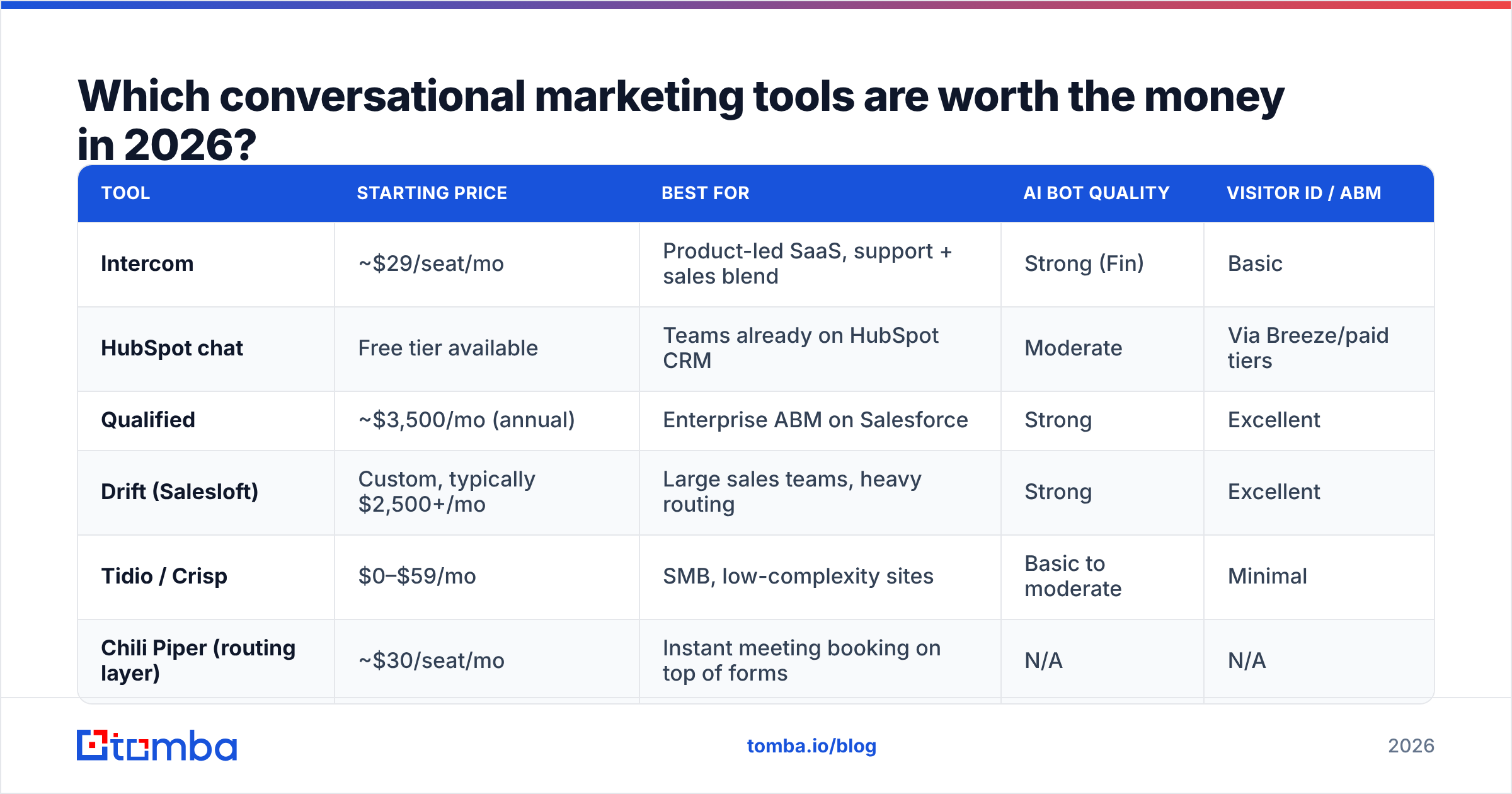
Which conversational marketing tools are worth the money in 2026?#
Pricing below reflects publicly listed starting tiers as of mid-2026. Enterprise quotes vary wildly, and most of these vendors negotiate. Always check the vendor's own page before you budget.
| Tool | Starting price | Best for | AI bot quality | Visitor ID / ABM |
|---|---|---|---|---|
| Intercom | ~$29/seat/mo | Product-led SaaS, support + sales blend | Strong (Fin) | Basic |
| HubSpot chat | Free tier available | Teams already on HubSpot CRM | Moderate | Via Breeze/paid tiers |
| Qualified | ~$3,500/mo (annual) | Enterprise ABM on Salesforce | Strong | Excellent |
| Drift (Salesloft) | Custom, typically $2,500+/mo | Large sales teams, heavy routing | Strong | Excellent |
| Tidio / Crisp | $0–$59/mo | SMB, low-complexity sites | Basic to moderate | Minimal |
| Chili Piper (routing layer) | ~$30/seat/mo | Instant meeting booking on top of forms | N/A | N/A |
Two honest observations from the field:
- The $3,000/mo tier only pays back above roughly $20k ACV or 20k monthly visitors. Below that, a $29/seat chat tool plus a good routing layer does 80% of the job. Read real deployment reviews on G2 before you sign an annual contract — the gap between demo and daily use is where the complaints live.
- Nobody's native data enrichment is as good as a dedicated provider. Every conversational platform bundles "company identification." Most resolve the ISP, not the company, on a meaningful share of traffic — and almost none give you a verified email for the specific human you want to reach next.
Is conversational marketing sales just chatbots with better branding?#
No — but the skeptics have a point about a specific failure mode.
A chatbot that asks "How can I help you today?" and then routes every answer to a contact form is a form with extra steps and worse UX. That is the version that gives conversational marketing a bad name, and it's genuinely common. If your bot's success metric is "conversations started," you will build that bot.
The version that works looks different. It behaves like a good SDR who happens to be typing:
- It opens with context, not a greeting. "Looks like you're comparing pricing tiers — want me to walk through what changes at the Growth level?" beats "Hi! 👋".
- It disqualifies fast and politely. Sending a 5-person startup to self-serve docs is a win, not a loss.
- It books, it doesn't collect. The output is a calendar event, not a lead record.
- It escalates to a human on the second sign of buying intent, every time.
The distinction is measurable. Track conversation-to-meeting rate, not chat volume. A widget doing 400 chats and 6 meetings a month is failing. A widget doing 60 chats and 14 meetings is working.
How do you build the data layer under a conversational program?#
This is the part most teams skip and then blame the platform for. A conversation is only as smart as the record behind it.
Step 1 — Identify the account. Visitor-reveal tooling gives you the company. Pair it with intent signals (pages viewed, repeat visits, pricing page dwell time) to score whether the account is worth a human's time.
Step 2 — Resolve the person. The account is not the buyer. You need the specific title. Run a domain search against the identified company to pull the full contact map — who's in RevOps, who's in procurement, who signs.
Step 3 — Verify before you touch. A conversational program that ends in a follow-up email is only as good as the deliverability behind it. Bounced follow-ups after a good chat are the fastest way to torch a warm account. Run every address through an email verifier before it enters a sequence, and keep your sender reputation clean.
Step 4 — Enrich the CRM record, then route. The rep should open the conversation already knowing headcount, funding stage, tech stack, and role. Routing rules built on enriched fields ("EMEA + 200+ headcount → senior AE") are the difference between conversational sales and expensive chat support.
Step 5 — Close the loop on non-chatters. Export the identified-but-silent accounts weekly. Those are your outbound list. They showed intent and never raised a hand — which is exactly the profile that responds best to a specific, well-researched cold email.
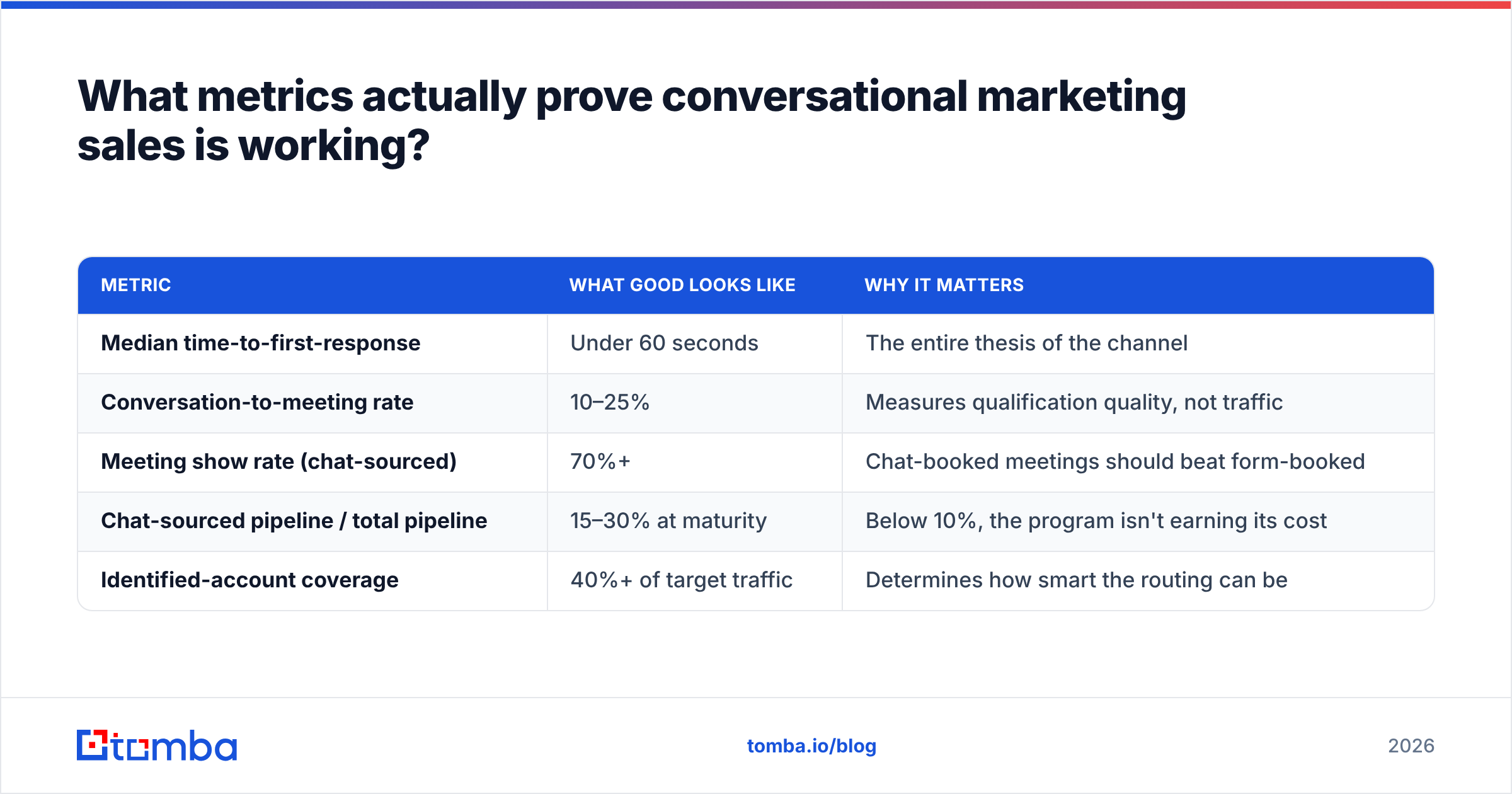
What metrics actually prove conversational marketing sales is working?#
Ignore vanity chat volume. These five numbers tell the truth:
| Metric | What good looks like | Why it matters |
|---|---|---|
| Median time-to-first-response | Under 60 seconds | The entire thesis of the channel |
| Conversation-to-meeting rate | 10–25% | Measures qualification quality, not traffic |
| Meeting show rate (chat-sourced) | 70%+ | Chat-booked meetings should beat form-booked |
| Chat-sourced pipeline / total pipeline | 15–30% at maturity | Below 10%, the program isn't earning its cost |
| Identified-account coverage | 40%+ of target traffic | Determines how smart the routing can be |
If your response rate is high but the meeting rate is low, your bot is too chatty and not qualifying. If both are low, you have a traffic problem, not a chat problem — and you should be spending that budget on outbound instead.
Should you run conversational marketing, outbound, or both?#
Both, and the split should follow your traffic.
- Under ~2,000 monthly ICP visitors: skip the expensive conversational platform. Add a cheap chat widget or a booking link, and put the money into outbound. You do not have enough inbound demand to justify staffing chat coverage.
- 2,000–20,000 ICP visitors/month: hybrid. Basic chat with instant routing for the hand-raisers, plus a weekly outbound push against identified-but-silent accounts. This is where most B2B companies live and where the hybrid model wins outright.
- 20,000+ ICP visitors/month: full conversational platform with ABM routing, live rep coverage across time zones, and a dedicated ops owner. The math works here and only here.
In all three cases the shared component is the same: a reliable contact database. Chat tells you who is interested. It does not tell you how to reach the four other people on the buying committee who never visited your site. That gap is filled by data, not by conversation software.
Where does Tomba fit?#
Conversational marketing sales lives or dies on knowing who you're talking to — and who you should be talking to next. That's the layer Tomba covers.
Use the Tomba Email Finder to turn every identified account into a real, verified contact map: the RevOps lead who chatted, the VP who didn't, and the CFO who will sign. Pair it with domain search and verification so your post-conversation follow-ups land in the inbox instead of the bounce log. Plans start free at 25 searches a month, with paid tiers from $49/mo — see Tomba pricing for the full breakdown.
Chat gets the hand-raisers. Good data gets the other 97%. Run both.
Related guides#
Ready to find emails that actually work?
Join 150,000+ professionals who stopped guessing and started sending. Free credits on signup — no credit card required.
Get the Tomba newsletter
Practical outbound tactics and product updates — once every two weeks.
About the author