Conversion Blitz vs Apollo.io: Full 2026 Comparison Guide
One is a 20-tool growth bundle, the other is a 275M-contact sales engine. We break down data quality, pricing, and where each one quietly falls apart.
TL;DR — Conversion Blitz vs Apollo.io in 30 seconds#
- Conversion Blitz is a bundle: 20-ish small growth tools (email extractor, chatbot, review manager, newly-registered-domain feed, AI writer) sold under one flat subscription. Breadth over depth.
- Apollo.io is a sales engine: a 275M+ contact database, filters, sequencing, dialer, and CRM sync. Depth over breadth — but priced per seat, and the good filters live upstairs.
- They are not really competitors. Conversion Blitz competes with buying five cheap SaaS tools. Apollo competes with ZoomInfo, Lusha, and Cognism.
- Data accuracy is the deciding factor. Both platforms hand you emails; neither guarantees they land. Verification is on you either way.
- The common pattern in 2026: a dedicated finder/verifier (Tomba, Findymail, BookYourData) for the data layer, plus a sending tool you actually like. Bundles look cheap until the bounce rate arrives.
What is Conversion Blitz, actually?#
Conversion Blitz (formerly known to a lot of people as the AppSumo-era lead-gen suite) is a collection of small tools sold together. You do not buy "a database." You buy access to a dashboard with roughly twenty utilities in it, and you use the three you need.
The headline modules:
- Email extractor / finder — scrape or look up business emails from domains, LinkedIn, or a company list.
- Newly registered domains feed — a daily list of freshly registered domains, filterable by keyword. This is genuinely differentiated. If you sell to brand-new businesses (agencies, web design, hosting, SaaS onboarding), a same-week domain list is a real signal no big database gives you.
- Chatbot + social proof widgets — on-site conversion toys, not outbound.
- Review management + AI writer — the "and also" tools that pad the bundle count.
- Basic email sender — enough to send a sequence, not enough to run a serious outbound program.
The pitch is straightforward: one price, twenty tools, cancel five other subscriptions. The honest read is that you're getting a lot of tools at 60% of the depth of the best-in-class version of each one. Which is fine — if your bar is "good enough."
What is Apollo.io, actually?#
Apollo.io is the opposite bet. It's one product with a very large spine: a contact database (Apollo publicly claims 275M+ contacts and 70M+ companies), a filter engine on top of it, and an execution layer — sequences, email sending, a dialer, LinkedIn extension, CRM bi-directional sync.
Apollo won the mid-market because of a specific trick: the free tier is generous enough to hook an SDR, and by the time the team realizes they need Organization-tier filters and higher export caps, three reps are already living in it. That's not a criticism — it's a very good product-led motion. But it means the price you evaluate is rarely the price you pay.
The structural difference in one line: Conversion Blitz sells you tools; Apollo sells you contacts and a way to hit them.

How do Conversion Blitz and Apollo.io compare head-to-head?#
Here's the side-by-side that most "vs" posts refuse to write plainly. Pricing reflects publicly listed plans at time of writing — both vendors change tiers, so verify before you buy.
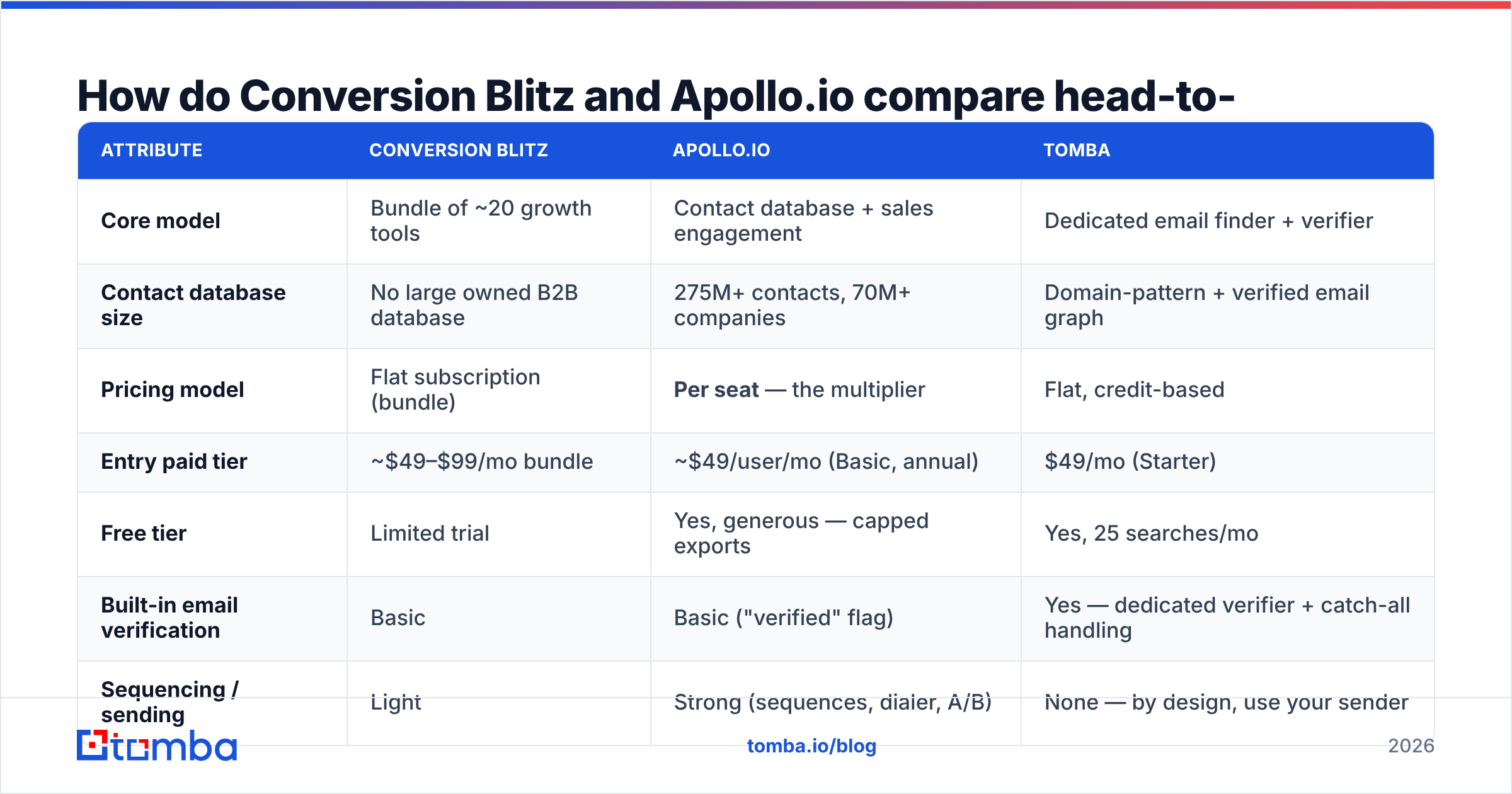
| Attribute | Conversion Blitz | Apollo.io | Tomba |
|---|---|---|---|
| Core model | Bundle of ~20 growth tools | Contact database + sales engagement | Dedicated email finder + verifier |
| Contact database size | No large owned B2B database | 275M+ contacts, 70M+ companies | Domain-pattern + verified email graph |
| Pricing model | Flat subscription (bundle) | Per seat — the multiplier | Flat, credit-based |
| Entry paid tier | ~$49–$99/mo bundle | ~$49/user/mo (Basic, annual) | $49/mo (Starter) |
| Free tier | Limited trial | Yes, generous — capped exports | Yes, 25 searches/mo |
| Built-in email verification | Basic | Basic ("verified" flag) | Yes — dedicated verifier + catch-all handling |
| Sequencing / sending | Light | Strong (sequences, dialer, A/B) | None — by design, use your sender |
| API quality | Limited | Good, rate-limited by tier | Full REST API, CLI, MCP, Sheets/Excel |
| Best for | Solo founders, agencies, SMB spray | SDR teams already in a US-heavy motion | Teams who want the data layer to be right |

Which one has better data accuracy?#
This is where the comparison stops being fun.
Apollo's database is enormous, and that's both the feature and the bug. A contact record that was accurate in 2023 is still sitting there in 2026 with a title that's two promotions stale and an email at a company the person left. Apollo flags emails as "verified," but its own verification is a coarse pass — every experienced operator I know runs an Apollo export through a second verifier before it touches a sending domain. Check the Apollo reviews on G2 and you'll find the same complaint threaded through years of feedback: great coverage, uneven freshness.
Conversion Blitz has the opposite problem. It doesn't carry a comparable owned database, so its finder leans on pattern inference and extraction. Pattern inference means: figure out that the company uses first.last@, apply it to the name, ship it. That works — until it doesn't, and it fails silently. A guessed address that's syntactically perfect and factually wrong bounces exactly like a made-up one.
Neither of those is a scandal. It's just the reality of B2B data: coverage and accuracy trade off against each other, and every vendor picks a side. What matters is what you do afterward.
The discipline that actually protects your domain:
- Never send to an unverified address, regardless of which vendor's "verified" badge it wears. Run every list through an independent email verifier before it enters your sequencer.
- Treat catch-all domains as a separate bucket. They pass basic SMTP checks and still bounce. A catch-all verifier gives you a real confidence score instead of a shrug.
- Cap unverifiable addresses at under 3% of any send. That's the practical ceiling before email deliverability starts sliding.
- Re-verify anything older than 90 days. B2B contact data decays at roughly 2-3% per month. A six-month-old export is a different list than the one you bought.

Is Apollo.io worth the per-seat price?#
Depends entirely on team size, and the math flips fast.
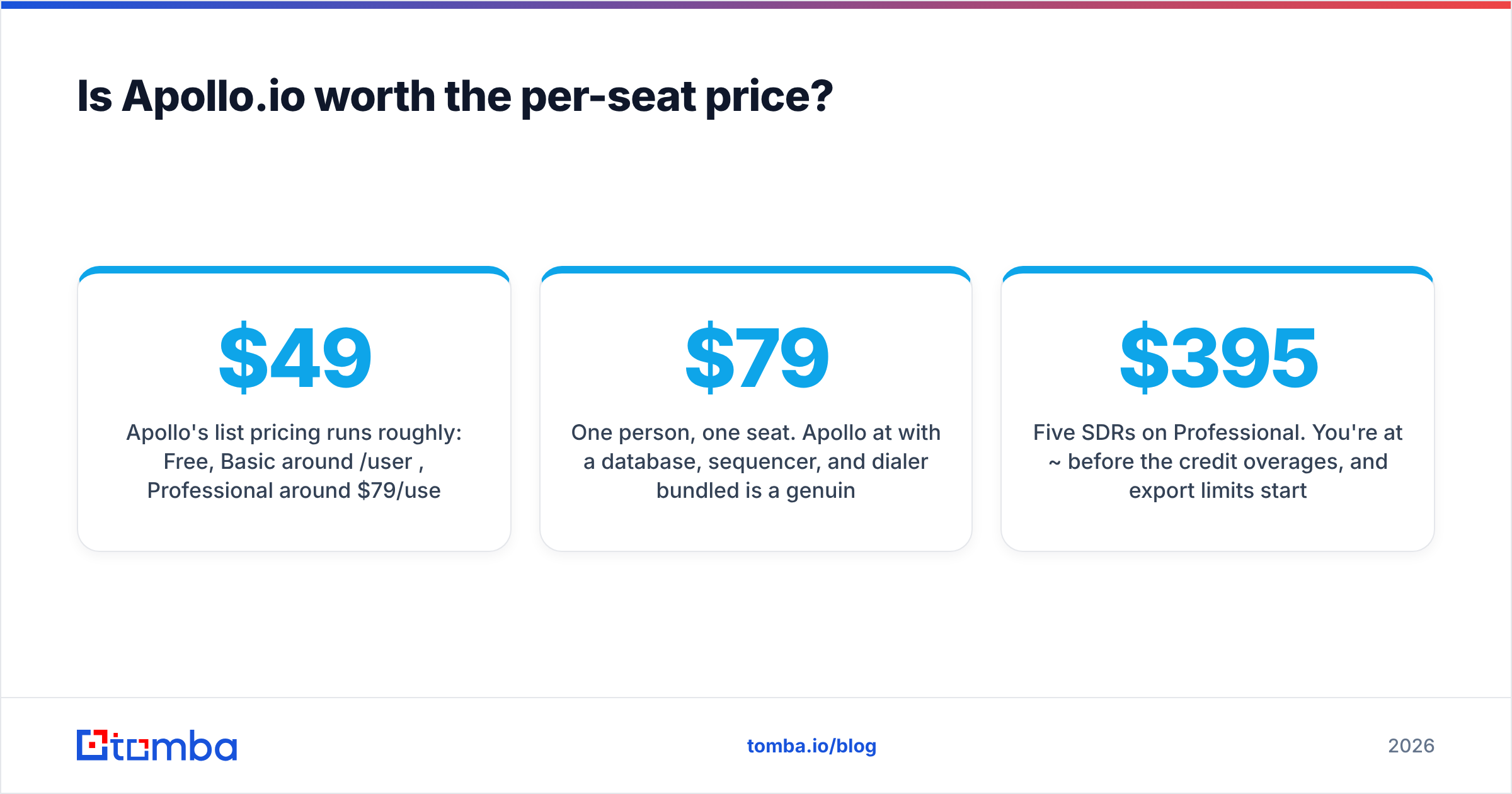
Apollo's list pricing runs roughly: Free, Basic around $49/user/month, Professional around $79/user/month, Organization around $119/user/month (annual billing; monthly is higher). Those numbers are per seat.
- One person, one seat. Apollo at $79/mo with a database, sequencer, and dialer bundled is a genuinely strong deal. Hard to beat.
- Five SDRs on Professional. You're at ~$395/mo before the credit overages, and export limits start to bite. Now you're comparing against a flat-rate data provider plus a dedicated sender — and the flat-rate stack usually wins on cost.
- Fifteen reps. You're in ZoomInfo-adjacent budget territory with a mid-market dataset. This is exactly where teams start hunting for an Apollo alternative — not because Apollo is bad, but because the pricing curve outruns the value curve.
The other cost nobody lines up in a spreadsheet: credit anxiety. Apollo meters exports and enrichment. Reps start hoarding credits, skipping enrichment on borderline accounts, and quietly shrinking the top of the funnel to protect their allowance. That's a real, unpriced tax on pipeline.
Is Conversion Blitz worth it, or is it just tool count?#
The bundle model has an honest version and a dishonest version.
The honest version: you genuinely need three of the tools, and buying them separately would cost more than the bundle. If you're an agency that wants a newly-registered-domain feed plus an email extractor plus a review widget, Conversion Blitz is a legitimately efficient purchase. The newly-registered-domain feed in particular is a real edge for anyone selling to businesses in their first 90 days.
The dishonest version: you're paying for twenty tools, using two, and telling yourself the other eighteen are "upside." They're not. Tool count is a marketing metric, not a value metric. The chatbot you'll never configure and the social proof popup you'll never install are worth exactly zero.
Ask yourself one question before you buy any bundle: which three modules will I use in week one? If you can't name three, you're buying a number, not a product.
The other structural weakness: extraction-first data means you inherit whatever the source page had. Scraped emails include role addresses (info@, support@, sales@), which have near-zero reply rates and disproportionately high complaint rates. If you're feeding a cold sequence, those need to be stripped, and the bundle won't do it for you with any rigor.
Which should you pick for cold outbound in 2026?#
Match the tool to the motion. Here's the decision framework, and it's shorter than you'd expect:
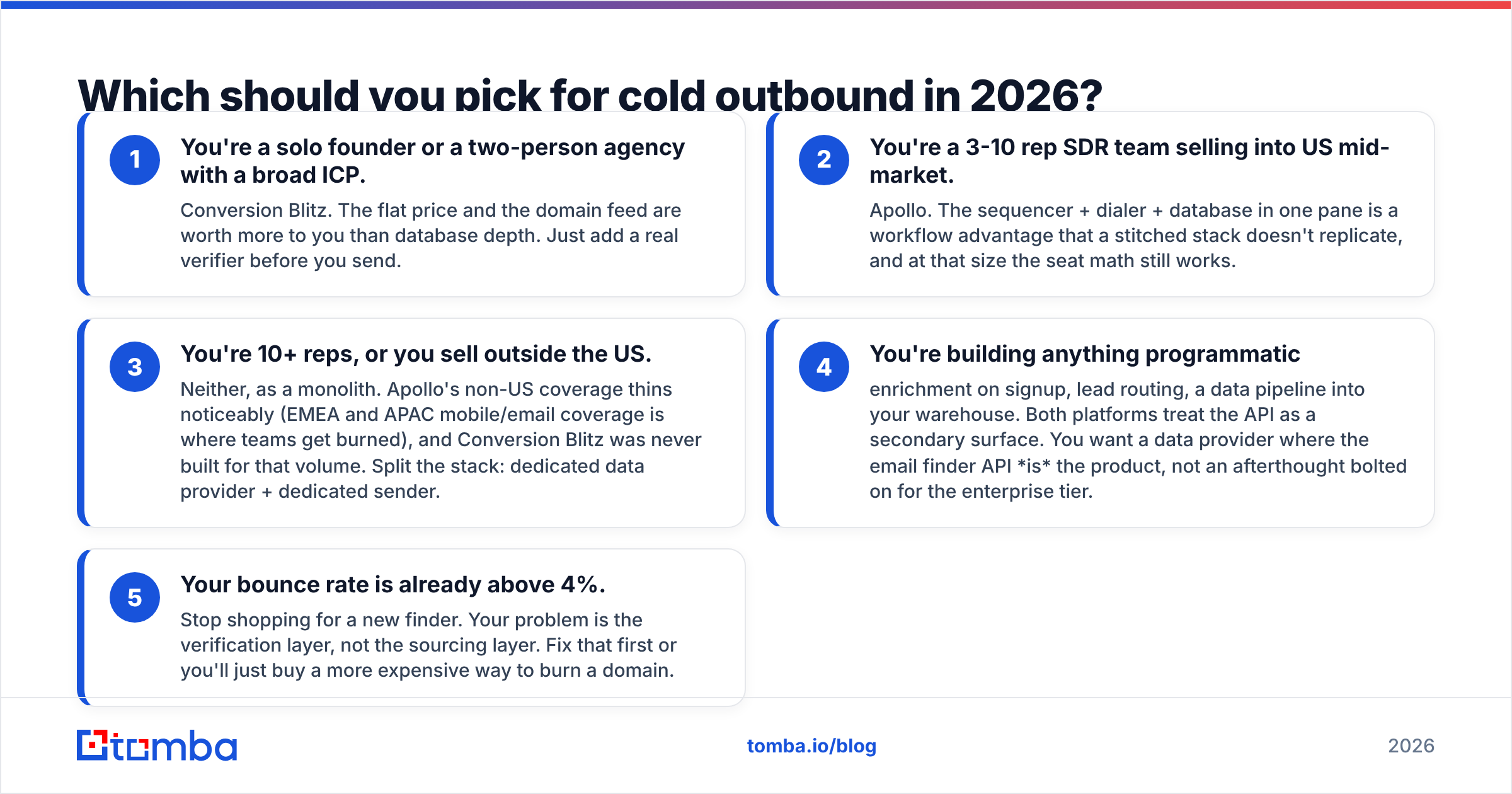
You're a solo founder or a two-person agency with a broad ICP. Conversion Blitz. The flat price and the domain feed are worth more to you than database depth. Just add a real verifier before you send.
You're a 3-10 rep SDR team selling into US mid-market. Apollo. The sequencer + dialer + database in one pane is a workflow advantage that a stitched stack doesn't replicate, and at that size the seat math still works.
You're 10+ reps, or you sell outside the US. Neither, as a monolith. Apollo's non-US coverage thins noticeably (EMEA and APAC mobile/email coverage is where teams get burned), and Conversion Blitz was never built for that volume. Split the stack: dedicated data provider + dedicated sender.
You're building anything programmatic — enrichment on signup, lead routing, a data pipeline into your warehouse. Both platforms treat the API as a secondary surface. You want a data provider where the email finder API is the product, not an afterthought bolted on for the enterprise tier.
Your bounce rate is already above 4%. Stop shopping for a new finder. Your problem is the verification layer, not the sourcing layer. Fix that first or you'll just buy a more expensive way to burn a domain.
Where does Tomba fit in this comparison?#
Honestly: Tomba is not trying to be either of these products, and pretending otherwise would be a bad sales pitch.
Tomba doesn't have a sequencer. There's no dialer, no chatbot, no review widget. What Tomba does is the data layer, and only the data layer — find email addresses by domain, name, or company; verify them; handle catch-all domains properly; and enrich what you already have. Then you hand off to whatever sender you actually like.
That's a narrower product, and for a lot of teams that's precisely the point. The stack that most 5-15 person outbound teams converge on in 2026 looks like:
- Data layer: a dedicated finder + verifier, flat-priced, API-first.
- Sending layer: Instantly, Smartlead, Lemlist, or your existing sequencer.
- CRM: HubSpot or Salesforce, with enrichment writing back on a schedule.
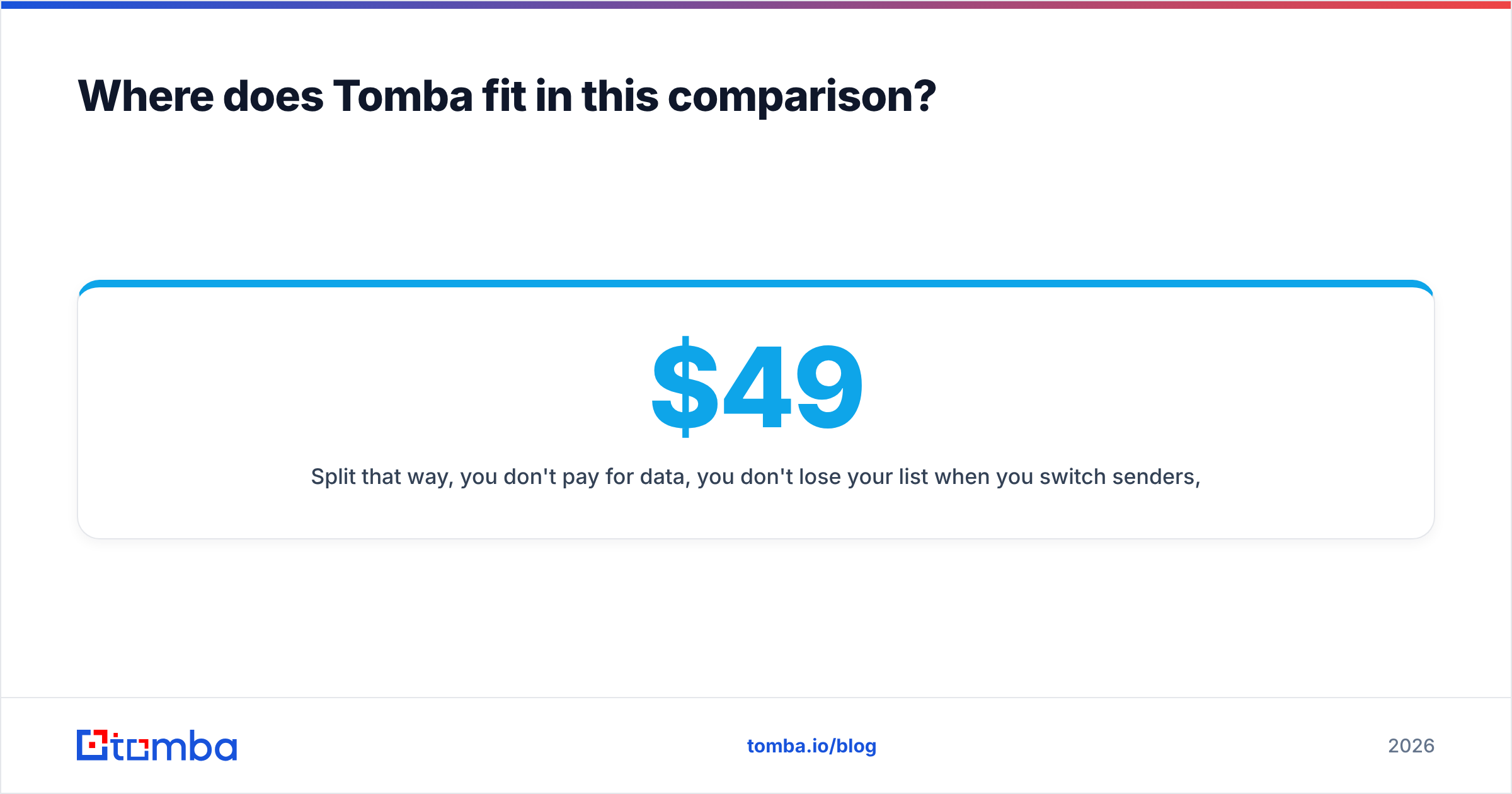
Split that way, you don't pay per seat for data, you don't lose your list when you switch senders, and each layer can be replaced independently when it stops earning its keep. Tomba pricing is flat — Free (25 searches/mo), Starter $49/mo, Growth $99/mo, Pro $249/mo — so a fourth rep doesn't multiply your data bill.
Where Tomba genuinely loses: if you want one login, one invoice, and a sequencer built in, Apollo does that and Tomba doesn't. Buy Apollo. That's not a hedge, it's just true.
What's the verdict on Conversion Blitz vs Apollo.io?#
Apollo wins on depth. Conversion Blitz wins on breadth-per-dollar. Neither wins on data hygiene, and that's the metric that decides whether your campaign works.
If someone forced a single pick: for an outbound team of any real size, Apollo is the more serious product, and it isn't close. For a solo operator running scrappy volume across a wide ICP, Conversion Blitz costs less and does more things adequately.
But the framing of "which one" is the trap. Both platforms sell you a list and let you send it, and both leave the hardest part — is this address real, today — as an exercise for the reader. The teams with 40%+ open rates and sub-1% bounce rates in 2026 aren't the ones with the biggest database. They're the ones who verify twice and send half as much.

Start with a data layer that doesn't bounce#
Before you commit to a per-seat contract or a twenty-tool bundle, test the part that actually breaks. Run 25 of your real target accounts through the Tomba Email Finder on the free tier — no card, no seat count, no credit anxiety. Compare what comes back against your current provider's export, verify both lists, and look at the bounce rate difference.
If the data holds up, Starter is $49/mo flat and the API, CLI, Sheets add-on, and Chrome extension all come with it. If it doesn't, you've lost twenty minutes and learned something useful about your current stack. Either way, you'll be arguing about the right thing.
Related guides#
Ready to find emails that actually work?
Join 150,000+ professionals who stopped guessing and started sending. Free credits on signup — no credit card required.
Get the Tomba newsletter
Practical outbound tactics and product updates — once every two weeks.
About the author