How to Convert Cold Email Replies to Meetings in 2026
Getting replies is the easy part. Most teams lose the deal between "sounds interesting" and a slot on the calendar. Here is the reply-handling playbook that actually books meetings.
TL;DR
- Reply-to-meeting conversion, not reply rate, is the metric that predicts pipeline. Most teams never measure it.
- Speed is the single biggest lever: responding within minutes beats a "better written" reply sent four hours later.
- Never send a bare scheduling link to a lukewarm reply. Offer two concrete times, and keep the link as a fallback.
- Objections ("send info", "not now", "wrong person") are not rejections. Each has a scripted path back to a calendar.
- Bad contact data poisons the whole funnel. Verified emails and a working phone number turn a 40% reply-to-meeting rate into a 60% one.
You spent weeks building a list, writing sequences, and warming domains. The replies finally land. Then half of them die in your inbox.
That gap — between someone typing "sure, tell me more" and someone actually showing up on a call — is where most outbound programs quietly leak revenue. This guide is about closing it.
Why do most cold email replies never turn into meetings?#
Because reps treat a reply as the finish line instead of the starting gun.
A cold email reply is a very fragile signal. The prospect gave you thirty seconds of attention because your subject line caught them between two meetings. That attention window closes fast. If your response takes four hours, arrives as a wall of text, and ends with "let me know what works for you," you have handed the prospect three separate reasons to not respond.
The classic Harvard Business Review study on online lead response time found that firms contacting a lead within an hour were roughly seven times more likely to qualify that lead than firms waiting even two hours. Cold email replies behave the same way, only faster — the prospect never asked to hear from you in the first place, so their interest decays harder.
The four most common failure modes:
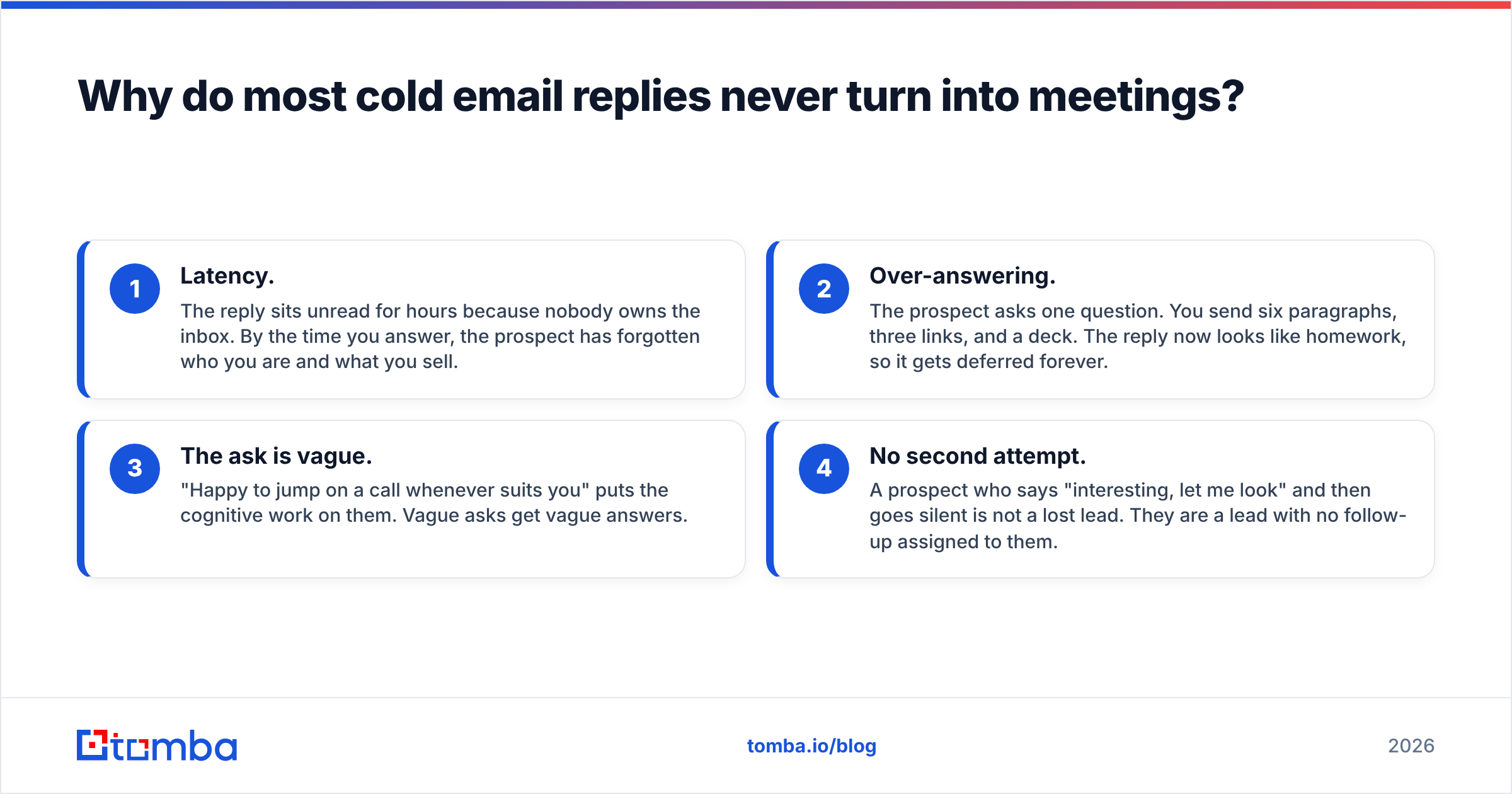
- Latency. The reply sits unread for hours because nobody owns the inbox. By the time you answer, the prospect has forgotten who you are and what you sell.
- Over-answering. The prospect asks one question. You send six paragraphs, three links, and a deck. The reply now looks like homework, so it gets deferred forever.
- The ask is vague. "Happy to jump on a call whenever suits you" puts the cognitive work on them. Vague asks get vague answers.
- No second attempt. A prospect who says "interesting, let me look" and then goes silent is not a lost lead. They are a lead with no follow-up assigned to them.
None of these are copywriting problems. They are process problems, which is good news — process is fixable.
What does a good reply-to-meeting rate look like?#
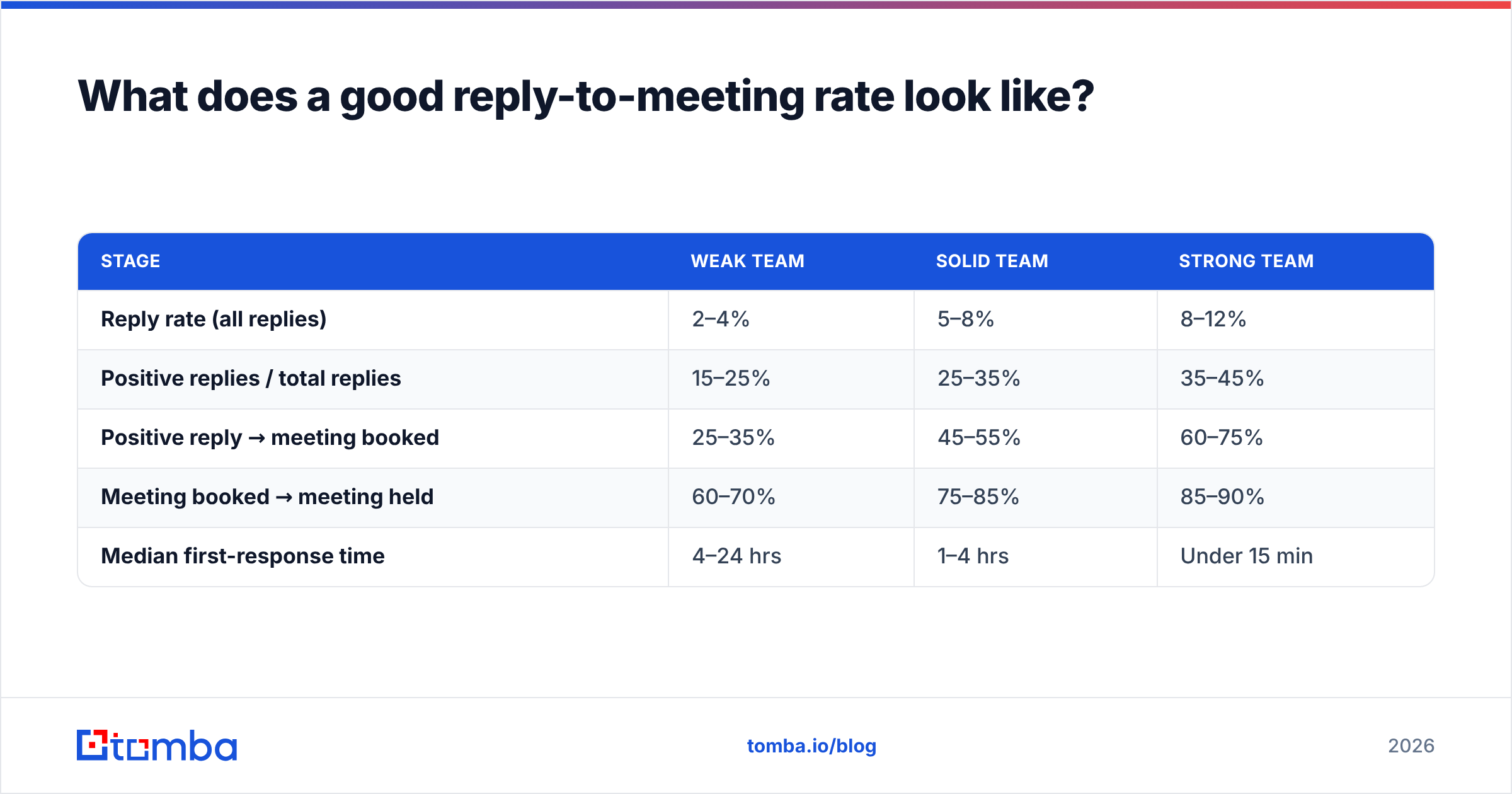
Benchmark against yourself first, but here is the rough shape of the funnel for a competent B2B outbound motion:
| Stage | Weak team | Solid team | Strong team |
|---|---|---|---|
| Reply rate (all replies) | 2–4% | 5–8% | 8–12% |
| Positive replies / total replies | 15–25% | 25–35% | 35–45% |
| Positive reply → meeting booked | 25–35% | 45–55% | 60–75% |
| Meeting booked → meeting held | 60–70% | 75–85% | 85–90% |
| Median first-response time | 4–24 hrs | 1–4 hrs | Under 15 min |
Read the third row carefully. The difference between a weak team and a strong team on that single line is a 2–3x swing in booked meetings — from the exact same volume of replies. You do not need a bigger list to double your pipeline. You need to stop dropping the replies you already get.
The fourth row matters too. Booking a meeting and holding a meeting are different events. A calendar invite accepted at 11pm on a Friday by someone who felt socially obligated is not a meeting; it is a no-show waiting to happen.
If you want the formal definitions behind these funnel stages, Tomba's glossary entry on response rate breaks down how to calculate each denominator consistently — which matters more than the absolute number, because a metric you compute differently each month is not a metric.
How fast do you actually need to reply?#
Under fifteen minutes during working hours. Under two hours as an absolute ceiling.
This is not a productivity flex. It is arithmetic. The prospect replied to you while your email was on screen. Reply within minutes and you are continuing a conversation. Reply the next morning and you are starting a new one, from a colder position, against an inbox that has since received two hundred other messages.
Practical ways to make speed structural rather than heroic:
- Assign inbox ownership by sending domain, not by rep mood. Every mailbox has one named human responsible for replies during business hours. Shared responsibility means no responsibility.
- Set up mobile push for reply notifications only. Not for opens. Not for clicks. Opens are noise; a reply is a live human.
- Pre-write the six replies you send 90% of the time. Interested, send-info, not-now, wrong-person, pricing-question, competitor-mention. Snippets, not full templates — you still personalise the first line.
- Batch-check at fixed times if you cannot do real-time. Three checks a day (9am, 1pm, 4pm) beats "whenever I remember," and it beats a rep who checks constantly and never does deep work.
The pre-written snippets are where most of the gain lives. If you need starting points, Tomba's cold email templates library covers the standard reply branches, and you can strip them down to two sentences each — which is what you actually want.
What should the reply itself say?#
Two to four sentences. One question. Two specific times. That is the whole formula.
Here is the anatomy, in order:
- Acknowledge what they said, in their words. "Makes sense that renewal timing is the constraint" beats "Thanks for getting back to me!" It proves you read the email.
- Answer their question directly, once. If they asked about pricing, give a range. Dodging pricing to "get them on a call" is the fastest way to lose a good-faith prospect.
- Bridge to the meeting with a reason that serves them. Not "so I can walk you through our platform." Instead: "The fastest way to know if this is a fit is fifteen minutes where I show you what we'd find in your specific domain."
- Propose two concrete times, with timezone. "Thursday 10:30am or Friday 2pm, both CET — either work?" A binary choice converts far better than an open field.
- Put the scheduling link last, as a fallback. "If neither works, here's my calendar: [link]." The link is the escape hatch, not the ask.
Why does the link go last? Because a scheduling link sent as the primary ask reads as "do the work of scheduling yourself, I'm busy." Tools like Calendly are excellent at removing friction after someone has decided to meet you. They are terrible at creating that decision. A lukewarm prospect who gets a bare link will open it, see fifteen empty slots, feel the weight of committing, and close the tab.
Length matters as much as structure. If your reply is longer than the prospect's reply, you have inverted the power dynamic. Match their energy or come in slightly under it.
How do you handle the four replies that are not a clean yes?#
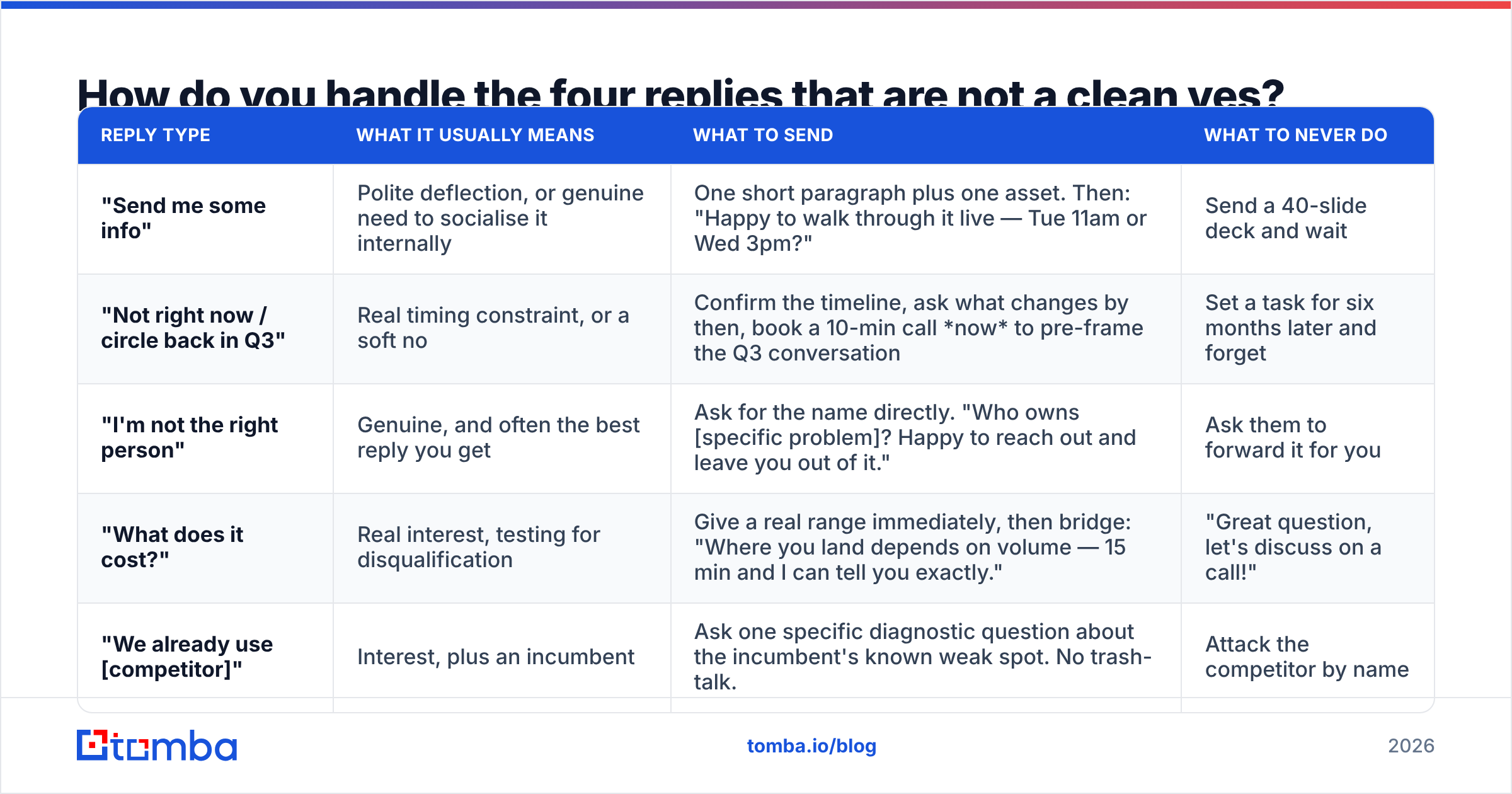
Most replies are not "yes, book me." They are one of four soft states, and each has a route back to the calendar.
| Reply type | What it usually means | What to send | What to never do |
|---|---|---|---|
| "Send me some info" | Polite deflection, or genuine need to socialise it internally | One short paragraph plus one asset. Then: "Happy to walk through it live — Tue 11am or Wed 3pm?" | Send a 40-slide deck and wait |
| "Not right now / circle back in Q3" | Real timing constraint, or a soft no | Confirm the timeline, ask what changes by then, book a 10-min call now to pre-frame the Q3 conversation | Set a task for six months later and forget |
| "I'm not the right person" | Genuine, and often the best reply you get | Ask for the name directly. "Who owns [specific problem]? Happy to reach out and leave you out of it." | Ask them to forward it for you |
| "What does it cost?" | Real interest, testing for disqualification | Give a real range immediately, then bridge: "Where you land depends on volume — 15 min and I can tell you exactly." | "Great question, let's discuss on a call!" |
| "We already use [competitor]" | Interest, plus an incumbent | Ask one specific diagnostic question about the incumbent's known weak spot. No trash-talk. | Attack the competitor by name |
The "wrong person" reply deserves special attention, because it is the most under-exploited reply in outbound. Someone just volunteered internal org information for free. Take the name, then find the contact — a quick domain search against their company will usually surface the right person's address in the correct company format within seconds, and you can open the new thread referencing the referral. That referral line — "Sarah in Ops suggested you own this" — routinely outperforms any cold opener you could write.
Should you call the prospect who replied?#
Yes — and almost nobody does, which is exactly why it works.
A positive email reply is the warmest signal you will get without a meeting. The prospect has self-identified as interested and is, statistically, at their desk right now. A call placed within ten minutes of a reply lands very differently from a cold dial: you are not interrupting a stranger, you are following up on something they started.
The script is short. "Hi — I'm the one who emailed about X, you just replied. Figured a two-minute call beats five emails. Is now terrible?" The "is now terrible" phrasing gives them an easy out, which paradoxically makes them more likely to stay on.
You need a number to do this, obviously. If your list only has emails, a phone finder lookup on the replying contact closes that gap. Treat it as a same-day action, not a research project — the value of the number decays with the reply.
Not every segment tolerates this. Enterprise security buyers may find a fast call intrusive; SMB founders usually appreciate it. Test on a sample of twenty replies before you make it standard practice.
How does contact data quality affect reply-to-meeting conversion?#
More than anyone wants to admit, and in ways that do not show up in your reply-rate dashboard.
Here is the chain. Unverified lists produce bounces. Bounces damage sender reputation. Damaged reputation pushes your replies — including your carefully-crafted reply to a hot prospect — into the promotions tab or spam. The prospect never sees the two times you proposed. You conclude they ghosted you. They conclude you ghosted them.
This failure is invisible from the sender's side. It looks identical to disinterest.
The fixes are unglamorous and cheap:
- Verify before send, not after bounce. Run every list through an email verifier and drop anything that does not come back valid. Keep hard bounce rates under 2%.
- Reply from the same mailbox that sent. Switching domains mid-thread breaks threading and trips spam filters.
- Watch catch-all domains carefully. They accept everything and tell you nothing. Segment them and treat them as lower-confidence.
- Enrich the reply, not just the send. When someone replies, you should immediately know their title, company size, and tech stack — that context is what lets you propose a relevant meeting instead of a generic one.
Analyst coverage of sales data quality — see Gartner's sales technology research — has consistently landed on the same conclusion: data decay is the silent tax on outbound. Contacts churn out of roles at roughly 25–30% per year in B2B. A list you built in January is meaningfully wrong by July.
What should you measure to fix this permanently?#
Four numbers, reviewed weekly. Not twenty.
- Median first-response time. Measured in minutes, from prospect reply to your reply. If this is over an hour, fix it before you touch anything else.
- Positive reply → meeting booked. Your core conversion. Track it per rep, because the spread between your best and worst rep on this number is usually enormous and entirely coachable.
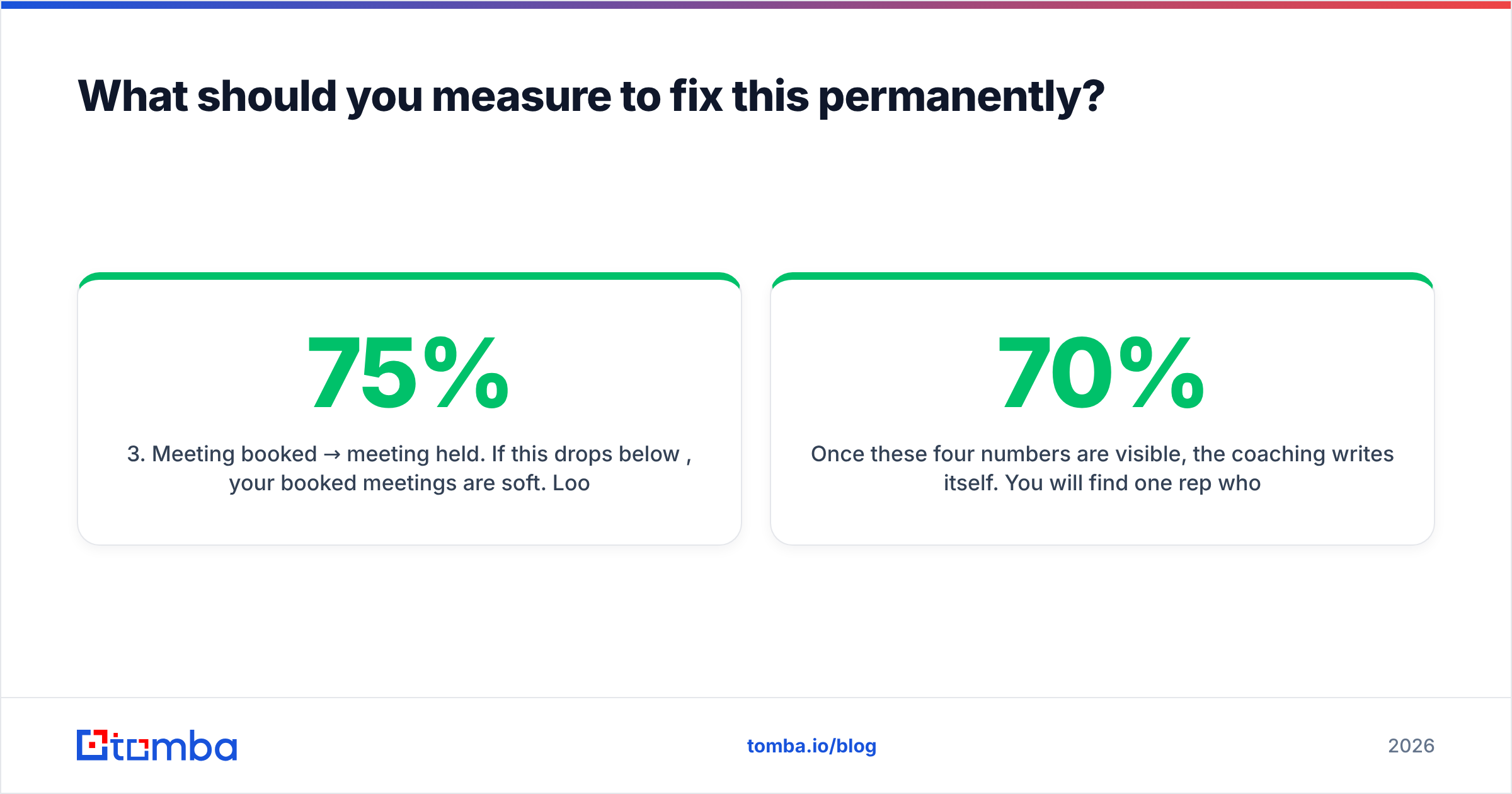
- Meeting booked → meeting held. If this drops below 75%, your booked meetings are soft. Look at whether reps are pushing links instead of proposing times.
- Objection distribution. Which of the four soft-no replies dominates? A spike in "wrong person" means your targeting is off. A spike in "not now" means your trigger events are weak.
Log every reply outcome in the CRM the day it happens. Not at the end of the week. HubSpot's own sales research is blunt on this point: teams that log reply outcomes at the moment of the reply produce forecast data that is usable; teams that batch-log on Friday produce fiction.
Once these four numbers are visible, the coaching writes itself. You will find one rep whose reply-to-meeting rate is 70% and another at 25%, both working the same list. Read the 70% rep's replies. Copy them. That is the whole exercise.
The three-line summary#
Reply fast. Propose two specific times instead of a link. Follow up twice more on anything that goes quiet.
Everything else in this article is elaboration on those three sentences. The teams that book meetings are not writing better prose than you — they are just not dropping the replies they already earned.
Where to start#
If your reply-to-meeting rate is stuck and you suspect the problem is upstream of the reply — wrong contacts, dead addresses, replies landing in spam — start by fixing the data. The Tomba Email Finder gives you verified, correctly-formatted addresses for the people who actually own the problem you solve, so the replies you get come from decision-makers rather than dead ends. The free tier includes 25 searches a month, and paid plans start at $49/mo — check the current Tomba pricing for the tier that matches your send volume.
Clean data does not write your reply for you. But it does guarantee that the reply you write actually arrives.
Related guides#
Ready to find emails that actually work?
Join 150,000+ professionals who stopped guessing and started sending. Free credits on signup — no credit card required.
Get the Tomba newsletter
Practical outbound tactics and product updates — once every two weeks.
About the author