Converting Meetings Into Opportunities: The 2026 Playbook
A calendar full of meetings is not a pipeline. Here's the exact qualification bar, next-step language, and follow-up cadence that turns booked calls into opportunities your forecast can actually count.
Your calendar is full. Your pipeline is not. That gap — between a meeting that happened and an opportunity that exists — is where most B2B revenue teams quietly lose the quarter.
TL;DR — What actually converts meetings into opportunities?#
- A meeting is not an opportunity until it has a dated next step with a named participant. "They said they'd loop in their VP" is not a next step. A calendar invite is.
- The conversion moment happens in the last 5 minutes of the call, not in the follow-up. If you leave without a scheduled second event, your close rate drops off a cliff.
- Recap within 24 hours, or the meeting decays. Buying committees forget details fast, and internal advocates cannot sell for you without written ammunition.
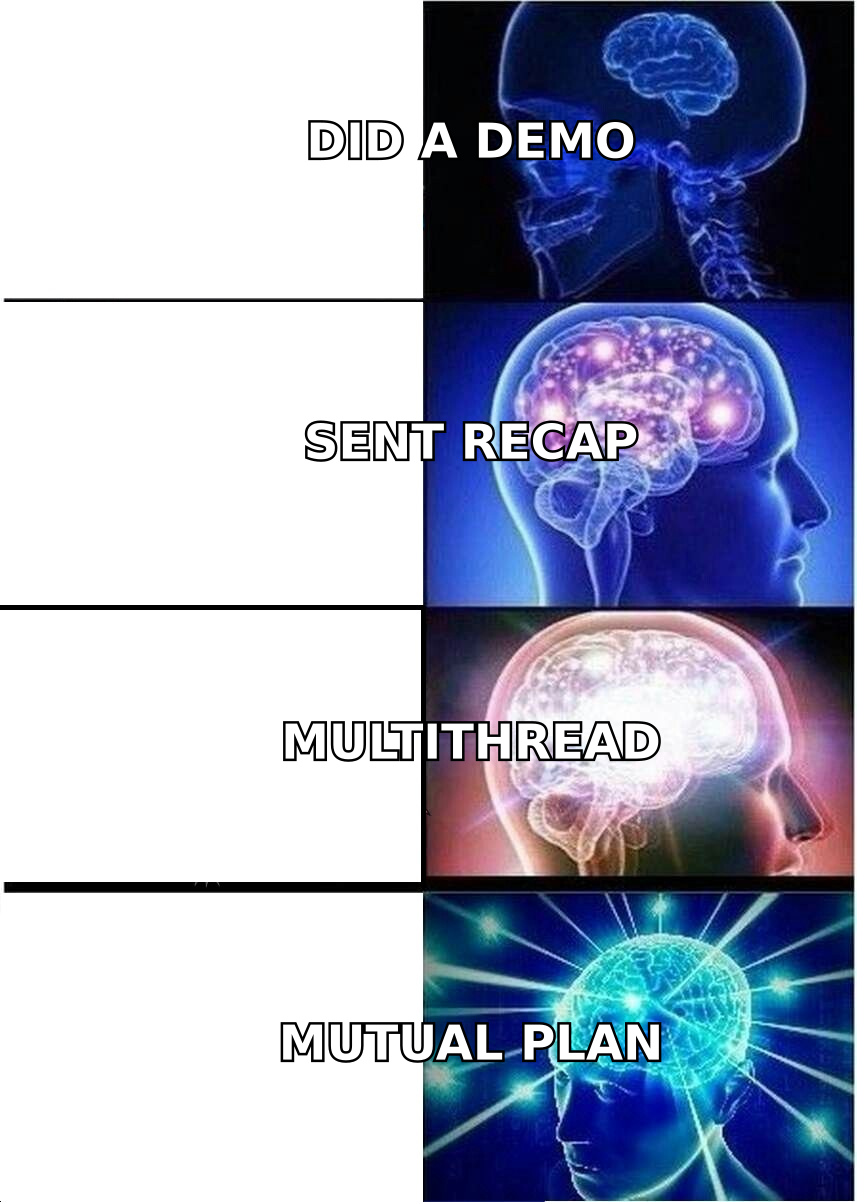
- Multithreading is the single biggest predictor of survival. Single-threaded deals die when one person changes jobs, gets busy, or gets overruled.
- Qualification must be written down, not felt. Use a scoring bar (budget signal, problem cost, timeline trigger, access to power) and enforce it — otherwise your forecast is fiction.
Why do so many "good" meetings never become opportunities?#
Because "good" is a feeling, and feelings don't survive a pipeline review.
A rep walks out of a 45-minute call thinking it went well. The prospect nodded, asked questions, said "this is interesting," and promised to "circle back." The rep marks the meeting as complete, logs a note that says strong interest, and moves on. Three weeks later, the deal is in the CRM as an opportunity with a 30% probability and no activity since.
This is the most expensive failure mode in B2B sales, and it is almost entirely a process problem, not a talent problem. Three things cause it:
- No exit criteria. The rep never defined what has to be true for the meeting to count. So anything counts.
- Politeness bias. Prospects are agreeable in meetings because agreement is cheap. Saying "no thanks" to someone who was friendly for 45 minutes is socially expensive, so they say "send me some info" instead.
- The follow-up vacuum. The rep sends a thank-you email with a deck attached and waits. Nothing in that email gives the internal champion anything to forward.
Research from HubSpot's sales statistics consistently shows that follow-up discipline — not charisma — separates reps who hit quota from reps who don't. The meeting is the raw material. Converting meetings into opportunities is a manufacturing process, and manufacturing processes need specifications.
What is the difference between a meeting and an opportunity?#
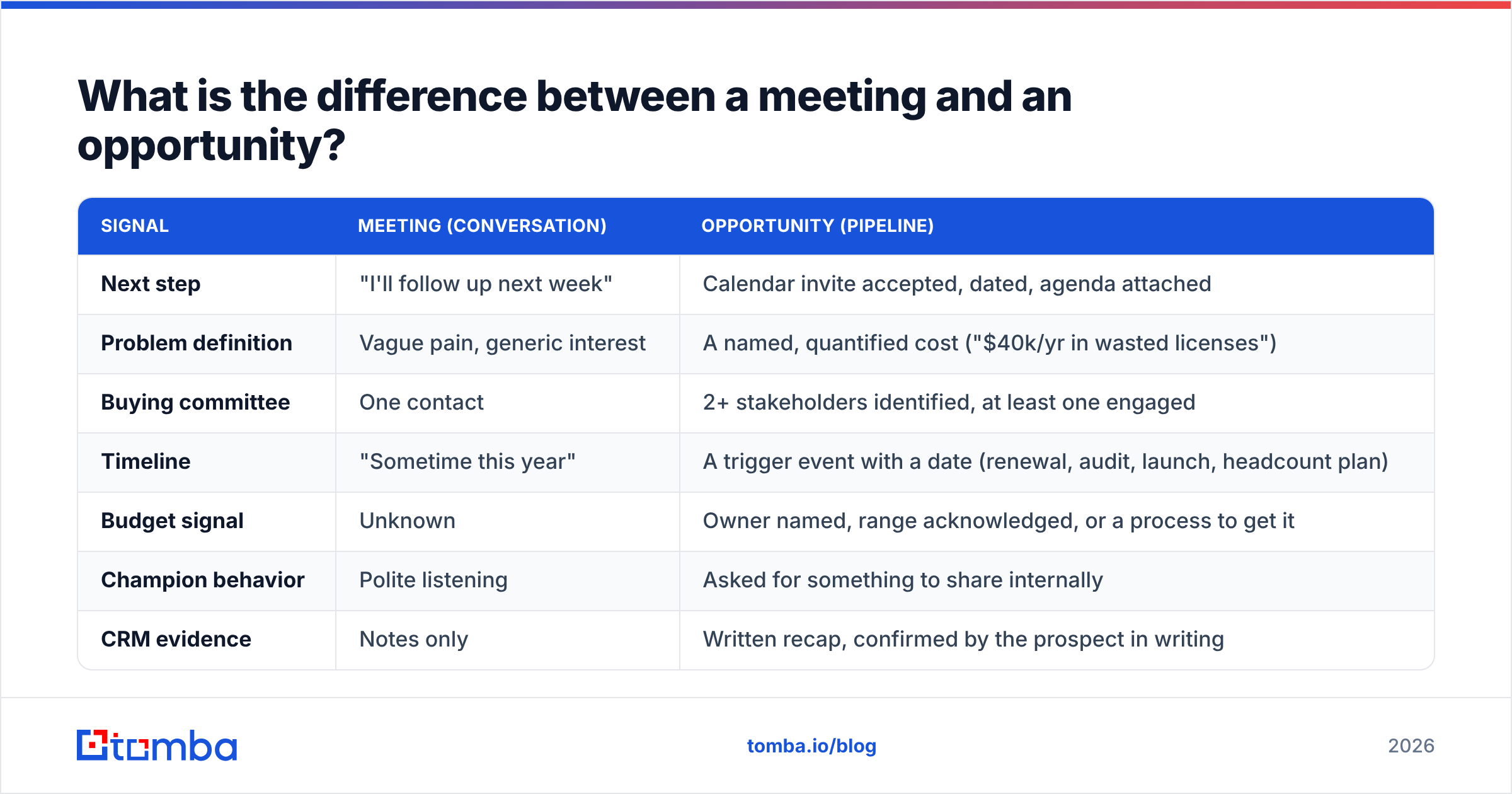
Here is the bar. If a call does not clear it, it is a conversation — valuable, maybe, but not pipeline. Do not let it into the forecast.
| Signal | Meeting (conversation) | Opportunity (pipeline) |
|---|---|---|
| Next step | "I'll follow up next week" | Calendar invite accepted, dated, agenda attached |
| Problem definition | Vague pain, generic interest | A named, quantified cost ("$40k/yr in wasted licenses") |
| Buying committee | One contact | 2+ stakeholders identified, at least one engaged |
| Timeline | "Sometime this year" | A trigger event with a date (renewal, audit, launch, headcount plan) |
| Budget signal | Unknown | Owner named, range acknowledged, or a process to get it |
| Champion behavior | Polite listening | Asked for something to share internally |
| CRM evidence | Notes only | Written recap, confirmed by the prospect in writing |
Four of seven clears the bar with a plan to fix the rest. Two of seven is a conversation. Be honest about the difference — the whole point of a sales pipeline is that it predicts revenue, and a pipeline that includes hopes instead of opportunities predicts nothing.
How do you close the meeting so it converts?#
The last five minutes are worth more than the first forty. Most reps use them to recap features. Use them to manufacture the next event instead.
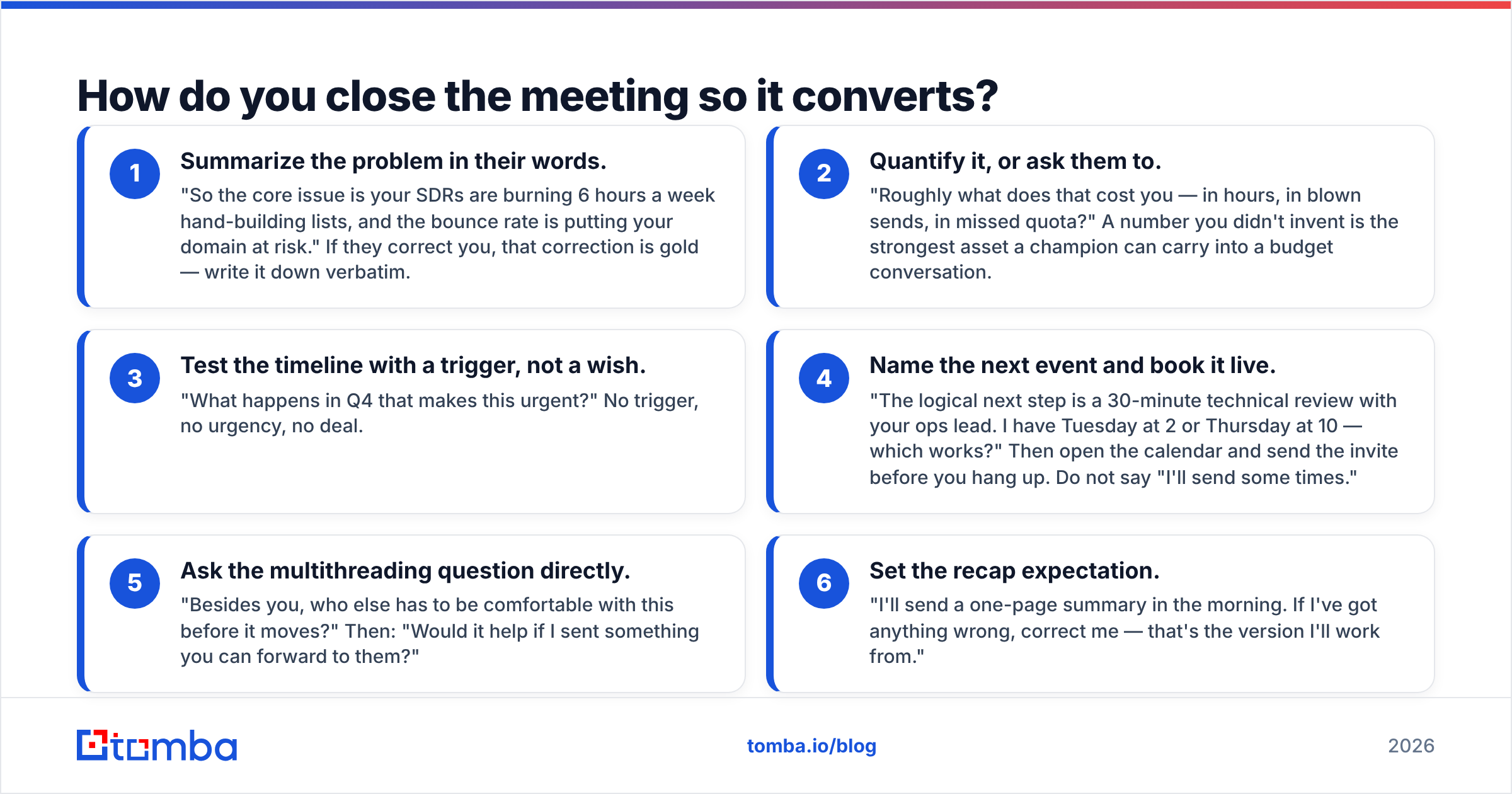
Run this sequence, out loud, every time:
- Summarize the problem in their words. "So the core issue is your SDRs are burning 6 hours a week hand-building lists, and the bounce rate is putting your domain at risk." If they correct you, that correction is gold — write it down verbatim.
- Quantify it, or ask them to. "Roughly what does that cost you — in hours, in blown sends, in missed quota?" A number you didn't invent is the strongest asset a champion can carry into a budget conversation.
- Test the timeline with a trigger, not a wish. "What happens in Q4 that makes this urgent?" No trigger, no urgency, no deal.
- Name the next event and book it live. "The logical next step is a 30-minute technical review with your ops lead. I have Tuesday at 2 or Thursday at 10 — which works?" Then open the calendar and send the invite before you hang up. Do not say "I'll send some times."
- Ask the multithreading question directly. "Besides you, who else has to be comfortable with this before it moves?" Then: "Would it help if I sent something you can forward to them?"
- Set the recap expectation. "I'll send a one-page summary in the morning. If I've got anything wrong, correct me — that's the version I'll work from."
Step 4 is non-negotiable. Everything else can be recovered by email; a missing next step cannot. A meeting that ends without a scheduled second event is a meeting you will have to re-sell from scratch, and the second sell is always harder because your prospect has now had time to remember they were busy.
What should the post-meeting follow-up actually contain?#
Not a thank-you note. Not a deck. A forwardable artifact — a document your champion can paste into Slack without editing.
A high-converting recap has five parts and fits on one screen:
- The problem, restated in their language. Two sentences maximum. Use their numbers.
- The cost of inaction. What it costs to do nothing for another two quarters.
- What we discussed as a fit. Three bullets, tied to their problem — not a feature list.
- Open questions. Things you need from them. This creates a reason to reply.
- The next step, with the date already on the calendar. Restate it so it exists in writing.
Send it inside 24 hours. Gartner's B2B buying research has found buyers spend the overwhelming majority of their buying journey not talking to sellers — they're doing internal work, comparing, and building consensus without you in the room. Your recap is the only thing representing you during that time. Make it do work.
If you're following up with people who weren't on the call, you need their contact details before you can write to them at all. This is where a lot of multithreading dies: the rep knows the VP of RevOps exists, but has no email address and doesn't want to ask. Running the company through a domain search or a LinkedIn finder takes seconds and removes the excuse.
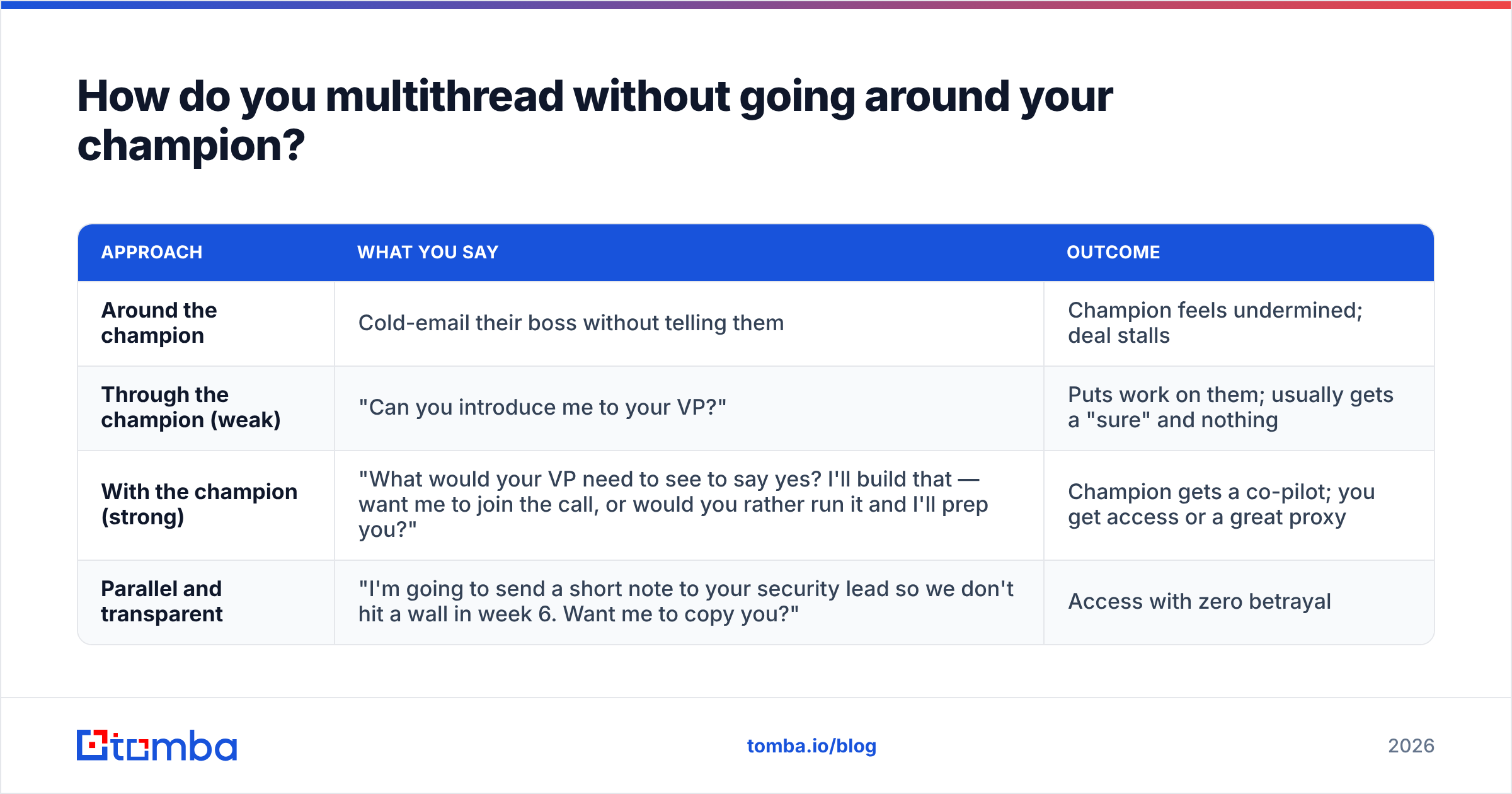
How do you multithread without going around your champion?#
Going over your contact's head is how you lose a champion. Going with them is how you win a deal.
The framing that works: make multithreading their idea, and make it about de-risking their internal pitch, not your commission.
| Approach | What you say | Outcome |
|---|---|---|
| Around the champion | Cold-email their boss without telling them | Champion feels undermined; deal stalls |
| Through the champion (weak) | "Can you introduce me to your VP?" | Puts work on them; usually gets a "sure" and nothing |
| With the champion (strong) | "What would your VP need to see to say yes? I'll build that — want me to join the call, or would you rather run it and I'll prep you?" | Champion gets a co-pilot; you get access or a great proxy |
| Parallel and transparent | "I'm going to send a short note to your security lead so we don't hit a wall in week 6. Want me to copy you?" | Access with zero betrayal |
The last two are the ones that convert. Notice they both offer the champion a way to stay in control. Nobody blocks help; everybody blocks a land grab.
Practically: after every first meeting, identify at least two more names in the account — the economic buyer and the likely technical blocker. Enrich them, verify the addresses so your notes actually land, and add them to the deal record. A deal with one contact is a coin flip. A deal with four is a forecast.

What does a mutual action plan do that a follow-up email can't?#
It converts a maybe into a shared project with two owners.
A mutual action plan (MAP) is a simple shared doc listing every step between now and go-live, who owns each one, and the target date. It sounds bureaucratic. It is the highest-leverage artifact in enterprise selling, for one reason: the moment a prospect edits your MAP, they have started buying.
A minimal MAP has six rows:
- Technical review — owner: their ops lead — target date
- Security / procurement questionnaire — owner: their IT — target date
- Pilot scope agreed — owner: joint — target date
- Pricing + business case to budget owner — owner: champion, prepped by you — target date
- Contract redlines — owner: their legal — target date
- Kickoff — owner: joint — target date
Send it as a draft, explicitly incomplete: "Here's my best guess at the path to a decision by October 15. I've almost certainly got the internal steps wrong — can you fix them?" You are not asking for commitment. You are asking for correction, which is much easier to give, and which produces commitment as a byproduct.
If they won't touch it, you've learned something more valuable than any verbal "we're very interested": there is no path. Downgrade the deal, save yourself six weeks of chasing, and go work an account that will engage.
Which meetings are worth converting in the first place?#
Some meetings should not become opportunities. Forcing them into the pipeline is how forecasts rot.
The uncomfortable truth is that a large share of conversion problems are actually targeting problems. If the person on the call has no budget, no authority, and no urgent trigger, no amount of next-step discipline will save it. You booked the wrong meeting.
That pushes the fix upstream, into how you build the list:
- Fit before volume. Ten meetings with the right title at the right company size beats fifty with anyone who'll take a call.
- Verify before you send. Bounces damage your sender reputation, and a damaged domain means your recaps and MAPs land in spam later — at exactly the moment they matter most. Run addresses through an email verifier before the first touch.
- Enrich before the call. Knowing headcount, tech stack, and recent funding lets you skip discovery small talk and go straight at the trigger event.
- Trigger-led, not title-led. A new VP of Sales in seat 60 days, a fresh Series B, a compliance deadline — these are the reasons someone buys now rather than someday.
Buyers on G2 consistently rank data accuracy as the top selection criterion in sales intelligence tools, and it's not vanity: bad data doesn't just waste a send, it poisons the entire downstream conversion math. If 20% of your meetings were never convertible, your "meeting-to-opportunity rate" is measuring your list, not your reps.
What should you measure to know it's working?#
Stop tracking "meetings booked" as a headline number. It rewards the wrong behavior — it pays reps to fill calendars, not pipeline.
Track these instead:
| Metric | Definition | Healthy range (B2B SaaS) |
|---|---|---|
| Meeting-to-opportunity rate | Meetings that clear your written qualification bar | 30–50% |
| Next-step-set rate | % of meetings ending with a booked, accepted calendar invite | 70%+ |
| 24h recap rate | % of meetings with a written recap sent same/next day | 95%+ |
| Contacts per open deal | Distinct engaged stakeholders | 3+ |
| MAP acceptance rate | % of opportunities where the prospect edits the plan | 40%+ |
| Stage-2 survival at 30 days | Opportunities still active a month after creation | 60%+ |
The two leading indicators — next-step-set rate and 24h recap rate — are fully within a rep's control, which makes them coachable in a way that "close rate" never is. Fix those two and the lagging metrics move on their own, usually within a quarter.
Track them per rep and per segment. When one rep sets next steps 85% of the time and another sits at 40%, you don't have a motivation problem. You have a script problem, and scripts are fixable in a single call.
Where does this break most often?#
Four failure points, in order of frequency:
- The rep is afraid to ask for the calendar. Fix: make the ask part of the meeting template, not a judgment call. What's on the agenda gets done.
- The champion goes dark. Fix: multithread before they go dark, not after. Once you're chasing, you've already lost leverage.
- The recap is a thank-you note. Fix: rewrite the template. If it can't be forwarded without edits, it's not a recap.
- Bad contact data quietly kills the follow-up. Fix: verify and enrich, and stop assuming your CRM's data is current. Contact records decay roughly 2–3% per month; over a 6-month sales cycle that's a meaningful chunk of your buying committee gone stale.
None of these require a new methodology, a new CRM, or a new headcount. They require a checklist and a manager who enforces it.
Ready to stop losing deals between the meeting and the pipeline?#
Converting meetings into opportunities is a discipline problem at the end of the call and a data problem at the start of the account. You control both.
Fix the last five minutes: name the next step, book it live, promise the recap. Fix the follow-through: send a forwardable artifact within 24 hours, find the other two people who have to say yes, and put a mutual action plan in front of them before they've had time to forget why they took the call.
And fix the input. You can't multithread an account whose stakeholders you can't reach. The Tomba Email Finder gets you verified addresses for the VP of RevOps, the security lead, and the budget owner — the people who decide whether your "great meeting" ever becomes a deal — with a free tier at 25 searches a month and paid plans from $49/mo. Check Tomba pricing if you want to see how it scales with your team, or start with the free tier and enrich your next ten open deals this afternoon.
The meeting is the easy part. Everything that makes it count happens after you hang up.
Related guides#
Ready to find emails that actually work?
Join 150,000+ professionals who stopped guessing and started sending. Free credits on signup — no credit card required.
Get the Tomba newsletter
Practical outbound tactics and product updates — once every two weeks.
About the author