Convoso Pricing Pros and Cons: 2026 Reviews & Costs
Convoso doesn't publish its rates. Here's what outbound teams actually pay, what verified reviewers praise, where the platform frustrates them, and when a cheaper stack wins.
TL;DR
- Convoso does not publish pricing. Every number you see online is a reseller estimate or a reviewer's leaked quote — expect a per-seat, annual-contract deal negotiated with a rep.
- Reported costs cluster in the $90–$150 per seat per month range, with seat minimums, onboarding fees, and telecom/usage charges billed on top.
- Reviewers consistently praise the dialing speed, list-management controls, and compliance tooling. The recurring complaints are contract rigidity, billing surprises, and support response times.
- Convoso is built for high-volume outbound call centers (10+ agents, dialing thousands of records a day). If you're a 3-person B2B SDR pod, it is almost certainly overbuilt and overpriced.
- The single biggest lever on your Convoso ROI isn't the plan you pick — it's the quality of the data you feed it. Bad numbers burn dial minutes you're paying for.
If you're researching Convoso pricing pros and cons, you've already hit the wall: there's no pricing page. There's a "Get a Quote" button. That's a deliberate choice. It means the only honest way to judge the platform is to triangulate — reported quotes, verified reviews, feature depth, and the cost of the stack around it.
This is that triangulation. No affiliate spin, no "10 best dialers" filler.
What is Convoso, and who is it actually built for?#
Convoso is a cloud-based contact center platform focused on outbound. Most contact-center suites treat outbound as a bolt-on to inbound support. Convoso is built the other way around. The core of the product is a multi-mode dialer — predictive, power, preview, and workflow. Around that dialer sit list management, lead scoring, answering-machine detection, local caller ID presence, and compliance tooling for TCPA-adjacent risk.
Its center of gravity is volume. Think insurance, home services, solar, education, debt relief, and healthcare enrollment. In those verticals a floor of agents dials a large list, and a 5% lift in connect rate is worth real money. You can read the official positioning on convoso.com. The buyer profile shows up clearly in the review corpus on G2, where the average reviewer runs a mid-sized call center rather than a boutique SaaS sales team.
That framing matters. Most people who Google Convoso pricing are trying to answer a question the price tag can't answer: is this the right class of tool for me?
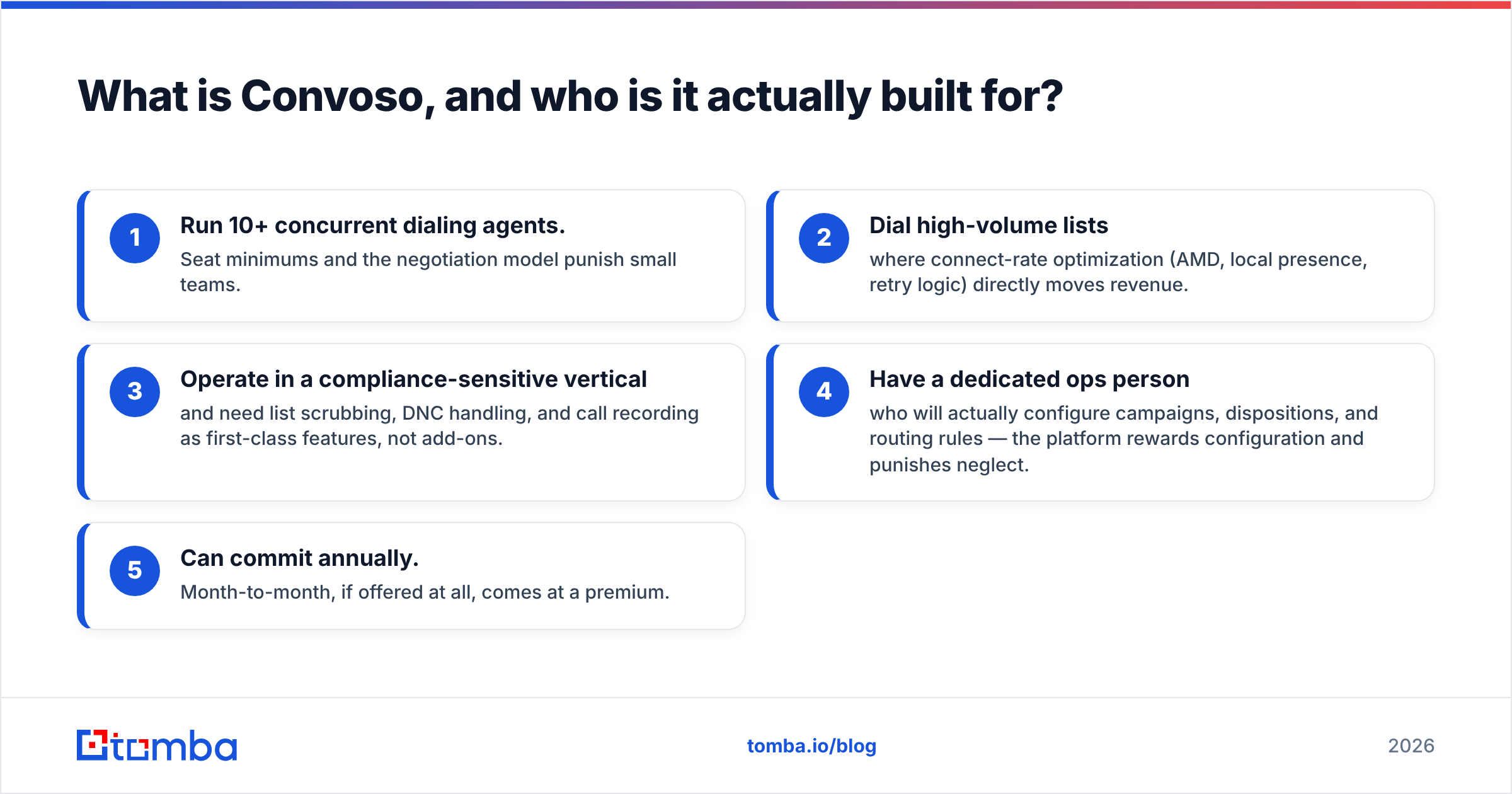
Convoso is a strong fit if you:
- Run 10+ concurrent dialing agents. Seat minimums and the negotiation model punish small teams.
- Dial high-volume lists where connect-rate optimization (AMD, local presence, retry logic) directly moves revenue.
- Operate in a compliance-sensitive vertical and need list scrubbing, DNC handling, and call recording as first-class features, not add-ons.
- Have a dedicated ops person who will actually configure campaigns, dispositions, and routing rules — the platform rewards configuration and punishes neglect.
- Can commit annually. Month-to-month, if offered at all, comes at a premium.
Convoso is a poor fit if you: run a small consultative B2B motion, dial fewer than a few hundred prospects a week, need deep two-way CRM sync as your primary workflow, or want transparent self-serve pricing you can expense without a procurement cycle.

What does Convoso pricing actually cost in 2026?#
The honest answer: nobody outside Convoso's sales team knows the rate card. That fact belongs in your evaluation of the Convoso pricing pros and cons.
Here's what the public record supports. Convoso sells on a per-seat, per-month basis, usually on an annual agreement, quoted after a discovery call and demo. Across user reviews, procurement forum threads, and third-party software directories like Capterra, reported figures for a standard agent seat cluster in the $90–$150/month band. Rates fall at higher seat counts and rise for smaller commitments.
Treat that band as a prior, not a quote. What actually determines your invoice:
- Seat count and seat minimums. Most quotes reference a floor (commonly cited around 10–20 seats). Below the floor, you either pay for empty seats or get told you're not a fit.
- Contract term. Annual is the default. Multi-year unlocks discounts; monthly, where available, carries a premium.
- Telecom and usage. Dial minutes, carrier fees, DID/number provisioning, and SMS are frequently separate line items. This is the #1 source of "my bill was higher than the quote" complaints.
- Onboarding and implementation. A one-time setup/training fee is common at this tier of contact center software.
- Add-on modules. AI features, advanced analytics, workforce tools, and premium support tiers are typically upsells rather than bundled.
So the sticker price is per-seat. But the total cost of ownership is per-seat plus usage plus setup plus modules. Budget conservatively. Assume your all-in cost lands well above the per-seat number your rep quotes.
How does Convoso compare on price and fit?#
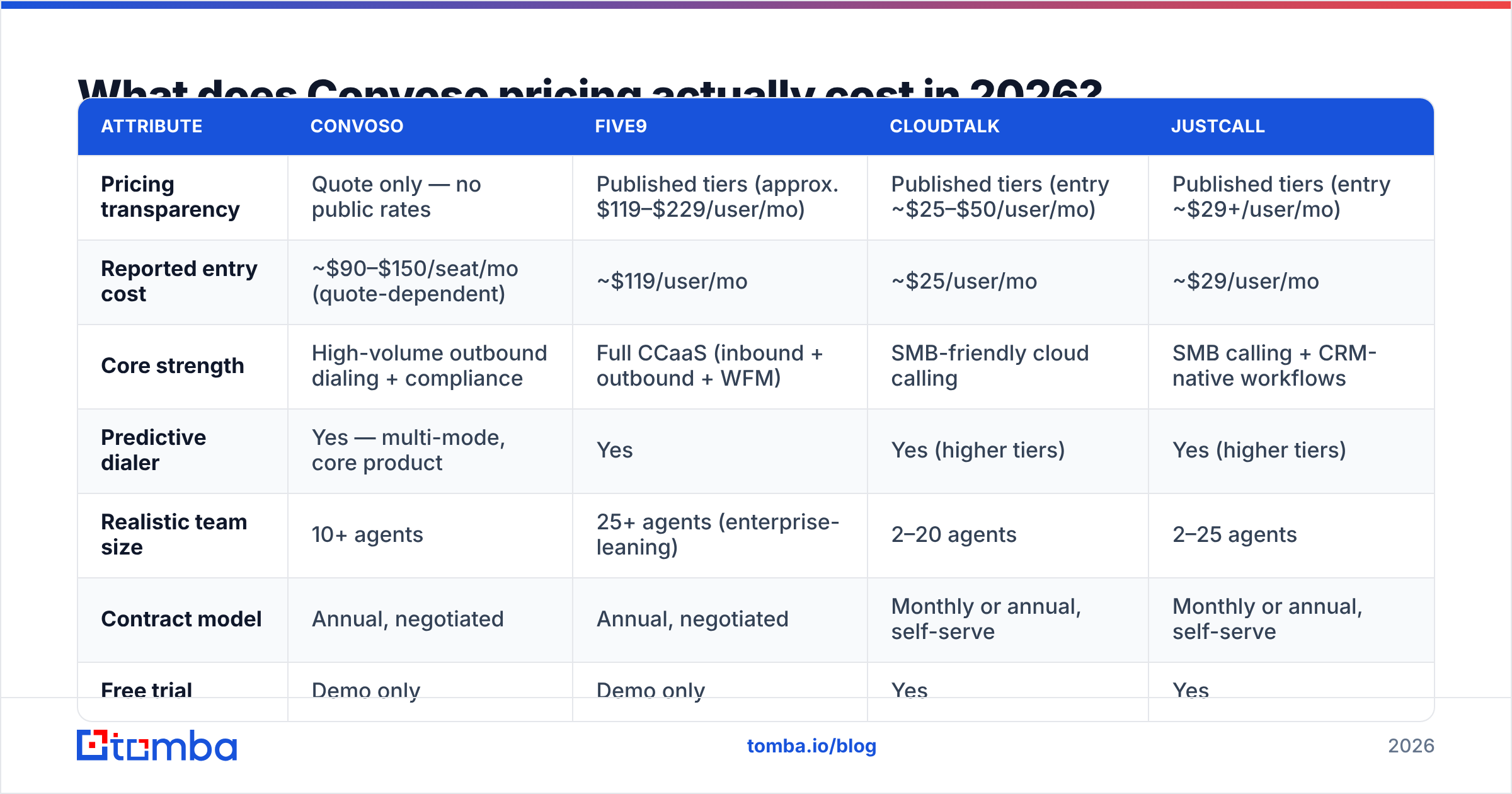
| Attribute | Convoso | Five9 | CloudTalk | JustCall |
|---|---|---|---|---|
| Pricing transparency | Quote only — no public rates | Published tiers (approx. $119–$229/user/mo) | Published tiers (entry ~$25–$50/user/mo) | Published tiers (entry ~$29+/user/mo) |
| Reported entry cost | ~$90–$150/seat/mo (quote-dependent) | ~$119/user/mo | ~$25/user/mo | ~$29/user/mo |
| Core strength | High-volume outbound dialing + compliance | Full CCaaS (inbound + outbound + WFM) | SMB-friendly cloud calling | SMB calling + CRM-native workflows |
| Predictive dialer | Yes — multi-mode, core product | Yes | Yes (higher tiers) | Yes (higher tiers) |
| Realistic team size | 10+ agents | 25+ agents (enterprise-leaning) | 2–20 agents | 2–25 agents |
| Contract model | Annual, negotiated | Annual, negotiated | Monthly or annual, self-serve | Monthly or annual, self-serve |
| Free trial | Demo only | Demo only | Yes | Yes |
| Usage/telecom billing | Typically separate | Typically separate | Bundled at tiers | Bundled at tiers |
Published competitor prices are as listed by each vendor at time of writing and shift frequently — verify before you model. The point of the table isn't the exact dollar figure; it's the shape of the market. Convoso sits in a category where you pay a premium for outbound-specific depth, and you pay it opaquely.
What are the real pros of Convoso, according to reviewers?#
Strip out the five-star noise and the same four themes surface repeatedly in verified reviews:
1. Dialing speed and connect rates. This is the recurring headline. Reviewers running high-volume campaigns report meaningful lifts in contact rate after switching from a generic dialer. They credit the mix of predictive pacing, answering-machine detection, and local caller ID presence. If your model is "more conversations per agent hour," this is the product's actual value proposition.
2. List and campaign management depth. You can slice lists, set retry cadences per disposition, prioritize records by score, and route by skill without engineering help. Ops leads who like knobs like this product.
3. Compliance tooling. DNC scrubbing, consent tracking, call recording, and configurable guardrails come standard enough that regulated verticals treat it as a differentiator versus lighter tools.
4. Reporting that ops people actually use. Real-time agent dashboards and campaign-level analytics get consistent praise. Reviewers cite spotting a bad list or a weak script mid-shift rather than in a Monday post-mortem.
What are the cons — and which ones should worry you?#
1. Opaque pricing is a negotiating disadvantage, structurally. When you can't benchmark, you can't push back. Ask for the rate card, the seat minimum, the usage rates per minute, and the renewal-uplift cap in writing before you sign.
2. Billing surprises. The most common substantive complaint across review sites is that the final invoice exceeded expectations, because telecom, minutes, or add-ons weren't clearly modeled in the quote. This is fixable — but only before signature.
3. Contract rigidity. Annual terms with auto-renew are standard. Reviewers who wanted to downsize seats mid-term report friction. Negotiate a seat-flex clause up front, especially if your headcount is seasonal.
4. Support inconsistency. Praise for onboarding is common. Complaints about response time on ongoing tickets are also common. The gap is real, and it tends to widen if you're a smaller account.
5. Overkill for low-volume B2B. Say your reps make 40 thoughtful calls a day into a named-account list. A predictive dialer isn't just unnecessary there — it's wrong for the motion. You'll pay enterprise dialer money to do preview dialing you could do from your CRM.
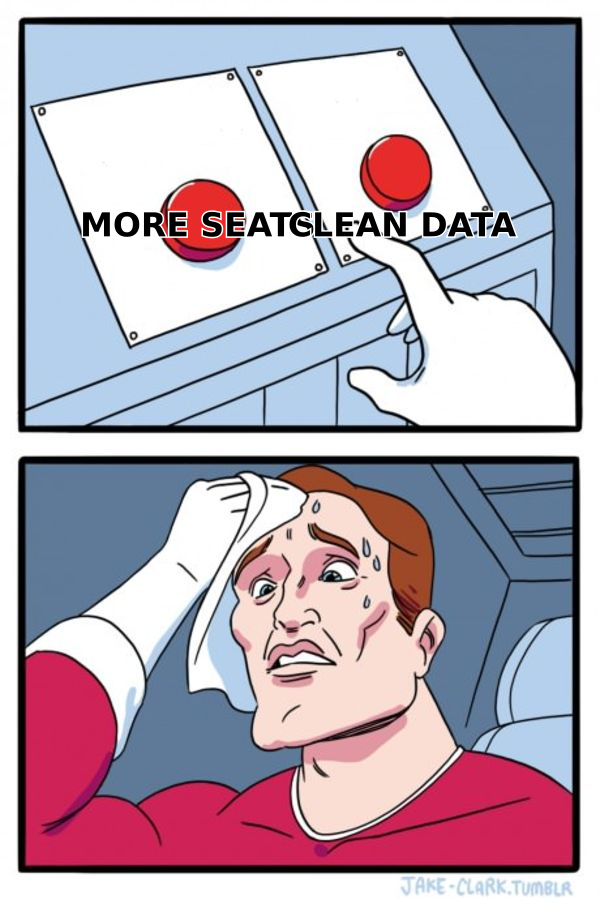
6. It amplifies whatever data you feed it. A dialer's job is to burn through a list fast. If 30% of that list is wrong numbers, dead lines, or gatekeeper switchboards, Convoso will burn through your budget fast too. Which brings us to the part most pricing reviews skip.
Is Convoso worth it — or is your problem actually the data?#
Before you buy a single seat, run this diagnostic: what percentage of your dialable records connect to a real, correct human?
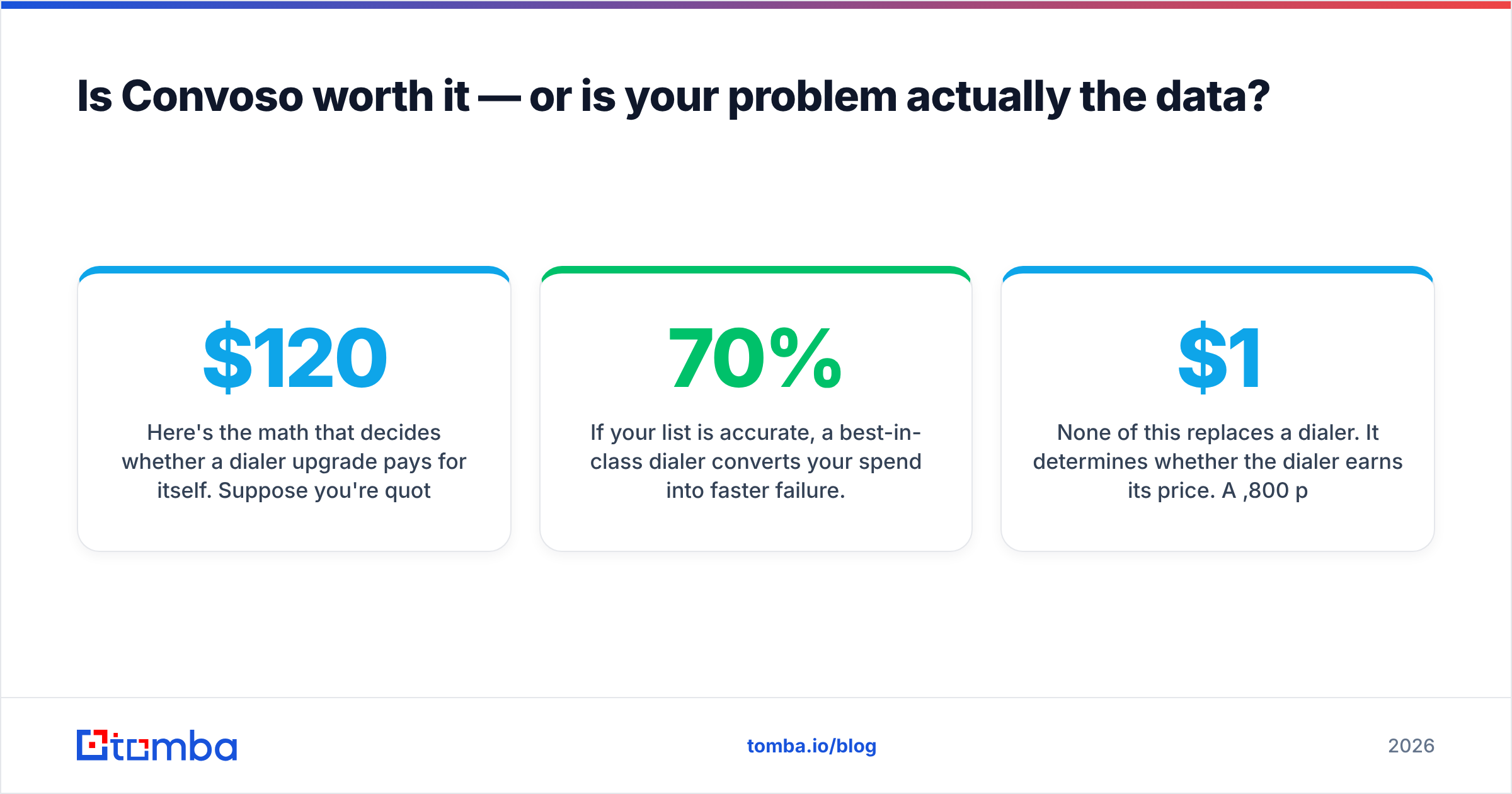
Here's the math that decides whether a dialer upgrade pays for itself. Suppose you're quoted $120/seat/month for 15 seats — $1,800/month, before usage. That platform can only improve the efficiency of dialing the list you give it. It cannot invent a correct phone number for a prospect whose direct line changed two employers ago.
If your list is 70% accurate, a best-in-class dialer converts your spend into faster failure. Teams routinely find that the same budget spent on data hygiene first, dialer second produces a bigger lift than the reverse. Connect rate is a product of reachability, not just pacing.
Concretely, that means:
- Validate numbers before they enter a campaign. A phone validator pass on your list strips dead and invalid lines before they cost you dial minutes.
- Source direct lines, not switchboards. A phone finder that returns verified B2B direct numbers changes the denominator of every connect-rate calculation you'll ever run.
- Enrich the record so the conversation is worth having. Data enrichment — title, company size, tech stack, seniority — is what turns a connect into a qualified conversation instead of a hang-up.
- Keep an email fallback on every record. Most dials don't connect. A verified email address on the same contact means the attempt isn't wasted; it becomes a touch in a multichannel sequence.
None of this replaces a dialer. It decides whether the dialer earns its price. A $1,800/month platform running against a clean, verified, enriched list is a growth engine. The same platform running against a scraped CSV is an expensive way to leave voicemails for people who left the company.
What should you ask Convoso before you sign?#
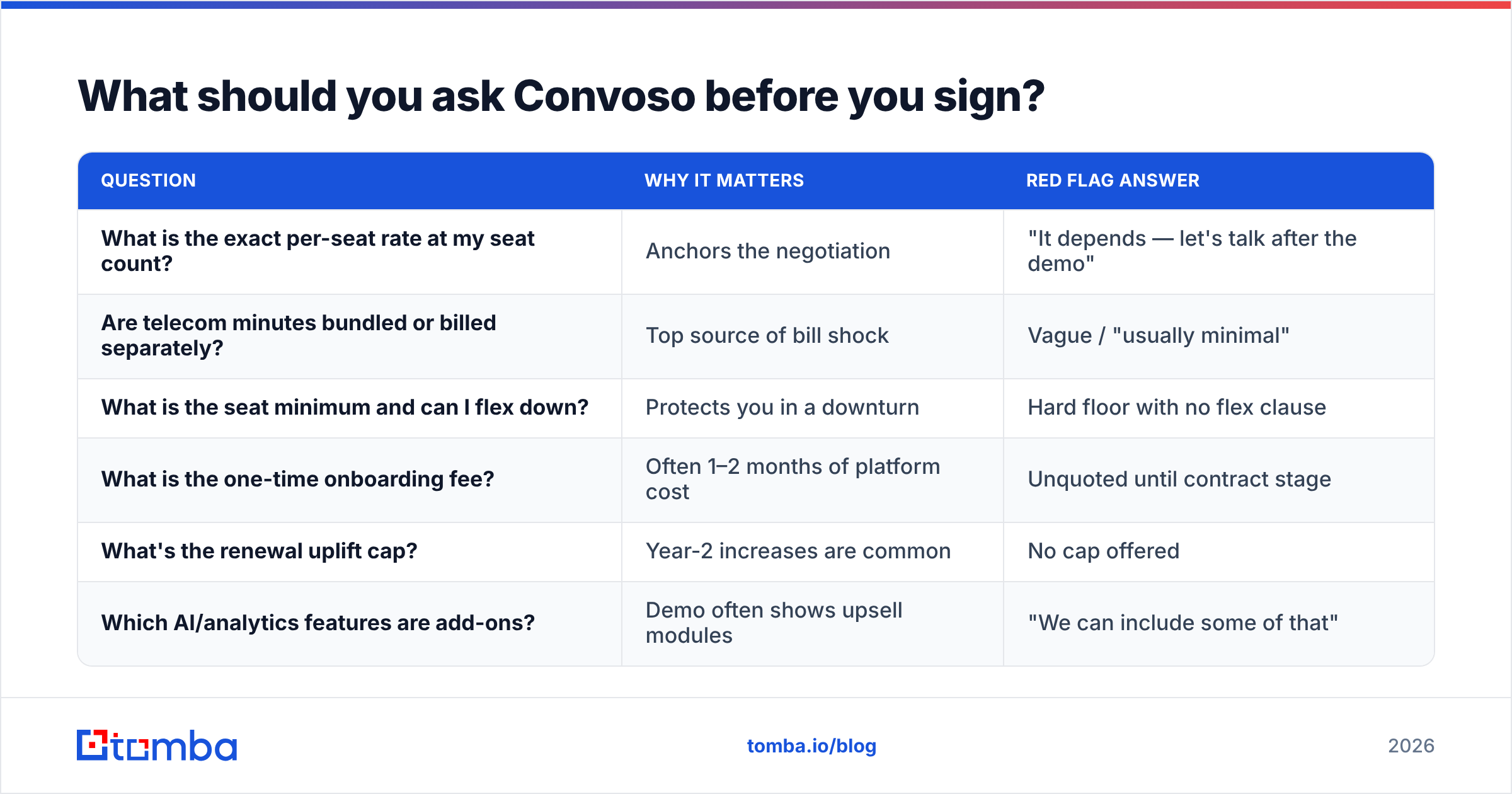
Take this list into the call. The answers are the review.
| Question | Why it matters | Red flag answer |
|---|---|---|
| What is the exact per-seat rate at my seat count? | Anchors the negotiation | "It depends — let's talk after the demo" |
| Are telecom minutes bundled or billed separately? | Top source of bill shock | Vague / "usually minimal" |
| What is the seat minimum and can I flex down? | Protects you in a downturn | Hard floor with no flex clause |
| What is the one-time onboarding fee? | Often 1–2 months of platform cost | Unquoted until contract stage |
| What's the renewal uplift cap? | Year-2 increases are common | No cap offered |
| Which AI/analytics features are add-ons? | Demo often shows upsell modules | "We can include some of that" |
If a rep won't put the usage rates and the renewal cap in writing, that tells you more about your future experience than any G2 badge will.
Convoso pricing pros and cons: the verdict#
Convoso is worth its price if — and only if — you are a genuine high-volume outbound shop with clean data and an ops owner. In that profile, the dialing engine, list controls, and compliance tooling justify a per-seat rate well above generic cloud calling tools. The opacity becomes an annoyance you negotiate through rather than a dealbreaker.
If you're a small B2B team, if your list quality is unproven, or if you need to expense a tool this quarter without a procurement cycle, the Convoso pricing pros and cons point the other way. It's the wrong shape of purchase. Start with a self-serve calling tool, prove your connect rate on clean data, and revisit the enterprise dialer when volume — not ambition — demands it.
And whichever platform you land on, fix the input before you optimize the throughput. Compare what you're paying for dial minutes against what you'd pay to make those minutes land: our pricing starts free at 25 searches/month, with Starter at $49/mo and Growth at $99/mo — a rounding error next to a 15-seat dialer contract.
Feed the dialer a list worth dialing. Use the Tomba Email Finder to build verified, enriched contact records — direct emails alongside the phone data your reps actually need — so every seat you're paying for connects to a real person, not a disconnected line. Start free, no card, and test it against your current list before your next renewal call.
Related guides#
Ready to find emails that actually work?
Join 150,000+ professionals who stopped guessing and started sending. Free credits on signup — no credit card required.
Get the Tomba newsletter
Practical outbound tactics and product updates — once every two weeks.
About the author