Corefactors Pricing Reviews Pros and Cons: 2026 Verdict
Corefactors bundles CRM, email, SMS and calling into one RevOps suite at a low entry price. Here's what the plans actually cost, where users say it wins, and where it quietly falls short.
Looking for Corefactors pricing reviews pros and cons in one place? This guide has all three. Corefactors is a low-cost RevOps CRM with calling, SMS and email built in. The seat price is small. The metered add-ons are not. Below you'll find what the plans really cost, what users praise, what they complain about, and who should walk away.
TL;DR — Corefactors Pricing Reviews Pros and Cons at a Glance#
- Corefactors is an all-in-one RevOps CRM (marketing, sales, support, success) built by an India-based team. Telephony, SMS, WhatsApp and email sit inside the same box rather than bolted on.
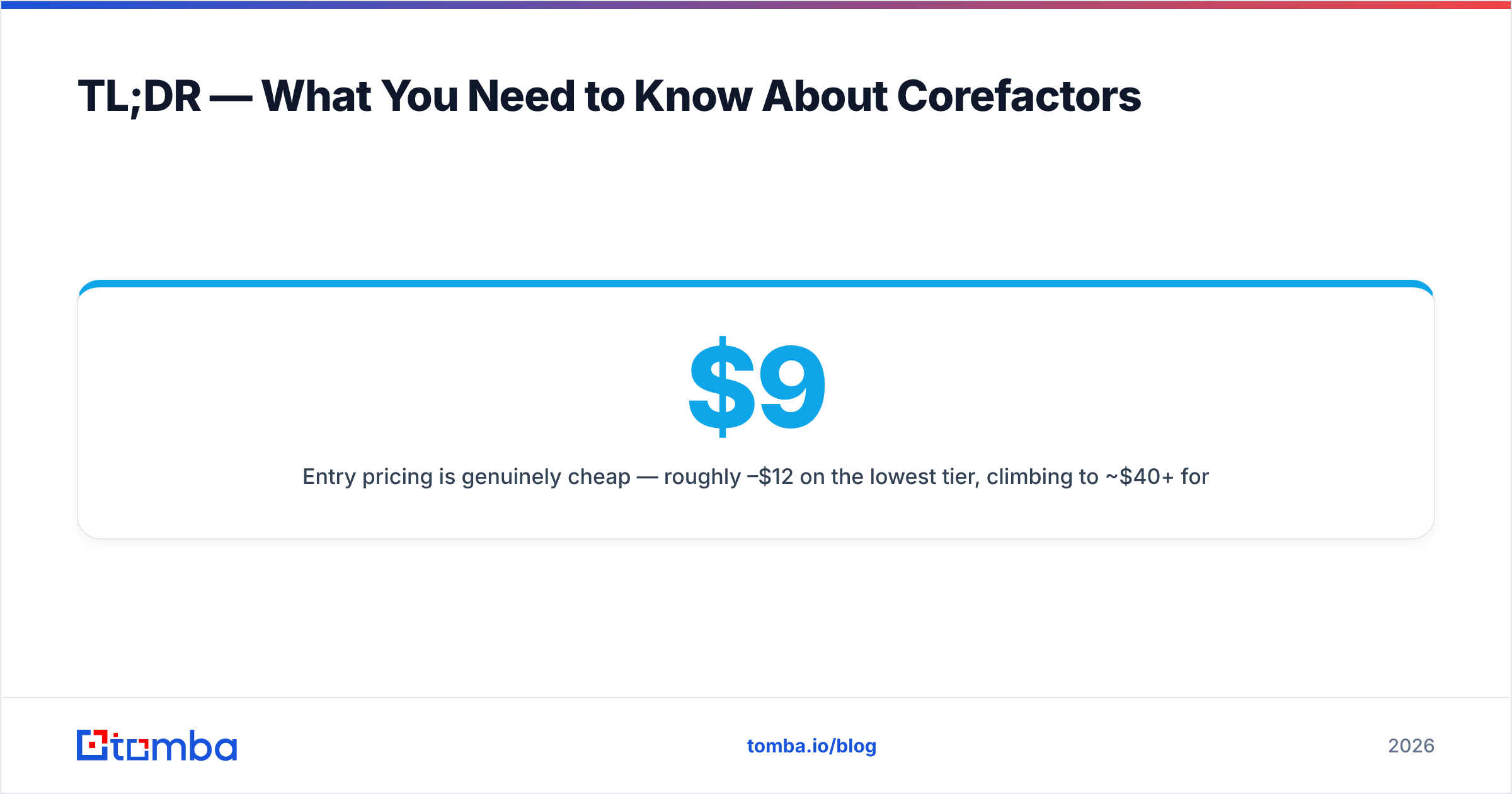
- Entry pricing is genuinely cheap — roughly $9–$12 per user/month on the lowest tier. Enterprise-grade plans climb to ~$40+ per user/month. That's a fraction of HubSpot Sales Hub or Salesforce.
- The real cost is not the seat price. Telephony minutes, SMS credits, WhatsApp conversations and email sends are consumption-based add-ons. That's where the bill grows.
Two more things shape the buying decision:
- Reviews cluster around a consistent story: strong support and fast onboarding, weak UI polish, and thin native integrations compared to global players.
- It has no email-finding or contact-data layer. You still need a dedicated email finder to fill the top of the funnel. Corefactors manages contacts. It doesn't source them.
What Is Corefactors and Who Actually Uses It?#
Corefactors is a RevOps CRM suite. Instead of selling you a sales CRM and then upselling a marketing cloud and a service cloud, it ships those as modules under one login: Sales Box, Marketing Box, Support Box, and Success Box.
The pitch is consolidation. One customer record, one automation engine, one reporting layer. Phone, SMS, WhatsApp and email run natively rather than through third-party connectors. Picture a 15-person sales team juggling a CRM, an autodialer, a bulk SMS vendor and a mail tool. Collapsing those four bills into one is the entire value proposition.
The typical Corefactors customer is a mid-market or SMB company in India, Southeast Asia, or the Gulf. Think edtech, real estate, healthcare, insurance, finance, or B2B services. In those sectors inbound lead volume is high, speed-to-lead beats sophistication, and phone is still the closing channel.
If your motion is "500 leads land today, call them within four minutes," Corefactors was designed for you. If your motion is enterprise ABM with a 14-month cycle and a Salesforce-shaped data model, it wasn't.
You can see the full module breakdown on the Corefactors website, and user-submitted reviews on G2 and Capterra.

What Does Corefactors Pricing Actually Look Like in 2026?#
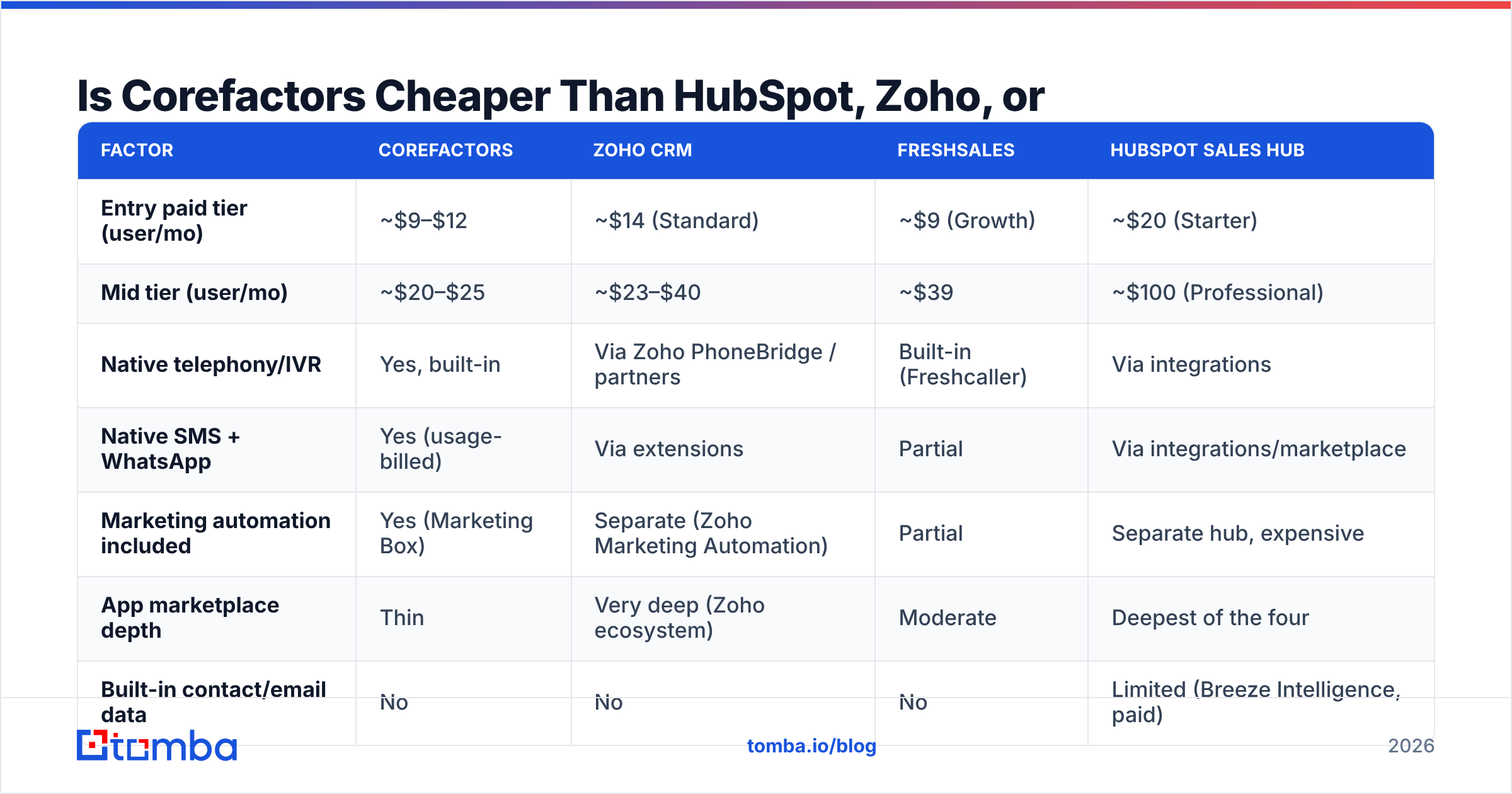
Corefactors publishes per-user, per-month pricing with an annual billing discount. The structure has stayed broadly consistent. Still, treat every number below as a planning estimate, not a quote. Region, currency, and negotiated bundles all move it, and the vendor's own page is the source of truth.
The headline tiers break down roughly like this:
| Plan tier | Approx. price (per user/mo, annual) | Core modules included | Best for |
|---|---|---|---|
| Startup / Basic | ~$9–$12 | Lead capture, basic Sales Box, pipeline, tasks | Solo founders, teams under 5 |
| Growth / Professional | ~$20–$25 | Sales Box + Marketing Box, automation, telephony integration | 5–25 rep inside-sales teams |
| Advanced / Business | ~$35–$40 | Adds Support Box, Success Box, advanced reporting, API access | Full RevOps teams, 25–100 seats |
| Enterprise | Custom quote | SLAs, dedicated instance options, custom workflows, priority support | 100+ seats, regulated industries |
Where the extra money goes. These are the line items people miss until invoice #2:
- Telephony minutes — the built-in cloud telephony and IVR are billed by usage. A team making 200 dials a day accrues real minutes.
- SMS credits — bulk SMS is sold in credit packs, not included in the seat price. In markets with DLT registration (India), there's an operational overhead too.
- WhatsApp Business API conversations — priced per conversation window, passed through from Meta's rate card plus a margin.
The next three are less obvious, and they hit bigger accounts hardest:
- Email sending volume — the Marketing Box tiers cap monthly sends. Going past the cap means upgrading or buying volume.
- Onboarding and migration — for larger accounts, implementation is frequently a separate, one-time professional-services fee.
- Minimum seat counts — some tiers carry a floor, commonly 3–5 users. So "just me trying it out" is not always the price you see.
Blend it out. A 20-rep team on the Growth tier with moderate dialing and SMS realistically lands in the $700–$1,200/month range once consumption is counted. That's still cheap against HubSpot's Sales Hub Professional. It is not the $20 × 20 = $400 the pricing page implies.
Is Corefactors Cheaper Than HubSpot, Zoho, or Freshsales?#
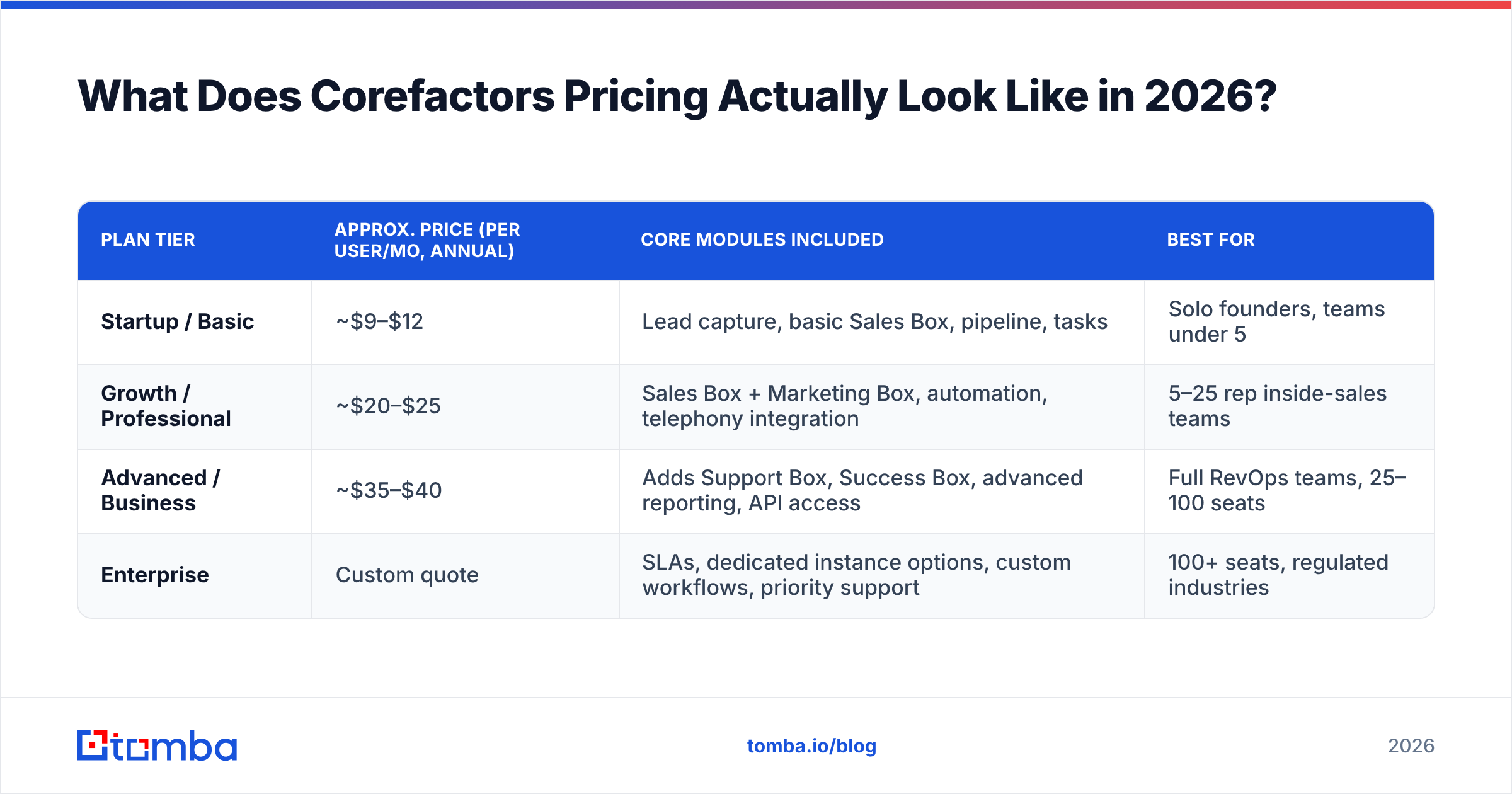
Yes on the seat price. It's more nuanced on total cost of ownership.
| Factor | Corefactors | Zoho CRM | Freshsales | HubSpot Sales Hub |
|---|---|---|---|---|
| Entry paid tier (user/mo) | ~$9–$12 | ~$14 (Standard) | ~$9 (Growth) | ~$20 (Starter) |
| Mid tier (user/mo) | ~$20–$25 | ~$23–$40 | ~$39 | ~$100 (Professional) |
| Native telephony/IVR | Yes, built-in | Via Zoho PhoneBridge / partners | Built-in (Freshcaller) | Via integrations |
| Native SMS + WhatsApp | Yes (usage-billed) | Via extensions | Partial | Via integrations/marketplace |
| Marketing automation included | Yes (Marketing Box) | Separate (Zoho Marketing Automation) | Partial | Separate hub, expensive |
| App marketplace depth | Thin | Very deep (Zoho ecosystem) | Moderate | Deepest of the four |
| Built-in contact/email data | No | No | No | Limited (Breeze Intelligence, paid) |
| Best-fit region | India, SEA, Gulf | Global | Global | Global, US/EU-weighted |
The honest read: Corefactors wins on bundled communication. If phone and SMS are core to your motion, the alternatives make you assemble the stack yourself — a dialer here, a messaging vendor there, a Zapier tax in between. Corefactors gives you one bill and one record.
HubSpot wins on ecosystem and polish. Their pricing page makes the gap obvious. You pay several times more per seat. In return you get a marketplace, a mature API, and an interface your reps won't complain about.
Zoho wins on breadth. If your company already runs Zoho Books, Desk, and People, staying inside that ecosystem beats a point-solution CRM almost regardless of feature parity.
None of these four sources contact data. That's a separate layer, and it's worth understanding before you blame the CRM for a bad pipeline.
What Do Corefactors Reviews Say — The Pros?#
Pull the recurring themes out of public review sites and user threads. The praise is consistent and specific:
- Speed to value. Teams report going live in days, not quarters. Lead capture forms, distribution rules, and a working pipeline in a week is a normal outcome. HubSpot and Salesforce rollouts rarely match that.
- Support quality. This is the single most-repeated positive. Named account managers, responsive chat, and a team that will actually build a workflow for you. For an SMB with no admin headcount, that beats a feature list.
- Lead-distribution and speed-to-lead automation. Round-robin, rule-based routing, and instant auto-dial on form fill are strong and easy to configure. If you're an edtech or real-estate firm competing on who calls first, this is the feature that pays for the tool.
Two more show up in almost every positive review:
- All channels in one timeline. Call recording, SMS thread, WhatsApp, and email all attach to the same lead record. No tab-hopping. This sounds mundane until you've worked without it.
- Price-to-capability ratio. Some teams would otherwise be priced out of a real CRM. Corefactors hands them a workable RevOps stack at a genuinely low entry point.
What Do Corefactors Reviews Say — The Cons?#
The criticism is equally consistent, and you should weigh it seriously:
- UI and UX feel dated. This is the most common complaint. The product is functional and dense rather than modern. Reps coming from HubSpot or Pipedrive notice immediately, and rep adoption is where CRMs go to die.
- Integration marketplace is thin. Native connectors to the wider SaaS world are limited next to Zoho, HubSpot, or Salesforce. Expect to lean on the API or a middleware layer. That means engineering time you didn't budget.
- Reporting depth plateaus. Standard dashboards are fine. Custom multi-object reporting and cohort analysis get frustrating fast, and advanced analytics sit behind higher tiers.
Three more complaints come up repeatedly, and they cost real money:
- Usage-based add-ons obscure the true cost. The seat price is honest. The total bill is harder to forecast, because telephony, SMS, and WhatsApp all meter. Model your volume before you sign an annual deal.
- Documentation gaps. Self-serve learners hit walls. That's partly why support is so praised — you need it more than you would elsewhere.
- No data layer. Corefactors stores and works your contacts. It does not find them. There is no email finder, no verifier, no enrichment engine. A CRM full of stale or guessed addresses will still bounce, no matter how good the routing rules are.

Where Does Corefactors Fall Short — and What Fills the Gap?#
A CRM is a system of record. It assumes the record already exists. The gap for most Corefactors buyers sits upstream: getting accurate, verified contacts into the system in the first place.
If your inbound volume is high and leads self-identify by filling in a form, that gap is small. But every outbound motion needs a sourcing and verification layer that Corefactors does not ship. Think of any "let's target 300 fintech CFOs in the Gulf" campaign.
Practically, that means pairing it with:
- A finder for the top of the funnel. Use a domain search to pull every reachable contact at a target company, then verify before importing. Bad addresses inflate your CRM record count and wreck your email deliverability at the same time.
- A verifier before every campaign. Corefactors will happily blast a list of 5,000 addresses. It won't tell you 900 of them are dead. An email verifier pass protects the sending domain you'll rely on for the next two years.
The last two matter most if you're paying for metered channels:
- An enrichment step on inbound forms. A form gives you an email and a name. Data enrichment gives you the company, headcount, tech stack, and seniority. That's what your routing rules need to score and distribute correctly.
- A phone layer that's actually accurate. Corefactors dials the number in the record. If the number is wrong, its telephony dials dead air on your dime. Sourcing verified B2B phone numbers upstream cuts your metered minute spend directly.
This isn't an argument against Corefactors. It's an argument for understanding what class of tool it is. A CRM is a warehouse. It doesn't manufacture the inventory.
Who Should Buy Corefactors — and Who Should Not?#
Buy it if:
- Your sales motion is high-volume inbound with a phone-first close.
- You operate in India, SEA, or the Gulf and want a vendor in your timezone with support that answers.
- You're consolidating three or four point tools and the integration tax is killing you.
- Your budget genuinely cannot absorb HubSpot Professional pricing, and Zoho's ecosystem sprawl feels like overkill.
Skip it if:
- Your team is UI-sensitive and adoption risk is your biggest concern.
- You need a deep integration marketplace or a mature developer ecosystem out of the box.
- Your GTM is outbound-heavy and data-driven. In that case your first spend should go to contact data and deliverability, not a CRM with bundled SMS.
- You're a US/EU enterprise with procurement, SOC 2 scrutiny, and a Salesforce-shaped org chart.
Evaluating alternatives in the broader stack? It's worth reviewing the Apollo alternatives landscape too. Several tools that get compared to Corefactors are prospecting platforms, not CRMs, and conflating the two leads to a bad purchase.
For a broader market view of where RevOps tooling is heading, the analyst coverage at Gartner is a useful sanity check against vendor marketing.
What's the Honest Verdict on Corefactors Pricing?#
Corefactors is priced well and reviewed fairly. It's a legitimate, low-cost, communication-heavy CRM. It solves one problem — speed-to-lead in phone-driven markets — better than most tools at its price point.
Here's the whole Corefactors pricing reviews pros and cons story in one line: cheap to start, honest in its reviews, and pricier than it looks at the edges. The pros are real — fast onboarding, human support, all channels in one timeline. So are the cons: dated UI, shallow integrations, and metered billing that hides the true cost.
The mistake to avoid is treating it as a complete GTM stack. It manages the relationship after the contact exists. It does nothing to create that contact, verify it, or keep your sending reputation intact. Those are the failures that quietly cap pipeline no matter how good your CRM configuration is.
Budget for the CRM. Then budget separately for the data that feeds it.
Fill your Corefactors pipeline with contacts that actually exist. Tomba's Email Finder sources verified professional email addresses by name, company, or domain. The leads you route, dial, and message are real ones. Start on the free tier (25 searches/month, no card), or scale up: Starter is $49/mo, Growth $99/mo, and Pro $249/mo. Full Tomba pricing is public, and there's no metered surprise on invoice #2.
Related guides#
Ready to find emails that actually work?
Join 150,000+ professionals who stopped guessing and started sending. Free credits on signup — no credit card required.
Get the Tomba newsletter
Practical outbound tactics and product updates — once every two weeks.
About the author