9 Best Coresignal Alternatives in 2026 (Free and Paid)
Coresignal sells firmographic, employee, and job-posting data at dataset scale — but that scale comes with contracts, credits, and a steep floor. Here are nine alternatives, ranked by what they actually do well.
TL;DR
- Coresignal is a raw B2B data vendor — company, employee, and job-posting records delivered via API or bulk dataset. It is built for data teams, not for an SDR who needs 200 verified emails by Friday.
- Most people searching for Coresignal alternatives want one of three things: lower entry cost, verified contact data (Coresignal does not hand you a validated email inbox-by-inbox), or a simpler delivery model than parquet dumps.
- If you need contact-level data (emails, phones, enrichment), Tomba, BookYourData, and Apollo are the practical swaps. If you need dataset-scale firmographics, People Data Labs, Bright Data, and Crunchbase are the closer matches.
- Price floors vary by an order of magnitude: entry-level contact tooling starts around $49/mo, while dataset licensing and enterprise platforms routinely run $1,000+/mo on annual contracts.
- The right pick depends on one question: are you building a data product or filling a pipeline? They are not the same buy, and vendors that pretend they are will overcharge you.
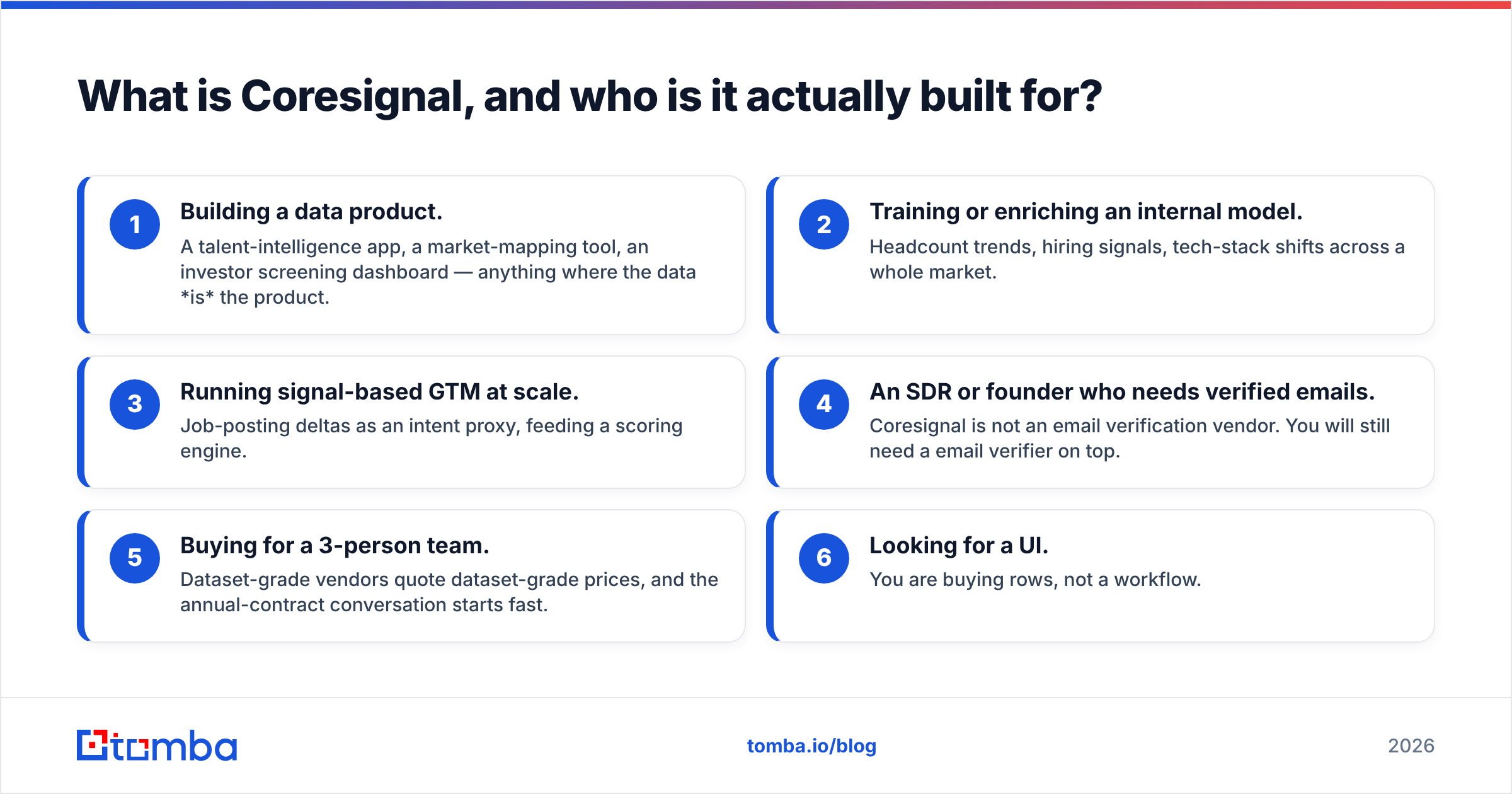
What is Coresignal, and who is it actually built for?#
Coresignal is a B2B data provider that sells structured records at scale: company profiles, professional/employee profiles, and job postings, mostly sourced from public web data. You consume it through an API or as bulk datasets (JSON/parquet), and the pitch is coverage and freshness — hundreds of millions of records, refreshed on a cadence.
That positioning matters, because it defines who Coresignal is not for.
Coresignal is a good fit when you are:
- Building a data product. A talent-intelligence app, a market-mapping tool, an investor screening dashboard — anything where the data is the product.
- Training or enriching an internal model. Headcount trends, hiring signals, tech-stack shifts across a whole market.
- Running signal-based GTM at scale. Job-posting deltas as an intent proxy, feeding a scoring engine.
Coresignal is a poor fit when you are:
- An SDR or founder who needs verified emails. Coresignal is not an email verification vendor. You will still need a email verifier on top.
- Buying for a 3-person team. Dataset-grade vendors quote dataset-grade prices, and the annual-contract conversation starts fast.
- Looking for a UI. You are buying rows, not a workflow.
If any of those three describe you, you are not really shopping for a Coresignal competitor. You are shopping for a different category of tool that happens to overlap.
Why do teams look for Coresignal alternatives?#
Four reasons come up over and over in G2 reviews and buying calls:
- The price floor. Raw-data licensing is not a $49 purchase. Once you scope volume, refresh frequency, and fields, you are usually in a quote-and-contract motion. Teams that just wanted a few thousand enriched contacts a month find the minimum uncomfortable.
- No contact-level verification. Web-sourced profile data tells you a person exists and where they work. It does not tell you that
first.last@company.comwill accept mail today. That gap is where bounce rates come from. - Engineering overhead. Bulk datasets need a pipeline: ingestion, dedup, normalization, storage. If you do not have a data engineer, that "cheap per record" price is not cheap.
- Coverage skew. Public-web sourcing is excellent for tech and enterprise, thinner for SMBs, trades, and non-English-first markets. Ask for a sample in your ICP before you sign anything.
None of that makes Coresignal bad. It makes it specific. The alternatives below are organized by what you are actually trying to replace.
How should you compare Coresignal alternatives?#
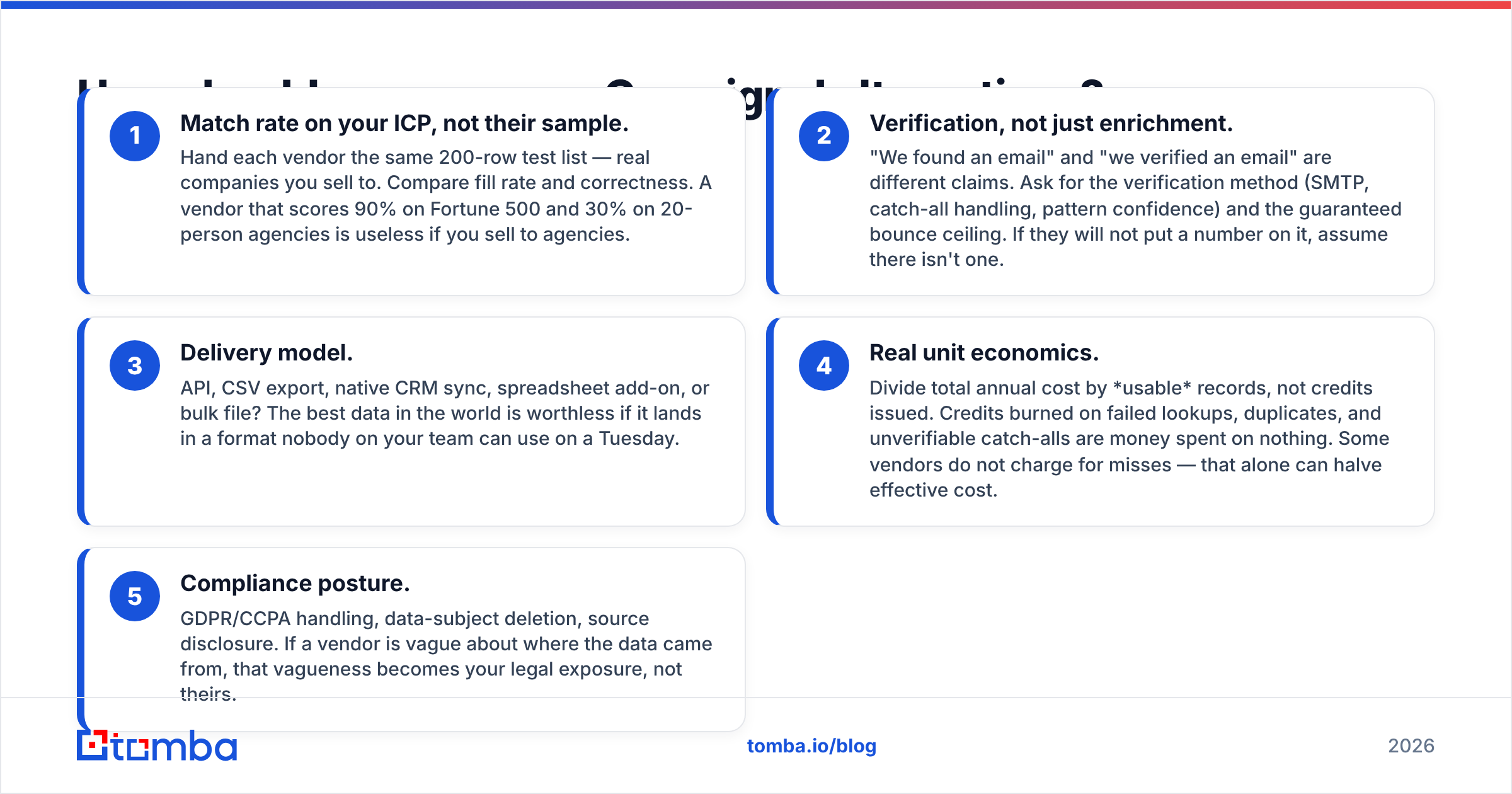
Run every vendor on your shortlist through the same five checks. Do it before the demo, not after.
- Match rate on your ICP, not their sample. Hand each vendor the same 200-row test list — real companies you sell to. Compare fill rate and correctness. A vendor that scores 90% on Fortune 500 and 30% on 20-person agencies is useless if you sell to agencies.
- Verification, not just enrichment. "We found an email" and "we verified an email" are different claims. Ask for the verification method (SMTP, catch-all handling, pattern confidence) and the guaranteed bounce ceiling. If they will not put a number on it, assume there isn't one.
- Delivery model. API, CSV export, native CRM sync, spreadsheet add-on, or bulk file? The best data in the world is worthless if it lands in a format nobody on your team can use on a Tuesday.
- Real unit economics. Divide total annual cost by usable records, not credits issued. Credits burned on failed lookups, duplicates, and unverifiable catch-alls are money spent on nothing. Some vendors do not charge for misses — that alone can halve effective cost.
- Compliance posture. GDPR/CCPA handling, data-subject deletion, source disclosure. If a vendor is vague about where the data came from, that vagueness becomes your legal exposure, not theirs.
Which Coresignal alternatives are worth your shortlist in 2026?#
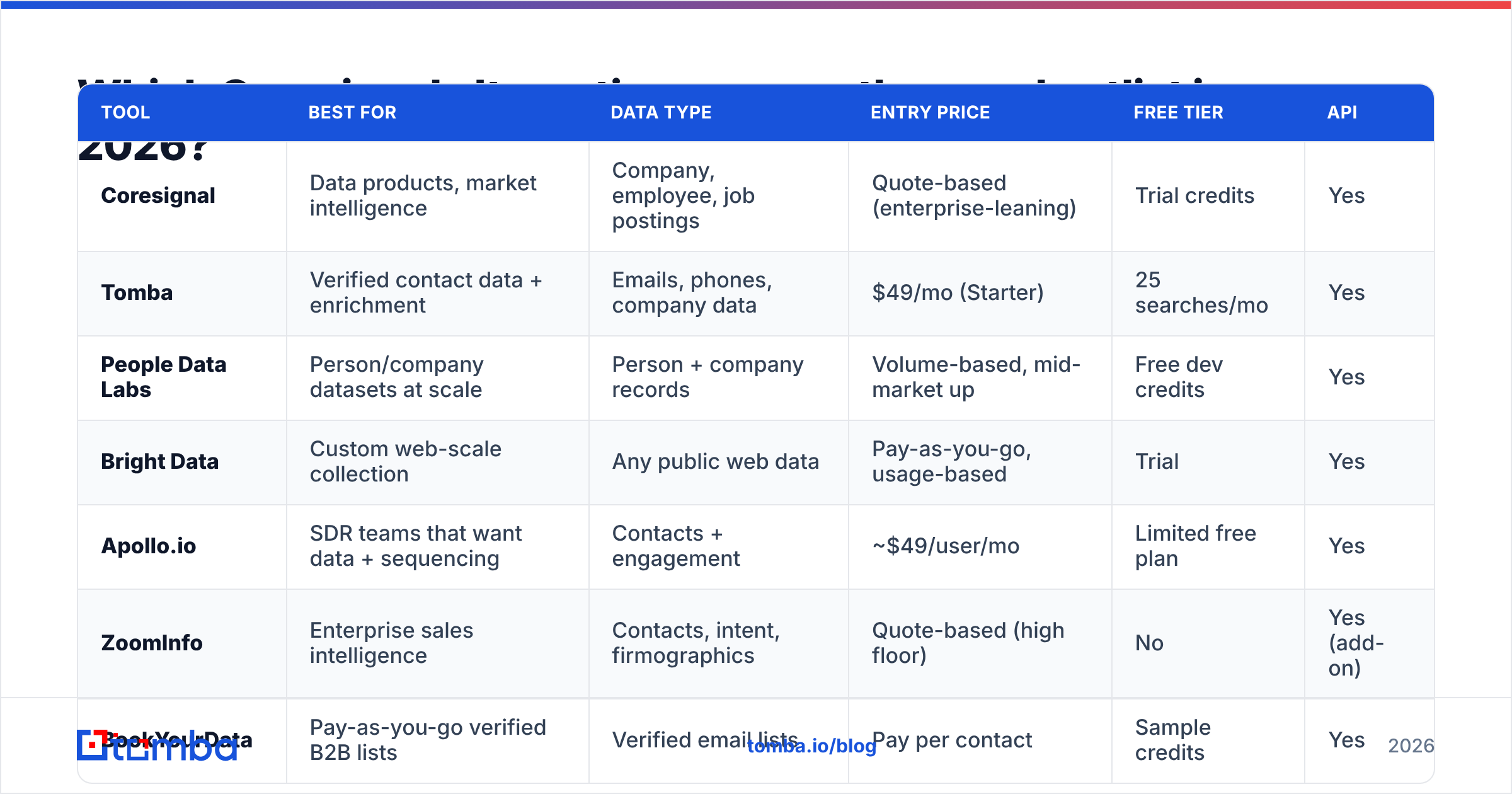
Here is the head-to-head. Prices are entry-level published rates at time of writing; enterprise and dataset tiers are quote-based almost everywhere in this category, so treat the floor as a floor.
| Tool | Best for | Data type | Entry price | Free tier | API |
|---|---|---|---|---|---|
| Coresignal | Data products, market intelligence | Company, employee, job postings | Quote-based (enterprise-leaning) | Trial credits | Yes |
| Tomba | Verified contact data + enrichment | Emails, phones, company data | $49/mo (Starter) | 25 searches/mo | Yes |
| People Data Labs | Person/company datasets at scale | Person + company records | Volume-based, mid-market up | Free dev credits | Yes |
| Bright Data | Custom web-scale collection | Any public web data | Pay-as-you-go, usage-based | Trial | Yes |
| Apollo.io | SDR teams that want data + sequencing | Contacts + engagement | ~$49/user/mo | Limited free plan | Yes |
| ZoomInfo | Enterprise sales intelligence | Contacts, intent, firmographics | Quote-based (high floor) | No | Yes (add-on) |
| BookYourData | Pay-as-you-go verified B2B lists | Verified email lists | Pay per contact | Sample credits | Yes |
| Crunchbase | Funding, M&A, company signals | Company + investment data | ~$99/mo (Starter) | Limited free | Yes (Pro tiers) |
| Clearbit (HubSpot) | Inbound enrichment inside HubSpot | Firmographic enrichment | Bundled/credits | Limited | Yes |
1. Tomba — the contact-data swap#
If what you actually needed from Coresignal was reachable people, this is the closest fit and the cheapest entry. Tomba's core is the email finder: give it a name and a domain, get a verified professional email back. Around it sit domain search (every public email pattern at a company), a catch-all verifier, phone finder, and data enrichment.
- Pricing: Free (25 searches/mo), Starter $49/mo, Growth $99/mo, Pro $249/mo, Enterprise custom. Full Tomba pricing.
- Delivery: REST API, Chrome extension, Google Sheets, Excel, bulk CSV, native CRM integrations.
- Where it wins: verification is built in, not bolted on. You get a confidence score per address, and catch-all domains are handled explicitly instead of silently passed through.
- Where it doesn't: it is not a firmographic dataset vendor. If you need 40 million company records dumped into a warehouse for model training, buy Coresignal or PDL.
2. People Data Labs — the like-for-like dataset play#
People Data Labs is the most direct structural competitor: person and company records, API-first, built for engineers who want to enrich or build on top. Coverage on person records is strong, and the developer experience is genuinely good.
- Best for: teams that already have engineers and want dataset semantics without a bulk-file pipeline.
- Watch for: enrichment credits burn fast on low-match ICPs, and contact-level emails still want independent verification before you send.
3. Bright Data — when you want the raw pipes#
Bright Data sells collection infrastructure: proxies, scraping browsers, and pre-built datasets. If Coresignal's schema does not have the field you need, Bright Data lets you go get it yourself.
- Best for: teams with a specific, non-standard data need and the engineering to run it.
- Watch for: you now own compliance, parsing, and maintenance. That is a real cost, just not on the invoice.
4. Apollo.io — data plus the outbound motion#
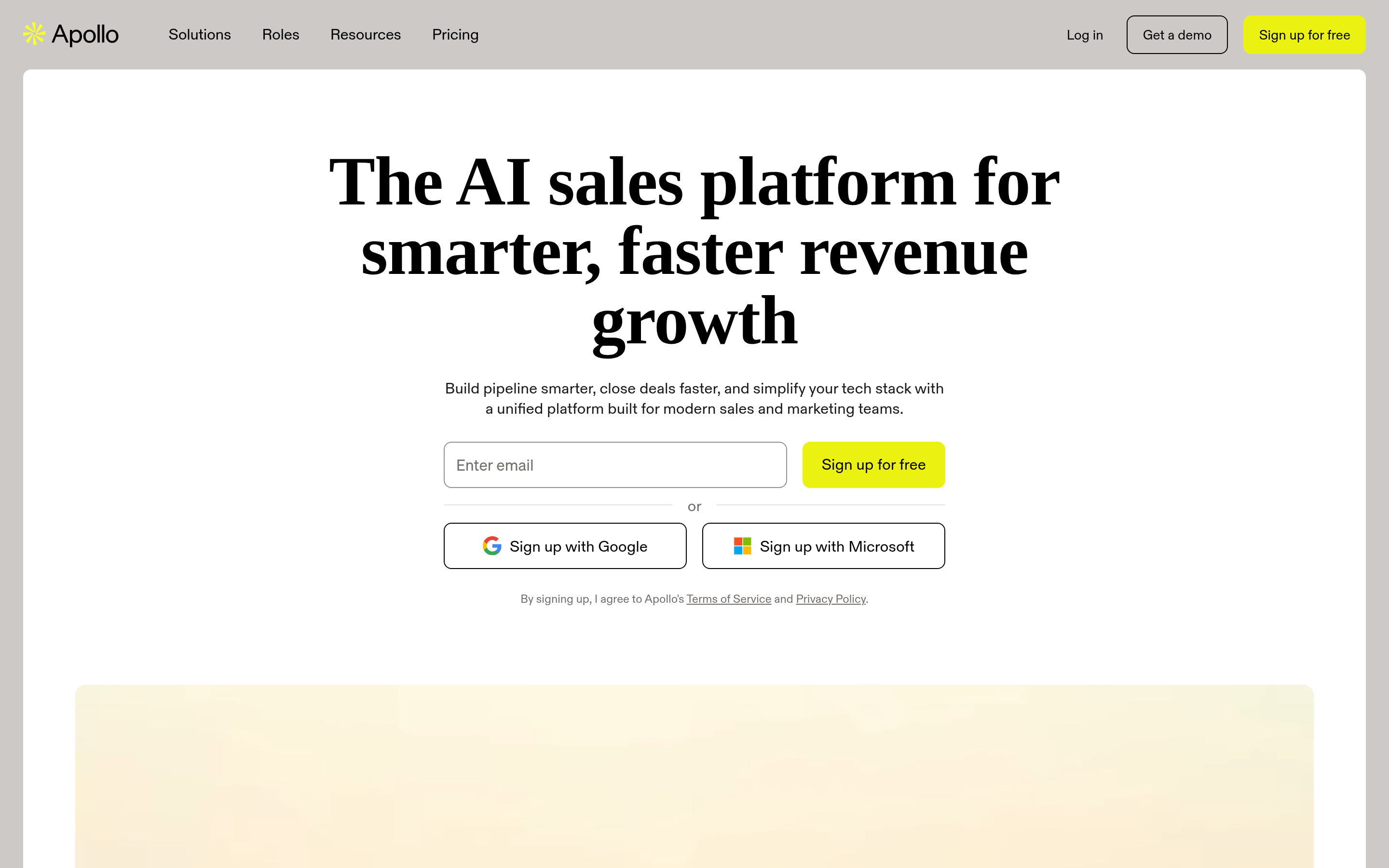
Apollo bundles a large contact database with sequencing, dialer, and basic CRM. For a sales team, that bundle is the entire point — one tool instead of three.
- Best for: SDR teams that want to search, enrich, and send in one place.
- Watch for: data accuracy varies by segment, and the all-in-one bundle means you pay per seat even for people who only need the data. If that math stops working, an Apollo alternative that charges per lookup rather than per seat usually lands cheaper.
5. ZoomInfo — the enterprise incumbent#

Deep firmographics, intent signals, org charts, and the strongest coverage of large-enterprise contacts in the category. It is also the highest floor on this list, typically annual, typically five figures.
- Best for: enterprise sales orgs with a real budget and a procurement team.
- Watch for: contract lock-in and credit structures that reward heavy use and punish light use.
6. BookYourData — pay-as-you-go, verified on delivery#
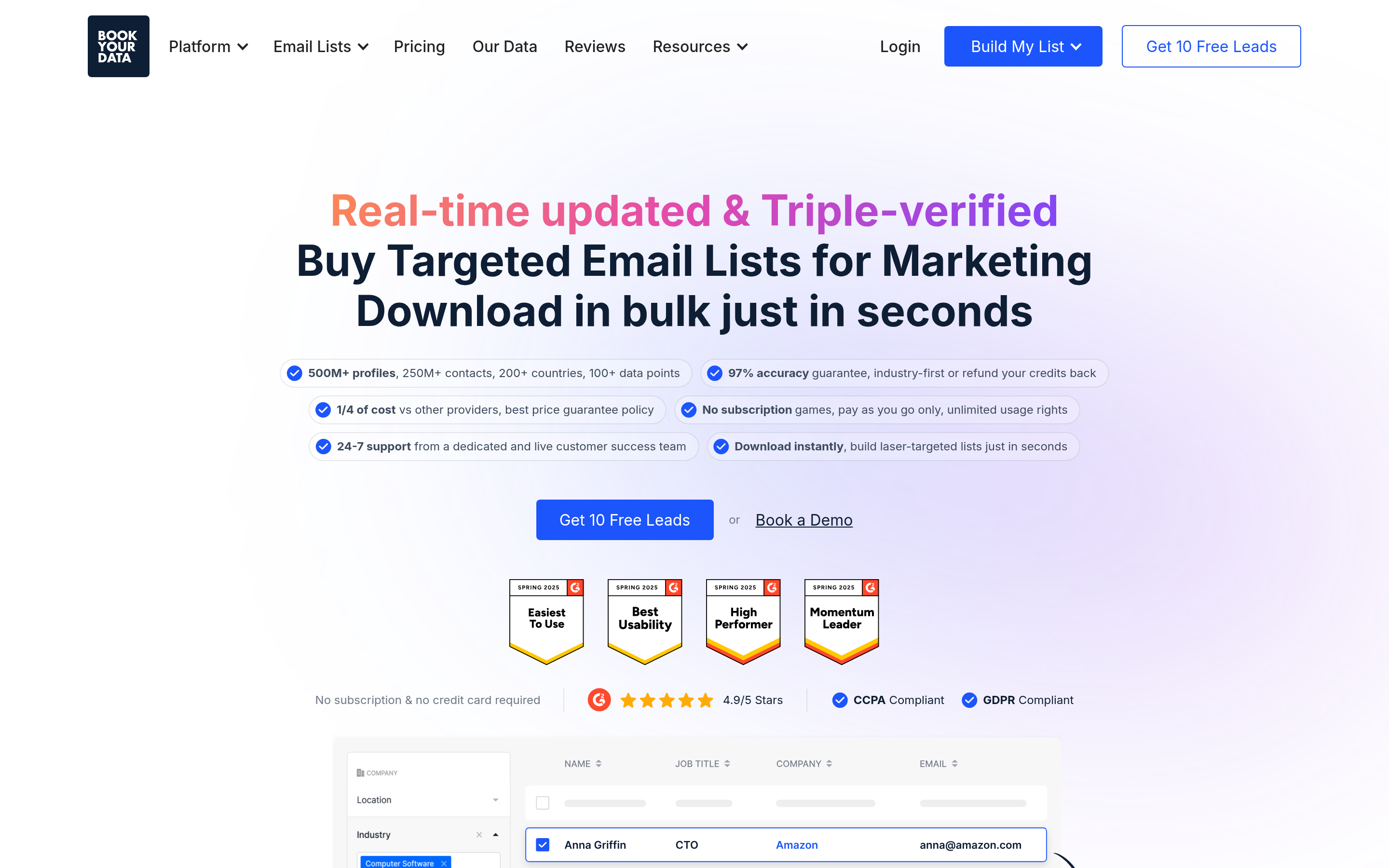
BookYourData takes a different route: instead of a subscription, you buy verified B2B contacts by the record, with filters for industry, title, geography, and company size. It is a strong option when your need is bursty — a campaign, an event list, a new market test — and you do not want a monthly commitment sitting on the P&L.
- Best for: teams that want a clean, verified list now without signing anything.
- Watch for: as with any list purchase, segment tightly. A big list you cannot personalize is a deliverability problem waiting to happen.
7. Crunchbase — signals, not contacts#
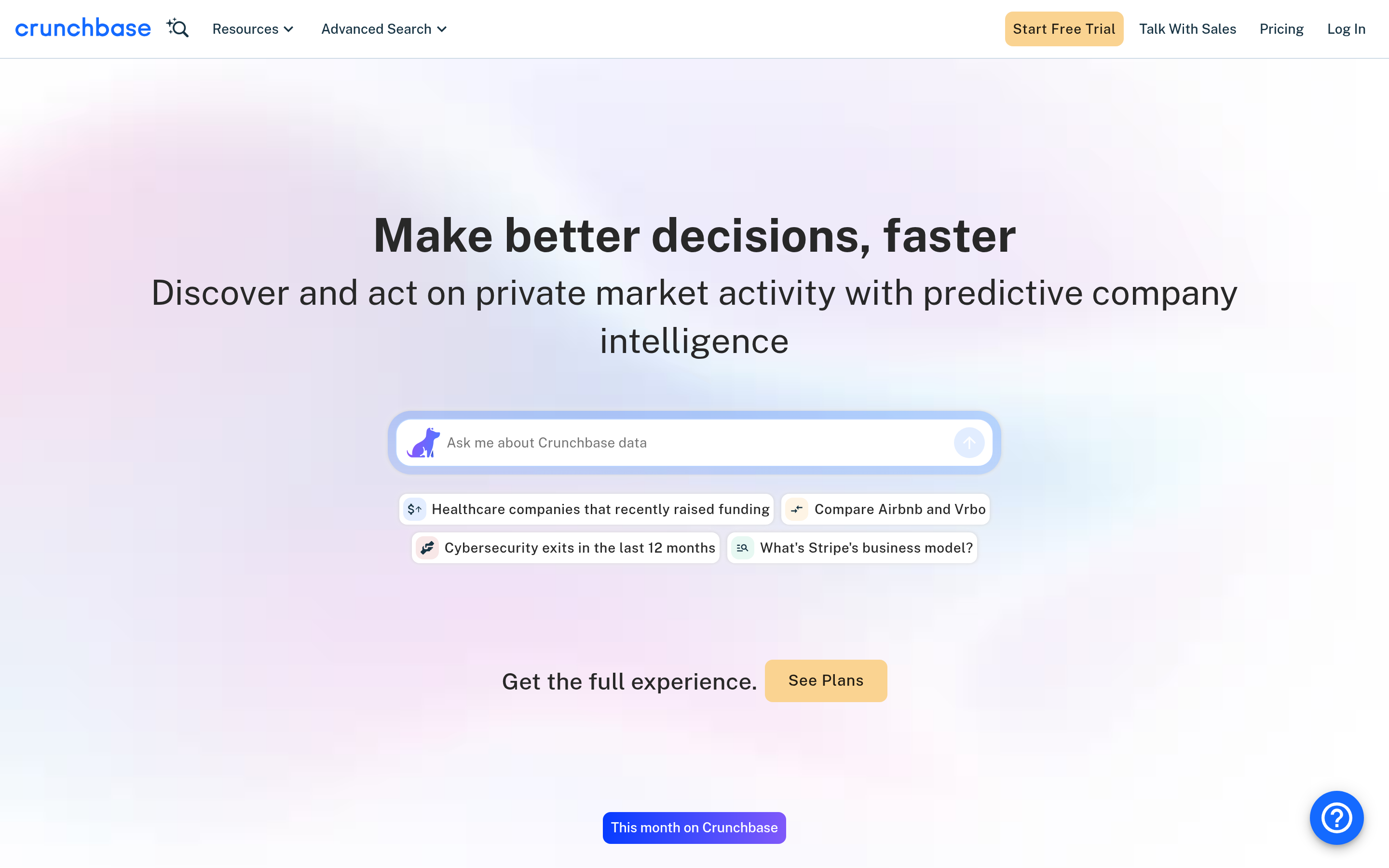
If the reason you were looking at Coresignal was company signals — funding rounds, acquisitions, growth stage — Crunchbase gives you that natively, with a far friendlier entry price.
- Best for: trigger-based outbound (just raised a Series A, just acquired someone).
- Watch for: contact data is not the strength. Pair it with a bulk email finder to turn a company list into a people list.
8. Clearbit / HubSpot Breeze Intelligence — inbound enrichment#
Now folded into HubSpot, Clearbit's enrichment shines on inbound: someone fills a form, you instantly know their company, size, and stack. Outside the HubSpot ecosystem it is a harder sell than it used to be — hence the steady traffic to any Clearbit alternative that still ships a standalone API.
- Best for: HubSpot-native teams enriching inbound forms.
- Watch for: it is not a prospecting database. It enriches what you already have.
9. Datarade and the marketplace route#
Not a vendor so much as a shelf: data marketplaces let you compare multiple providers on the same schema and buy a slice. Useful for discovery, painful for procurement — you still negotiate with each supplier individually.

Is Coresignal still worth it in 2026?#
Yes — for the job it was built for. If your product depends on wide, refreshed, structured web data and you have engineers who can work with it, Coresignal remains a credible buy and the alternatives above mostly do less, not more.
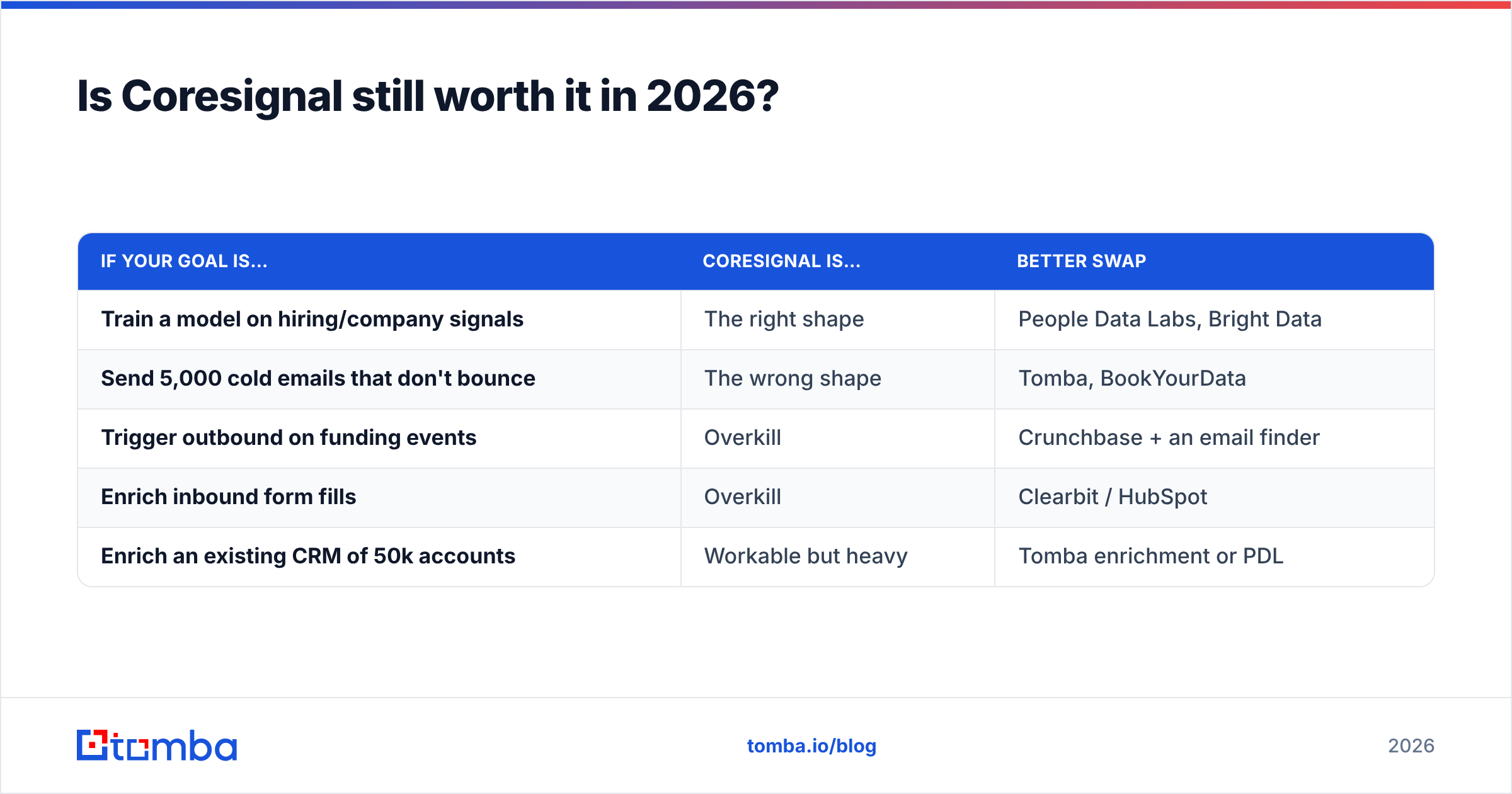
The mistake is buying it for the wrong job. Three honest tests:
| If your goal is… | Coresignal is… | Better swap |
|---|---|---|
| Train a model on hiring/company signals | The right shape | People Data Labs, Bright Data |
| Send 5,000 cold emails that don't bounce | The wrong shape | Tomba, BookYourData |
| Trigger outbound on funding events | Overkill | Crunchbase + an email finder |
| Enrich inbound form fills | Overkill | Clearbit / HubSpot |
| Enrich an existing CRM of 50k accounts | Workable but heavy | Tomba enrichment or PDL |
Notice the pattern: the further you get from building with data and the closer you get to contacting humans, the worse the fit — and the more you overpay for coverage you will never query.
What does a realistic 2026 stack look like?#
Most teams under 50 people do not need one vendor. They need two cheap ones that do not overlap:
- Signal layer — where you find out that a company is worth contacting. Crunchbase for funding, job boards for hiring, your own product analytics for intent. Often free or under $100/mo.
- Contact layer — where a company name becomes a verified person with a working inbox. This is where an email verifier and finder earn their keep, because a 3% bounce rate is a deliverability tax on every future campaign.
The expensive mistake is buying an enterprise dataset to solve a contact-layer problem. You end up with 40 million rows, no verified emails, and a bill that has to be justified to a CFO who will ask how many meetings it booked.
How do you actually test an alternative before you buy?#
Do this in an afternoon, not a quarter:
- Build a 200-row golden list. Real companies, real target titles, from your actual ICP. Include some SMBs and at least one non-US market.
- Run it through every shortlisted vendor's free tier or trial. Same list, same fields.
- Measure three numbers: fill rate (how many rows got data), accuracy (spot-check 30 by hand or by verification), and bounce rate (send a small, warm, throwaway-safe validation batch).
- Divide cost by usable rows. Not credits. Usable rows.
- Ask about the miss policy. Vendors that do not charge for failed lookups are quietly 20–40% cheaper than their sticker price suggests.
Any vendor that resists step 1 is telling you something about their coverage in your segment. Believe them.
The bottom line#
Coresignal is a dataset company. Most people who search for Coresignal alternatives are not, in fact, dataset companies — they are revenue teams who need reachable contacts without a six-figure contract and a data engineer.
If that is you, start at the contact layer. Run your real ICP list through the Tomba Email Finder on the free tier — 25 searches, no card — and compare fill rate and bounce rate against whatever quote is currently sitting in your inbox. If the numbers hold, Starter is $49/mo and the same data is available through the Tomba API, Sheets, or a bulk CSV. If they don't, you will have learned that in an afternoon instead of after signing an annual contract.
Related guides#
Ready to find emails that actually work?
Join 150,000+ professionals who stopped guessing and started sending. Free credits on signup — no credit card required.
Get the Tomba newsletter
Practical outbound tactics and product updates — once every two weeks.
About the author