Coresignal Pricing Reviews Pros and Cons: 2026 Buyer Guide
Coresignal sells raw B2B data at scale — company, employee, and jobs records via API or bulk datasets. Here's what it actually costs, where the credit model bites, and when a simpler email finder does the job for a fraction of the spend.
Coresignal pricing reviews pros and cons — here is the short version, without the sales gloss. Coresignal sells raw B2B data. You pay in credits. You build the workflow yourself. This guide covers what it really costs, what buyers praise, what they complain about, and when a simple email finder wins.
TL;DR
- Coresignal is a raw B2B data vendor, not a lead-gen app. You buy company, employee, and job-posting records through an API or as bulk datasets, then build your own workflow on top.
- Pricing is credit-based and quote-heavy. Self-serve API plans land in the low-to-mid hundreds per month. Bulk dataset contracts are annual and start much higher. Expect a sales call for anything serious.
- The strongest reviews praise coverage and freshness. The most common complaints: credits burn faster than expected, there is no built-in email verification, and you need engineering work before you see a single reply.
- Coresignal does not sell a verified, inbox-ready email list. If your job is "find and verify work emails," a dedicated email finder costs a fraction of a data license.
- Best fit: data teams building products, enrichment layers, or scoring models. Worst fit: a two-person SDR team that just needs contacts this quarter.
What is Coresignal, and who actually buys it?#
Coresignal is a B2B data-as-a-service provider. It collects public web data — company profiles, employee profiles, job postings, funding, technographics — and resells it as structured records. You get it three ways: a search-and-enrich API, bulk datasets delivered as JSON/Parquet drops, or a hosted database you query directly.
The everyday analogy: Coresignal is a wholesale warehouse, not a grocery store. It sells pallets. If you want a sandwich, you still have to build the kitchen.
That framing explains almost every review you'll read. Data teams, AI startups, VC platforms, HR-tech products, and market-intelligence tools love it. They want pallets. Sales teams arrive expecting an Apollo-style prospecting UI and leave confused, because there isn't one.
Who buys Coresignal:
- Product companies embedding data. A recruiting SaaS that needs 400M professional profiles under the hood.
- AI/ML teams training models. Historical job-posting archives and firmographic panels are hard to source elsewhere.
- Investment and market-research firms. Headcount trends work as a proxy for company health.
- RevOps teams building enrichment pipelines. Piping firmographics into Salesforce or a warehouse.
- Data brokers and aggregators. Reselling or blending Coresignal into their own stack.
Notice who is missing from that list: the person who needs 500 verified emails for next week's campaign. Hold that thought. It is the crux of the pros-and-cons section.

How does Coresignal pricing actually work in 2026?#
Coresignal prices on credits and contracts, not seats. That is the single most important thing to grasp before you judge the cost.
A credit is spent per record returned, or per API call on some endpoints. Search calls, enrichment calls, and bulk collection calls all draw down the same balance, at different rates. Unused credits usually do not roll over forever. Overage is either billed or hard-capped, depending on your agreement.
There are broadly three commercial motions:
- Free trial / test credits — a small allocation (a couple hundred credits) so you can check schema and coverage. Enough to test, not enough to run.
- Self-service API plans — monthly tiers with a credit bundle. Entry pricing sits in the low hundreds of dollars per month and rises with the size of your credit pack. Most solo builders and small data teams start here.
- Custom datasets / enterprise — annual contracts, delivered as bulk files or a hosted DB. This tier is quote-only. Public reviews and buyer reports put it in the five-figure annual range once you want full-record access at volume.
Coresignal publishes indicative self-serve tiers on its own site, and those numbers move. Confirm the live figures on coresignal.com before you budget. List prices change quarterly, and negotiated prices vary widely by volume.
What drives your Coresignal bill up#
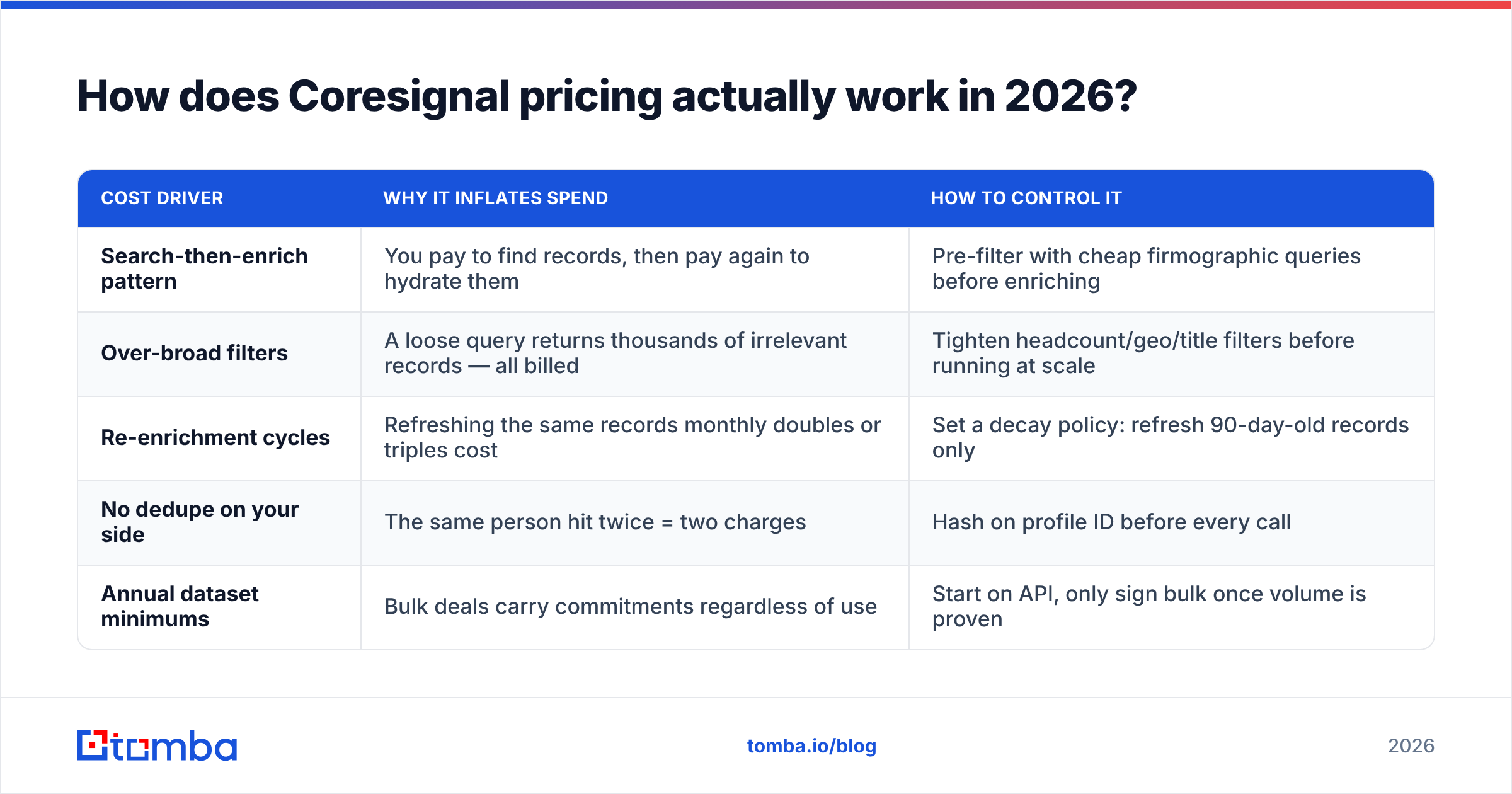
| Cost driver | Why it inflates spend | How to control it |
|---|---|---|
| Search-then-enrich pattern | You pay to find records, then pay again to hydrate them | Pre-filter with cheap firmographic queries before enriching |
| Over-broad filters | A loose query returns thousands of irrelevant records — all billed | Tighten headcount/geo/title filters before running at scale |
| Re-enrichment cycles | Refreshing the same records monthly doubles or triples cost | Set a decay policy: refresh 90-day-old records only |
| No dedupe on your side | The same person hit twice = two charges | Hash on profile ID before every call |
| Annual dataset minimums | Bulk deals carry commitments regardless of use | Start on API, only sign bulk once volume is proven |
The pattern is consistent across reviews: teams do not overspend because the per-record price is high. They overspend because they query sloppily. Credit models punish exploratory work.
Coresignal pricing reviews pros and cons: what buyers really say#
Pull the sentiment from public review platforms like G2 and buyer forums, and it splits neatly by buyer type. That is exactly what you would expect from a wholesale data product.
Pros that come up repeatedly:
- Coverage depth. Hundreds of millions of professional profiles and tens of millions of company records. Few vendors match that breadth.
- Freshness cadence. Records are re-crawled on a rolling basis. Headcount and job-posting changes work as live signals, not stale snapshots.
- Clean schema and solid docs. The developer documentation is well organized. The JSON is predictable enough to build against.
- Genuine flexibility. API, bulk files, and hosted DB delivery. You pick the shape that fits your infrastructure.
- Historical data. Multi-year job-posting archives are a real differentiator for trend models.
Cons that come up just as often:
- Credit anxiety is real. The top complaint is burning a monthly allocation too fast. It usually happens while you are still learning the filters.
- No verification layer. Records may carry contact fields, but Coresignal does not verify emails. Send a raw list cold and you risk your sender reputation.
- Engineering lift before value. Nothing works out of the box. You need a developer, a pipeline, and a destination first.
- Quote-driven pricing. Dataset buyers face sales calls, minimums, and annual terms. Small teams cannot absorb that friction.
- Not a prospecting tool. Buyers who expected a Chrome extension and a click-to-find button rate it poorly. That is a fit problem, and an avoidable one.
Is Coresignal worth it compared to the alternatives?#
It depends on whether you are buying raw material or a finished part. Here is a like-for-like view of the options buyers actually shortlist.
| Coresignal | Tomba | BookYourData | Clearbit-style enrichment | |
|---|---|---|---|---|
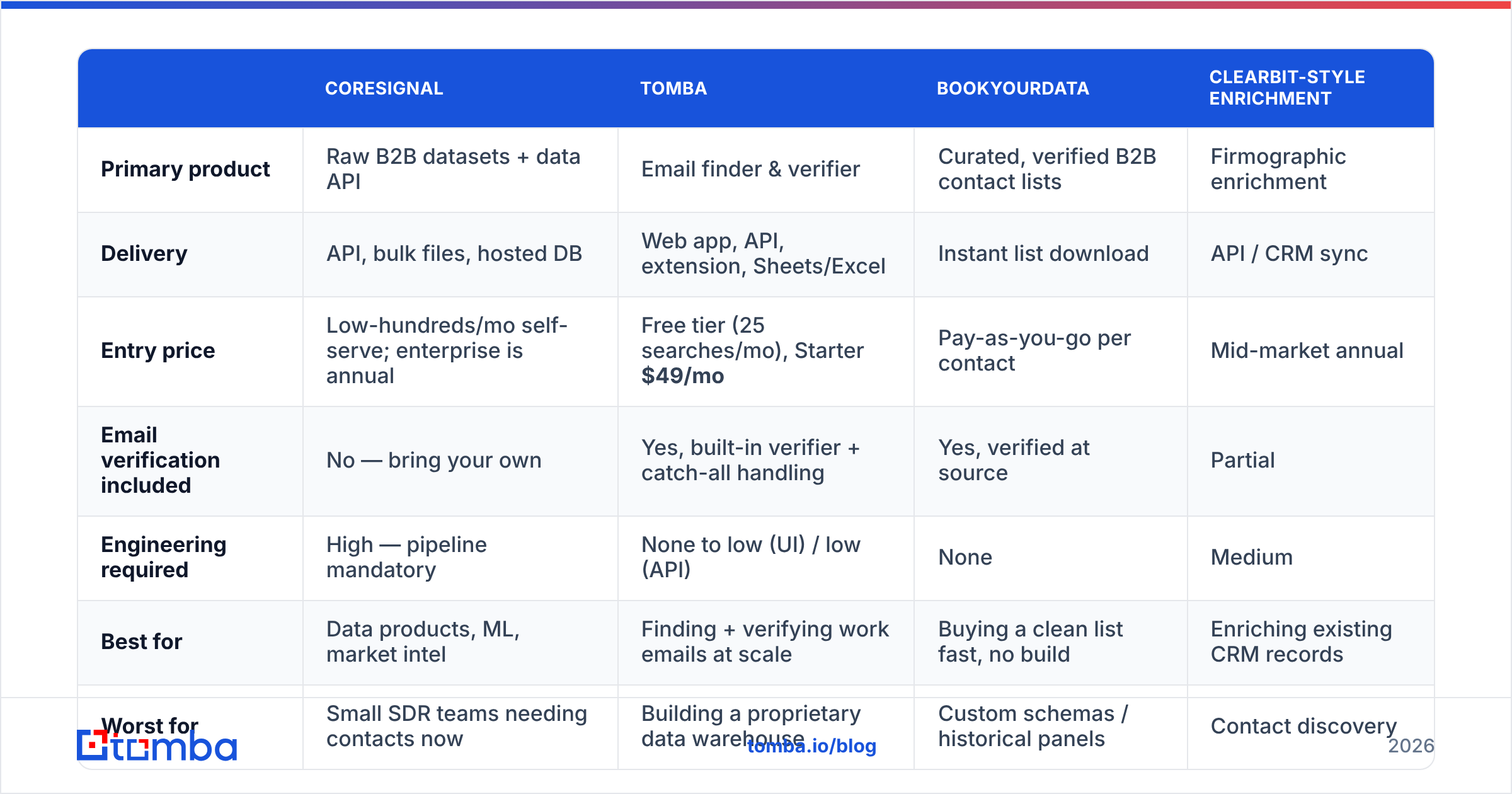
| Primary product | Raw B2B datasets + data API | Email finder & verifier | Curated, verified B2B contact lists | Firmographic enrichment |
| Delivery | API, bulk files, hosted DB | Web app, API, extension, Sheets/Excel | Instant list download | API / CRM sync |
| Entry price | Low-hundreds/mo self-serve; enterprise is annual | Free tier (25 searches/mo), Starter $49/mo | Pay-as-you-go per contact | Mid-market annual |
| Email verification included | No — bring your own | Yes, built-in verifier + catch-all handling | Yes, verified at source | Partial |
| Engineering required | High — pipeline mandatory | None to low (UI) / low (API) | None | Medium |
| Best for | Data products, ML, market intel | Finding + verifying work emails at scale | Buying a clean list fast, no build | Enriching existing CRM records |
| Worst for | Small SDR teams needing contacts now | Building a proprietary data warehouse | Custom schemas / historical panels | Contact discovery |
Read that table honestly and the split is obvious. Coresignal wins when the data itself is your product. BookYourData wins when you want verified contacts today with zero build. A focused finder wins when your bottleneck is simple: you have names and companies, and you need working inboxes.

The cost math nobody runs before signing#
Take a realistic scenario. You need 3,000 verified work emails per month for outbound.
- Coresignal route: you query the employee API to find matching profiles. You pay credits on search, then pay again on enrichment. Contact fields come back incomplete or unverified. So you bolt on a separate verification vendor, plus a developer week to build the pipeline. Your true cost per usable email is far above the sticker credit price.
- Finder route: you run the same 3,000 names through an email finder with verification built in, on a plan that starts at $49/mo. No pipeline. No second vendor. No credit archaeology.
That is not a knock on Coresignal's quality. It is a knock on using a warehouse to buy a sandwich. If you are building a product that serves 3 million profiles to your own customers, the finder route collapses and Coresignal is the right call.
When should you choose Coresignal — and when should you not?#
Use this as a decision filter before you take the sales call.
Choose Coresignal if:
- Data is the product. You embed profiles, firmographics, or job signals inside something you sell.
- You have engineering capacity. At least one developer who can own a pipeline and a refresh policy.
- You need historical depth. Trend analysis on hiring, headcount, or tech adoption over several years.
- Volume is high and predictable. Credit models reward teams who know what they will query.
- You already have a verification stack. Or you are ready to buy one separately.
Skip Coresignal if:
- Your goal is replies, not records. Outbound teams need deliverable inboxes, not JSON.
- You have no dev resource. The time-to-first-value gap will kill the project.
- Your volume is under a few thousand records a month. Self-serve credits are poor value at that scale.
- You need catch-all handling. Raw data cannot tell you whether a domain accepts everything. A catch-all verifier can.
- Procurement is a blocker. If you cannot sign an annual contract, the dataset tier is off the table.
How do you avoid overpaying, whichever vendor you pick?#
Three habits separate teams who get value from data vendors from teams who write off the spend.
Run a paid pilot with a hard scope. Pick one segment — say, Series B SaaS companies in DACH with 50-200 employees — and enrich only that. Measure match rate, bounce rate, and reply rate. Do not judge a vendor on whether the data "looks right." Judge it on downstream outcomes.
Separate discovery from verification. These are two different jobs. Pretending one vendor does both well is how lists get burned. Even with a premium data source, push every record through an email verifier before it touches a sequence. Once bounce rate passes 3%, your domain reputation starts sliding.
Model total cost, not unit cost. A record that costs $0.02 but needs a $6k pipeline and a second verification vendor is not a $0.02 record. Count engineering hours, verification spend, and the cost of a burned sending domain.
Negotiate the credit floor, not the headline. In enterprise data deals, the real lever is the minimum commitment and the rollover policy, not the per-record rate. Ask for rollover. It is often granted and rarely offered.
The verdict on Coresignal pricing reviews pros and cons#
Coresignal is a good product sold to the wrong people about half the time. The data is deep. The docs are solid. The freshness is genuine. If you are building a data-driven product, it belongs on your shortlist next to any serious data-as-a-service provider. The pricing is fair for that use case.
But most B2B teams reading a pricing review have a different problem. They have a list of 2,000 target people and need verified work emails this week. For them, Coresignal is expensive infrastructure for a job that needs a tool. The credit model punishes exploration. The missing verification layer means a second vendor. The engineering lift means your first campaign ships a month late.
So be honest about which buyer you are. If the answer is "I need contacts, not a data warehouse," you just saved yourself a quote call and a five-figure line item.
Need working emails, not raw records? Tomba's Email Finder finds and verifies professional email addresses from a name and domain. You get catch-all detection, bulk processing, and a developer-friendly API if you want to automate it. Start free with 25 searches a month, or move to Starter at $49/mo. See full Tomba pricing for the Growth ($99/mo) and Pro ($249/mo) tiers. No annual contract, no credit archaeology, no pipeline to build.
Related guides#
Ready to find emails that actually work?
Join 150,000+ professionals who stopped guessing and started sending. Free credits on signup — no credit card required.
Get the Tomba newsletter
Practical outbound tactics and product updates — once every two weeks.
About the author