Coresignal vs DiscoverOrg in 2026: Which B2B Data Wins?
DiscoverOrg is now ZoomInfo, and Coresignal never sold to salespeople in the first place. Here is what each actually gives you, what it costs, and which one belongs in your stack in 2026.
TL;DR#
- DiscoverOrg does not exist as a separate product anymore. It bought ZoomInfo in 2019 and adopted the ZoomInfo name. If a vendor page or agency deck still says "DiscoverOrg," you are being quoted ZoomInfo.
- Coresignal is not a sales tool. It is a raw web-data API and dataset provider. There is no dashboard your SDRs will log into, no sequences, no intent alerts.
- They are not really competitors. Coresignal sells data to engineers and product teams. ZoomInfo (ex-DiscoverOrg) sells a seat-based platform to revenue teams. Choosing between them is choosing between building and buying.
- Cost profiles are opposite. Coresignal charges for volume of records; ZoomInfo charges for seats plus credits on an annual contract, typically five figures.
- Most teams need neither at full price. If the actual job is "get verified work emails for a target list," a focused email finder does that at a fraction of the spend.
Why does the Coresignal vs DiscoverOrg comparison confuse everyone?#
Because one of the two brands was retired six years ago and nobody updated the internet.
DiscoverOrg, founded in 2007, built its reputation on human-verified org charts — the kind of data where a researcher literally called the company to confirm who ran IT infrastructure. In February 2019 DiscoverOrg acquired ZoomInfo, and by 2020 the combined company had consolidated under the ZoomInfo brand and gone public on NASDAQ. The DiscoverOrg product line was folded in. The verification methodology survived; the name did not.
So when you search "Coresignal vs DiscoverOrg," what you are actually comparing is:
- Coresignal — a Lithuania-based data-as-a-service company selling public web data (company records, employee profiles, job postings) through APIs and bulk datasets.
- ZoomInfo, formerly DiscoverOrg — a full sales intelligence platform with contact records, org charts, intent signals, engagement tooling, and a CRM sync layer.
That distinction changes every part of the evaluation. One is a pipe. The other is a building.

What is Coresignal, exactly?#
Coresignal is infrastructure. You pay for structured records and you decide what to do with them.
Their catalogue centres on three record types, refreshed on a rolling basis and delivered either through a REST API, a search-and-collect flow, or as flat datasets you load into your own warehouse:
- Company data — firmographics, headcount trends, funding, tech signals, industry codes.
- Employee data — public professional profiles, current and past roles, tenure, skills, seniority.
- Jobs data — active postings, which is the closest thing Coresignal has to an intent signal (a company hiring six Kubernetes engineers is telling you something).
What Coresignal deliberately does not do: verified work emails at scale, direct dials, buying-intent scores, sequencing, or anything resembling a rep-facing UI. Their own documentation is written for developers, not for account executives, and that is the honest positioning.
The upshot: Coresignal is excellent if you are building a product — a lead-scoring engine, a market-map dashboard, a recruiting tool, a competitive-intelligence feed. It is a poor fit if your problem is "my three SDRs need 400 good contacts on Monday."
What is DiscoverOrg (ZoomInfo) today?#
ZoomInfo is the maximalist end of the market: a database, an org-chart layer, intent data from its Bidstream and content networks, a Chrome extension, a sequencer (Engage), a website-visitor module, and deep CRM integrations.
The DiscoverOrg DNA still shows in the parts of the dataset covered by human research — IT, HR, marketing and finance org structures at mid-market and enterprise accounts remain the strongest slice. That is genuinely hard to replicate, and it is the reason large sales orgs keep renewing despite the price.
The trade-offs are equally well documented across G2 reviews: annual contracts with limited flexibility, seat-based pricing that punishes teams who want data without headcount, credit systems that run dry, and coverage that thins out fast outside North America and outside the classic tech/enterprise segment. Data on European SMBs is frequently stale — a known cost of any database built on aggregation plus periodic verification.
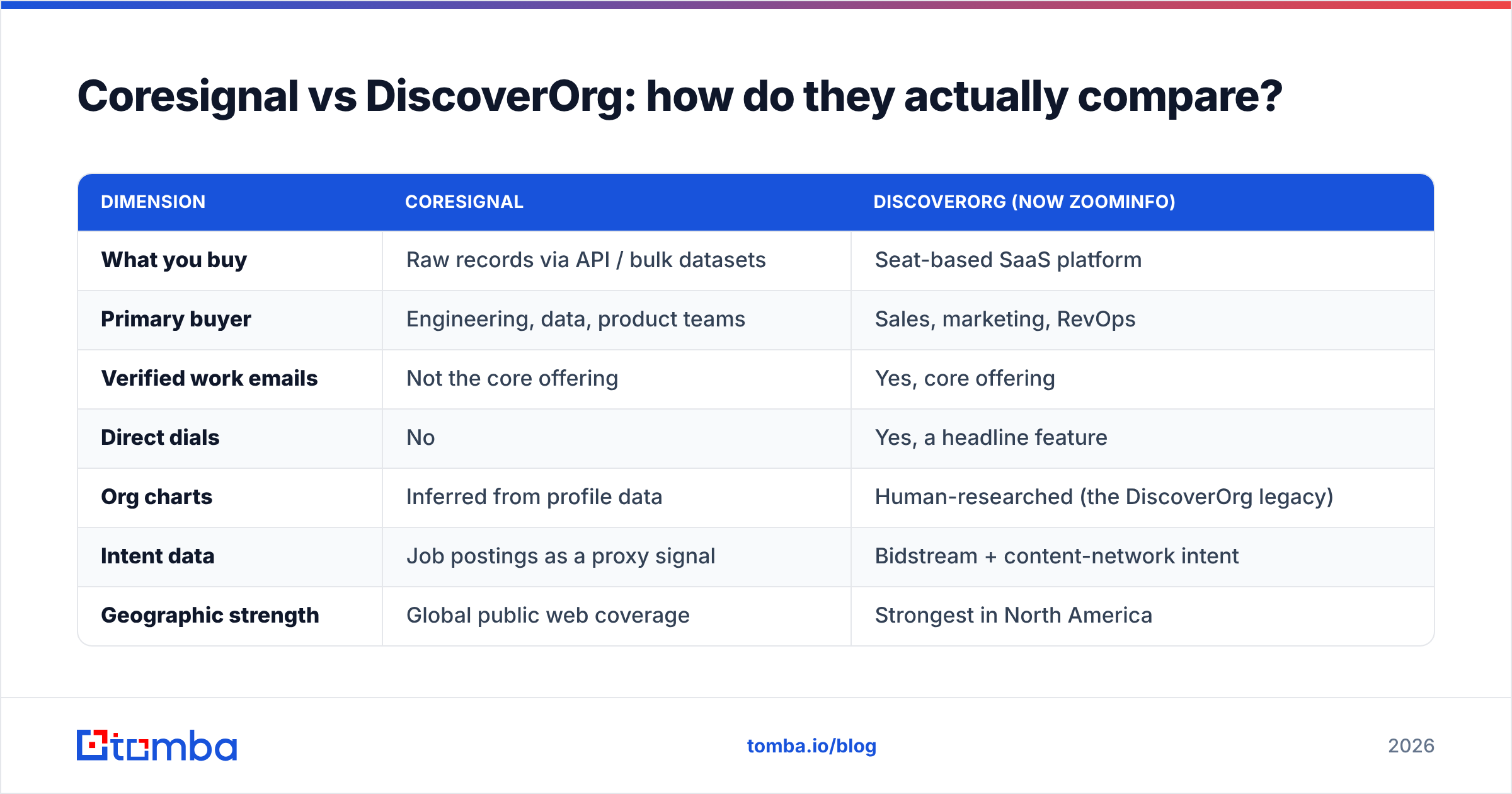
Coresignal vs DiscoverOrg: how do they actually compare?#
| Dimension | Coresignal | DiscoverOrg (now ZoomInfo) |
|---|---|---|
| What you buy | Raw records via API / bulk datasets | Seat-based SaaS platform |
| Primary buyer | Engineering, data, product teams | Sales, marketing, RevOps |
| Verified work emails | Not the core offering | Yes, core offering |
| Direct dials | No | Yes, a headline feature |
| Org charts | Inferred from profile data | Human-researched (the DiscoverOrg legacy) |
| Intent data | Job postings as a proxy signal | Bidstream + content-network intent |
| Geographic strength | Global public web coverage | Strongest in North America |
| Delivery | REST API, datasets, warehouse drops | Web app, Chrome extension, CRM sync |
| Contract | Usage/volume based, self-serve tiers available | Annual contract, typically five figures |
| Time to first value | Days to weeks (you build) | Hours (you log in) |
| Best for | Building a data product or scoring model | Equipping a rep team today |
The table makes the real decision visible. You are not picking a winner. You are picking a shape: pay engineers to turn raw records into pipeline, or pay a vendor to hand your reps a UI.
Which one is cheaper — and is that the right question?#
Cost only means something once you attach it to an outcome.
Coresignal prices on volume. Self-serve API tiers are published on their site and scale with the number of records you pull; large historical datasets and custom feeds are quoted. The sticker price can look modest, but the true cost includes the engineer who builds the enrichment job, the storage, the deduplication logic, and the email-derivation layer you will inevitably need to bolt on — because raw profiles are not deliverable contacts.
ZoomInfo prices on seats plus credits, almost always on an annual commitment. Public reports and buyer forums consistently put realistic entry points in the five-figure range once you add a few seats and the modules that make the platform worth having. There is no meaningful free tier and there is no month-to-month escape hatch.
Now compare both to the narrow job most teams actually have:
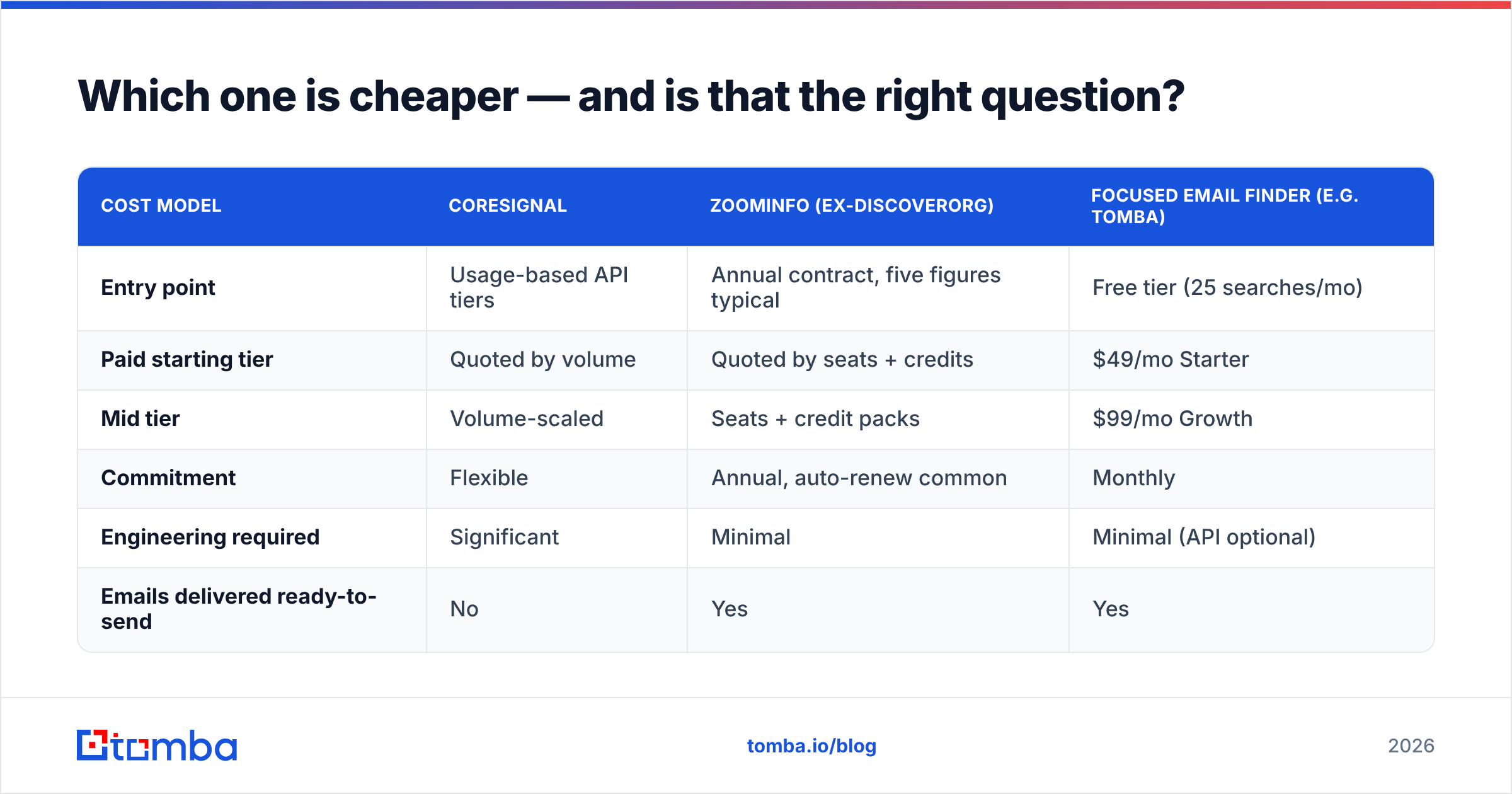
| Cost model | Coresignal | ZoomInfo (ex-DiscoverOrg) | Focused email finder (e.g. Tomba) |
|---|---|---|---|
| Entry point | Usage-based API tiers | Annual contract, five figures typical | Free tier (25 searches/mo) |
| Paid starting tier | Quoted by volume | Quoted by seats + credits | $49/mo Starter |
| Mid tier | Volume-scaled | Seats + credit packs | $99/mo Growth |
| Commitment | Flexible | Annual, auto-renew common | Monthly |
| Engineering required | Significant | Minimal | Minimal (API optional) |
| Emails delivered ready-to-send | No | Yes | Yes |
If your evaluation started with "we need contact data," you may find that neither of these two platforms is priced for the problem you have. That is not a knock on either vendor — it is a scoping error, and it is the single most common reason B2B data contracts get cancelled at renewal. Compare the Tomba pricing tiers against a ZoomInfo quote and the gap is usually two orders of magnitude for the same core deliverable.
When should you choose Coresignal?#
Pick Coresignal when the data is an input to something you are building, not an output your reps consume.
- You are building a product. A recruiting platform, an investor screening tool, a market-intelligence dashboard. Coresignal is designed for exactly this and priced accordingly.
- You want to own your scoring model. If you would rather compute your own ICP fit score from headcount growth, hiring velocity and tech signals than accept a vendor's black-box intent score, raw records beat a platform.
- You need global coverage of company and people data. Coresignal's public-web sourcing does not fall off a cliff outside the US the way North-America-first databases do.
- You have an engineer. This is non-negotiable. Without one, Coresignal is a set of JSON files nobody will ever open.
What you will still need to solve: turning profiles into reachable contacts. Coresignal will tell you that Maria is the VP of Engineering at a 300-person fintech. It will not hand you maria@ that actually accepts mail. That is a separate layer — a domain search to resolve the company's email pattern, then an email verifier pass before anything gets sent.
When should you choose DiscoverOrg (ZoomInfo)?#
Pick ZoomInfo when you are selling into North American mid-market and enterprise accounts, you need org charts and direct dials, and you have budget approved at the VP level.
- Complex buying committees. If you need to know who reports to whom in a 4,000-person insurance company, the DiscoverOrg research legacy is still the best thing on the market.
- Direct dials matter. Nobody else has comparable phone coverage at that scale. If your motion is phone-first, this is a real moat.
- You want one vendor, one invoice, one QBR. Platform consolidation has genuine operational value, and ZoomInfo's CRM integrations equivalents are mature.
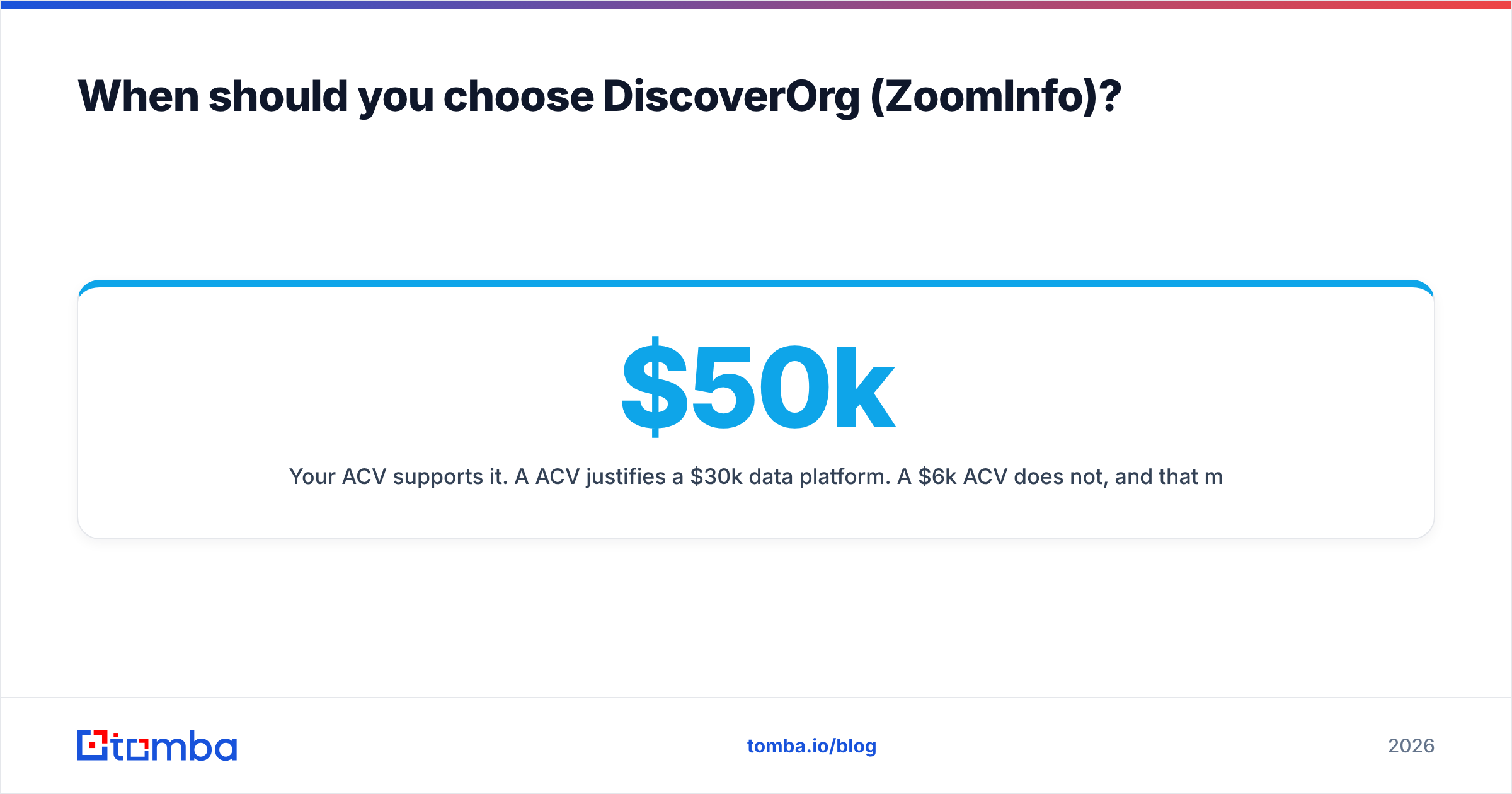
- Your ACV supports it. A $50k ACV justifies a $30k data platform. A $6k ACV does not, and that math has killed more ZoomInfo renewals than any competitor ever did.
Where it hurts: European and APAC coverage, SMB coverage, contract rigidity, and credit exhaustion in month nine.

Is there a middle path between raw data and a full platform?#
Yes, and it is where most teams under 50 reps actually land: buy the specific data layer you need, skip the platform tax.
The honest breakdown of what a typical outbound team consumes:
- A target account list — usually built from a filter (industry, headcount, geography, tech stack), which you can source from Coresignal, a B2B database, Crunchbase, or your own CRM's closed-lost pile.
- The right people at those accounts — job title filters against public profile data. This is a solved problem and it is not where the money should go.
- A reachable, verified email — the only step where failure is expensive, because a bad address burns sender reputation that takes weeks to rebuild.
- Optionally, a phone number — needed only if your motion is phone-first.
- A sequencer — commoditised. Instantly, Smartlead, Lemlist, Apollo, Saleshandy all do this competently at a fraction of enterprise platform pricing.
Note what is not on that list: intent scores, org charts, and a unified UI. Those are real features, but they are the features you pay the five-figure premium for. If you do not use them weekly, you are subsidising someone else's roadmap.
For teams that recognise themselves in that breakdown, the practical stack is: a list source (Coresignal, a scraper, or a niche database — providers like BookYourData do well on verified-at-purchase list buying, which is a legitimately different model worth knowing about), plus a dedicated finder-and-verifier layer, plus a cheap sequencer. Total spend under $200/month for a small team, versus a ZoomInfo quote that starts an order of magnitude higher.
What should you actually do next?#
Run the evaluation in this order, and be brutal about step one.
- Write down the job. "Enrich 40k accounts nightly in our product" and "get 500 verified CMO emails in Germany this quarter" are completely different jobs. Only one of them is a Coresignal problem, and neither is necessarily a ZoomInfo problem.
- Test coverage on your ICP, not on a demo list. Hand every vendor the same 100 accounts you actually sell to. Count hits. Vendors that look identical on a homepage diverge by 30+ points on a real ICP — especially outside the US.
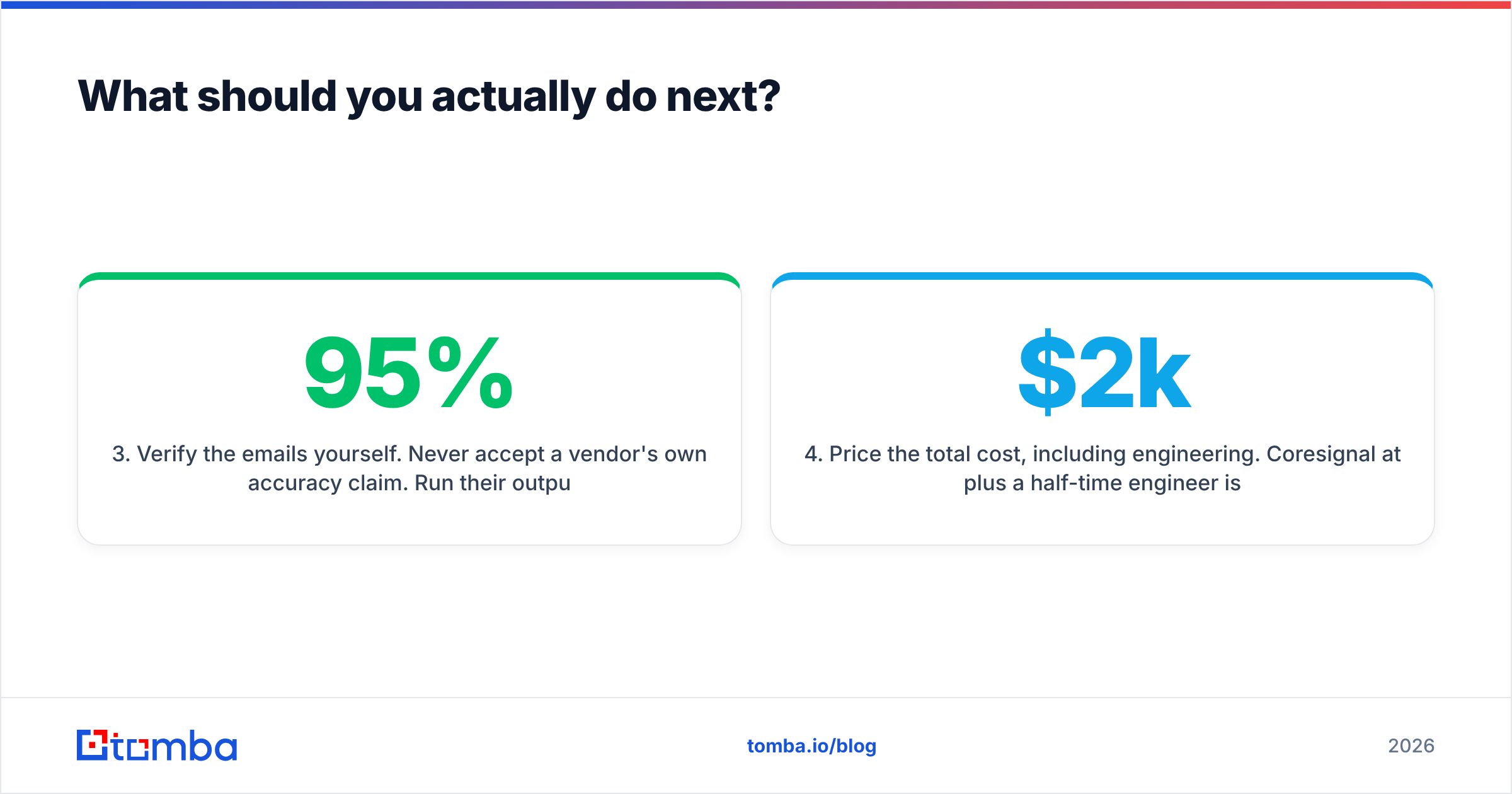
- Verify the emails yourself. Never accept a vendor's own accuracy claim. Run their output through an independent email verification pass and count the bounces. A "95% accurate" database that returns 78% deliverable on your segment is a $30k mistake waiting to happen.
- Price the total cost, including engineering. Coresignal at $2k/mo plus a half-time engineer is not cheaper than a platform. Be honest about the internal cost.
- Only then negotiate. Both vendors discount. Neither discounts for buyers who have not tested alternatives.
The verdict#
Coresignal wins if you are building. It is the better raw-data provider, it is global, and it does not force you into a seat-based contract. But it will not hand your reps anything they can send an email to without additional work.
DiscoverOrg — that is, ZoomInfo — wins if you are selling into North American enterprise with an ACV that can absorb the cost. The org charts and direct dials are still class-leading, and the DiscoverOrg research heritage is the reason why.
Neither wins if your real job is finding verified work emails for a defined list. That is a narrow, solvable problem, and paying platform prices for it is the most common budget leak in B2B sales.
If that last sentence describes you, start with the Tomba Email Finder. Feed it a name and a domain, or a domain alone, and get a verified, deliverability-checked address back — through the web app, the Chrome extension, Google Sheets, or the API. The free tier gives you 25 searches a month to test the hit rate on your own ICP before you spend anything, and Starter is $49/mo when you are ready to scale. Run your ICP list through it side by side with any Coresignal or ZoomInfo trial data, count the bounces, and let the numbers decide.
Related guides#
Ready to find emails that actually work?
Join 150,000+ professionals who stopped guessing and started sending. Free credits on signup — no credit card required.
Get the Tomba newsletter
Practical outbound tactics and product updates — once every two weeks.
About the author