Coresignal vs Generect: B2B Data API Comparison (2026)
Coresignal sells bulk B2B datasets. Generect sells real-time lead lookups. They solve different problems, and picking the wrong one costs you a year of contract. Here's the honest breakdown.
TL;DR
- Coresignal is a data warehouse, not a prospecting tool. It sells large, structured firmographic and employee datasets (bulk files or API) built for data teams, ML models, and investment research — not for an SDR who needs 200 emails today.
- Generect is a real-time lookup API. It queries public professional profiles on demand and returns leads with contact fields. Smaller footprint, faster to integrate, aimed at outbound teams and lead-gen agencies.
- They rarely compete head-to-head. If you are choosing between them, you probably haven't defined whether you need data at rest (Coresignal) or data on demand (Generect).
- Neither is an email verification layer. Both hand you addresses; keeping your bounce rate under 2% is still your problem, and that's where a dedicated email verifier earns its keep.
- Budget reality: Coresignal's serious tiers land in enterprise contract territory. Generect is cheaper to start. Tomba starts free and goes to $49/mo — a different order of magnitude, for a narrower job.
What is Coresignal, and who actually buys it?#
Coresignal is a public web data provider. Its product is scale: hundreds of millions of employee records, tens of millions of company records, plus job postings, funding events, and technology signals — refreshed on a rolling schedule and delivered as flat files (CSV, JSON, Parquet) or through search and collect APIs.
The buyer is almost never a sales rep. It's:
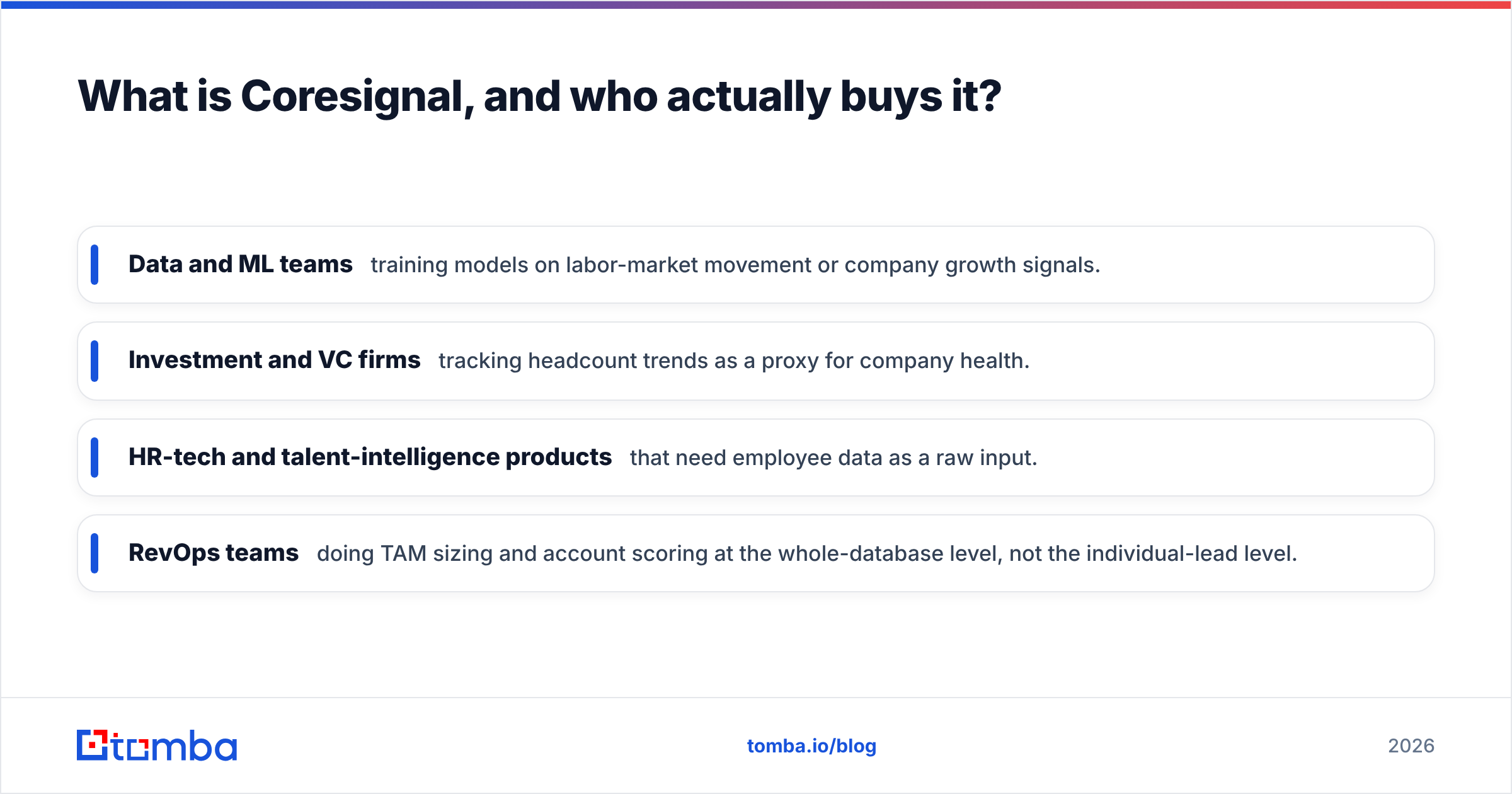
- Data and ML teams training models on labor-market movement or company growth signals.
- Investment and VC firms tracking headcount trends as a proxy for company health.
- HR-tech and talent-intelligence products that need employee data as a raw input.
- RevOps teams doing TAM sizing and account scoring at the whole-database level, not the individual-lead level.
Coresignal's pitch is coverage and structure. You get a schema, a delivery pipeline, and a lot of rows. What you do not get is a UI your SDR opens on a Tuesday morning to find the VP of Engineering at one specific company.
What is Generect, and how is it different?#
Generect is a B2B lead data API oriented toward outbound. You send a query — a company domain, a role filter, a professional network URL — and it returns matching people with contact fields, resolved at request time rather than pulled from a months-old snapshot.
The buyer profile is different: lead-gen agencies, outbound automation builders, growth engineers wiring a data source into a sequencer. It's the kind of API you drop behind a Clay table, an n8n workflow, or your own enrichment microservice.
The tradeoff is baked in. Real-time resolution means fresher answers but a slower, per-request cost model, and you cannot dump the whole database to disk and query it locally. Coresignal will happily hand you the disk dump. That difference — bulk snapshot vs. live lookup — is the entire comparison in one sentence.
Coresignal vs Generect: how do they compare feature by feature?#
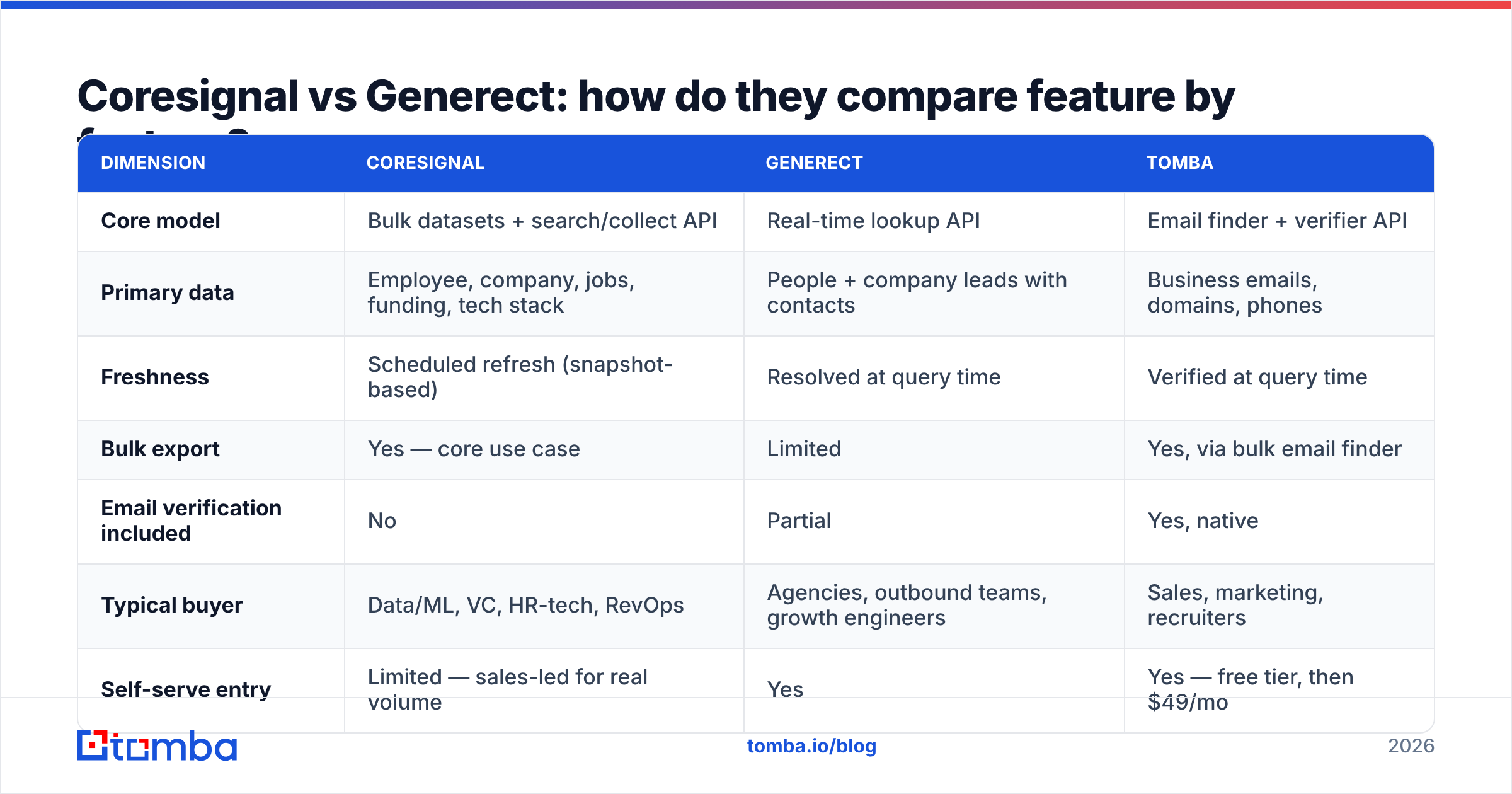
| Dimension | Coresignal | Generect | Tomba |
|---|---|---|---|
| Core model | Bulk datasets + search/collect API | Real-time lookup API | Email finder + verifier API |
| Primary data | Employee, company, jobs, funding, tech stack | People + company leads with contacts | Business emails, domains, phones |
| Freshness | Scheduled refresh (snapshot-based) | Resolved at query time | Verified at query time |
| Bulk export | Yes — core use case | Limited | Yes, via bulk email finder |
| Email verification included | No | Partial | Yes, native |
| Typical buyer | Data/ML, VC, HR-tech, RevOps | Agencies, outbound teams, growth engineers | Sales, marketing, recruiters |
| Self-serve entry | Limited — sales-led for real volume | Yes | Yes — free tier, then $49/mo |
| Contract minimum | Common on serious tiers | Lower | None |
| No-code surface | Minimal | Some | Chrome extension, Sheets, Excel, Airtable |
Read that table as a routing decision, not a scoreboard. Coresignal wins categories Generect doesn't compete in, and vice versa.
Which one has fresher data?#
Generect, structurally — but "fresher" is doing a lot of work in that sentence.
A real-time lookup returns what the source shows at request time. If someone changed jobs last week, a live query is more likely to catch it than a dataset refreshed on a cycle. That matters enormously for outbound, where a stale title means a wasted send and a bounce that chips away at sender reputation.
But three caveats:
- Freshness is not accuracy. A live query can confidently return a pattern-guessed email that has never received mail. Fresh and wrong is still wrong.
- Coresignal's refresh cadence is often fine for its use case. If you're modeling headcount growth over 8 quarters, a snapshot lag of a few weeks is noise.
- Neither one guarantees deliverability. This is the trap. Teams buy a data provider, assume the emails are validated, blast a sequence, and watch a 12% bounce rate torch their domain.
That last point is why serious outbound stacks put a verification step between the data source and the sequencer — a catch-all verifier for the domains that accept everything, SMTP checks for the rest, and a hard rule that nothing unverified enters a send.
How does pricing actually work for each?#
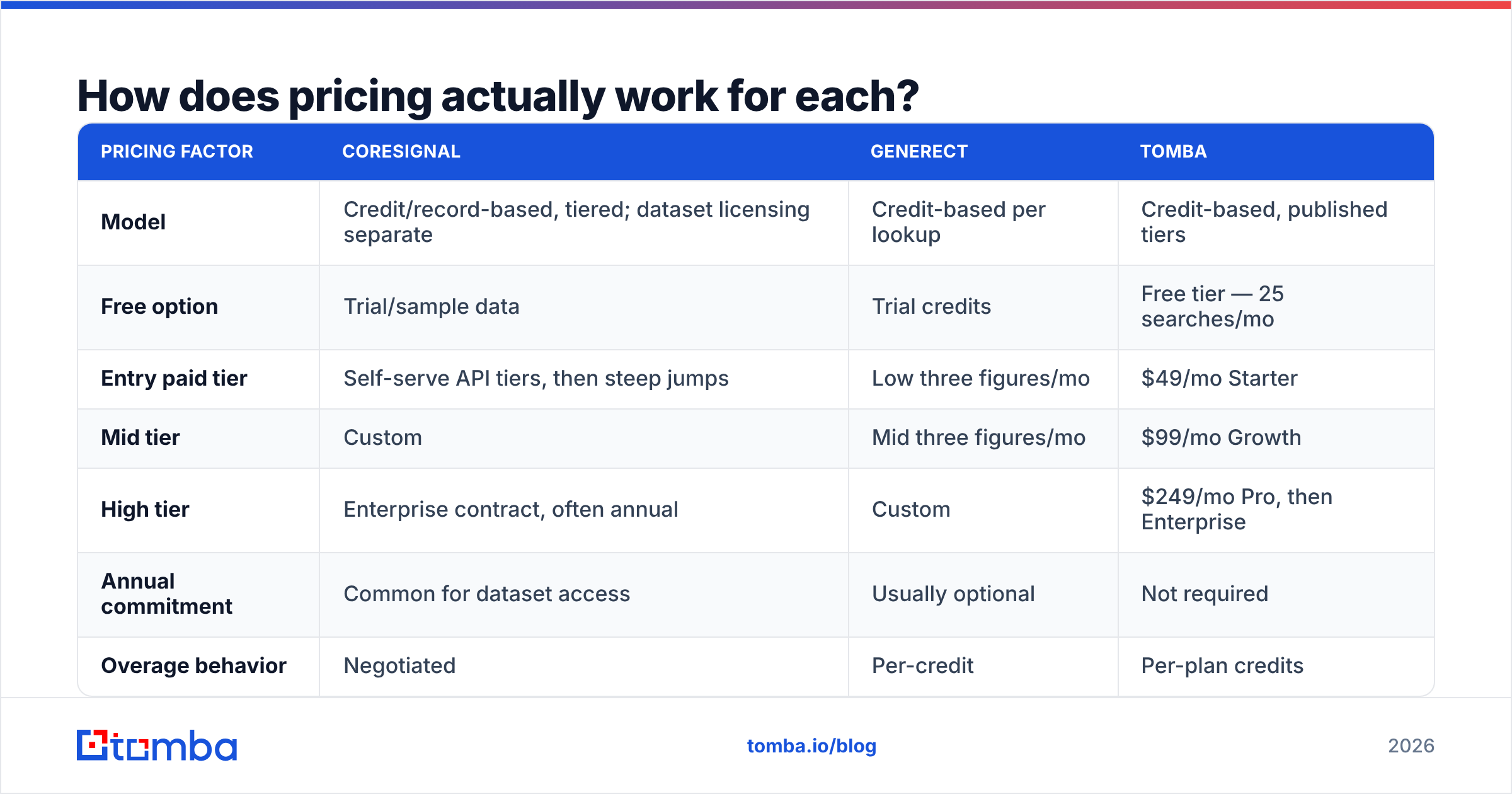
This is where most comparisons get vague, so here's the honest structure. Published pricing changes — check both vendors' current pages before you sign anything — but the shape of each model is stable.
| Pricing factor | Coresignal | Generect | Tomba |
|---|---|---|---|
| Model | Credit/record-based, tiered; dataset licensing separate | Credit-based per lookup | Credit-based, published tiers |
| Free option | Trial/sample data | Trial credits | Free tier — 25 searches/mo |
| Entry paid tier | Self-serve API tiers, then steep jumps | Low three figures/mo | $49/mo Starter |
| Mid tier | Custom | Mid three figures/mo | $99/mo Growth |
| High tier | Enterprise contract, often annual | Custom | $249/mo Pro, then Enterprise |
| Annual commitment | Common for dataset access | Usually optional | Not required |
| Overage behavior | Negotiated | Per-credit | Per-plan credits |
The pattern: Coresignal's real product lives behind a sales conversation. The self-serve tier is an on-ramp; full dataset access is a contract with a floor. That's normal for data-as-a-service and it's not a criticism — it's just a fact you should know before you spend three weeks in evaluation only to discover the minimum is 20x your budget.
Generect sits in the middle. Tomba sits deliberately at the bottom of the cost curve because it's solving a narrower problem — you can see exactly what you'd pay on the Tomba pricing page without a call.

Which is easier to integrate?#
Generect, for most teams. Coresignal, for data teams.
Here's the split, with the honest reasoning:
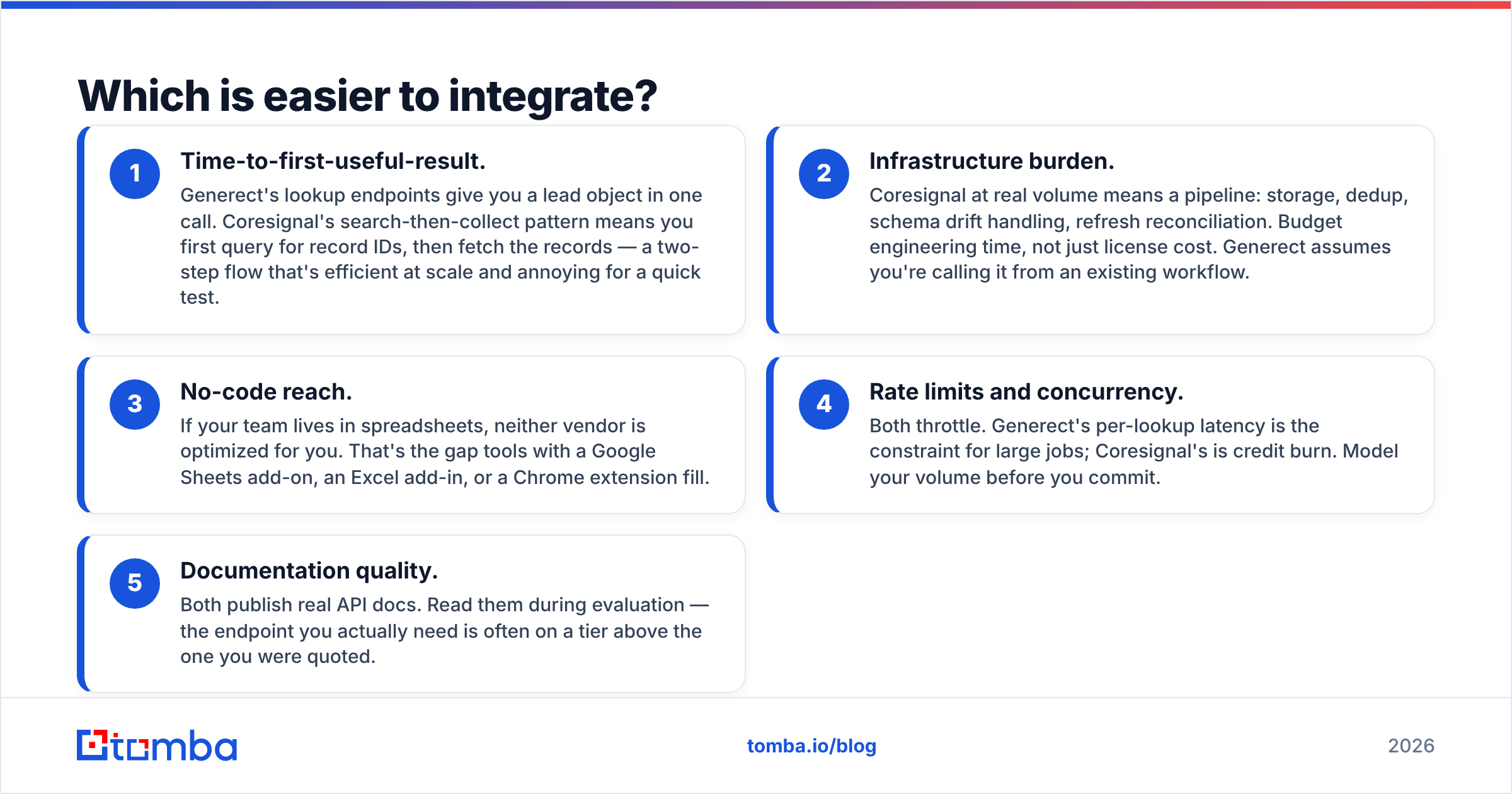
- Time-to-first-useful-result. Generect's lookup endpoints give you a lead object in one call. Coresignal's search-then-collect pattern means you first query for record IDs, then fetch the records — a two-step flow that's efficient at scale and annoying for a quick test.
- Infrastructure burden. Coresignal at real volume means a pipeline: storage, dedup, schema drift handling, refresh reconciliation. Budget engineering time, not just license cost. Generect assumes you're calling it from an existing workflow.
- No-code reach. If your team lives in spreadsheets, neither vendor is optimized for you. That's the gap tools with a Google Sheets add-on, an Excel add-in, or a Chrome extension fill.
- Rate limits and concurrency. Both throttle. Generect's per-lookup latency is the constraint for large jobs; Coresignal's is credit burn. Model your volume before you commit.
- Documentation quality. Both publish real API docs. Read them during evaluation — the endpoint you actually need is often on a tier above the one you were quoted.
If your integration target is "our internal data warehouse," Coresignal is built for that. If it's "our sequencer," Generect is closer. If it's "our SDR's browser," neither is the answer.
Where do both tools fall short?#
Three honest gaps, and they're the same gaps for both:
They don't own deliverability. Data providers deliver records. They do not manage your domain warmup, your SPF and DKIM alignment, your reply rates, or the Google and Microsoft filters deciding whether you land in Primary or Promotions. Vendors on G2 get review-bombed for this constantly, and it's an unfair complaint aimed at the wrong layer of the stack. You still need a warmup plan and clean list hygiene, or you're just sending more mail to spam faster.
Verification is a separate job. A record that says sarah.chen@acme.com is a hypothesis until an SMTP conversation confirms the mailbox exists. Coresignal is explicit that it's a data source, not a validator. Generect does more here but is not a dedicated verification engine. Whatever you buy, budget for a verification pass — a bounce rate above 3% is the fastest way to lose a sending domain, and HubSpot's own research on email performance keeps landing on list quality as the dominant variable.
Coverage is uneven by geography and company size. Both skew toward tech, toward mid-market and enterprise, and toward North America and Western Europe. If you sell to SMBs in Southeast Asia or manufacturing firms in Central Europe, run a match-rate test on 200 of your real accounts before you sign. Vendor-reported coverage numbers are averages across a database you don't care about; your match rate on your ICP is the only number that matters.
When should you pick Coresignal over Generect?#
Pick Coresignal when:
- You need the whole dataset, not individual lookups — TAM analysis, market mapping, model training.
- Headcount, job-posting, or funding signals matter more than individual contact records.
- You have a data engineer who will own the pipeline.
- Your budget accommodates an annual contract with a real floor.
Pick Generect when:
- You need contacts resolved on demand, inside a workflow, today.
- Your volume is measured in thousands of lookups per month, not millions of rows.
- You're an agency or growth team wiring a data source into automation.
- You want to start without a procurement cycle.
Pick neither — and use a focused email finder — when:
- Your actual job is "find and verify the business email of a specific person or role at a specific company."
- You want a free tier to test with before spending anything.
- Your team works in Chrome, Sheets, or a CRM rather than a data warehouse.
That third bucket is bigger than most people admit. A lot of teams buy a heavyweight data platform because it feels strategic, then use 4% of it to do email lookups. That's an expensive way to run a domain search.
How does Tomba fit alongside them?#
Not as a replacement for Coresignal's datasets — that would be a dishonest claim, and the products aren't the same shape. Tomba is narrower and cheaper on purpose.
Where it slots in:
| Job to be done | Best fit |
|---|---|
| License 200M employee records for a model | Coresignal |
| Track headcount/funding signals over time | Coresignal |
| Resolve a lead list in real time inside a workflow | Generect |
| Find a decision-maker's email at a known domain | Tomba |
| Verify a purchased list before sending | Tomba |
| Enrich a CRM with emails, phones, and firmographics | Tomba or Generect |
| Do all of it on a $49/mo budget | Tomba |
A common, sane stack: use a heavyweight provider for account intelligence, then run every contact through a verification layer before it touches your sequencer. The Tomba API is designed to be that last mile — email finder, verifier, and catch-all detection behind one key, with a free tier so you can benchmark match rates against whatever you're already paying for.
What should you actually do next?#
Run a bake-off. It takes an afternoon:
- Export 200 accounts from your real ICP — not a sample the vendor gives you.
- Query all three sources for the same target role.
- Measure three numbers: match rate (did you get a contact?), bounce rate (did the email land?), and cost per verified contact (the only unit price that matters).
- Ignore every marketing claim that contradicts those three numbers.
The winner is almost never the one with the biggest database. It's the one with the best cost per verified, deliverable contact for your specific segment — and that ranking flips depending on who you sell to.
If you're in that third bucket — you don't need a data warehouse, you need working email addresses for people you've already identified — start with the Tomba Email Finder. Free tier gets you 25 searches a month to test against your own list, verification is built in rather than bolted on, and if it works, the Starter plan is $49/mo with no annual commitment and no sales call. Benchmark it against whatever Coresignal or Generect quotes you, and let the bounce rate decide.
Related guides#
Ready to find emails that actually work?
Join 150,000+ professionals who stopped guessing and started sending. Free credits on signup — no credit card required.
Get the Tomba newsletter
Practical outbound tactics and product updates — once every two weeks.
About the author