Coresignal vs Jet Leads Pro: Which B2B Data Tool Wins in 2026
One sells raw data infrastructure by the record. The other sells finished lead lists by the seat. Here is how Coresignal and Jet Leads Pro actually compare on coverage, pricing, and email accuracy — and when neither is the right buy.
Coresignal vs Jet Leads Pro is a common shortlist, but the two tools are barely rivals. One sells raw data. The other sells finished lists. Here is the short version.
TL;DR
- Coresignal is data infrastructure, not a prospecting app. It sells firmographic, employee, and job-posting records in bulk, via API or dataset delivery. You need engineers to consume them. Pricing starts in the hundreds-to-thousands per month, not tens.
- Jet Leads Pro sits at the opposite end. It is a self-serve lead-list tool for small sales teams. You get a CSV of contacts today, not a data pipeline next quarter. Public documentation is thin, so verify claims and pricing before you commit budget.
- They are barely competitors. Coresignal vs Jet Leads Pro is really a choice between building a data layer and renting finished lists. Compare them on price alone and you will pick the wrong one.
- Neither one is a dedicated email-verification layer. Contact data decays roughly 2–3% per month. A verification step in front of your sender is non-optional.
- A common, cheaper stack: source companies and roles from whichever provider fits. Then resolve and verify the actual email addresses with a purpose-built email finder before anything hits your sequencer.
Coresignal vs Jet Leads Pro: what is the real difference?#
The honest framing of Coresignal vs Jet Leads Pro is not "which tool has better data." It is "which layer of the stack are you buying?"
Coresignal is a B2B data provider, in the same class as the big public-web data vendors. It aggregates company profiles, employee profiles, and job postings from public sources. It refreshes them on a schedule and ships them to you as raw records — through a REST API, a search API, or bulk dataset delivery (S3, GCS, or flat files).
Its buyers are data engineers, ML teams, VC/PE research groups, and RevOps orgs building an internal ICP scoring model. Coresignal does not hand you a campaign-ready list with verified emails attached. It hands you the substrate you build one from.
Jet Leads Pro sits at the other end of the pipeline. It is a self-serve prospecting product: filter by industry, title, geography, and company size, then export contacts. The promise is speed. You go from signup to a CSV inside an hour, with no engineering work. That is genuinely useful for a two-person agency or a founder running their own outbound.
One caveat is worth stating plainly. Jet Leads Pro is a smaller, less-documented vendor than Coresignal. Its public docs, data-sourcing disclosures, and review volume on sites like G2 are thin next to established players. That is not automatically a knock on the product. But it does mean you should insist on a live trial with your ICP filters before you pay for a year.
Coresignal vs Jet Leads Pro: the head-to-head comparison#
| Attribute | Coresignal | Jet Leads Pro |
|---|---|---|
| What you're buying | Raw B2B data records (company, employee, job posting) | Finished, filterable contact lists |
| Primary delivery | REST/search API, bulk datasets (S3/GCS/CSV) | Web app + CSV export |
| Typical buyer | Data engineers, RevOps, ML/AI teams, investors | SDRs, founders, small agencies |
| Setup time | Days to weeks (integration + schema mapping) | Minutes |
| Pricing model | Subscription + credit/record volume; enterprise-tier commitments common | Seat- or credit-based self-serve tiers |
| Entry cost | High — typically four figures/month for meaningful volume | Low — designed for small budgets |
| Email addresses included | Not the core product; work-email coverage is partial | Yes, bundled with the list |
| Email verification | Not a verification vendor | Basic checks; verify independently |
| Refresh cadence | Scheduled bulk refreshes across the dataset | Vendor-dependent; ask for specifics |
| Best at | Depth, scale, historical/job-posting signals | Speed to a usable list |
| Weakest at | Cost and time-to-first-email | Transparency, depth, enterprise scale |
Read that table once more and you will notice something. The two products barely overlap in a single row. That is the point.

Which one should you choose for your use case?#
Skip the scorecard and use a decision path. Four situations cover most buyers.
You're building a product or model on top of B2B data. Choose Coresignal. If your output is a scoring model, an enrichment microservice, a market map, or a data product you resell, you need schema stability, bulk delivery, and historical depth. A lead-list app cannot give you that. No pile of CSV exports will substitute for a proper dataset. Budget it as infrastructure, not as sales tooling.
You need 500 contacts for a campaign that starts Monday. Choose the self-serve tool — Jet Leads Pro or any comparable list builder. Paying for a data-infrastructure contract to run one quarter of outbound is the classic over-buy. The failure mode here is not the tool. It is skipping verification (more on that below).
You're a mid-market GTM team with a CRM to keep clean. Neither, on its own. What you want is an enrichment layer wired into your CRM that fills gaps continuously. Contact enrichment plus a scheduled re-verification pass beats a quarterly bulk purchase that starts rotting the day it lands.
You already have the companies and just need the people. Skip both. Your ICP list may already exist — a conference roster, a G2 category, your website's visitor identification log, or a partner's customer page. In that case you do not need a discovery engine. You need a resolver: give it a domain and a name, get back a verified work email. That is a domain search job, and it costs a fraction of either product above.
That fourth case is more common than most teams admit. Many "we need a data provider" budget requests are really "we can't get from a company name to a deliverable inbox" problems in disguise.
How accurate is the contact data from each?#
Here is where both tools deserve scrutiny. Public marketing numbers are least trustworthy on this exact point.
Coresignal's strength is profile coverage: hundreds of millions of employee and company records, refreshed at scale. Its weakness, from a cold-outbound view, is simple. A rich profile is not a deliverable email address.
Public-web employee data gives you a name, a title, a company, and a tenure. It often does not give you firstname.lastname@company.com with any confidence. When it does, it rarely tells you whether that mailbox still accepts mail. That gap is by design: Coresignal sells data, not deliverability.
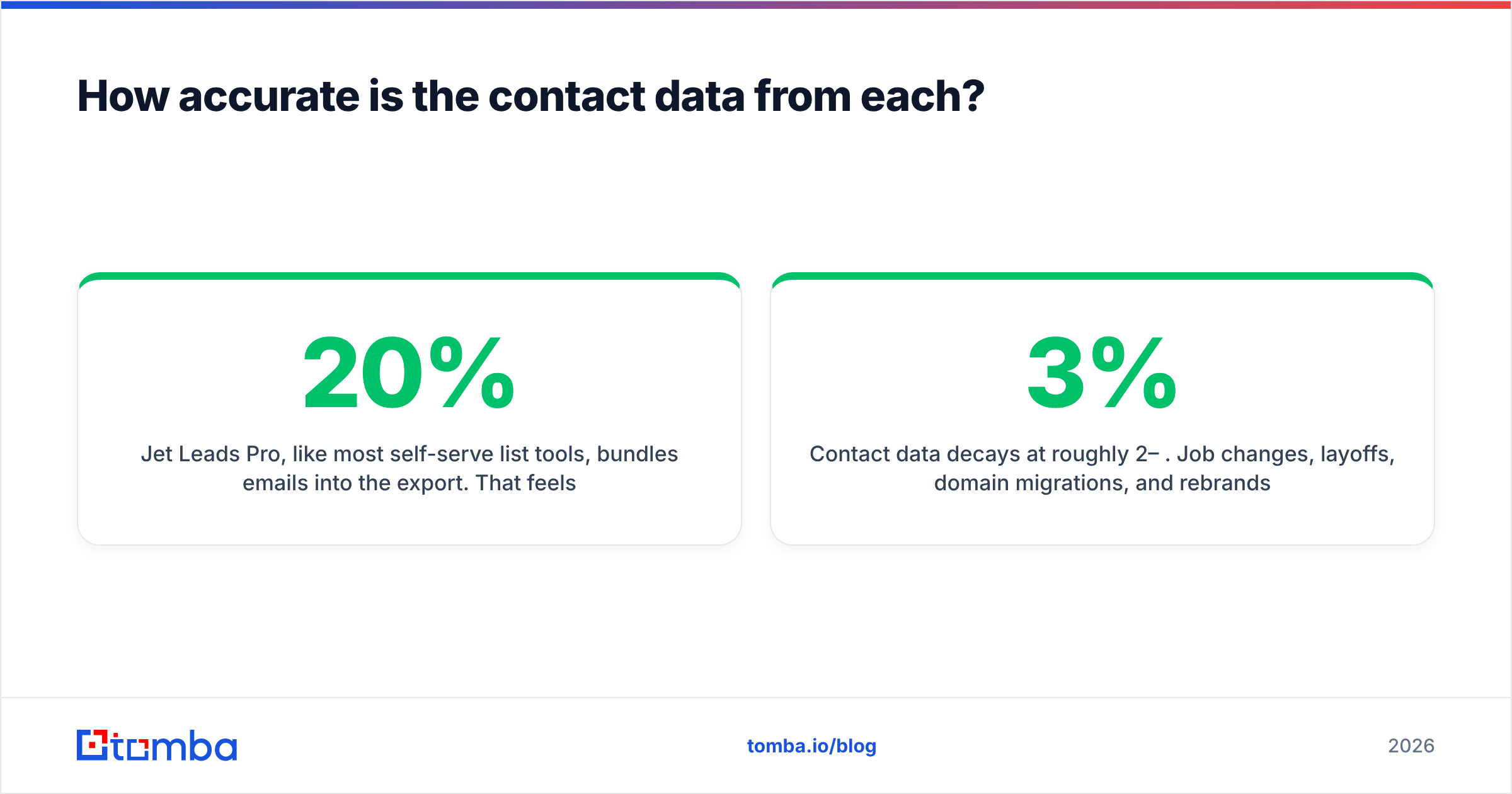
Jet Leads Pro, like most self-serve list tools, bundles emails into the export. That feels like a better deal until you send. Bundled emails are usually a mix of three things: addresses sourced and verified once, pattern-guessed addresses ({first}.{last}@domain), and stale records from a shared pool that half the market has already burned.
The bounce rate on an un-rechecked export from any bulk list vendor often lands in the 8–20% range. That is well past the ~2–3% threshold where mailbox providers start throttling you.
Two numbers to hold onto:
- Contact data decays at roughly 2–3% per month. Job changes, layoffs, domain migrations, and rebrands compound. A list that was 95% accurate in January is meaningfully worse by June. No vendor is immune, including the good ones.
- Bounces are a reputation event, not a rounding error. Once your sender reputation drops, your good emails stop landing too. The cost of a bad list is not the wasted credits. It is the domain you have to warm up again.
The practical rule: treat every list as unverified until you verify it yourself — from every vendor, at every price point. Run the export through an email verifier before it touches your sequencer. It takes minutes, and it is the highest-ROI step in the whole outbound chain.

What does Coresignal vs Jet Leads Pro actually cost?#
Pricing is where the "vs" framing breaks down hardest.
Coresignal publishes tiered plans built around record volume and API access. Bulk dataset delivery runs on enterprise agreements. For any serious ingestion volume, expect a four-figure monthly commitment and, usually, an annual contract. That is normal for the category. Gartner would file it under data infrastructure spend, not sales tooling spend. If your finance team routes it through the sales-tools budget, expect friction.
Jet Leads Pro is priced as self-serve SaaS: low monthly entry, credits or seats, upgrade as you scale. Its published pricing has moved, and it is not always documented clearly. Confirm the current numbers on the vendor's own checkout page before you plan around them. Do not trust a third-party blog — including this one — for a live price.
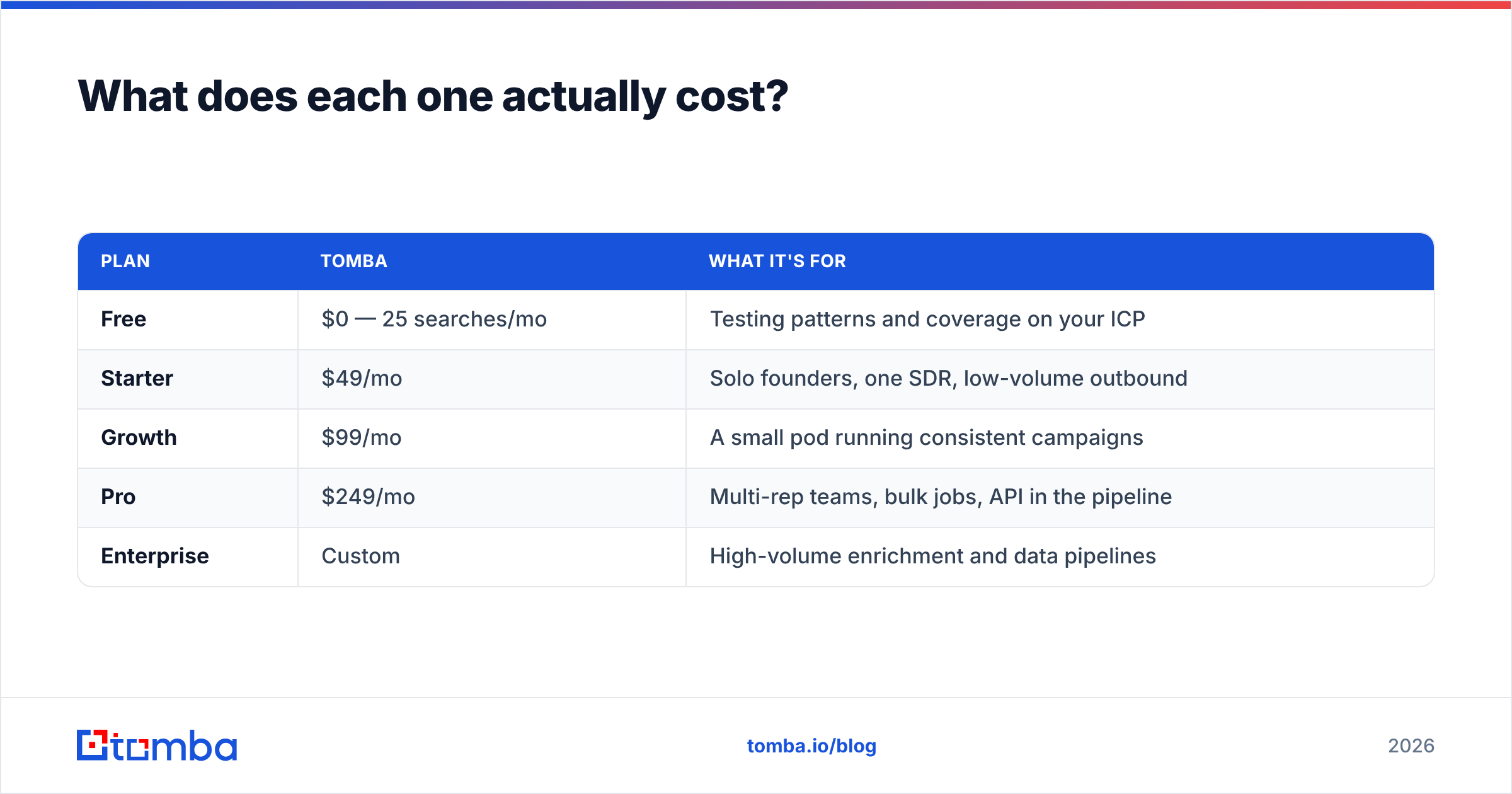
For context on the third path, here is what a purpose-built email-resolution layer costs.
| Plan | Tomba | What it's for |
|---|---|---|
| Free | $0 — 25 searches/mo | Testing patterns and coverage on your ICP |
| Starter | $49/mo | Solo founders, one SDR, low-volume outbound |
| Growth | $99/mo | A small pod running consistent campaigns |
| Pro | $249/mo | Multi-rep teams, bulk jobs, API in the pipeline |
| Enterprise | Custom | High-volume enrichment and data pipelines |
See Tomba pricing for current details. The point of this table is not "Tomba is cheaper." It is that the three products answer different questions. Coresignal answers "what does the market look like?" Jet Leads Pro answers "who can I email this week?" An email finder answers "is this person reachable, and will the message land?"
Buy the wrong one for your question and you end up with a $2,000/month data contract and a 14% bounce rate.
Are there better alternatives to both?#
It depends on the job you are hiring the tool for.
- If you need market-scale data with historical depth: Coresignal's real peers are the other large public-web data providers — People Data Labs, Proxycurl, and the enterprise firmographic vendors. Compare them on schema stability, refresh cadence, and how they source data. Ask directly, and get it in writing.
- If you need a fast, no-engineering list: the self-serve category is crowded. Apollo, Lusha, and BookYourData all serve this need with more public track record than a newer entrant. Each has a distinct strength. BookYourData, for example, sells verified lists with a bounce guarantee rather than a subscription treadmill, which suits one-off campaign buyers well. If you are shopping that tier, our Apollo alternative breakdown covers the trade-offs.
- If your bottleneck is email accuracy: you do not need a new data provider at all. You need a resolver and a verifier in front of the data you already have. It is the cheapest fix available, and most teams skip it because it is not exciting.
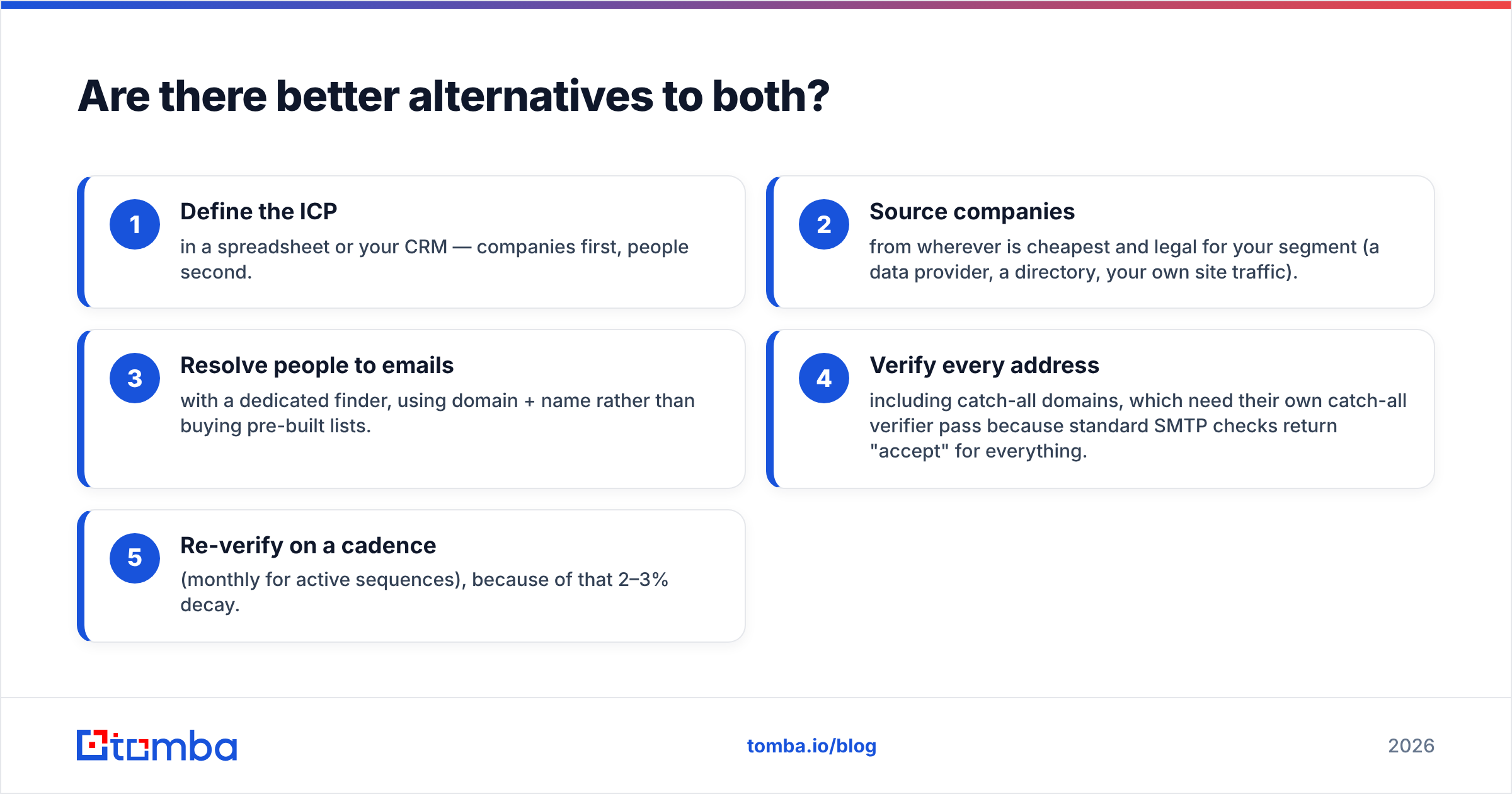
The stack that works for most B2B teams under 50 reps is boring and layered:
- Define the ICP in a spreadsheet or your CRM — companies first, people second.
- Source companies from wherever is cheapest and legal for your segment: a data provider, a directory, or your own site traffic.
- Resolve people to emails with a dedicated finder, using domain and name rather than buying pre-built lists.
- Verify every address. Catch-all domains need their own catch-all verifier pass, because standard SMTP checks return "accept" for everything.
- Re-verify on a cadence — monthly for active sequences — because of that 2–3% decay.
Steps 3 through 5 are where deliverability is won or lost. They cost less than most teams spend on step 2.
The verdict on Coresignal vs Jet Leads Pro#
Coresignal wins if you're building. Jet Leads Pro wins if you're sending this week. Neither wins if what you actually need is deliverable email addresses.
Coresignal is a legitimate, mature data provider with real infrastructure behind it. If you have the engineering capacity and a use case that justifies the spend, it will do things no list tool can.
Jet Leads Pro is a reasonable low-cost entry point for a small team that needs momentum. The standard caveats for any newer vendor apply: trial it hard, verify the data yourself, and do not sign an annual deal on the strength of a demo.
Run the diagnostic before you buy either one. Did your last campaign underperform because of bounces, spam placement, or emails sent to people who left nine months ago? A bigger data contract will not fix that. A verification layer will.
Start with the layer that actually moves reply rates. Tomba's Email Finder turns a name and a domain into a verified work email. SMTP checks, catch-all handling, and confidence scores are built in, so you know what is safe to send before you send it. The free tier gives you 25 searches a month to test it against your own ICP. Paid plans start at $49/mo. Point it at whatever list you already have and see how much of it survives.
Related guides#
Ready to find emails that actually work?
Join 150,000+ professionals who stopped guessing and started sending. Free credits on signup — no credit card required.
Get the Tomba newsletter
Practical outbound tactics and product updates — once every two weeks.
About the author