Coresignal vs Kaspr (2026): Which B2B Data Tool Wins?
Coresignal sells raw B2B datasets by API. Kaspr sells LinkedIn contact details by the seat. They are not the same product — and picking wrong costs you a year of budget. Here is the honest breakdown.
TL;DR
- Coresignal and Kaspr are not competitors in the normal sense. Coresignal is a raw B2B data supplier (firmographic, employee, and job-posting datasets delivered by API or bulk file). Kaspr is a per-seat prospecting tool that pulls emails and mobile numbers off LinkedIn profiles.
- Pick Coresignal if you are building a product, a data warehouse, or an ICP scoring model and you need millions of records you can process yourself.
- Pick Kaspr if you are an SDR who lives in LinkedIn Sales Navigator and needs a phone number in the next ten seconds.
- Pricing works differently in each. Coresignal is contract-and-volume based and lands in the four-figures-per-month range for serious API use. Kaspr is priced per user, per month, with credit caps — cheap to start, expensive to scale across a team.
- Neither is a great fit if what you actually need is verified work emails at a specific set of companies. That is a third category, and it is where a dedicated email finder is cheaper and more accurate than both.
What are Coresignal and Kaspr, really?#
Start here, because most "Coresignal vs Kaspr" comparisons pretend these tools do the same job. They don't.
Coresignal is a data-as-a-service company. It scrapes and structures public web data — company profiles, employee records, job postings, funding events, technographics — and sells it as an API, a search API, or a bulk dataset dump. You are buying rows. What you do with them is entirely your problem. Coresignal's typical customer is a data engineer at an HR-tech startup, a VC platform team building a sourcing engine, or a RevOps group feeding a lead-scoring model.
Kaspr is a sales prospecting tool, now part of the Cognism group. Its core surface is a Chrome extension: you open a LinkedIn profile or a Sales Navigator list, click the widget, and Kaspr reveals the person's email addresses and phone numbers, then pushes them to a list, a sequence, or your CRM. Its typical customer is an SDR, a recruiter, or a two-person founding sales team.
The analogy: Coresignal sells you a truckload of lumber. Kaspr sells you a finished chair. Asking which is "better" only makes sense once you know whether you own a workshop.
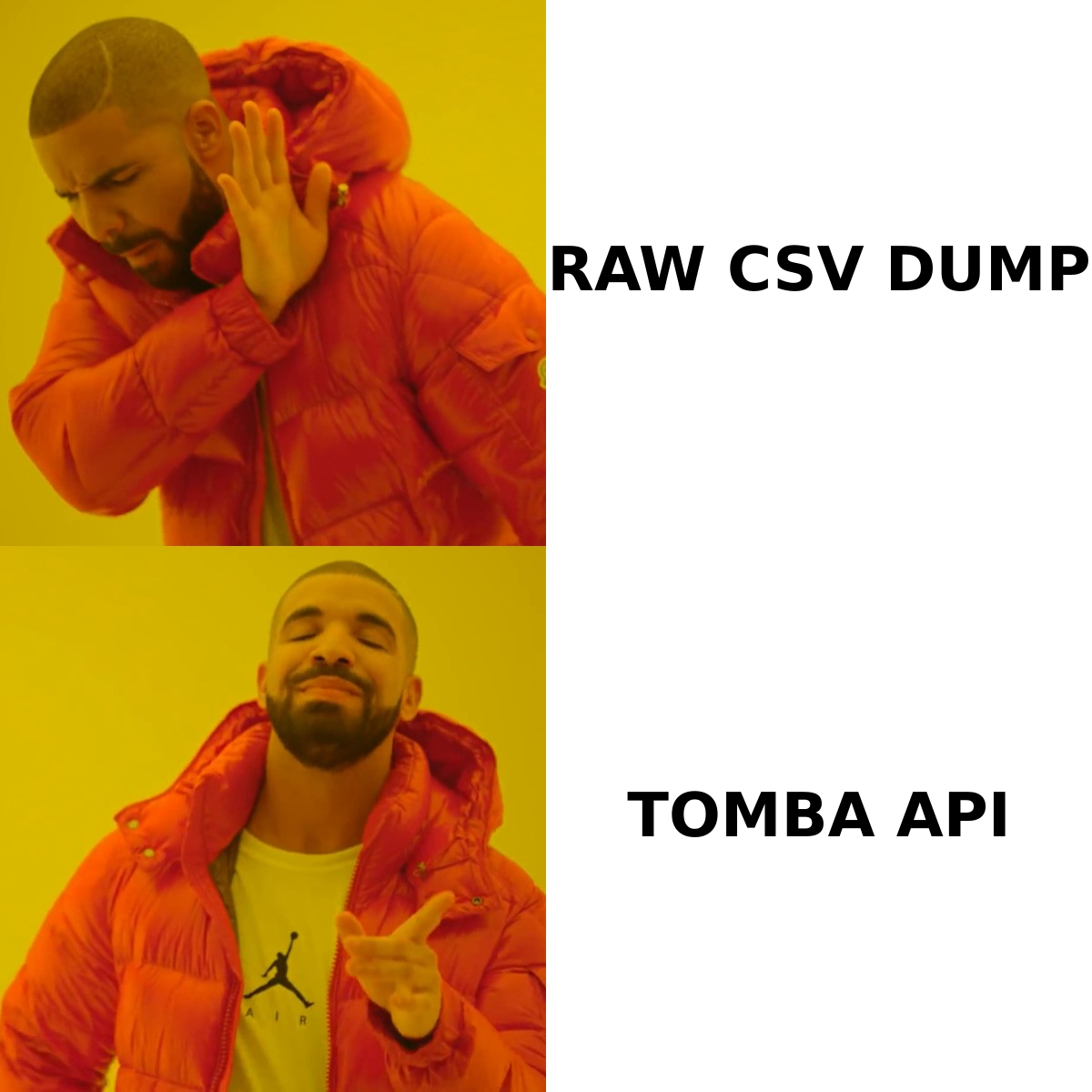
How do Coresignal and Kaspr compare head-to-head?#
| Attribute | Coresignal | Kaspr |
|---|---|---|
| Product type | Raw B2B data (API + bulk datasets) | Per-seat prospecting tool + Chrome extension |
| Primary user | Data engineer, RevOps, product team | SDR, recruiter, founder |
| Main data assets | Company, employee, job posting, funding, technographic records | Emails and mobile numbers tied to LinkedIn profiles |
| Delivery | REST API, Elasticsearch-style search API, S3 bulk files | Browser extension, web app, CRM integrations |
| Phone numbers | Limited / not the core offer | Core offer — mobile numbers are the headline feature |
| Works inside LinkedIn | No | Yes (extension is the product) |
| Free tier | Trial credits on request | Yes — a small monthly free credit allowance |
| Contract shape | Annual / volume commitment typical | Monthly or annual, per user |
| Engineering required | High — you must build on top of it | None |
| Best for | Building datasets, scoring models, or a product | Working a list of named prospects today |
If that table already told you the answer, you can stop reading. If you're somewhere in the middle — say, a RevOps lead who has both an SDR team and a warehouse — keep going.
What does Coresignal actually do well?#
Scale and depth. Coresignal's pitch is hundreds of millions of employee and company records, refreshed on a schedule, with historical snapshots. If your use case is "find every Series B company in DACH that has posted three or more DevOps roles in the last 90 days," Coresignal is genuinely one of the few vendors that can answer it. Standard prospecting tools cannot.
Data you can reshape. Because you get raw structured records rather than a UI, you can join Coresignal data against your own product usage, CRM history, or intent signals. This is the foundation for real revenue operations work — scoring, territory design, TAM sizing — rather than one-off list building.
Where it disappoints: contact-level reachability. Coresignal's employee records are strong on who works where and what they do. They are considerably weaker on the thing sales teams actually need — a verified, deliverable work email or a live mobile number. Many teams buy Coresignal, get their beautiful account list, and then discover they still have to buy contact data separately. That's a second line item nobody budgeted for.
Also worth knowing: you need engineers. Not "a technical marketer who can write a Zapier step" — you need someone who is comfortable with pagination, rate limits, schema drift, and deduplication. Budget for that, or the data sits in an S3 bucket doing nothing.
What does Kaspr actually do well?#
Speed on a named prospect. Kaspr's whole reason to exist is that the gap between "I found this person on LinkedIn" and "I have their mobile number" should be one click. It is very good at that. For LinkedIn outreach motions and for recruiters working candidate lists, that loop matters more than dataset breadth.
Mobile numbers. This is Kaspr's real differentiator, and it's a legitimate one. European mobile coverage in particular is a strength — unsurprising given the Cognism relationship. If cold calling is a real channel for you, a tool that surfaces a direct dial is worth more than one that surfaces a fourth email guess.
Low barrier to entry. There is a free plan with a modest monthly credit allowance, the extension installs in a minute, and a new rep can be productive the same day. Compare that to a Coresignal integration, which is measured in sprints.
Where it disappoints:
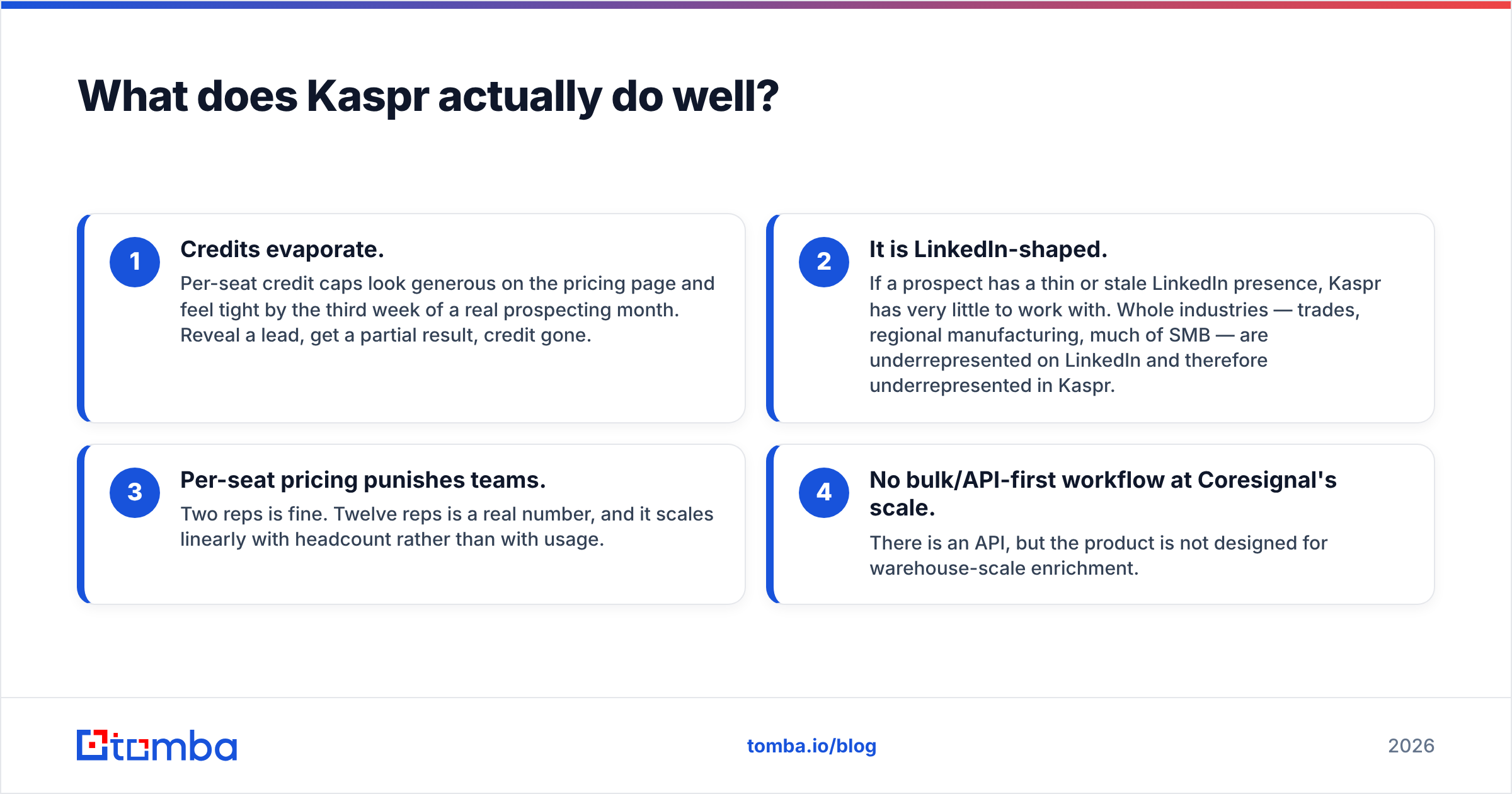
- Credits evaporate. Per-seat credit caps look generous on the pricing page and feel tight by the third week of a real prospecting month. Reveal a lead, get a partial result, credit gone.
- It is LinkedIn-shaped. If a prospect has a thin or stale LinkedIn presence, Kaspr has very little to work with. Whole industries — trades, regional manufacturing, much of SMB — are underrepresented on LinkedIn and therefore underrepresented in Kaspr.
- Per-seat pricing punishes teams. Two reps is fine. Twelve reps is a real number, and it scales linearly with headcount rather than with usage.
- No bulk/API-first workflow at Coresignal's scale. There is an API, but the product is not designed for warehouse-scale enrichment.

How does the pricing compare?#
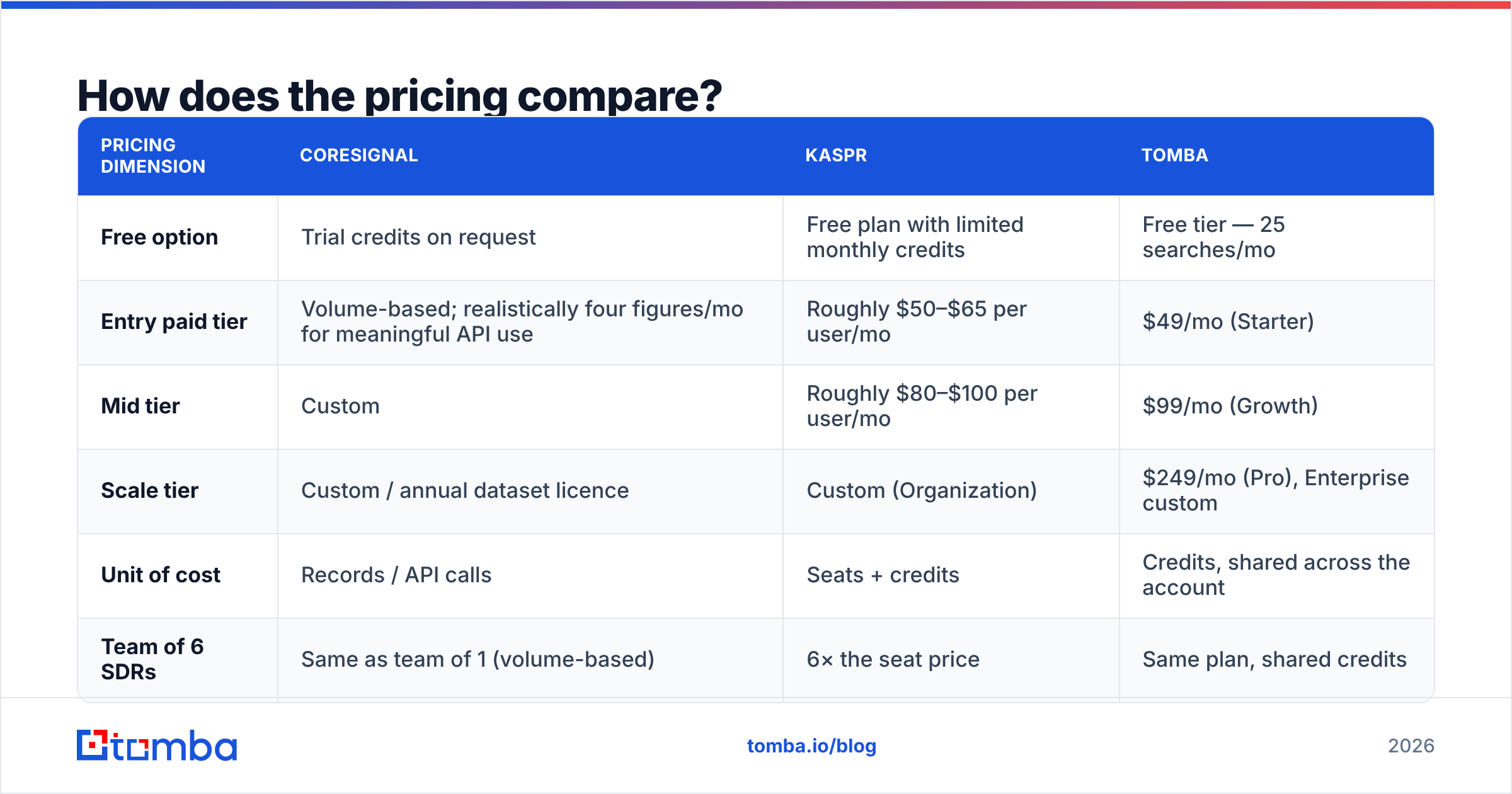
Both vendors change pricing periodically, so treat these as shape-of-the-deal rather than a quote. Check Coresignal's pricing page and Kaspr's pricing page before you sign anything.
| Pricing dimension | Coresignal | Kaspr | Tomba |
|---|---|---|---|
| Free option | Trial credits on request | Free plan with limited monthly credits | Free tier — 25 searches/mo |
| Entry paid tier | Volume-based; realistically four figures/mo for meaningful API use | Roughly $50–$65 per user/mo | $49/mo (Starter) |
| Mid tier | Custom | Roughly $80–$100 per user/mo | $99/mo (Growth) |
| Scale tier | Custom / annual dataset licence | Custom (Organization) | $249/mo (Pro), Enterprise custom |
| Unit of cost | Records / API calls | Seats + credits | Credits, shared across the account |
| Team of 6 SDRs | Same as team of 1 (volume-based) | 6× the seat price | Same plan, shared credits |
The pattern is worth internalising. Coresignal charges for data volume and doesn't care how many humans touch it. Kaspr charges for humans and caps the data each one can touch. Credit-pooled tools sit in the middle and are usually the cheapest per useful contact once you're past two or three reps. Full Tomba pricing is public if you want to sanity-check the third column.
How accurate is the data from each?#
Honest answer: nobody's public accuracy number should be trusted, including the ones on this page, because every vendor benchmarks on the segment where they win.
What we can say with more confidence:
- Coresignal's company- and role-level data is solid and its freshness cadence is a real strength. Its contact data — deliverable email, live phone — is not what you're paying for and should not be treated as verified.
- Kaspr's mobile numbers beat most competitors in Europe and are middling in North America. Its email hit rate is decent on well-populated LinkedIn profiles and drops sharply outside them.
- Both degrade fast on catch-all domains. A large slice of corporate mail servers accept everything at the SMTP layer, which means any provider can return a plausible-looking address that bounces. If you're not running the result through a catch-all verifier, your reported accuracy is fiction regardless of vendor.
The operational fix is the same in every stack: never trust a single source's confidence score. Take whatever address you got, run it through a real email verifier, and only then let it into a sequence. Bounce rate is the number that determines your sender reputation, and sender reputation is the number that determines whether the campaign happens at all. G2's category grids for sales intelligence software are useful for tracking how reviewer sentiment shifts on this quarter to quarter.
Which one should you pick for your use case?#
- You're building a product or a scoring model — Coresignal. Nothing else on this page can hand you the volume of structured employee and firmographic records you need, and per-seat tools will never let you export at that scale legally or economically.
- You're an SDR working named accounts on LinkedIn, and you cold call — Kaspr. The mobile coverage plus the in-LinkedIn workflow is the whole point, and no API is going to beat a one-click reveal on the profile you're already looking at.
- You're a recruiter — Kaspr, for the same reasons, with the caveat that candidates outside white-collar tech roles will have thin LinkedIn footprints.
- You need verified work emails at a defined list of companies — neither. This is a domain-search problem, not a dataset problem and not a LinkedIn problem. Feed a list of domains to a domain search tool, get the pattern plus the named contacts, verify, done. Cheaper and higher hit rate than either tool on this page.
- You have both an SDR team and a data team — you'll likely end up with Coresignal for account selection and something else for contact-level reachability. Just budget for both up front instead of discovering it in month four.
- You're a two-person startup with no budget — start with a free tier, prove the channel works, then buy. Both Kaspr and Tomba have usable free plans; Coresignal does not really have a self-serve on-ramp.
Where does a dedicated email finder fit in this stack?#
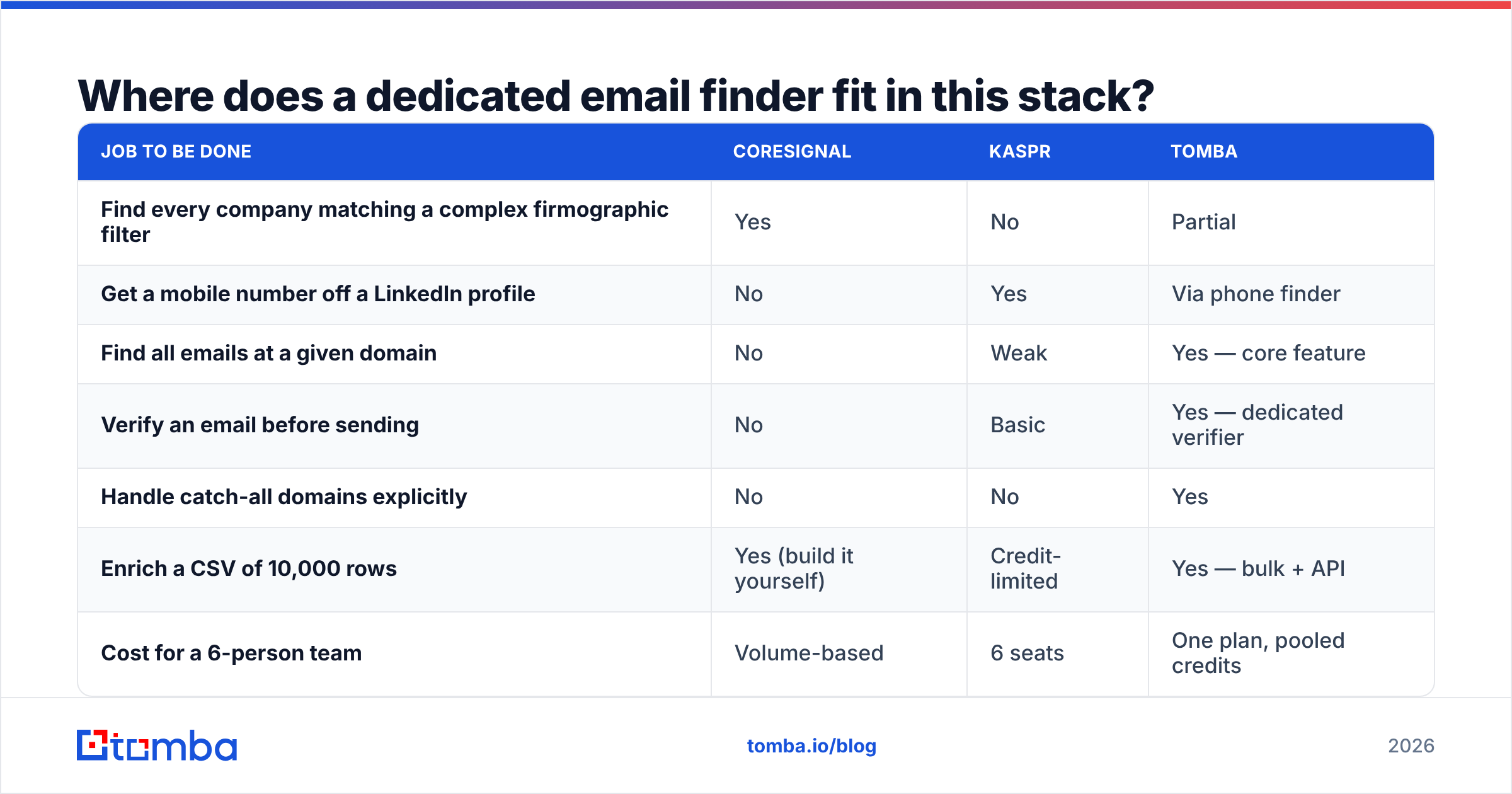
There's a third shape of tool that sits between Coresignal's raw-lumber model and Kaspr's finished-chair model: the contact-layer API. You bring the accounts — from Coresignal, from your CRM, from a conference attendee list, from anywhere — and it returns verified contact details for the people you actually want to reach.
That's the job Tomba is built for. Concretely:
| Job to be done | Coresignal | Kaspr | Tomba |
|---|---|---|---|
| Find every company matching a complex firmographic filter | Yes | No | Partial |
| Get a mobile number off a LinkedIn profile | No | Yes | Via phone finder |
| Find all emails at a given domain | No | Weak | Yes — core feature |
| Verify an email before sending | No | Basic | Yes — dedicated verifier |
| Handle catch-all domains explicitly | No | No | Yes |
| Enrich a CSV of 10,000 rows | Yes (build it yourself) | Credit-limited | Yes — bulk + API |
| Cost for a 6-person team | Volume-based | 6 seats | One plan, pooled credits |
The point is not that Tomba replaces Coresignal — it doesn't, and if you need 200 million employee records you should go buy 200 million employee records. The point is that the contact layer is a separable problem that both of these tools handle as a side quest, and side quests are where accuracy goes to die.
If you're wiring this into a pipeline rather than clicking around a UI, the Tomba API and data enrichment endpoints cover the same integration surface a Coresignal deployment would, without the four-figure floor. HubSpot's own sales prospecting research is a decent sanity check on how much of a rep's week still disappears into data hygiene — it's the single biggest argument for buying the contact layer instead of building it.
What's the final verdict on Coresignal vs Kaspr?#
Coresignal wins on scale and flexibility. Kaspr wins on speed and phone numbers. Neither wins on verified work email, which is what most B2B outbound teams actually run on.
Choose Coresignal when data is your raw material and you have engineers to shape it. Choose Kaspr when LinkedIn is your hunting ground and a dial tone is the goal. If you find yourself trying to force either one to do the other's job — exporting Kaspr credits into a warehouse, or hand-verifying Coresignal contact rows before a send — that's the signal you've picked the wrong tool for the job, not that you need a bigger plan.
And if the honest description of your workflow is "I have a list of target companies and I need the right person's verified email in my sequencer by Thursday," skip the debate. Point the Tomba Email Finder at your domains, verify what comes back, and spend the saved budget on something that isn't data. The free tier gives you 25 searches a month to test the hit rate on your own accounts before you pay anyone — including us.
Related guides#
Ready to find emails that actually work?
Join 150,000+ professionals who stopped guessing and started sending. Free credits on signup — no credit card required.
Get the Tomba newsletter
Practical outbound tactics and product updates — once every two weeks.
About the author