Coresignal vs Kipplo (2026): Which B2B Data Tool Wins?
Coresignal sells raw B2B datasets by the million. Kipplo sells ready-to-email leads. They solve different problems — and picking the wrong one wastes a quarter. Here's the honest breakdown.
TL;DR — Coresignal vs Kipplo in 30 seconds#
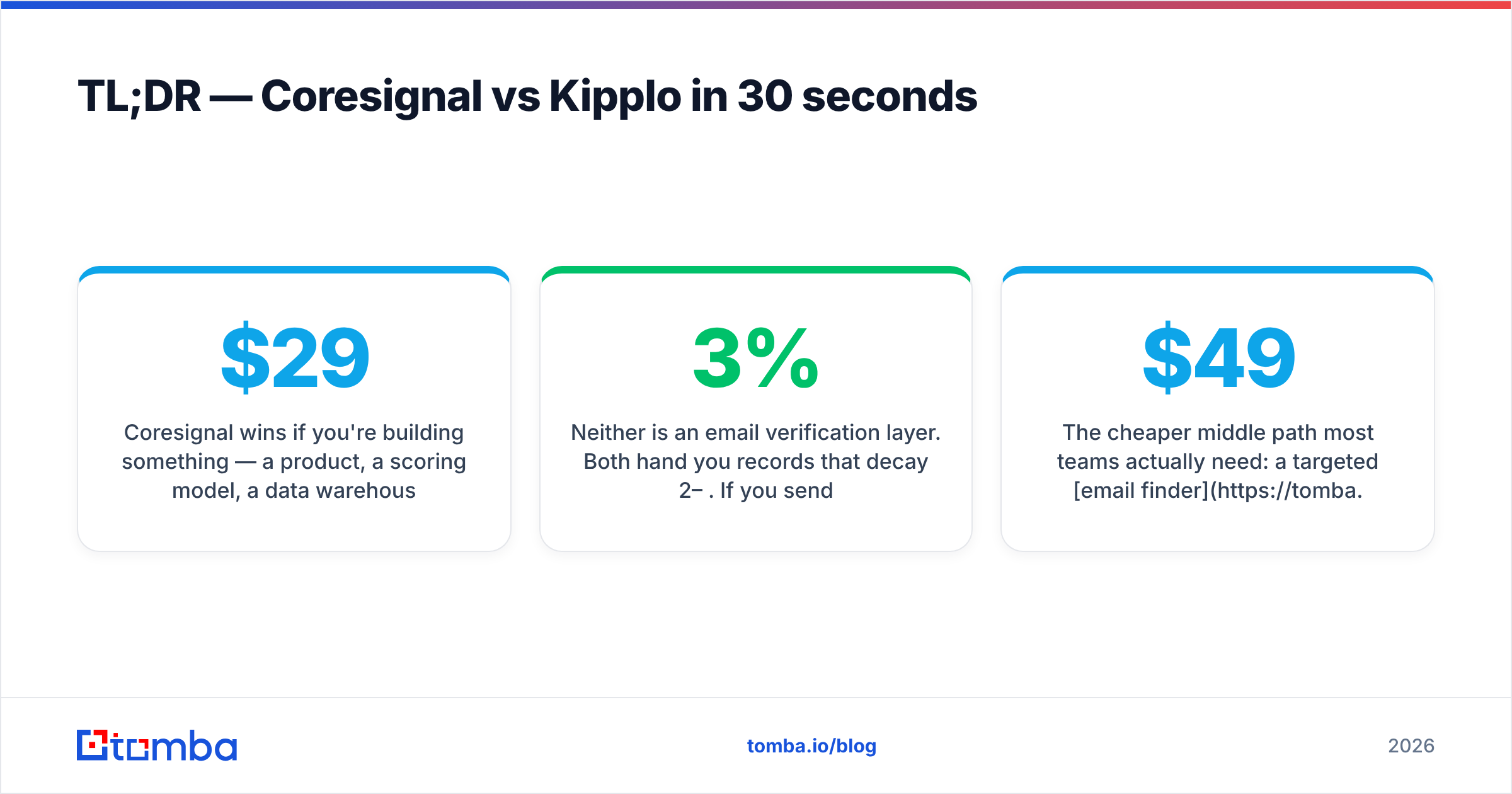
- They are not really competitors. Coresignal is a data-as-a-service provider that sells large firmographic and employee datasets through APIs and bulk datafeeds. Kipplo is a self-serve lead platform aimed at people who want a list of contacts they can email this week.
- Coresignal wins if you're building something — a product, a scoring model, a data warehouse, an ICP engine. It's infrastructure, and it's priced like infrastructure (expect custom quotes and annual commitments, not a $29 checkout).
- Kipplo wins if you're a small sales team that just needs contacts, doesn't want to write code, and doesn't want to talk to a salesperson before seeing the product.
- Neither is an email verification layer. Both hand you records that decay 2–3% per month. If you send without verifying, you burn your domain regardless of which vendor you paid.
- The cheaper middle path most teams actually need: a targeted email finder plus a verification step, at $49/mo, instead of a six-figure data contract or a list you can't audit.
What is Coresignal, actually?#
Coresignal is a B2B data provider that sells structured company, employee, and job-posting data at scale. Think of it less like a lead tool and more like a water utility: you don't go to Coresignal for a glass of water, you go there because you're plumbing an entire building.
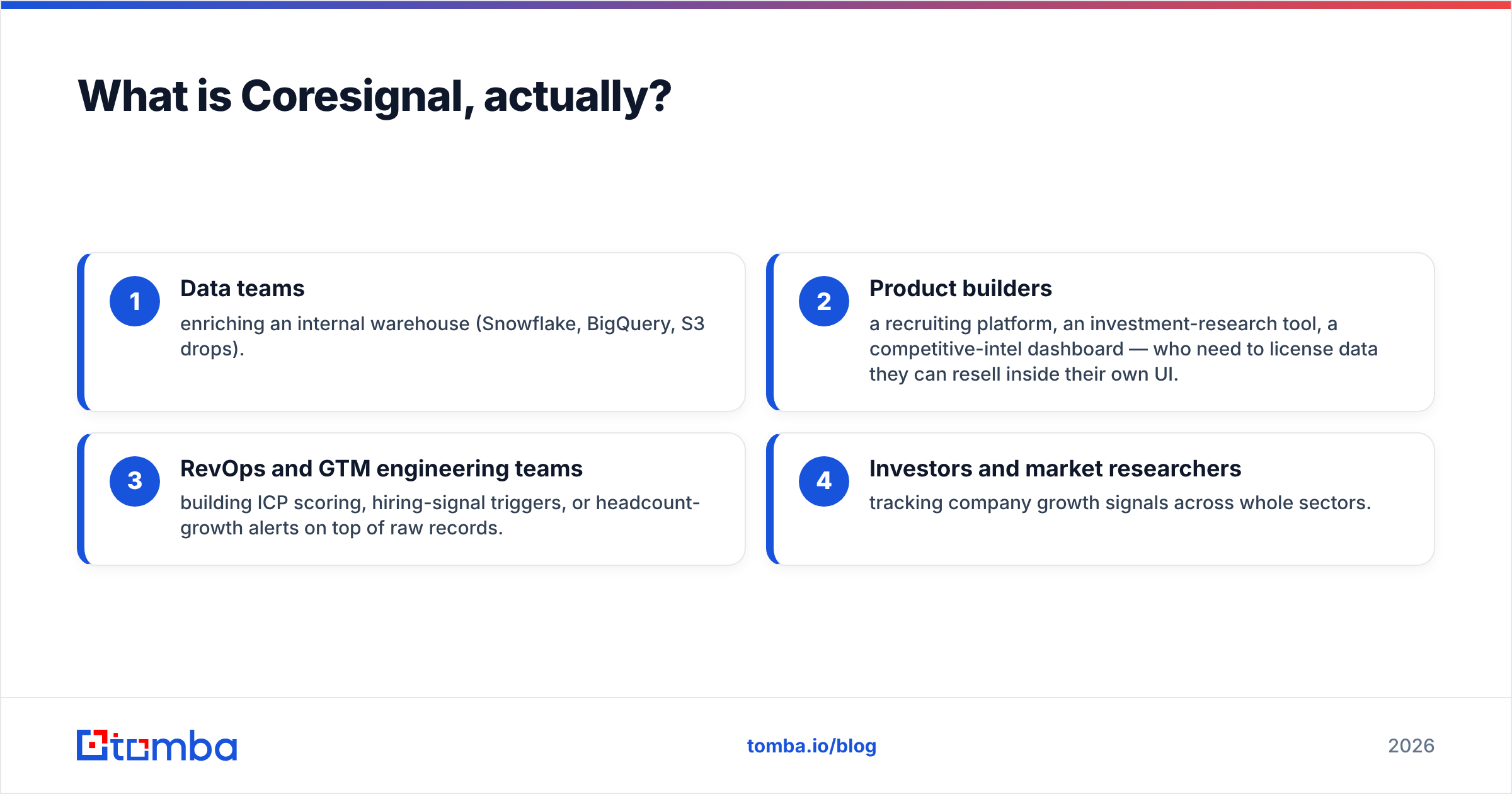
Its typical customers are:
- Data teams enriching an internal warehouse (Snowflake, BigQuery, S3 drops).
- Product builders — a recruiting platform, an investment-research tool, a competitive-intel dashboard — who need to license data they can resell inside their own UI.
- RevOps and GTM engineering teams building ICP scoring, hiring-signal triggers, or headcount-growth alerts on top of raw records.
- Investors and market researchers tracking company growth signals across whole sectors.
The delivery model is the tell. Coresignal leans on APIs, bulk datafeeds, and cloud-hosted dataset delivery, not a point-and-click prospecting UI with a "send email" button. If your team's answer to "how will you use this?" is "we'll query it," Coresignal is in the right conversation. If your answer is "we'll email them," you're probably paying for a refinery when you needed a gas station. Their own product documentation is the source of truth for current dataset counts and delivery options — those numbers move, and any blog quoting a hard record count from last year is quoting a stale figure.
The honest weaknesses: it's a heavier lift. You need someone who can consume an API or a Parquet file. Pricing is quote-based, which means procurement, which means weeks. And raw people-data does not equal deliverable email addresses — the presence of a person in a dataset is not a guarantee that the address on file still routes to a live mailbox.
What is Kipplo, and who is it for?#
Kipplo sits at the other end of the spectrum: a self-serve B2B lead platform where the promise is speed. You search, you filter, you export contacts, you load them into your sequencer. No procurement call, no engineer, no data pipeline.
That model has real advantages for a specific buyer:
- The 1–10 person sales team that needs 500 contacts by Thursday.
- Founders doing their own outbound who have no ops function to lean on.
- Agencies running campaigns for clients where the deliverable is meetings, not infrastructure.
The trade-offs are equally real, and they're the same trade-offs every self-serve list tool carries. You have limited visibility into where each record came from and when it was last confirmed. Coverage tends to be strong in high-volume segments (US tech, marketing, common titles) and thinner in the places where deals are actually hard to find — mid-market manufacturing in Germany, healthcare procurement, regulated finance. And the "verified" badge in a lead tool's UI usually means "we ran a syntax and MX check," not "we confirmed the mailbox exists today."
Before you commit spend, check the current feature set and pricing on Kipplo's own site and cross-reference real reviews on G2 rather than trusting any single vendor's landing page — including this one.
Coresignal vs Kipplo: how do they actually compare?#
Here's the head-to-head. Prices and limits change; treat the pricing row as a category, not a quote.
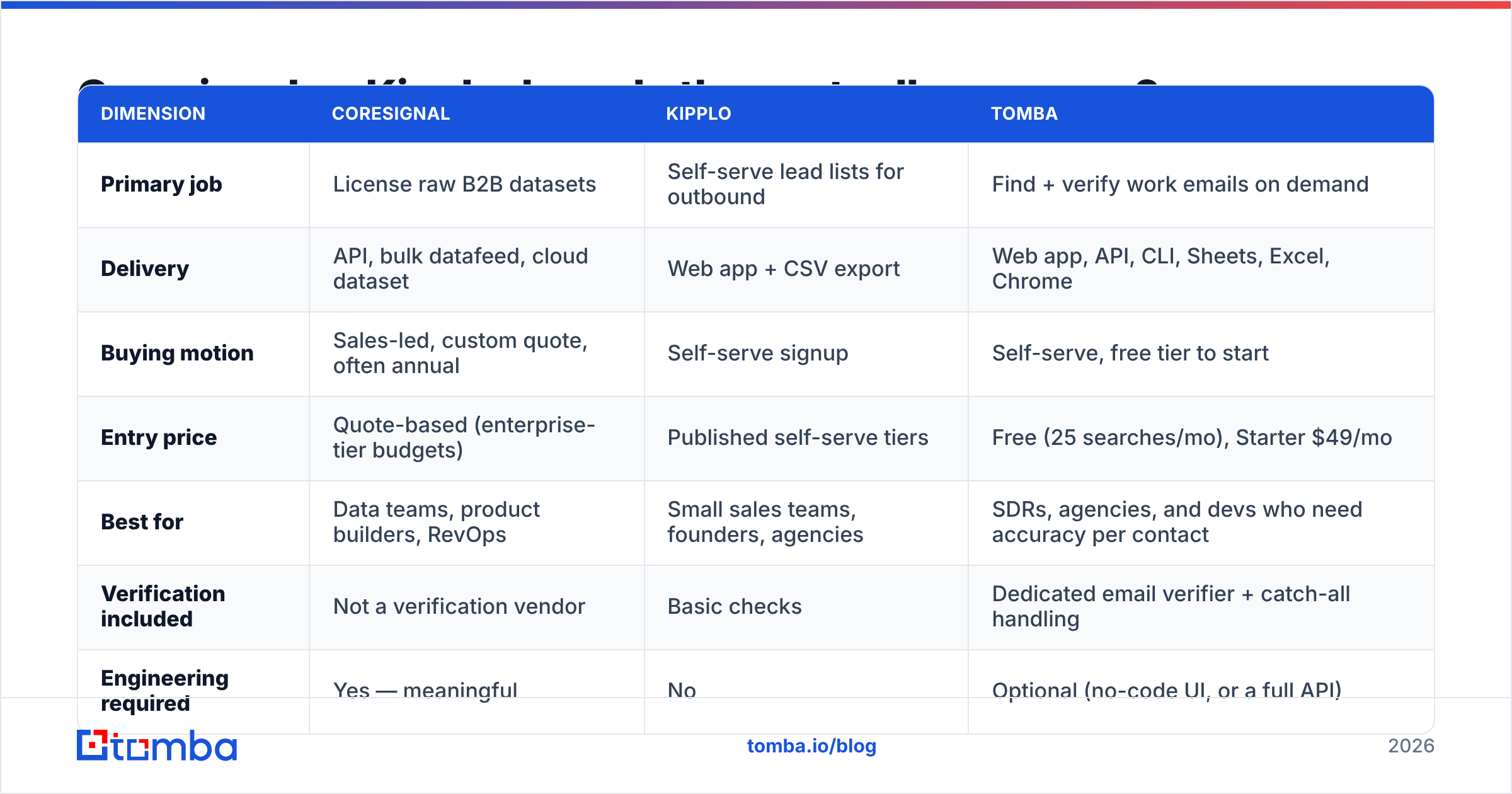
| Dimension | Coresignal | Kipplo | Tomba |
|---|---|---|---|
| Primary job | License raw B2B datasets | Self-serve lead lists for outbound | Find + verify work emails on demand |
| Delivery | API, bulk datafeed, cloud dataset | Web app + CSV export | Web app, API, CLI, Sheets, Excel, Chrome |
| Buying motion | Sales-led, custom quote, often annual | Self-serve signup | Self-serve, free tier to start |
| Entry price | Quote-based (enterprise-tier budgets) | Published self-serve tiers | Free (25 searches/mo), Starter $49/mo |
| Best for | Data teams, product builders, RevOps | Small sales teams, founders, agencies | SDRs, agencies, and devs who need accuracy per contact |
| Verification included | Not a verification vendor | Basic checks | Dedicated email verifier + catch-all handling |
| Engineering required | Yes — meaningful | No | Optional (no-code UI, or a full API) |
| Weak spot | Overkill and slow to buy for pure outbound | Limited source transparency and niche coverage | Not a firehose dataset licensor |
Read that table twice and the real question surfaces. It isn't "which tool is better." It's "which of three jobs am I hiring for?" Licensing a dataset, buying a list, and resolving a specific person to a specific mailbox are three different purchases that get shoved into the same budget line every year.
Which one gives you more accurate contact data?#
Neither vendor can promise you an accurate contact, and any that does is selling you a story.
Here's why, in plain terms. B2B contact data is a photograph, not a live feed. Someone at a company changes jobs, and the record you licensed last quarter is now a bounce waiting to happen. Industry-wide, B2B data decays somewhere in the range of 2–3% per month — call it roughly a quarter to a third of a list going stale over a year. That decay applies to Coresignal's datasets and Kipplo's exports equally, because it's a property of the world, not of the vendor.
What separates good outcomes from ugly ones is what you do after you get the data:
- Verify before you send, every time. An SMTP-level check at send-time, not a 90-day-old "verified" flag from a UI badge.
- Handle catch-all domains explicitly. A catch-all accepts everything, so a naive verifier marks it "valid" and you find out the truth from your bounce report. Use a dedicated catch-all verifier rather than pretending the problem away.
- Re-verify anything older than 30 days. Especially in fast-churn segments like tech sales and startups.
- Watch your bounce rate as a leading indicator. Anything creeping past 2–3% is a domain-reputation problem in progress, not a data problem you can shrug at. Your sender reputation is the asset you're actually protecting.
- Prefer per-contact resolution for high-value accounts. For your top 200 target accounts, "find and verify this exact person" beats "download 50,000 rows and hope."
This is the gap both Coresignal and Kipplo leave open, and it's the gap that quietly determines whether your campaign lands in an inbox or a spam folder.
Is Coresignal or Kipplo better value for the money?#
Depends entirely on whether you're going to use the volume you buy.
Coresignal's economics only work at scale. If you're enriching 500,000 company records or powering a product feature, the cost per record collapses to something rational. If you're a five-person sales team that will realistically contact 2,000 people this year, you're paying enterprise dataset prices for a rounding error of usage. That's not Coresignal being expensive — that's a mismatch between the tool and the job.
Kipplo's economics work for volume outbound at small scale, which is exactly what it's built for. The risk isn't the sticker price. It's the hidden cost: credits burned on records that bounce, domain reputation damage that takes months to repair, and reps spending Monday morning cleaning a list instead of selling.
Run the arithmetic that most teams skip. If a plan gives you 10,000 credits and 20% of what you pull is undeliverable, you didn't buy 10,000 contacts. You bought 8,000 contacts and 2,000 chances to hurt your domain. The cost per usable contact is the only number that matters, and it's never the one on the pricing page.

When should you skip both and just use an email finder?#
Skip both when your actual need is: I know who I want to reach — I just need their address, confirmed.
That's the majority of B2B outbound, and it's a smaller problem than either vendor is selling against. You don't need to license the internet's employment graph. You don't need a 50,000-row CSV you'll never work through. You need the marketing director at 300 named accounts, with a verified mailbox and a low bounce risk.
That's a per-contact resolution job, and it's what Tomba's email finder is built for — with the verification step attached rather than sold separately. Concretely:
- Domain search — pull every discoverable address at a target company, with confidence scores and source attribution, instead of guessing at patterns. See domain search.
- Verification in the same loop — SMTP checks, catch-all detection, role-account flagging, before the record ever reaches your sequencer.
- Bulk when you need it — bulk email finder for the list you already have, not a dataset you have to build a pipeline around.
- API and integrations — a proper email finder API, plus HubSpot, Salesforce, Sheets, and Excel, so the data lands where your team already works.
- Pricing that matches the job — a free tier at 25 searches/mo to test the accuracy yourself, then Starter at $49/mo, Growth at $99/mo, and Pro at $249/mo. Full Tomba pricing is public — no quote call to find out what it costs.
The honest caveat, since this is a comparison and not a commercial: Tomba is not a Coresignal replacement. If you genuinely need licensed bulk datasets to power a product or a warehouse, Coresignal is the right category and Tomba isn't competing for that spend. What Tomba replaces is the habit of buying a dataset or a list when what you needed was 300 verified addresses.
What does the decision tree actually look like?#
Four questions, in order. Stop at the first "yes."
- Are you building a product or a data warehouse that needs licensed bulk B2B data? → Coresignal. Budget for procurement time and an engineer.
- Do you need a large self-serve list right now, with no technical resources, and you accept variable quality? → Kipplo, or a peer platform in that category. Verify everything before you send.
- Do you have named target accounts and need confirmed mailboxes for specific people? → An email finder plus a verifier. This is most teams, most of the time.
- Are you already sitting on a stale CRM export you never cleaned? → Don't buy anything yet. Run data enrichment and verification on what you have. The cheapest leads you'll ever get are the ones already in your database.
Most teams answer "no, no, yes" — and then buy as if they'd answered "yes" to question one, because a big dataset feels like a big strategy. It isn't. It's usually a big invoice attached to a small amount of actual sending.
What should you do next?#
Test accuracy before you sign anything. That's the whole recommendation, and it costs nothing.
Take 50 contacts you can independently confirm — people you've emailed, LinkedIn connections, customers, anyone whose real address you already know. Run those 50 through each tool you're evaluating. Count the hits, count the misses, count the bounces when you actually send. A vendor's published accuracy claim is a marketing asset; your 50-contact test is evidence. The two are rarely the same number.
Then pick the tool that matches the job, not the tool with the biggest dataset. Coresignal is excellent infrastructure for teams who need infrastructure. Kipplo is a fast way to get moving for teams who need speed over depth. And if what you actually need is verified email addresses for people you've already identified, you don't need either.
Start with the Tomba Email Finder free tier — 25 searches a month, no card, no sales call. Run your 50-contact accuracy test on it, compare the bounce rate against whatever you're using now, and let your own numbers pick the winner. If it holds up, Starter is $49/mo and includes the verification layer that both of the tools in this comparison leave to you.
Related guides#
Ready to find emails that actually work?
Join 150,000+ professionals who stopped guessing and started sending. Free credits on signup — no credit card required.
Get the Tomba newsletter
Practical outbound tactics and product updates — once every two weeks.
About the author