Coresignal vs Lead411 (2026): Which B2B Data Tool Wins?
Coresignal sells raw B2B datasets by API. Lead411 sells verified contacts and intent to sellers. They barely compete — until you're the one signing the invoice. Here's how to pick.
TL;DR
- Coresignal is a data-as-a-service company. It sells large, raw B2B datasets — company records, employee profiles, job postings — through APIs and bulk delivery. It is built for engineers and data teams, not for an SDR with a quota.
- Lead411 is a sales intelligence platform. It sells verified emails, direct dials, buyer intent, and trigger alerts inside a UI a rep can actually use on Monday morning.
- They get compared because both are "B2B data," but they solve different problems. Choosing between them is mostly a question of who consumes the data: a pipeline or a person.
- Coresignal is the better fit if you're building a product, scoring accounts, or enriching a warehouse. Lead411 is the better fit if you're a 5–50 person sales team that wants contacts and dials today.
- If all you actually need is accurate, verified email addresses at a predictable price, a dedicated email finder will cost you a fraction of either and skip the annual contract entirely.
What is Coresignal, actually?#
Coresignal is a B2B data provider that operates at the raw-dataset layer. Its core products are public web data collections — company profiles, employee/professional profiles, job postings, technographics, and firmographic records — delivered as APIs, search endpoints, or bulk files you drop into a warehouse.
The mental model: Coresignal is a wholesale grain supplier, not a bakery. It hands you tonnes of flour with a spec sheet. What you bake is your problem.
That framing explains almost every design decision:
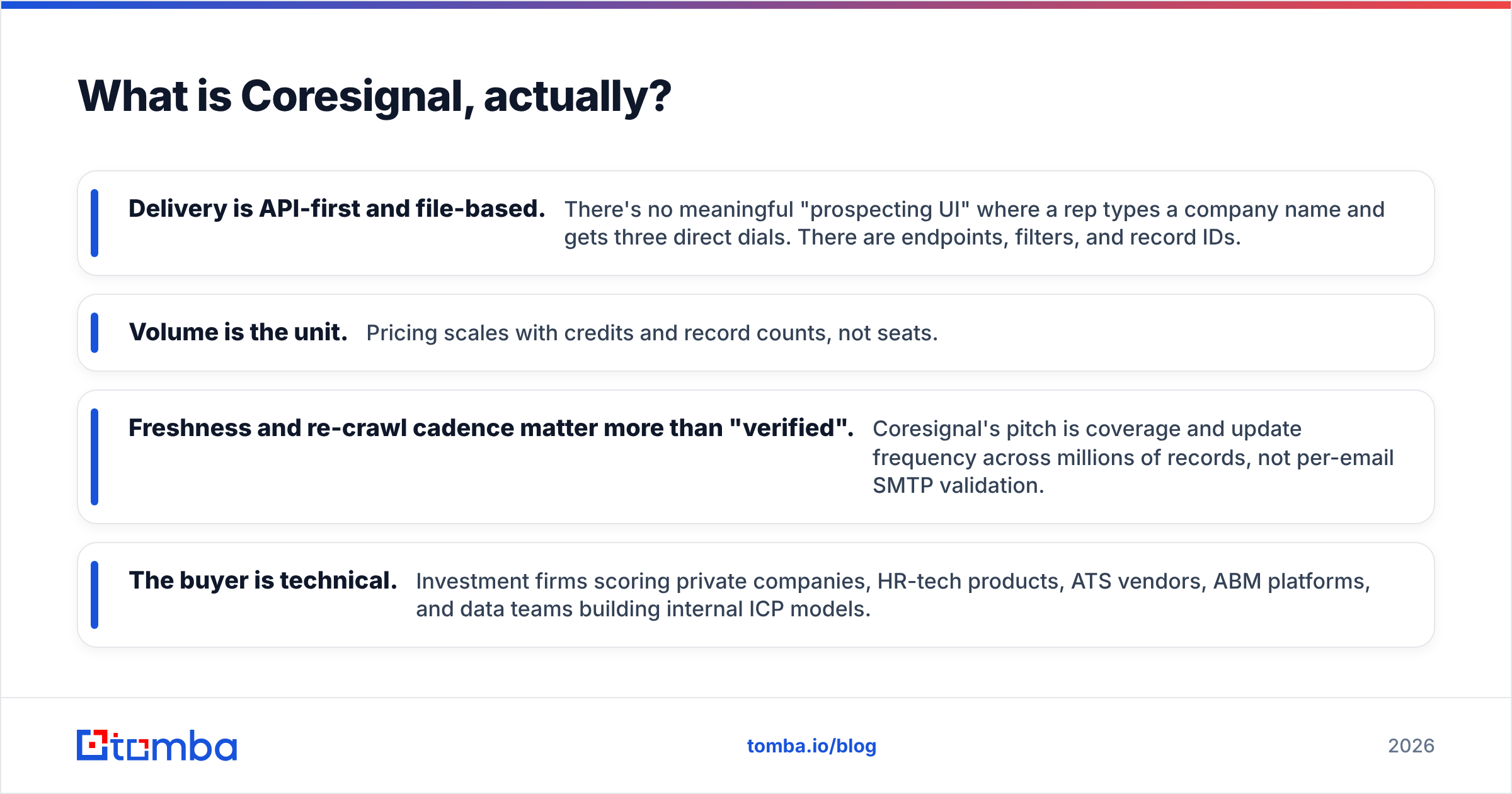
- Delivery is API-first and file-based. There's no meaningful "prospecting UI" where a rep types a company name and gets three direct dials. There are endpoints, filters, and record IDs.
- Volume is the unit. Pricing scales with credits and record counts, not seats.
- Freshness and re-crawl cadence matter more than "verified". Coresignal's pitch is coverage and update frequency across millions of records, not per-email SMTP validation.
- The buyer is technical. Investment firms scoring private companies, HR-tech products, ATS vendors, ABM platforms, and data teams building internal ICP models.
Coresignal will also sell you contact-adjacent fields, but historically its email coverage on the professional-profile side is thinner and less validated than what a dedicated contact vendor gives you. If you're expecting a plug-and-play list of "VP Marketing at 500 SaaS companies with verified work emails," you'll be doing joins and verification work yourself.
What is Lead411, actually?#
Lead411 sits at the opposite end. It's a sales intelligence tool aimed squarely at revenue teams: search for people and companies, pull verified emails and direct-dial mobile numbers, layer on Bombora-powered buyer intent, get triggered alerts when a target company raises funding or hires a new exec, and push it all into your CRM.
It's the bakery. Bread on the shelf, ready to eat.
What Lead411 leans on:
- Verified contacts, including direct dials. Direct mobile numbers are the headline feature and the reason many teams keep it around — that's a genuinely hard dataset to build.
- Intent + triggers. Growth signals (funding, hiring, exec changes) plus intent topics let you time outreach instead of spraying.
- A rep-usable UI + Chrome extension. No engineering required to get value on day one.
- CRM sync. HubSpot, Salesforce, Pipedrive, and the usual outbound tooling.
The friction people report on G2 and in review threads is not usually data quality — it's the commercial model. Plans are typically per-user, contracts often push annual, and "unlimited" viewing frequently comes with a very-much-limited monthly export allowance. That distinction bites teams who plan to bulk-build lists.

Coresignal vs Lead411: how do they compare head to head?#
| Dimension | Coresignal | Lead411 |
|---|---|---|
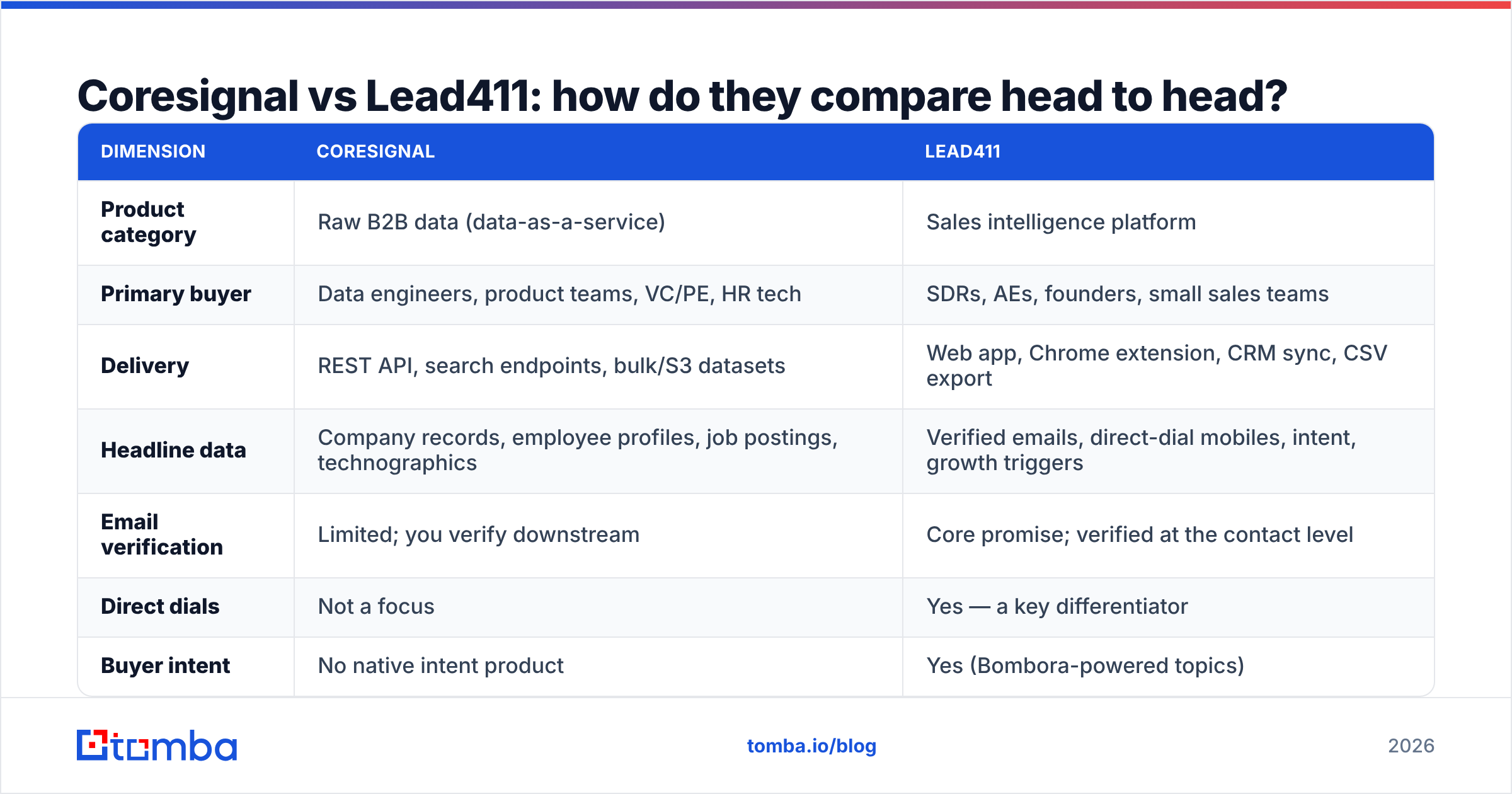
| Product category | Raw B2B data (data-as-a-service) | Sales intelligence platform |
| Primary buyer | Data engineers, product teams, VC/PE, HR tech | SDRs, AEs, founders, small sales teams |
| Delivery | REST API, search endpoints, bulk/S3 datasets | Web app, Chrome extension, CRM sync, CSV export |
| Headline data | Company records, employee profiles, job postings, technographics | Verified emails, direct-dial mobiles, intent, growth triggers |
| Email verification | Limited; you verify downstream | Core promise; verified at the contact level |
| Direct dials | Not a focus | Yes — a key differentiator |
| Buyer intent | No native intent product | Yes (Bombora-powered topics) |
| Pricing model | Credit/record volume, custom quotes; entry tiers run into four figures per month | Per-user seats, commonly annual; monthly export caps |
| Time to first value | Days to weeks (you have to build) | Same day |
| Best for | Building data products, enrichment pipelines, ICP scoring at scale | Running outbound this quarter |
| Worst for | A 4-rep team that just needs emails | A platform team that needs 20M company records |
Read that table once and the "versus" mostly dissolves. Coresignal loses to Lead411 for a sales team because it was never trying to win that account. Lead411 loses to Coresignal for a data platform for the same reason.
The real question isn't which is better. It's which layer of the stack are you buying, and are you overpaying for the other layer you won't use?
Which one has better data quality?#
Data quality is not one number, so stop asking for one. It decomposes into at least four things, and the two vendors win different ones:
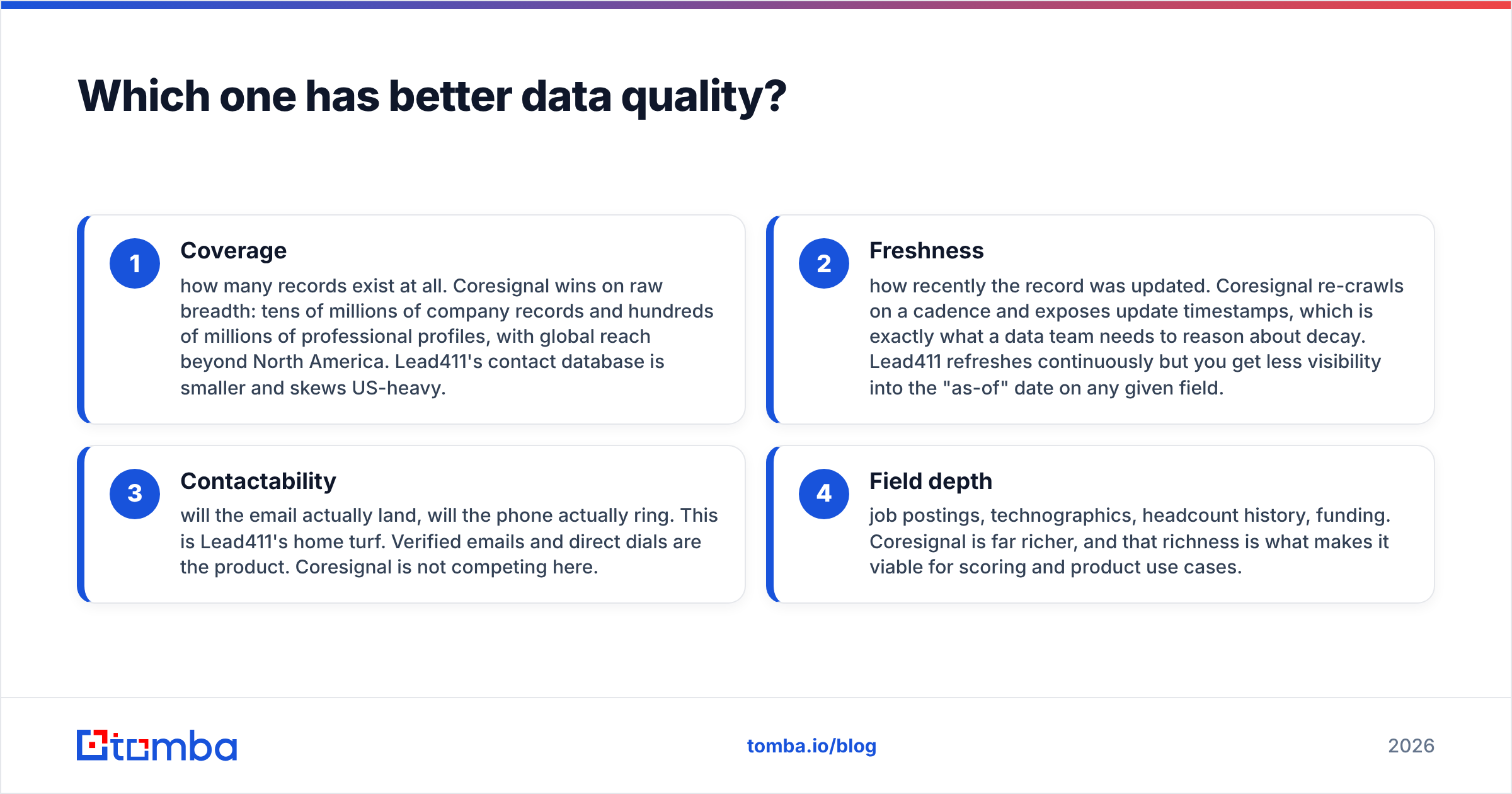
- Coverage — how many records exist at all. Coresignal wins on raw breadth: tens of millions of company records and hundreds of millions of professional profiles, with global reach beyond North America. Lead411's contact database is smaller and skews US-heavy.
- Freshness — how recently the record was updated. Coresignal re-crawls on a cadence and exposes update timestamps, which is exactly what a data team needs to reason about decay. Lead411 refreshes continuously but you get less visibility into the "as-of" date on any given field.
- Contactability — will the email actually land, will the phone actually ring. This is Lead411's home turf. Verified emails and direct dials are the product. Coresignal is not competing here.
- Field depth — job postings, technographics, headcount history, funding. Coresignal is far richer, and that richness is what makes it viable for scoring and product use cases.
So: if "quality" means I can call this person, Lead411. If "quality" means I can model this market, Coresignal.
One caveat that applies to both, and to every vendor in this category: B2B contact data decays roughly 25–30% per year. People change jobs. Companies rebrand domains. A record that was accurate in January is a bounce in October. Any provider claiming "95%+ accuracy" is quoting a number measured at the moment of collection, not the moment you send. That's why a verification step before send is non-negotiable regardless of which vendor you sign with — run your final list through an email verifier and you'll protect your domain from the bounces neither vendor will refund you for.

How does pricing compare, and where do the costs hide?#
Both vendors keep pricing partly behind a "talk to sales" wall, so treat every number below as directional and confirm on a call. But the shape of the pricing is stable and it's the shape that determines your real cost.
Coresignal prices on data volume — credits, records, or dataset licences. Self-service tiers exist, but meaningful usage (the kind that justifies buying raw data at all) lands in four-figures-per-month territory, and full dataset licences go well beyond that. There's usually no per-seat cost because there are no seats.
Lead411 prices per user, and this is where teams get surprised. The pattern to watch:
- A seat licence that looks reasonable per month — but is quoted annually, so the monthly-equivalent price only exists if you commit for a year.
- "Unlimited" search/view credits, paired with a capped monthly export allowance. Viewing 10,000 contacts is not the same as owning 10,000 contacts.
- Additional export credits, intent topics, and extra seats sold as add-ons.
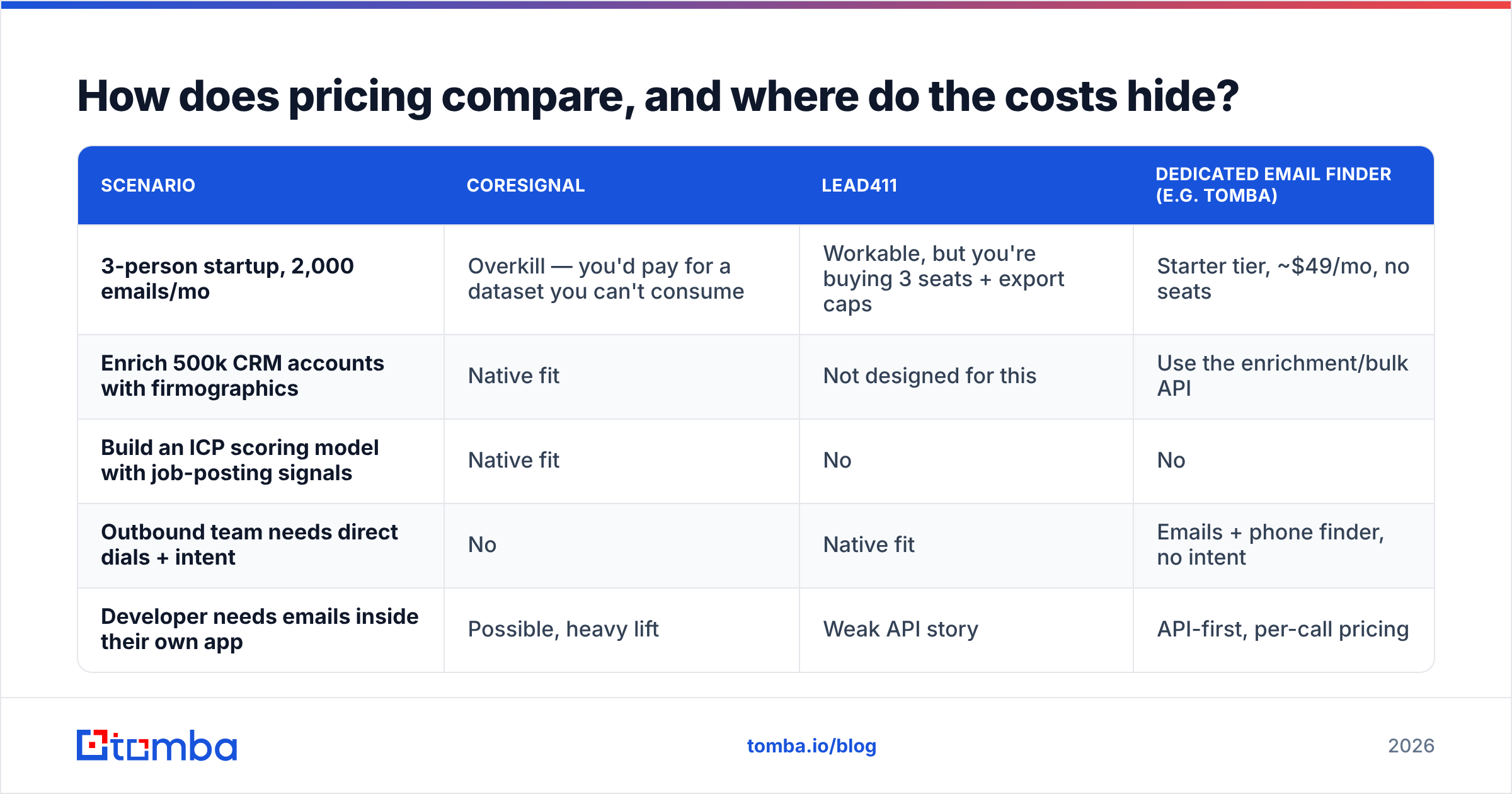
Here's the cost model that actually matters — total spend for a realistic job, not sticker price:
| Scenario | Coresignal | Lead411 | Dedicated email finder (e.g. Tomba) |
|---|---|---|---|
| 3-person startup, 2,000 emails/mo | Overkill — you'd pay for a dataset you can't consume | Workable, but you're buying 3 seats + export caps | Starter tier, ~$49/mo, no seats |
| Enrich 500k CRM accounts with firmographics | Native fit | Not designed for this | Use the enrichment/bulk API |
| Build an ICP scoring model with job-posting signals | Native fit | No | No |
| Outbound team needs direct dials + intent | No | Native fit | Emails + phone finder, no intent |
| Developer needs emails inside their own app | Possible, heavy lift | Weak API story | API-first, per-call pricing |
For reference, Tomba pricing runs Free (25 searches/mo), Starter $49/mo, Growth $99/mo, Pro $249/mo, Enterprise custom — monthly, no seat tax, no annual lock. That's not an apples-to-apples replacement for Coresignal's datasets or Lead411's direct dials. It is an apples-to-apples replacement for the "I just need correct email addresses" job that many teams are, in fact, hiring a $12k/year contract to do.
Is Coresignal better than Lead411 for lead generation?#
For most lead-gen teams: no — unless you have engineering capacity you're not using.
Coresignal gives you the raw material for something better than a list: a scored, prioritised, continuously refreshed view of your market. Job postings tell you who's hiring for the role your product serves. Headcount deltas tell you who's growing. Technographics tell you who already runs the stack you integrate with. That's a genuine edge — and it's the reason ABM platforms and data-driven GTM teams buy it.
But converting that raw material into an SDR-ready sequence requires:
- A place to land the data (warehouse or DB)
- A pipeline to refresh it
- ICP logic to score it
- A contact layer to make it actionable — because a company record with 40 firmographic fields still doesn't give your rep an email that lands
That last step is where most Coresignal deployments quietly bolt on a second vendor anyway. You can close that gap with a domain search call per account, or run the whole enriched account list through a bulk email finder in one pass. It's the cheapest part of the build, and skipping it is the reason "we bought data and nothing happened" post-mortems exist.
Lead411, by contrast, is lead generation out of the box. Search, filter, export, sequence. The ceiling is lower — you're working from someone else's ICP filters, not your own signals — but you'll be sending on day one instead of month two.
Who should choose which?#
Choose Coresignal if:
- You're building a product on top of the data. Recruiting tools, market intelligence dashboards, investment screeners, ABM engines. This is the archetypal Coresignal customer.
- You have a data team and a warehouse. The value is in joins, models, and scoring — not in a UI.
- You need global coverage and non-contact fields. Job postings and headcount history are not something a sales-intelligence tool will ever give you at that depth.
- Volume is your unit of value, not seats. You want to pay for records, not for people looking at records.
Choose Lead411 if:
- Direct dials are a real part of your motion. If your reps live on the phone, this is a legitimate reason to pay a premium.
- You want intent and trigger alerts bundled in. Buying intent separately (Bombora, 6sense) costs more than getting it packaged.
- Your team is small and non-technical. Time-to-value beats flexibility when you have four reps and a number to hit.
- You'll actually use the seats you buy. Per-seat pricing punishes teams that buy for a whole department and use three logins.
Choose neither — and buy a focused contact layer instead — if:
- Your actual bottleneck is "we have the company list, we just can't reach the right person."
- You're already paying for a CRM, a sequencer, and a data tool, and the data tool is the one with the worst usage-to-cost ratio.
- You need this inside code. An email finder API with per-call pricing is a fundamentally different (and cheaper) commercial object than a seat licence or a dataset licence.
- Bounce rate is your problem, not coverage. Fix email deliverability before you buy more names to burn.
What's the honest verdict?#
There is no winner, because there is no shared race.
Coresignal wins the data-infrastructure job. Lead411 wins the ready-to-sell job. If you pick the wrong one for your job, you will spend six months either (a) paying for a warehouse-scale dataset your reps can't touch, or (b) paying per-seat for a UI when what you needed was an endpoint.
The trap most teams fall into is a third thing: buying either of them to solve a problem that is smaller than the product. A four-figure monthly dataset licence and a locked-in annual seat contract are both wildly expensive ways to answer the question "what's this person's work email?" That question has a $49 answer, it's monthly, and it doesn't require a procurement cycle.
Before you sign anything, write down the sentence: "I am buying this to ___." If the blank fills in with "model my market" — Coresignal. If it fills in with "call and email 200 people this month" — Lead411. If it fills in with "get verified emails, reliably, without a contract" — you don't need either.
Ready to fix the contact layer first?#
Most GTM data problems are not coverage problems. They're contactability problems wearing a coverage costume. You have the accounts. You have the titles. What you don't have is an address that lands.
Tomba Email Finder finds professional email addresses by domain, name, or company — with verification built into the same workflow, an API for the engineers, and a Chrome extension for the reps. Start free with 25 searches, move to Starter at $49/mo when it works, and cancel any month you want. Test it against whatever Coresignal or Lead411 quote lands in your inbox this week, and let the bounce rate settle the argument.
Related guides#
Ready to find emails that actually work?
Join 150,000+ professionals who stopped guessing and started sending. Free credits on signup — no credit card required.
Get the Tomba newsletter
Practical outbound tactics and product updates — once every two weeks.
About the author