Coresignal vs Leadsforge (2026): Which B2B Data Tool Wins?
Coresignal sells raw B2B data at scale. Leadsforge sells AI-assisted lead lists. They solve different problems — and most teams pick the wrong one. Here's the honest breakdown, plus where a dedicated email finder beats both.
- They are not really competitors. Coresignal is a raw B2B data provider built for engineering teams that want firehose access to company and employee records. Leadsforge is an AI-assisted lead list builder aimed at salespeople who want a usable list in minutes.
- Coresignal wins on depth and volume. If you are training models, enriching a warehouse, or building a product on top of company data, it is the stronger option.
- Leadsforge wins on time-to-first-list. If you have no data engineer and want targeted contacts today, the chat-style search is far less friction.
- Both leave a gap: verified, deliverable emails. Neither tool's core promise is "this inbox exists right now," which is exactly what your bounce rate cares about.
- Most teams end up pairing one of them with a dedicated email finder and verifier rather than betting the whole pipeline on a single vendor.
What is Coresignal, actually?#
Coresignal is a B2B data infrastructure company. It sells access to large-scale, regularly refreshed datasets: company records, employee records, job postings, and related firmographic signals. You consume it through an API, or you take delivery of bulk datasets (parquet/CSV drops) and load them into your own warehouse.
The mental model matters here. Coresignal is closer to a wholesale supplier than a sales tool. You do not log in, type "VP of Marketing at fintech companies in Berlin," and get a list you can email tomorrow. You get records — a lot of them — and you are expected to have the technical capacity to filter, join, dedupe, and operationalize them yourself.
Who that suits:
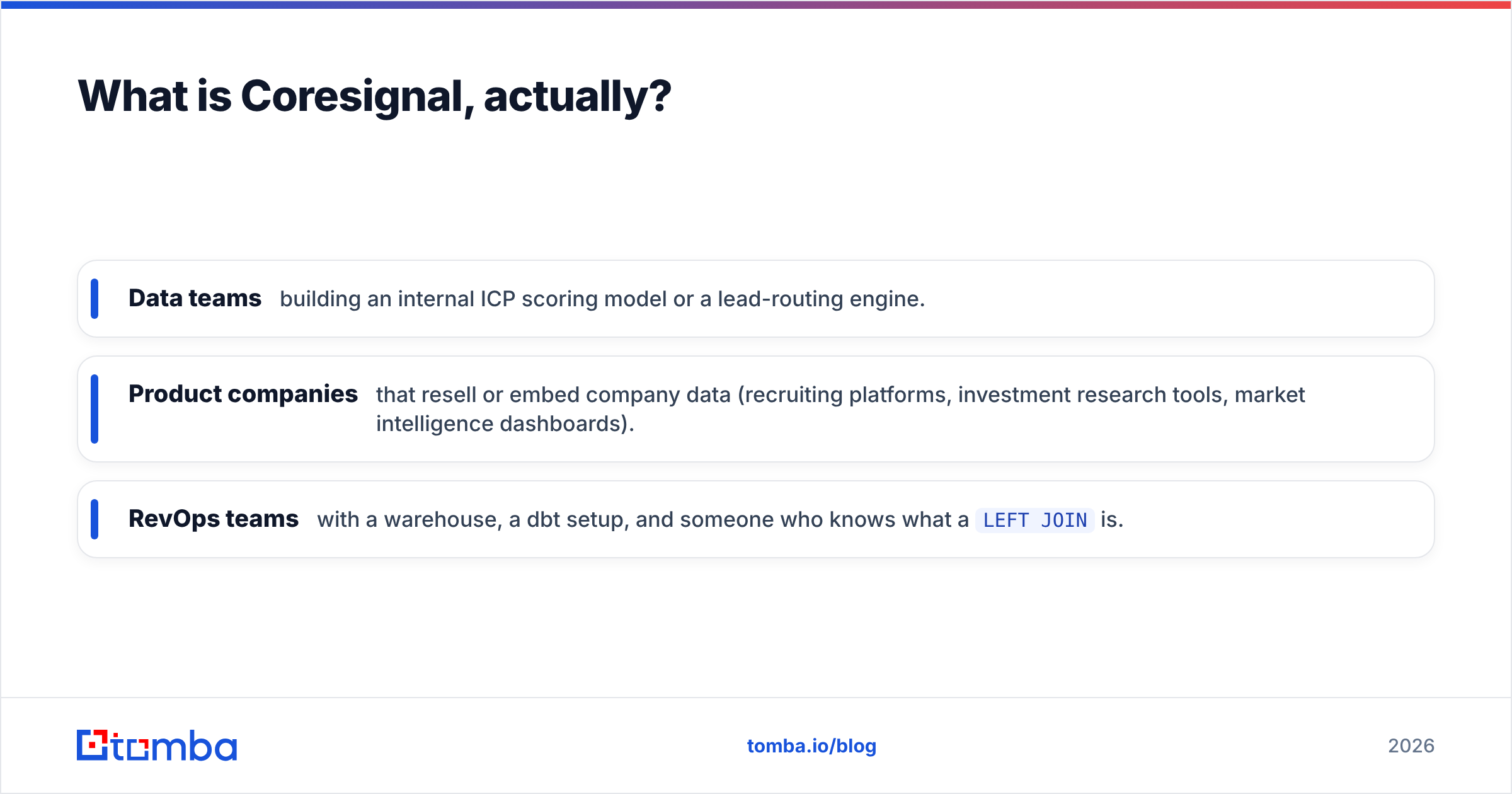
- Data teams building an internal ICP scoring model or a lead-routing engine.
- Product companies that resell or embed company data (recruiting platforms, investment research tools, market intelligence dashboards).
- RevOps teams with a warehouse, a dbt setup, and someone who knows what a
LEFT JOINis.
Who it does not suit: a three-person SDR team that needs 200 contacts this week.
What is Leadsforge, actually?#
Leadsforge sits at the opposite end. It is an AI-driven lead generation tool where you describe your ideal customer in plain language and it returns a list of matching contacts. The pitch is speed and accessibility — no filters to learn, no schema to understand, no CSV wrangling.
The mental model here is a retail storefront. Someone else did the sourcing, cleaning, and packaging; you describe what you want and walk out with it. That convenience is real, and it is why tools in this category convert so well with non-technical buyers.
The tradeoff is control. When an AI interprets "mid-market SaaS companies scaling their sales org," you cannot see exactly which filters it applied, which records it excluded, or how fresh the underlying data is. For a quick prospecting sprint, that opacity is acceptable. For a system of record, it is not.

Coresignal vs Leadsforge: how do they compare head to head?#
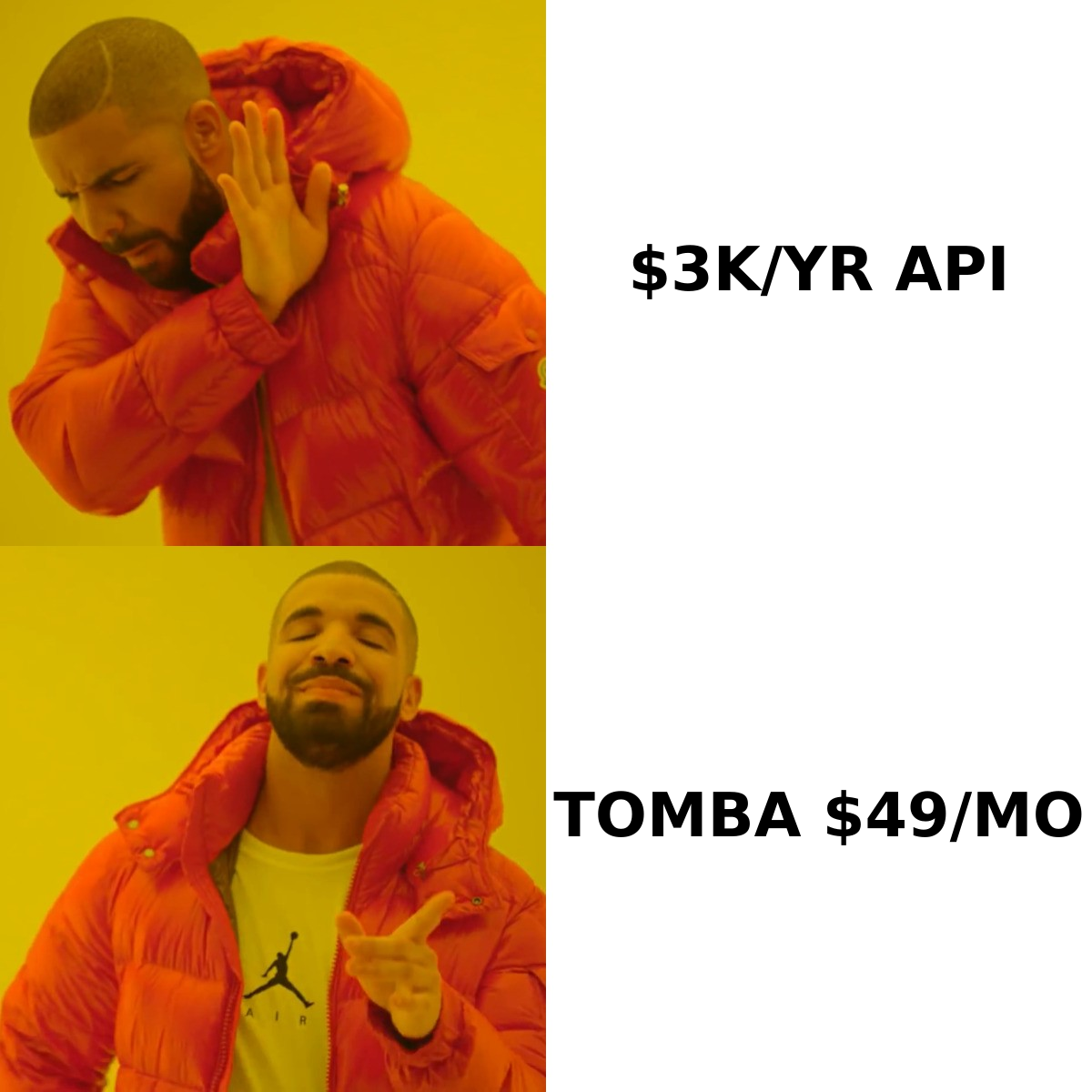
Here is the honest side-by-side. Note that both vendors sell primarily through quotes and tiered plans rather than one flat public price, so treat the cost column as a shape, not a promise — check current pages before you sign anything.
| Dimension | Coresignal | Leadsforge | Tomba |
|---|---|---|---|
| Core product | Raw B2B data (API + bulk datasets) | AI-assisted lead list builder | Email finder + verifier |
| Primary buyer | Data / engineering / product teams | SDRs, founders, small sales teams | Anyone doing outbound or enrichment |
| Time to first usable list | Days to weeks (build required) | Minutes | Minutes |
| Technical skill needed | High (API, warehouse, ETL) | Low | Low (UI) or high (API) — your choice |
| Email verification built in | Not the core promise | Varies by plan | Yes — SMTP + catch-all handling |
| Bulk / CSV workflow | Yes, at dataset scale | Yes, list export | Yes, bulk email finder |
| Pricing model | Custom / annual contracts, enterprise-weighted | Credit or subscription tiers | Free (25/mo), $49, $99, $249, custom |
| Free tier | Limited sample data | Trial credits | 25 searches/mo, no card |
| Best at | Depth, volume, freshness at scale | Speed, ease, zero learning curve | Deliverability and per-contact accuracy |
The pattern you should notice: Coresignal and Leadsforge are optimizing for different bottlenecks. Coresignal removes the "we cannot get enough data" bottleneck. Leadsforge removes the "we do not have time to build anything" bottleneck. Neither is primarily built to remove the "our emails bounce" bottleneck.
Which one is more accurate?#
This is the wrong question, and asking it is how teams end up disappointed.
"Accuracy" means at least three different things in B2B data, and the two tools score differently on each:
- Record accuracy — is this person really the CRO at this company, or did they leave eight months ago? Coresignal's refresh cadence and scale generally give it an edge here, because it is re-crawling and re-shipping data continuously as a core product obligation.
- Match accuracy — did the tool return companies that actually fit your description? This is where AI-first tools like Leadsforge are convenient but harder to audit. A structured filter query is auditable; a natural-language interpretation is not.
- Deliverability accuracy — will an email you send to this address actually land? This is the one that shows up in your bounce rate, your domain reputation, and eventually your reply rate. It is also the dimension both tools treat as a secondary concern rather than the product itself.
That third number is the one that costs you money. A 5% hard-bounce rate on a cold campaign will drag your sender reputation down fast, and once your domain is flagged, no amount of data depth helps — your perfectly-sourced contacts simply never see the message.
This is why mature outbound teams almost never trust a single source. They source from wherever the coverage is best, then run every address through a dedicated email verifier before it touches a sequence. The verifier is the goalkeeper. Sourcing is the midfield.
How should you actually choose between them?#
Answer these four questions honestly and the decision usually makes itself.
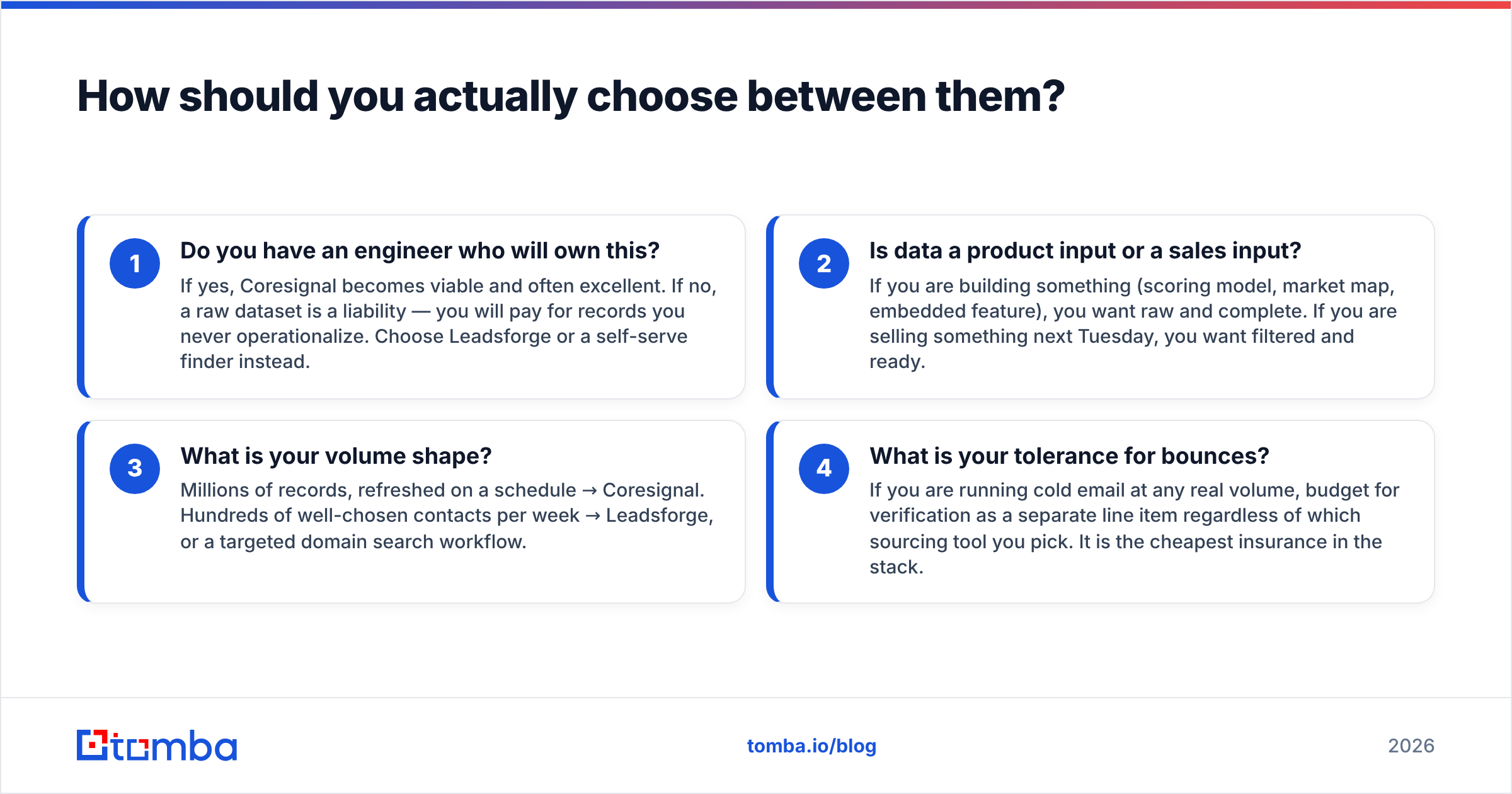
- Do you have an engineer who will own this? If yes, Coresignal becomes viable and often excellent. If no, a raw dataset is a liability — you will pay for records you never operationalize. Choose Leadsforge or a self-serve finder instead.
- Is data a product input or a sales input? If you are building something (scoring model, market map, embedded feature), you want raw and complete. If you are selling something next Tuesday, you want filtered and ready.
- What is your volume shape? Millions of records, refreshed on a schedule → Coresignal. Hundreds of well-chosen contacts per week → Leadsforge, or a targeted domain search workflow.
- What is your tolerance for bounces? If you are running cold email at any real volume, budget for verification as a separate line item regardless of which sourcing tool you pick. It is the cheapest insurance in the stack.
There is also the boring commercial question: what does the contract look like? Enterprise data providers tend toward annual commitments with minimums. AI lead tools tend toward monthly credits. If your outbound program is still being validated, monthly beats annual every time — you do not want a twelve-month bill for a motion you might kill in six weeks. Independent review sites like G2 are useful here, mostly for reading the one-star reviews, which is where contract friction and data-quality complaints actually surface.
What do these tools leave out?#
Both leave out the last mile, and the last mile is where deals die.
Coresignal's gap: it hands you records, not a workflow. Between the dataset and a booked meeting sit ETL, dedupe, ICP filtering, email pattern resolution, verification, sequencing, and CRM sync. That is real engineering work, and it is invisible in the sticker price.
Leadsforge's gap: it hands you a list, but the provenance is opaque. You do not always know how stale a record is or how an address was derived. When a campaign underperforms, you cannot diagnose whether the targeting was wrong or the data was wrong.
The shared gap: neither is architected around the single question "is this specific mailbox live right now?" That question is genuinely hard. It involves MX checks, SMTP handshakes, catch-all domain detection, role-account filtering, and disposable-domain screening. A catch-all verifier exists as a distinct product category precisely because generic data vendors punt on it.
Where does Tomba fit in this comparison?#
Not as a Coresignal replacement, and not as a Leadsforge clone. Tomba is deliberately narrower: it is built around finding and verifying the professional email address for a person or a domain, and doing that with a deliverability-first bias.
The practical difference is what happens on a low-confidence match. A volume-oriented data source will often ship a plausible pattern-derived address (first.last@company.com) because coverage metrics reward shipping it. A verification-first tool would rather return a lower confidence score — or nothing — than hand you a bounce. That is a worse-looking coverage number and a better-looking bounce rate, and only one of those two numbers affects revenue.
Three ways teams actually combine these tools in practice:
- Coresignal + verification. Use Coresignal for the company and person graph, then resolve and verify addresses at the point of send. Your warehouse stays rich; your sending domain stays clean.
- Leadsforge + verification. Build the list fast, then run it through a bulk verify pass before it enters the sequencer. Two minutes of work, and it catches the stale records no AI search can see.
- Neither — just the finder. For a lot of teams doing focused, account-based outbound, the honest answer is that a heavyweight data contract is over-engineering. If you have 400 target accounts, you do not need a firehose. You need the right eight people at each of them, with addresses that work. A domain search plus an API call in your enrichment job covers it.
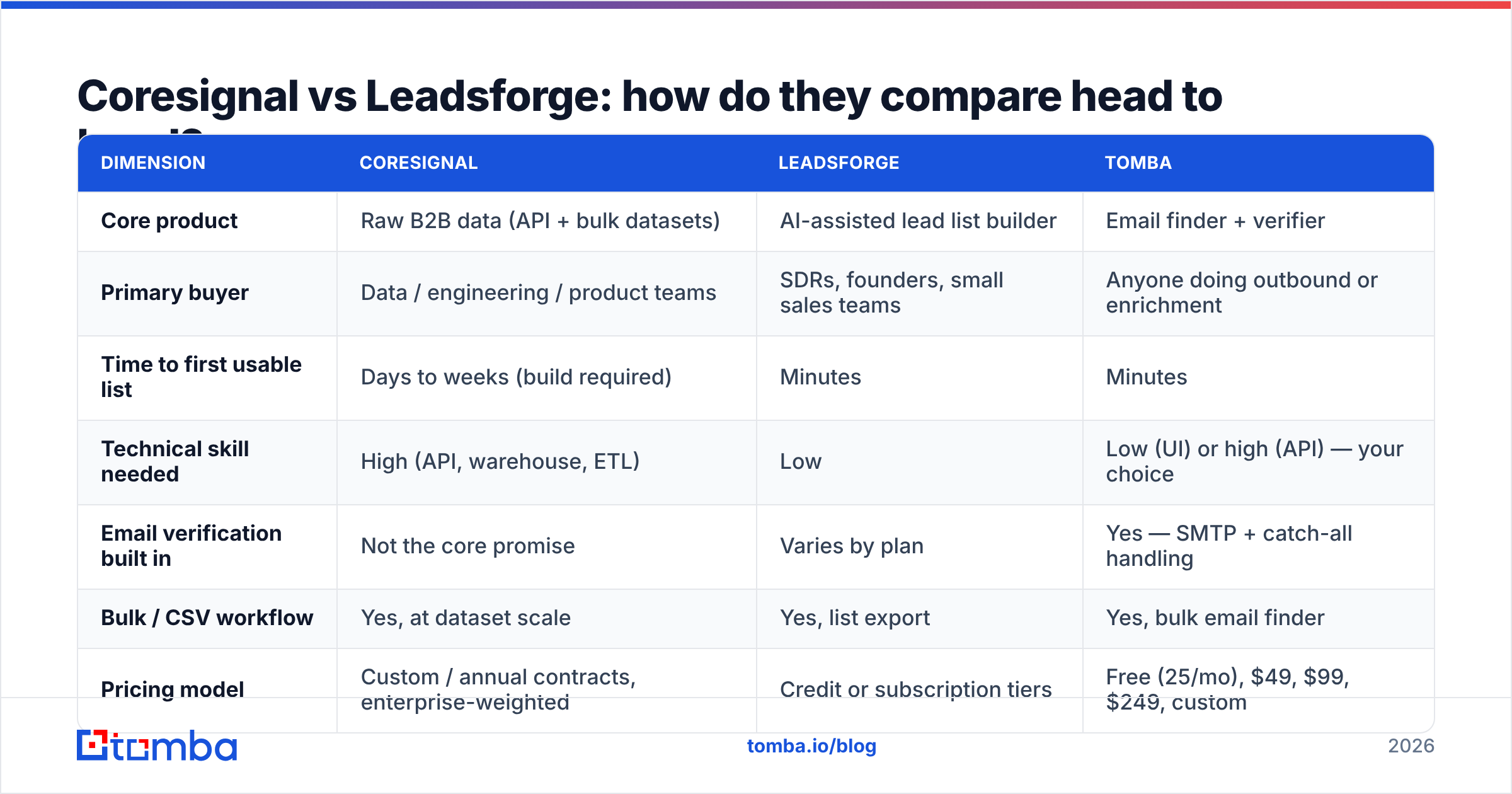
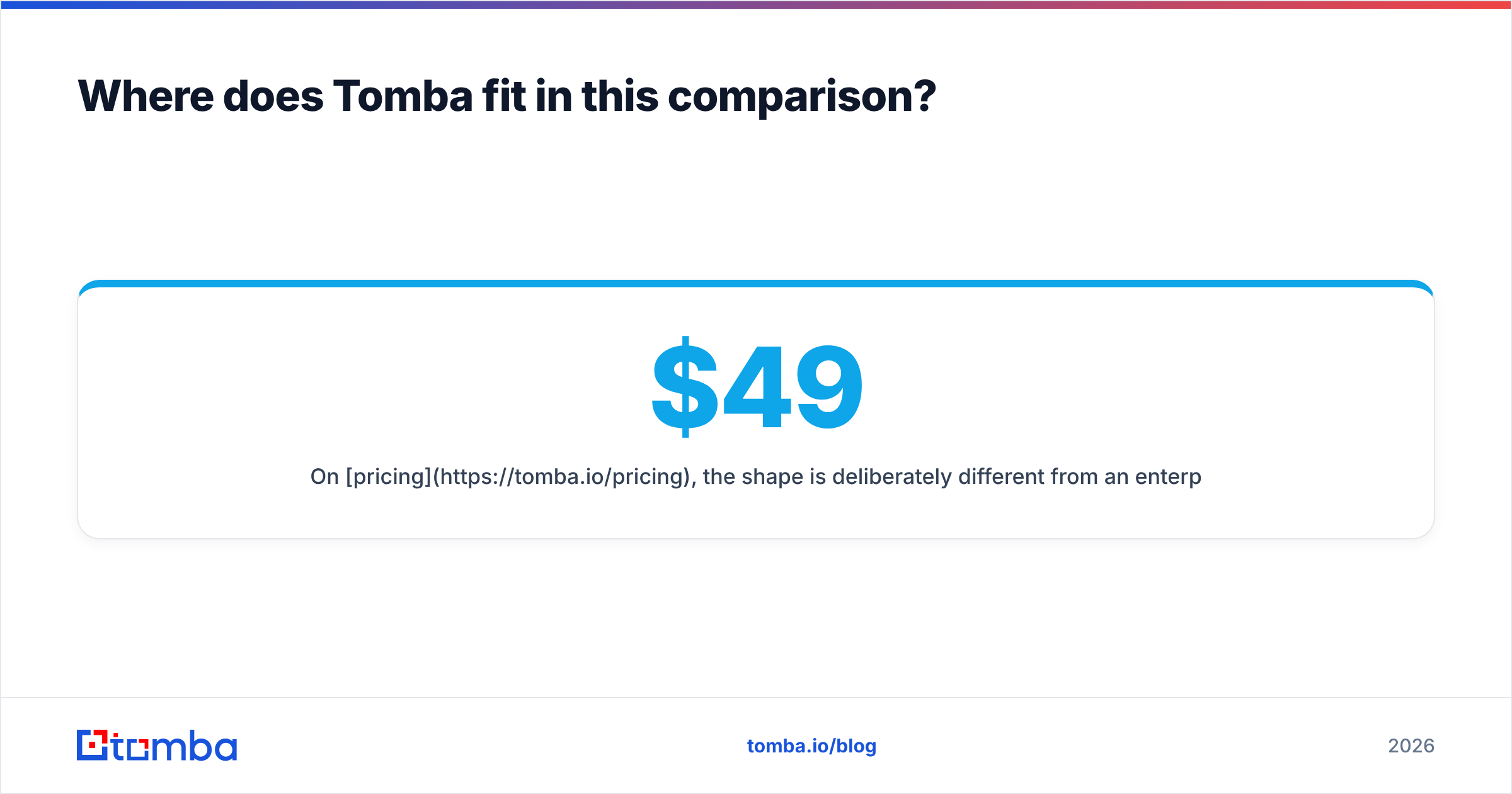
On pricing, the shape is deliberately different from an enterprise data contract: a free tier at 25 searches a month, Starter at $49/mo, Growth at $99/mo, Pro at $249/mo, and custom enterprise beyond that. Monthly, cancellable, no minimum-commitment negotiation. That is not a flex — it is just the right structure for a team that is still figuring out whether the motion works.
What is the verdict on Coresignal vs Leadsforge?#
Pick Coresignal if you have engineering capacity, you are building a data product or a serious internal data asset, and you need scale and refresh cadence more than you need convenience. It is a strong choice for the job it is designed for, and a bad one for any other job.
Pick Leadsforge if you are a small sales team or a founder doing your own prospecting, you want a list today, and you value speed over auditability. The AI search is genuinely a lower-friction way to get started than learning a filter UI.
Pick neither — or rather, do not stop at either — if your actual pain is bounces, spam folders, and dead addresses. That is a different problem with a different tool. No amount of record depth or AI targeting fixes a mailbox that no longer exists.
The teams that get this right treat sourcing and verification as two separate purchasing decisions, because they are. Buy depth where you need depth. Buy accuracy where accuracy is what gets billed to you — in bounce rate, in email deliverability, and in the domain reputation you spent months building.
Try it on your own list. Take twenty contacts from whichever tool you are evaluating, run them through the Tomba Email Finder, and compare the confidence scores against what you were handed. It takes about four minutes, the free tier covers 25 searches a month with no card, and the result tells you more about your data quality than any vendor comparison page — including this one. If the numbers hold up, keep your current stack. If they do not, you just found the leak before your sending domain did.
Related guides#
Ready to find emails that actually work?
Join 150,000+ professionals who stopped guessing and started sending. Free credits on signup — no credit card required.
Get the Tomba newsletter
Practical outbound tactics and product updates — once every two weeks.
About the author