Coresignal vs ListKit: Which B2B Data Source Wins in 2026?
Coresignal sells raw B2B web data through an API. ListKit sells ready-to-send lead lists with verified emails. They solve different problems — and picking wrong costs you a quarter. Here's the honest breakdown.
TL;DR
- Coresignal is a raw B2B web-data provider: firmographics, employee profiles, job postings, funding signals — delivered as API responses or bulk datasets. It is built for engineers and data teams, not for an SDR with a Monday quota.
- ListKit is a lead-list platform born out of the cold-email agency world: filter, click, export a list of contacts with verified emails and phone numbers, push straight into Smartlead or Instantly.
- They are not really competitors. Coresignal answers "who exists and what changed?" ListKit answers "who do I email tomorrow morning?"
- Coresignal generally starts in the hundreds per month for self-serve API access and climbs into four figures for dataset delivery. ListKit is credit-based and cheaper to start, but credit burn is real.
- If your actual bottleneck is finding and verifying the email address — not building a data warehouse — a dedicated email finder plus email verifier will cost you far less than either.
What are Coresignal and ListKit, actually?#
Most "X vs Y" posts pretend two tools are twins. These two aren't, and the fastest way to waste money here is to buy the wrong category.
Coresignal is a public web-data company. It crawls and structures large volumes of company records, employee/professional profiles, and job postings, then ships them to you in one of three shapes: a REST API, a search-and-filter endpoint, or a bulk dataset drop (S3, GCS, CSV/JSON parquet-style delivery). The buyer is usually a data engineer, an AI startup training on firmographic data, an investment firm tracking headcount and hiring signals, or a RevOps team building an in-house account graph. Nobody logs into Coresignal to send an email.
ListKit came from the opposite end of the funnel. It was built by people who ran cold-email agencies and got tired of stitching together a scraper, a verifier, and a sequencer. You pick filters (title, industry, headcount, geography, tech stack, sometimes intent), you preview the list, you spend credits, and you export — or you push contacts directly into a sending tool. The emails come pre-verified, and phone numbers are available on higher tiers. The buyer is an agency owner, a founder doing their own outbound, or a small SDR team.
Think of it as a lumber yard versus a furniture store. Coresignal sells you the timber and expects you to have a workshop. ListKit sells you the finished table. Both are legitimate. Only one of them is what you need this quarter.
How do Coresignal and ListKit compare head to head?#
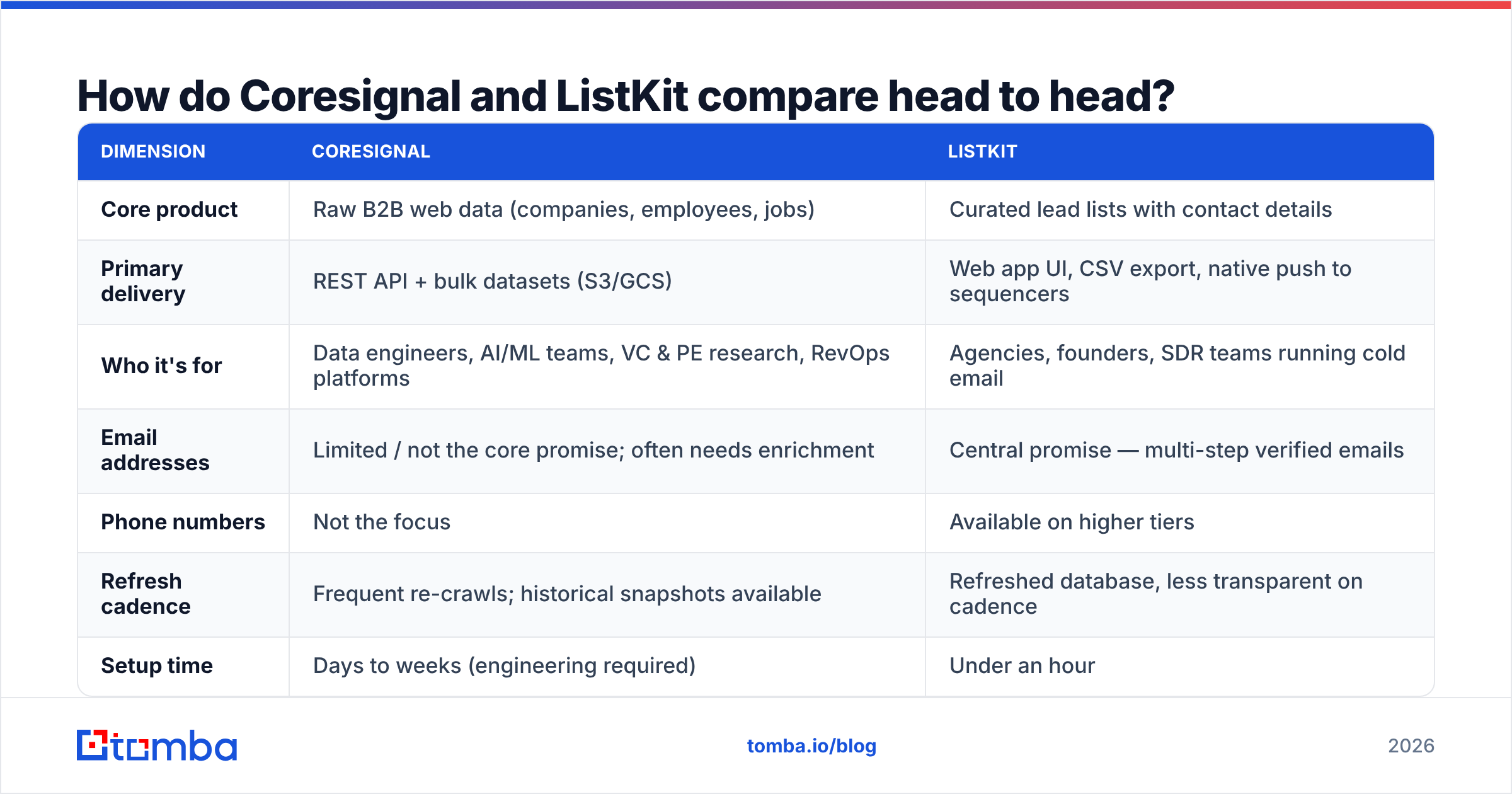
| Dimension | Coresignal | ListKit |
|---|---|---|
| Core product | Raw B2B web data (companies, employees, jobs) | Curated lead lists with contact details |
| Primary delivery | REST API + bulk datasets (S3/GCS) | Web app UI, CSV export, native push to sequencers |
| Who it's for | Data engineers, AI/ML teams, VC & PE research, RevOps platforms | Agencies, founders, SDR teams running cold email |
| Email addresses | Limited / not the core promise; often needs enrichment | Central promise — multi-step verified emails |
| Phone numbers | Not the focus | Available on higher tiers |
| Refresh cadence | Frequent re-crawls; historical snapshots available | Refreshed database, less transparent on cadence |
| Setup time | Days to weeks (engineering required) | Under an hour |
| Typical entry cost | Hundreds/mo self-serve; four figures for datasets | Low hundreds/mo, credit-metered |
| Skill needed | SQL, Python, data modelling | Point and click |
| Biggest risk | You buy timber and never build the table | Credit burn on lists you never send |
The table above is the whole argument in miniature. If your team cannot name the person who will write the ETL job, Coresignal is not a purchase — it's a shelf-ware invoice.
Which one has better data coverage?#
Coverage is the wrong question. Coverage of what is the right one.
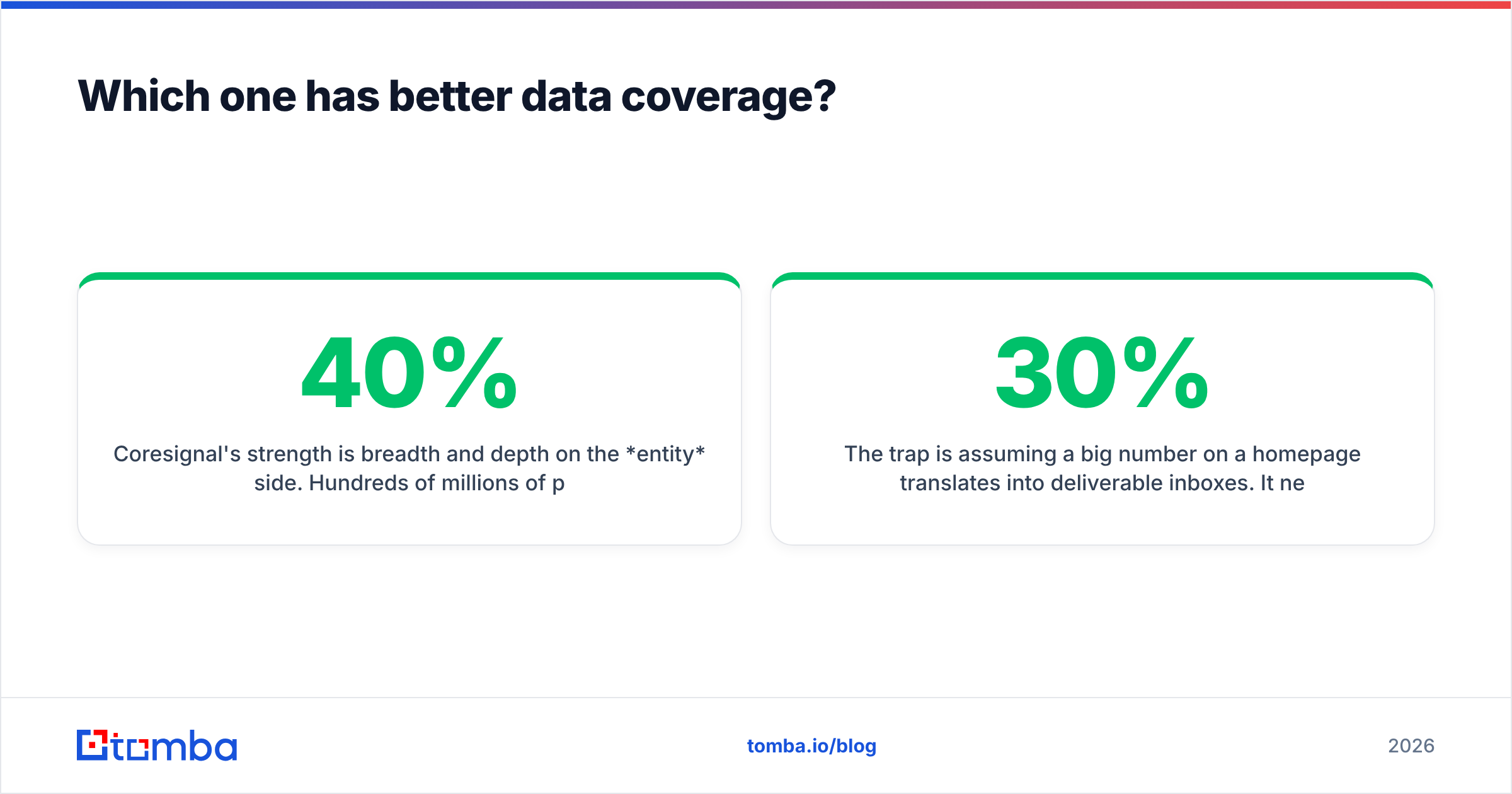
Coresignal's strength is breadth and depth on the entity side. Hundreds of millions of professional profiles and tens of millions of company records, with attributes most lead tools never expose: historical headcount by department, job-posting velocity, technology mentions in postings, founding dates, funding rounds. If you want to build a model that predicts which companies are about to hire a VP of Sales, this is the raw material. If you want to know that a company's engineering team grew 40% in six months while its support team shrank, Coresignal can answer that. ListKit cannot.
ListKit's strength is coverage of the contactable subset. Its database is the intersection of "this person exists," "this person matches your ICP," and "we have a deliverable email for them." That intersection is much smaller than Coresignal's universe — but it is the only part of the universe that matters if your job is booking meetings this month.
A useful frame:
- Entity coverage — how many companies and people exist in the dataset. Coresignal wins comfortably.
- Attribute depth — how many fields per record, including historical ones. Coresignal wins again.
- Contact coverage — what share of matching records come with a usable email. ListKit wins.
- Freshness on people moves — how quickly a job change is reflected. Both claim frequent refreshes; both drift. Verify at send time regardless.
- Compliance posture — both operate on public web data; check the DPA and your own region's rules before you scale. This is not optional in the EU.
The trap is assuming a big number on a homepage translates into deliverable inboxes. It never does. A 400-million-profile dataset with a 30% email hit rate gives you fewer sendable contacts than a smaller, contact-first database with an 80% hit rate on your exact ICP.
Is Coresignal or ListKit more accurate on emails?#
Neither should be trusted blindly, and the reason is structural, not a knock on either vendor.
Coresignal is upfront that it is a data company, not an email-finding company. Many records come without a verified business email, or with a pattern-derived guess. Teams that buy Coresignal almost always bolt on an enrichment or email-discovery layer afterwards — that's an expected part of the architecture, not a failure of the product.
ListKit makes email deliverability its headline claim, running contacts through multiple verification passes before they hit your export. In practice, agencies report solid but not magical results: a bounce rate in the low single digits when the list is fresh, creeping upward on older or catch-all-heavy segments. Catch-all domains are the honest weak point of every list vendor, because a catch-all server accepts everything and reveals nothing. That's exactly the gap a dedicated catch-all verifier exists to close.
Three rules that survive every vendor comparison:
- Re-verify before every send. Any list is decaying the moment it is exported. B2B contact data rots at roughly 2-3% per month, which means a six-month-old list is meaningfully broken.
- Treat "verified" as a vendor's opinion, not a fact. Run your own check. The cost of verification is trivial next to the cost of a burned sending domain.
- Segment catch-alls separately. Don't let them poison your main sequence's bounce rate. Send to them from a secondary domain, or don't send at all.
For a deeper primer on why bounces destroy email deliverability faster than bad copy ever will, that glossary entry is worth ten minutes.
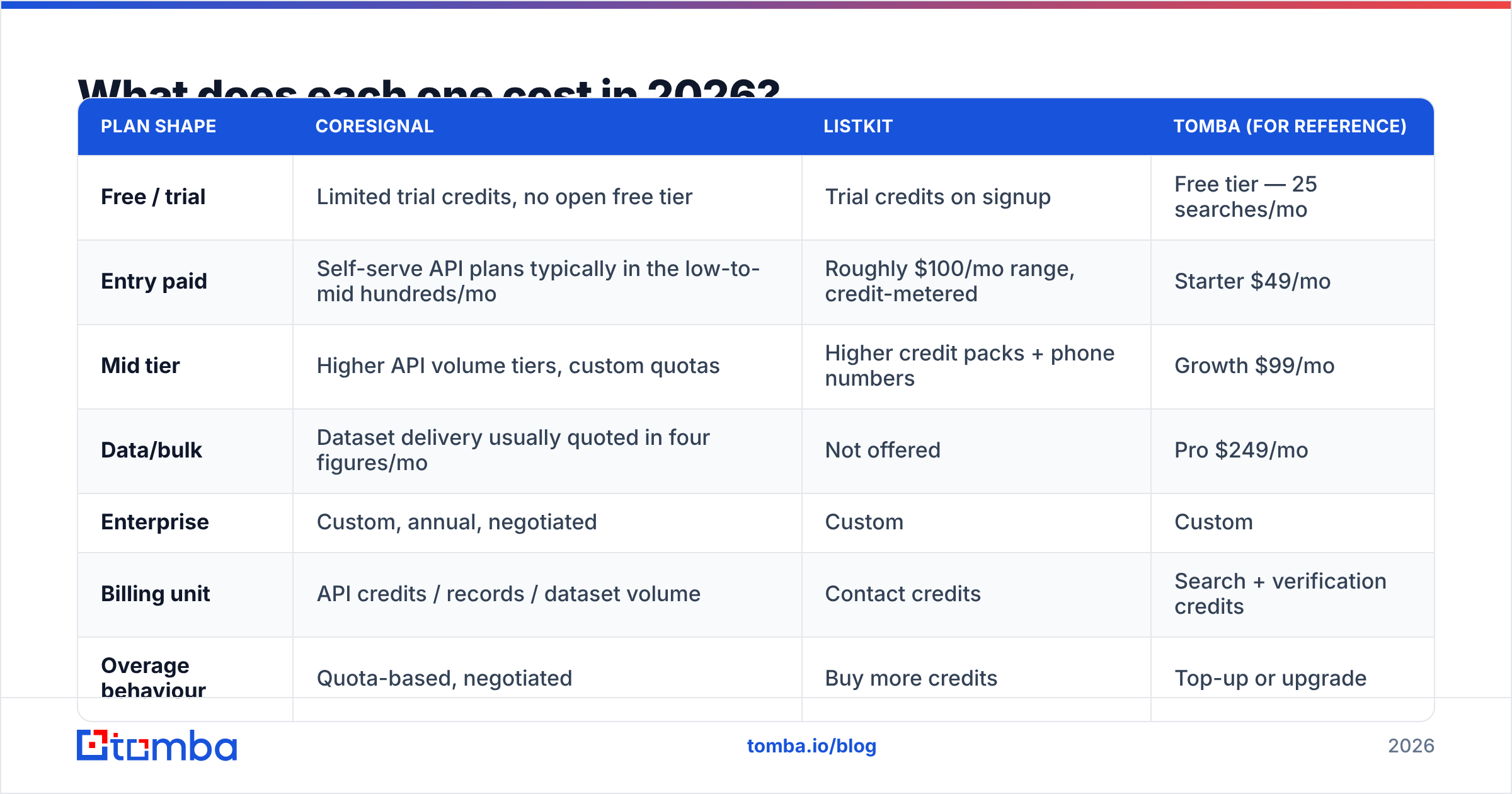
What does each one cost in 2026?#
Pricing on both sides moves, and both publish less than they used to, so treat these as directional and confirm on the vendor's own page before you sign anything.
| Plan shape | Coresignal | ListKit | Tomba (for reference) |
|---|---|---|---|
| Free / trial | Limited trial credits, no open free tier | Trial credits on signup | Free tier — 25 searches/mo |
| Entry paid | Self-serve API plans typically in the low-to-mid hundreds/mo | Roughly $100/mo range, credit-metered | Starter $49/mo |
| Mid tier | Higher API volume tiers, custom quotas | Higher credit packs + phone numbers | Growth $99/mo |
| Data/bulk | Dataset delivery usually quoted in four figures/mo | Not offered | Pro $249/mo |
| Enterprise | Custom, annual, negotiated | Custom | Custom |
| Billing unit | API credits / records / dataset volume | Contact credits | Search + verification credits |
| Overage behaviour | Quota-based, negotiated | Buy more credits | Top-up or upgrade |
Two cost traps worth naming out loud.
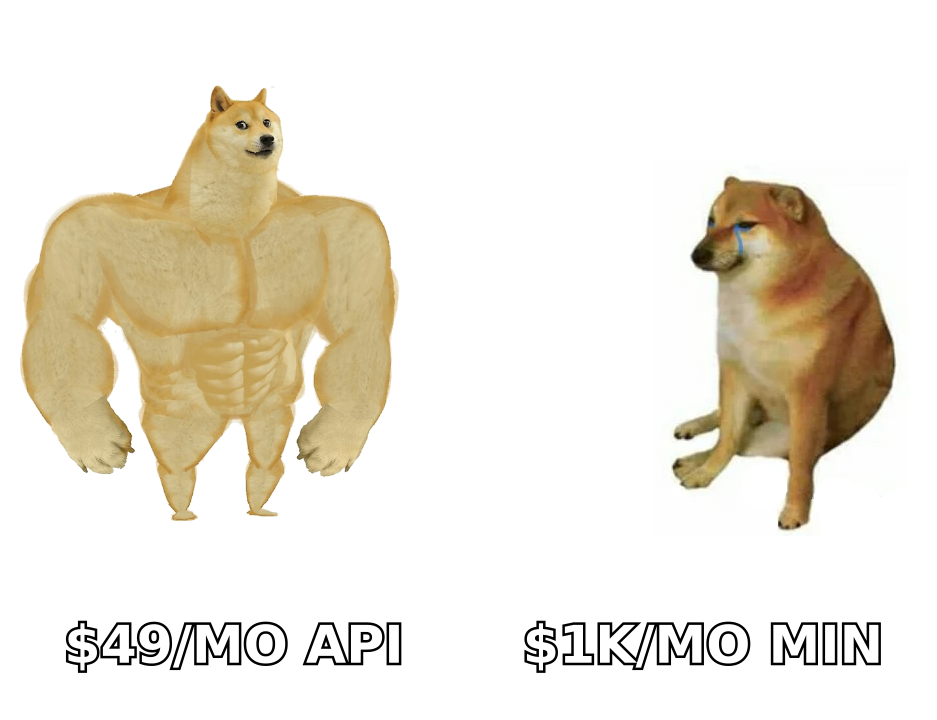
Coresignal's real cost is not the invoice. It's the engineer. Budget for pipeline work, schema mapping, storage, and someone who owns freshness. If that person doesn't exist, the effective cost per usable contact is infinite, because you never ship.
ListKit's real cost is credit discipline. Credit-metered list tools reward hoarding: you pull 5,000 contacts because the filter looked good, send to 800, and quietly write off the rest. Track cost per sent contact, not cost per exported contact. The gap is usually embarrassing.
Who should choose Coresignal?#
Pick Coresignal if two or more of these are true:
- You are building a product, not a campaign. You need firmographic data inside your own app, scoring model, or investor dashboard.
- You need historical signals. Headcount trajectories, hiring velocity, job-posting trends over time — things a lead-list UI simply cannot express.
- You have engineering capacity. Someone owns the ingestion job and the schema, and they are not going to quit next month.
- Your volume is large enough that per-record economics beat per-seat tools. At millions of records, dataset delivery is genuinely cheaper than any UI-based product.
- You want to be vendor-neutral downstream. Raw data means you can enrich, score, and route it however you want, including plugging in your own email discovery via an email finder API.
Do not pick Coresignal because it sounds more serious. "More serious" is a personality trait, not a strategy.
Who should choose ListKit?#
Pick ListKit if:
- Your bottleneck is meetings, not modelling. You need names in a sequencer this week.
- You have no data engineer and no appetite to become one.
- You run cold email at agency volume and value native pushes into Smartlead, Instantly, or a CRM.
- You want phones and emails in one pull rather than stitching two vendors together.
- You accept a narrower universe in exchange for contacts that are actually reachable.
ListKit's honest limitation is the same as its selling point: it is opinionated. The filters are the filters. If your ICP is weird — a niche vertical, a specific tech stack, a geography the database is thin on — you'll hit the wall fast and find yourself doing manual research anyway. And competitors in the ready-made list space, from BookYourData to other verified-list vendors, are genuinely strong on specific verticals, so it's worth trialling more than one before you commit annually.

Is there a third option that beats both?#
For a lot of teams, yes — because the question they're actually asking isn't "raw data or ready lists?" It's "how do I get a correct, deliverable email for a person I already identified?"
That's a narrower and much cheaper problem. You already know the target company. You already know the role, or the name, from LinkedIn, a webinar list, a conference roster, a Clay table, or a Coresignal record you already own. You do not need to buy a second full database to close the last mile.
The last-mile stack looks like this:
- Domain search — give it a company domain, get back the people and the company's email pattern. This is how you turn a Coresignal company record into contactable humans without buying a whole lead product.
- Email finder — first name + last name + domain, out comes the verified address with a confidence score.
- Email verifier — SMTP-level checking, syntax, MX, disposable/role detection, plus a catch-all judgement call.
- Data enrichment — fill in the missing fields on records you already have, rather than re-buying them.
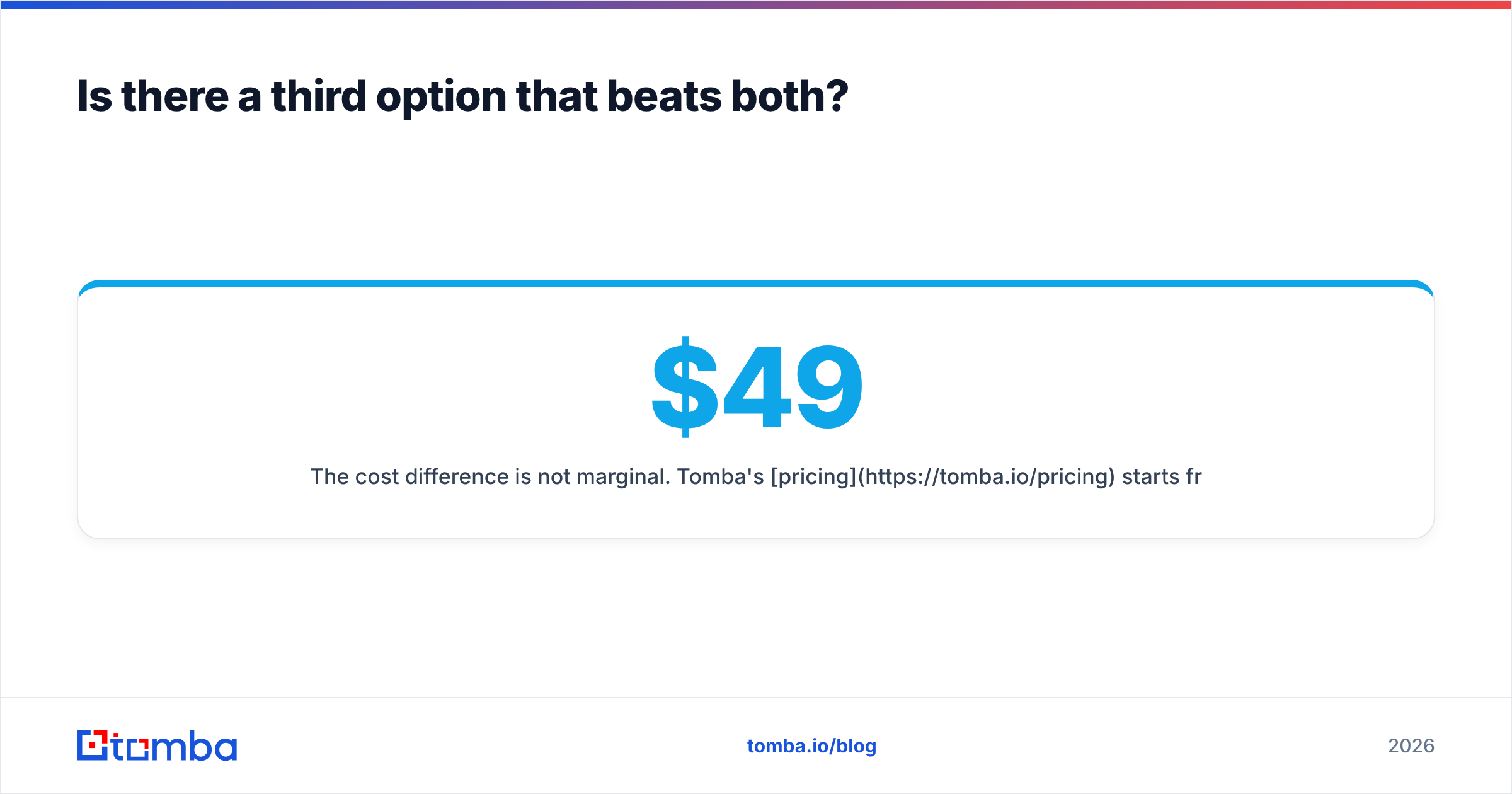
The cost difference is not marginal. Tomba's pricing starts free at 25 searches a month, then $49/mo Starter, $99/mo Growth, $249/mo Pro — an order of magnitude below a Coresignal dataset contract, and typically below what an agency burns in ListKit credits once you count the exports that never got sent.
The hybrid that works well in practice: use Coresignal (or any raw data source, including your own scraping) for targeting intelligence — who to go after, when, and why. Then use a dedicated finder + verifier for contactability. You get Coresignal's depth without paying list-tool prices for contacts you'd have to re-verify anyway.
What's the verdict on Coresignal vs ListKit?#
If you're a data or product team: Coresignal. Nothing in ListKit's product surface can give you historical headcount, job-posting velocity, or the schema control you need to build on top. Accept the engineering cost with open eyes.
If you're an agency or a founder running outbound: ListKit. It will get you sending in an afternoon, and the verification layer means you won't torch your domain in week one. Watch your credit-to-send ratio like a hawk.
If your bottleneck is the email address itself: neither, or either plus a finder. This is the majority case, and it's the one both vendors are structurally incentivised not to tell you about. You rarely need a new database. You need the last mile solved cheaply, accurately, and on demand.
Whichever way you go, run the same test before committing: take 100 contacts from your real ICP, pull them from each vendor, verify all of them independently, and send. Measure bounce rate, connect rate, and reply rate. One afternoon of that beats a month of comparison posts — including this one.
Ready to solve the last mile? Start with the Tomba Email Finder. Feed it a name and a domain — or a whole company via domain search — and get verified, confidence-scored business emails without a data-engineering project or a credit-burn problem. The free tier gives you 25 searches a month to test it against whatever list you're currently paying for. If Tomba's hit rate on your ICP beats theirs, you just found the cheaper half of your stack.
Related guides#
Ready to find emails that actually work?
Join 150,000+ professionals who stopped guessing and started sending. Free credits on signup — no credit card required.
Get the Tomba newsletter
Practical outbound tactics and product updates — once every two weeks.
About the author