Coresignal vs Lusha in 2026: Which B2B Data Tool Wins?
Coresignal sells raw B2B datasets by the million. Lusha sells contacts one click at a time. They barely compete — and picking the wrong one wastes a year of budget. Here's the honest breakdown.
Coresignal vs Lusha is the wrong fight to pick — and most buyers learn that after they sign. Coresignal sells raw B2B data by the million. Lusha sells one contact at a time to a rep. Here is the honest Coresignal vs Lusha breakdown, plus a cheaper third pick if all you need is email.
TL;DR
- Coresignal vs Lusha is not a real fight. Coresignal ships raw B2B records by API or bulk file. Lusha hands a rep an email and a phone number, one prospect at a time.
- Choose Coresignal if you have engineers and want to build something — an ABM model, a data product, a lead-scoring system.
- Choose Lusha if your SDRs need a working number for the LinkedIn tab that is open right now.
Two more things buyers miss until the invoice lands:
- Both get expensive fast. Coresignal is an annual data contract with a four-figure floor. Lusha bills per seat and per credit, so a five-person team adds up.
- Neither is built for email deliverability. If emails are the output you need, a finder-plus-verifier stack usually wins on cost per usable email. Tomba starts at $49/mo, free tier included.
What is Coresignal, exactly?#
Coresignal is a B2B data provider, not a sales tool. Think of it as a wholesale supplier. It ships pallets of structured records to your warehouse. You do not log in and click around.
Its catalog comes from public web data. Three record types matter:
- Company data — firmographics, headcount, tech signals, funding, industry codes, growth over time.
- Employee data — public profile records: titles, tenure, skills, career history, company mapping.
- Job posting data — live and past postings. Teams read them as a hiring-intent signal.
Delivery tells you what Coresignal really is. You call a REST API. Or you drop a bulk dataset (Parquet, JSON, CSV) into your own warehouse. There is a search API, a collect API, and a clean layer that merges records. None of that helps a rep with a quota. All of it helps a data team build a scoring model or a market map.
Typical buyers: GTM teams with engineering support, HR-tech and investment-tech startups building on workforce data, and VC or PE firms sourcing deals by headcount.
The honest limit: Coresignal is thin on direct contact details. It knows who works where and how a company is changing. It is not where you go for a personal email and a mobile number.
What is Lusha, exactly?#
Lusha is the opposite bet. It is a sales-facing contact database. Its whole job is to hand a rep an email and a phone number in under three seconds.
The core surfaces:
- Chrome extension — the part most people actually use. Open a LinkedIn profile, click the icon, get details.
- Prospecting platform — filter by title, industry, size, tech, or intent. Build a list. Export it or push it to your CRM.
- Enrichment + API — clean up a CRM record or an inbound form fill.
- CRM integrations — Salesforce, HubSpot, Pipedrive, Outreach, Salesloft.
Lusha's edge is mobile phone numbers plus a loud compliance posture (GDPR, CCPA, ISO 27701). Dial-heavy teams in Europe care about both. That is a fair reason to pick it over cheaper US-centric databases.
The honest limit: coverage leans to North America and Western Europe, mid-market and up. Ask for a plant manager at a 40-person industrial supplier in Poland. You will hit blanks. Email accuracy is decent, but not category-leading — and email accuracy decides whether your domain survives the quarter.

Coresignal vs Lusha: how do they compare head-to-head?#
Here is the comparison that actually decides the purchase.
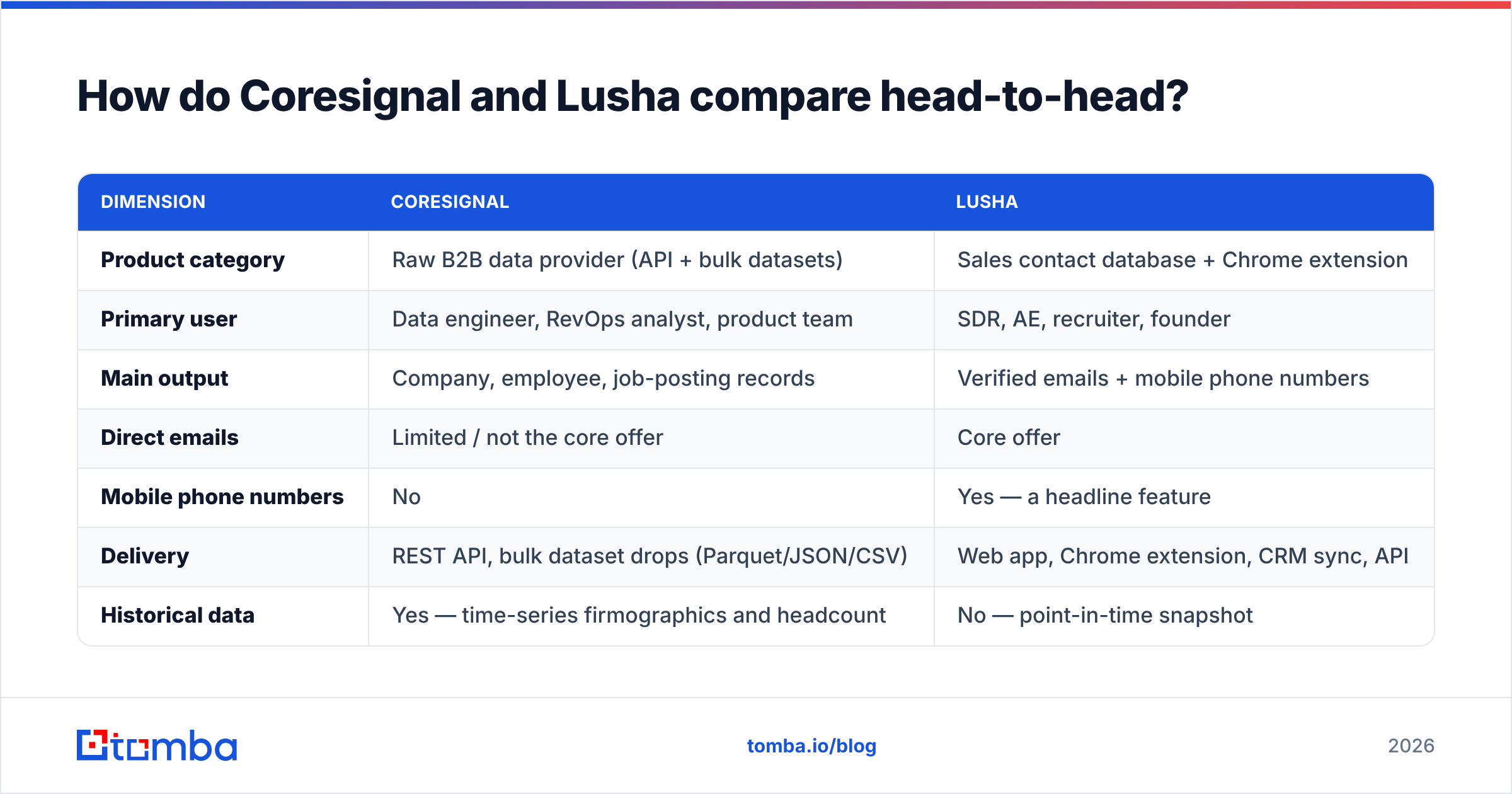
| Dimension | Coresignal | Lusha |
|---|---|---|
| Product category | Raw B2B data provider (API + bulk datasets) | Sales contact database + Chrome extension |
| Primary user | Data engineer, RevOps analyst, product team | SDR, AE, recruiter, founder |
| Main output | Company, employee, job-posting records | Verified emails + mobile phone numbers |
| Direct emails | Limited / not the core offer | Core offer |
| Mobile phone numbers | No | Yes — a headline feature |
| Delivery | REST API, bulk dataset drops (Parquet/JSON/CSV) | Web app, Chrome extension, CRM sync, API |
| Historical data | Yes — time-series firmographics and headcount | No — point-in-time snapshot |
| Time to first value | Days to weeks (engineering required) | Minutes |
| Free tier | No — trials via sales | Yes (limited monthly credits) |
| Pricing model | Annual contract, quoted by volume | Per seat + credit packs, self-serve tiers |
| Realistic floor spend | Four figures/mo and up | Free → tens of dollars per user/mo |
| Best for | Building a data product or scoring model | Working a list this week |
Read the "primary user" row again. There is almost no overlap. Most Coresignal vs Lusha searches come down to one question: which layer of the stack am I missing? The raw data layer, or the contact-activation layer. The two tools answer different questions.
Coresignal vs Lusha: which one has better coverage and accuracy?#
You cannot compare their coverage numbers. They count different things.
Coresignal publishes hundreds of millions of professional records and tens of millions of company records. The number is real, and it is honest for what it is: breadth of profile records. It says nothing about whether you can email those people.
Lusha publishes a smaller pool. Every record is meant to carry a contact method. Its self-reported accuracy sits in the 80–90% range, which is where the whole category lives. On G2, the pattern in Lusha reviews is the familiar one. Strong on US mid-market decision-makers. Patchy on SMB, non-English markets, and non-tech verticals.
Three things are true of both:
- Freshness beats size. A 400M-record database that refreshes quarterly is worse than a 40M-record one that refreshes weekly. Roughly one in five B2B contacts goes stale in a year.
- "Verified" means different things. Some vendors mean "we saw it once." Others mean "we ran SMTP validation this week." Always ask which.
- Catch-all domains break both. On a catch-all domain, any provider is guessing unless it runs a dedicated catch-all verifier. That is why a bounce spike often has nothing to do with your copy.
The takeaway: whichever one you buy, run the emails through an independent email verifier before you send. Trusting one vendor's own "valid" flag is how teams land on a blocklist.
Coresignal vs Lusha: how do they price their data?#
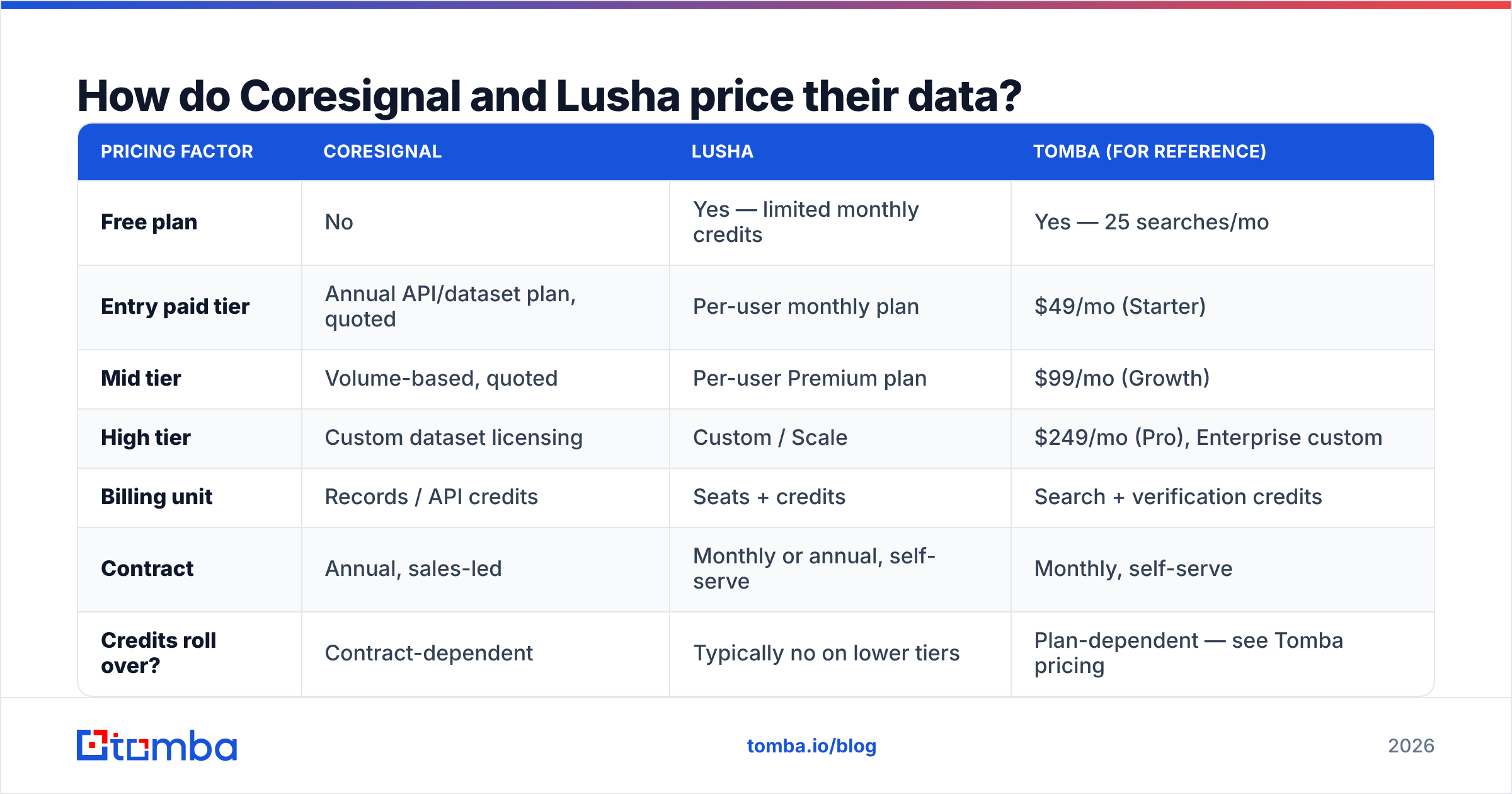
Neither vendor makes this simple. Prices change. Treat the table below as the shape, not a quote, and confirm current numbers with each vendor.
| Pricing factor | Coresignal | Lusha | Tomba (for reference) |
|---|---|---|---|
| Free plan | No | Yes — limited monthly credits | Yes — 25 searches/mo |
| Entry paid tier | Annual API/dataset plan, quoted | Per-user monthly plan | $49/mo (Starter) |
| Mid tier | Volume-based, quoted | Per-user Premium plan | $99/mo (Growth) |
| High tier | Custom dataset licensing | Custom / Scale | $249/mo (Pro), Enterprise custom |
| Billing unit | Records / API credits | Seats + credits | Search + verification credits |
| Contract | Annual, sales-led | Monthly or annual, self-serve | Monthly, self-serve |
| Credits roll over? | Contract-dependent | Typically no on lower tiers | Plan-dependent — see Tomba pricing |
| Get started without a demo? | No | Yes | Yes |
Two budget traps are worth naming.
Coresignal's trap is the floor. You cannot dip a toe in. It is an annual, volume-quoted license. The smallest sensible deal is still a real line item. You pay for the whole dataset even if your model uses 5% of the fields. That is fine if you are building something. It is a terrible way to buy 2,000 emails.
Lusha's trap is the multiplier. Per seat plus per credit means cost scales with headcount and usage. A five-rep team can burn its credits by month three. Then it upgrades, buys top-ups, or watches reps sit idle. Model your annual cost at real usage, not at the sticker price.
Coresignal vs Lusha: where do both fall short?#
If your job is "put verified emails into a sequencer," both tools leave gaps. Here is what breaks first.
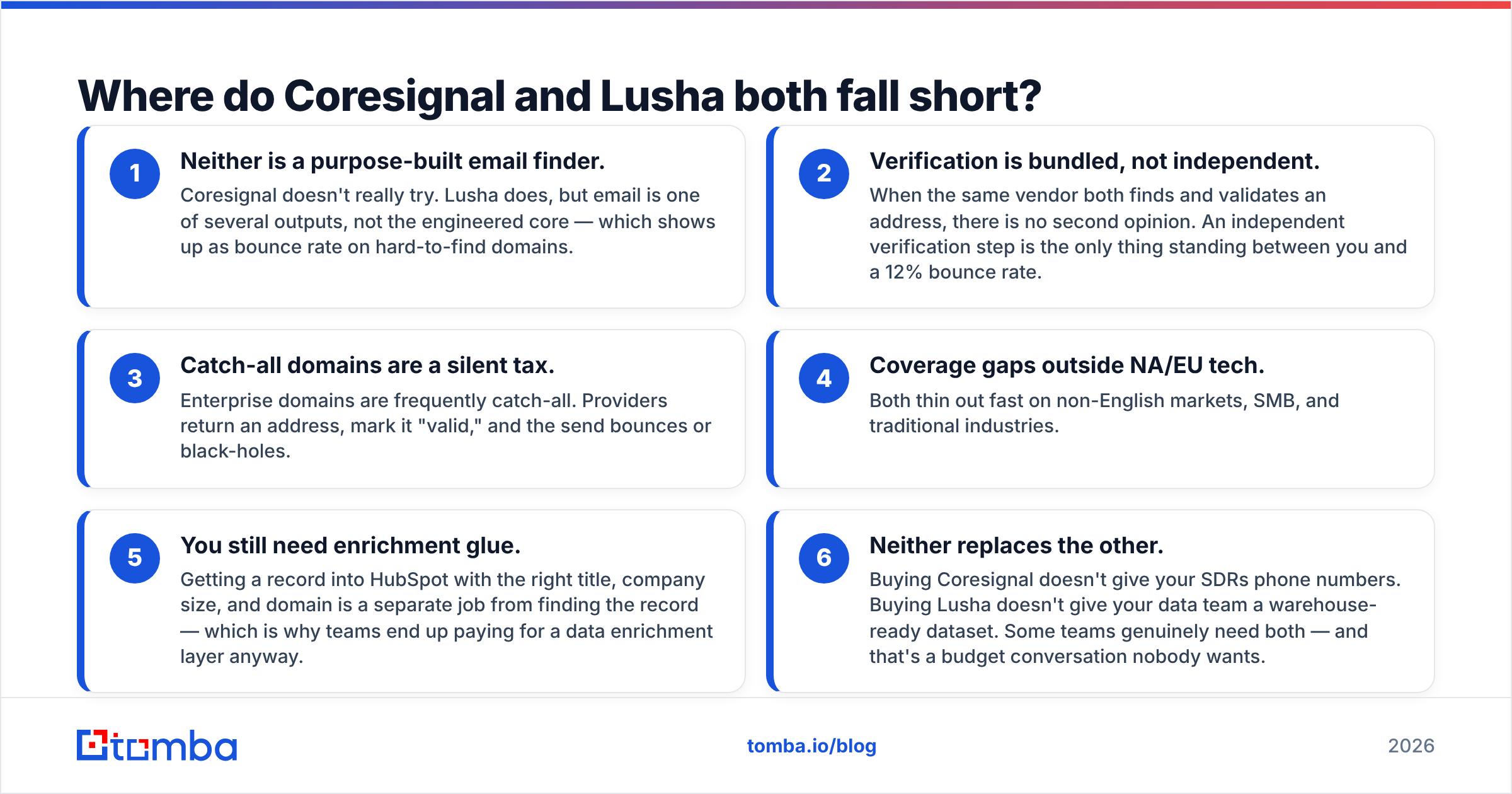
- Neither is a purpose-built email finder. Coresignal barely tries. Lusha does try, but email is one output among several, not the engineered core. That shows up as bounce rate on hard domains.
- Verification is bundled, not independent. When one vendor both finds and validates an address, there is no second opinion. An independent verification step is the only thing standing between you and a 12% bounce rate.
- Catch-all domains are a silent tax. Many enterprise domains are catch-all. The provider returns an address, marks it "valid," and the send bounces or black-holes.
Those three are about email quality. The next three are about scope.
- Coverage thins outside NA/EU tech. Both drop off fast on non-English markets, SMB, and traditional industries.
- You still need enrichment glue. Landing a record in HubSpot with the right title, company size, and domain is a separate job. That is why teams pay for a data enrichment layer anyway.
- Neither replaces the other. Coresignal gives your SDRs no phone numbers. Lusha gives your data team no warehouse-ready dataset. Some teams need both, and that is a budget conversation nobody wants.

Who should buy Coresignal in 2026?#
In the Coresignal vs Lusha choice, buy Coresignal if three or more of these are true:
- You have an engineer who can consume an API or land a dataset in a warehouse.
- You need historical data: headcount over time, hiring trends, tech-stack changes.
- You are building something durable — a scoring model, an ICP engine, a data product, a deal-sourcing pipeline.
- Your budget is annual and five figures or more.
- You care about firmographic depth far more than contact details.
Do not buy Coresignal because the coverage number on the homepage looked big. If nobody on your team can query it, that number is decoration.
Who should buy Lusha in 2026?#
On the other side of the Coresignal vs Lusha line, buy Lusha if:
- Your reps live in LinkedIn and want a one-click extension, not a data pipeline.
- Mobile numbers matter. You run a dial-heavy motion, and connect rates justify the seat cost.
- You sell into North America and Western Europe, mid-market and up.
- Compliance is a procurement gate, and you need documented GDPR/CCPA handling.
- You want to start today, without a sales call.
Do not buy Lusha if your motion is 95% email and your bounce rate is already shaky. You would pay a premium for phone numbers you never dial, and still need a verification layer on top.
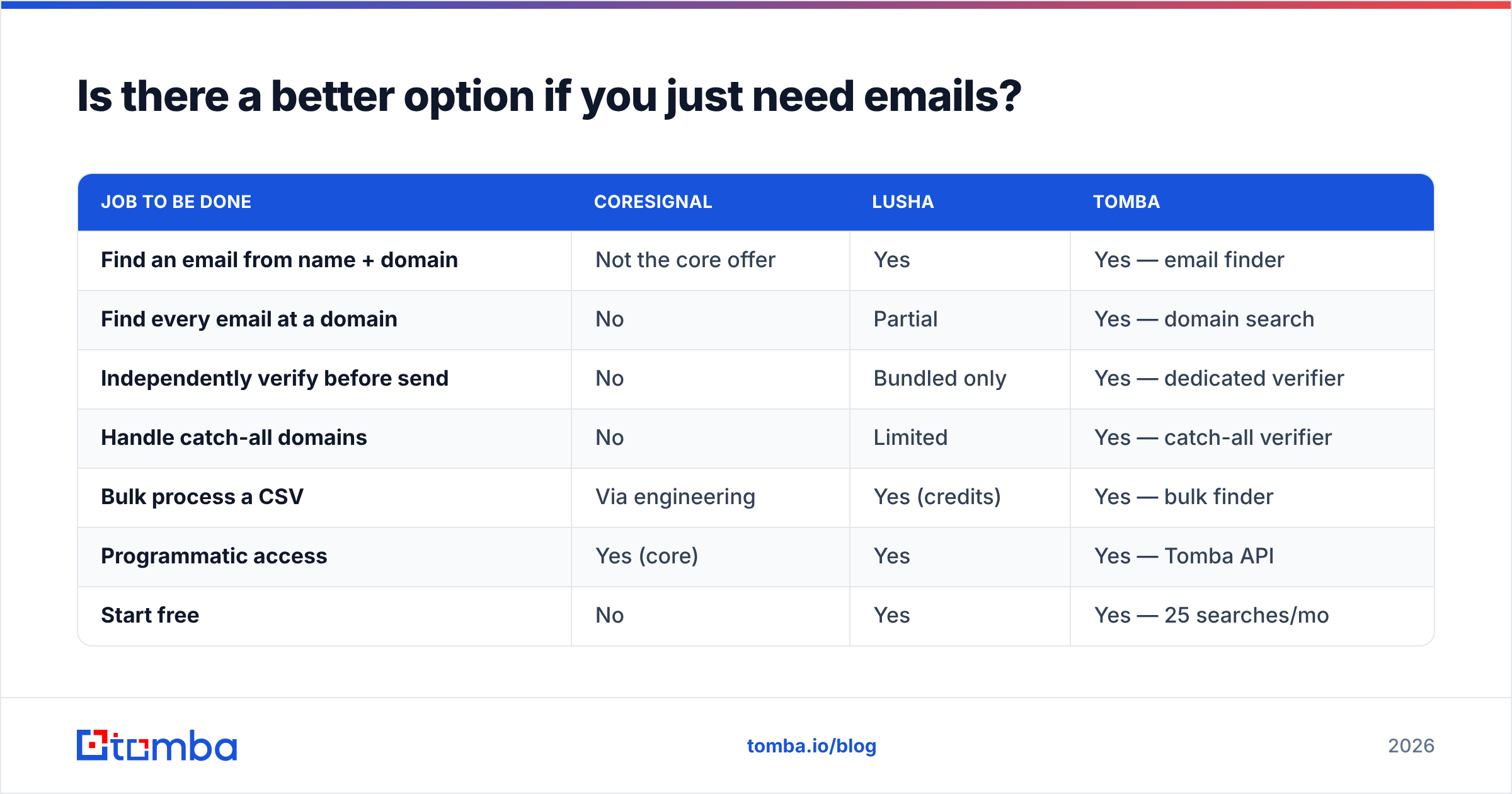
Is there a better option if you just need emails?#
Yes. This is where most Coresignal vs Lusha comparisons quietly stop.
If the deliverable is verified email addresses at a predictable cost per lead, both tools overcharge you. Coresignal makes you build the last mile yourself. Lusha bundles phone numbers you may not need into a per-seat price.
A dedicated finder-plus-verifier stack solves the narrow problem head-on:
| Job to be done | Coresignal | Lusha | Tomba |
|---|---|---|---|
| Find an email from name + domain | Not the core offer | Yes | Yes — email finder |
| Find every email at a domain | No | Partial | Yes — domain search |
| Independently verify before send | No | Bundled only | Yes — dedicated verifier |
| Handle catch-all domains | No | Limited | Yes — catch-all verifier |
| Bulk process a CSV | Via engineering | Yes (credits) | Yes — bulk finder |
| Programmatic access | Yes (core) | Yes | Yes — Tomba API |
| Start free | No | Yes | Yes — 25 searches/mo |
| Entry price | Quoted, annual | Per user/mo | $49/mo |
The stack that works for most outbound teams in 2026 is boring. Use a firmographic layer to pick targets. Use a finder to get the address. Use an independent verifier to protect the domain. Coresignal is a fair pick for layer one, if you have engineers. Lusha is a fair pick for layer two, if you need phones. But if layers two and three are the whole job, either one is more product than you need.
Coresignal vs Lusha: the verdict#
Coresignal wins on raw data depth, historical signals, and anything you plan to build software on. It is a supplier, and a good one. You just need someone who can receive the shipment.
Lusha wins on speed to value, mobile phone coverage, and rep adoption. It is a tool, and a good one. Your ICP has to sit inside its coverage, and you have to stomach per-seat math.
Neither wins on cost per usable email address. For most B2B teams, that is the metric that maps to pipeline. It belongs to a different product category, and it costs less than both.
So the answer is simple. Pick the layer you are missing, not the vendor with the nicer homepage.
Ready to stop paying enterprise prices for email addresses?#
If the Coresignal vs Lusha debate ends with "I just need verified emails," start with the Tomba Email Finder. Search by domain, name, or company. Verify before you send. Pay $49/mo instead of signing an annual contract. The free tier gives you 25 searches a month, no card required, so you can test accuracy against your current provider before you switch anything.
Related guides#
Ready to find emails that actually work?
Join 150,000+ professionals who stopped guessing and started sending. Free credits on signup — no credit card required.
Get the Tomba newsletter
Practical outbound tactics and product updates — once every two weeks.
About the author